Demand, Supply, and
Market Equilibrium
A Presentation by
Anamitra Roy
The Basic Decision-Making Units
• A firm is an organization that transforms resources
(inputs) into products (outputs). Firms are the
primary producing units in a market economy.
• An entrepreneur is a person who organizes,
manages, and assumes the risks of a firm, taking a
new idea or a new product and turning it into a
successful business.
• Households are the consuming units in an
economy.
The Circular Flow of Economic
Activity
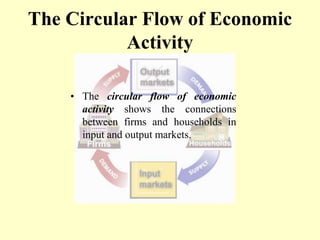
• The circular flow of economic
activity shows the connections
between firms and households in
input and output markets.
Input Markets and Output
Markets
• Output, or product, markets are
the markets in which goods and
services are exchanged.
• Input markets are the markets in
which resources—labor, capital,
and land—used to produce
products, are exchanged.
• Payments flow in the opposite
direction as the physical flow of
resources, goods, and services
(counterclockwise).
Input Markets
Input markets include:
• The labor market, in which households supply
work for wages to firms that demand labor.
• The capital market, in which households
supply their savings, for interest or for claims
to future profits, to firms that demand funds to
buy capital goods.
• The land market, in which households supply
land or other real property in exchange for rent.
Determinants of Household
Demand
• The price of the product in question.
• The income available to the household.
• The household’s amount of accumulated wealth.
• The prices of related products available to the
household.
• The household’s tastes and preferences.
• The household’s expectations about future income,
wealth, and prices.
A household’s decision about the quantity of a particular output
to demand depends on:
Quantity Demanded
• Quantity demanded is the amount (number of
units) of a product that a household would buy in
a given time period if it could buy all it wanted at
the current market price.
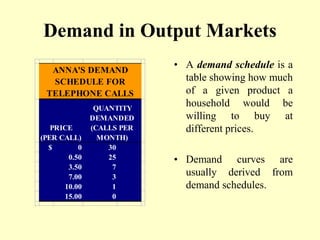
Demand in Output Markets
• A demand schedule is a
table showing how much
of a given product a
household would be
willing to buy at
different prices.
• Demand curves are
usually derived from
demand schedules.
PRICE
(PER CALL)
QUANTITY
DEMANDED
(CALLS PER
MONTH)
$ 0 30
0.50 25
3.50 7
7.00 3
10.00 1
15.00 0
ANNA'S DEMAND
SCHEDULE FOR
TELEPHONE CALLS
The Demand Curve
• The demand curve is
a graph illustrating
how much of a given
product a household
would be willing to
buy at different
prices.
PRICE
(PER CALL)
QUANTITY
DEMANDED
(CALLS PER
MONTH)
$ 0 30
0.50 25
3.50 7
7.00 3
10.00 1
15.00 0
ANNA'S DEMAND
SCHEDULE FOR
TELEPHONE CALLS
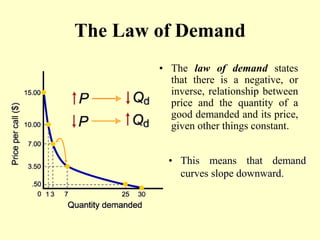
The Law of Demand
• The law of demand states
that there is a negative, or
inverse, relationship between
price and the quantity of a
good demanded and its price,
given other things constant.
• This means that demand
curves slope downward.
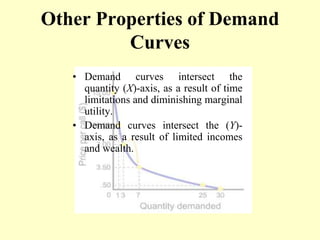
Other Properties of Demand
Curves
• Demand curves intersect the
quantity (X)-axis, as a result of time
limitations and diminishing marginal
utility.
• Demand curves intersect the (Y)-
axis, as a result of limited incomes
and wealth.
Income and Wealth
• Income is the sum of all households wages,
salaries, profits, interest payments, rents, and other
forms of earnings in a given period of time. It is a
flow measure.
• Wealth, or net worth, is the total value of what a
household owns minus what it owes. It is a stock
measure.
Related Goods and Services
• Normal Goods are goods for which demand goes
up when income is higher and for which demand
goes down when income is lower.
• Inferior Goods are goods for which demand falls
when income rises.
Related Goods and Services
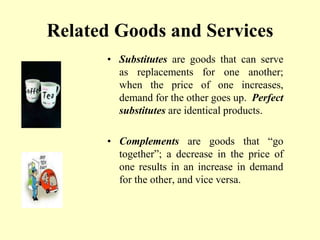
• Substitutes are goods that can serve
as replacements for one another;
when the price of one increases,
demand for the other goes up. Perfect
substitutes are identical products.
• Complements are goods that “go
together”; a decrease in the price of
one results in an increase in demand
for the other, and vice versa.
Shift of Demand Versus Movement
Along a Demand Curve
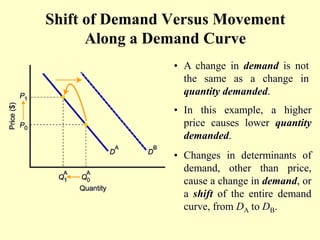
• A change in demand is not
the same as a change in
quantity demanded.
• In this example, a higher
price causes lower quantity
demanded.
• Changes in determinants of
demand, other than price,
cause a change in demand, or
a shift of the entire demand
curve, from DA to DB.
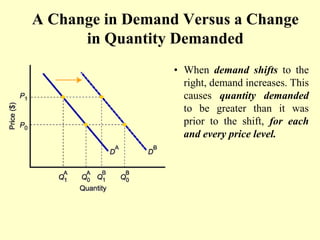
• When demand shifts to the
right, demand increases. This
causes quantity demanded
to be greater than it was
prior to the shift, for each
and every price level.
A Change in Demand Versus a Change
in Quantity Demanded
A Change in Demand Versus a Change
in Quantity Demanded
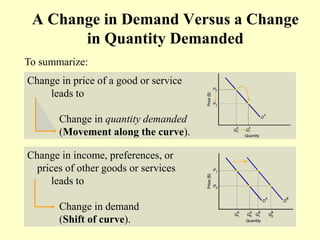
To summarize:
Change in price of a good or service
leads to
Change in quantity demanded
(Movement along the curve).
Change in income, preferences, or
prices of other goods or services
leads to
Change in demand
(Shift of curve).
The Impact of a Change in
Income
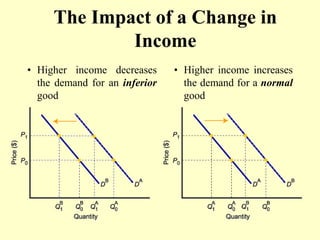
• Higher income decreases
the demand for an inferior
good
• Higher income increases
the demand for a normal
good
The Impact of a Change in the
Price of Related Goods
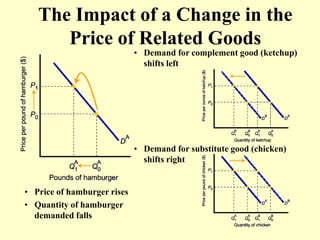
• Price of hamburger rises
• Demand for complement good (ketchup)
shifts left
• Demand for substitute good (chicken)
shifts right
• Quantity of hamburger
demanded falls
From Household to Market
Demand
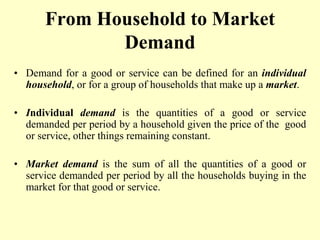
• Demand for a good or service can be defined for an individual
household, or for a group of households that make up a market.
• Individual demand is the quantities of a good or service
demanded per period by a household given the price of the good
or service, other things remaining constant.
• Market demand is the sum of all the quantities of a good or
service demanded per period by all the households buying in the
market for that good or service.
From Household Demand to
Market Demand
• Assuming there are only two households in the market,
market demand is derived as follows:
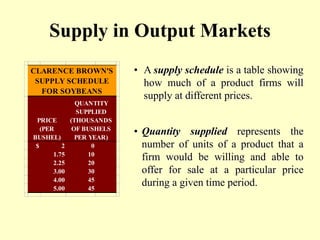
Supply in Output Markets
• A supply schedule is a table showing
how much of a product firms will
supply at different prices.
• Quantity supplied represents the
number of units of a product that a
firm would be willing and able to
offer for sale at a particular price
during a given time period.
PRICE
(PER
BUSHEL)
QUANTITY
SUPPLIED
(THOUSANDS
OF BUSHELS
PER YEAR)
$ 2 0
1.75 10
2.25 20
3.00 30
4.00 45
5.00 45
CLARENCE BROWN'S
SUPPLY SCHEDULE
FOR SOYBEANS
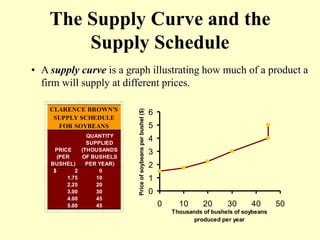
The Supply Curve and the
Supply Schedule
• A supply curve is a graph illustrating how much of a product a
firm will supply at different prices.
0
1
2
3
4
5
6
0 10 20 30 40 50
Thousands of bushels of soybeans
produced per year
Price
of
soybeans
per
bushel
($)
PRICE
(PER
BUSHEL)
QUANTITY
SUPPLIED
(THOUSANDS
OF BUSHELS
PER YEAR)
$ 2 0
1.75 10
2.25 20
3.00 30
4.00 45
5.00 45
CLARENCE BROWN'S
SUPPLY SCHEDULE
FOR SOYBEANS
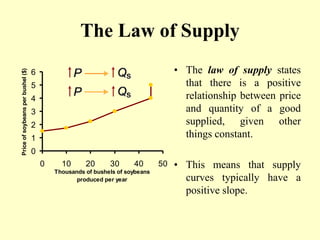
The Law of Supply
• The law of supply states
that there is a positive
relationship between price
and quantity of a good
supplied, given other
things constant.
• This means that supply
curves typically have a
positive slope.
0
1
2
3
4
5
6
0 10 20 30 40 50
Thousands of bushels of soybeans
produced per year
Price
of
soybeans
per
bushel
($)
Determinants of Supply
• The price of the good or service.
• The cost of producing the good, which in turn depends on:
• The price of required inputs (labor, capital, and land),
• The technologies that can be used to produce the
product.
• The prices of related products.
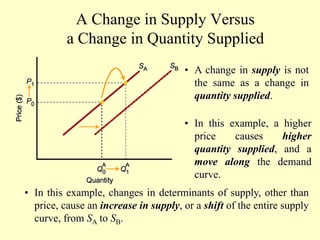
A Change in Supply Versus
a Change in Quantity Supplied
• A change in supply is not
the same as a change in
quantity supplied.
• In this example, a higher
price causes higher
quantity supplied, and a
move along the demand
curve.
• In this example, changes in determinants of supply, other than
price, cause an increase in supply, or a shift of the entire supply
curve, from SA to SB.
• When supply shifts to
the right, supply
increases. This causes
quantity supplied to be
greater than it was prior
to the shift, for each
and every price level.
A Change in Supply Versus a Change in
Quantity Supplied
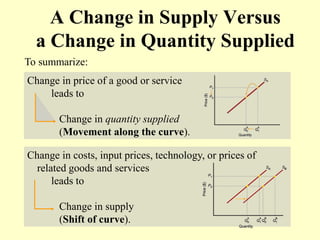
A Change in Supply Versus
a Change in Quantity Supplied
To summarize:
Change in price of a good or service
leads to
Change in quantity supplied
(Movement along the curve).
Change in costs, input prices, technology, or prices of
related goods and services
leads to
Change in supply
(Shift of curve).
From Individual Supply to
Market Supply
• The supply of a good or service can be defined for an
individual firm, or for a group of firms that make up a
market or an industry.
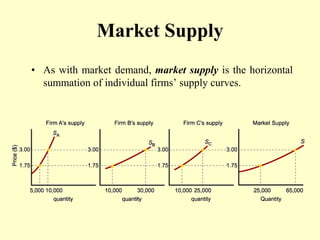
• Market supply is the sum of all the quantities of a good or
service supplied per period by all the firms selling in the
market for that good or service.
Market Supply
• As with market demand, market supply is the horizontal
summation of individual firms’ supply curves.
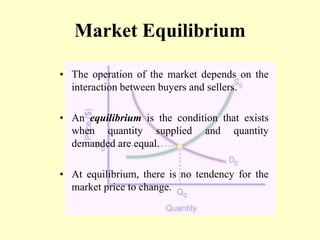
Market Equilibrium
• The operation of the market depends on the
interaction between buyers and sellers.
• An equilibrium is the condition that exists
when quantity supplied and quantity
demanded are equal.
• At equilibrium, there is no tendency for the
market price to change.
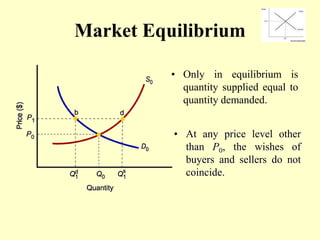
Market Equilibrium
• Only in equilibrium is
quantity supplied equal to
quantity demanded.
• At any price level other
than P0, the wishes of
buyers and sellers do not
coincide.
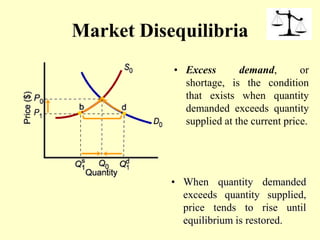
Market Disequilibria
• Excess demand, or
shortage, is the condition
that exists when quantity
demanded exceeds quantity
supplied at the current price.
• When quantity demanded
exceeds quantity supplied,
price tends to rise until
equilibrium is restored.
Market Disequilibria
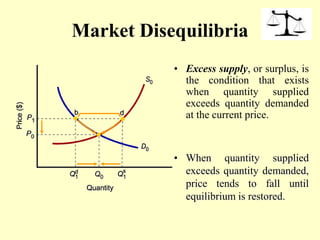
• Excess supply, or surplus, is
the condition that exists
when quantity supplied
exceeds quantity demanded
at the current price.
• When quantity supplied
exceeds quantity demanded,
price tends to fall until
equilibrium is restored.
Increases in Demand and Supply
• Higher demand leads to higher
equilibrium price and higher
equilibrium quantity.
• Higher supply leads to lower
equilibrium price and higher
equilibrium quantity.
Decreases in Demand and Supply
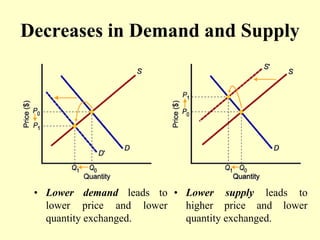
• Lower demand leads to
lower price and lower
quantity exchanged.
• Lower supply leads to
higher price and lower
quantity exchanged.
Relative Magnitudes of Change
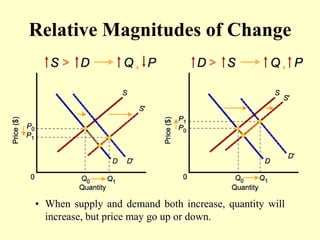
• The relative magnitudes of change in supply and demand
determine the outcome of market equilibrium.
Relative Magnitudes of Change
• When supply and demand both increase, quantity will
increase, but price may go up or down.
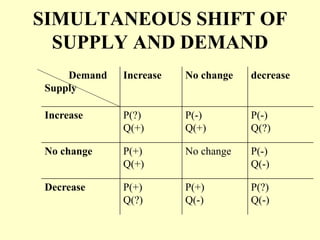
SIMULTANEOUS SHIFT OF
SUPPLY AND DEMAND
Demand
Supply
Increase No change decrease
Increase P(?)
Q(+)
P(-)
Q(+)
P(-)
Q(?)
No change P(+)
Q(+)
No change P(-)
Q(-)
Decrease P(+)
Q(?)
P(+)
Q(-)
P(?)
Q(-)
Thank You.

DemandSupplyMarketEquilibrium.ppt

  • 1.
    Demand, Supply, and MarketEquilibrium A Presentation by Anamitra Roy
  • 2.
    The Basic Decision-MakingUnits • A firm is an organization that transforms resources (inputs) into products (outputs). Firms are the primary producing units in a market economy. • An entrepreneur is a person who organizes, manages, and assumes the risks of a firm, taking a new idea or a new product and turning it into a successful business. • Households are the consuming units in an economy.
  • 3.
    The Circular Flowof Economic Activity • The circular flow of economic activity shows the connections between firms and households in input and output markets.
  • 4.
    Input Markets andOutput Markets • Output, or product, markets are the markets in which goods and services are exchanged. • Input markets are the markets in which resources—labor, capital, and land—used to produce products, are exchanged. • Payments flow in the opposite direction as the physical flow of resources, goods, and services (counterclockwise).
  • 5.
    Input Markets Input marketsinclude: • The labor market, in which households supply work for wages to firms that demand labor. • The capital market, in which households supply their savings, for interest or for claims to future profits, to firms that demand funds to buy capital goods. • The land market, in which households supply land or other real property in exchange for rent.
  • 6.
    Determinants of Household Demand •The price of the product in question. • The income available to the household. • The household’s amount of accumulated wealth. • The prices of related products available to the household. • The household’s tastes and preferences. • The household’s expectations about future income, wealth, and prices. A household’s decision about the quantity of a particular output to demand depends on:
  • 7.
    Quantity Demanded • Quantitydemanded is the amount (number of units) of a product that a household would buy in a given time period if it could buy all it wanted at the current market price.
  • 8.
    Demand in OutputMarkets • A demand schedule is a table showing how much of a given product a household would be willing to buy at different prices. • Demand curves are usually derived from demand schedules. PRICE (PER CALL) QUANTITY DEMANDED (CALLS PER MONTH) $ 0 30 0.50 25 3.50 7 7.00 3 10.00 1 15.00 0 ANNA'S DEMAND SCHEDULE FOR TELEPHONE CALLS
  • 9.
    The Demand Curve •The demand curve is a graph illustrating how much of a given product a household would be willing to buy at different prices. PRICE (PER CALL) QUANTITY DEMANDED (CALLS PER MONTH) $ 0 30 0.50 25 3.50 7 7.00 3 10.00 1 15.00 0 ANNA'S DEMAND SCHEDULE FOR TELEPHONE CALLS
  • 10.
    The Law ofDemand • The law of demand states that there is a negative, or inverse, relationship between price and the quantity of a good demanded and its price, given other things constant. • This means that demand curves slope downward.
  • 11.
    Other Properties ofDemand Curves • Demand curves intersect the quantity (X)-axis, as a result of time limitations and diminishing marginal utility. • Demand curves intersect the (Y)- axis, as a result of limited incomes and wealth.
  • 12.
    Income and Wealth •Income is the sum of all households wages, salaries, profits, interest payments, rents, and other forms of earnings in a given period of time. It is a flow measure. • Wealth, or net worth, is the total value of what a household owns minus what it owes. It is a stock measure.
  • 13.
    Related Goods andServices • Normal Goods are goods for which demand goes up when income is higher and for which demand goes down when income is lower. • Inferior Goods are goods for which demand falls when income rises.
  • 14.
    Related Goods andServices • Substitutes are goods that can serve as replacements for one another; when the price of one increases, demand for the other goes up. Perfect substitutes are identical products. • Complements are goods that “go together”; a decrease in the price of one results in an increase in demand for the other, and vice versa.
  • 15.
    Shift of DemandVersus Movement Along a Demand Curve • A change in demand is not the same as a change in quantity demanded. • In this example, a higher price causes lower quantity demanded. • Changes in determinants of demand, other than price, cause a change in demand, or a shift of the entire demand curve, from DA to DB.
  • 16.
    • When demandshifts to the right, demand increases. This causes quantity demanded to be greater than it was prior to the shift, for each and every price level. A Change in Demand Versus a Change in Quantity Demanded
  • 17.
    A Change inDemand Versus a Change in Quantity Demanded To summarize: Change in price of a good or service leads to Change in quantity demanded (Movement along the curve). Change in income, preferences, or prices of other goods or services leads to Change in demand (Shift of curve).
  • 18.
    The Impact ofa Change in Income • Higher income decreases the demand for an inferior good • Higher income increases the demand for a normal good
  • 19.
    The Impact ofa Change in the Price of Related Goods • Price of hamburger rises • Demand for complement good (ketchup) shifts left • Demand for substitute good (chicken) shifts right • Quantity of hamburger demanded falls
  • 20.
    From Household toMarket Demand • Demand for a good or service can be defined for an individual household, or for a group of households that make up a market. • Individual demand is the quantities of a good or service demanded per period by a household given the price of the good or service, other things remaining constant. • Market demand is the sum of all the quantities of a good or service demanded per period by all the households buying in the market for that good or service.
  • 21.
    From Household Demandto Market Demand • Assuming there are only two households in the market, market demand is derived as follows:
  • 22.
    Supply in OutputMarkets • A supply schedule is a table showing how much of a product firms will supply at different prices. • Quantity supplied represents the number of units of a product that a firm would be willing and able to offer for sale at a particular price during a given time period. PRICE (PER BUSHEL) QUANTITY SUPPLIED (THOUSANDS OF BUSHELS PER YEAR) $ 2 0 1.75 10 2.25 20 3.00 30 4.00 45 5.00 45 CLARENCE BROWN'S SUPPLY SCHEDULE FOR SOYBEANS
  • 23.
    The Supply Curveand the Supply Schedule • A supply curve is a graph illustrating how much of a product a firm will supply at different prices. 0 1 2 3 4 5 6 0 10 20 30 40 50 Thousands of bushels of soybeans produced per year Price of soybeans per bushel ($) PRICE (PER BUSHEL) QUANTITY SUPPLIED (THOUSANDS OF BUSHELS PER YEAR) $ 2 0 1.75 10 2.25 20 3.00 30 4.00 45 5.00 45 CLARENCE BROWN'S SUPPLY SCHEDULE FOR SOYBEANS
  • 24.
    The Law ofSupply • The law of supply states that there is a positive relationship between price and quantity of a good supplied, given other things constant. • This means that supply curves typically have a positive slope. 0 1 2 3 4 5 6 0 10 20 30 40 50 Thousands of bushels of soybeans produced per year Price of soybeans per bushel ($)
  • 25.
    Determinants of Supply •The price of the good or service. • The cost of producing the good, which in turn depends on: • The price of required inputs (labor, capital, and land), • The technologies that can be used to produce the product. • The prices of related products.
  • 26.
    A Change inSupply Versus a Change in Quantity Supplied • A change in supply is not the same as a change in quantity supplied. • In this example, a higher price causes higher quantity supplied, and a move along the demand curve. • In this example, changes in determinants of supply, other than price, cause an increase in supply, or a shift of the entire supply curve, from SA to SB.
  • 27.
    • When supplyshifts to the right, supply increases. This causes quantity supplied to be greater than it was prior to the shift, for each and every price level. A Change in Supply Versus a Change in Quantity Supplied
  • 28.
    A Change inSupply Versus a Change in Quantity Supplied To summarize: Change in price of a good or service leads to Change in quantity supplied (Movement along the curve). Change in costs, input prices, technology, or prices of related goods and services leads to Change in supply (Shift of curve).
  • 29.
    From Individual Supplyto Market Supply • The supply of a good or service can be defined for an individual firm, or for a group of firms that make up a market or an industry. • Market supply is the sum of all the quantities of a good or service supplied per period by all the firms selling in the market for that good or service.
  • 30.
    Market Supply • Aswith market demand, market supply is the horizontal summation of individual firms’ supply curves.
  • 31.
    Market Equilibrium • Theoperation of the market depends on the interaction between buyers and sellers. • An equilibrium is the condition that exists when quantity supplied and quantity demanded are equal. • At equilibrium, there is no tendency for the market price to change.
  • 32.
    Market Equilibrium • Onlyin equilibrium is quantity supplied equal to quantity demanded. • At any price level other than P0, the wishes of buyers and sellers do not coincide.
  • 33.
    Market Disequilibria • Excessdemand, or shortage, is the condition that exists when quantity demanded exceeds quantity supplied at the current price. • When quantity demanded exceeds quantity supplied, price tends to rise until equilibrium is restored.
  • 34.
    Market Disequilibria • Excesssupply, or surplus, is the condition that exists when quantity supplied exceeds quantity demanded at the current price. • When quantity supplied exceeds quantity demanded, price tends to fall until equilibrium is restored.
  • 35.
    Increases in Demandand Supply • Higher demand leads to higher equilibrium price and higher equilibrium quantity. • Higher supply leads to lower equilibrium price and higher equilibrium quantity.
  • 36.
    Decreases in Demandand Supply • Lower demand leads to lower price and lower quantity exchanged. • Lower supply leads to higher price and lower quantity exchanged.
  • 37.
    Relative Magnitudes ofChange • The relative magnitudes of change in supply and demand determine the outcome of market equilibrium.
  • 38.
    Relative Magnitudes ofChange • When supply and demand both increase, quantity will increase, but price may go up or down.
  • 39.
    SIMULTANEOUS SHIFT OF SUPPLYAND DEMAND Demand Supply Increase No change decrease Increase P(?) Q(+) P(-) Q(+) P(-) Q(?) No change P(+) Q(+) No change P(-) Q(-) Decrease P(+) Q(?) P(+) Q(-) P(?) Q(-)
  • 40.