BRAIN DRAIN FROM PAKISTAN
HIRA NOOR
ZOHA NAEEM
SAMEER AHAD HAQ
CONTENTS
• What is Brain Drain
• History of brain drain
• Reasons for brain drain
• Brain drain in Pakistan
• Reasons of brain drain from Pakistan
• Effects of brain drain
Positive effects
Negative effects
• Measures to stop brain drain
• Conclusion
WHAT IS BRAIN DRAIN?
• The loss of skilled, intellectual and technical labor through
their movement to more favorable geographic, economic, or
professional environments.
• It can be simply defined as the mass emigration of technically
skilled people from one country to another country.
• Brain-drain is also termed as “human capital flight” because it
resembles the case of capital flight.
HISTORY OF BRAIN
DRAIN
• The term originated about 1960.
• In 1960, many British scientists
and intellectuals emigrated to the
United States for a better working
climate.
• Its meaning has broadened into:
the departure of educated or
professional people from one
country.
Neil Bohr
Albert Einstein
WHY BRAIN DRAINS?
• Lack of better opportunity
• Political instability
• Health risks
• Personal conflicts
• Poor Conditions of Service
• Disregard for Local Talent
• Economic under development.
WHY BRAIN DRAINS?
• Lack of research and other facilities
• Lack of freedom
• Poor working facilities
• Unsuitable institution.
• Desire for a better urban life
• Desire for higher qualification and recognition
• Lack of satisfactory working conditions.
• Europe as “GREEN PASTURES” for doctors
• Lack of variety in specializations
• Disregard for local degrees
• Lack of job opportunities
• Merit systems
• Lack of infrastructure
• High corporate tax rate
REASONS FOR BRAIN
DRAIN
• Lack of scientific tradition and culture
• Over production and under utilization of HQM.
• Discrimination in appointment and promotion.
• Lack of research and other facilities
• Income inequalities
• Ten times more earning than home country.
REASONS FOR BRAIN
DRAIN
• Receiving of millions of dollars in shape of
remittance sent back to Pakistan every year.
• Creating space for freshmen here.
• Population decrease.
• People bring technology, skills and new ideas
from abroad.
• Higher rate of people starting capital intensive
enterprises.
POSITIVE EFFECTS
• Money remittance has reduced the severity of
poverty to some extent.
• Money sent are invested in education, housing
and health.
• Improved quality of education by insuring
international standards and training.
• Improved competitiveness in home country as
international degrees are held in higher esteem.
POSITIVE EFFECTS
NEGATIVE EFFECTS
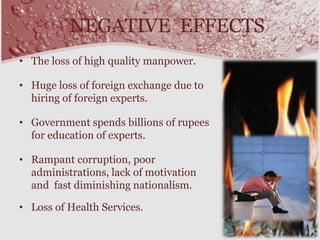
• The loss of high quality manpower.
• Huge loss of foreign exchange due to
hiring of foreign experts.
• Government spends billions of rupees
for education of experts.
• Rampant corruption, poor
administrations, lack of motivation
and fast diminishing nationalism.
• Loss of Health Services.
MEASURES TAKEN
• National Research Program for Universities
(NRPU)
• TTU performance based pay system by HEC
• Foreign faculty members of Pakistani origin are
encouraged to come and transfer their expertise
• Transfer of knowledge through expatriate
nationals (TOKTEN) (UNDP)
• Initiative for 11 foreign universities
• Delaying emigration
For example :
Doctors may be asked to stay on for two years.
• Tax proposals
For example :
Native professionals pay a percent of income earning abroad.
• Fix govt. policies
MEASURES TO STOP BRAIN
DRAIN
MEASURES TO STOP BRAIN
DRAIN
• Revive HEC
Build new universities
Conduct evening classes in campuses.
• PIA should allow a 50% discount for all students of
Pakistani origin on international routes.
• Entering into international agreements
For not to recruit skilled people from
less-developed countries.
• Our leaders often deliver lengthy speeches but no worthy
positive steps have been taken.
• Our government has not even asked Pakistani professionals to
return back and serve their country.
“Reversing the brain drain is a key priority for us.”
CONCLUSION

Brain drain

  • 1.
    BRAIN DRAIN FROMPAKISTAN HIRA NOOR ZOHA NAEEM SAMEER AHAD HAQ
  • 2.
    CONTENTS • What isBrain Drain • History of brain drain • Reasons for brain drain • Brain drain in Pakistan • Reasons of brain drain from Pakistan • Effects of brain drain Positive effects Negative effects • Measures to stop brain drain • Conclusion
  • 3.
    WHAT IS BRAINDRAIN? • The loss of skilled, intellectual and technical labor through their movement to more favorable geographic, economic, or professional environments. • It can be simply defined as the mass emigration of technically skilled people from one country to another country. • Brain-drain is also termed as “human capital flight” because it resembles the case of capital flight.
  • 4.
    HISTORY OF BRAIN DRAIN •The term originated about 1960. • In 1960, many British scientists and intellectuals emigrated to the United States for a better working climate. • Its meaning has broadened into: the departure of educated or professional people from one country. Neil Bohr Albert Einstein
  • 5.
    WHY BRAIN DRAINS? •Lack of better opportunity • Political instability • Health risks • Personal conflicts • Poor Conditions of Service • Disregard for Local Talent • Economic under development.
  • 6.
    WHY BRAIN DRAINS? •Lack of research and other facilities • Lack of freedom • Poor working facilities • Unsuitable institution. • Desire for a better urban life • Desire for higher qualification and recognition • Lack of satisfactory working conditions.
  • 7.
    • Europe as“GREEN PASTURES” for doctors • Lack of variety in specializations • Disregard for local degrees • Lack of job opportunities • Merit systems • Lack of infrastructure • High corporate tax rate REASONS FOR BRAIN DRAIN
  • 8.
    • Lack ofscientific tradition and culture • Over production and under utilization of HQM. • Discrimination in appointment and promotion. • Lack of research and other facilities • Income inequalities • Ten times more earning than home country. REASONS FOR BRAIN DRAIN
  • 9.
    • Receiving ofmillions of dollars in shape of remittance sent back to Pakistan every year. • Creating space for freshmen here. • Population decrease. • People bring technology, skills and new ideas from abroad. • Higher rate of people starting capital intensive enterprises. POSITIVE EFFECTS
  • 10.
    • Money remittancehas reduced the severity of poverty to some extent. • Money sent are invested in education, housing and health. • Improved quality of education by insuring international standards and training. • Improved competitiveness in home country as international degrees are held in higher esteem. POSITIVE EFFECTS
  • 11.
    NEGATIVE EFFECTS • Theloss of high quality manpower. • Huge loss of foreign exchange due to hiring of foreign experts. • Government spends billions of rupees for education of experts. • Rampant corruption, poor administrations, lack of motivation and fast diminishing nationalism. • Loss of Health Services.
  • 12.
    MEASURES TAKEN • NationalResearch Program for Universities (NRPU) • TTU performance based pay system by HEC • Foreign faculty members of Pakistani origin are encouraged to come and transfer their expertise • Transfer of knowledge through expatriate nationals (TOKTEN) (UNDP) • Initiative for 11 foreign universities
  • 13.
    • Delaying emigration Forexample : Doctors may be asked to stay on for two years. • Tax proposals For example : Native professionals pay a percent of income earning abroad. • Fix govt. policies MEASURES TO STOP BRAIN DRAIN
  • 14.
    MEASURES TO STOPBRAIN DRAIN • Revive HEC Build new universities Conduct evening classes in campuses. • PIA should allow a 50% discount for all students of Pakistani origin on international routes. • Entering into international agreements For not to recruit skilled people from less-developed countries.
  • 15.
    • Our leadersoften deliver lengthy speeches but no worthy positive steps have been taken. • Our government has not even asked Pakistani professionals to return back and serve their country. “Reversing the brain drain is a key priority for us.” CONCLUSION