In Pakistan
Presented to: Sir Abdul Manan
Arslan Shaikh
Presented By: Jahanzeb Memon
Sajid Ali Soomro
Contents
 Introduction of Balance of Trade
 History Of Trade in Pakistan
 Types of Trade
 Exports
 Advantages and Challenges of Exports
 Imports
 Advantages and Challenges of Imports
 Process Of Exports & Imports
 Main Trading Partners of Pakistan
 Balance of Trade In Pakistan
Balance:
A state of equilibrium or equipoise or equal
distribution of weight, amount etc.
Trade:
The act or process of buying, selling or exchange
commodities at either wholesale or retail, within country
or between countries. Also called Domestic Trade or
Foreign Trade.
Balance of Trade
 The balance of trade is the difference between the monetary value of
exports and imports in an economy over a certain period of time.
 A positive balance of trade is known as a trade surplus and occurs when
value of exports is higher than that of imports.
 A negative balance of trade is known as a trade deficit or a tradegap.
 The difference between a country's imports and its exports. Balance of
trade is the largest component of a country's balance of payments.
History of Foreign Trade in Pakistan
• Foreign Trade start from 1950.
• Pakistan Become member of World Trade Organization on
01-01-1995.
• Pakistan had deficit on its balance of trade from FY1973 to
till yet
Types of Trade
Domestic International
Domestic Trade
Wholesale
The Sale of good in large quantities.
Retail
The Sale of goods to ultimate consumers,
usually in small quantities.
Export
Export
Out Carry
Exportare Take
Away
Exports
Send (goods or services) to another country for
sale.
Produce goods or services within country and sale
it out to other countries.
Advantages and challenges to Exports
Advantages
• Earning more money
• Increased Sales and Profits
• Un wastage of things
• Gain Global shares
• Lower per unit costs
Challenges
• High Transportation fees
• Entering an export and
business requires careful
planning
• Market Information
• Financial Risk
• Security reasons
Import
• To bring or carry in from an outside source, especially to
bring in (goods or materials) from a foreign country for trade
or sale.
• to bring a product into a country to be sold
Advantages and Challenges to Imports
Advantages
• Lower Price rate
• High Quality
• Consumer Benefits
Challenges
• Needs Funds to
Importing
• Risk To Sale
• Transport Costs
Process of Exports And Imports
• Methods of export include a product or good or
information being mailed, hand-delivered, shipped
by air, shipped by vessel, uploaded to an internet
site, or downloaded from an internet site.
• Exports also include the distribution of information
that can be sent in the form of an email, an email
attachment, a fax or can be shared during a
telephone conversation.
 Food Group
– Rice
– Meat
– Fruits
– Spices
– Fish
 Textiles
– Raw Cotton
– Cotton Cloth
– Garments
– Towels
 Food Group
– Wheat
– Milk food
– Dry Fruits
– Spices
– Sugar
 Machinery
– Textile Machinery
– Aircrafts, Ships etc
– Agro Machines
 Telecom
– Mobiles, Computers etc
Export Goods Import Goods
Balance of Trade in Pakistan
Export Goods
 Petroleum
– Petroleum Products
– Solid Fuel (Coal)
 Other Manufactures
– Sports Goods
– Carpets
– Chemical & Pharma
– Engineering Goods
Import Goods
 Petroleum
– Petroleum Products
– Petroleum Cruds
 Consumer Durables
– Motor Vehicles, Electricity
goods
Balance of Trade in Pakistan
Foreign Trading Partners of Pakistan
Export Partners
 USA 13.6%
 European Union 18.2%
 China 11.1%
 UAE 8.5%
 Saudi Arabia 8.5%
 Afghanistan 7.6%
 India 2.1%
 Kuwait 1%
 Japan 1.6%
Import Partners
 USA 3.2%
 European Union 10.4%
 China 19.7%
 UAE 12.1%
 Saudi Arabia 12.2%
 Afghanistan 0.3%
 India 3.4%
 Kuwait 6.3%
 Japan 3.6%
Entrepot Trade
Trade in which imported goods are re-exported with
or without any additional processing or repackaging.
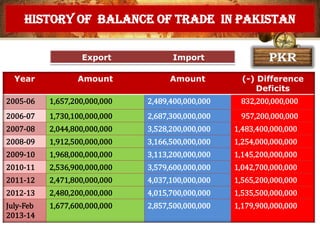
History of Balance Of Trade In Pakistan
Year Amount Amount (-) Difference
Deficits
2005-06 1,657,200,000,000 2,489,400,000,000 832,200,000,000
2006-07 1,730,100,000,000 2,687,300,000,000 957,200,000,000
2007-08 2,044,800,000,000 3,528,200,000,000 1,483,400,000,000
2008-09 1,912,500,000,000 3,166,500,000,000 1,254,000,000,000
2009-10 1,968,000,000,000 3,113,200,000,000 1,145,200,000,000
2010-11 2,536,900,000,000 3,579,600,000,000 1,042,700,000,000
2011-12 2,471,800,000,000 4,037,100,000,000 1,565,200,000,000
2012-13 2,480,200,000,000 4,015,700,000,000 1,535,500,000,000
July-Feb
2013-14
1,677,600,000,000 2,857,500,000,000 1,179,900,000,000
Export Import PKR
Balance of trade
Balance of trade

Balance of trade

  • 2.
  • 3.
    Presented to: SirAbdul Manan Arslan Shaikh Presented By: Jahanzeb Memon Sajid Ali Soomro
  • 4.
    Contents  Introduction ofBalance of Trade  History Of Trade in Pakistan  Types of Trade  Exports  Advantages and Challenges of Exports  Imports  Advantages and Challenges of Imports  Process Of Exports & Imports  Main Trading Partners of Pakistan  Balance of Trade In Pakistan
  • 6.
    Balance: A state ofequilibrium or equipoise or equal distribution of weight, amount etc. Trade: The act or process of buying, selling or exchange commodities at either wholesale or retail, within country or between countries. Also called Domestic Trade or Foreign Trade.
  • 7.
    Balance of Trade The balance of trade is the difference between the monetary value of exports and imports in an economy over a certain period of time.  A positive balance of trade is known as a trade surplus and occurs when value of exports is higher than that of imports.  A negative balance of trade is known as a trade deficit or a tradegap.  The difference between a country's imports and its exports. Balance of trade is the largest component of a country's balance of payments.
  • 8.
    History of ForeignTrade in Pakistan • Foreign Trade start from 1950. • Pakistan Become member of World Trade Organization on 01-01-1995. • Pakistan had deficit on its balance of trade from FY1973 to till yet
  • 9.
  • 10.
    Domestic Trade Wholesale The Saleof good in large quantities. Retail The Sale of goods to ultimate consumers, usually in small quantities.
  • 11.
  • 12.
    Exports Send (goods orservices) to another country for sale. Produce goods or services within country and sale it out to other countries.
  • 13.
    Advantages and challengesto Exports Advantages • Earning more money • Increased Sales and Profits • Un wastage of things • Gain Global shares • Lower per unit costs Challenges • High Transportation fees • Entering an export and business requires careful planning • Market Information • Financial Risk • Security reasons
  • 15.
    Import • To bringor carry in from an outside source, especially to bring in (goods or materials) from a foreign country for trade or sale. • to bring a product into a country to be sold
  • 16.
    Advantages and Challengesto Imports Advantages • Lower Price rate • High Quality • Consumer Benefits Challenges • Needs Funds to Importing • Risk To Sale • Transport Costs
  • 17.
    Process of ExportsAnd Imports • Methods of export include a product or good or information being mailed, hand-delivered, shipped by air, shipped by vessel, uploaded to an internet site, or downloaded from an internet site. • Exports also include the distribution of information that can be sent in the form of an email, an email attachment, a fax or can be shared during a telephone conversation.
  • 19.
     Food Group –Rice – Meat – Fruits – Spices – Fish  Textiles – Raw Cotton – Cotton Cloth – Garments – Towels  Food Group – Wheat – Milk food – Dry Fruits – Spices – Sugar  Machinery – Textile Machinery – Aircrafts, Ships etc – Agro Machines  Telecom – Mobiles, Computers etc Export Goods Import Goods Balance of Trade in Pakistan
  • 21.
    Export Goods  Petroleum –Petroleum Products – Solid Fuel (Coal)  Other Manufactures – Sports Goods – Carpets – Chemical & Pharma – Engineering Goods Import Goods  Petroleum – Petroleum Products – Petroleum Cruds  Consumer Durables – Motor Vehicles, Electricity goods Balance of Trade in Pakistan
  • 23.
    Foreign Trading Partnersof Pakistan Export Partners  USA 13.6%  European Union 18.2%  China 11.1%  UAE 8.5%  Saudi Arabia 8.5%  Afghanistan 7.6%  India 2.1%  Kuwait 1%  Japan 1.6% Import Partners  USA 3.2%  European Union 10.4%  China 19.7%  UAE 12.1%  Saudi Arabia 12.2%  Afghanistan 0.3%  India 3.4%  Kuwait 6.3%  Japan 3.6%
  • 24.
    Entrepot Trade Trade inwhich imported goods are re-exported with or without any additional processing or repackaging.
  • 25.
    History of BalanceOf Trade In Pakistan Year Amount Amount (-) Difference Deficits 2005-06 1,657,200,000,000 2,489,400,000,000 832,200,000,000 2006-07 1,730,100,000,000 2,687,300,000,000 957,200,000,000 2007-08 2,044,800,000,000 3,528,200,000,000 1,483,400,000,000 2008-09 1,912,500,000,000 3,166,500,000,000 1,254,000,000,000 2009-10 1,968,000,000,000 3,113,200,000,000 1,145,200,000,000 2010-11 2,536,900,000,000 3,579,600,000,000 1,042,700,000,000 2011-12 2,471,800,000,000 4,037,100,000,000 1,565,200,000,000 2012-13 2,480,200,000,000 4,015,700,000,000 1,535,500,000,000 July-Feb 2013-14 1,677,600,000,000 2,857,500,000,000 1,179,900,000,000 Export Import PKR