Utility
The Utility (The Basis of Consumer Demand)
Utility is the power or property of a
commodity to satisfy human needs.
Utility is ethically neutral.
(Alcoholism, drugs, smoking etc.)
1. WOULD YOU GET THE SAME
SATISFACTION FROM A CUP
OF COFFEE AND A CAN OF
Coke ON A HOT SUMMER
DAY?
HOW ABOUT A COLD WINTER DAY?
AT DIFFERENT TIMES.
DIFFERENT ITEMS
WILL GIVE DIFFERENT UTILITY
IN DIFFERENT SITUATIONS
CONCLUSION
NO
NO
OBJ 1
DEFINE THE CONCEPT OF UTILITY
2. WOULD TWO PEOPLE GET THE SAME
SATISFACTION FROM THE SAME ITEM?
PERSON LEAVING A BANQUET?
WOULD A CANDY BAR HAVE THE SAME
UTILITY FOR A HOMELESS PERSON AND
DIFFERENT PEOPLE
WILL HAVE DIFFERENT UTILITY
FOR THE SAME ITEM
CONCLUSION
OBJ 1
DEFINE THE CONCEPT OF UTILITY
Total Utility
Sum of the utilities derived by a consumer
from the various units of goods and
services he/she consumes.
 Tux = u1 + u2 + u3 + u4
 Tun = ux + uy + uz
Marginal Utility
Utility derived from the marginal unit consumed.
Or
Additional to the total utility resulting from the
consumption of one additional unit.
Or
Refers to the change in the Total Utility (∆TU) obtained
from the consumption of an additional unit of a
commodity.
 MU = ∆TU
∆Q
TU = Total Utility, ∆Q = Change in quantity consumed by
one unit.
MU of nth Unit = TUn – TUn-1
The Law of Diminishing
Marginal Utility
As the quantity
consumed of a
commodity increases,
the utility derived
from each successive
unit decreases
consumption of all
other commodities
remaining the same.
-10456
-5555
0604
10603
20502
30301
Marginal
Utility
Total
Utility
No. of Units
Demanded
Diminishing Marginal Utility
Assumption: Theory of
Diminishing M.U.
 Unit of the consumer good must be a
standard one.
 Consumer’s taste or preference must
remain the same during the period of
consumption.
 There must be continuity in consumption.
 Mental Condition of the consumer must
remain normal.
What is DEMAND???
 Desire to buy
 Willingness to Pay
 Ability to Pay
Depends on:
 Utility
 Value in Exchange
Demand for a commodity has always a reference to
a “Price” a “Period of Time” and a “Place”.
Demand
 Demand is the quantity of a
commodity which a consumer is willing
and able to purchase at any given
price, during some specific period of
time.
Determinants of Demand
1. The price of the product in
question.
2. The income available to the
household.
• A household’s decision about the
quantity of a particular output to demand
depends on:
Determinants of Demand
3 The prices of other products (substitutes and
complements) available to the household.
4. The household’s tastes and preferences.
5. The household’s expectations about future
income, wealth, and prices.
6. Population
7. New Discoveries
8. Climate and Weather
9. Savings
10. Reduction in Taxes
Demand schedule :
 A demand schedule is
a table showing how
much of a given product
a household would be
willing to and able to buy
at different prices.
 Demand curves are
usually derived from
demand schedules.
PRICE
(PER CALL)
QUANTITY
DEMANDED
(CALLS PER
MONTH)
$ 0 30
0.50 25
3.50 7
7.00 3
10.00 1
15.00 0
ANNA'S DEMAND
SCHEDULE FOR
TELEPHONE CALLS
Demand schedule :
1. Individual Demand Schedule
2. Market Demand Schedule
Individual Demand Schedule
PRICE
(PER CALL)
QUANTITY
DEMANDED
(CALLS PER
MONTH)
$ 0 30
0.50 25
3.50 7
7.00 3
10.00 1
15.00 0
ANNA'S DEMAND
SCHEDULE FOR
TELEPHONE CALLS
Market Demand Schedule
Price
of Milk
(Rs.)
Demand
for Mr.
X
(Kg.)
Demand
for Mr.
Y
(Kg.)
Market
Demand
(Kg.)
5 1 2 1+2 = 3
4 2 3 2+3 = 5
3 3 4 3+4 = 7
2 4 5 4+5 = 9
1 5 6 5+6 = 11
: Demand curve
 The demand
curve is a graph
illustrating how
much of a given
product a
household would
be willing to buy
at different prices.
PRICE
(PER
CALL)
QUANTITY
DEMANDED
(CALLS PER
MONTH)
$ 0 30
0.50 25
3.50 7
7.00 3
10.00 1
15.00 0
ANNA'S DEMAND
SCHEDULE FOR
TELEPHONE CALLS
Assumption of Law of Demand
 We use “all else equal” device, to
examine the relationship between the
quantity demanded of a good per
period of time and the price of that
good, while holding income, wealth,
other prices, tastes, and expectations
constant.
The Law of Demand
Price and Quantity Demanded:
 The law of demand
states that there is a
negative, or inverse,
relationship between
price and the quantity
of a good demanded
and its price.
• This means that demand
curves slope downward.
Two Views
 for every possible price, it shows the
quantity demanded
 for each unit of item, it shows the
maximum price that the buyer is willing
to pay
Demand Curve: Slope
 Due to diminishing marginal benefit
demand curve slopes downward
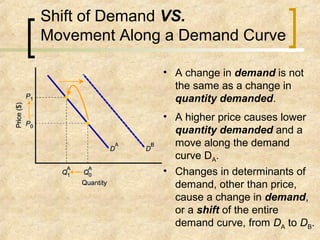
Shift of Demand VS.
Movement Along a Demand Curve
• A change in demand is not
the same as a change in
quantity demanded.
• A higher price causes lower
quantity demanded and a
move along the demand
curve DA.
• Changes in determinants of
demand, other than price,
cause a change in demand,
or a shift of the entire
demand curve, from DA to DB.
A Change in Demand VS.
a Change in Quantity Demanded
To summarize:
Change in price of a good or service
leads to
Change in quantity demanded
(Movement along the curve).
Change in income, preferences, or
prices of other goods or services
leads to
Change in demand
(Shift of curve).
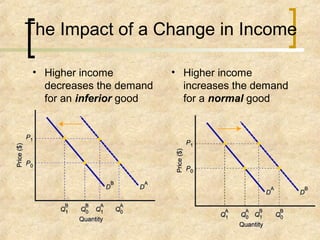
The Impact of a Change in Income
• Higher income
decreases the demand
for an inferior good
• Higher income
increases the demand
for a normal good
The Impact of a Change
in the Price of Related Goods
• Price of hamburger rises
• Demand for
complement
good
(ketchup)
shifts left
• Demand for
substitute
good
(chicken)
shifts right
• Quantity of hamburger
demanded per month falls
THANKS

Utility

  • 1.
  • 2.
    The Utility (TheBasis of Consumer Demand) Utility is the power or property of a commodity to satisfy human needs. Utility is ethically neutral. (Alcoholism, drugs, smoking etc.)
  • 3.
    1. WOULD YOUGET THE SAME SATISFACTION FROM A CUP OF COFFEE AND A CAN OF Coke ON A HOT SUMMER DAY? HOW ABOUT A COLD WINTER DAY? AT DIFFERENT TIMES. DIFFERENT ITEMS WILL GIVE DIFFERENT UTILITY IN DIFFERENT SITUATIONS CONCLUSION NO NO OBJ 1 DEFINE THE CONCEPT OF UTILITY
  • 4.
    2. WOULD TWOPEOPLE GET THE SAME SATISFACTION FROM THE SAME ITEM? PERSON LEAVING A BANQUET? WOULD A CANDY BAR HAVE THE SAME UTILITY FOR A HOMELESS PERSON AND DIFFERENT PEOPLE WILL HAVE DIFFERENT UTILITY FOR THE SAME ITEM CONCLUSION OBJ 1 DEFINE THE CONCEPT OF UTILITY
  • 5.
    Total Utility Sum ofthe utilities derived by a consumer from the various units of goods and services he/she consumes.  Tux = u1 + u2 + u3 + u4  Tun = ux + uy + uz
  • 6.
    Marginal Utility Utility derivedfrom the marginal unit consumed. Or Additional to the total utility resulting from the consumption of one additional unit. Or Refers to the change in the Total Utility (∆TU) obtained from the consumption of an additional unit of a commodity.  MU = ∆TU ∆Q TU = Total Utility, ∆Q = Change in quantity consumed by one unit. MU of nth Unit = TUn – TUn-1
  • 7.
    The Law ofDiminishing Marginal Utility As the quantity consumed of a commodity increases, the utility derived from each successive unit decreases consumption of all other commodities remaining the same. -10456 -5555 0604 10603 20502 30301 Marginal Utility Total Utility No. of Units Demanded
  • 8.
  • 9.
    Assumption: Theory of DiminishingM.U.  Unit of the consumer good must be a standard one.  Consumer’s taste or preference must remain the same during the period of consumption.  There must be continuity in consumption.  Mental Condition of the consumer must remain normal.
  • 10.
    What is DEMAND??? Desire to buy  Willingness to Pay  Ability to Pay Depends on:  Utility  Value in Exchange Demand for a commodity has always a reference to a “Price” a “Period of Time” and a “Place”.
  • 11.
    Demand  Demand isthe quantity of a commodity which a consumer is willing and able to purchase at any given price, during some specific period of time.
  • 12.
    Determinants of Demand 1.The price of the product in question. 2. The income available to the household. • A household’s decision about the quantity of a particular output to demand depends on:
  • 13.
    Determinants of Demand 3The prices of other products (substitutes and complements) available to the household. 4. The household’s tastes and preferences. 5. The household’s expectations about future income, wealth, and prices. 6. Population 7. New Discoveries 8. Climate and Weather 9. Savings 10. Reduction in Taxes
  • 14.
    Demand schedule : A demand schedule is a table showing how much of a given product a household would be willing to and able to buy at different prices.  Demand curves are usually derived from demand schedules. PRICE (PER CALL) QUANTITY DEMANDED (CALLS PER MONTH) $ 0 30 0.50 25 3.50 7 7.00 3 10.00 1 15.00 0 ANNA'S DEMAND SCHEDULE FOR TELEPHONE CALLS
  • 15.
    Demand schedule : 1.Individual Demand Schedule 2. Market Demand Schedule
  • 16.
    Individual Demand Schedule PRICE (PERCALL) QUANTITY DEMANDED (CALLS PER MONTH) $ 0 30 0.50 25 3.50 7 7.00 3 10.00 1 15.00 0 ANNA'S DEMAND SCHEDULE FOR TELEPHONE CALLS
  • 17.
    Market Demand Schedule Price ofMilk (Rs.) Demand for Mr. X (Kg.) Demand for Mr. Y (Kg.) Market Demand (Kg.) 5 1 2 1+2 = 3 4 2 3 2+3 = 5 3 3 4 3+4 = 7 2 4 5 4+5 = 9 1 5 6 5+6 = 11
  • 18.
    : Demand curve The demand curve is a graph illustrating how much of a given product a household would be willing to buy at different prices. PRICE (PER CALL) QUANTITY DEMANDED (CALLS PER MONTH) $ 0 30 0.50 25 3.50 7 7.00 3 10.00 1 15.00 0 ANNA'S DEMAND SCHEDULE FOR TELEPHONE CALLS
  • 19.
    Assumption of Lawof Demand  We use “all else equal” device, to examine the relationship between the quantity demanded of a good per period of time and the price of that good, while holding income, wealth, other prices, tastes, and expectations constant.
  • 20.
    The Law ofDemand Price and Quantity Demanded:  The law of demand states that there is a negative, or inverse, relationship between price and the quantity of a good demanded and its price. • This means that demand curves slope downward.
  • 21.
    Two Views  forevery possible price, it shows the quantity demanded  for each unit of item, it shows the maximum price that the buyer is willing to pay
  • 22.
    Demand Curve: Slope Due to diminishing marginal benefit demand curve slopes downward
  • 23.
    Shift of DemandVS. Movement Along a Demand Curve • A change in demand is not the same as a change in quantity demanded. • A higher price causes lower quantity demanded and a move along the demand curve DA. • Changes in determinants of demand, other than price, cause a change in demand, or a shift of the entire demand curve, from DA to DB.
  • 24.
    A Change inDemand VS. a Change in Quantity Demanded To summarize: Change in price of a good or service leads to Change in quantity demanded (Movement along the curve). Change in income, preferences, or prices of other goods or services leads to Change in demand (Shift of curve).
  • 25.
    The Impact ofa Change in Income • Higher income decreases the demand for an inferior good • Higher income increases the demand for a normal good
  • 26.
    The Impact ofa Change in the Price of Related Goods • Price of hamburger rises • Demand for complement good (ketchup) shifts left • Demand for substitute good (chicken) shifts right • Quantity of hamburger demanded per month falls
  • 27.