Planning
Dr. Rahul B. Pandit
Faculty of Nursing
Sassoon General Hospital, Pune
Definition
Planning is the process of determining the
objective of administrative efforts and
devising the means calculated to achieve
them.
--- Millet
Definition
Planning is the process of setting formal
guidelines and constraints for the behavior of
the firm.
--- Assoff and Brundinharg
 Planning is essentially a process of making
choice between available alternatives at all
levels of decision making.
 Planning is an intellectual process of making
decisions and it aims to achieve a co ordinate
and consistent set of operations aimed at
desired objectives.
CHARACTERISTIC OF PLANNING
1. Planning is looking into the future.
2. Planning involves pre determined line of
action.
3. Planning discovers the best alternative out of
available many alternatives.
4. Planning requires considerable time for
implementation.
CHARACTERISTIC OF PLANNING
5. Planning is a continuous process.
6. Planning’s object is to achieve pre determined
objectives in a better way.
7. Planning integrates various activities of
organization.
8. Planning is done for a specific period.
CHARACTERISTIC OF PLANNING
9. Planning not only selects the objectives but
also develops polices program and procedures
to achieve the objective.
10.Planning is required at all levels of
management.
11.Planning is an inter- dependent process which
co-ordinates the various business activities.
CHARACTERISTIC OF PLANNING
12. Planning directs the members of the
organization.
13.Growth and prosperity of any organization
depends upon planning.
OBJECTIVES OF PLANNING
 Reduce uncertainty
 Brings co-operation and co-ordination
 Economy in operation
 Anticipation unpredictable contingencies
 Achieving the pre determined goals
NATURE OF PLANNING
1. Primary of planning
2. Planning contributes to objectives
3. Planning an intellectual activity
4. Planning results in higher efficiency
5. Planning is a continuous process
6. Planning is flexible
NATURE OF PLANNING
7. Unity and consistency
8. Planning is common to all
9. Basis for all managerial functions
10. Getting co-ordination
IMPORTANCE OF PLANNING
 To manage by objectives
 Convert uncertainty into certainty
 Economy in operation
 Helps in co-ordination
 Effective control
 Effective utilization of resources
 Avoiding business failures
PRINCIPLE OF PLANNING
1. Planning must focus on purposes.
2. Planning is a continuous and iterative process
3. Planning should be simple
4. In planning, there should be a good harmony
with organization
5. Planning is hierarchical in nature
PRINCIPLE OF PLANNING
7. Planning should be pervasive activity covering
the entire organization
8. Planning must be precise
9. In planning the provision should be made to
use all available resources.
10. Planning should always be documented
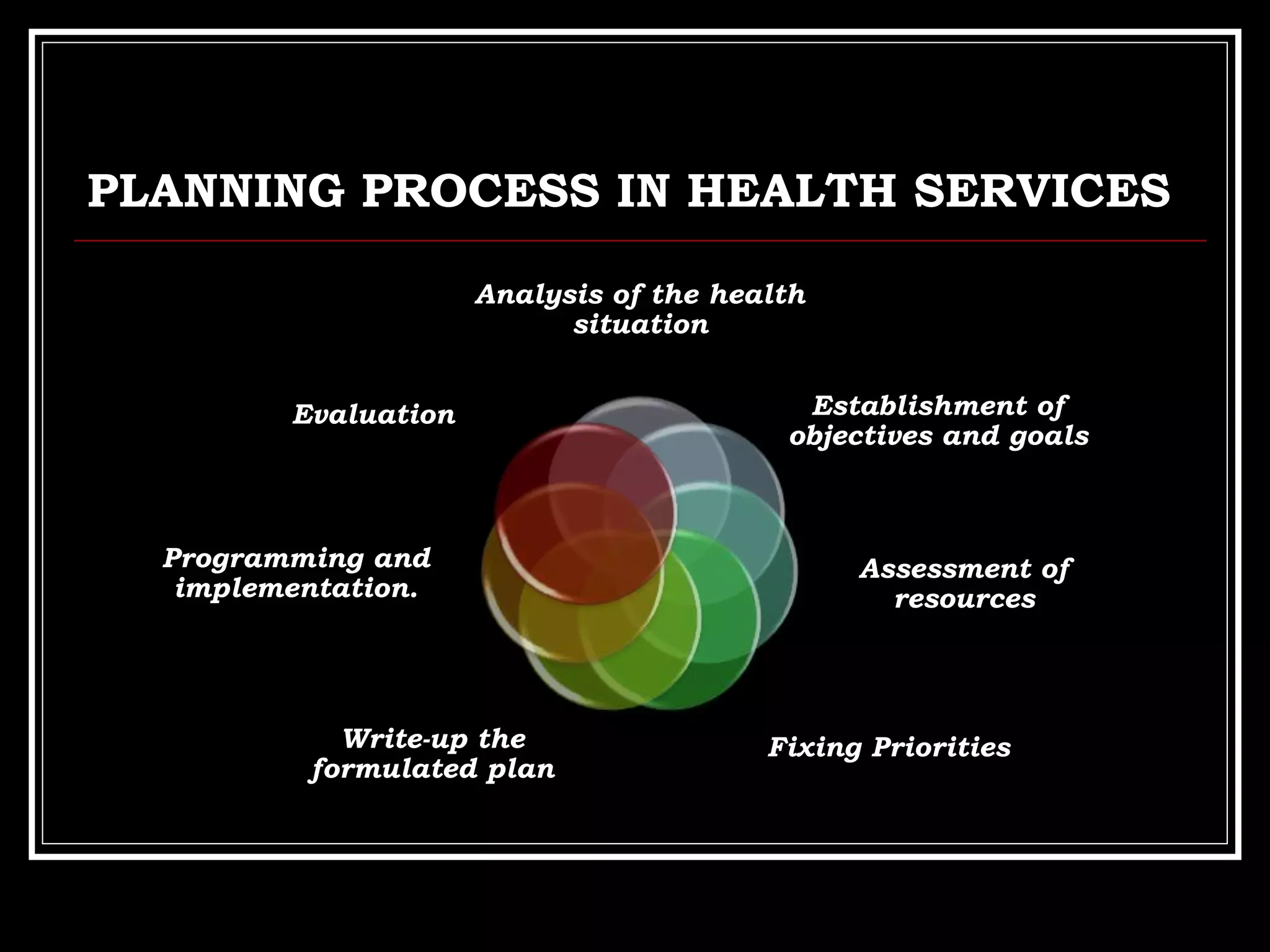
PLANNING PROCESS IN HEALTH SERVICES
Analysis of the health
situation
Establishment of
objectives and goals
Assessment of
resources
Fixing PrioritiesWrite-up the
formulated plan
Programming and
implementation.
Evaluation
FUNCTION OF PLANNING
 Investigation and analysis of the situation
and resource
 Forecasting
 Developing philosophy.
 Setting objectives.
 Setting priorities and strategies.
FUNCTION OF PLANNING
 Formulating broad policies for organizing,
directing, staffing, coordinating and
controlling.
 Formulating the plan.
 Programming.
 Formulating specific guidelines
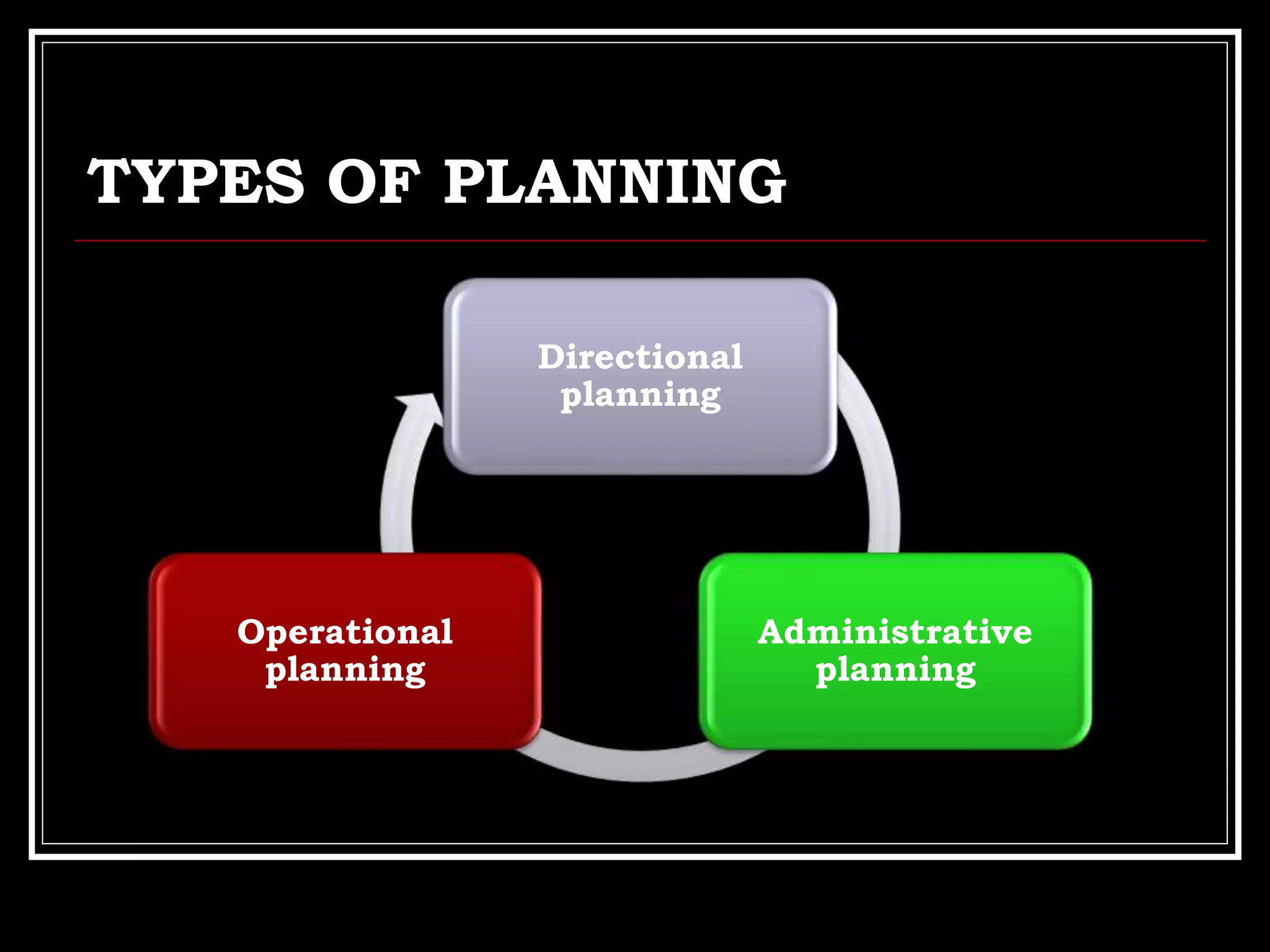
TYPES OF PLANNING
Directional
planning
Administrative
planning
Operational
planning
ADVANTAGES
 Planning leads to more effective and faster
achievements of any organization.
 Planning gives a competitive edge to company
that forecast and plan.
 Planning minimizes costs of performance.
ADVANTAGES
 Planning secures and ensures unity of
propose, direction and effort by focusing
attention on objectives.
 Planning has unique contribution towards the
efficiency of other managerial function.
DISADVANTAGES
 It depends upon facts and information,
reliable information is not possible.
 Planning may lead to internal inflexibilities
and procedural rigidities.
 It is said to be time-consuming and expensive
process
 People resistance
References
1. Basavanthappa BT. Nursing administration. Ist edn. New Delhi: Jaypee brothers medical publishers
(p) ltd; 2000.
2. Wise PS. Leading and managing in nursing. Ist edn. Philadelphia: Mosby publications; 1995.
3. Koontz H, Weihrich H . Essentials of management an international perspective. (Ist edn). New Delhi:
Tata Mc Graw Hill publishers; 2007.
4. Koontz H, Weihrich H. Management a global perspective. 1st edn. New Delhi: Tata Mc. Graw Hill
publishers;2001.
5. Anthony MK, Theresa S, Glick J, Duffy M, Paschall F. Leadership and nurse retention, the pivotal role
of nurse managers. JONA. Vol 35, Mar 2005.
6. Beyers Marjorie. Nurse executives’ perspectives on succession planning. JONA. Vol 36. June 2006.
7. Berkow S, Jaggi J& Fogelson R. Fourteen unit attributes to guide staffing. JONA.vol 37, no.3 mar
2007.
8. Blegen MA, Goode C J& Reed L. Nurse staffing and patient outcomes. Nurs res. 1998; 47(1):43-50.
Planning

Planning

  • 1.
    Planning Dr. Rahul B.Pandit Faculty of Nursing Sassoon General Hospital, Pune
  • 2.
    Definition Planning is theprocess of determining the objective of administrative efforts and devising the means calculated to achieve them. --- Millet
  • 3.
    Definition Planning is theprocess of setting formal guidelines and constraints for the behavior of the firm. --- Assoff and Brundinharg
  • 4.
     Planning isessentially a process of making choice between available alternatives at all levels of decision making.  Planning is an intellectual process of making decisions and it aims to achieve a co ordinate and consistent set of operations aimed at desired objectives.
  • 5.
    CHARACTERISTIC OF PLANNING 1.Planning is looking into the future. 2. Planning involves pre determined line of action. 3. Planning discovers the best alternative out of available many alternatives. 4. Planning requires considerable time for implementation.
  • 6.
    CHARACTERISTIC OF PLANNING 5.Planning is a continuous process. 6. Planning’s object is to achieve pre determined objectives in a better way. 7. Planning integrates various activities of organization. 8. Planning is done for a specific period.
  • 7.
    CHARACTERISTIC OF PLANNING 9.Planning not only selects the objectives but also develops polices program and procedures to achieve the objective. 10.Planning is required at all levels of management. 11.Planning is an inter- dependent process which co-ordinates the various business activities.
  • 8.
    CHARACTERISTIC OF PLANNING 12.Planning directs the members of the organization. 13.Growth and prosperity of any organization depends upon planning.
  • 9.
    OBJECTIVES OF PLANNING Reduce uncertainty  Brings co-operation and co-ordination  Economy in operation  Anticipation unpredictable contingencies  Achieving the pre determined goals
  • 10.
    NATURE OF PLANNING 1.Primary of planning 2. Planning contributes to objectives 3. Planning an intellectual activity 4. Planning results in higher efficiency 5. Planning is a continuous process 6. Planning is flexible
  • 11.
    NATURE OF PLANNING 7.Unity and consistency 8. Planning is common to all 9. Basis for all managerial functions 10. Getting co-ordination
  • 12.
    IMPORTANCE OF PLANNING To manage by objectives  Convert uncertainty into certainty  Economy in operation  Helps in co-ordination  Effective control  Effective utilization of resources  Avoiding business failures
  • 13.
    PRINCIPLE OF PLANNING 1.Planning must focus on purposes. 2. Planning is a continuous and iterative process 3. Planning should be simple 4. In planning, there should be a good harmony with organization 5. Planning is hierarchical in nature
  • 14.
    PRINCIPLE OF PLANNING 7.Planning should be pervasive activity covering the entire organization 8. Planning must be precise 9. In planning the provision should be made to use all available resources. 10. Planning should always be documented
  • 15.
    PLANNING PROCESS INHEALTH SERVICES Analysis of the health situation Establishment of objectives and goals Assessment of resources Fixing PrioritiesWrite-up the formulated plan Programming and implementation. Evaluation
  • 16.
    FUNCTION OF PLANNING Investigation and analysis of the situation and resource  Forecasting  Developing philosophy.  Setting objectives.  Setting priorities and strategies.
  • 17.
    FUNCTION OF PLANNING Formulating broad policies for organizing, directing, staffing, coordinating and controlling.  Formulating the plan.  Programming.  Formulating specific guidelines
  • 18.
  • 19.
    ADVANTAGES  Planning leadsto more effective and faster achievements of any organization.  Planning gives a competitive edge to company that forecast and plan.  Planning minimizes costs of performance.
  • 20.
    ADVANTAGES  Planning securesand ensures unity of propose, direction and effort by focusing attention on objectives.  Planning has unique contribution towards the efficiency of other managerial function.
  • 21.
    DISADVANTAGES  It dependsupon facts and information, reliable information is not possible.  Planning may lead to internal inflexibilities and procedural rigidities.  It is said to be time-consuming and expensive process  People resistance
  • 22.
    References 1. Basavanthappa BT.Nursing administration. Ist edn. New Delhi: Jaypee brothers medical publishers (p) ltd; 2000. 2. Wise PS. Leading and managing in nursing. Ist edn. Philadelphia: Mosby publications; 1995. 3. Koontz H, Weihrich H . Essentials of management an international perspective. (Ist edn). New Delhi: Tata Mc Graw Hill publishers; 2007. 4. Koontz H, Weihrich H. Management a global perspective. 1st edn. New Delhi: Tata Mc. Graw Hill publishers;2001. 5. Anthony MK, Theresa S, Glick J, Duffy M, Paschall F. Leadership and nurse retention, the pivotal role of nurse managers. JONA. Vol 35, Mar 2005. 6. Beyers Marjorie. Nurse executives’ perspectives on succession planning. JONA. Vol 36. June 2006. 7. Berkow S, Jaggi J& Fogelson R. Fourteen unit attributes to guide staffing. JONA.vol 37, no.3 mar 2007. 8. Blegen MA, Goode C J& Reed L. Nurse staffing and patient outcomes. Nurs res. 1998; 47(1):43-50.