SUPERVISION
Miss.VINOLI.S.G, M.Sc(N),PGDHM
READER
ANNAMMAL COLLEGE OF NURSING
DEFINITION
• Supervision is defined as, “an art or a process
by which designated individual or group of
individuals oversee the work of others and
establish controls to improve the work as well
as the worker”.
OBJECTIVES OF SUPERVISION
1. To help subordinate to do their job skillfully
and efficiently.
2. To develop subordinates capacity to the
fullest extent.
3. To promote team work
4. To promote moral and motivation among
workers.
5. To bridge the gap between personal goal and
organizational goal.
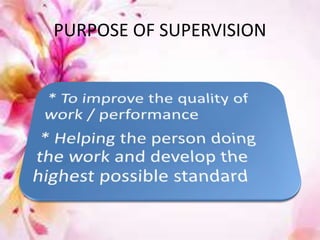
PURPOSE OF SUPERVISION
PRINCIPLES OF SUPERVISION
1. Supervision should aim at growth in knowledge and
improvement of skill of the person.
2. Supervision should improve the ability in thinking and
adjusting to the new situation.
3. It should help to formulate objects.
4. Good supervision stimulates their interest and
effectors.
5. No undue pressure for achievement
6. Autonomy to subordinate preferred
7. Supervision should have competence
8. Supervision should have receive training
9. Decision making is encouraged
10. Free communication to required
11. No over burdening to staff
12. Good leadership by supervisor
13. Suitable climate for work
14. Give guidance
15. Supervision should encourage innovation
allowing free flow of ideas and share positive
experiences of personnel.
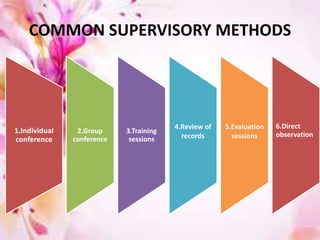
COMMON SUPERVISORY METHODS
1.Individual
conference
2.Group
conference
3.Training
sessions
4.Review of
records
5.Evaluation
sessions
6.Direct
observation
WHO IS SUPERVISOR?
A supervisor is a person who is primarily
incharge of a section & is responsible for both
quality & quantity of production, for the
efficient performance of the equipment, & for
the employees in his charge & their efficiency,
training & morale.
A supervisor drives authority from the
departmental head for getting work done
from the workers by using the resources of the
enterprises.
He issues instructions to the workers,
directs their activities & reports to the
department head on the performance of his
section.
QUALITIES
OF A GOOD
SUPERVISOR
Trained
person
Good
knowledge
Good in
health, skills
& have
pleasing
manner.
Good
listener
Supervisor
should lead
examplenory
life
Creative
enthusia
sm
Just
impartial
human,
tolerant
and tactful
Helpful
Good
power of
judgment
FUNCTIONS OF SUPERVISION
Other functions are;
• Co-ordinates there of subordinates and agents
and promote team worker.
• Promote social contact with in the team to bring
staff together and increases group cohesiveness.
• Develops mutual confidence
• Raises level of motivation
• Develops good IPR
• Maintains Records & Reports
• Establish control over the subordinates
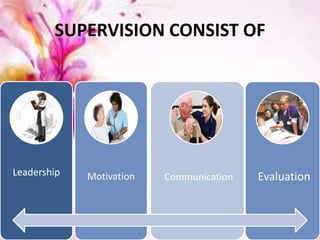
SUPERVISION CONSIST OF
Leadership Motivation Communication Evaluation
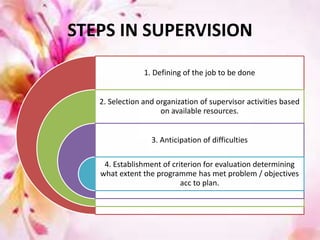
STEPS IN SUPERVISION
1. Defining of the job to be done
2. Selection and organization of supervisor activities based
on available resources.
3. Anticipation of difficulties
4. Establishment of criterion for evaluation determining
what extent the programme has met problem / objectives
acc to plan.
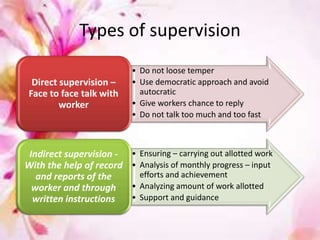
Types of supervision
• Do not loose temper
• Use democratic approach and avoid
autocratic
• Give workers chance to reply
• Do not talk too much and too fast
Direct supervision –
Face to face talk with
worker
• Ensuring – carrying out allotted work
• Analysis of monthly progress – input
efforts and achievement
• Analyzing amount of work allotted
• Support and guidance
Indirect supervision -
With the help of record
and reports of the
worker and through
written instructions
Methods of supervision
Technical vs. creative supervision
Scientific vs. intuitive
Co-operative vs. authoritarian
Task oriented vs. employee oriented
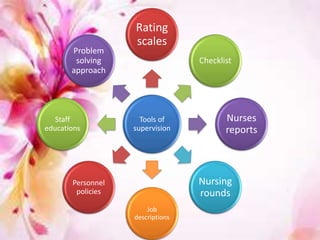
Tools of
supervision
Rating
scales
Checklist
Nurses
reports
Nursing
rounds
Job
descriptions
Personnel
policies
Staff
educations
Problem
solving
approach
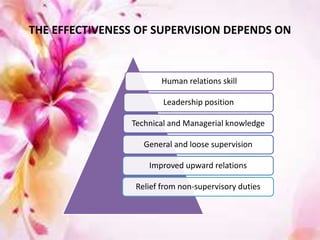
THE EFFECTIVENESS OF SUPERVISION DEPENDS ON
Human relations skill
Leadership position
Technical and Managerial knowledge
General and loose supervision
Improved upward relations
Relief from non-supervisory duties
PROBLEMS OF SUPERVISION
PROBLEMS IN NURSING SERVICE
1. Shortage of nursing personnel.
2. Individual differences among personnel in
interests, capacities and abilities.
3. Lack of information, insight and
understanding of changes and developments
in the interest of the continuance and
improvement of nursing.
4. Lack of clearly defined assignments, multiple
responsibility and lack of planning on the part of
those to whom personnel is responsible
5. Outdated policies, procedures and guides to
workmanship which cause them to be
disregarded and unused.
6. Inadequate, unsafe, and defective equipment.
7. Ill health in the part of personnel
8. Undesirable personnel characteristics with
special attention to attitudes.
COMMON PROBLEMS IN COMMUNITY HEALTH NURSING
1. Problems inherent to budgeting, planning and timing.
2. Personnel problems including problems of poor performance.
3. Grievances
4. Lack of financial resources.
5. Lack administrative support
6. Staff members who are inflexible and resist any type of change
7. Assignment to projects other than those committed to perform
8. Lack of political support
9. . Staff members who do not accept or support the program goals.
10. Conflict within the nursing unit itself.
11. Inability to proceed (for many reasons) because the timing is wrong
12. Inability to hire qualified personnel.
13. Changes in program priorities.
14. Other issues can include anything from car rental, uniform allowance,
security of the staff within the community, need for supplies and
equipment, duplication of services provided by another organization.

Supervision

  • 1.
  • 2.
    DEFINITION • Supervision isdefined as, “an art or a process by which designated individual or group of individuals oversee the work of others and establish controls to improve the work as well as the worker”.
  • 3.
    OBJECTIVES OF SUPERVISION 1.To help subordinate to do their job skillfully and efficiently. 2. To develop subordinates capacity to the fullest extent. 3. To promote team work 4. To promote moral and motivation among workers. 5. To bridge the gap between personal goal and organizational goal.
  • 4.
  • 5.
    PRINCIPLES OF SUPERVISION 1.Supervision should aim at growth in knowledge and improvement of skill of the person. 2. Supervision should improve the ability in thinking and adjusting to the new situation. 3. It should help to formulate objects. 4. Good supervision stimulates their interest and effectors. 5. No undue pressure for achievement 6. Autonomy to subordinate preferred 7. Supervision should have competence 8. Supervision should have receive training
  • 6.
    9. Decision makingis encouraged 10. Free communication to required 11. No over burdening to staff 12. Good leadership by supervisor 13. Suitable climate for work 14. Give guidance 15. Supervision should encourage innovation allowing free flow of ideas and share positive experiences of personnel.
  • 7.
  • 8.
    WHO IS SUPERVISOR? Asupervisor is a person who is primarily incharge of a section & is responsible for both quality & quantity of production, for the efficient performance of the equipment, & for the employees in his charge & their efficiency, training & morale.
  • 9.
    A supervisor drivesauthority from the departmental head for getting work done from the workers by using the resources of the enterprises. He issues instructions to the workers, directs their activities & reports to the department head on the performance of his section.
  • 10.
    QUALITIES OF A GOOD SUPERVISOR Trained person Good knowledge Goodin health, skills & have pleasing manner. Good listener Supervisor should lead examplenory life Creative enthusia sm Just impartial human, tolerant and tactful Helpful Good power of judgment
  • 11.
  • 12.
    Other functions are; •Co-ordinates there of subordinates and agents and promote team worker. • Promote social contact with in the team to bring staff together and increases group cohesiveness. • Develops mutual confidence • Raises level of motivation • Develops good IPR • Maintains Records & Reports • Establish control over the subordinates
  • 13.
    SUPERVISION CONSIST OF LeadershipMotivation Communication Evaluation
  • 14.
    STEPS IN SUPERVISION 1.Defining of the job to be done 2. Selection and organization of supervisor activities based on available resources. 3. Anticipation of difficulties 4. Establishment of criterion for evaluation determining what extent the programme has met problem / objectives acc to plan.
  • 15.
    Types of supervision •Do not loose temper • Use democratic approach and avoid autocratic • Give workers chance to reply • Do not talk too much and too fast Direct supervision – Face to face talk with worker • Ensuring – carrying out allotted work • Analysis of monthly progress – input efforts and achievement • Analyzing amount of work allotted • Support and guidance Indirect supervision - With the help of record and reports of the worker and through written instructions
  • 16.
    Methods of supervision Technicalvs. creative supervision Scientific vs. intuitive Co-operative vs. authoritarian Task oriented vs. employee oriented
  • 17.
  • 18.
    THE EFFECTIVENESS OFSUPERVISION DEPENDS ON Human relations skill Leadership position Technical and Managerial knowledge General and loose supervision Improved upward relations Relief from non-supervisory duties
  • 19.
    PROBLEMS OF SUPERVISION PROBLEMSIN NURSING SERVICE 1. Shortage of nursing personnel. 2. Individual differences among personnel in interests, capacities and abilities. 3. Lack of information, insight and understanding of changes and developments in the interest of the continuance and improvement of nursing.
  • 20.
    4. Lack ofclearly defined assignments, multiple responsibility and lack of planning on the part of those to whom personnel is responsible 5. Outdated policies, procedures and guides to workmanship which cause them to be disregarded and unused. 6. Inadequate, unsafe, and defective equipment. 7. Ill health in the part of personnel 8. Undesirable personnel characteristics with special attention to attitudes.
  • 21.
    COMMON PROBLEMS INCOMMUNITY HEALTH NURSING 1. Problems inherent to budgeting, planning and timing. 2. Personnel problems including problems of poor performance. 3. Grievances 4. Lack of financial resources. 5. Lack administrative support 6. Staff members who are inflexible and resist any type of change 7. Assignment to projects other than those committed to perform 8. Lack of political support 9. . Staff members who do not accept or support the program goals. 10. Conflict within the nursing unit itself.
  • 22.
    11. Inability toproceed (for many reasons) because the timing is wrong 12. Inability to hire qualified personnel. 13. Changes in program priorities. 14. Other issues can include anything from car rental, uniform allowance, security of the staff within the community, need for supplies and equipment, duplication of services provided by another organization.