• Meaning
– Discipline- disciples (Pupils) + Descipere (to comprehend).
– Applying standards in a consistent, flexible & fair
manner.
• Definition
– Discipline is the treatment suited to a disciple or learner,
education, development, of the faculties by instructions,
and exercises, training, whether physical, mental, or moral
• Jane Nelson, 2002
– Discipline consists in the submission of one’s impulses &
powers to a regulation which imposes from chaos &
brings efficiency & economy where there would otherwise
it is ineffective and waste.
• Percununn

s
Aims of discipline
1. To create & maintain desirable conditions in the
teaching-learning situation & thus to achieve in
the achievement of objectives
2. To create favorable attitude towards the
establishment & maintenance of conditions
essential to effective work, in order to achieve
the desired objectives.
3. To assist the development of self-control & cooperation which are regarded as essential traits
in the daily living as well as professional
functioning.
Facts about discipline
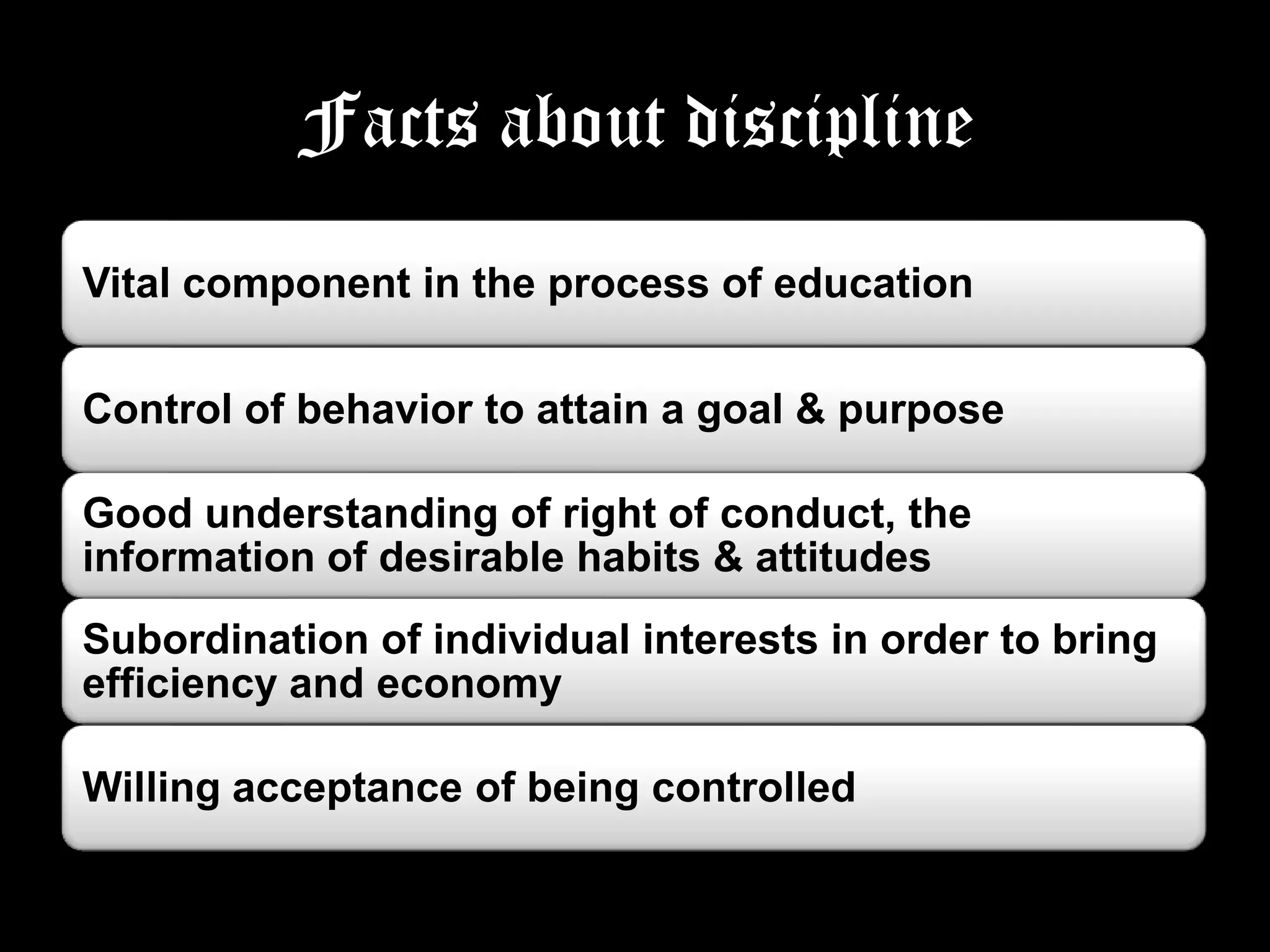
Vital component in the process of education
Control of behavior to attain a goal & purpose

Good understanding of right of conduct, the information of
desirable habits & attitudes
Subordination of individual interests in order to bring
efficiency and economy
Willing acceptance of being controlled
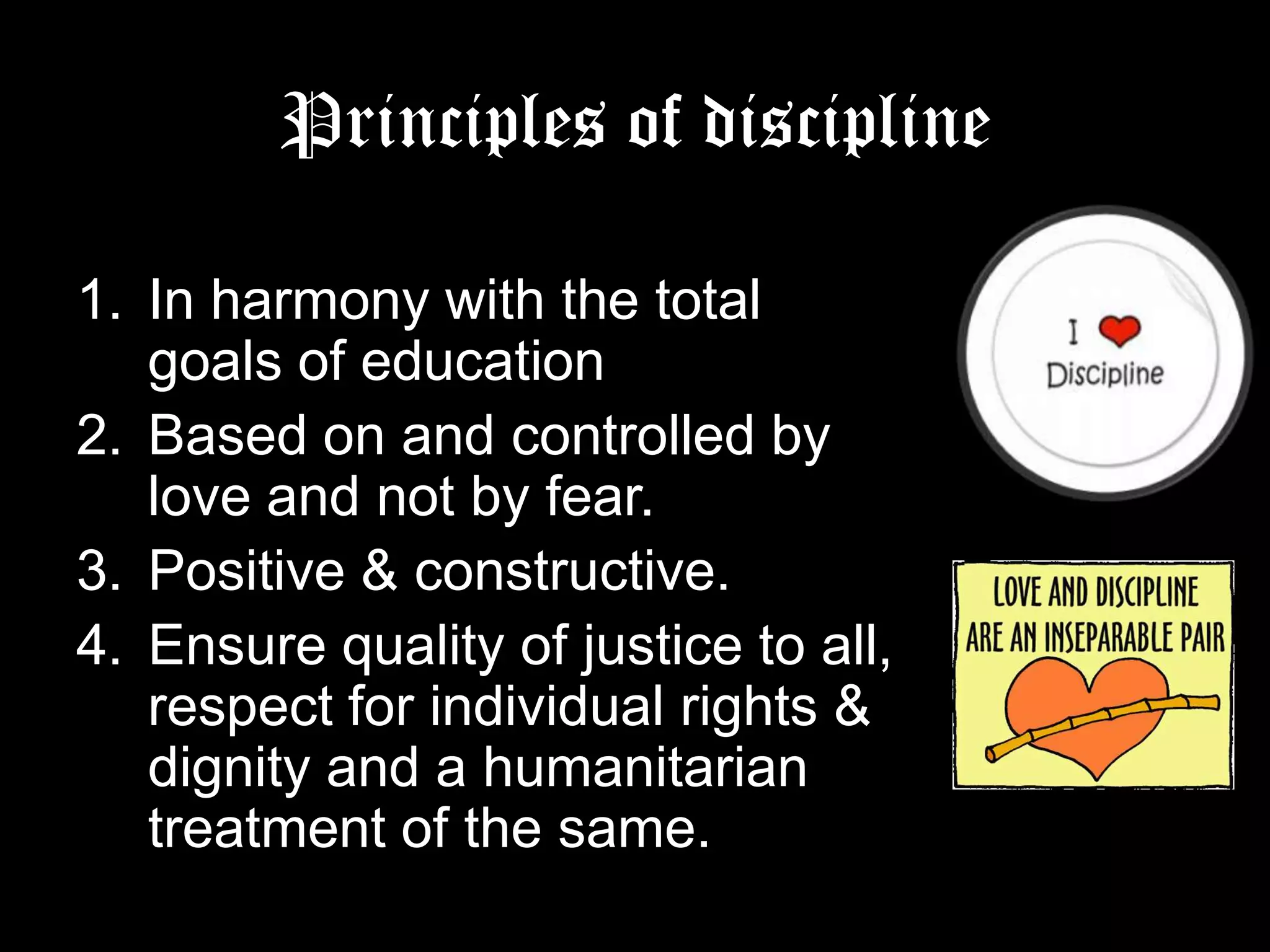
Principles of discipline
1. In harmony with the total goals of
education
2. Based on and controlled by love
and not by fear.
3. Positive & constructive.
4. Ensure quality of justice to all,
respect for individual rights &
dignity and a humanitarian
treatment of the same.
5. Mean for successful
implementation of the
educational program
6. Disciplinary policies and
procedures should be primarily
preventive, secondarily
corrective, and never reattribute.
7. Situation specific disciplinary
actions followed by counseling.
8. It is something which the teacher
helps the children to attain, not
something the teacher maintains.
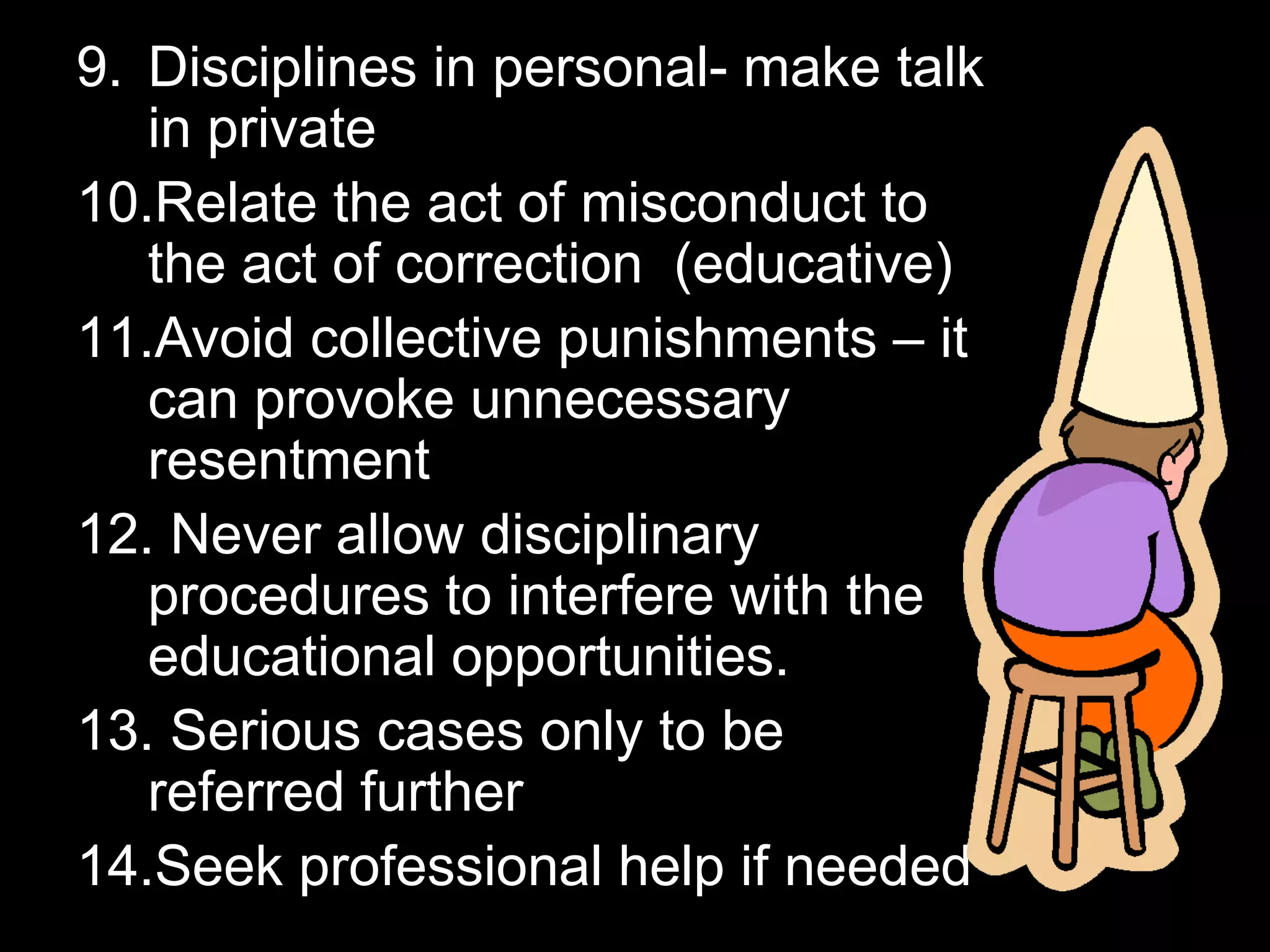
9. Disciplines in personal- make talk in
private
10.Relate the act of misconduct to the
act of correction (educative)
11.Avoid collective punishments – it can
provoke unnecessary resentment
12. Never allow disciplinary procedures
to interfere with the educational
opportunities.
13. Serious cases only to be referred
further
14.Seek professional help if needed
Functions of discipline
Facilitate & assist in learning those standards
of conduct acceptable within the society.
Helps to acquire characteristics of positive
nature such as self control and persistence

Assists in securing stability of the social order
Achieve security & maturity
Types of discipline
1. Authoritarian discipline
– Traditional form
– Authority of old over young
– Punishment for undesirable behavior

2. Democratic discipline
– Students & teachers have mutual participation

3. Self discipline
– True discipline
– Satisfy the need for satisfying the need of self
respect & security.
– Source of control largely within the individual students
4. Assertive discipline
Clear expectation for the required behavior is set out
by the teacher
Specific, concrete, & verbal praises are given for the
desired behavior.
Negative reinforcement for the undesired behaviors
Teacher is assertive in insisting on the application of
the rewards & sanctions
Power resides with the teacher where choice is with
the students (teacher can tell explicitly about the
desired behavior and the consequences; students
can chose to obey or not to obey.
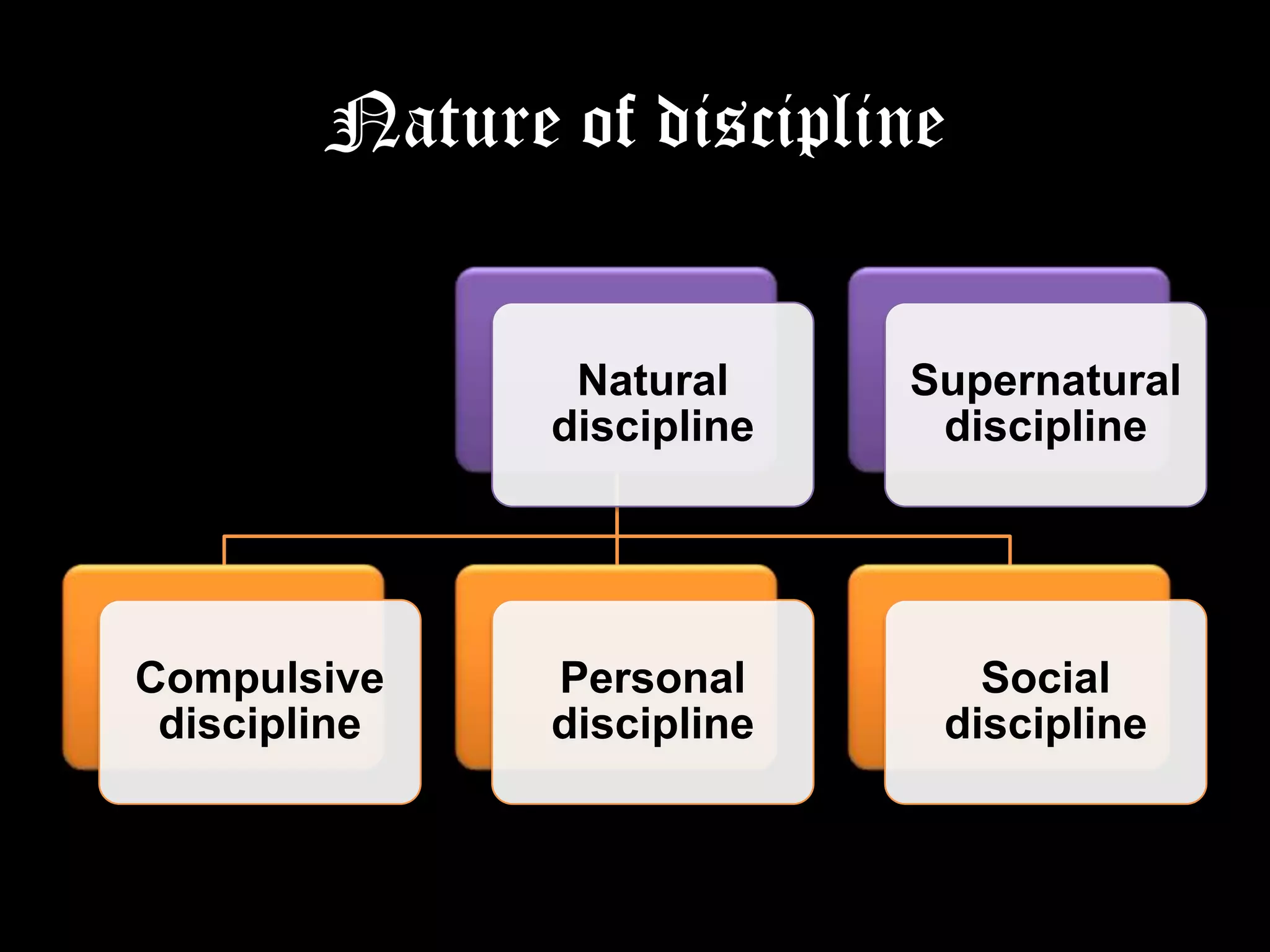
Nature of discipline
Natural
discipline

Compulsive
discipline

Supernatural
discipline

Personal
discipline

Social
discipline
1. Compulsive discipline:
– Lowest level of discipline, imposed from top to
down.
– External rules by force
– Establishment of permanent & proper habits of
conduct.

2. Personal discipline
– Personality centered
– It is educative in nature

3. Social discipline:
– Group norms based
– Self control is exercised through the social context
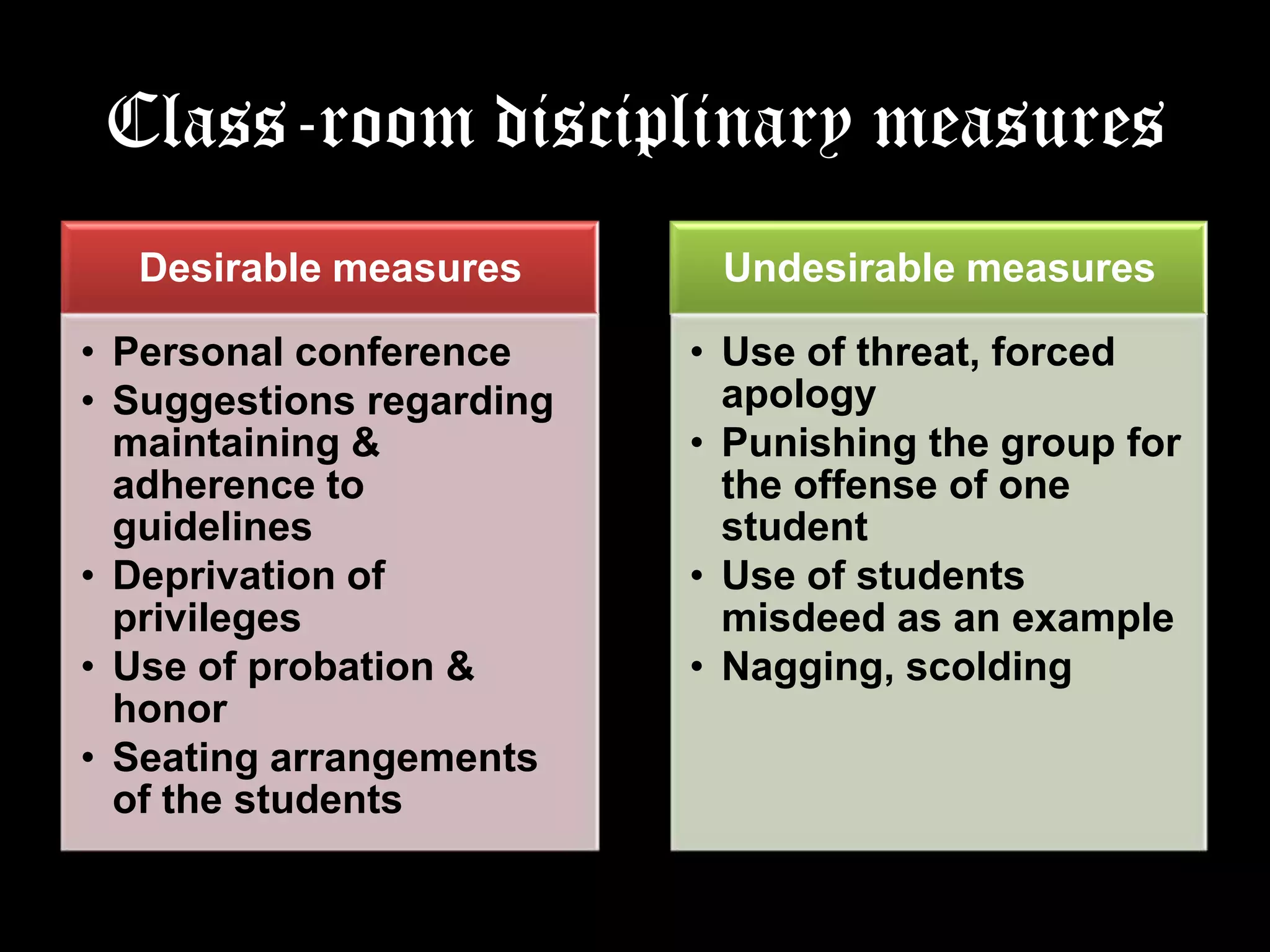
Class-room disciplinary measures
Desirable measures

Undesirable measures

• Personal conference
• Suggestions regarding
maintaining &
adherence to guidelines
• Deprivation of privileges
• Use of probation &
honor
• Seating arrangements of
the students

• Use of threat, forced
apology
• Punishing the group for
the offense of one
student
• Use of students misdeed
as an example
• Nagging, scolding
Measures to maintain class discipline
• Ensure class room conditions are favorable to the
lesson planned
• Make sure that the teaching process doesn’t
depress the class morale
• Appropriate reinforcement on time
• Neither too friendly nor too remote with the
students
• Watch for the signs of trouble very carefully
• Plan the class with desirable pace with appt.
learning measures
• Be fair-mind & impartial- favoritism in any
sense can lead to will lead to withdrawal of
co-operation and indiscipline among students.
• When there is an order, impose it firmly &
unambiguously
• Teacher must know when & how to punish (i.e.
to implement disciplinary measures)
• Ensure the necessity for a reprimand
• Follow up all important disciplinary matters
• Revise & execute the best among the measures
adopted by reviewing
Oral reprimand
• Nature of misconduct, the corrective action required,
& the consequences if not been corrected.

Disciplinary process

Written reprimand
• Formal written statement on nature of misconduct,
the corrective action required, & the consequences if
not been corrected.

Suspension/ financial penalty
• Temporary & immediate removal from the job +
written reprimand

Demotion
• It is done with misconduct of managerial persons
Disciplinary termination
• Culminating misconducts
• Determining the employee is no longer suitable for
the specific employment
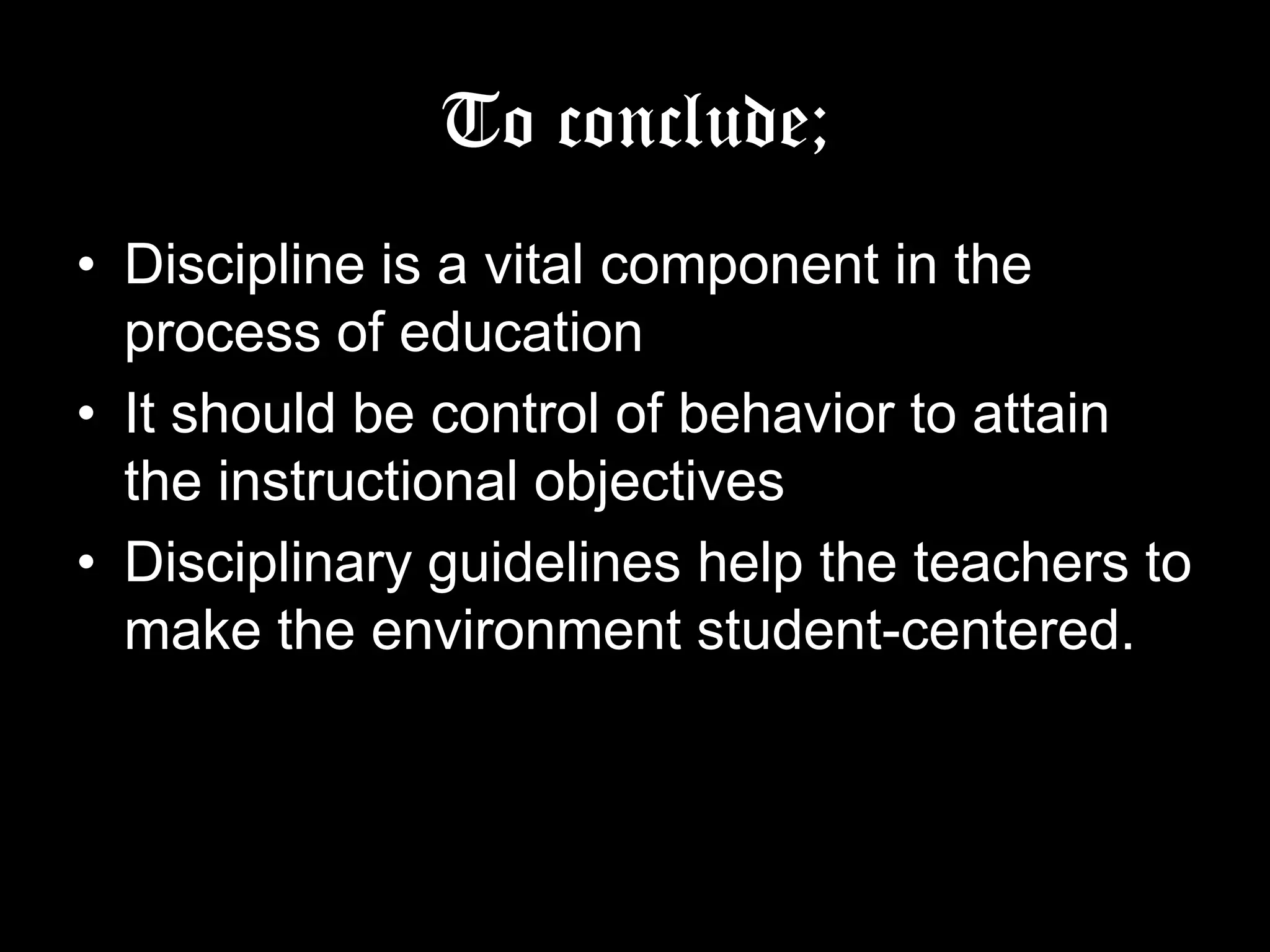
To conclude;
• Discipline is a vital component in the process of
education
• It should be control of behavior to attain the
instructional objectives
• Disciplinary guidelines help the teachers to
make the environment student-centered.
Further reading
• Basavanthappa BT (2003). Nursing education,
1st ed., Newdelhi, Jaypee Brothers.
• Sankara Narayan & Sindhu B (2008). Learning
and teaching. 2nd ed., Calicut, Braifill.

Discipline in nursing education

  • 2.
    • Meaning – Discipline-disciples (Pupils) + Descipere (to comprehend). – Applying standards in a consistent, flexible & fair manner. • Definition – Discipline is the treatment suited to a disciple or learner, education, development, of the faculties by instructions, and exercises, training, whether physical, mental, or moral • Jane Nelson, 2002 – Discipline consists in the submission of one’s impulses & powers to a regulation which imposes from chaos & brings efficiency & economy where there would otherwise it is ineffective and waste. • Percununn s
  • 3.
    Aims of discipline 1.To create & maintain desirable conditions in the teaching-learning situation & thus to achieve in the achievement of objectives 2. To create favorable attitude towards the establishment & maintenance of conditions essential to effective work, in order to achieve the desired objectives. 3. To assist the development of self-control & cooperation which are regarded as essential traits in the daily living as well as professional functioning.
  • 4.
    Facts about discipline Vitalcomponent in the process of education Control of behavior to attain a goal & purpose Good understanding of right of conduct, the information of desirable habits & attitudes Subordination of individual interests in order to bring efficiency and economy Willing acceptance of being controlled
  • 5.
    Principles of discipline 1.In harmony with the total goals of education 2. Based on and controlled by love and not by fear. 3. Positive & constructive. 4. Ensure quality of justice to all, respect for individual rights & dignity and a humanitarian treatment of the same.
  • 6.
    5. Mean forsuccessful implementation of the educational program 6. Disciplinary policies and procedures should be primarily preventive, secondarily corrective, and never reattribute. 7. Situation specific disciplinary actions followed by counseling. 8. It is something which the teacher helps the children to attain, not something the teacher maintains.
  • 7.
    9. Disciplines inpersonal- make talk in private 10.Relate the act of misconduct to the act of correction (educative) 11.Avoid collective punishments – it can provoke unnecessary resentment 12. Never allow disciplinary procedures to interfere with the educational opportunities. 13. Serious cases only to be referred further 14.Seek professional help if needed
  • 8.
    Functions of discipline Facilitate& assist in learning those standards of conduct acceptable within the society. Helps to acquire characteristics of positive nature such as self control and persistence Assists in securing stability of the social order Achieve security & maturity
  • 9.
    Types of discipline 1.Authoritarian discipline – Traditional form – Authority of old over young – Punishment for undesirable behavior 2. Democratic discipline – Students & teachers have mutual participation 3. Self discipline – True discipline – Satisfy the need for satisfying the need of self respect & security. – Source of control largely within the individual students
  • 10.
    4. Assertive discipline Clearexpectation for the required behavior is set out by the teacher Specific, concrete, & verbal praises are given for the desired behavior. Negative reinforcement for the undesired behaviors Teacher is assertive in insisting on the application of the rewards & sanctions Power resides with the teacher where choice is with the students (teacher can tell explicitly about the desired behavior and the consequences; students can chose to obey or not to obey.
  • 11.
  • 12.
    1. Compulsive discipline: –Lowest level of discipline, imposed from top to down. – External rules by force – Establishment of permanent & proper habits of conduct. 2. Personal discipline – Personality centered – It is educative in nature 3. Social discipline: – Group norms based – Self control is exercised through the social context
  • 13.
    Class-room disciplinary measures Desirablemeasures Undesirable measures • Personal conference • Suggestions regarding maintaining & adherence to guidelines • Deprivation of privileges • Use of probation & honor • Seating arrangements of the students • Use of threat, forced apology • Punishing the group for the offense of one student • Use of students misdeed as an example • Nagging, scolding
  • 14.
    Measures to maintainclass discipline • Ensure class room conditions are favorable to the lesson planned • Make sure that the teaching process doesn’t depress the class morale • Appropriate reinforcement on time • Neither too friendly nor too remote with the students • Watch for the signs of trouble very carefully • Plan the class with desirable pace with appt. learning measures
  • 15.
    • Be fair-mind& impartial- favoritism in any sense can lead to will lead to withdrawal of co-operation and indiscipline among students. • When there is an order, impose it firmly & unambiguously • Teacher must know when & how to punish (i.e. to implement disciplinary measures) • Ensure the necessity for a reprimand • Follow up all important disciplinary matters • Revise & execute the best among the measures adopted by reviewing
  • 16.
    Oral reprimand • Natureof misconduct, the corrective action required, & the consequences if not been corrected. Disciplinary process Written reprimand • Formal written statement on nature of misconduct, the corrective action required, & the consequences if not been corrected. Suspension/ financial penalty • Temporary & immediate removal from the job + written reprimand Demotion • It is done with misconduct of managerial persons Disciplinary termination • Culminating misconducts • Determining the employee is no longer suitable for the specific employment
  • 17.
    To conclude; • Disciplineis a vital component in the process of education • It should be control of behavior to attain the instructional objectives • Disciplinary guidelines help the teachers to make the environment student-centered.
  • 18.
    Further reading • BasavanthappaBT (2003). Nursing education, 1st ed., Newdelhi, Jaypee Brothers. • Sankara Narayan & Sindhu B (2008). Learning and teaching. 2nd ed., Calicut, Braifill.