Prepared by:
Ahmed mohammed zinhom
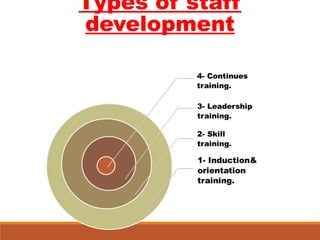
TYPES OF STAFF DEVELPMENTTYPES OF STAFF DEVELPMENT
Objectives:
At the end of this session the participants
will be able to:
1-compare between the four types of staff
development:
)Induction& orientation training, Skill training,
Leadership training, Continues training(.
2- Define organization socialization
3- Discuss socialization categories .
4- List organizational phases.
5- Differentiate between successful & un successful socialization.
6- identify common problems in employee
orientation.
7- recognize the impact of staff development on
nurses ,organization, and society.
outlines
1.Introduction.
2.Four types of staff development:
A. Induction& orientation training.

organization socialization
socialization categories .
organizational phases.
successful & un successful socialization.
Out linesOut lines
B. Skill training.
C. Leadership training.
D. Continues training.
3- common problems in employee
orientation.
4- The impact of staff development
on nurses, organization, and society.
Introductio
n
*Staff development programs is very important in any career
for improving the quality of work and coping with the
surrounding changes and demands
*it will assist each employee to:
-To improve performance in her or his present position.
-To acquire personal and professional abilities that
maximize the possibility of career advancement.
Types of staff
development
Induction & Orientation training:-
A. Induction training:
 
Should be standardized to all agency new employees and
is provided during the employee’s first 2 to 3days in the
agency
WHO SHOULD CONDUCT OR BE ACTIVELY
INVOLVED IN AN EMPLOYEE INDUCTION?
1-Members of HR.
2-Members of management.
3-Experts in Specific fields.
Objectives OF Induction training:
It provides the following information:
1(Identification of agency's philosophy, mission, history, and
goals.
2(Departmental structure.
3(Employment policies, purpose.
4(Holidays, vacations.
5(Sick time benefits and employees health services.
6(Position classifications and promotion opportunities.
7(In-services education.
8(Socialization.
B. Orientation training:B. Orientation training:
• * Is an individualized training program
after induction training is completed.
• * an employee should be oriented by
the requirements of the position for
which he/ she was hired.
PurposePurpose
To help new staff form positive first
impressions, that he/she belongs to the
organization, feels welcome and
supported;
To assist in understanding the culture and
values;
Cont ,Cont ,
To reduce anxiety .
To reduce employee turnover .
To save time for supervisor & colleagues.
To Develop Realistic Job Expectations
and Job Satisfaction .
SOCIALIZATION
Organizational SocializationOrganizational Socialization
The process of adjusting to a new
organization
The process by which an individual
acquires the social knowledge and skills
necessary to assume an organizational
role.
Socialization categoriesSocialization categories
1. Preliminary Learning )discovery( learning will
be necessary what to learn whom to learn
from , learning about the organization including
the goals, values, and policies of the
organization ,learning to function in the work
group values, norms, roles, and friendships
within the group.
2. Learning how to perform the job: necessary
skills and knowledge for a particular job,
Personal learning : learning from experience
with the past job and organization
Socialization phasesSocialization phases
1- Anticipatory socialization:
This stage occurs before new
hires join the organization Through
interacting with representatives of
the organization )e.g., recruiters,
managers(,
 new hires develop expectations
about the organization and the job
prior to organizational entry.
Cont ,Cont ,
2-Encounter:
When new employees begin a new
job, they start to learn about job tasks
and receive training.
Managers can exert their influence by
helping new employees understand
their roles and duties.
Cont ,Cont ,
3- Settling:
New employees begin to feel
comfortable with their job demands and
social relationships.
They will be interested in the
organization’s evaluation of their
performance and in learning about
potential career opportunities within the
organization.
Successful & un successful socializationSuccessful & un successful socialization
Successful Socialization:
Newcomer develops greater
knowledge of the organization and
work group,
attitudes that make performing, fitting
into, and remaining with the
organization,
 employee satisfaction,
commitment ‫بطاط‬َ‫طا‬ ‫ت‬ِ‫َب‬ ‫ر‬ْ‫ِت‬ ‫ا‬ِ‫َب‬ & loyalty to the
organization ,
achieving high performance .
Unsuccessful SocializationUnsuccessful Socialization
Results in unmet
expectations ,
 Dissatisfaction ,
Lack of commitment ,
 Turnover
what employees should learn andwhat employees should learn and
develop through socialization?develop through socialization?
Performance proficiency
Learning and mastering the knowledge, skills
and abilities to perform the required work
task proficiently.
People
Establishing successful and satisfying work
relationships with organizational members.
Politics
Gaining information regarding formal and
informal work relationships and power
structures.
Cont,Cont,
Language
Understanding the profession’s technical
language as well as acronyms unique to the
organization.
Organizational goals and values
Understanding the rules or principles that
maintain the integrity of the organization.
History
Learning the organization’s traditions, customs,
personal background of other members.
Content of orientation programContent of orientation program
(I)General information about the daily
work routine;
(ii)A review of organization’s history,
objectives, as well as how the employee’s
job contributes to the organization`s
needs .
(iii)A detailed presentation ,perhaps, in a
brochure, of the organization policies,
work rules and employee benefits.
Cont ,Cont ,
Educate the attendees about the history of the
organization, the financial performance of the
organization and the marketing initiatives of the
hospital.
services of the organization.
The organization structure.
Location of department and employee facilities.
Rules, regulations and daily work routines.
ContCont
Terms and conditions of service including
wages, working hours, overtime, holidays etc.
Benefits and services for employees.
Job opportunities for training, promotions,
transfers.
Safety measures.
Grievance procedures.‫الشكوى‬ ‫او‬ ‫التظلم‬ ‫كتطابة‬
Common problems in employeeCommon problems in employee
orientation.orientation.
Busy or Untrained supervisor.
Too much information.
Emphasis on formal, one-way communication
– Not giving newcomers a chance to discuss
issues of interest or ask questions.
No evaluation of program
ContCont
Lack of follow-up
The program was not planned.
The employee was unaware of the job
requirements .
The employee does not feel welcome.
One-shot mentality(Limiting the orientation
program to only the first day at work) .
Designing and implementing anDesigning and implementing an
orientation programorientation program
Set general goals and objectives .
Determine whose responsible for the
program.
Determine who need the orientation
program.
Select content and delivery method .
Evaluate the effectiveness of orientation
program.
To make orientation program must
consider the following variable:
1. Size of agency.
2. Philosophy of agency, nursing
practice, and staff development.
3. Instructional staff.
4. Resources available.
5. Staff development policies.
6. Staffing pattern.
2- Skill training program:
Refer to an ongoing-on-the-job
instruction that is given to enhance
the worker's performance in their
present job.
This program is directed towards
providing employees with basic
skills and attitudes required for the
job.
Objectives:
1. Provide the hospital and patients
with staff who know and are able
to perform effectively.
2. Enable employees to meet
standards established for
quantity and quality of
performance.
3. Promote job satisfaction and
reduce conflicts.
cont.
4. Develop employee's skills required
for the efficient performance of
his/her function.
5. Help employee to be familiar
with changes in methods and
techniques.
6. Meeting the job related learning
needs of the nurse and other
personnel.
cont.
7.To maintain high standard of nursing
care to patients, which would increase
the level of satisfaction of patients /
relatives.
8. To improve communication
skills among nursing personnel.
9. Increase competence of care.
Content:
The program covers:
1.Technical and manual skills.
2. Communication skills, which
are vital to good nursing care
3- Leadership and management
development program:
•This program is directed towards
preparing a selected group of
employees for management and
leadership position, growing
responsibilities and new positions in
nursing.
Objectives:
1. Develop leadership and
management competency among
personnel.
2. Increased delegation of authority
and developing professional
accountability.
3. Promote good morale among
administrative personnel.
cont.
4. Reduce the cost of turnover in
top position.
5. Broaden selection possibility for
promotion.
4. Continuing education:
Continuing education is the
part of staff development
designed to:
a. Assist nursing personnel to
gain new knowledge and
skills.
2. Review and add to
knowledge already gained.
3. Investigate new approaches
in nursing.
4. Strengthen their clinical
competencies.
cont.
cont.
Continuing education can be
offered to groups from various
positions classifications as:
1. Supervisor.
2. Head nurse.
3. Staff nurse.
4. Clinical specialist.
5. Staff development educator.
 
cont.
•Objectives:
1. Meeting the learning needs of
the nurse following basic nursing
education.
2. Meeting the job related learning
needs of the nurse and other
personnel.
cont.
3. Promote the development of
knowledge, skills and attitudes
for the enhancement of nursing
practice, thus improving health
care to the public.
4. To investigate new approaches
in nursing.
5. Updated information on a regular
basis to ensure best possible
care is provided to patients
cont.
6. To assist nursing personnel to
gain new knowledge and skills.
7. To enhance and promote
nursing leadership competencies.
8. To offer innovative and creative
approaches to the nursing care of
patients for the purpose of
achieving improved competence
in nursing care.
The impact of staff
development on nurses
1. Identify hospital committees on
which staff nurses can become
members; recognize the conditions
for membership.
cont.
2. Important to success in a work
group and in the organization
itself.
3. Better morale.
4. Greater pride in work.
5. Reduce anxiety that new
employees feel when beginning
the job.
6. Socializing the employee into the
workplace contributes to unit
effectiveness by reducing
dissatisfaction, absenteeism, and
turnover.
7. Increasing employee's personal
and professional satisfaction.
cont.
cont.
8. Helps the new nurse develop
any necessary skills.
9. Update with new techniques,
new methods, new machines,
and equipments for doing the
work.
10.Promoting safety measure.
11. Increasing the knowledge and skill
for people for a definite purpose.
12. To achieve a change in the
behavior of those being trained.
13. Employees will acquire new skills,
technical knowledge, problem solving
ability, and attitudes.
cont.
cont.
14. Even the employees are
experienced workers, it is
necessary to refresh.
15. Provide the opportunities for
education and self development.
16. The employees become motivated.
17. Better cooperation.
18. Greater loyalty.
cont.
The impact of staff development
on organization
1. Read the overall philosophy,
goals, and standard of nursing care
adopted by nursing service as the
criteria for determining quality
care.
cont.
2. High productivity.
3. Reduce operating costs.
4. Fewer accidents or mistakes.
5. Teaching employees to efficiently
operate new machine which are
installed or are likely to install in the
near future.
cont.
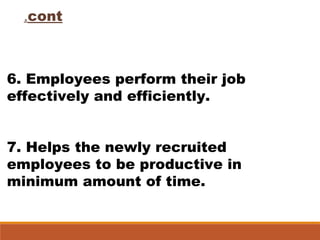
6. Employees perform their job
effectively and efficiently.
7. Helps the newly recruited
employees to be productive in
minimum amount of time.
cont.
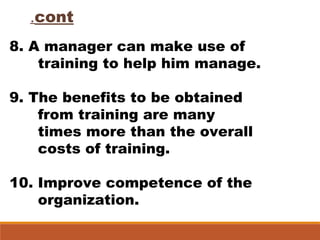
8. A manager can make use of
training to help him manage.
9. The benefits to be obtained
from training are many
times more than the overall
costs of training.
10. Improve competence of the
organization.
cont.
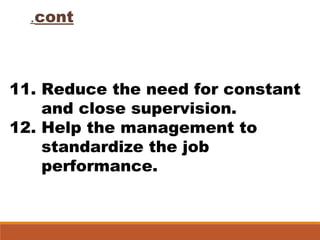
11. Reduce the need for constant
and close supervision.
12. Help the management to
standardize the job
performance.
cont.
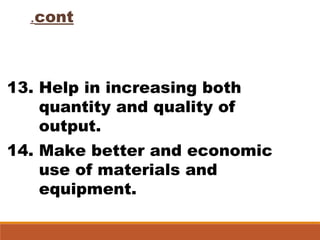
13. Help in increasing both
quantity and quality of
output.
14. Make better and economic
use of materials and
equipment.
cont.
15. Wastage will be low.
16. Helps in building an efficient
and cooperative workforce.
17. Manager can use training in
improving his/her planning,
organizing, controlling.
cont.
18. Increases the stability and
flexibility of the organization.
29. Improving the performance
by reducing the gap
between expectations and
achievements.
20. Prepare new graduates for
first line supervisory
positions.
The impact of staff development
on society
1. Enhance the quality of client
care.
2. Efficient performance in work.
3. Rendering better service to
patient.
cont.
4. Promoting safety measure.
5. Help the institution meet its
corporate responsibilities in the
community.
6. Employees know community
needs.
7. Receive maximum benefits
at minimum cost
‫طليق‬ ‫بوجه‬ ‫اخاك‬ ‫تلقى‬ ‫أن‬ ‫ولو‬ ‫شيئا‬ ‫المعروف‬ ‫من‬ ‫تحقرن‬ ‫ل‬

Types of staff development

  • 1.
    Prepared by: Ahmed mohammedzinhom TYPES OF STAFF DEVELPMENTTYPES OF STAFF DEVELPMENT
  • 2.
    Objectives: At the endof this session the participants will be able to: 1-compare between the four types of staff development: )Induction& orientation training, Skill training, Leadership training, Continues training(. 2- Define organization socialization
  • 3.
    3- Discuss socializationcategories . 4- List organizational phases. 5- Differentiate between successful & un successful socialization. 6- identify common problems in employee orientation. 7- recognize the impact of staff development on nurses ,organization, and society.
  • 4.
    outlines 1.Introduction. 2.Four types ofstaff development: A. Induction& orientation training.  organization socialization socialization categories . organizational phases. successful & un successful socialization.
  • 5.
    Out linesOut lines B.Skill training. C. Leadership training. D. Continues training. 3- common problems in employee orientation. 4- The impact of staff development on nurses, organization, and society.
  • 6.
    Introductio n *Staff development programsis very important in any career for improving the quality of work and coping with the surrounding changes and demands *it will assist each employee to: -To improve performance in her or his present position. -To acquire personal and professional abilities that maximize the possibility of career advancement.
  • 7.
  • 8.
    Induction & Orientationtraining:- A. Induction training:   Should be standardized to all agency new employees and is provided during the employee’s first 2 to 3days in the agency
  • 9.
    WHO SHOULD CONDUCTOR BE ACTIVELY INVOLVED IN AN EMPLOYEE INDUCTION? 1-Members of HR. 2-Members of management. 3-Experts in Specific fields.
  • 10.
    Objectives OF Inductiontraining: It provides the following information: 1(Identification of agency's philosophy, mission, history, and goals. 2(Departmental structure. 3(Employment policies, purpose. 4(Holidays, vacations. 5(Sick time benefits and employees health services. 6(Position classifications and promotion opportunities. 7(In-services education. 8(Socialization.
  • 11.
    B. Orientation training:B.Orientation training: • * Is an individualized training program after induction training is completed. • * an employee should be oriented by the requirements of the position for which he/ she was hired.
  • 12.
    PurposePurpose To help newstaff form positive first impressions, that he/she belongs to the organization, feels welcome and supported; To assist in understanding the culture and values;
  • 13.
    Cont ,Cont , Toreduce anxiety . To reduce employee turnover . To save time for supervisor & colleagues. To Develop Realistic Job Expectations and Job Satisfaction . SOCIALIZATION
  • 14.
    Organizational SocializationOrganizational Socialization Theprocess of adjusting to a new organization The process by which an individual acquires the social knowledge and skills necessary to assume an organizational role.
  • 15.
    Socialization categoriesSocialization categories 1.Preliminary Learning )discovery( learning will be necessary what to learn whom to learn from , learning about the organization including the goals, values, and policies of the organization ,learning to function in the work group values, norms, roles, and friendships within the group. 2. Learning how to perform the job: necessary skills and knowledge for a particular job, Personal learning : learning from experience with the past job and organization
  • 16.
    Socialization phasesSocialization phases 1- Anticipatory socialization: Thisstage occurs before new hires join the organization Through interacting with representatives of the organization )e.g., recruiters, managers(,  new hires develop expectations about the organization and the job prior to organizational entry.
  • 17.
    Cont ,Cont , 2-Encounter: Whennew employees begin a new job, they start to learn about job tasks and receive training. Managers can exert their influence by helping new employees understand their roles and duties.
  • 18.
    Cont ,Cont , 3-Settling: New employees begin to feel comfortable with their job demands and social relationships. They will be interested in the organization’s evaluation of their performance and in learning about potential career opportunities within the organization.
  • 19.
    Successful & unsuccessful socializationSuccessful & un successful socialization Successful Socialization: Newcomer develops greater knowledge of the organization and work group, attitudes that make performing, fitting into, and remaining with the organization,  employee satisfaction, commitment ‫بطاط‬َ‫طا‬ ‫ت‬ِ‫َب‬ ‫ر‬ْ‫ِت‬ ‫ا‬ِ‫َب‬ & loyalty to the organization , achieving high performance .
  • 20.
    Unsuccessful SocializationUnsuccessful Socialization Resultsin unmet expectations ,  Dissatisfaction , Lack of commitment ,  Turnover
  • 21.
    what employees shouldlearn andwhat employees should learn and develop through socialization?develop through socialization? Performance proficiency Learning and mastering the knowledge, skills and abilities to perform the required work task proficiently. People Establishing successful and satisfying work relationships with organizational members. Politics Gaining information regarding formal and informal work relationships and power structures.
  • 22.
    Cont,Cont, Language Understanding the profession’stechnical language as well as acronyms unique to the organization. Organizational goals and values Understanding the rules or principles that maintain the integrity of the organization. History Learning the organization’s traditions, customs, personal background of other members.
  • 23.
    Content of orientationprogramContent of orientation program (I)General information about the daily work routine; (ii)A review of organization’s history, objectives, as well as how the employee’s job contributes to the organization`s needs . (iii)A detailed presentation ,perhaps, in a brochure, of the organization policies, work rules and employee benefits.
  • 24.
    Cont ,Cont , Educatethe attendees about the history of the organization, the financial performance of the organization and the marketing initiatives of the hospital. services of the organization. The organization structure. Location of department and employee facilities. Rules, regulations and daily work routines.
  • 25.
    ContCont Terms and conditionsof service including wages, working hours, overtime, holidays etc. Benefits and services for employees. Job opportunities for training, promotions, transfers. Safety measures. Grievance procedures.‫الشكوى‬ ‫او‬ ‫التظلم‬ ‫كتطابة‬
  • 26.
    Common problems inemployeeCommon problems in employee orientation.orientation. Busy or Untrained supervisor. Too much information. Emphasis on formal, one-way communication – Not giving newcomers a chance to discuss issues of interest or ask questions. No evaluation of program
  • 27.
    ContCont Lack of follow-up Theprogram was not planned. The employee was unaware of the job requirements . The employee does not feel welcome. One-shot mentality(Limiting the orientation program to only the first day at work) .
  • 28.
    Designing and implementinganDesigning and implementing an orientation programorientation program Set general goals and objectives . Determine whose responsible for the program. Determine who need the orientation program. Select content and delivery method . Evaluate the effectiveness of orientation program.
  • 29.
    To make orientationprogram must consider the following variable: 1. Size of agency. 2. Philosophy of agency, nursing practice, and staff development. 3. Instructional staff. 4. Resources available. 5. Staff development policies. 6. Staffing pattern.
  • 30.
    2- Skill trainingprogram: Refer to an ongoing-on-the-job instruction that is given to enhance the worker's performance in their present job. This program is directed towards providing employees with basic skills and attitudes required for the job.
  • 31.
    Objectives: 1. Provide thehospital and patients with staff who know and are able to perform effectively. 2. Enable employees to meet standards established for quantity and quality of performance. 3. Promote job satisfaction and reduce conflicts.
  • 32.
    cont. 4. Develop employee'sskills required for the efficient performance of his/her function. 5. Help employee to be familiar with changes in methods and techniques. 6. Meeting the job related learning needs of the nurse and other personnel.
  • 33.
    cont. 7.To maintain highstandard of nursing care to patients, which would increase the level of satisfaction of patients / relatives. 8. To improve communication skills among nursing personnel. 9. Increase competence of care.
  • 34.
    Content: The program covers: 1.Technicaland manual skills. 2. Communication skills, which are vital to good nursing care
  • 35.
    3- Leadership andmanagement development program: •This program is directed towards preparing a selected group of employees for management and leadership position, growing responsibilities and new positions in nursing.
  • 36.
    Objectives: 1. Develop leadershipand management competency among personnel. 2. Increased delegation of authority and developing professional accountability. 3. Promote good morale among administrative personnel.
  • 37.
    cont. 4. Reduce thecost of turnover in top position. 5. Broaden selection possibility for promotion.
  • 38.
    4. Continuing education: Continuingeducation is the part of staff development designed to: a. Assist nursing personnel to gain new knowledge and skills.
  • 39.
    2. Review andadd to knowledge already gained. 3. Investigate new approaches in nursing. 4. Strengthen their clinical competencies. cont.
  • 40.
    cont. Continuing education canbe offered to groups from various positions classifications as: 1. Supervisor. 2. Head nurse. 3. Staff nurse. 4. Clinical specialist. 5. Staff development educator.  
  • 41.
    cont. •Objectives: 1. Meeting thelearning needs of the nurse following basic nursing education. 2. Meeting the job related learning needs of the nurse and other personnel.
  • 42.
    cont. 3. Promote thedevelopment of knowledge, skills and attitudes for the enhancement of nursing practice, thus improving health care to the public. 4. To investigate new approaches in nursing. 5. Updated information on a regular basis to ensure best possible care is provided to patients
  • 43.
    cont. 6. To assistnursing personnel to gain new knowledge and skills. 7. To enhance and promote nursing leadership competencies. 8. To offer innovative and creative approaches to the nursing care of patients for the purpose of achieving improved competence in nursing care.
  • 44.
    The impact ofstaff development on nurses 1. Identify hospital committees on which staff nurses can become members; recognize the conditions for membership.
  • 45.
    cont. 2. Important tosuccess in a work group and in the organization itself. 3. Better morale. 4. Greater pride in work. 5. Reduce anxiety that new employees feel when beginning the job.
  • 46.
    6. Socializing theemployee into the workplace contributes to unit effectiveness by reducing dissatisfaction, absenteeism, and turnover. 7. Increasing employee's personal and professional satisfaction. cont.
  • 47.
    cont. 8. Helps thenew nurse develop any necessary skills. 9. Update with new techniques, new methods, new machines, and equipments for doing the work. 10.Promoting safety measure.
  • 48.
    11. Increasing theknowledge and skill for people for a definite purpose. 12. To achieve a change in the behavior of those being trained. 13. Employees will acquire new skills, technical knowledge, problem solving ability, and attitudes. cont.
  • 49.
    cont. 14. Even theemployees are experienced workers, it is necessary to refresh. 15. Provide the opportunities for education and self development.
  • 50.
    16. The employeesbecome motivated. 17. Better cooperation. 18. Greater loyalty. cont.
  • 51.
    The impact ofstaff development on organization 1. Read the overall philosophy, goals, and standard of nursing care adopted by nursing service as the criteria for determining quality care.
  • 52.
    cont. 2. High productivity. 3.Reduce operating costs. 4. Fewer accidents or mistakes. 5. Teaching employees to efficiently operate new machine which are installed or are likely to install in the near future.
  • 53.
    cont. 6. Employees performtheir job effectively and efficiently. 7. Helps the newly recruited employees to be productive in minimum amount of time.
  • 54.
    cont. 8. A managercan make use of training to help him manage. 9. The benefits to be obtained from training are many times more than the overall costs of training. 10. Improve competence of the organization.
  • 55.
    cont. 11. Reduce theneed for constant and close supervision. 12. Help the management to standardize the job performance.
  • 56.
    cont. 13. Help inincreasing both quantity and quality of output. 14. Make better and economic use of materials and equipment.
  • 57.
    cont. 15. Wastage willbe low. 16. Helps in building an efficient and cooperative workforce. 17. Manager can use training in improving his/her planning, organizing, controlling.
  • 58.
    cont. 18. Increases thestability and flexibility of the organization. 29. Improving the performance by reducing the gap between expectations and achievements. 20. Prepare new graduates for first line supervisory positions.
  • 59.
    The impact ofstaff development on society 1. Enhance the quality of client care. 2. Efficient performance in work. 3. Rendering better service to patient.
  • 60.
    cont. 4. Promoting safetymeasure. 5. Help the institution meet its corporate responsibilities in the community. 6. Employees know community needs. 7. Receive maximum benefits at minimum cost
  • 62.
    ‫طليق‬ ‫بوجه‬ ‫اخاك‬‫تلقى‬ ‫أن‬ ‫ولو‬ ‫شيئا‬ ‫المعروف‬ ‫من‬ ‫تحقرن‬ ‫ل‬