SUPERVISION
Origin
The word meaning of "Supervision" is
Overseeing. The word "super" means
above and "vision" means seeing. It means
personally observing a function or activity,
providing leadership in the process of nursing
care, delegating functions or activities while
retaining the accountability, evaluating and
ensuring that the nursing care provided is
adequate and delivered appropriately
Meaning
Definition:
Main goal
Objectives of
Supervision
Other purpose of supervision is to help the
personnel to grow, know themselves, to
render the most efficient service and to give
them assistance in acquiring knowledge and
techniques necessary for self-development.
The main aim of supervision Is to see that a
particular work or task is being done in the
expected manner.
Specific objectives in Nursing supervision.
To persist in the delivery of high quality of health care services,
To assist and to help in the development of the staff to their highest potential.
To interpret policies, objectives, needs etc of the organization and to suggest ways and means to improve
them.
To plan services cooperatively and to develop coordination to avoid overlapping.
To develop standards of service and methods of evaluation of personnel and services.
To assist in problem solving of the matters concerning personnel, administrative and operation of services.
To evaluate the services given, personnel performance, progress made etc. and to suggest changes for
improving the work effectively and out come of personnel.
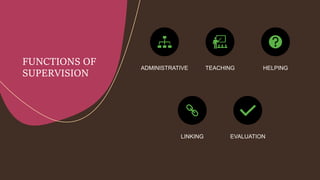
FUNCTIONS OF
SUPERVISION
ADMINISTRATIVE TEACHING HELPING
LINKING EVALUATION
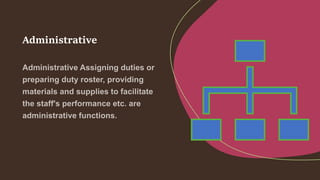
Administrative
Teaching
Helping
Linking
Evaluation
Essentials
in
supervision
Administration
Clinical competence
Democratic management
Good
supervision
means
• A supervisor can produce attitudes which are both positive and negative in
character.
• A supervisor can produce positive attitudes when are positive when an
employee is conscious of the benefits to himself which he attributes to the
influence of the supervisor.
• A supervisor can produce negative attitude when the reaction of workers is
resistance to discipline or actual fear of demotion or discharge
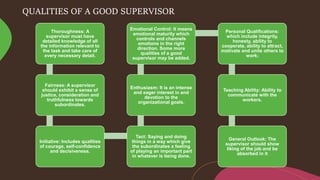
QUALITIES OF A GOOD SUPERVISOR
Thoroughness: A
supervisor must have
detailed knowledge of all
the information relevant to
the task and take care of
every necessary detail.
Fairness: A supervisor
should exhibit a sense of
justice, consideration and
truthfulness towards
subordinates.
Initiative: Includes qualities
of courage, self-confidence
and decisiveness.
Tact: Saying and doing
things in a way which give
the subordinates a feeling
of playing an important part
in whatever is being done.
Enthusiasm: It is an intense
and eager interest in and
devotion to the
organizational goals.
Emotional Control: It means
emotional maturity which
controls and channels
emotions in the right
direction. Some more
qualities of a good
supervisor may be added.
Personal Qualifications:
which include integrity,
honesty, ability to
cooperate, ability to attract,
motivate and unite others to
work;
Teaching Ability: Ability to
communicate with the
workers.
General Outlook: The
supervisor should show
liking of the job and be
absorbed in it
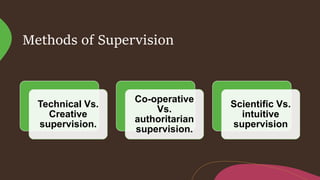
Methods of Supervision
Technical Vs.
Creative
supervision.
Co-operative
Vs.
authoritarian
supervision.
Scientific Vs.
intuitive
supervision
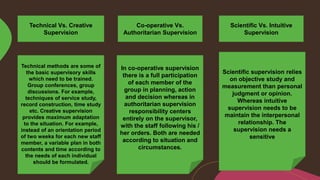
Technical Vs. Creative
Supervision
Scientific Vs. Intuitive
Supervision
Co-operative Vs.
Authoritarian Supervision
Technical methods are some of
the basic supervisory skills
which need to be trained.
Group conferences, group
discussions. For example,
techniques of service study,
record construction, time study
etc. Creative supervision
provides maximum adaptation
to the situation. For example,
instead of an orientation period
of two weeks for each new staff
member, a variable plan in both
contents and time according to
the needs of each individual
should be formulated.
In co-operative supervision
there is a full participation
of each member of the
group in planning, action
and decision whereas in
authoritarian supervision
responsibility centers
entirely on the supervisor,
with the staff following his /
her orders. Both are needed
according to situation and
circumstances.
Scientific supervision relies
on objective study and
measurement than personal
judgment or opinion.
Whereas intuitive
supervision needs to be
maintain the interpersonal
relationship. The
supervision needs a
sensitive
Types of Supervision
Direct
Observation
Indirect
Observation
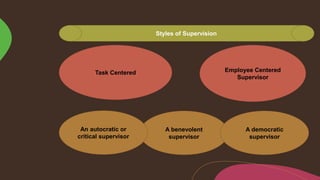
Styles of Supervision
Task Centered Employee Centered
Supervisor
A benevolent
supervisor
An autocratic or
critical supervisor
A democratic
supervisor
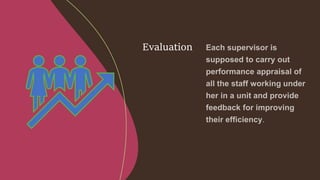
 Evaluation
Efficient assignments,
rotation and follow-up
Guidance
Orientation
SUPERVISORY
TECHNIQUES
PRINCIPLES OF
SUPERVISION
Good
supervision
is
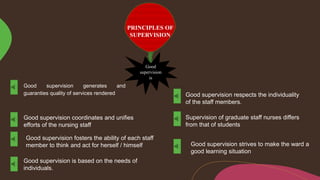
Good supervision generates and
guaranties quality of services rendered
Good supervision coordinates and unifies
efforts of the nursing staff
Good supervision fosters the ability of each staff
member to think and act for herself / himself Good supervision strives to make the ward a
good learning situation
Good supervision respects the individuality
of the staff members.
Supervision of graduate staff nurses differs
from that of students
Good supervision is based on the needs of
individuals.
PRINCIPLES OF
SUPERVISION
Good
supervision
is
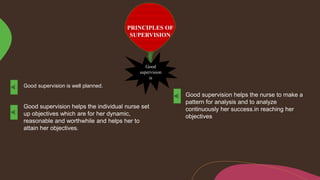
Good supervision is well planned.
Good supervision helps the individual nurse set
up objectives which are for her dynamic,
reasonable and worthwhile and helps her to
attain her objectives.
Good supervision helps the nurse to make a
pattern for analysis and to analyze
continuously her success.in reaching her
objectives
PRINCIPLES OF
SUPERVISION
Good
supervision
is
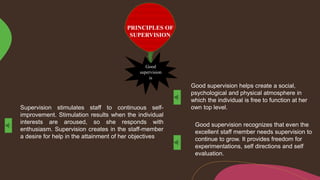
Good supervision recognizes that even the
excellent staff member needs supervision to
continue to grow. It provides freedom for
experimentations, self directions and self
evaluation.
Good supervision helps create a social,
psychological and physical atmosphere in
which the individual is free to function at her
own top level.
Supervision stimulates staff to continuous self-
improvement. Stimulation results when the individual

interests are aroused, so she responds with
enthusiasm. Supervision creates in the staff-member
a desire for help in the attainment of her objectives
BY
JINCE THOMAS
PROFESSOR
SJB COLLEGE OF
NURSING
BANGALORE-60
THANK YOU

Super vision

  • 1.
  • 2.
  • 3.
    The word meaningof "Supervision" is Overseeing. The word "super" means above and "vision" means seeing. It means personally observing a function or activity, providing leadership in the process of nursing care, delegating functions or activities while retaining the accountability, evaluating and ensuring that the nursing care provided is adequate and delivered appropriately Meaning
  • 4.
  • 5.
  • 6.
    Objectives of Supervision Other purposeof supervision is to help the personnel to grow, know themselves, to render the most efficient service and to give them assistance in acquiring knowledge and techniques necessary for self-development. The main aim of supervision Is to see that a particular work or task is being done in the expected manner.
  • 7.
    Specific objectives inNursing supervision. To persist in the delivery of high quality of health care services, To assist and to help in the development of the staff to their highest potential. To interpret policies, objectives, needs etc of the organization and to suggest ways and means to improve them. To plan services cooperatively and to develop coordination to avoid overlapping. To develop standards of service and methods of evaluation of personnel and services. To assist in problem solving of the matters concerning personnel, administrative and operation of services. To evaluate the services given, personnel performance, progress made etc. and to suggest changes for improving the work effectively and out come of personnel.
  • 8.
  • 9.
  • 10.
  • 11.
  • 12.
  • 13.
  • 14.
  • 15.
    Good supervision means • A supervisorcan produce attitudes which are both positive and negative in character. • A supervisor can produce positive attitudes when are positive when an employee is conscious of the benefits to himself which he attributes to the influence of the supervisor. • A supervisor can produce negative attitude when the reaction of workers is resistance to discipline or actual fear of demotion or discharge
  • 16.
    QUALITIES OF AGOOD SUPERVISOR Thoroughness: A supervisor must have detailed knowledge of all the information relevant to the task and take care of every necessary detail. Fairness: A supervisor should exhibit a sense of justice, consideration and truthfulness towards subordinates. Initiative: Includes qualities of courage, self-confidence and decisiveness. Tact: Saying and doing things in a way which give the subordinates a feeling of playing an important part in whatever is being done. Enthusiasm: It is an intense and eager interest in and devotion to the organizational goals. Emotional Control: It means emotional maturity which controls and channels emotions in the right direction. Some more qualities of a good supervisor may be added. Personal Qualifications: which include integrity, honesty, ability to cooperate, ability to attract, motivate and unite others to work; Teaching Ability: Ability to communicate with the workers. General Outlook: The supervisor should show liking of the job and be absorbed in it
  • 17.
    Methods of Supervision TechnicalVs. Creative supervision. Co-operative Vs. authoritarian supervision. Scientific Vs. intuitive supervision
  • 18.
    Technical Vs. Creative Supervision ScientificVs. Intuitive Supervision Co-operative Vs. Authoritarian Supervision Technical methods are some of the basic supervisory skills which need to be trained. Group conferences, group discussions. For example, techniques of service study, record construction, time study etc. Creative supervision provides maximum adaptation to the situation. For example, instead of an orientation period of two weeks for each new staff member, a variable plan in both contents and time according to the needs of each individual should be formulated. In co-operative supervision there is a full participation of each member of the group in planning, action and decision whereas in authoritarian supervision responsibility centers entirely on the supervisor, with the staff following his / her orders. Both are needed according to situation and circumstances. Scientific supervision relies on objective study and measurement than personal judgment or opinion. Whereas intuitive supervision needs to be maintain the interpersonal relationship. The supervision needs a sensitive
  • 19.
  • 20.
    Styles of Supervision TaskCentered Employee Centered Supervisor A benevolent supervisor An autocratic or critical supervisor A democratic supervisor
  • 21.
     Evaluation Efficient assignments, rotationand follow-up Guidance Orientation SUPERVISORY TECHNIQUES
  • 23.
    PRINCIPLES OF SUPERVISION Good supervision is Good supervisiongenerates and guaranties quality of services rendered Good supervision coordinates and unifies efforts of the nursing staff Good supervision fosters the ability of each staff member to think and act for herself / himself Good supervision strives to make the ward a good learning situation Good supervision respects the individuality of the staff members. Supervision of graduate staff nurses differs from that of students Good supervision is based on the needs of individuals.
  • 24.
    PRINCIPLES OF SUPERVISION Good supervision is Good supervisionis well planned. Good supervision helps the individual nurse set up objectives which are for her dynamic, reasonable and worthwhile and helps her to attain her objectives. Good supervision helps the nurse to make a pattern for analysis and to analyze continuously her success.in reaching her objectives
  • 25.
    PRINCIPLES OF SUPERVISION Good supervision is Good supervisionrecognizes that even the excellent staff member needs supervision to continue to grow. It provides freedom for experimentations, self directions and self evaluation. Good supervision helps create a social, psychological and physical atmosphere in which the individual is free to function at her own top level. Supervision stimulates staff to continuous self- improvement. Stimulation results when the individual interests are aroused, so she responds with enthusiasm. Supervision creates in the staff-member a desire for help in the attainment of her objectives
  • 26.
  • 27.