Menuntut ilmu adalah TAQWA
    Menyampaikan ilmu adalah IBADAH
    Mengulang-ulang ilmu adalah ZIKIR
       Mencari ilmu adalah JIHAD


Chapter 1 : Techniques of DC Circuit
                           Analysis
     Engr. Mohd Riduwan bin Ghazali (Grad. IEM)
1.1 Review Circuit Analysis I:
 Most Important thing that should remember:
  Ohm Laws,V = IR
  (Kirchoff’s) KCL/KVL
  Independent/Dependent Source
  Nodal/SuperNode
  Mesh/SuperMesh
  Source Transformation
OHM’S LAW
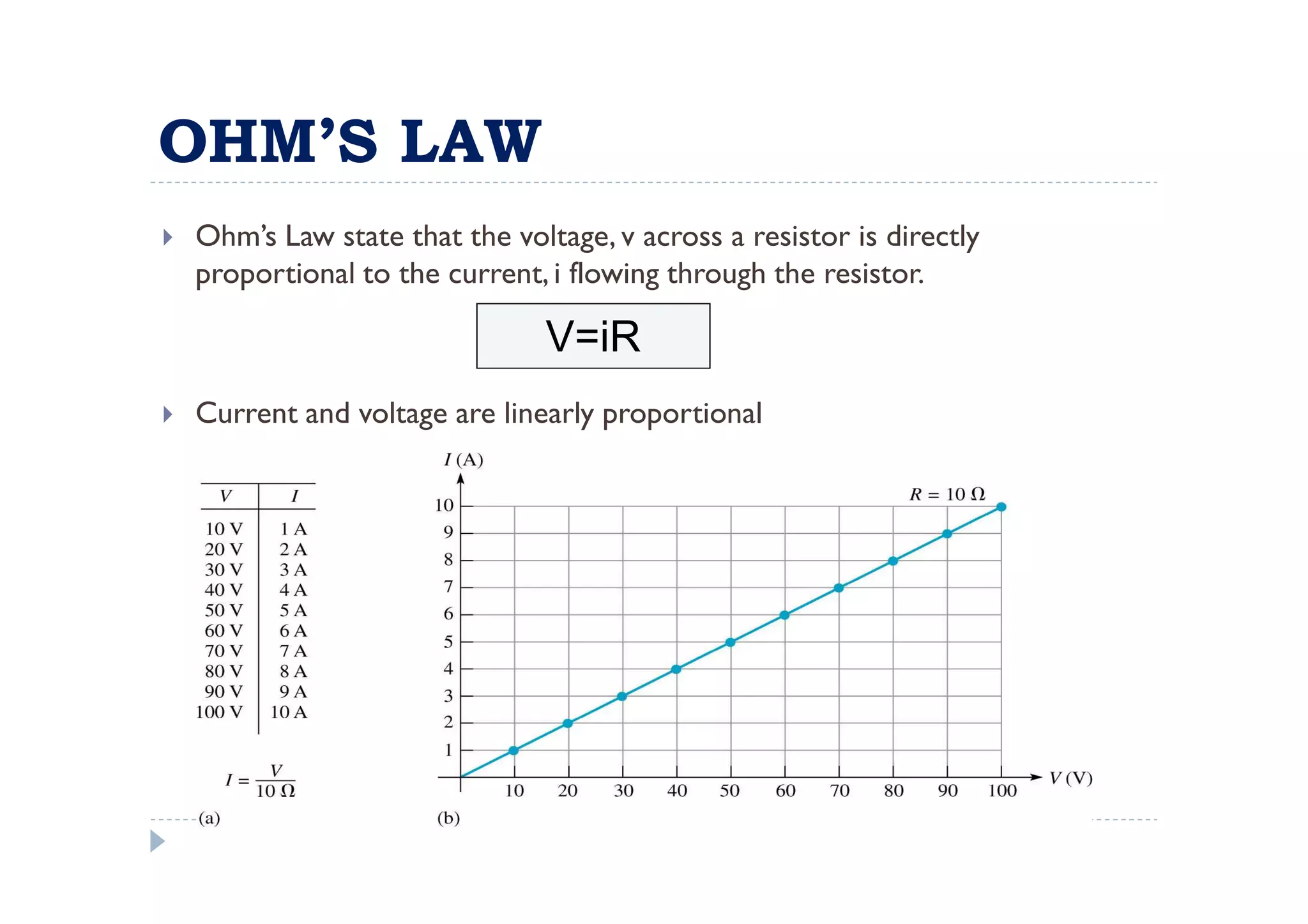
Ohm’s Law state that the voltage, v across a resistor is directly
proportional to the current, i flowing through the resistor.

                             V=iR
Current and voltage are linearly proportional
KIRCHHOFF’S LAW

 Kirchhoff current law (KCL)

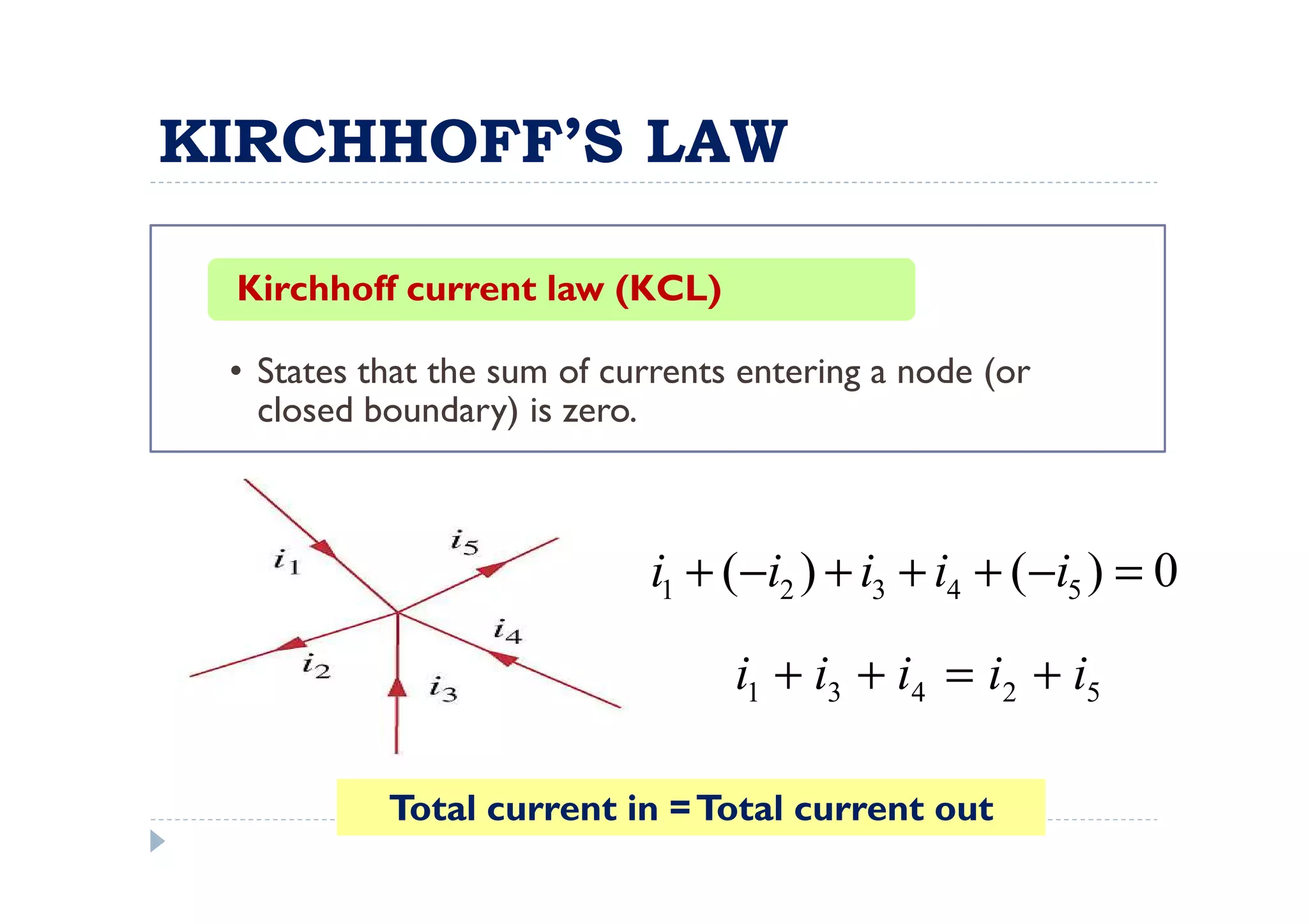
 • States that the sum of currents entering a node (or
   closed boundary) is zero.


                            i1 + (−i2 ) + i3 + i4 + ( −i5 ) = 0

                                  i1 + i3 + i4 = i2 + i5

           Total current in = Total current out
KIRCHHOFF’S LAW
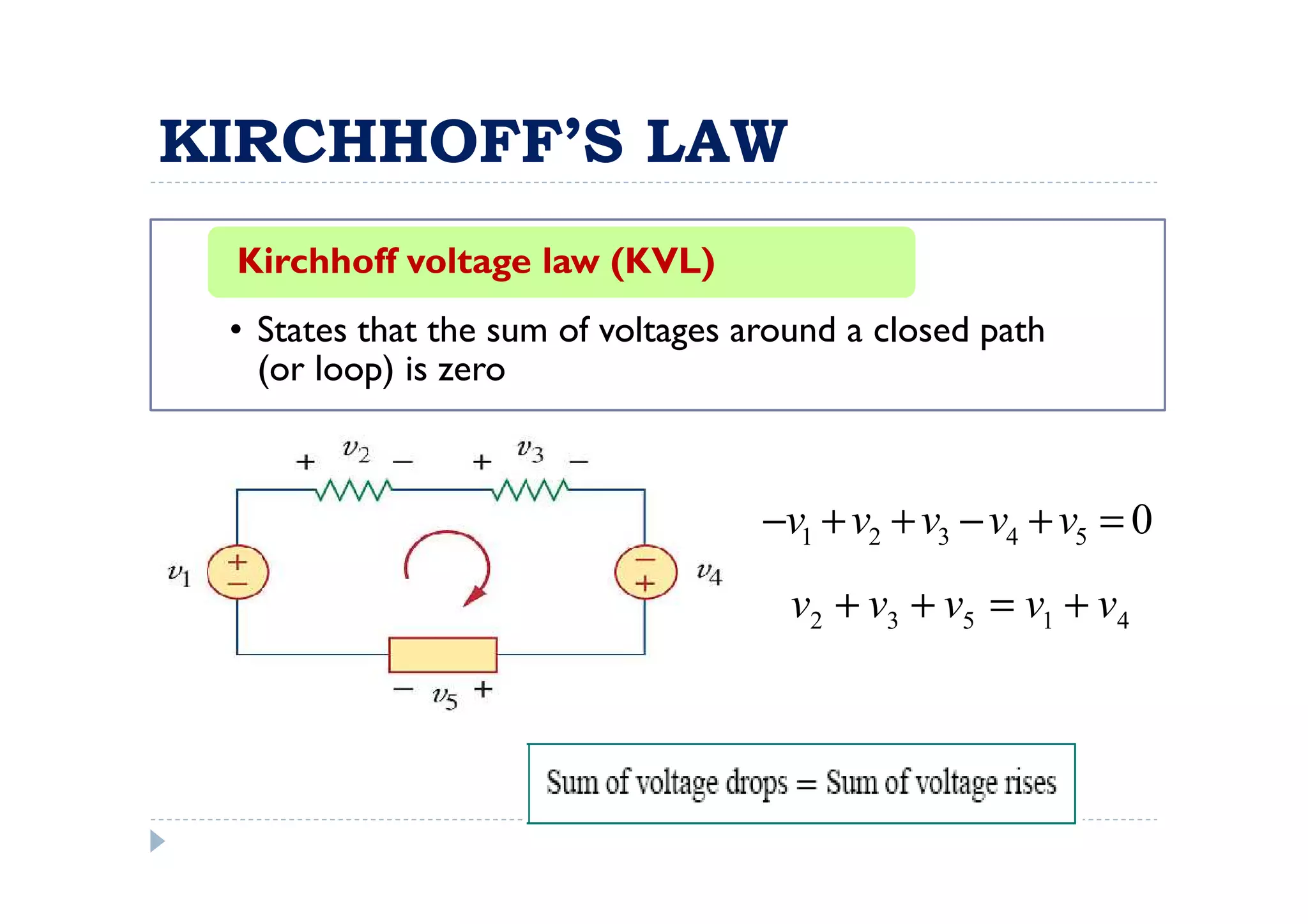
 Kirchhoff voltage law (KVL)
 • States that the sum of voltages around a closed path
   (or loop) is zero


                                    −v1 + v2 + v3 − v4 + v5 = 0
                                      v2 + v3 + v5 = v1 + v4
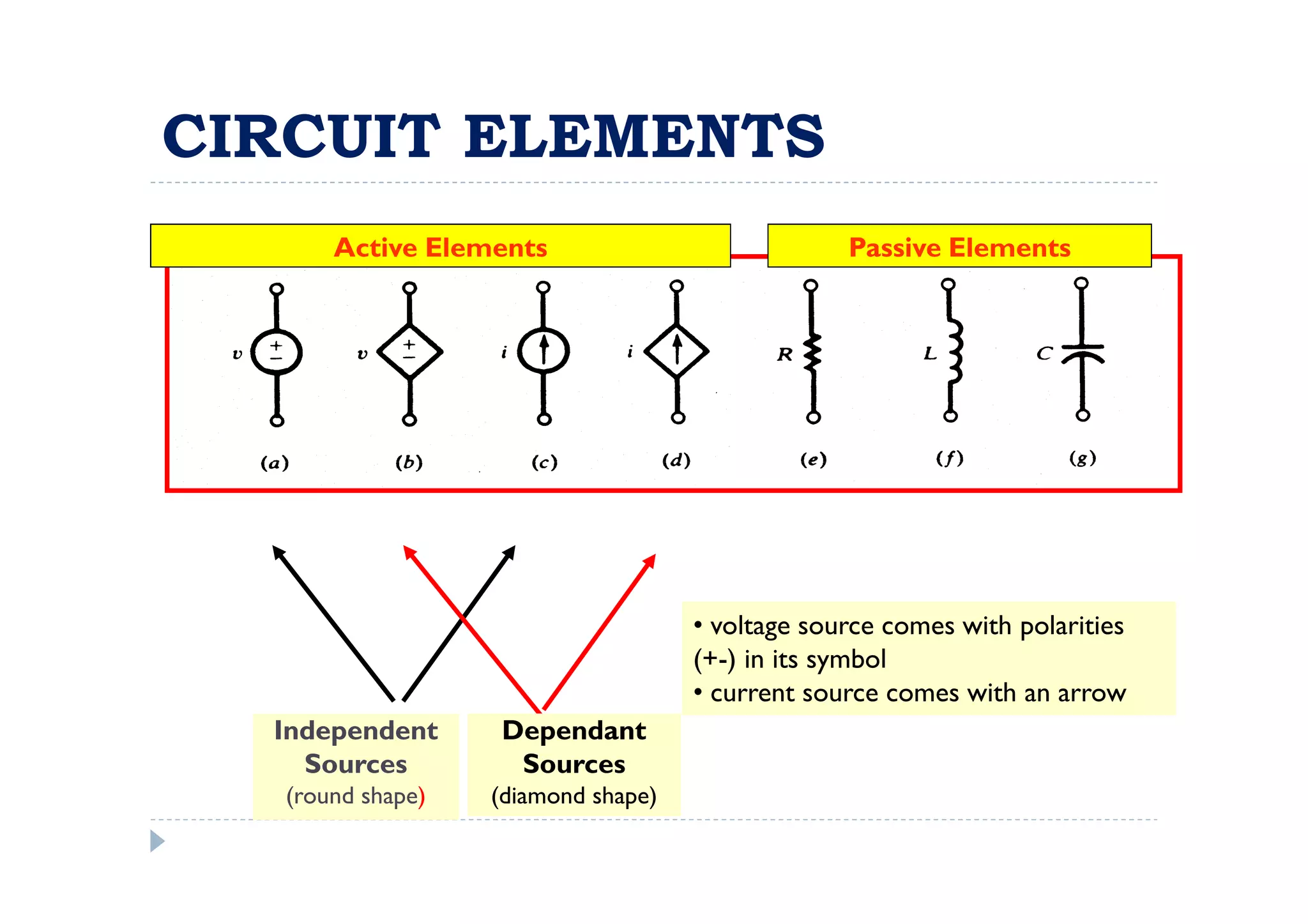
CIRCUIT ELEMENTS
      Active Elements                            Passive Elements


                                    • voltage source comes with polarities
                                    (+-) in its symbol
                                    • current source comes with an arrow
  Independent     Dependant
    Sources        Sources
  (round shape)   (diamond shape)
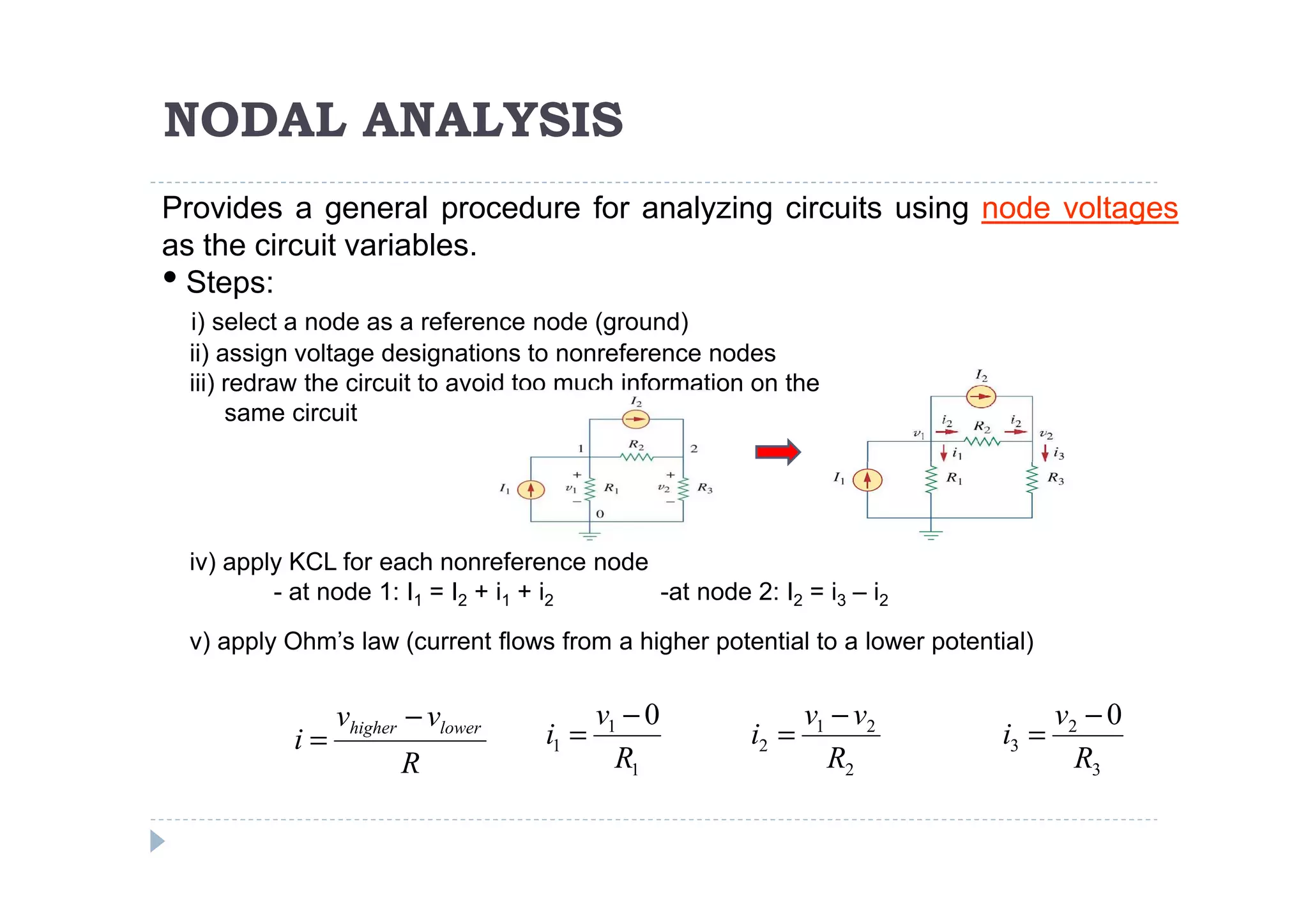
NODAL ANALYSIS
Provides a general procedure for analyzing circuits using node voltages
as the circuit variables.
• Steps:
 i) select a node as a reference node (ground)
 ii) assign voltage designations to nonreference nodes
 iii) redraw the circuit to avoid too much information on the
      same circuit


 iv) apply KCL for each nonreference node
         - at node 1: I1 = I2 + i1 + i2   -at node 2: I2 = i3 – i2
 v) apply Ohm’s law (current flows from a higher potential to a lower potential)


               vhigher − vlower          v1 − 0              v1 − v2                v2 − 0
          i=                      i1 =                i2 =                   i3 =
                      R                    R1                  R2                     R3
Nodal Analysis With Voltage Sources
We now consider how voltage sources affect nodal analysis:

CASE 1: If a voltage source is connected between the reference node, we
simply set the voltage at the nonreference node equal to the voltage of the
voltage source
                            E.g.: v1 = 10V

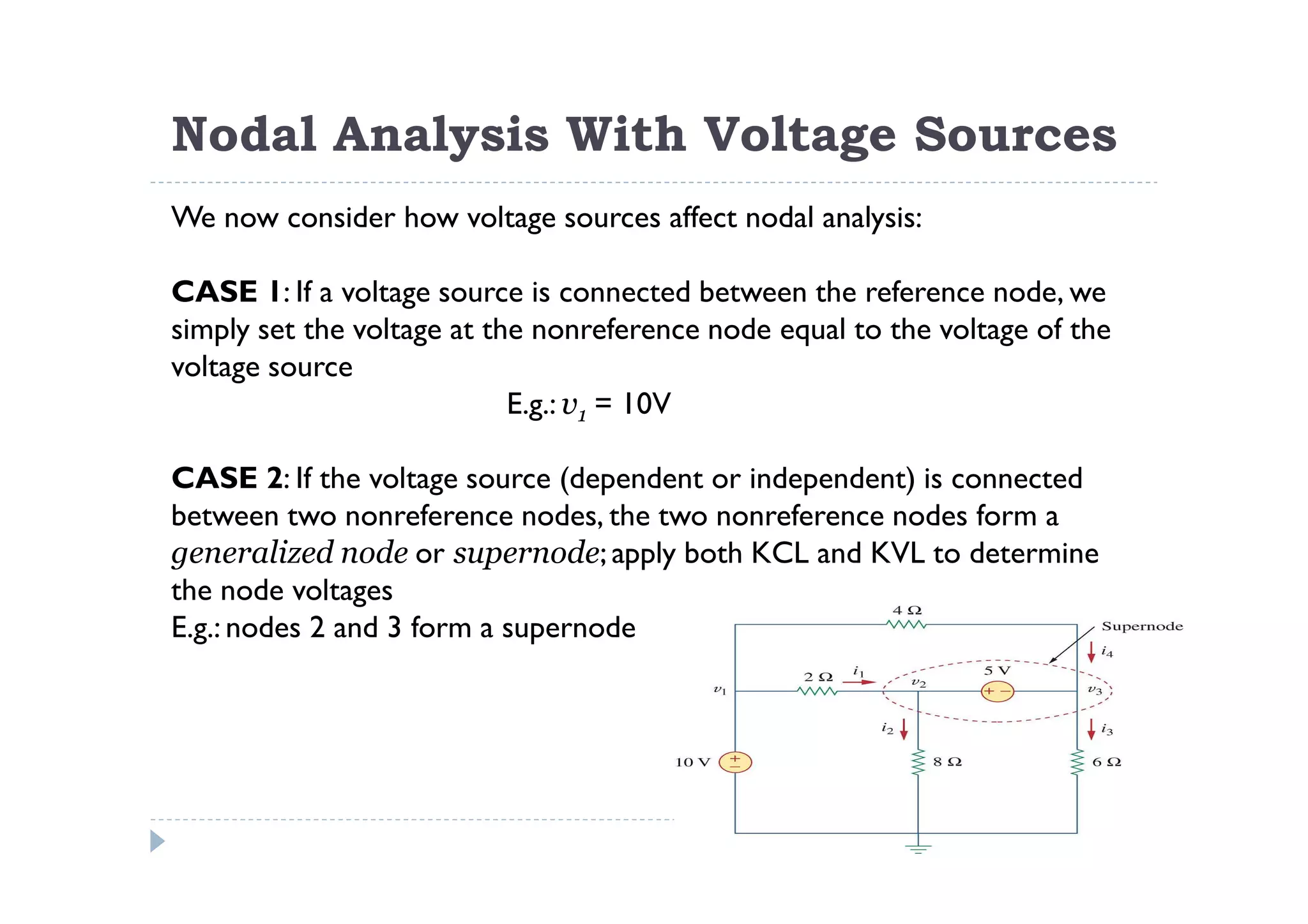
CASE 2: If the voltage source (dependent or independent) is connected
between two nonreference nodes, the two nonreference nodes form a
generalized node or supernode; apply both KCL and KVL to determine
the node voltages
E.g.: nodes 2 and 3 form a supernode
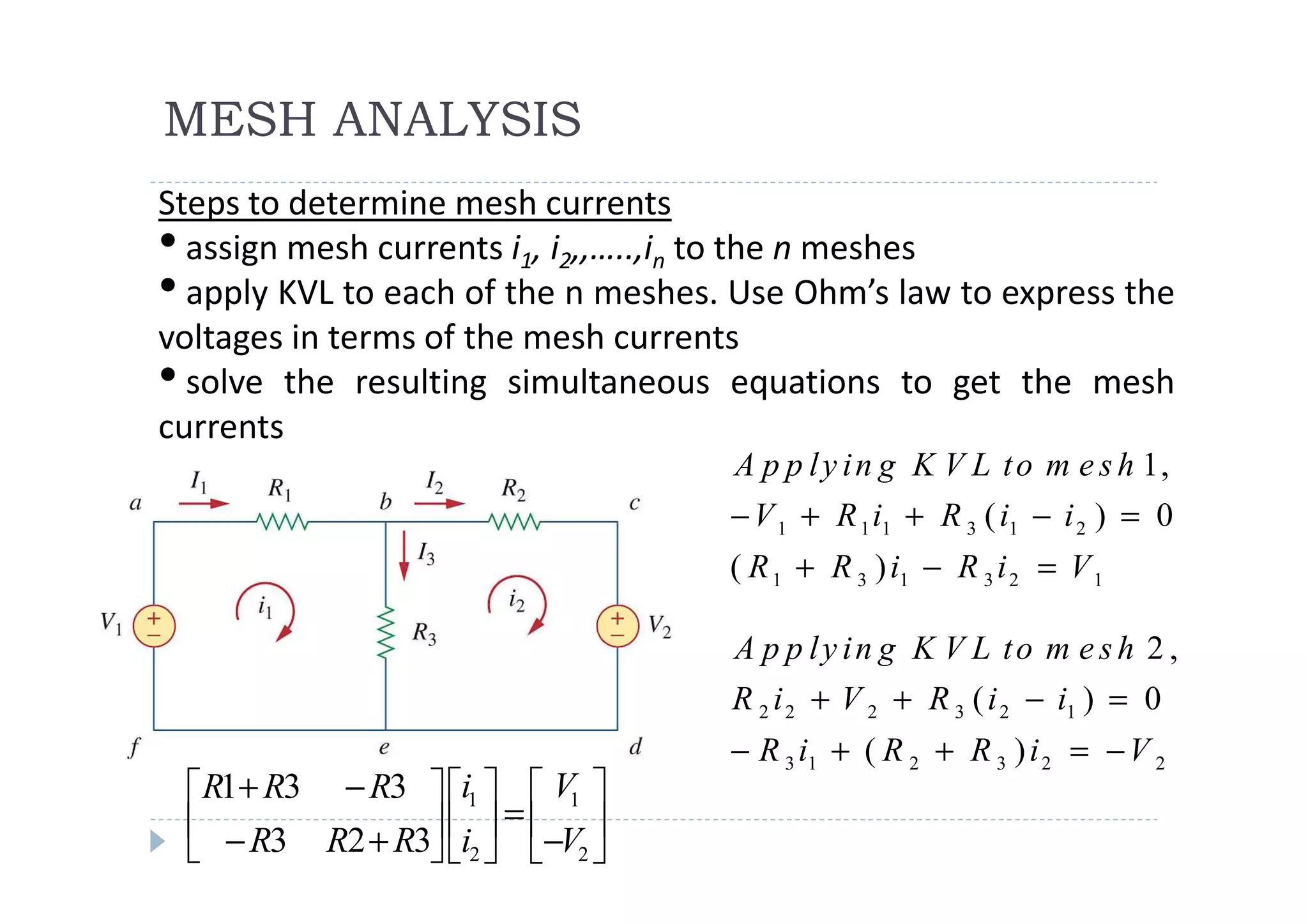
MESH ANALYSIS
Steps to determine mesh currents
• assign mesh currents i1, i2,,…..,in to the n meshes
• apply KVL to each of the n meshes. Use Ohm’s law to express the
voltages in terms of the mesh currents
• solve the resulting simultaneous equations to get the mesh
currents
                                    A p p l y i n g K V L t o m e s h 1,
                                    − V 1 + R 1 i1 + R 3 ( i1 − i 2 ) = 0
                                    ( R 1 + R 3 ) i1 − R 3 i 2 = V 1

                                    A p p ly in g K V L to m e s h 2 ,
                                    R 2 i 2 + V 2 + R 3 ( i 2 − i1 ) = 0
                                    − R 3 i1 + ( R 2 + R 3 ) i 2 = − V 2
 R1+ R3 − R3  i1   V1 
  − R3 R2 + R3 i  = −V 
               2  2
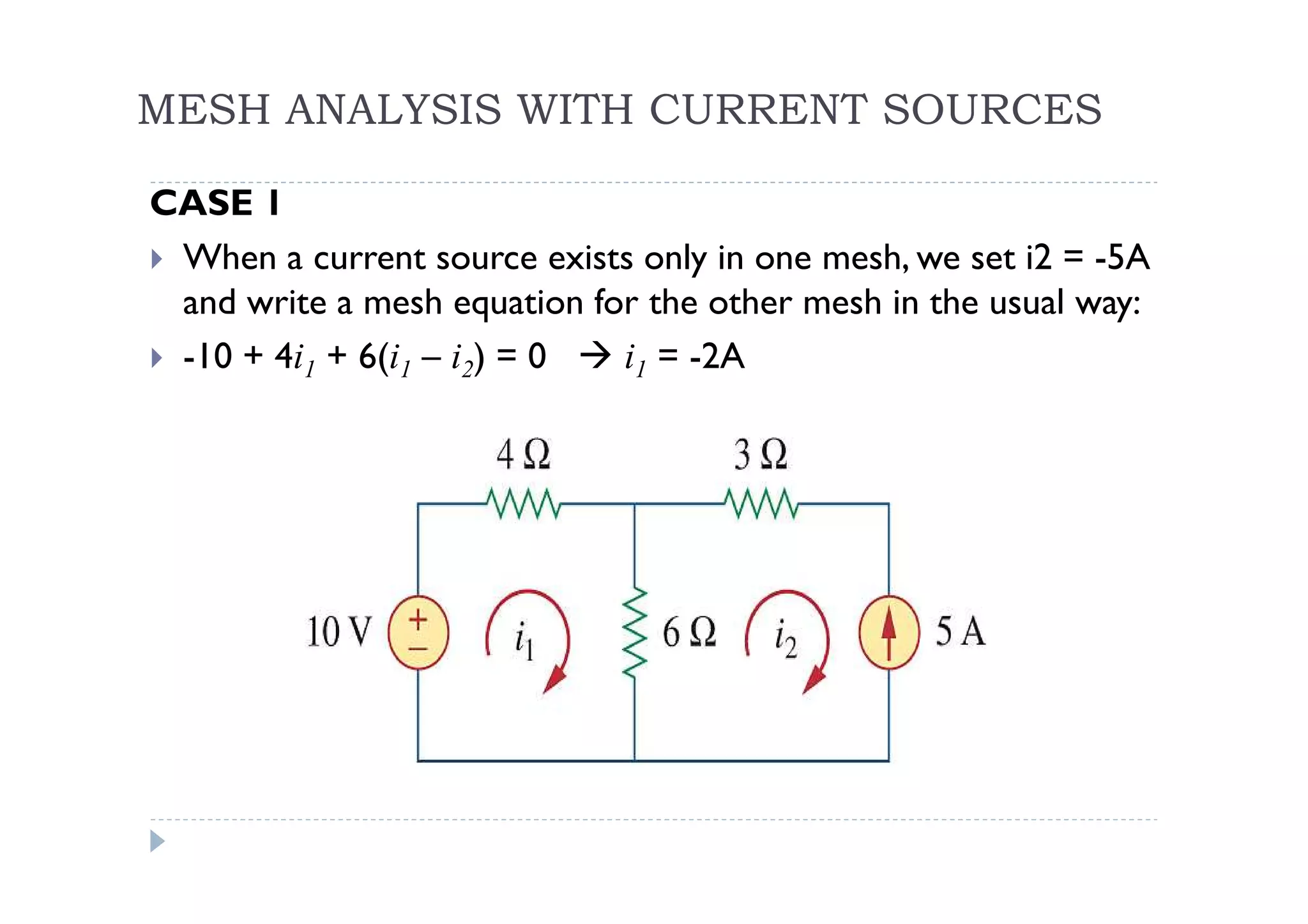
MESH ANALYSIS WITH CURRENT SOURCES

CASE 1
 When a current source exists only in one mesh, we set i2 = -5A
 and write a mesh equation for the other mesh in the usual way:
 -10 + 4i1 + 6(i1 – i2) = 0  i1 = -2A
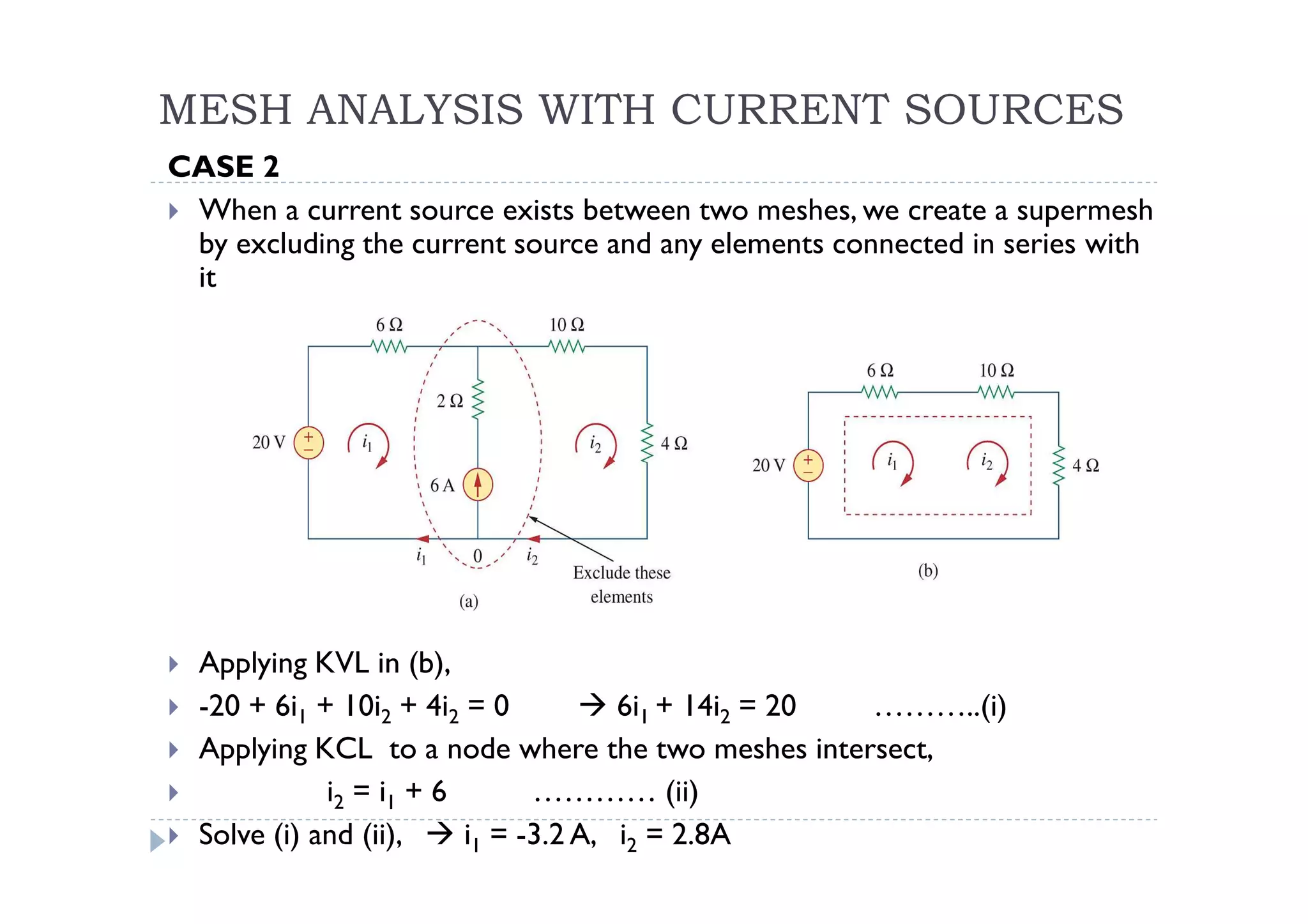
MESH ANALYSIS WITH CURRENT SOURCES
CASE 2
 When a current source exists between two meshes, we create a supermesh
 by excluding the current source and any elements connected in series with
 it


  Applying KVL in (b),
  -20 + 6i1 + 10i2 + 4i2 = 0          6i1 + 14i2 = 20 ………..(i)
  Applying KCL to a node where the two meshes intersect,
             i2 = i1 + 6       ………… (ii)
  Solve (i) and (ii),    i1 = -3.2 A, i2 = 2.8A
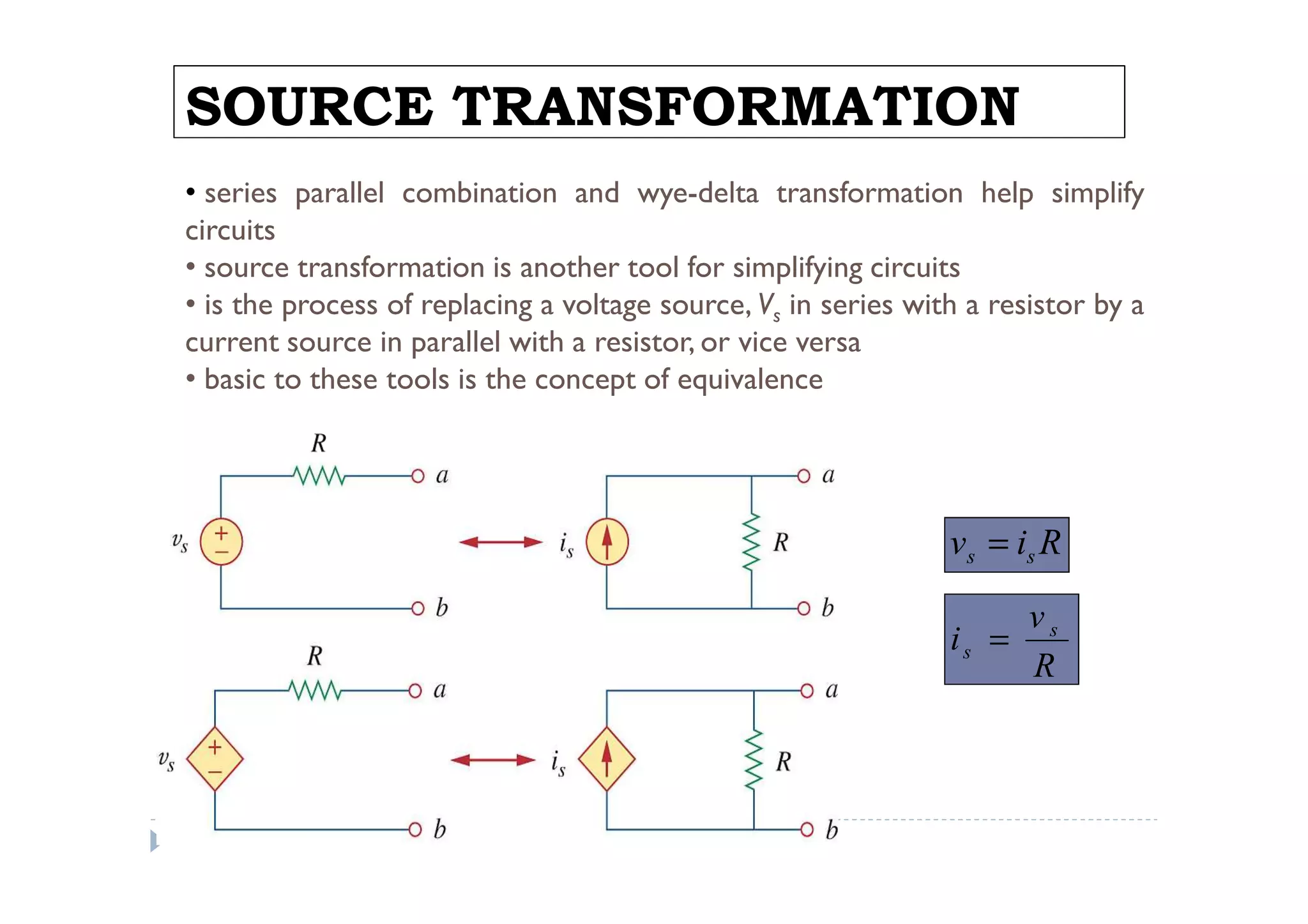
SOURCE TRANSFORMATION
• series parallel combination and wye-delta transformation help simplify
circuits
• source transformation is another tool for simplifying circuits
• is the process of replacing a voltage source, Vs in series with a resistor by a
current source in parallel with a resistor, or vice versa
• basic to these tools is the concept of equivalence


                                                                v s = is R

                                                                     vs
                                                                is =
                                                                     R
Superposition theorem

 For circuit network have more than one independent
 source
 voltage or current produced by a source acting in
 isolation can be determined by assuming other
 sources do not work, where the resources should
 be switched off in the following manner: -
  Independent voltage source – short circuit (0 V) or internal
  resistance if have
  Independent current source – open circuit (0 A)
Superposition theorem cont.
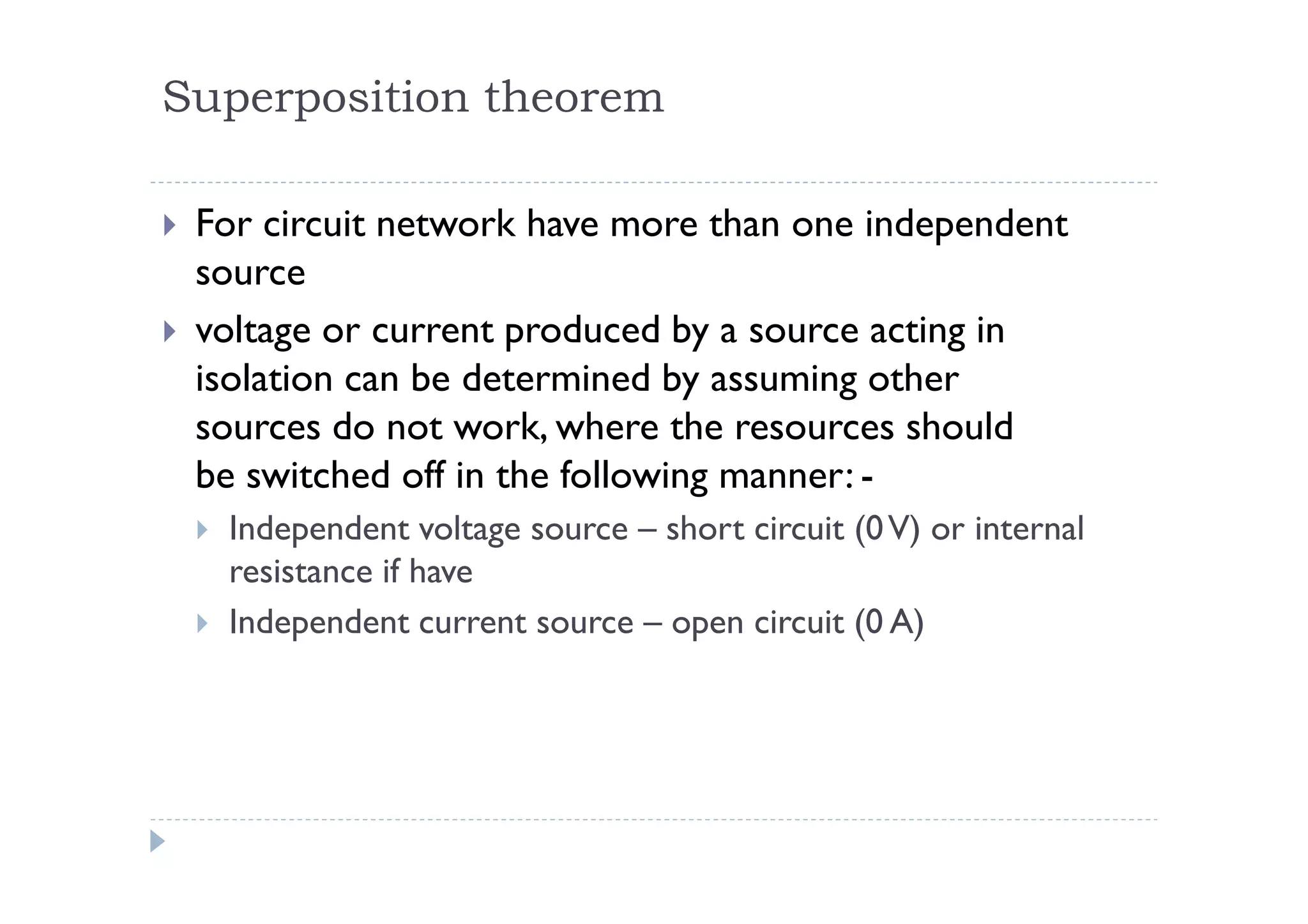
     Example for superposition theorem.


                                                      IB
Solution.
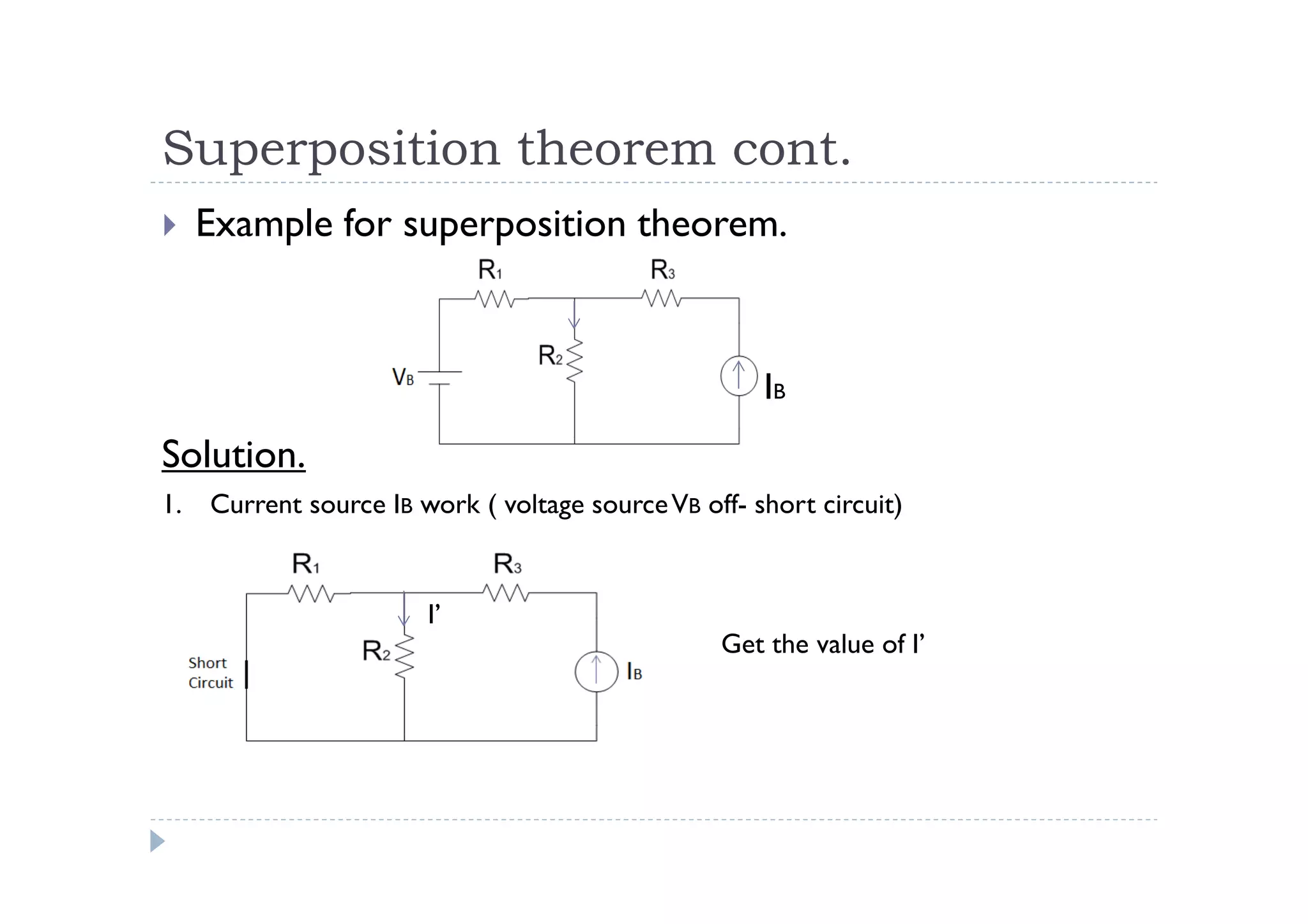
1.   Current source IB work ( voltage source VB off- short circuit)


                        I’
                                                  Get the value of I’
Superposition theorem cont.
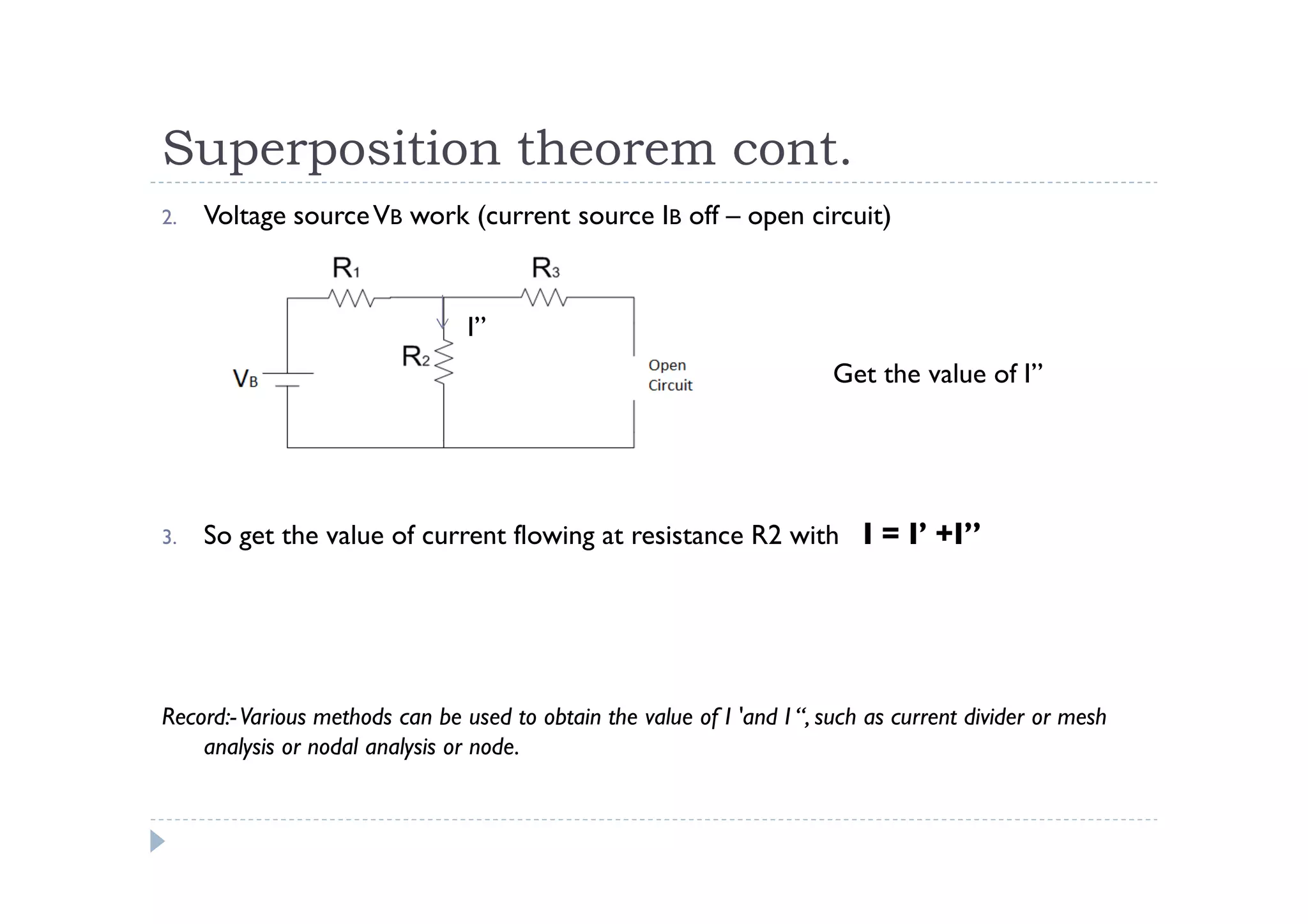
2.   Voltage source VB work (current source IB off – open circuit)


                                 I”
                                                                         Get the value of I”


3.   So get the value of current flowing at resistance R2 with I = I’ +I”


Record:- Various methods can be used to obtain the value of I 'and I “, such as current divider or mesh
    analysis or nodal analysis or node.
Superposition theorem cont.
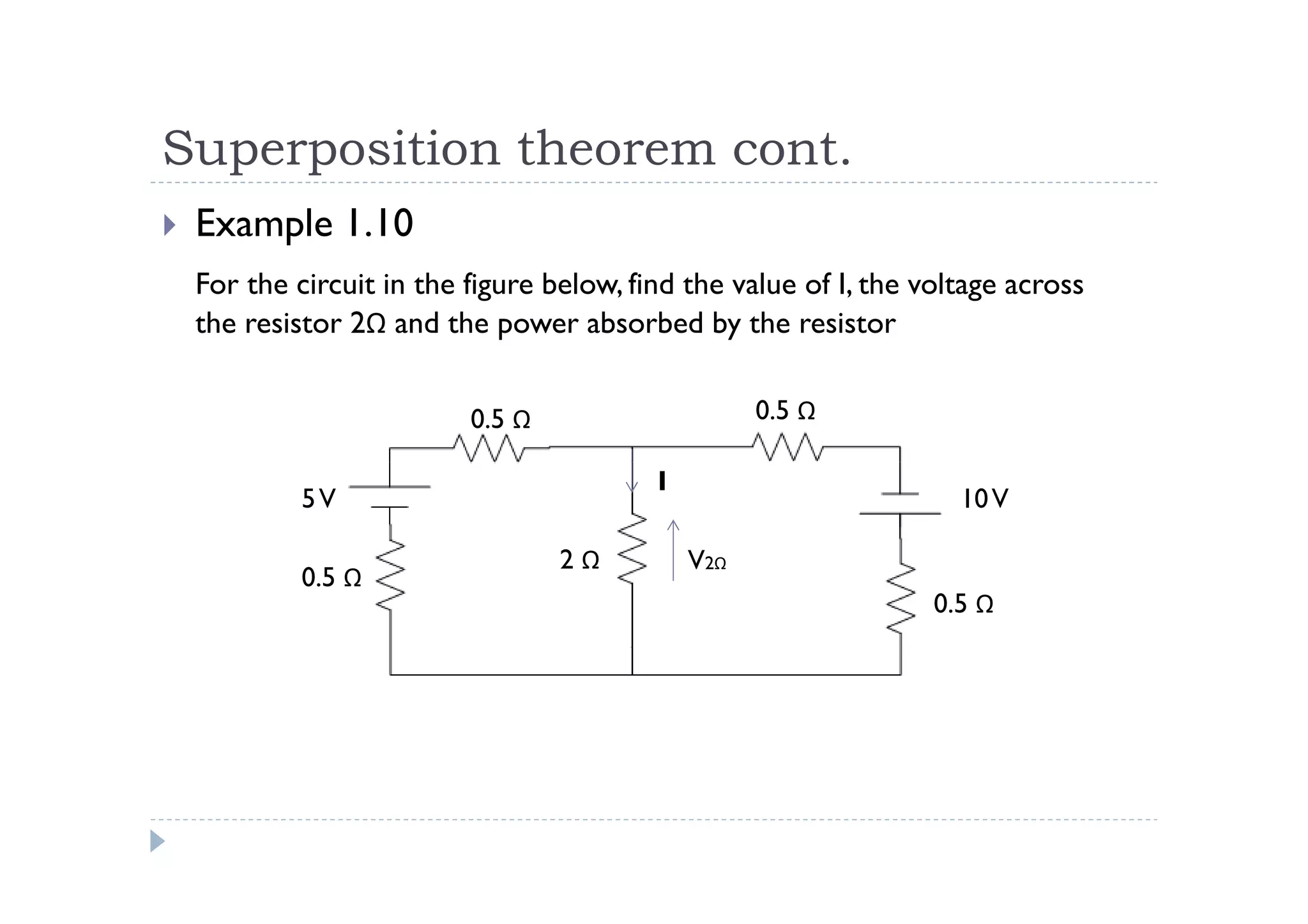
 Example 1.10
 For the circuit in the figure below, find the value of I, the voltage across
 the resistor 2Ω and the power absorbed by the resistor


                        0.5 Ω                     0.5 Ω

                                        I
          5V                                                      10 V

                                2Ω          V2Ω
          0.5 Ω
                                                                0.5 Ω
Superposition theorem cont.
Solution

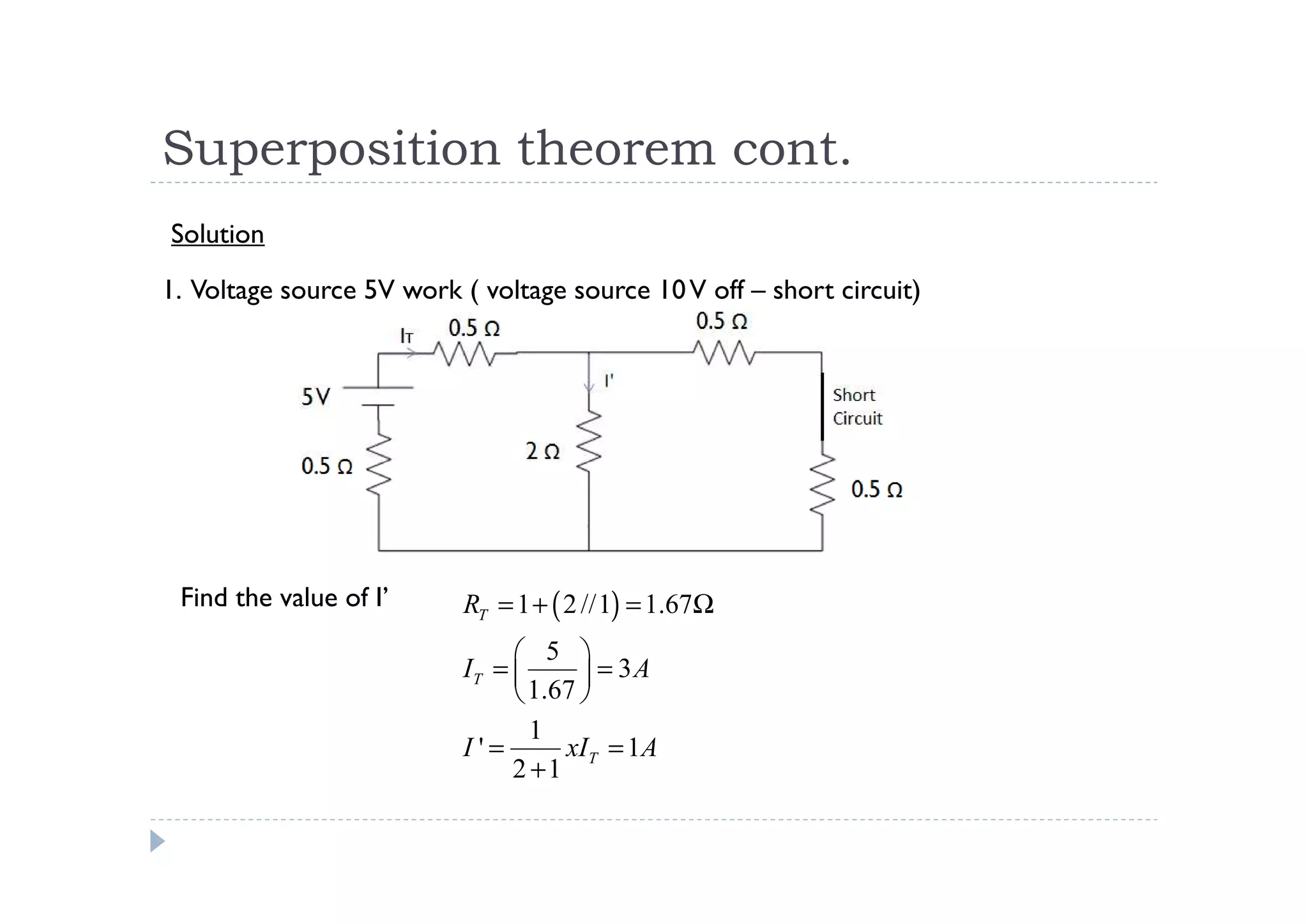
1. Voltage source 5V work ( voltage source 10 V off – short circuit)


 Find the value of I’     RT = 1 + ( 2 //1) = 1.67Ω
                                5 
                          IT =        = 3A
                                1.67 
                                 1
                          I'=       xIT = 1A
                               2 +1
Superposition theorem cont.
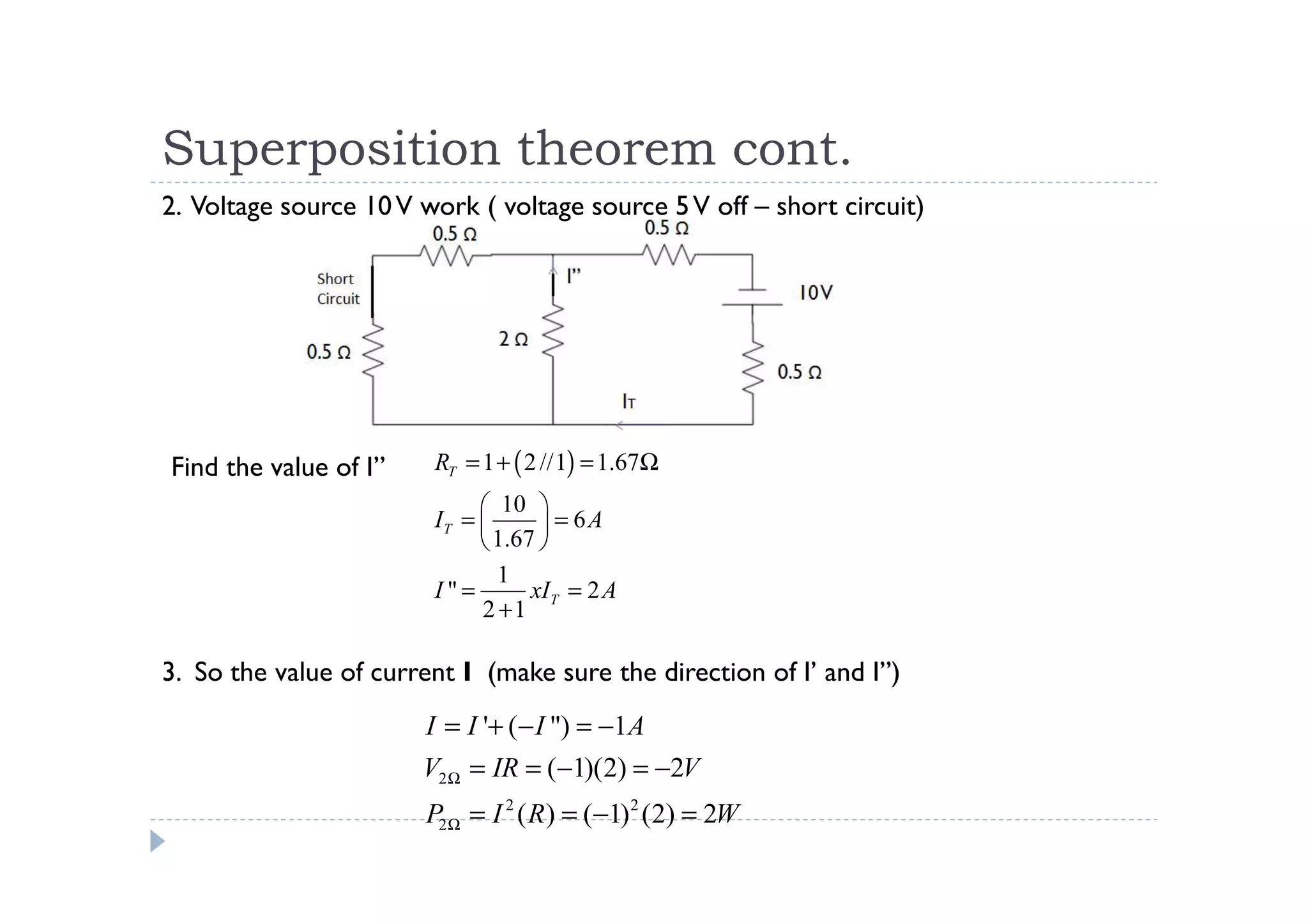
2. Voltage source 10 V work ( voltage source 5 V off – short circuit)


Find the value of I”    RT = 1 + ( 2 //1) = 1.67Ω
                              10 
                        IT =        = 6A
                              1.67 
                               1
                        I"=        xIT = 2 A
                             2 +1

3. So the value of current I (make sure the direction of I’ and I”)
                       I = I '+ (− I ") = −1A
                       V2 Ω = IR = (−1)(2) = −2V
                       P2 Ω = I 2 ( R) = (−1) 2 (2) = 2W
Superposition theorem cont.
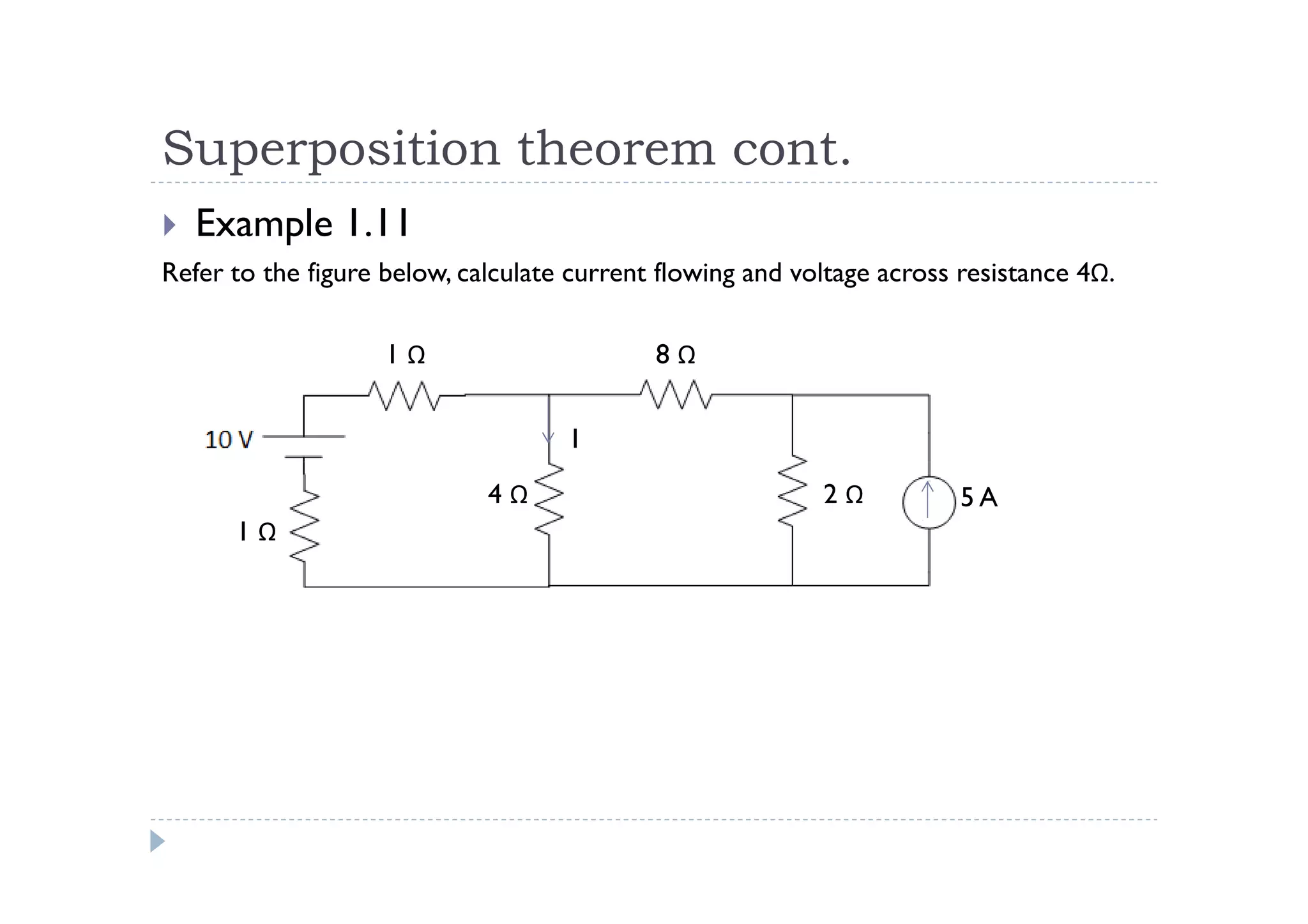
   Example 1.11
Refer to the figure below, calculate current flowing and voltage across resistance 4Ω.

                    1Ω                      8Ω


                                    I
                             4Ω                            2Ω           5A
      1Ω
Superposition theorem cont.
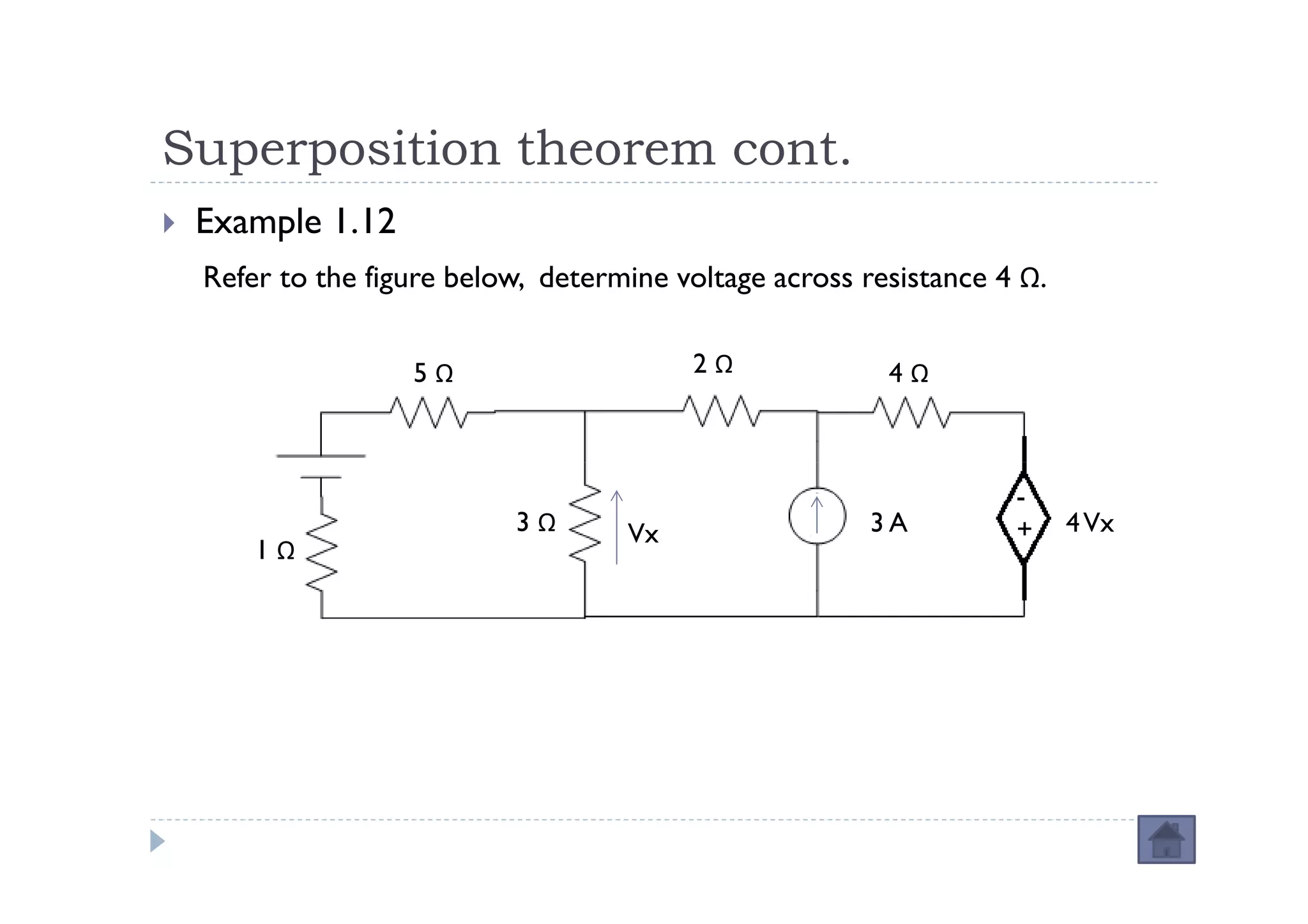
 Example 1.12
 Refer to the figure below, determine voltage across resistance 4 Ω.


                 5Ω                    2Ω              4Ω


                                                                 -
                         3Ω       Vx                 3A          +     4 Vx
     1Ω
Thevenin theorem


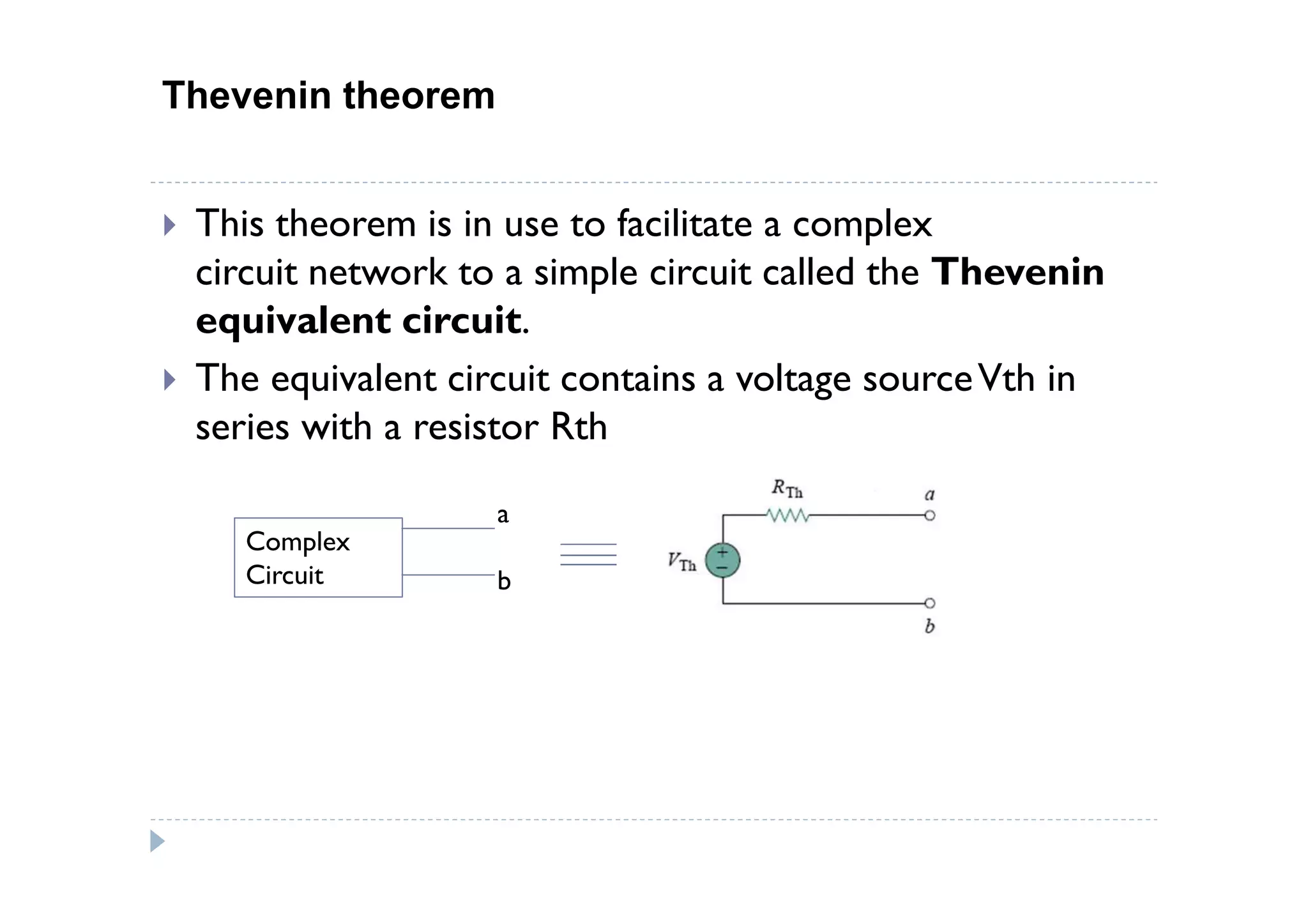
 This theorem is in use to facilitate a complex
 circuit network to a simple circuit called the Thevenin
 equivalent circuit.
 The equivalent circuit contains a voltage source Vth in
 series with a resistor Rth

                   a
    Complex
    Circuit        b
Thevenin theorem cont.
                  I=0 A
                          a                            a
      Complex                        OFF
                           VTH                             RTH
      Circuit             b          Circuit           b

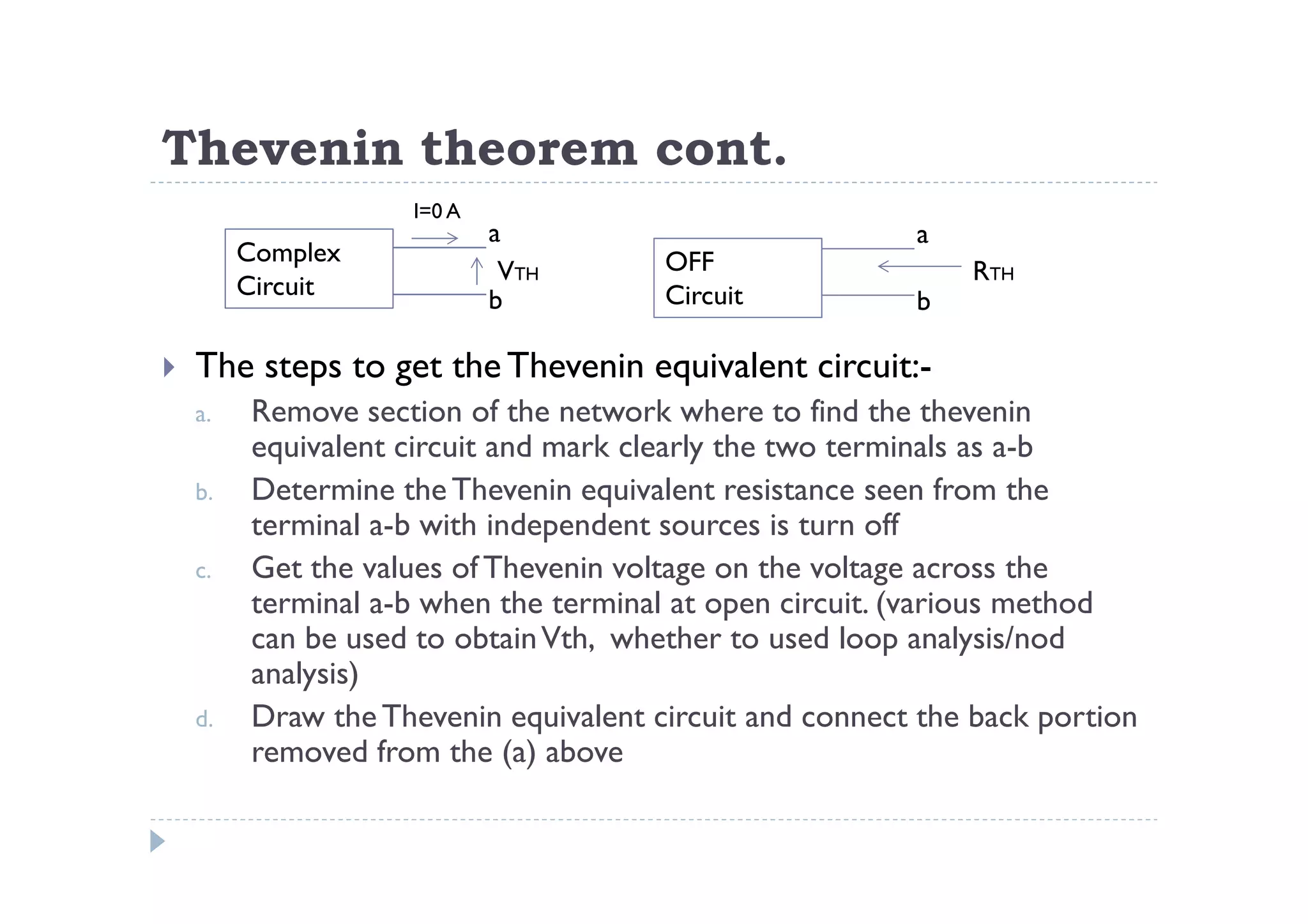
 The steps to get the Thevenin equivalent circuit:-
 a.    Remove section of the network where to find the thevenin
       equivalent circuit and mark clearly the two terminals as a-b
 b.    Determine the Thevenin equivalent resistance seen from the
       terminal a-b with independent sources is turn off
 c.    Get the values of Thevenin voltage on the voltage across the
       terminal a-b when the terminal at open circuit. (various method
       can be used to obtain Vth, whether to used loop analysis/nod
       analysis)
 d.    Draw the Thevenin equivalent circuit and connect the back portion
       removed from the (a) above
Thevenin theorem cont.
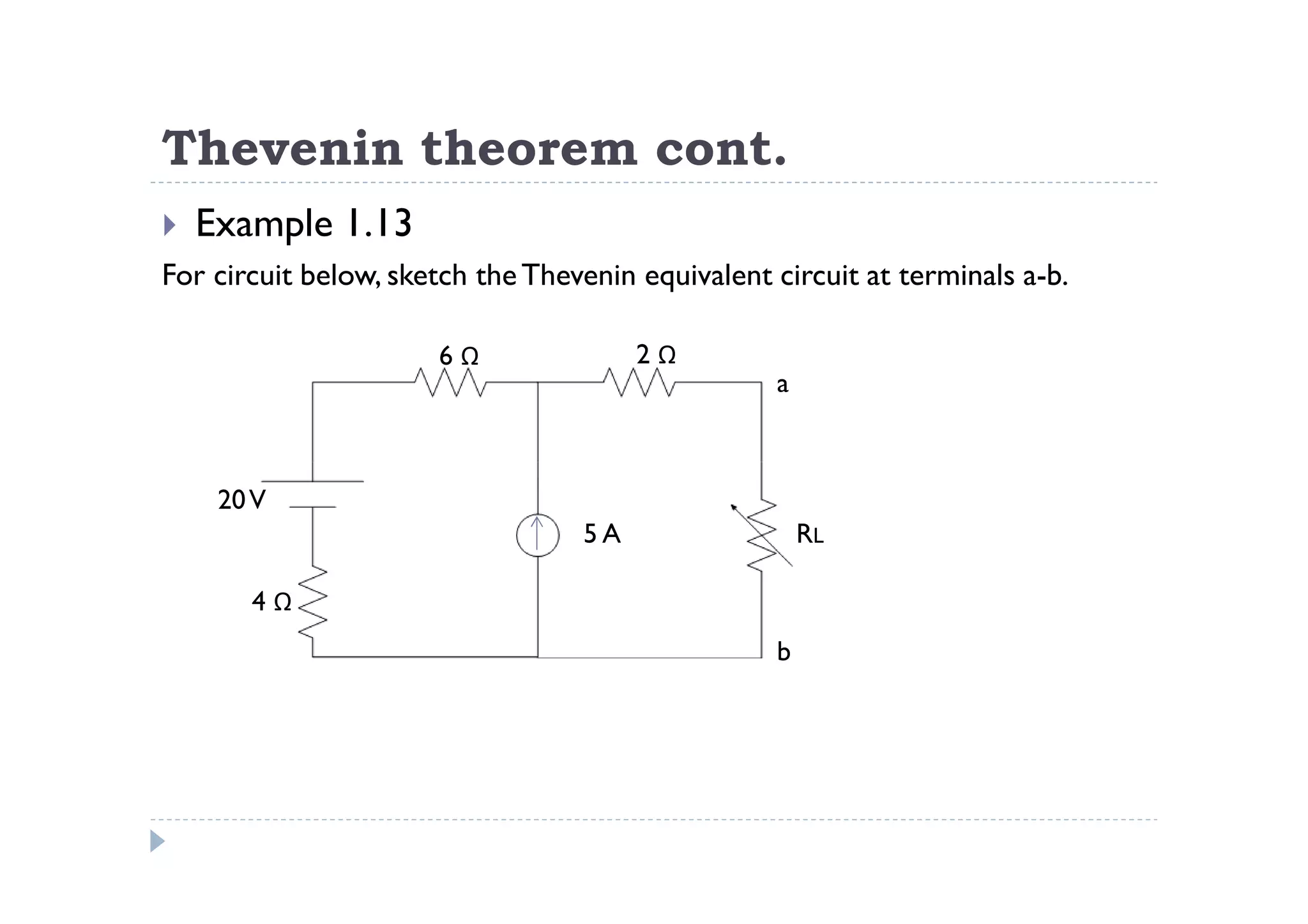
  Example 1.13
For circuit below, sketch the Thevenin equivalent circuit at terminals a-b.

                      6Ω               2Ω
                                                  a


    20 V
                                  5A                  RL

       4Ω
                                                  b
Thevenin theorem cont.
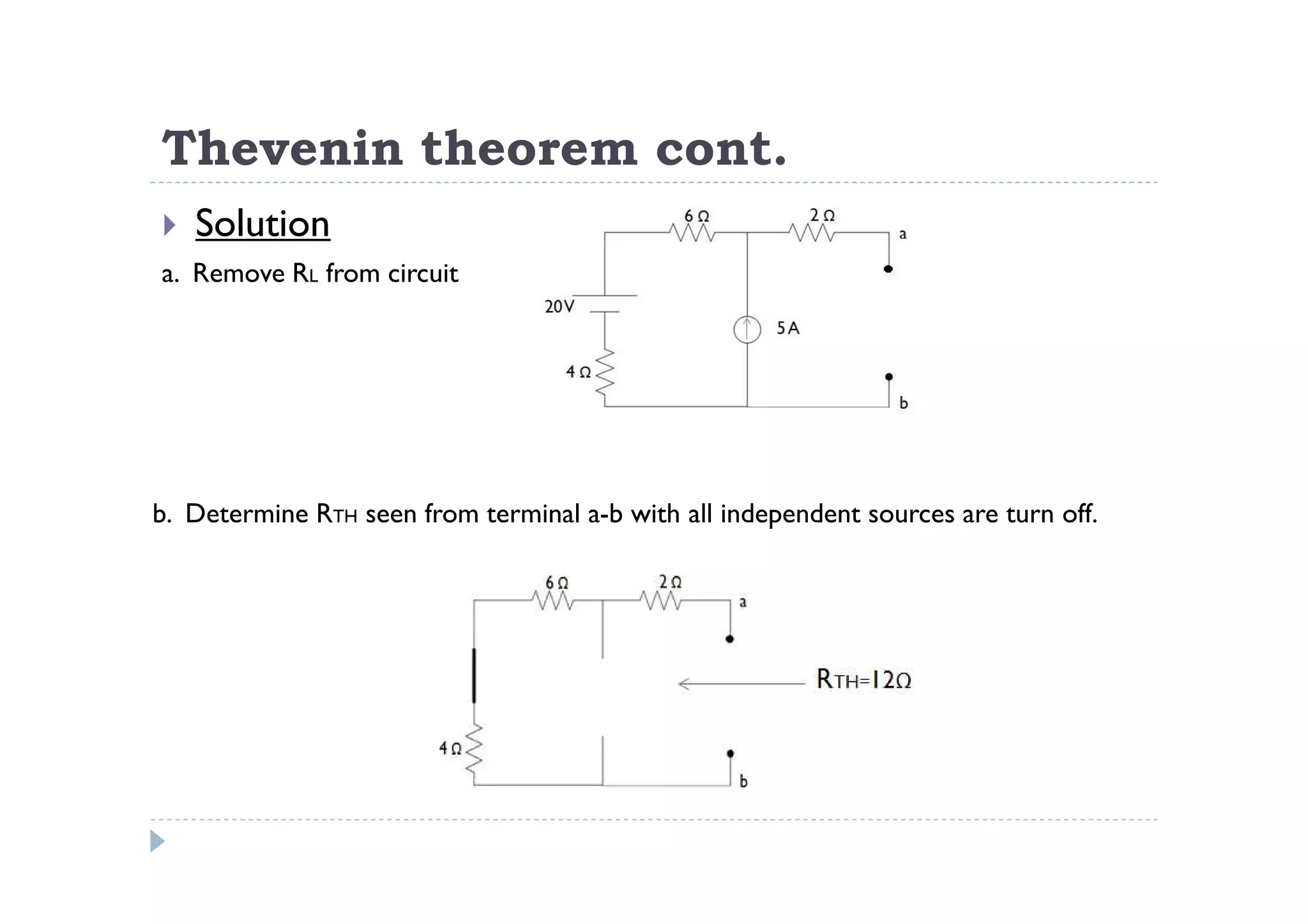
   Solution
a. Remove RL from circuit


b. Determine RTH seen from terminal a-b with all independent sources are turn off.
Thevenin theorem cont.
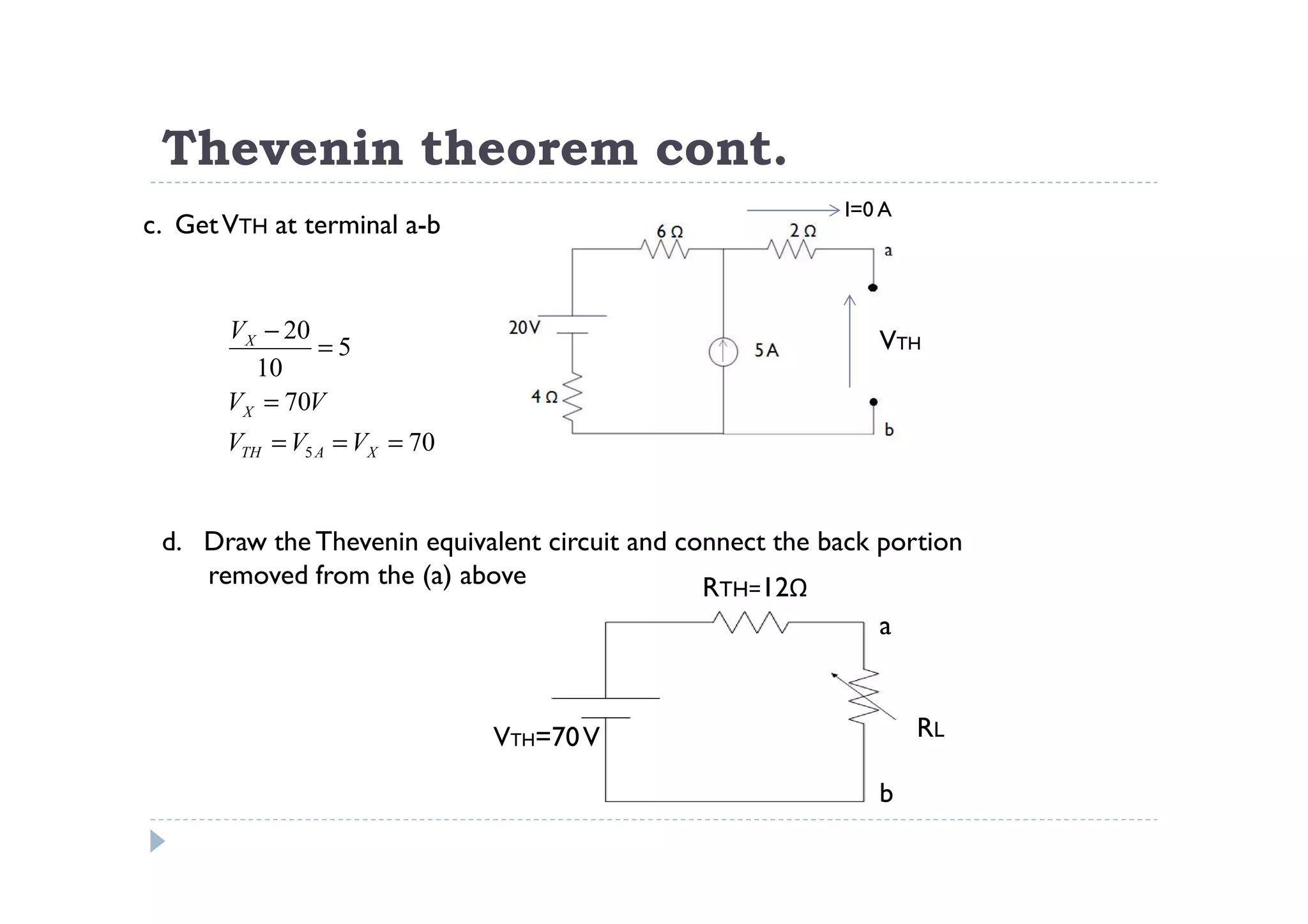
                                                          I=0 A
c. Get VTH at terminal a-b


       VX − 20
               =5                                            VTH
         10
       VX = 70V
       VTH = V5 A = VX = 70


 d. Draw the Thevenin equivalent circuit and connect the back portion
    removed from the (a) above                 RTH=12Ω
                                                             a


                              VTH=70 V                            RL

                                                             b
Thevenin theorem cont.
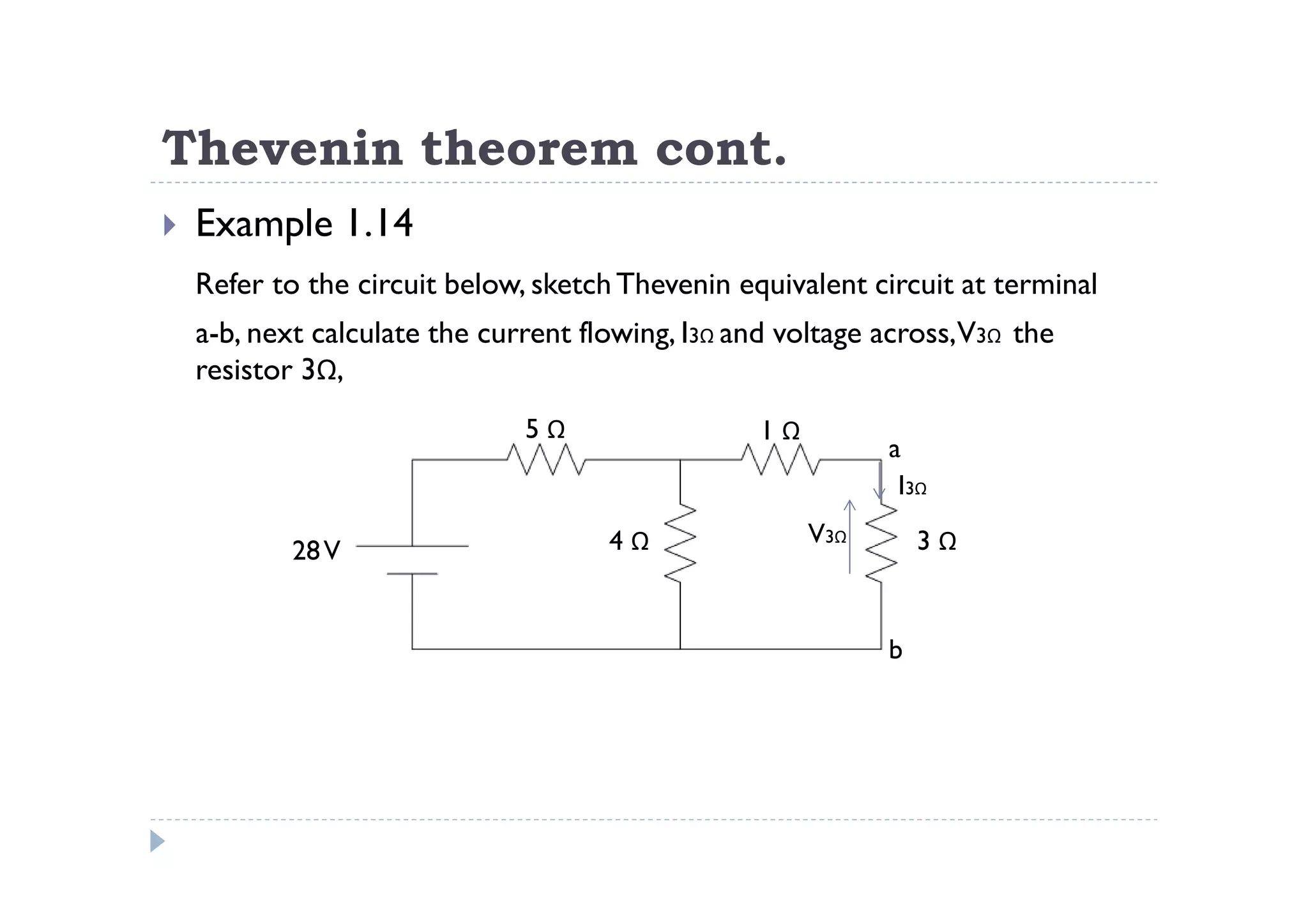
 Example 1.14
 Refer to the circuit below, sketch Thevenin equivalent circuit at terminal
 a-b, next calculate the current flowing, I3Ω and voltage across,V3Ω the
 resistor 3Ω,
                            5Ω                 1Ω
                                                          a
                                                           I3Ω
                                   4Ω               V3Ω       3Ω
         28 V


                                                          b
Thevenin theorem cont.
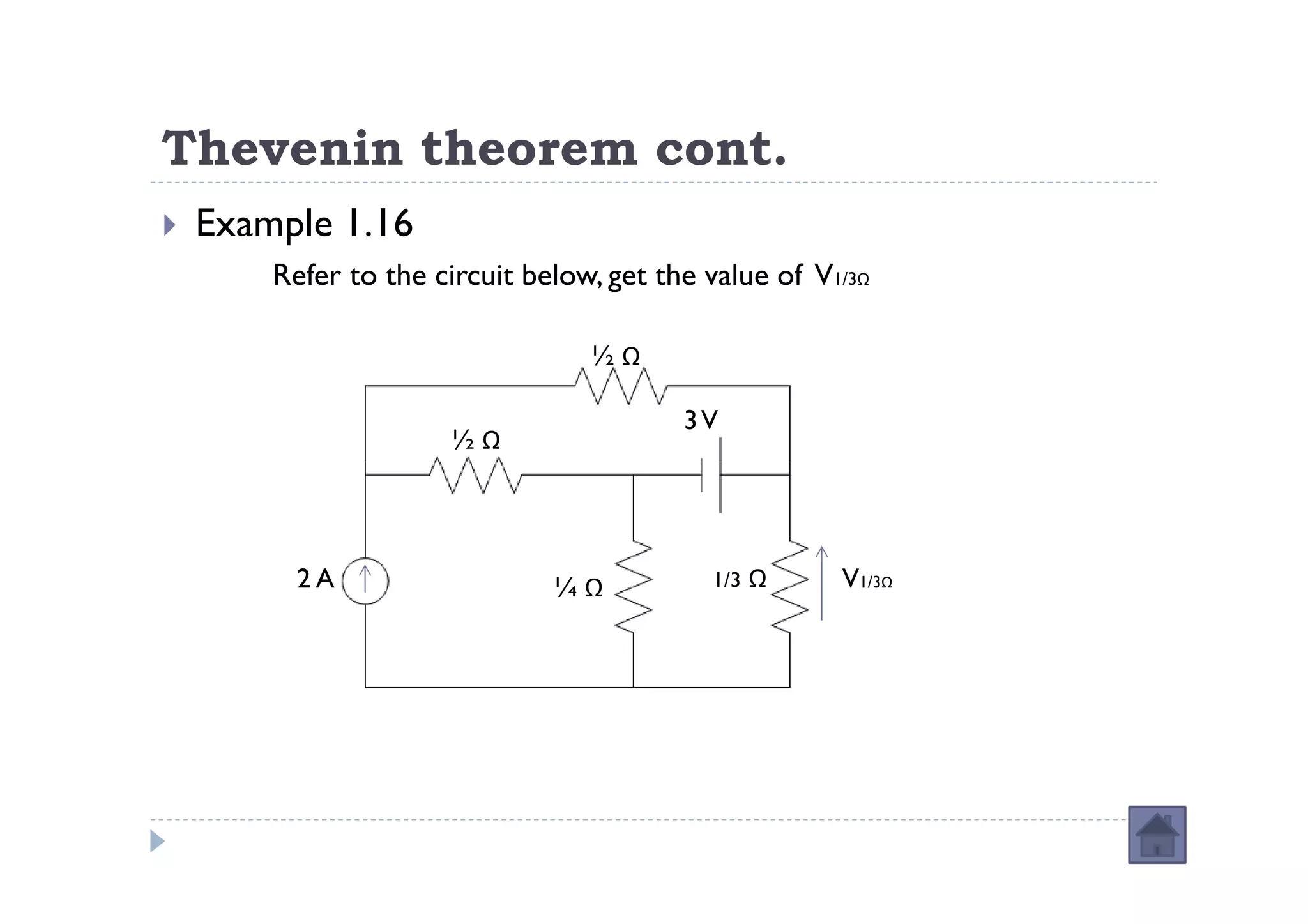
 Example 1.16
     Refer to the circuit below, get the value of V1/3Ω

                               ½Ω

                                       3V
                   ½Ω


       2A                   ¼Ω           1/3   Ω    V1/3Ω
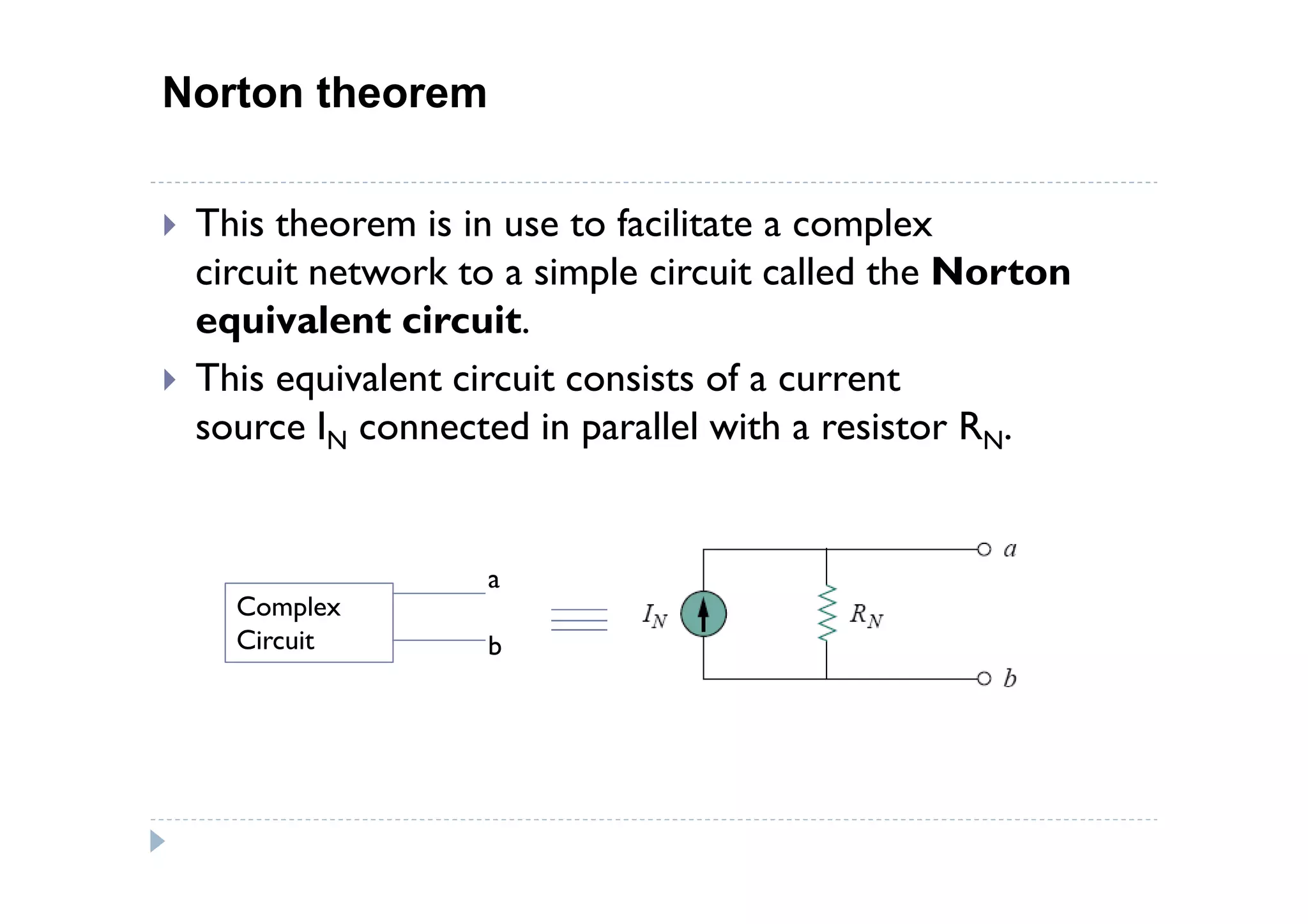
Norton theorem

 This theorem is in use to facilitate a complex
 circuit network to a simple circuit called the Norton
 equivalent circuit.
 This equivalent circuit consists of a current
 source IN connected in parallel with a resistor RN.


                  a
   Complex
   Circuit        b
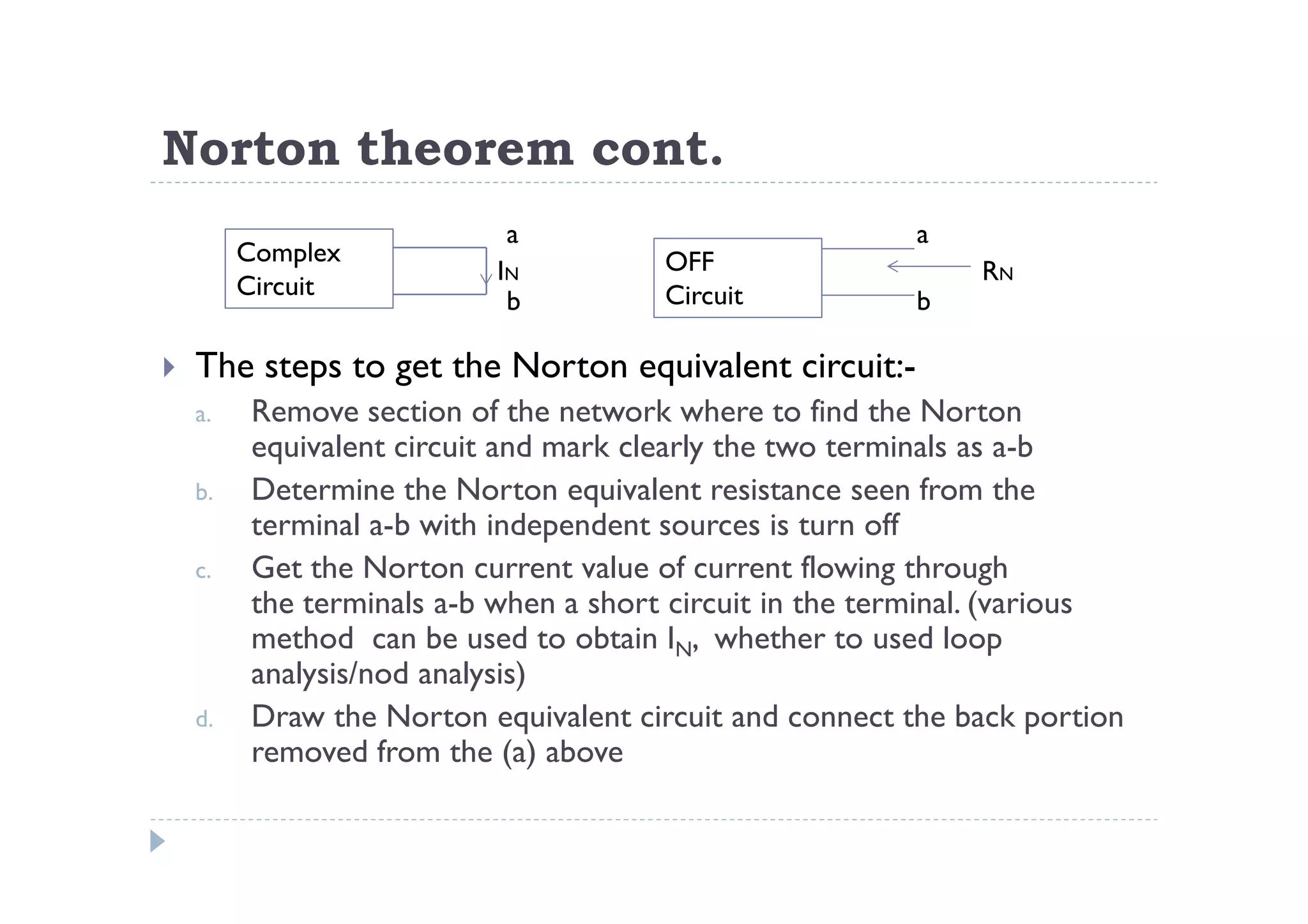
Norton theorem cont.
                         a                             a
      Complex                        OFF
                         IN                                 RN
      Circuit                        Circuit
                          b                            b

 The steps to get the Norton equivalent circuit:-
 a.    Remove section of the network where to find the Norton
       equivalent circuit and mark clearly the two terminals as a-b
 b.    Determine the Norton equivalent resistance seen from the
       terminal a-b with independent sources is turn off
 c.    Get the Norton current value of current flowing through
       the terminals a-b when a short circuit in the terminal. (various
       method can be used to obtain IN, whether to used loop
       analysis/nod analysis)
 d.    Draw the Norton equivalent circuit and connect the back portion
       removed from the (a) above
Norton theorem cont.
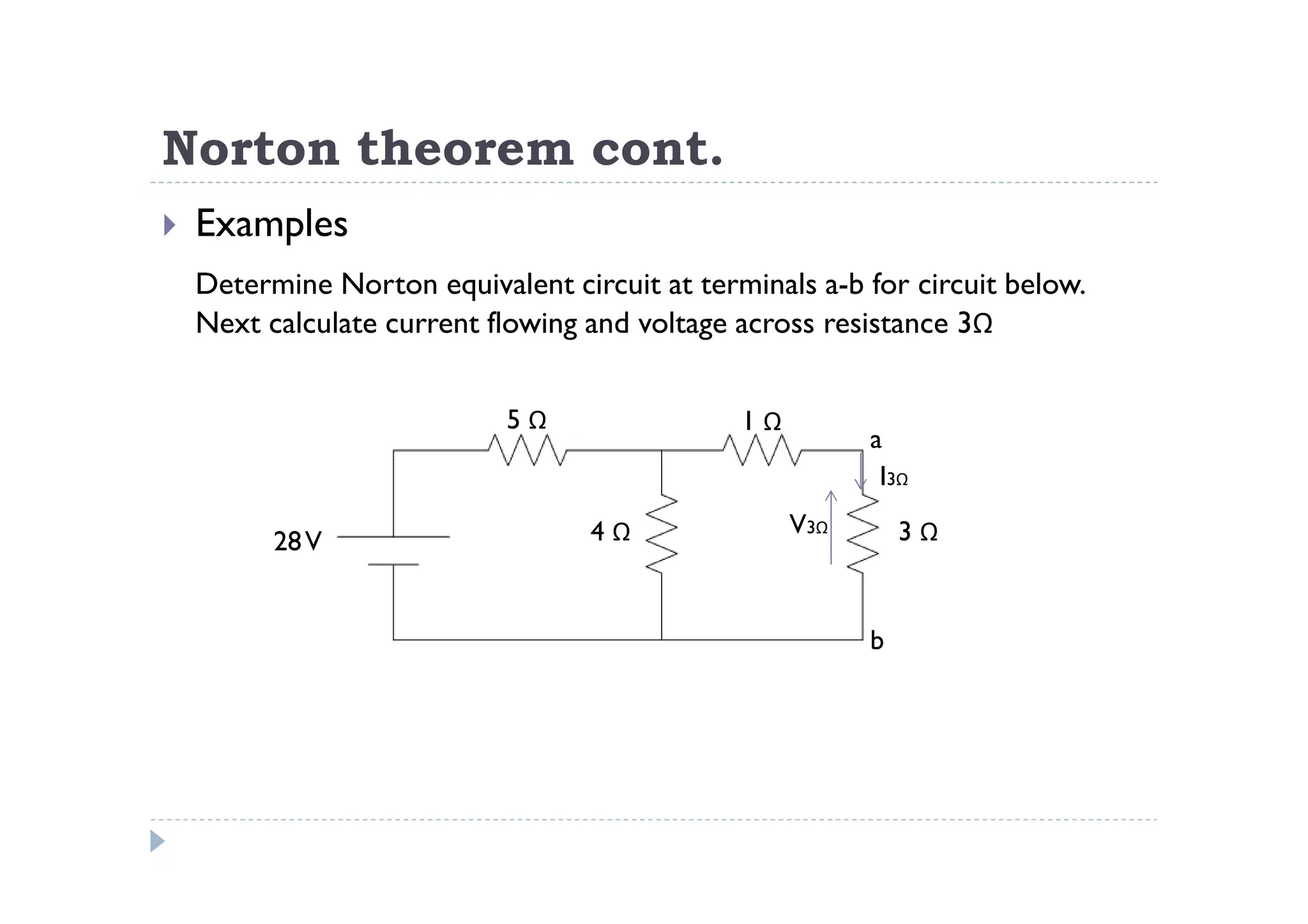
 Examples
 Determine Norton equivalent circuit at terminals a-b for circuit below.
 Next calculate current flowing and voltage across resistance 3Ω


                         5Ω                 1Ω
                                                       a
                                                        I3Ω
                                4Ω               V3Ω       3Ω
       28 V


                                                       b
Norton theorem cont.
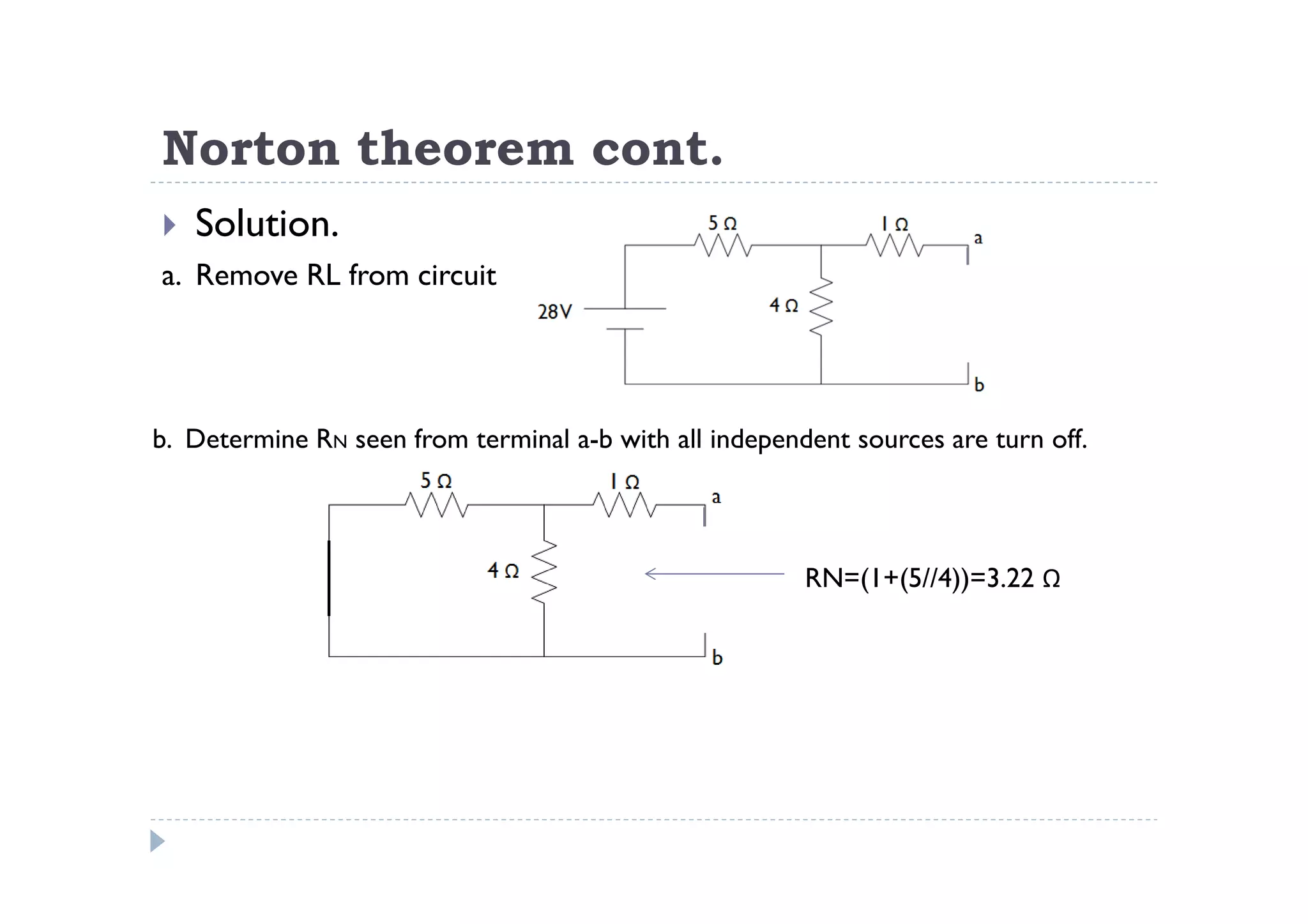
   Solution.
a. Remove RL from circuit


b. Determine RN seen from terminal a-b with all independent sources are turn off.


                                                        RN=(1+(5//4))=3.22 Ω
Norton theorem cont.
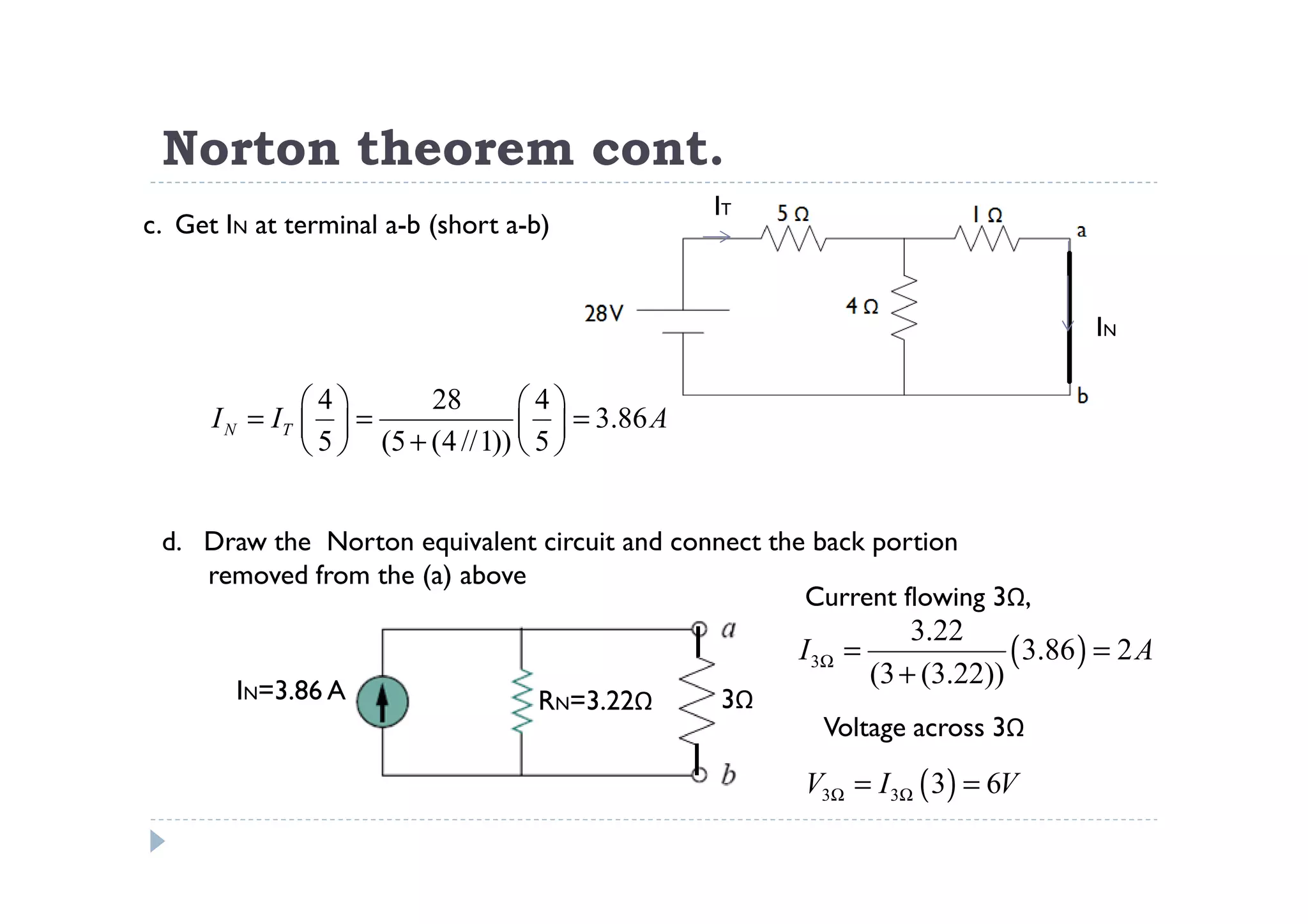
                                                  IT
c. Get IN at terminal a-b (short a-b)


                                                                                     IN

               4        28       4
      I N = IT   =                 = 3.86 A
                5  (5 + (4 //1))  5 


 d. Draw the Norton equivalent circuit and connect the back portion
    removed from the (a) above
                                                      Current flowing 3Ω,
                                                                    3.22
                                                       I 3Ω =                ( 3.86 ) = 2 A
                                                                (3 + (3.22))
        IN=3.86 A                  RN=3.22Ω       3Ω
                                                         Voltage across 3Ω

                                                       V3Ω = I 3Ω ( 3) = 6V
Norton theorem cont.
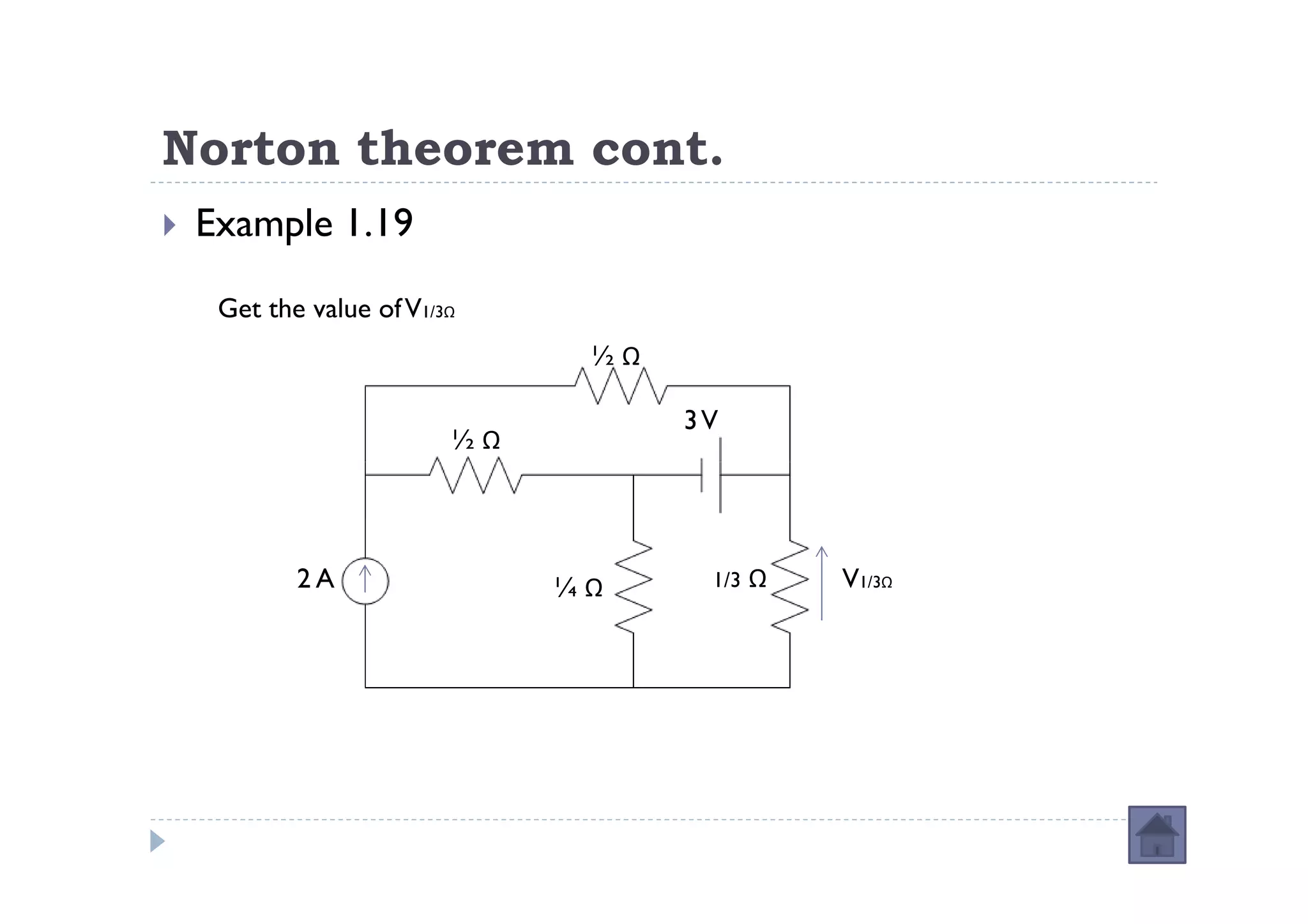
 Example 1.19

  Get the value of V1/3Ω
                             ½Ω

                                  3V
                       ½Ω


         2A                 ¼Ω     1/3   Ω   V1/3Ω
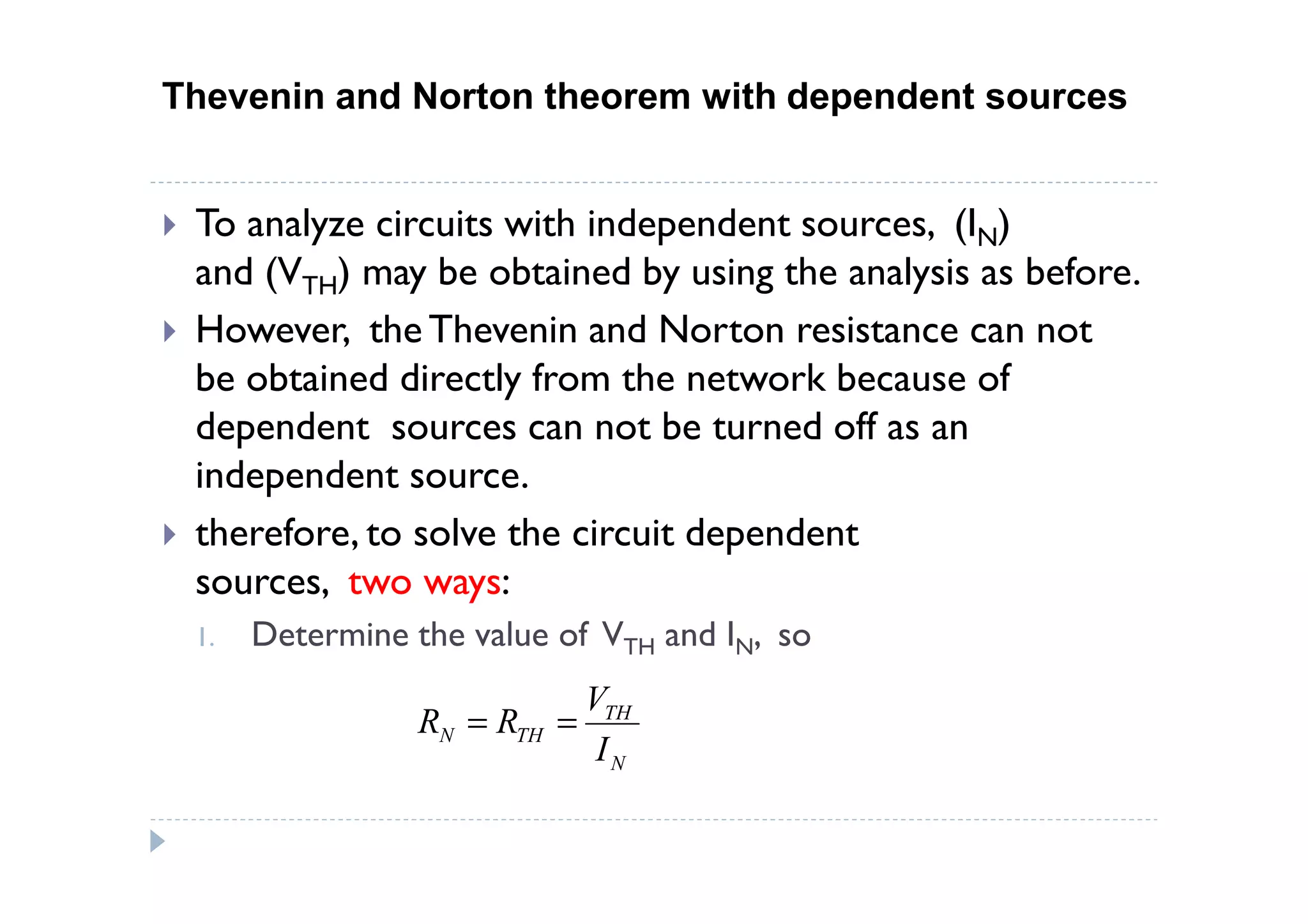
Thevenin and Norton theorem with dependent sources


 To analyze circuits with independent sources, (IN)
 and (VTH) may be obtained by using the analysis as before.
 However, the Thevenin and Norton resistance can not
 be obtained directly from the network because of
 dependent sources can not be turned off as an
 independent source.
 therefore, to solve the circuit dependent
 sources, two ways:
 1.   Determine the value of VTH and IN, so
                              VTH
                 RN = RTH =
                               IN
Thevenin and Norton theorem with dependent
sources CONT.
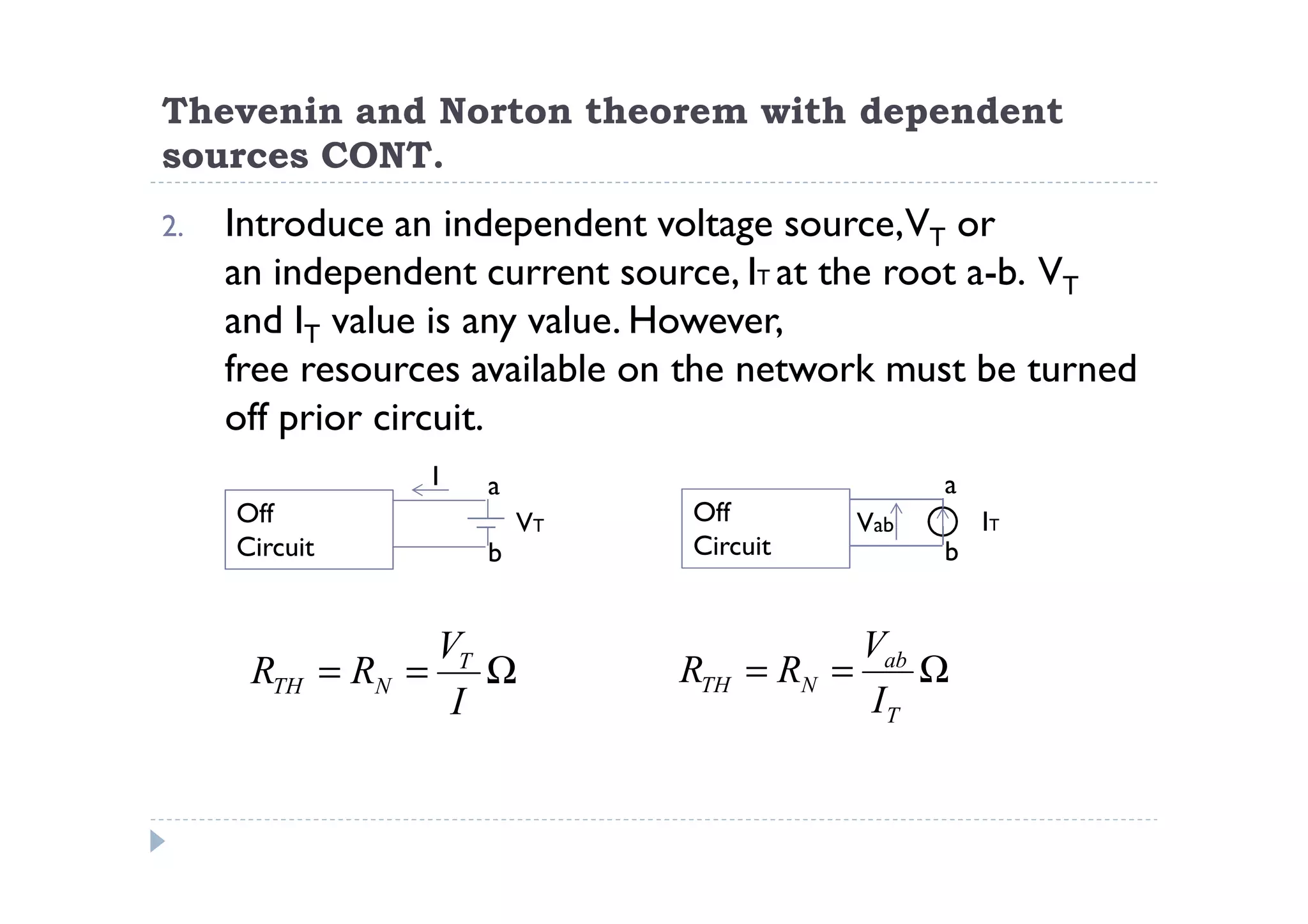
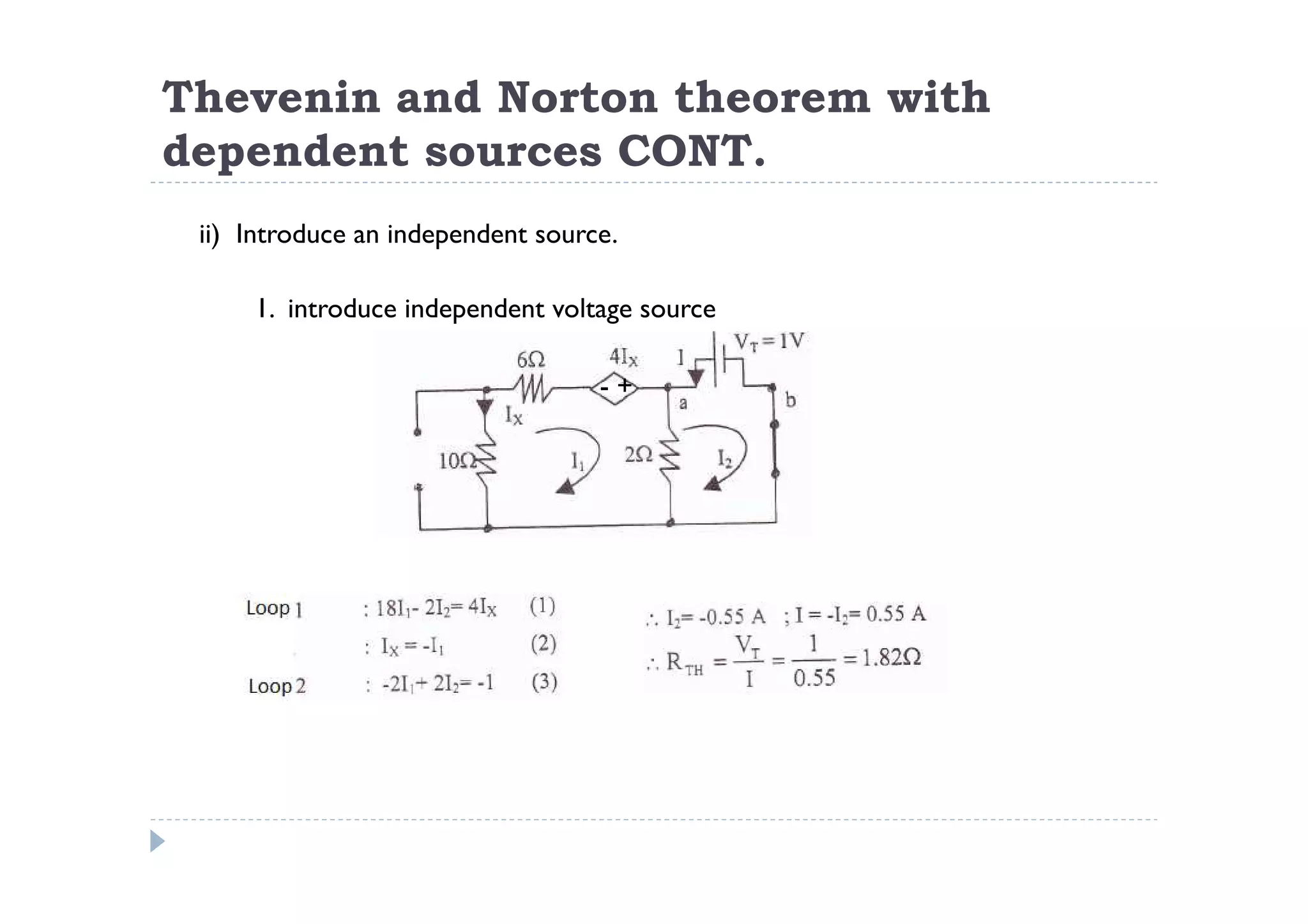
2.   Introduce an independent voltage source,VT or
     an independent current source, IT at the root a-b. VT
     and IT value is any value. However,
     free resources available on the network must be turned
     off prior circuit.
                   I   a                          a
     Off                   VT   Off         Vab       IT
     Circuit           b        Circuit           b


                     VT                      Vab
      RTH      = RN = Ω         RTH   = RN =     Ω
                      I                      IT
Thevenin and Norton theorem with dependent
sources CONT.
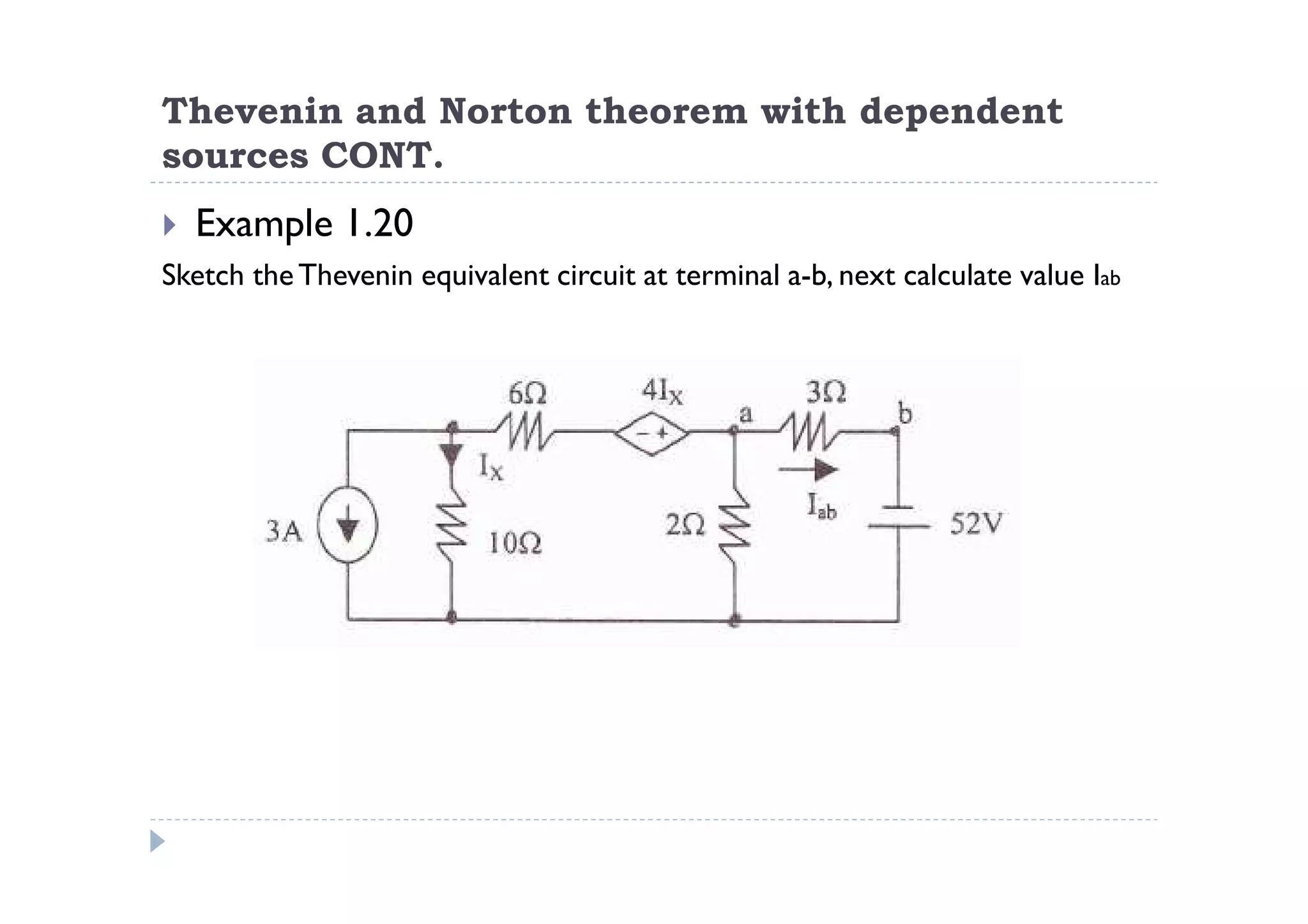
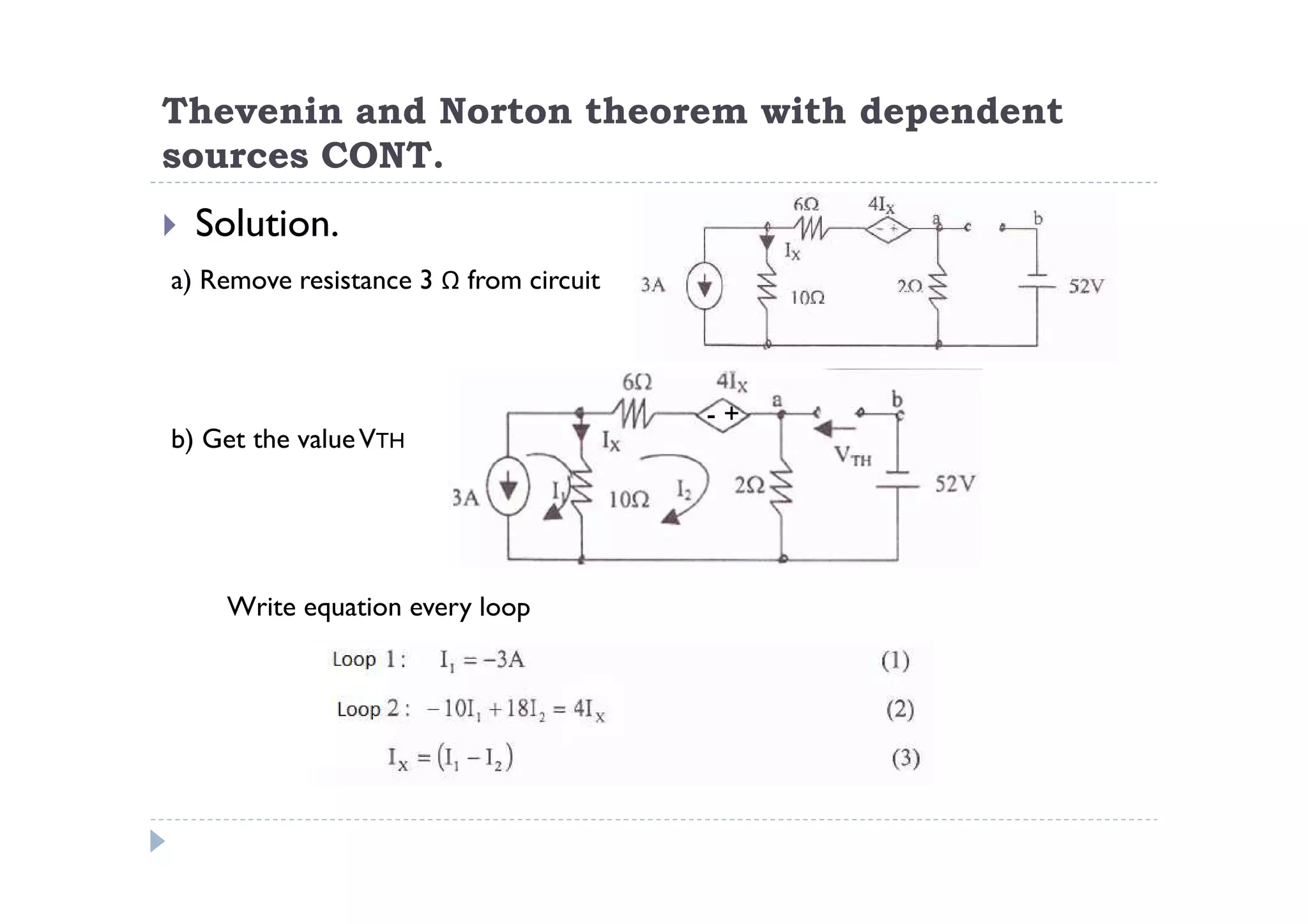
  Example 1.20
Sketch the Thevenin equivalent circuit at terminal a-b, next calculate value Iab
Thevenin and Norton theorem with dependent
sources CONT.
  Solution.
a) Remove resistance 3 Ω from circuit


                                        -+
b) Get the value VTH


    Write equation every loop
Thevenin and Norton theorem with
dependent sources CONT.
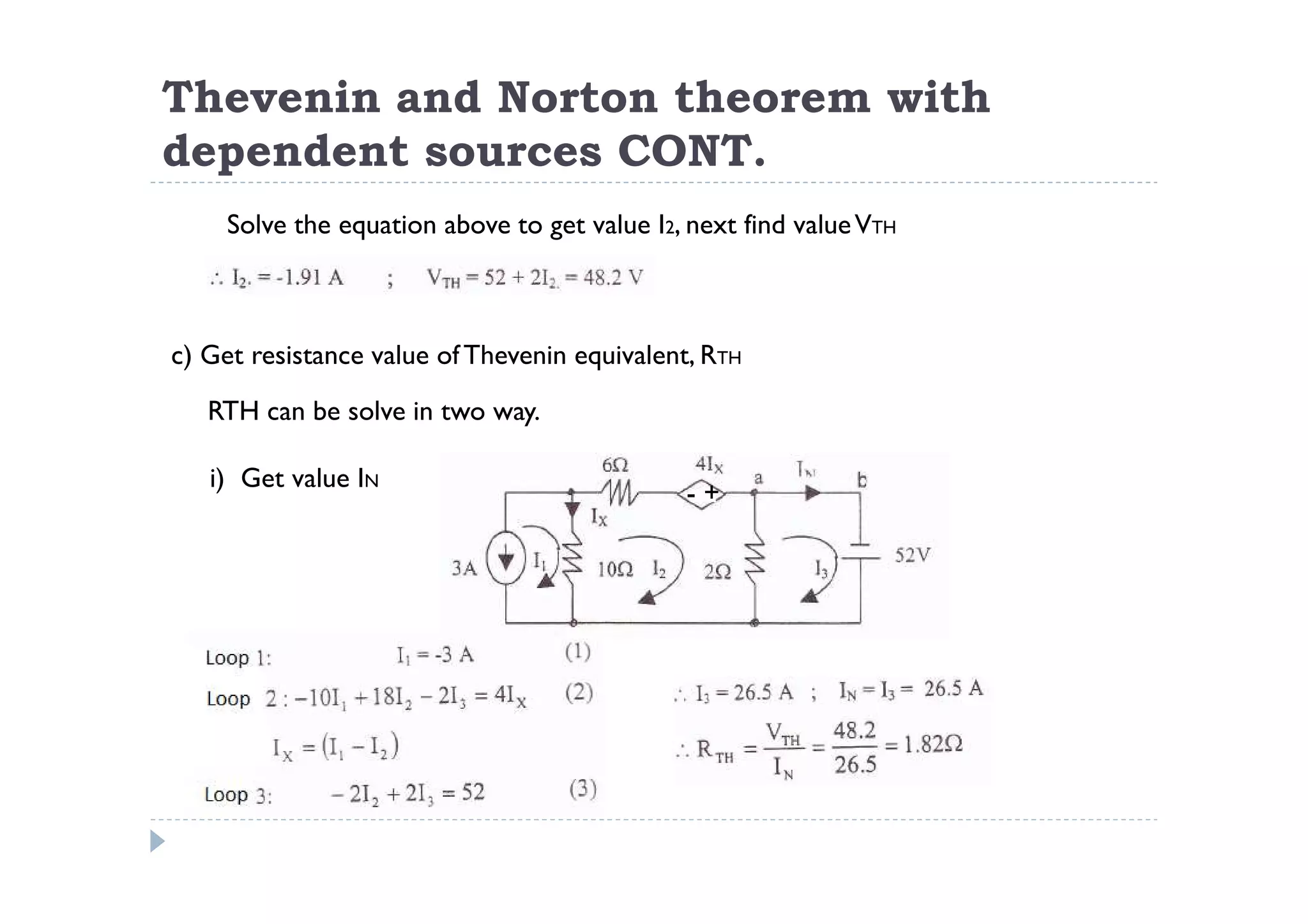
    Solve the equation above to get value I2, next find value VTH


c) Get resistance value of Thevenin equivalent, RTH

   RTH can be solve in two way.

   i) Get value IN
                                              -+
Thevenin and Norton theorem with
dependent sources CONT.
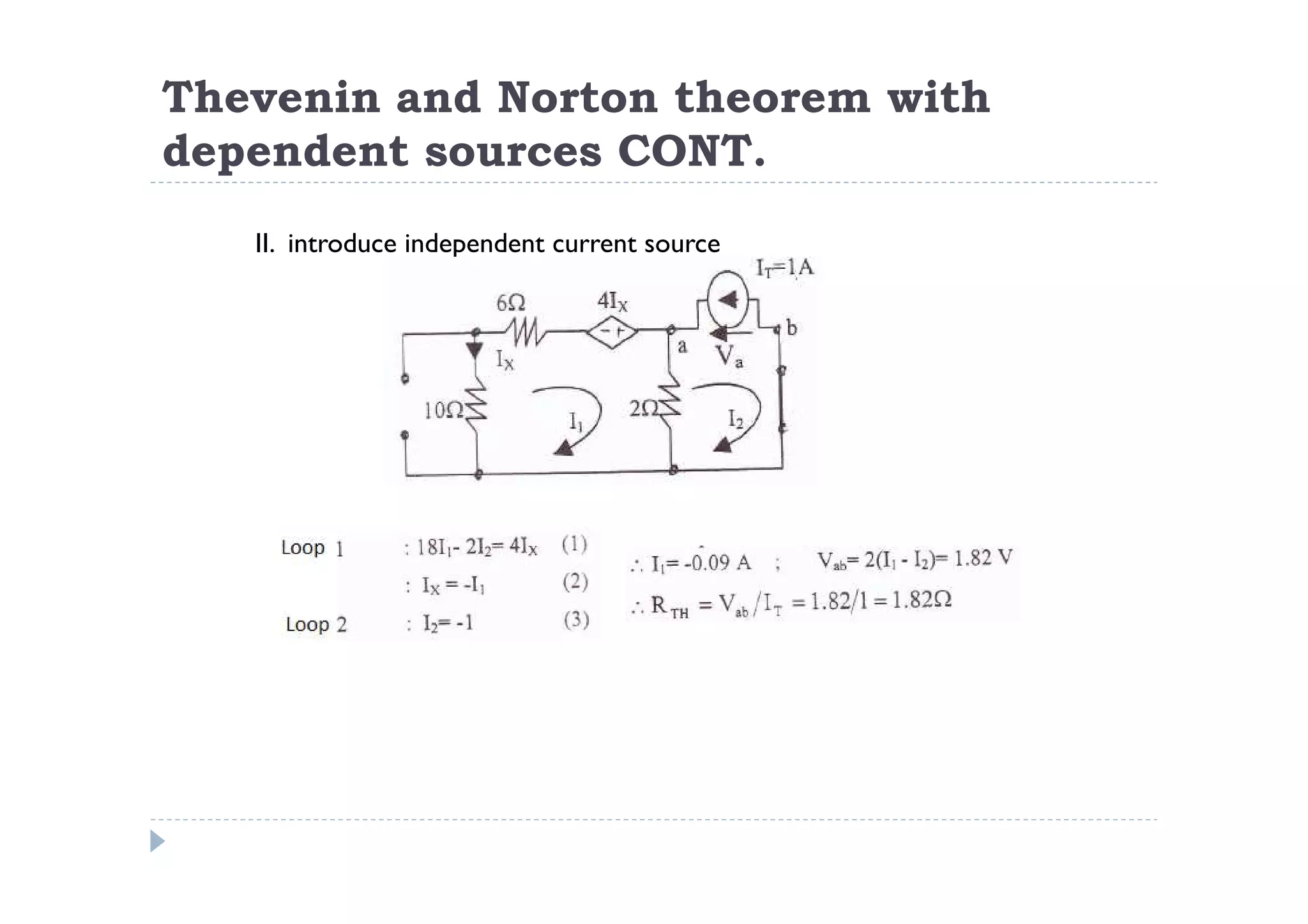
 ii) Introduce an independent source.

     1. introduce independent voltage source

                                   -+
Thevenin and Norton theorem with
dependent sources CONT.
   II. introduce independent current source
Thevenin and Norton theorem with
  dependent sources CONT.
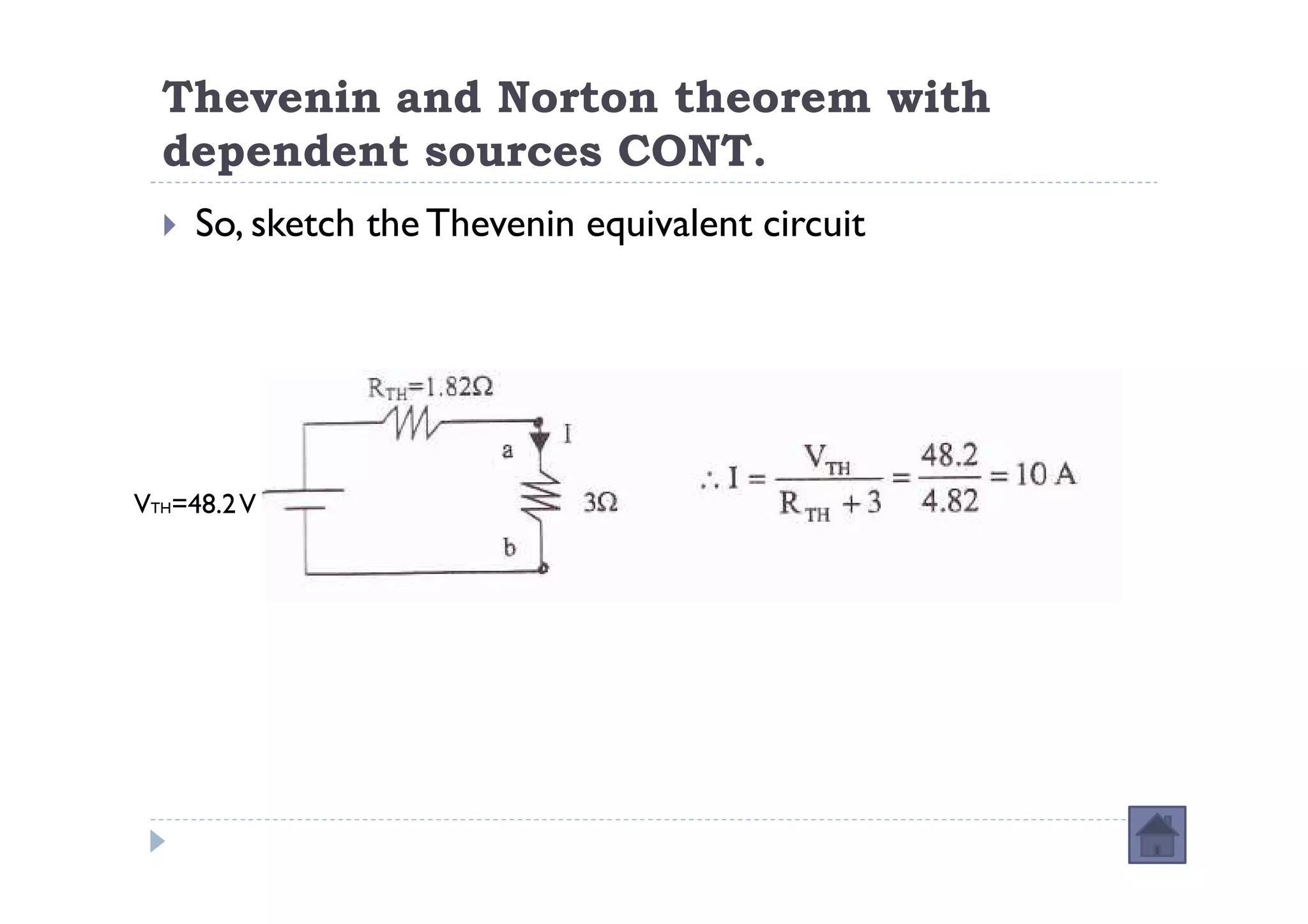
     So, sketch the Thevenin equivalent circuit


VTH=48.2 V
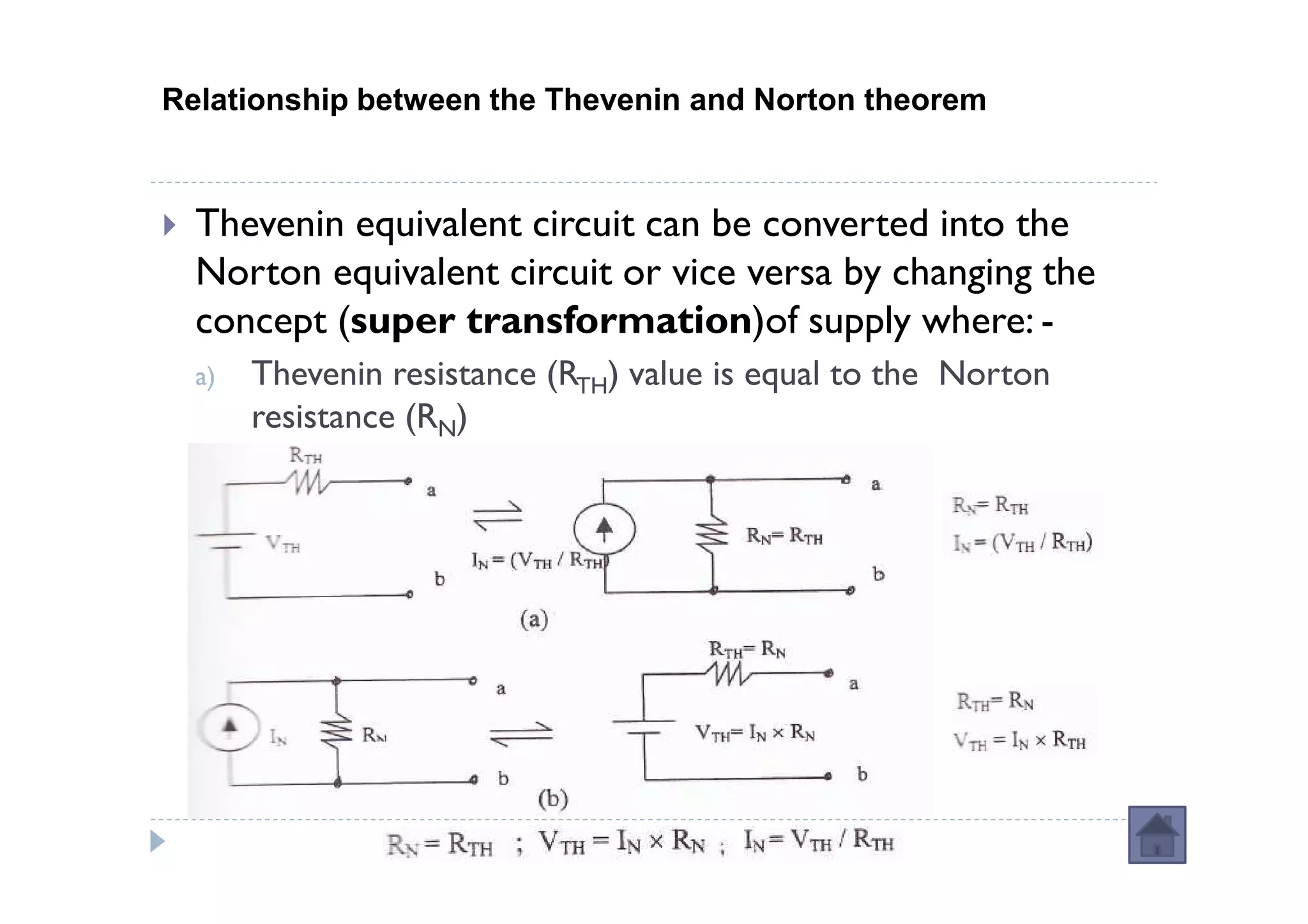
Relationship between the Thevenin and Norton theorem


  Thevenin equivalent circuit can be converted into the
  Norton equivalent circuit or vice versa by changing the
  concept (super transformation)of supply where: -
  a)   Thevenin resistance (RTH) value is equal to the Norton
       resistance (RN)
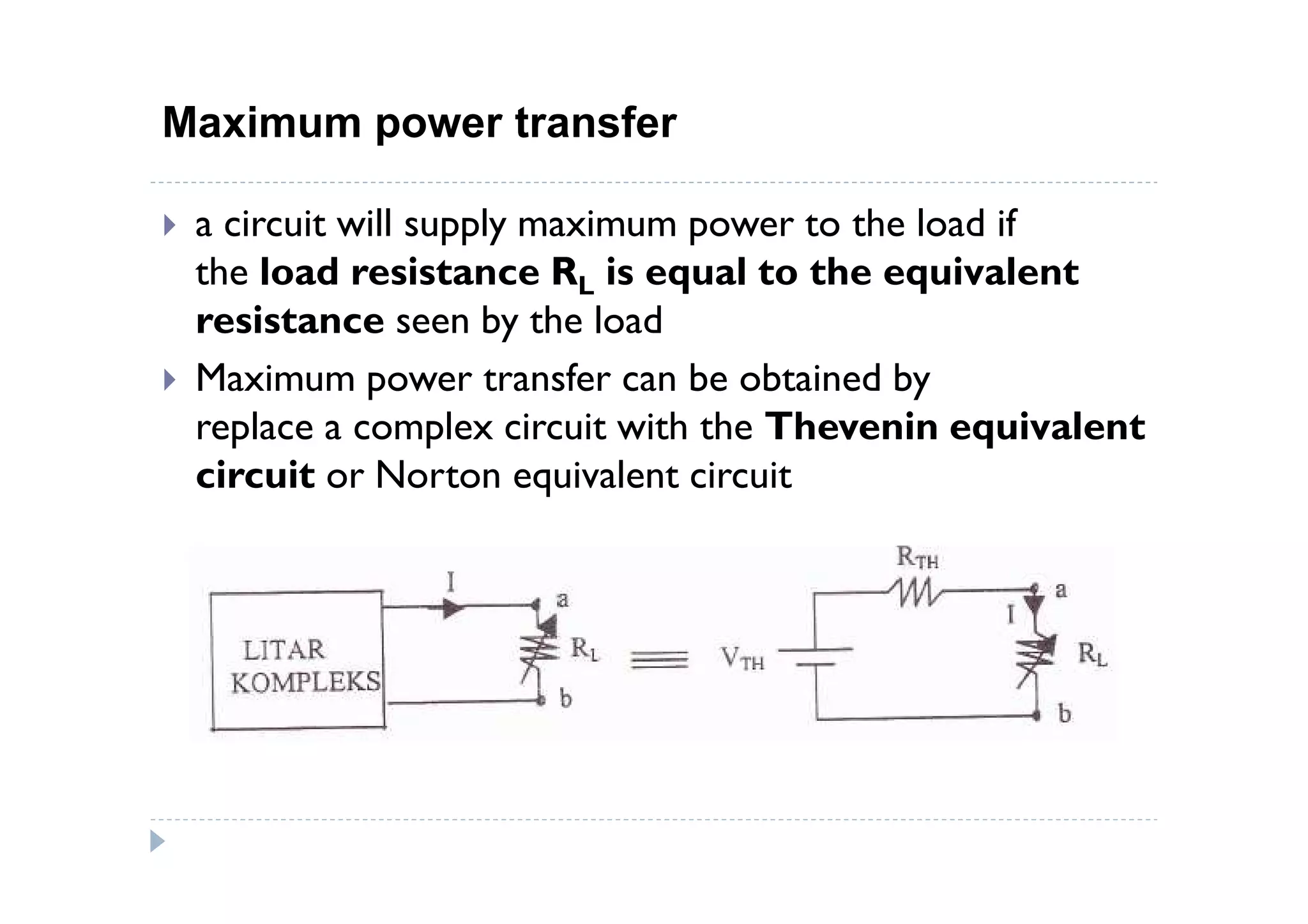
Maximum power transfer

 a circuit will supply maximum power to the load if
 the load resistance RL is equal to the equivalent
 resistance seen by the load
 Maximum power transfer can be obtained by
 replace a complex circuit with the Thevenin equivalent
 circuit or Norton equivalent circuit
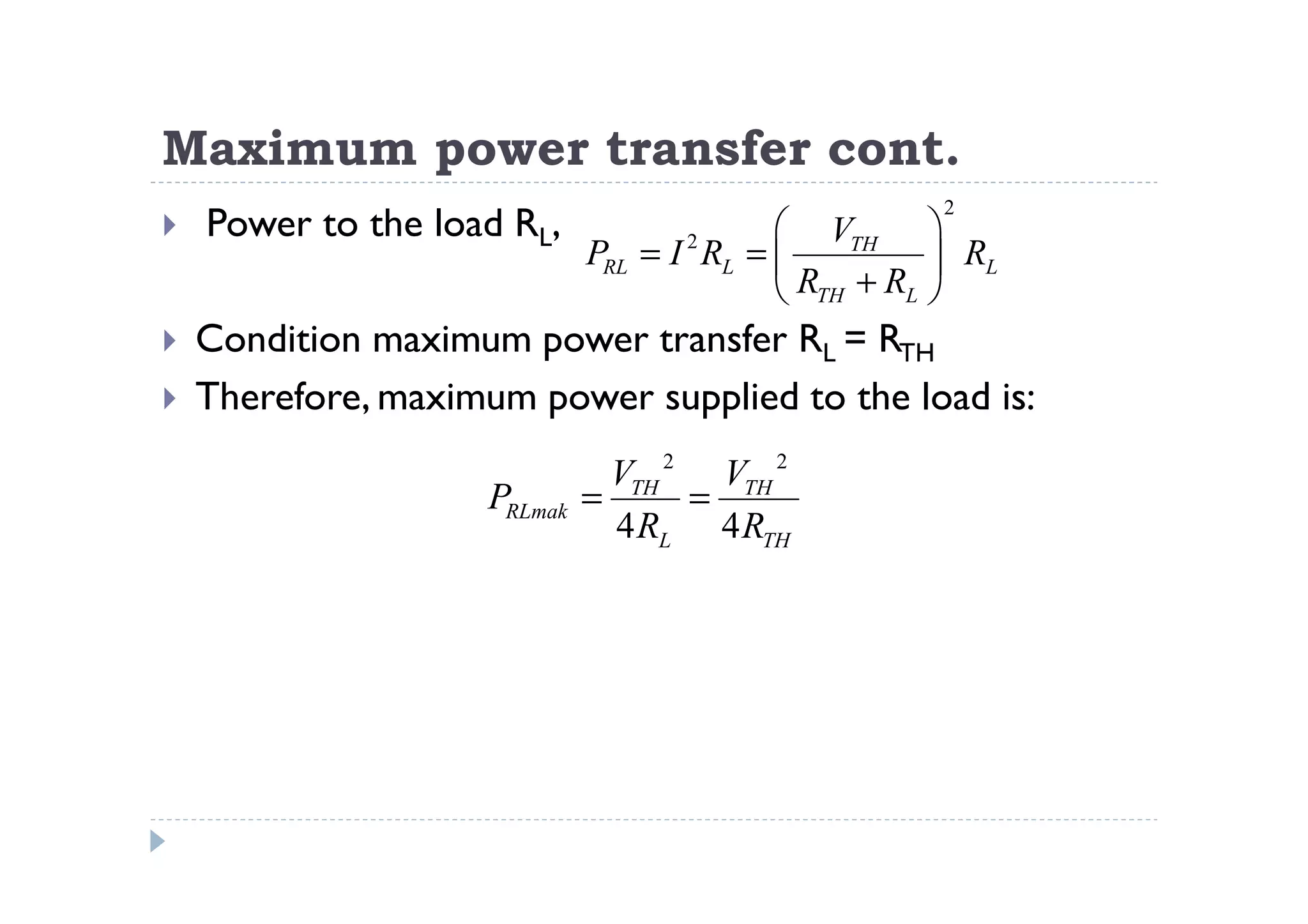
Maximum power transfer cont.
                                                   2
 Power to the load RL,                   VTH 
                           PRL = I RL = 
                                 2
                                                    RL
                                         RTH + RL 
 Condition maximum power transfer RL = RTH
 Therefore, maximum power supplied to the load is:
                             VTH 2 VTH 2
                  PRLmak   =      =
                             4 RL 4 RTH
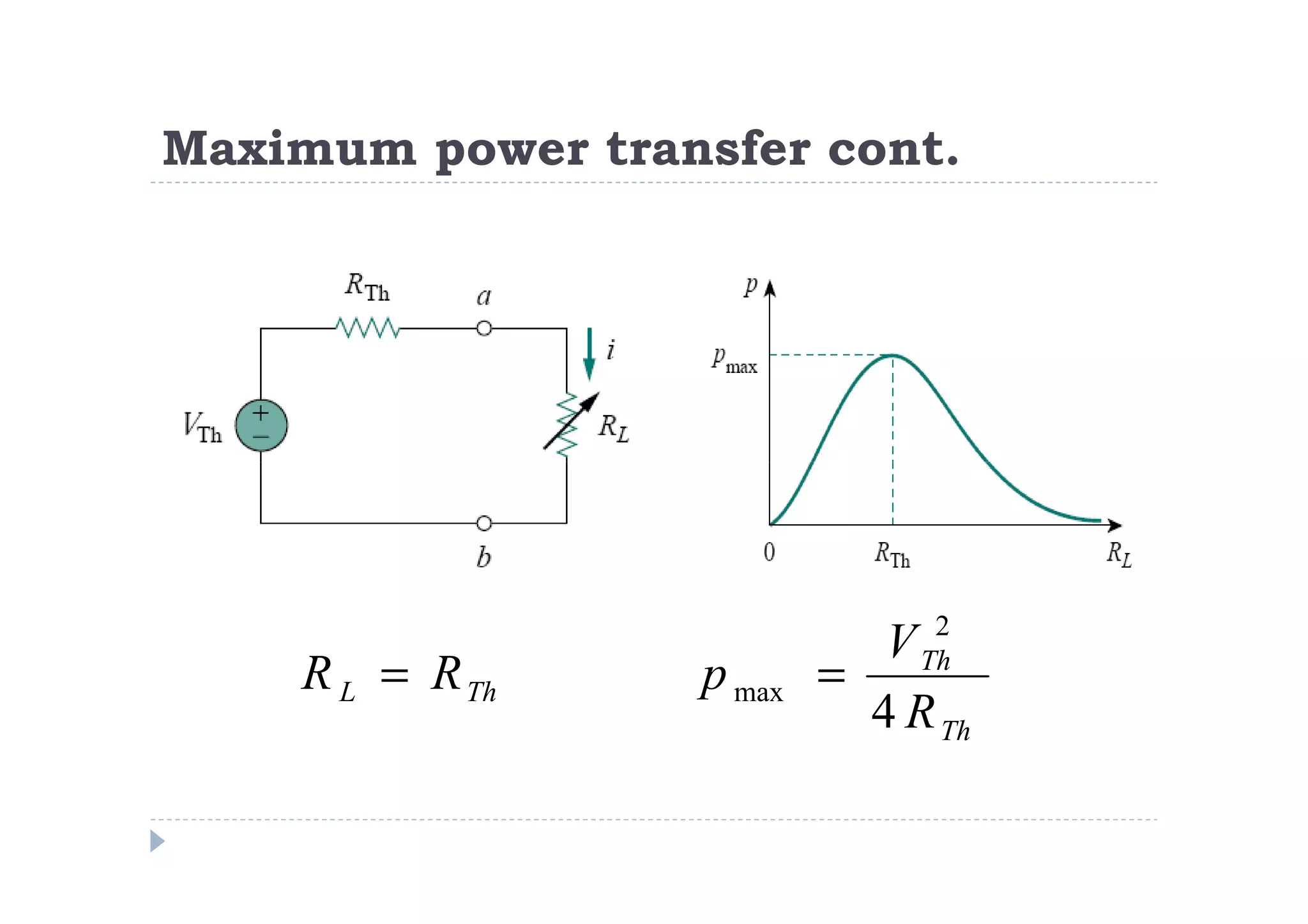
Maximum power transfer cont.


                                2
                             V Th
    R L = R Th    p max   =
                            4 R Th
Maximum power transfer cont.
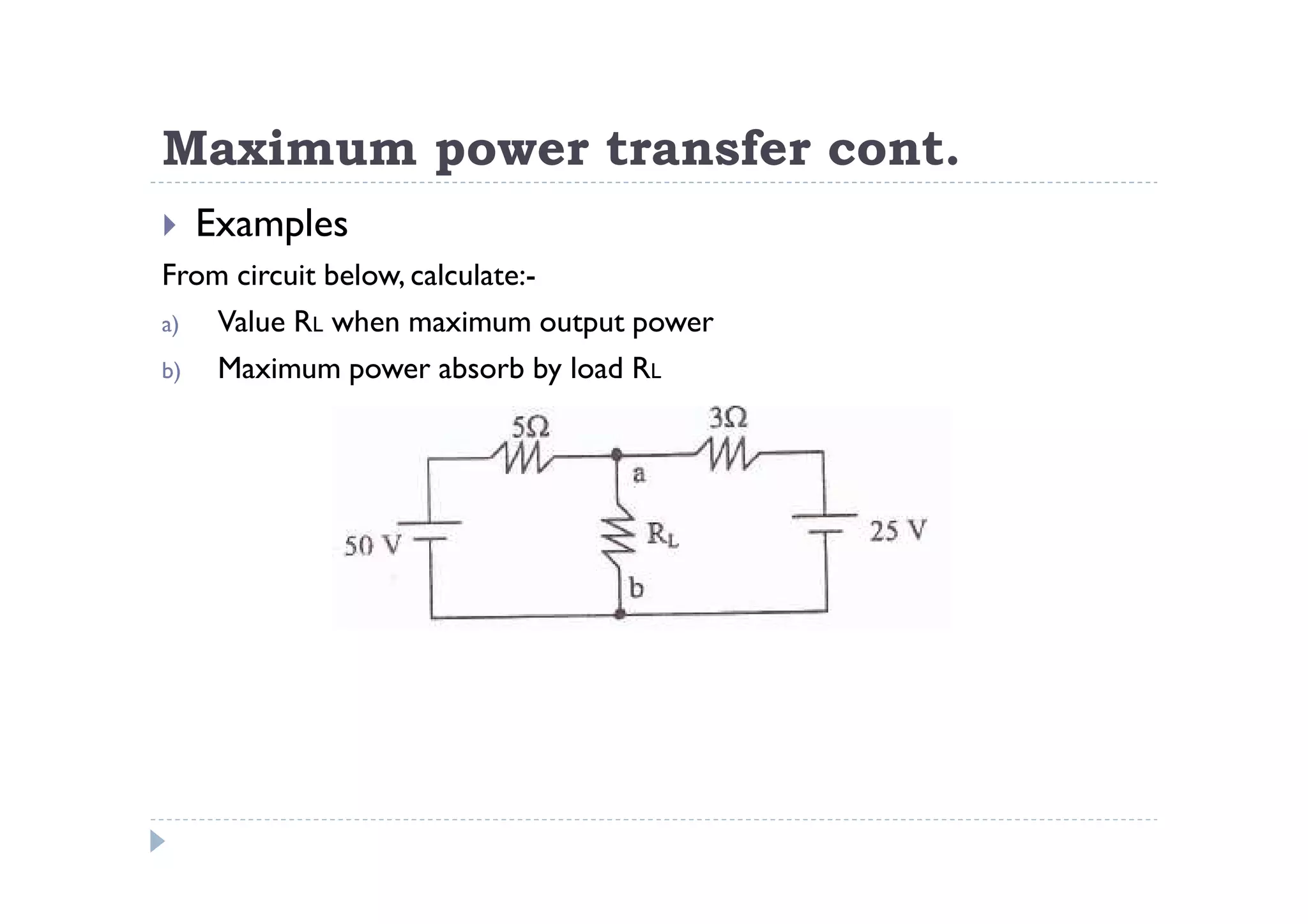
  Examples
From circuit below, calculate:-
a)  Value RL when maximum output power
b)  Maximum power absorb by load RL
Maximum power transfer cont.
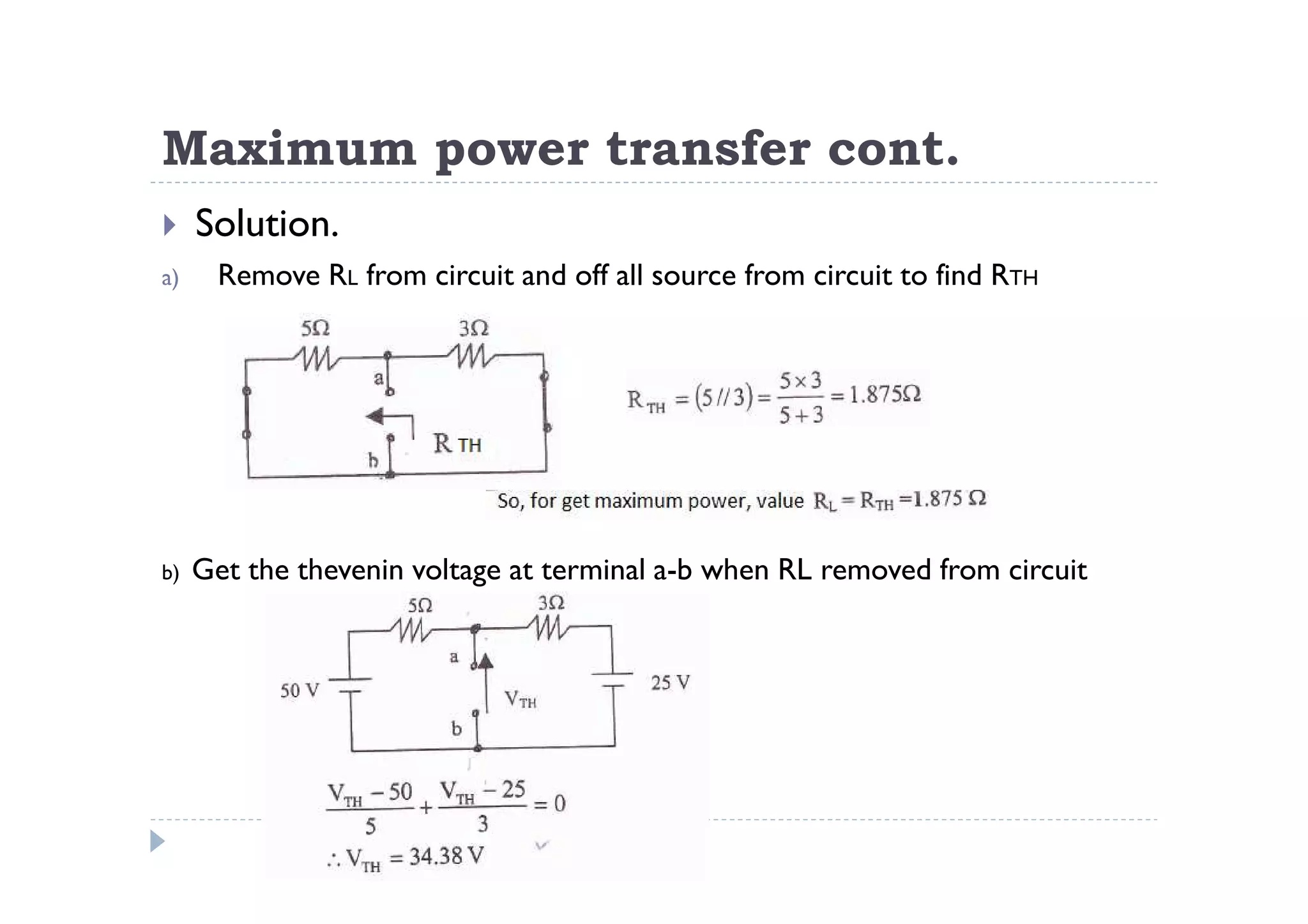
     Solution.
a)     Remove RL from circuit and off all source from circuit to find RTH


b)   Get the thevenin voltage at terminal a-b when RL removed from circuit
Maximum power transfer cont.

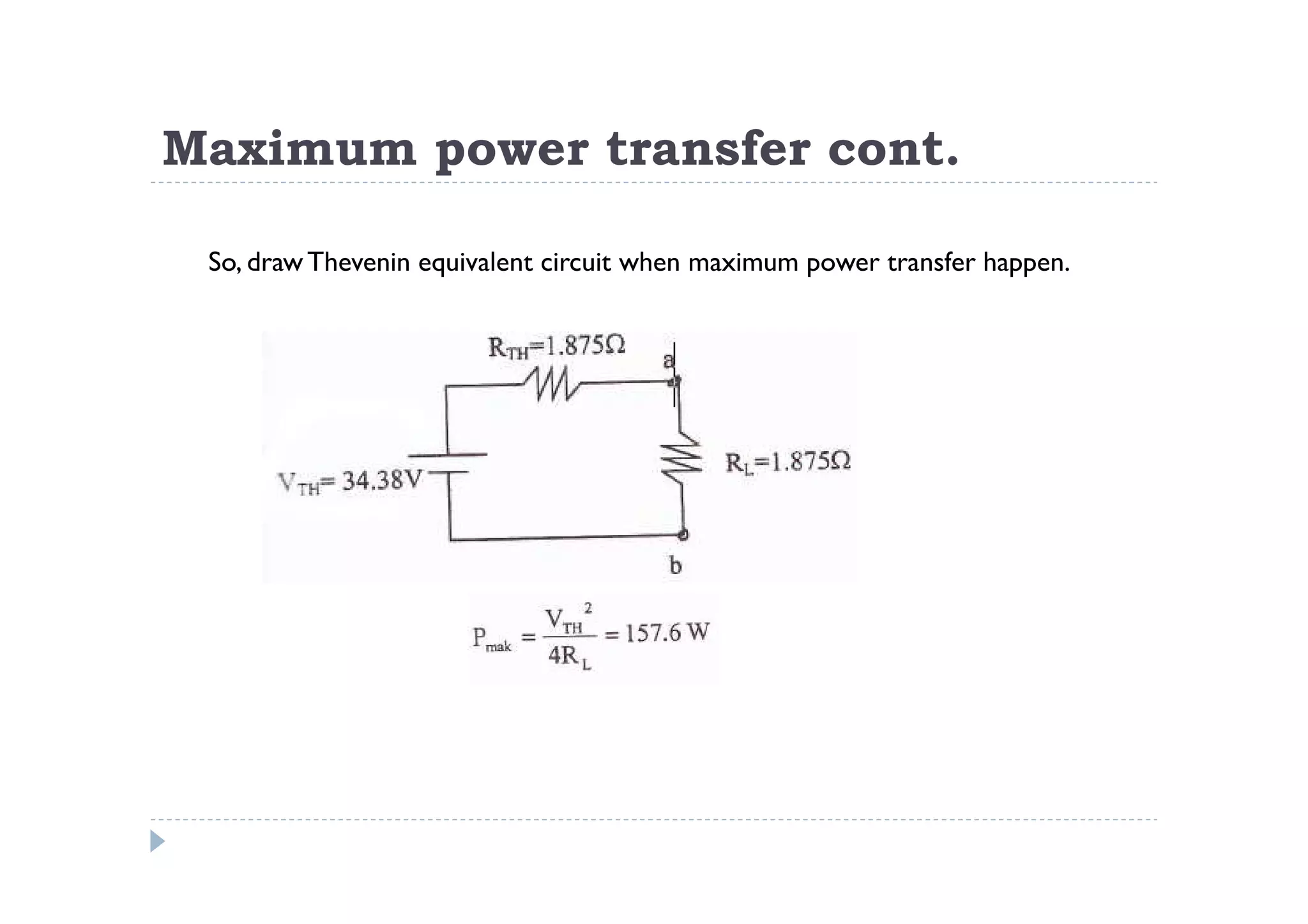
 So, draw Thevenin equivalent circuit when maximum power transfer happen.
Maximum power transfer cont.
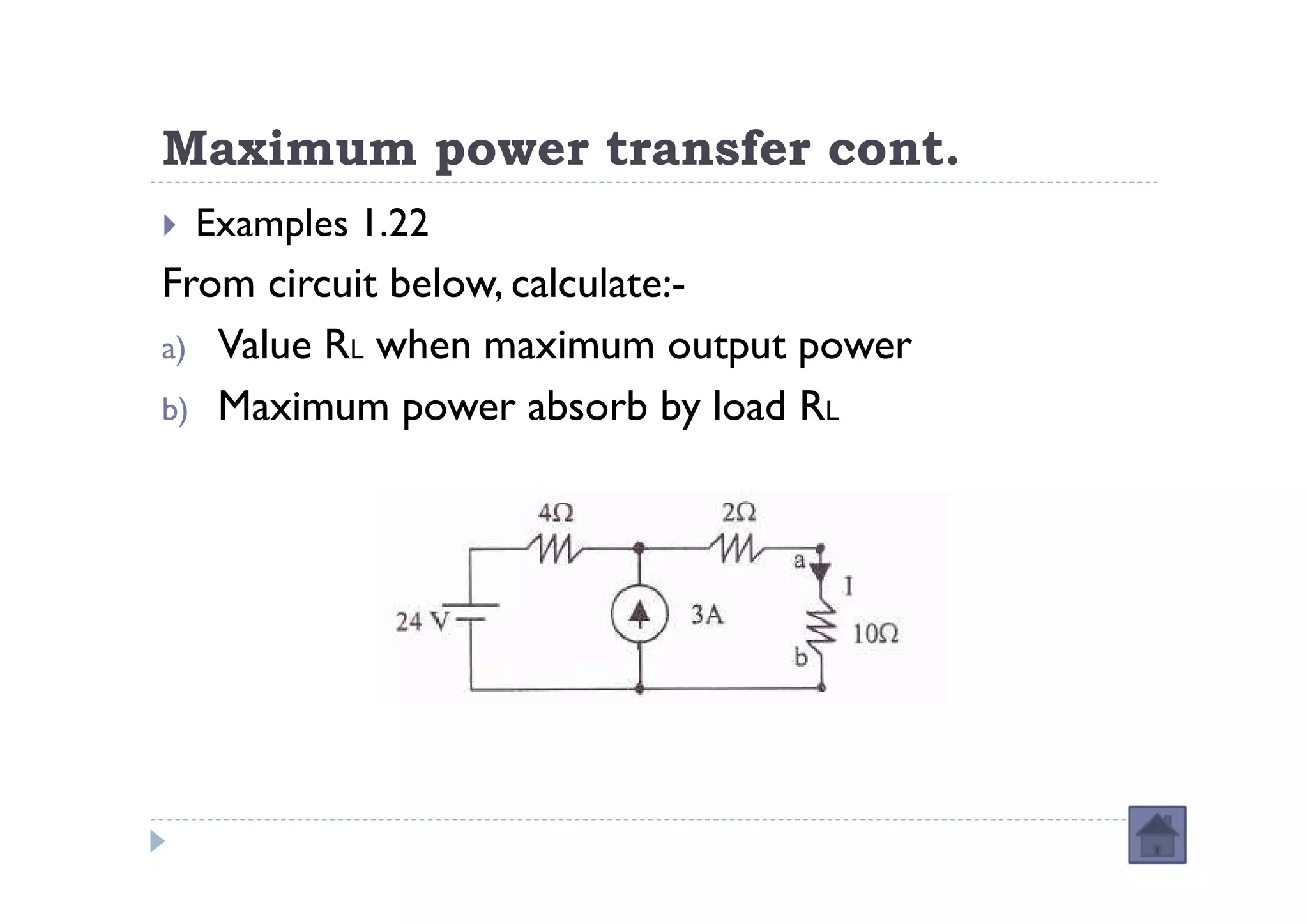
 Examples 1.22
From circuit below, calculate:-
a) Value RL when maximum output power
b) Maximum power absorb by load RL

Chapter 1 techniques of dc circuit analysis

  • 1.
    Menuntut ilmu adalahTAQWA Menyampaikan ilmu adalah IBADAH Mengulang-ulang ilmu adalah ZIKIR Mencari ilmu adalah JIHAD Chapter 1 : Techniques of DC Circuit Analysis Engr. Mohd Riduwan bin Ghazali (Grad. IEM)
  • 2.
    1.1 Review CircuitAnalysis I: Most Important thing that should remember: Ohm Laws,V = IR (Kirchoff’s) KCL/KVL Independent/Dependent Source Nodal/SuperNode Mesh/SuperMesh Source Transformation
  • 3.
    OHM’S LAW Ohm’s Lawstate that the voltage, v across a resistor is directly proportional to the current, i flowing through the resistor. V=iR Current and voltage are linearly proportional
  • 4.
    KIRCHHOFF’S LAW Kirchhoffcurrent law (KCL) • States that the sum of currents entering a node (or closed boundary) is zero. i1 + (−i2 ) + i3 + i4 + ( −i5 ) = 0 i1 + i3 + i4 = i2 + i5 Total current in = Total current out
  • 5.
    KIRCHHOFF’S LAW Kirchhoffvoltage law (KVL) • States that the sum of voltages around a closed path (or loop) is zero −v1 + v2 + v3 − v4 + v5 = 0 v2 + v3 + v5 = v1 + v4
  • 6.
    CIRCUIT ELEMENTS Active Elements Passive Elements • voltage source comes with polarities (+-) in its symbol • current source comes with an arrow Independent Dependant Sources Sources (round shape) (diamond shape)
  • 7.
    NODAL ANALYSIS Provides ageneral procedure for analyzing circuits using node voltages as the circuit variables. • Steps: i) select a node as a reference node (ground) ii) assign voltage designations to nonreference nodes iii) redraw the circuit to avoid too much information on the same circuit iv) apply KCL for each nonreference node - at node 1: I1 = I2 + i1 + i2 -at node 2: I2 = i3 – i2 v) apply Ohm’s law (current flows from a higher potential to a lower potential) vhigher − vlower v1 − 0 v1 − v2 v2 − 0 i= i1 = i2 = i3 = R R1 R2 R3
  • 8.
    Nodal Analysis WithVoltage Sources We now consider how voltage sources affect nodal analysis: CASE 1: If a voltage source is connected between the reference node, we simply set the voltage at the nonreference node equal to the voltage of the voltage source E.g.: v1 = 10V CASE 2: If the voltage source (dependent or independent) is connected between two nonreference nodes, the two nonreference nodes form a generalized node or supernode; apply both KCL and KVL to determine the node voltages E.g.: nodes 2 and 3 form a supernode
  • 9.
    MESH ANALYSIS Steps todetermine mesh currents • assign mesh currents i1, i2,,…..,in to the n meshes • apply KVL to each of the n meshes. Use Ohm’s law to express the voltages in terms of the mesh currents • solve the resulting simultaneous equations to get the mesh currents A p p l y i n g K V L t o m e s h 1, − V 1 + R 1 i1 + R 3 ( i1 − i 2 ) = 0 ( R 1 + R 3 ) i1 − R 3 i 2 = V 1 A p p ly in g K V L to m e s h 2 , R 2 i 2 + V 2 + R 3 ( i 2 − i1 ) = 0 − R 3 i1 + ( R 2 + R 3 ) i 2 = − V 2 R1+ R3 − R3  i1   V1   − R3 R2 + R3 i  = −V    2  2
  • 10.
    MESH ANALYSIS WITHCURRENT SOURCES CASE 1 When a current source exists only in one mesh, we set i2 = -5A and write a mesh equation for the other mesh in the usual way: -10 + 4i1 + 6(i1 – i2) = 0 i1 = -2A
  • 11.
    MESH ANALYSIS WITHCURRENT SOURCES CASE 2 When a current source exists between two meshes, we create a supermesh by excluding the current source and any elements connected in series with it Applying KVL in (b), -20 + 6i1 + 10i2 + 4i2 = 0 6i1 + 14i2 = 20 ………..(i) Applying KCL to a node where the two meshes intersect, i2 = i1 + 6 ………… (ii) Solve (i) and (ii), i1 = -3.2 A, i2 = 2.8A
  • 12.
    SOURCE TRANSFORMATION • seriesparallel combination and wye-delta transformation help simplify circuits • source transformation is another tool for simplifying circuits • is the process of replacing a voltage source, Vs in series with a resistor by a current source in parallel with a resistor, or vice versa • basic to these tools is the concept of equivalence v s = is R vs is = R
  • 13.
    Superposition theorem Forcircuit network have more than one independent source voltage or current produced by a source acting in isolation can be determined by assuming other sources do not work, where the resources should be switched off in the following manner: - Independent voltage source – short circuit (0 V) or internal resistance if have Independent current source – open circuit (0 A)
  • 14.
    Superposition theorem cont. Example for superposition theorem. IB Solution. 1. Current source IB work ( voltage source VB off- short circuit) I’ Get the value of I’
  • 15.
    Superposition theorem cont. 2. Voltage source VB work (current source IB off – open circuit) I” Get the value of I” 3. So get the value of current flowing at resistance R2 with I = I’ +I” Record:- Various methods can be used to obtain the value of I 'and I “, such as current divider or mesh analysis or nodal analysis or node.
  • 16.
    Superposition theorem cont. Example 1.10 For the circuit in the figure below, find the value of I, the voltage across the resistor 2Ω and the power absorbed by the resistor 0.5 Ω 0.5 Ω I 5V 10 V 2Ω V2Ω 0.5 Ω 0.5 Ω
  • 17.
    Superposition theorem cont. Solution 1.Voltage source 5V work ( voltage source 10 V off – short circuit) Find the value of I’ RT = 1 + ( 2 //1) = 1.67Ω  5  IT =   = 3A  1.67  1 I'= xIT = 1A 2 +1
  • 18.
    Superposition theorem cont. 2.Voltage source 10 V work ( voltage source 5 V off – short circuit) Find the value of I” RT = 1 + ( 2 //1) = 1.67Ω  10  IT =   = 6A  1.67  1 I"= xIT = 2 A 2 +1 3. So the value of current I (make sure the direction of I’ and I”) I = I '+ (− I ") = −1A V2 Ω = IR = (−1)(2) = −2V P2 Ω = I 2 ( R) = (−1) 2 (2) = 2W
  • 19.
    Superposition theorem cont. Example 1.11 Refer to the figure below, calculate current flowing and voltage across resistance 4Ω. 1Ω 8Ω I 4Ω 2Ω 5A 1Ω
  • 20.
    Superposition theorem cont. Example 1.12 Refer to the figure below, determine voltage across resistance 4 Ω. 5Ω 2Ω 4Ω - 3Ω Vx 3A + 4 Vx 1Ω
  • 21.
    Thevenin theorem Thistheorem is in use to facilitate a complex circuit network to a simple circuit called the Thevenin equivalent circuit. The equivalent circuit contains a voltage source Vth in series with a resistor Rth a Complex Circuit b
  • 22.
    Thevenin theorem cont. I=0 A a a Complex OFF VTH RTH Circuit b Circuit b The steps to get the Thevenin equivalent circuit:- a. Remove section of the network where to find the thevenin equivalent circuit and mark clearly the two terminals as a-b b. Determine the Thevenin equivalent resistance seen from the terminal a-b with independent sources is turn off c. Get the values of Thevenin voltage on the voltage across the terminal a-b when the terminal at open circuit. (various method can be used to obtain Vth, whether to used loop analysis/nod analysis) d. Draw the Thevenin equivalent circuit and connect the back portion removed from the (a) above
  • 23.
    Thevenin theorem cont. Example 1.13 For circuit below, sketch the Thevenin equivalent circuit at terminals a-b. 6Ω 2Ω a 20 V 5A RL 4Ω b
  • 24.
    Thevenin theorem cont. Solution a. Remove RL from circuit b. Determine RTH seen from terminal a-b with all independent sources are turn off.
  • 25.
    Thevenin theorem cont. I=0 A c. Get VTH at terminal a-b VX − 20 =5 VTH 10 VX = 70V VTH = V5 A = VX = 70 d. Draw the Thevenin equivalent circuit and connect the back portion removed from the (a) above RTH=12Ω a VTH=70 V RL b
  • 26.
    Thevenin theorem cont. Example 1.14 Refer to the circuit below, sketch Thevenin equivalent circuit at terminal a-b, next calculate the current flowing, I3Ω and voltage across,V3Ω the resistor 3Ω, 5Ω 1Ω a I3Ω 4Ω V3Ω 3Ω 28 V b
  • 27.
    Thevenin theorem cont. Example 1.16 Refer to the circuit below, get the value of V1/3Ω ½Ω 3V ½Ω 2A ¼Ω 1/3 Ω V1/3Ω
  • 28.
    Norton theorem Thistheorem is in use to facilitate a complex circuit network to a simple circuit called the Norton equivalent circuit. This equivalent circuit consists of a current source IN connected in parallel with a resistor RN. a Complex Circuit b
  • 29.
    Norton theorem cont. a a Complex OFF IN RN Circuit Circuit b b The steps to get the Norton equivalent circuit:- a. Remove section of the network where to find the Norton equivalent circuit and mark clearly the two terminals as a-b b. Determine the Norton equivalent resistance seen from the terminal a-b with independent sources is turn off c. Get the Norton current value of current flowing through the terminals a-b when a short circuit in the terminal. (various method can be used to obtain IN, whether to used loop analysis/nod analysis) d. Draw the Norton equivalent circuit and connect the back portion removed from the (a) above
  • 30.
    Norton theorem cont. Examples Determine Norton equivalent circuit at terminals a-b for circuit below. Next calculate current flowing and voltage across resistance 3Ω 5Ω 1Ω a I3Ω 4Ω V3Ω 3Ω 28 V b
  • 31.
    Norton theorem cont. Solution. a. Remove RL from circuit b. Determine RN seen from terminal a-b with all independent sources are turn off. RN=(1+(5//4))=3.22 Ω
  • 32.
    Norton theorem cont. IT c. Get IN at terminal a-b (short a-b) IN 4 28 4 I N = IT   =   = 3.86 A  5  (5 + (4 //1))  5  d. Draw the Norton equivalent circuit and connect the back portion removed from the (a) above Current flowing 3Ω, 3.22 I 3Ω = ( 3.86 ) = 2 A (3 + (3.22)) IN=3.86 A RN=3.22Ω 3Ω Voltage across 3Ω V3Ω = I 3Ω ( 3) = 6V
  • 33.
    Norton theorem cont. Example 1.19 Get the value of V1/3Ω ½Ω 3V ½Ω 2A ¼Ω 1/3 Ω V1/3Ω
  • 34.
    Thevenin and Nortontheorem with dependent sources To analyze circuits with independent sources, (IN) and (VTH) may be obtained by using the analysis as before. However, the Thevenin and Norton resistance can not be obtained directly from the network because of dependent sources can not be turned off as an independent source. therefore, to solve the circuit dependent sources, two ways: 1. Determine the value of VTH and IN, so VTH RN = RTH = IN
  • 35.
    Thevenin and Nortontheorem with dependent sources CONT. 2. Introduce an independent voltage source,VT or an independent current source, IT at the root a-b. VT and IT value is any value. However, free resources available on the network must be turned off prior circuit. I a a Off VT Off Vab IT Circuit b Circuit b VT Vab RTH = RN = Ω RTH = RN = Ω I IT
  • 36.
    Thevenin and Nortontheorem with dependent sources CONT. Example 1.20 Sketch the Thevenin equivalent circuit at terminal a-b, next calculate value Iab
  • 37.
    Thevenin and Nortontheorem with dependent sources CONT. Solution. a) Remove resistance 3 Ω from circuit -+ b) Get the value VTH Write equation every loop
  • 38.
    Thevenin and Nortontheorem with dependent sources CONT. Solve the equation above to get value I2, next find value VTH c) Get resistance value of Thevenin equivalent, RTH RTH can be solve in two way. i) Get value IN -+
  • 39.
    Thevenin and Nortontheorem with dependent sources CONT. ii) Introduce an independent source. 1. introduce independent voltage source -+
  • 40.
    Thevenin and Nortontheorem with dependent sources CONT. II. introduce independent current source
  • 41.
    Thevenin and Nortontheorem with dependent sources CONT. So, sketch the Thevenin equivalent circuit VTH=48.2 V
  • 42.
    Relationship between theThevenin and Norton theorem Thevenin equivalent circuit can be converted into the Norton equivalent circuit or vice versa by changing the concept (super transformation)of supply where: - a) Thevenin resistance (RTH) value is equal to the Norton resistance (RN)
  • 43.
    Maximum power transfer a circuit will supply maximum power to the load if the load resistance RL is equal to the equivalent resistance seen by the load Maximum power transfer can be obtained by replace a complex circuit with the Thevenin equivalent circuit or Norton equivalent circuit
  • 44.
    Maximum power transfercont. 2 Power to the load RL,  VTH  PRL = I RL =  2  RL  RTH + RL  Condition maximum power transfer RL = RTH Therefore, maximum power supplied to the load is: VTH 2 VTH 2 PRLmak = = 4 RL 4 RTH
  • 45.
    Maximum power transfercont. 2 V Th R L = R Th p max = 4 R Th
  • 46.
    Maximum power transfercont. Examples From circuit below, calculate:- a) Value RL when maximum output power b) Maximum power absorb by load RL
  • 47.
    Maximum power transfercont. Solution. a) Remove RL from circuit and off all source from circuit to find RTH b) Get the thevenin voltage at terminal a-b when RL removed from circuit
  • 48.
    Maximum power transfercont. So, draw Thevenin equivalent circuit when maximum power transfer happen.
  • 49.
    Maximum power transfercont. Examples 1.22 From circuit below, calculate:- a) Value RL when maximum output power b) Maximum power absorb by load RL