WELCOME
TO
OUR PRESENTATION
1
Work Done In An Adiabatic
Process
Presented By:
Imran Hossain Chowdhury
Presented To:
Mirza Mahbubur Rahman
Senior Lecturer,
Department of EEE
2
Overview
 Work Done.
 Adiabatic Process.
 Work Done During an Adiabatic Process
 Adiabatic Expansion & Compression
 A Problem & Solution
 Conclusion
3
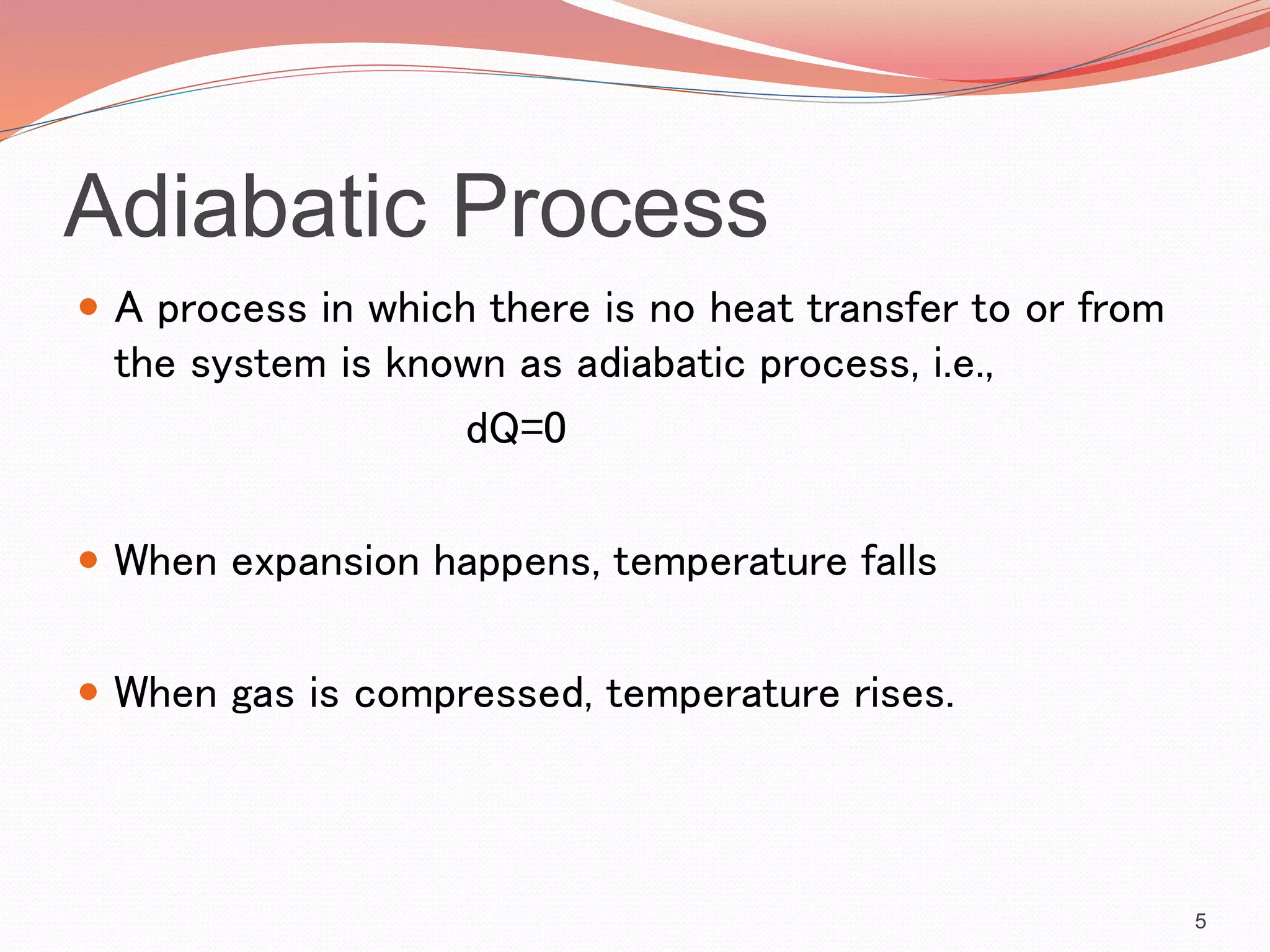
Work Done
 Work is a measure of change of energy.
 The net work done equals the change in Kinetic Energy.
 Work is the integral of the scalar product (dot-product)
of two vectors: Force and Displacement.
"Displacement" means the change in position of the
point at which the force is applied.
 The SI unit of the amount of Work done by a Force of
one Newton acting over a displacement of one meter,
and is called the joule (J), or Newton-meter (N-m).
4
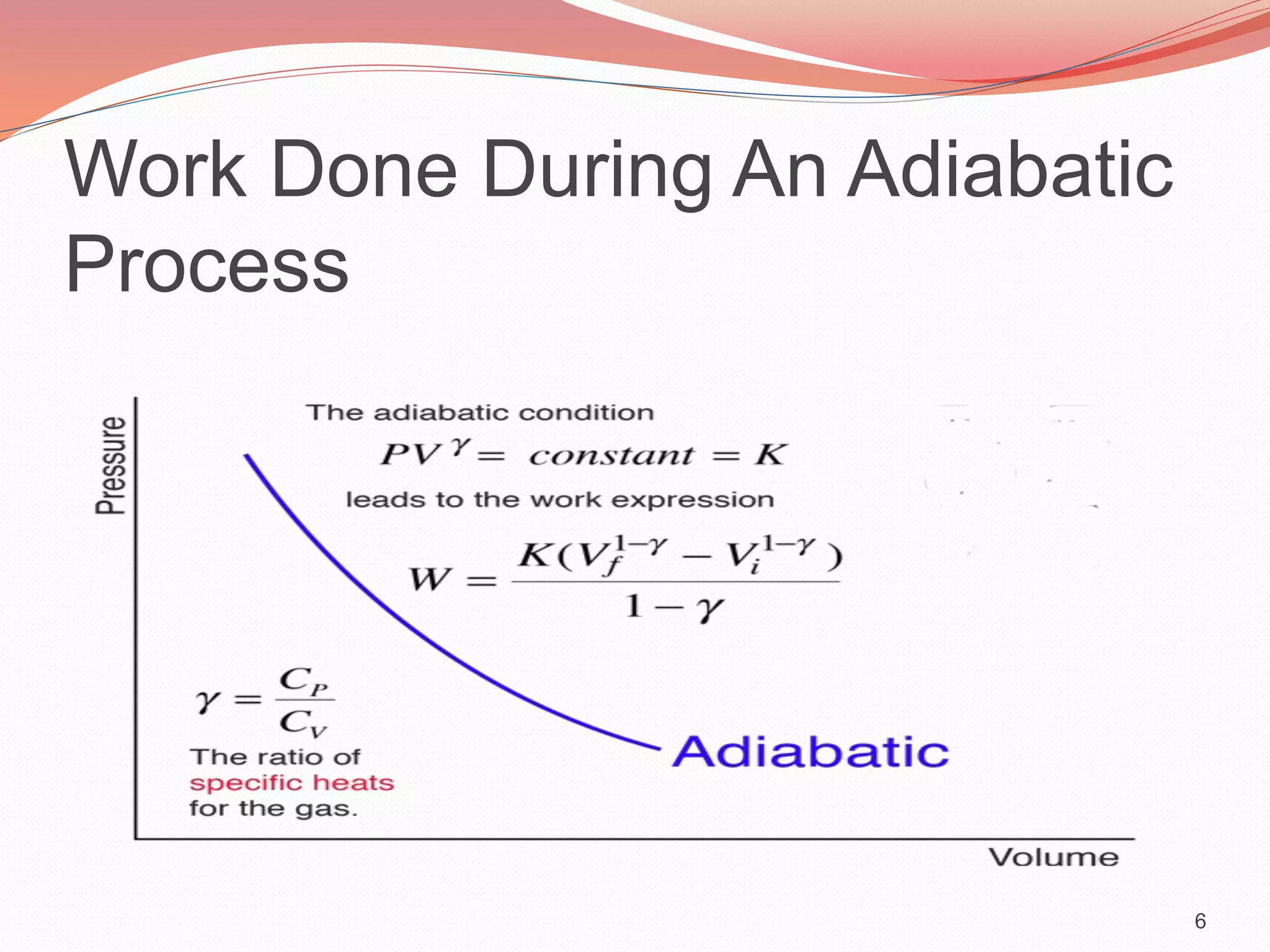
Adiabatic Process
 A process in which there is no heat transfer to or from
the system is known as adiabatic process, i.e.,
dQ=0
 When expansion happens, temperature falls
 When gas is compressed, temperature rises.
5
Work Done During An Adiabatic
Process
6
Adiabatic Expansion & Adiabatic
Compression
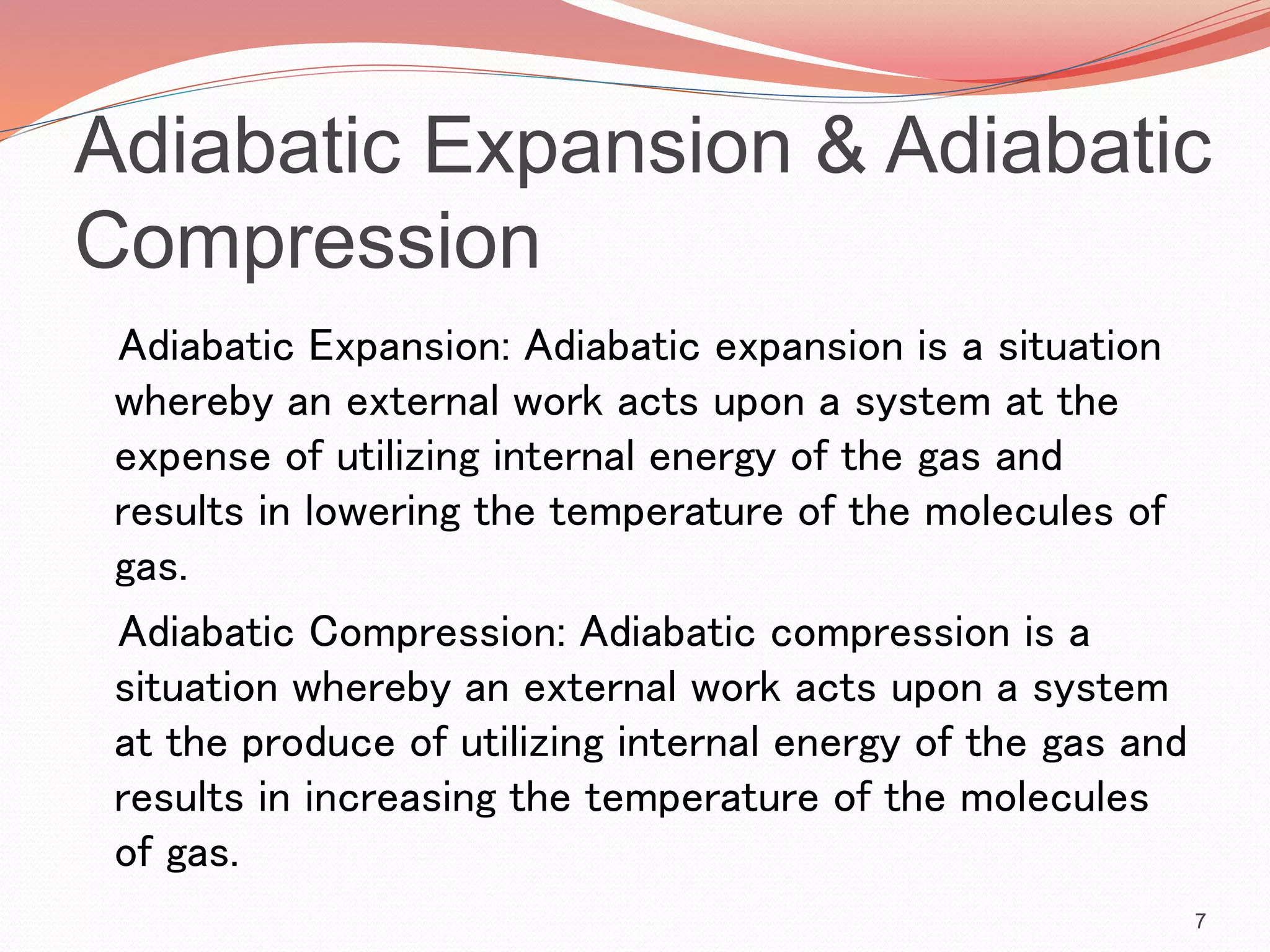
Adiabatic Expansion: Adiabatic expansion is a situation
whereby an external work acts upon a system at the
expense of utilizing internal energy of the gas and
results in lowering the temperature of the molecules of
gas.
Adiabatic Compression: Adiabatic compression is a
situation whereby an external work acts upon a system
at the produce of utilizing internal energy of the gas and
results in increasing the temperature of the molecules
of gas.
7
A Problem & Solution
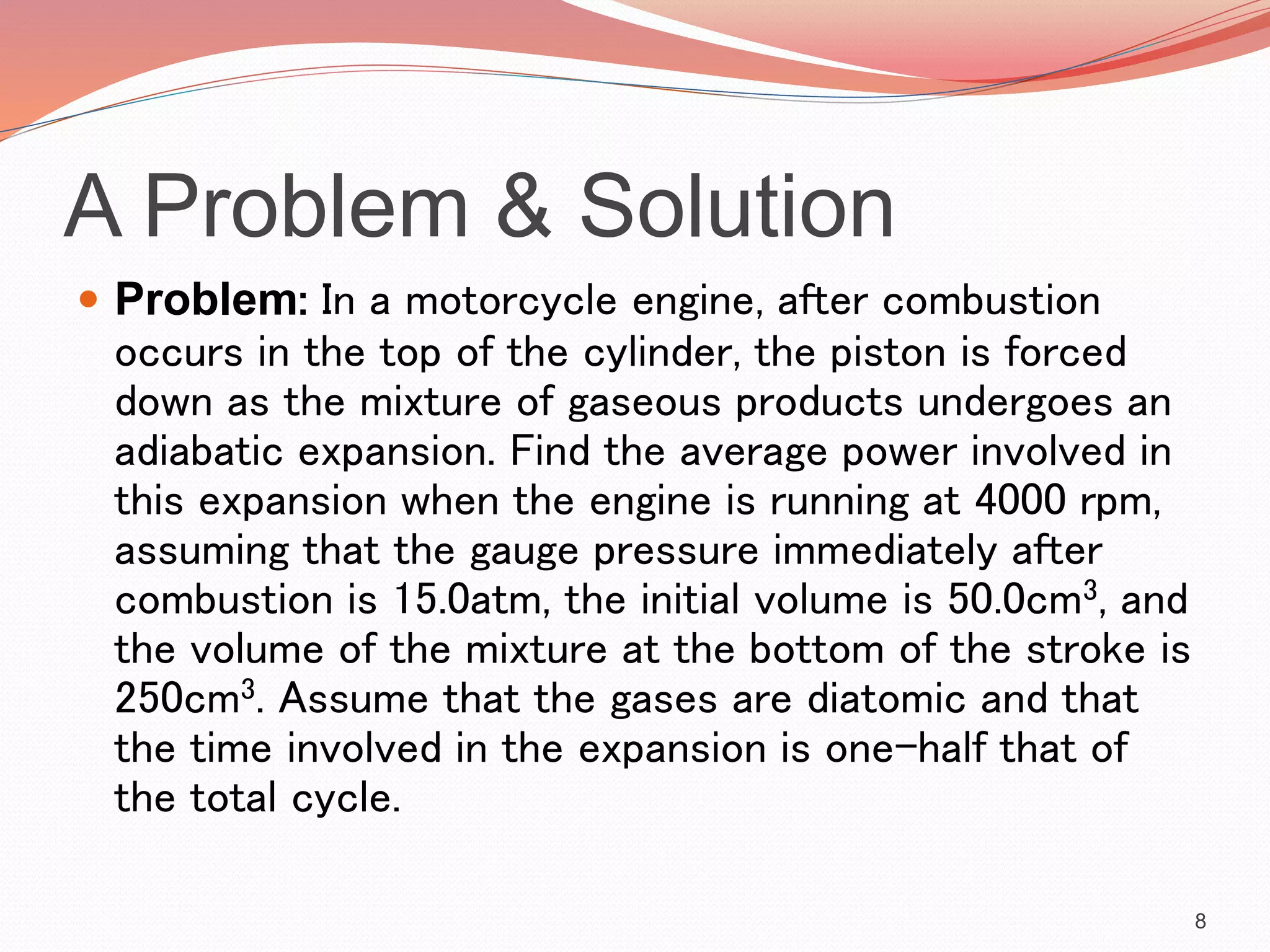
 Problem: In a motorcycle engine, after combustion
occurs in the top of the cylinder, the piston is forced
down as the mixture of gaseous products undergoes an
adiabatic expansion. Find the average power involved in
this expansion when the engine is running at 4000 rpm,
assuming that the gauge pressure immediately after
combustion is 15.0atm, the initial volume is 50.0cm3, and
the volume of the mixture at the bottom of the stroke is
250cm3. Assume that the gases are diatomic and that
the time involved in the expansion is one-half that of
the total cycle.
8
A Problem & Solution
Solution:
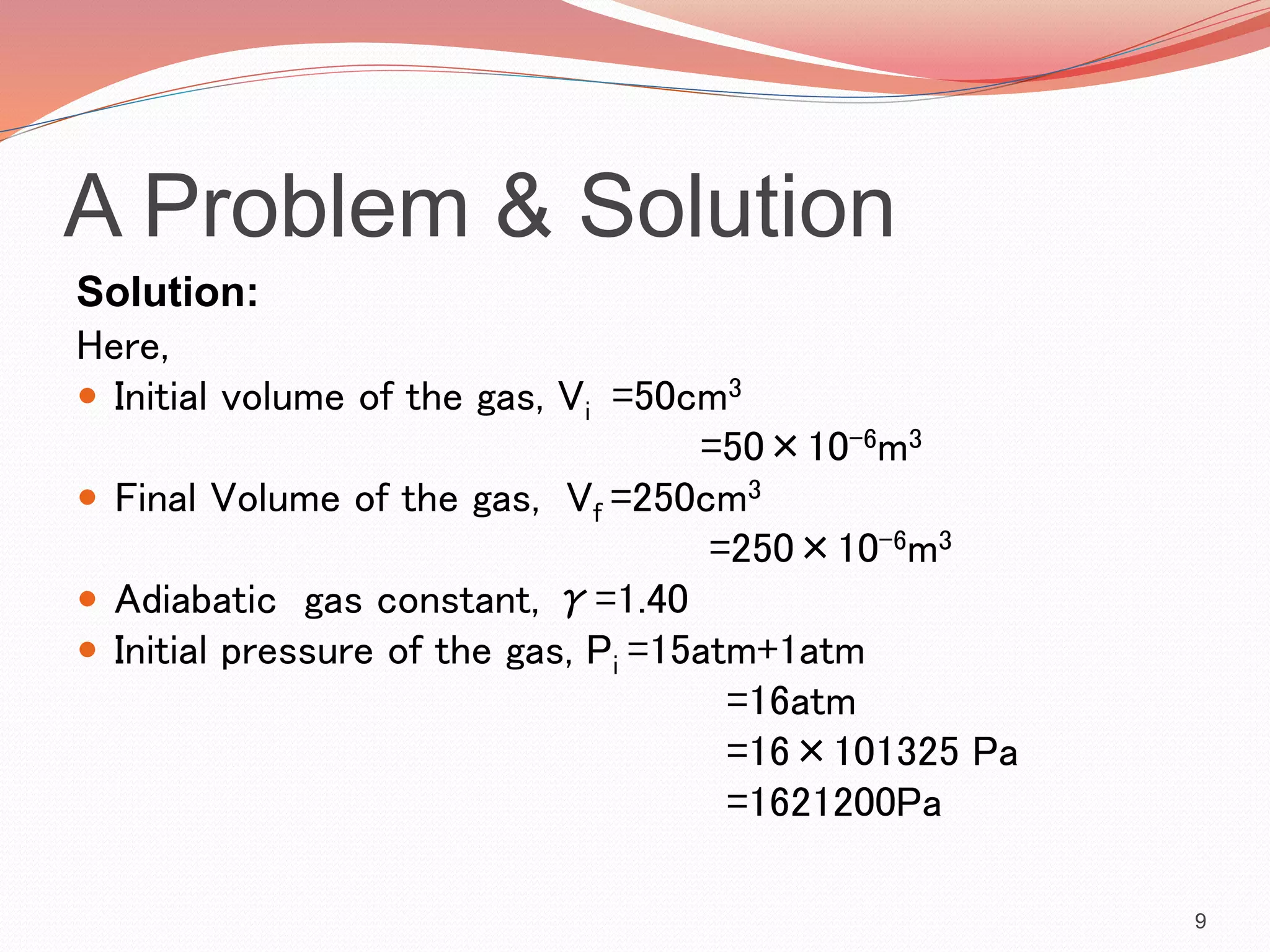
Here,
 Initial volume of the gas, Vi =50cm3
=50×10-6m3
 Final Volume of the gas, Vf =250cm3
=250×10-6m3
 Adiabatic gas constant, γ=1.40
 Initial pressure of the gas, Pi =15atm+1atm
=16atm
=16×101325 Pa
=1621200Pa
9
A Problem & Solution
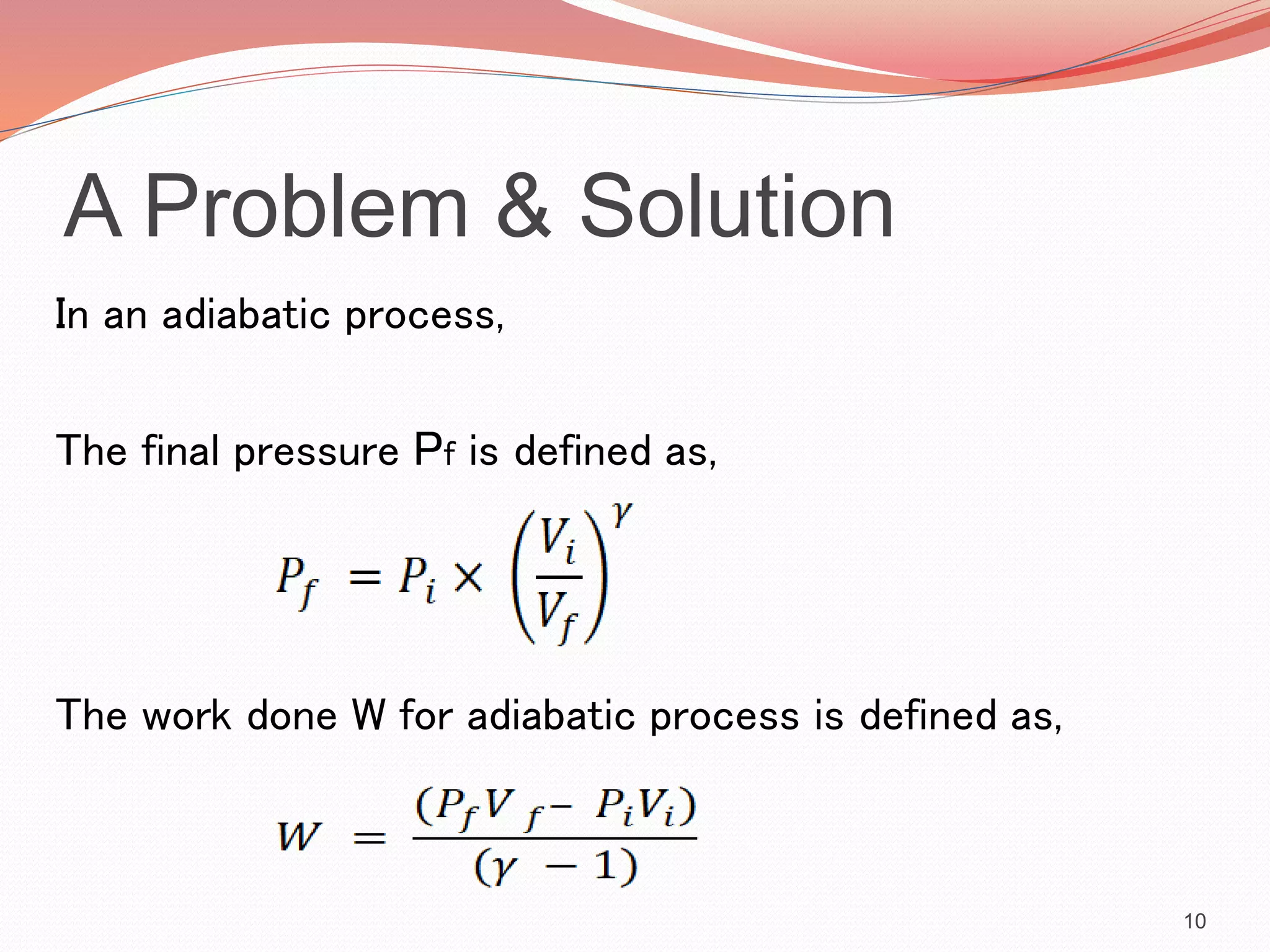
In an adiabatic process,
The final pressure Pf is defined as,
The work done W for adiabatic process is defined as,
10
A Problem & Solution
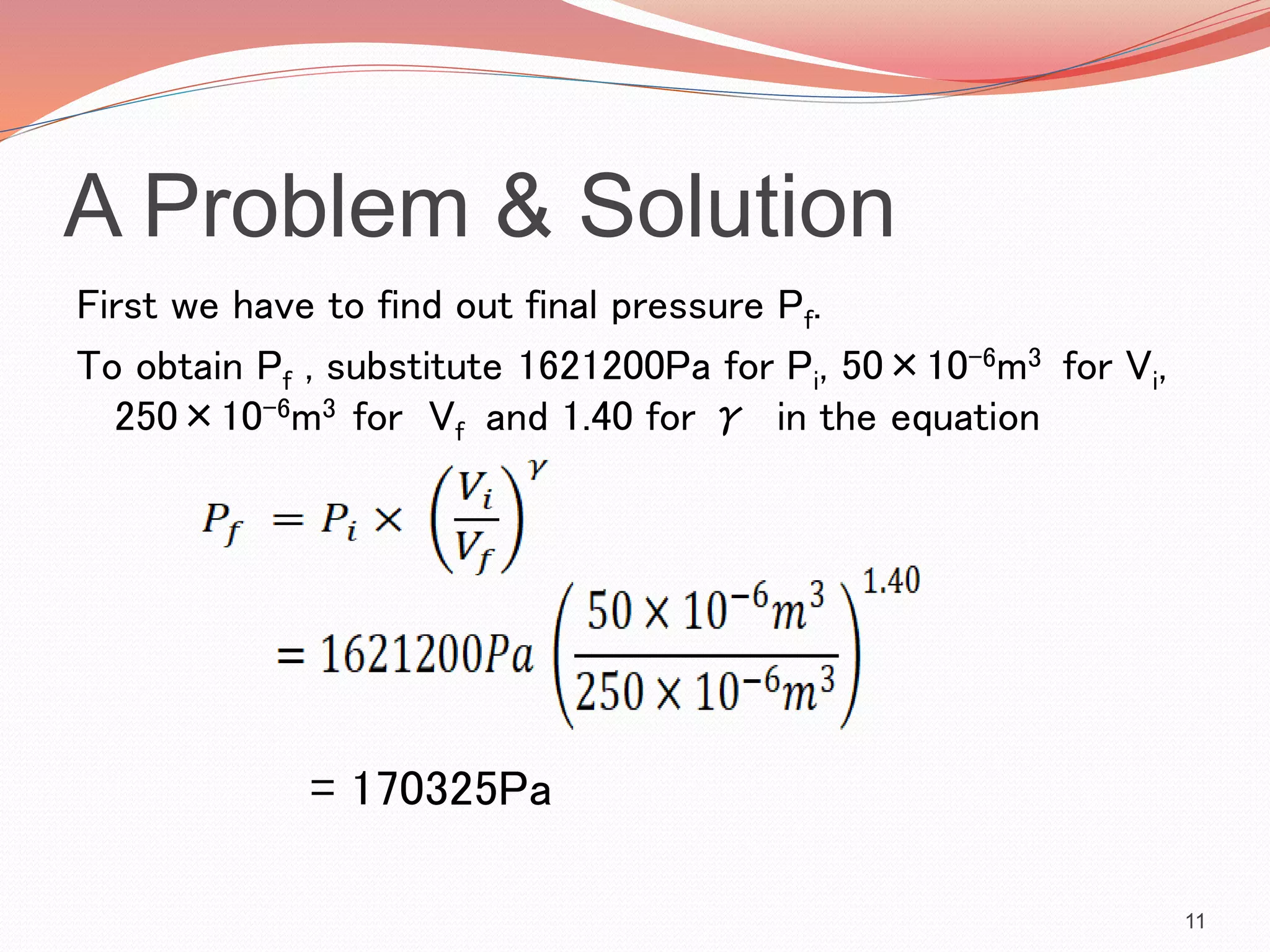
First we have to find out final pressure Pf.
To obtain Pf , substitute 1621200Pa for Pi, 50×10-6m3 for Vi,
250×10-6m3 for Vf and 1.40 for γ in the equation
= 170325Pa
11
A Problem & Solution
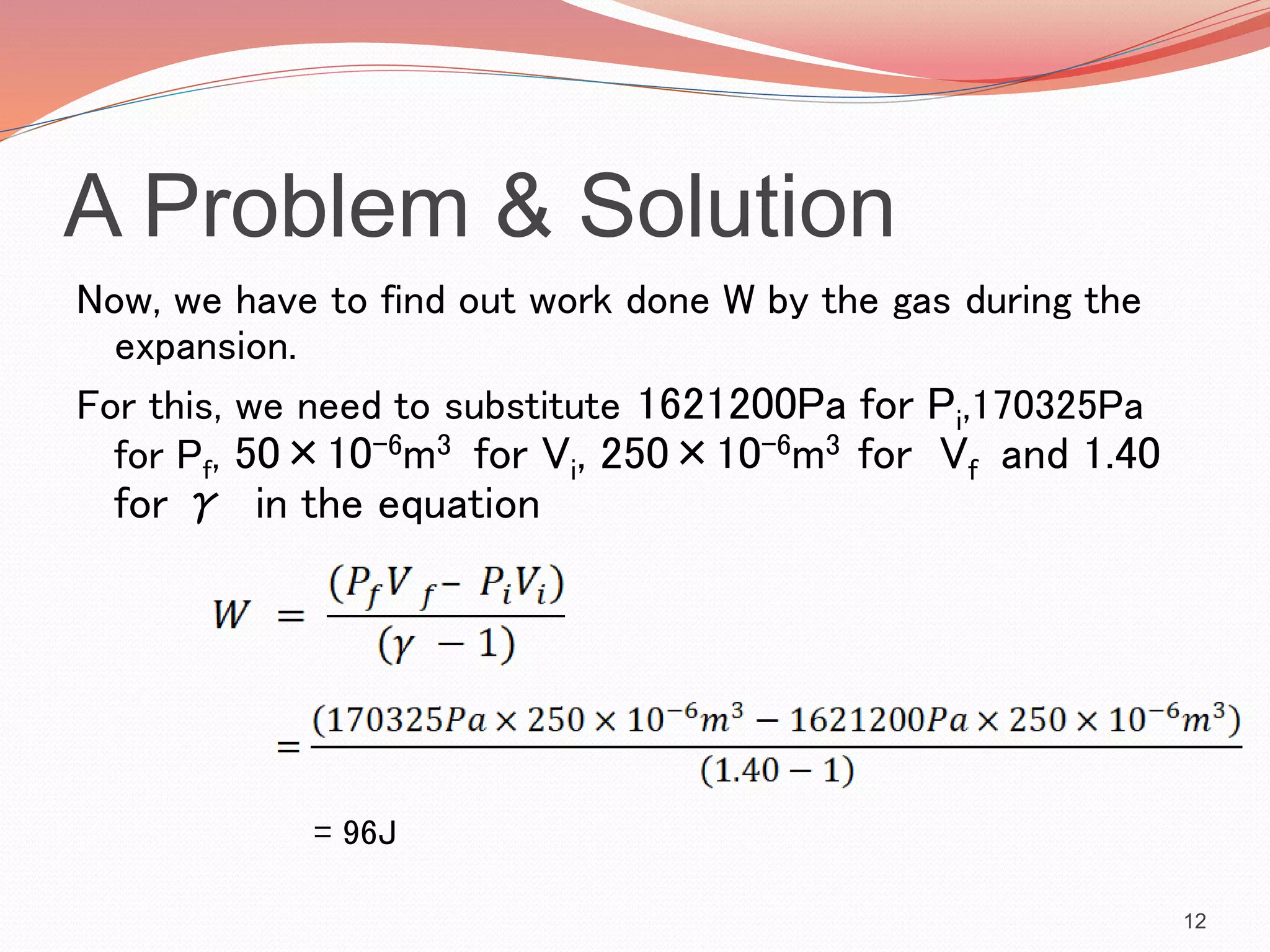
Now, we have to find out work done W by the gas during the
expansion.
For this, we need to substitute 1621200Pa for Pi,170325Pa
for Pf, 50×10-6m3 for Vi, 250×10-6m3 for Vf and 1.40
for γ in the equation
= 96J
12
A Problem & Solution
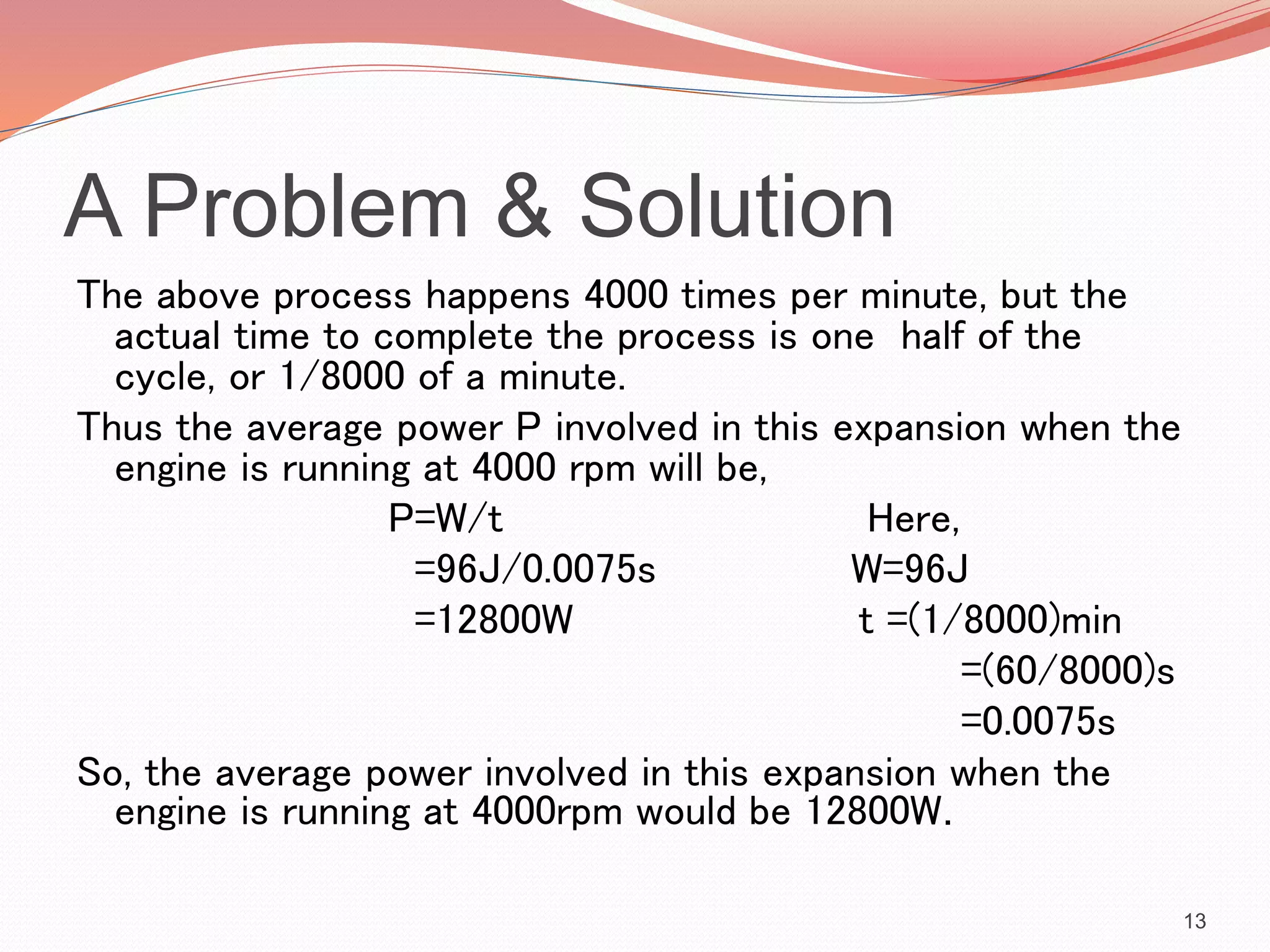
The above process happens 4000 times per minute, but the
actual time to complete the process is one half of the
cycle, or 1/8000 of a minute.
Thus the average power P involved in this expansion when the
engine is running at 4000 rpm will be,
P=W/t Here,
=96J/0.0075s W=96J
=12800W t =(1/8000)min
=(60/8000)s
=0.0075s
So, the average power involved in this expansion when the
engine is running at 4000rpm would be 12800W.
13
Conclusion
At the end of the presentation we came to know-
 Concept of adiabatic expansion & compression.
 Analysis of adiabatic process
 Use of work done formula in adiabatic process.
14
End Of
Presentation
15

Work Done in an Adiabatic Process

  • 1.
  • 2.
    Work Done InAn Adiabatic Process Presented By: Imran Hossain Chowdhury Presented To: Mirza Mahbubur Rahman Senior Lecturer, Department of EEE 2
  • 3.
    Overview  Work Done. Adiabatic Process.  Work Done During an Adiabatic Process  Adiabatic Expansion & Compression  A Problem & Solution  Conclusion 3
  • 4.
    Work Done  Workis a measure of change of energy.  The net work done equals the change in Kinetic Energy.  Work is the integral of the scalar product (dot-product) of two vectors: Force and Displacement. "Displacement" means the change in position of the point at which the force is applied.  The SI unit of the amount of Work done by a Force of one Newton acting over a displacement of one meter, and is called the joule (J), or Newton-meter (N-m). 4
  • 5.
    Adiabatic Process  Aprocess in which there is no heat transfer to or from the system is known as adiabatic process, i.e., dQ=0  When expansion happens, temperature falls  When gas is compressed, temperature rises. 5
  • 6.
    Work Done DuringAn Adiabatic Process 6
  • 7.
    Adiabatic Expansion &Adiabatic Compression Adiabatic Expansion: Adiabatic expansion is a situation whereby an external work acts upon a system at the expense of utilizing internal energy of the gas and results in lowering the temperature of the molecules of gas. Adiabatic Compression: Adiabatic compression is a situation whereby an external work acts upon a system at the produce of utilizing internal energy of the gas and results in increasing the temperature of the molecules of gas. 7
  • 8.
    A Problem &Solution  Problem: In a motorcycle engine, after combustion occurs in the top of the cylinder, the piston is forced down as the mixture of gaseous products undergoes an adiabatic expansion. Find the average power involved in this expansion when the engine is running at 4000 rpm, assuming that the gauge pressure immediately after combustion is 15.0atm, the initial volume is 50.0cm3, and the volume of the mixture at the bottom of the stroke is 250cm3. Assume that the gases are diatomic and that the time involved in the expansion is one-half that of the total cycle. 8
  • 9.
    A Problem &Solution Solution: Here,  Initial volume of the gas, Vi =50cm3 =50×10-6m3  Final Volume of the gas, Vf =250cm3 =250×10-6m3  Adiabatic gas constant, γ=1.40  Initial pressure of the gas, Pi =15atm+1atm =16atm =16×101325 Pa =1621200Pa 9
  • 10.
    A Problem &Solution In an adiabatic process, The final pressure Pf is defined as, The work done W for adiabatic process is defined as, 10
  • 11.
    A Problem &Solution First we have to find out final pressure Pf. To obtain Pf , substitute 1621200Pa for Pi, 50×10-6m3 for Vi, 250×10-6m3 for Vf and 1.40 for γ in the equation = 170325Pa 11
  • 12.
    A Problem &Solution Now, we have to find out work done W by the gas during the expansion. For this, we need to substitute 1621200Pa for Pi,170325Pa for Pf, 50×10-6m3 for Vi, 250×10-6m3 for Vf and 1.40 for γ in the equation = 96J 12
  • 13.
    A Problem &Solution The above process happens 4000 times per minute, but the actual time to complete the process is one half of the cycle, or 1/8000 of a minute. Thus the average power P involved in this expansion when the engine is running at 4000 rpm will be, P=W/t Here, =96J/0.0075s W=96J =12800W t =(1/8000)min =(60/8000)s =0.0075s So, the average power involved in this expansion when the engine is running at 4000rpm would be 12800W. 13
  • 14.
    Conclusion At the endof the presentation we came to know-  Concept of adiabatic expansion & compression.  Analysis of adiabatic process  Use of work done formula in adiabatic process. 14
  • 15.