BY SAYEDA SALMA
1ST M PHARM
What is supac ?
In the process of developing the new product ,
the batch size used in earliest human studies are
small.
The sizes of the batch is gradually increased(scale
up).
The scale up and the changes made after approval
in the composition, manufacturing process ,
manufacturing equipment and change of site have
become known as scale up and post approval
changes (supac).
SUPAC
The FDA has issued various guidance for supac changes
designated as:
Supac-IR ( for immediate release solid oral dosage
form).
Supac-MR (for modified release solid oral dosage
form).
Supac-SS (for non sterile semisolid dosage form
including creams, ointments, gels and lotions).
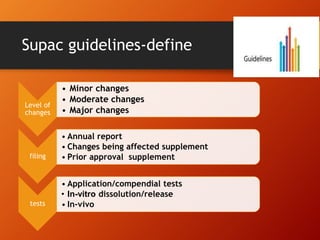
Supac guidelines-define
Level of
changes
• Minor changes
• Moderate changes
• Major changes
filing
• Annual report
• Changes being affected supplement
• Prior approval supplement
tests
• Application/compendial tests
• In-vitro dissolution/release
• In-vivo
Level of changes
Likelihood of impact on formulation quality and performance:
• Level 1: Those changes that are unlikely to have any detectable
impact on formulation quality and performance.
• Example- Changes in the colour, flavours, Changes In the
excipient expressed as percentage (w/w) of total formulation,
less than or equal to the following range .
• Level2: Changes are those that could have significant
impact on the formulation quality and performance.
• Example -Changes in the technical grade of excipient
(Avicel PH102 vs Avicel PH200) Changes expressed as
percent (w/w of total formulation) .
• Level3:
 Level 3 : changes are those that are likely to have significant
impact on formulation quality and performance.
Example -Any qualitative or quantitative excipient changes a
narrow therapeutic drug beyond the range for level 1 and All
other drug not meeting the dissolution criteria as level 2.
These guidelines provide recommdation for post
approval changes in:
• In component or compostion
• The site of manufacture
• The scale up of manufacture
• The manufacturing(process and equipment)
Component and composition
changes
SUPAC-IR:
 Focus on changes in the amount of excipients in the
drug product.
SUPAC-MR:
 Excipient critical or non critical to the drug release. -
Changes in non release controlling excipients - Changes
in release controlling excipients.
SUPAC-SS:
 Changes in preservative.
SUPAC-IR ( components
and composition)
SUPAC-IR
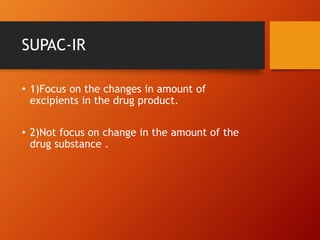
• 1)Focus on the changes in amount of
excipients in the drug product.
• 2)Not focus on change in the amount of the
drug substance .
LEVEL CLASSIFICATION EXCIPIENT
RANGES (%w/w
of total
formulation)
TEST
DOCUMENTATION
FILING
DOCUMENTA
TION
1) • Delition or
partial
delition of an
ingredient
(colour ,
flavor or
change in
ingredient of
the ink).
• -Changes in
excipients,
expressed as
% (w/w) of
total
formulation,
less than or
equal to
excipient.
 Filler
 ±5
Disintegrant
 Starch
 ±1 Binder
 ±0.5 Lubricant
 Calcium
(Ca)or
Magnesium
 (Mg) Stearate
±0.25
 stability
 Application/Co
mpendial
requirements
 Annual report
LEVEL CLASSIFICATION EXCIPIENT
RANGES (%w/w of
total formulation)
TEST
DOCUMENTATION
FILING
DOCUMEN
TATION
2)  Change in
technical
grade of
excipient.
 Changes in
excipients,
expressed as
% (w/w) of
total
formulation,
greater than
Level 1
changes.
 Filler
 ±10
Disintegrant
 Starch
 ±6 Other
 ±1 Binder
 ±1 Lubricant
 Calcium (Ca) or
 Magnesium (Mg)
 Stearate ±0.5
 Other
±2 Glidant Talc
±2 Other
±0.2
 -stability
application/co
mpendial
requirements.
 Dissolution
data depends
on solubility,
therapeutic
range and
permeability.
 Case A(hp-hs)
 Case B(lp-hs)
 Case C(hp-ls)
•Prior
approval
supplement
•Annual report
LEVEL CLASSIFICATION TEST DOCUMENTATION FILING
DOCUMENTATION
3)  Higher than SUPAC-
IR.
 Level 1 and Level 2
excipient ranges.
 stability
application/compend
ial requirements.
 Case B dissolution
profile (Multi-point
dissolution profile in
the application
/compendial medium
at 15, 30, 45, 60,
and 120 minutes or
until an asymptote is
reached for the
proposed and
currently accepted
formulation).

 Biostudy or IVIVC
•Prior approval
supplement.
•Annual report.
SUPAC-MR (components
and composition)
SUPAC-MR
Components and composition of non-release controlling
excipient and release controlling excipient.
 Focuses on changes to non-release controlling excipients.
 Changes in components or composition that have the
effect of adding a new excipient or deleting an excipient
are defined at level 3.
Non-release controlling excipient
LEVEL CLASSIFICATION TEST DOCUMENTATION FILING
1)  Delition or partial
delition of an
ingredient –up to
SUPAC-IR Level 1
excipient ranges.
 stability-
application/compen
dial requirements.
 Annual report
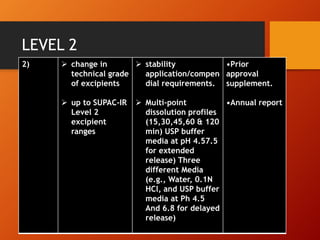
LEVEL 2
2)  change in
technical grade
of excipients
 up to SUPAC-IR
Level 2
excipient
ranges
 stability
application/compen
dial requirements.
 Multi-point
dissolution profiles
(15,30,45,60 & 120
min) USP buffer
media at pH 4.57.5
for extended
release) Three
different Media
(e.g., Water, 0.1N
HCl, and USP buffer
media at Ph 4.5
And 6.8 for delayed
release)
•Prior
approval
supplement.
•Annual report
LEVEL 3
3)  Higher than
SUPAC-IR
Level 1 and
Level 2
excipient
ranges.
 -stability
application/compen
dial requirements.
 Biostudy or IVIVC
 Prior approval
supplement
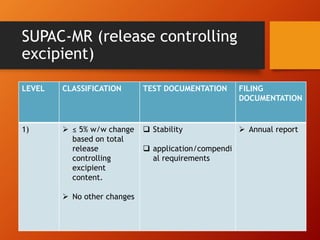
SUPAC-MR (release controlling
excipient)
LEVEL CLASSIFICATION TEST DOCUMENTATION FILING
DOCUMENTATION
1)  ≤ 5% w/w change
based on total
release
controlling
excipient
content.
 No other changes
 Stability
 application/compendi
al requirements
 Annual report
LEVEL 2
2)  change in
technical grade
of excipients.
 ≤ 10% w/w
change based
on total release
controlling
excipient
content.
 stability
application/compendi
al requirements.
 Multi-point dissolution
profiles (15,30,45,60
& 120 min) USP buffer
pH 4.5-7.5 for
extended release)
Three different Media
(e.g., Water, 0.1N
HCl, and USP buffer
media at Ph 4.5 And
6.8 for DR release)
 Prior
approval
supplement
 Annual
report
SUPAC-SS (components
and composition)
SUPAC-SS
• for non sterile semisolid dosage form including
creams , ointments , gels and lotions.
SUPAC-SS (Components and
composition)
LEVEL CLASSIFICATION TEST
DOCUMENTATION
FILING
DOCUMENTATION
1)  Delition or partial
delition of an
ingredient.
 change in supplier or
technical grade of
any other excipient.
 Up to 5 % change in
approved amount of
ingredient
 Stability
 application/
compendial
requirements
 Annual report
LEVEL 2
2)  Upto >5 % and ≤ 10
% change in
approved amount of
ingredient.
 Change in particle
size distribution of
the drug substance,
if the drug is in
Suspension.
 change in supplier
or technical grade
of any other
excipient
 stability
application/compe
ndial requirements
 in vitro release
test
 Changes
being
effected
supplement
 Annual
report
LEVEL 3
3)  change in approved
amount of
ingredient.
 Change in
crystalline form of
ingredient
 Stability
 application/comp
endial
requirements
 Prior
approval
supplement
SUPAC-SS (preservative)
LEVEL CLASSIFICATION TEST
DOCUMENTATION
FILING
DOCUMENTATION
1) Quantitatively 10% or
less change in the
approved amount of
preservative.
 application/comp
endial
requirements
 Preservative
effectiveness test
at lowest
specified
preservative level
Annual report
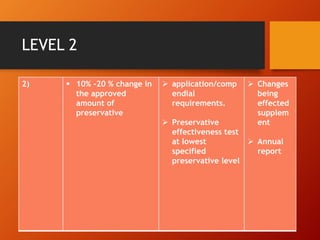
LEVEL 2
2)  10% -20 % change in
the approved
amount of
preservative
 application/comp
endial
requirements.
 Preservative
effectiveness test
at lowest
specified
preservative level
 Changes
being
effected
supplem
ent
 Annual
report
LEVEL 3
3)  > 20% change in
the approved
amount of
preservative
(including
deletion) or use of
a different
preservative.
 application/compen
dial requirements -
executed batch
records.
 For new
preservative,
analytical method
for identification
and assay validation
studies.
 Preservative
effectiveness test at
lowest specified
preservative.
 Prior
approval
supplement
 Annual
report
Site changes
It includes the changes in location of the site
of manufacturing facilities for both company
owner and contract manufacturer.
It does not include scale up
LEVEL 1
LEVEL CLASSIFICATION TEST
DOCUMENTATION
FILING
DOCUMENTATION
1)  Site change within a
single facility.
 No change in SOP,
environmental
conditions or
equipment's used.
 Common personnel's
 application/co
mpendial
requirements
Annual report
Level 2
2)  Same
continuous
campus
 Common
personnel
 No other
changes
 application/compendial
requirements.
 Notification of Location of
new site
 Updated batch records.
 SUPAC – MR : Multi-point
dissolution profiles
(15,30,45,60 & 120 min) USP
buffer media at pH 4.5-7.5 for
extended release) Three
different Media (e.g., Water,
0.1N HCl, and USP buffer
media at Ph 4.5 And 6.8 for
delayed release)until 80% of
Drug Released.
 Annual
report
 Changes
being
Effected
Supplement
LEVEL 3
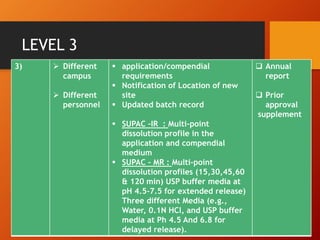
3)  Different
campus
 Different
personnel
 application/compendial
requirements
 Notification of Location of new
site
 Updated batch record
 SUPAC –IR : Multi-point
dissolution profile in the
application and compendial
medium
 SUPAC – MR : Multi-point
dissolution profiles (15,30,45,60
& 120 min) USP buffer media at
pH 4.5-7.5 for extended release)
Three different Media (e.g.,
Water, 0.1N HCl, and USP buffer
media at Ph 4.5 And 6.8 for
delayed release).
 Annual
report
 Prior
approval
supplement
Change in
batch size
(scale up of
manufacture)
Post approval changes in the size of a
batch from the pivotal/pilot scale
biobatch material to larger or smaller
production.
Post
Scale down below 1,00,000 dosage
units is not covered by this guideline.
Scale
down
Scale up changes should be properly
validated and if needed, inspected by
appropriate agency personnel.
Scale
up
Level 1
LEVEL CLASSIFICATION TEST DOCUMENTATION FILING
DOCUMENTATION
1)  Change in batch
size, up to and
including a
factor of 10
times the size
of the
pilot/biobatch
 Updated batch records
application/compendial
requirements stability
Annual report
Level 2
2)  Changes in
batch size
beyond a factor
of ten times the
size of the pilot
or biobatch
 No other
changes
 -Updated batch records -
application/compendial
requirements
 Stability
 SUPAC –IR Multi-point
dissolution profiles.
 SUPAC – MR -Multi-point
dissolution profiles in multiple
medias (e.g., USP buffer
media at pH 4.5-7.5 for
extended release) three other
media (e.g., Water, 0.1N HCl,
and USP buffer media at Ph
4.5 And 6.8 for delayed
o Annual
report
o Changes
being
effected
by
suppleme
nt
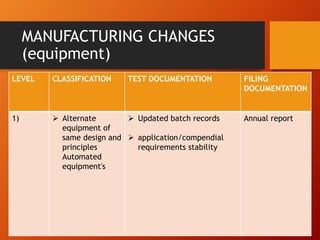
MANUFACTURING CHANGES
(equipment)
LEVEL CLASSIFICATION TEST DOCUMENTATION FILING
DOCUMENTATION
1)  Alternate
equipment of
same design and
principles
Automated
equipment's
 Updated batch records
 application/compendial
requirements stability
Annual report
LEVEL 2
2)  Change to
equipment of
different design
and principle
 Updated batch records
application/compendial
requirements
 Stability
 SUPAC –IR Multi-point
dissolution profiles in
multiple medias
 SUPAC – MR -Multi-point
dissolution profiles in
multiple medias
 Annual
report
 Changes
being
Effected
Suppleme
nt
MANUFACTURING CHANGES
(PROCESS)

LEVEL CLASSIFICATION TEST DOCUMENTATION FILING
DOCUMENTATION
1)  Adjustment
of equipment
operating
conditions
(operating
speeds,
mixing times)
 Within
approved
application
ranges
 Updated batch records
 application/compendial
requirements
 Stability
Annual report
LEVEL 2
2)  Adjustment of
equipment
operating
conditions
(operating
speeds,
mixing times)
 Beyond
approved
application
ranges
 SUPAC – SS
Change in the
process of
combining two
phases
 -Updated batch records -
application/compendial
requirements
 Stability
 SUPAC-IR Multi-point
dissolution profile.
 SUPAC-MR -Multi-point
dissolution profiles in
multiple medias (e.g., USP
buffer media at pH 4.5-7.5
for extended release) three
other media (e.g., Water,
0.1N HCl, and USP buffer
media at Ph 4.5 And 6.8 for
delayed release).
 SUPAC-SS In vitro release
test Documentation.
 Annual
report
 Changes
being
Effected
Suppleme
nt
LEVEL 3
3)  Changes in
the type of
process
used (e.g.
wet
granulation
to direct
compressio
n
 Updated batch records -
application/compendial
requirements -Stability -
Biostudy or IVIVC.
 SUPAC-IR Multi-point
dissolution profile.
 SUPAC-MR Multi-point
dissolution profiles in
multiple medias (e.g., USP
buffer media at pH 4.5-7.5
for extended release) three
other media (e.g., Water,
0.1N HCl, and USP buffer
media at Ph 4.5 And 6.8 for
delayed release)
 Prior
approval
supplement
 Annual
report
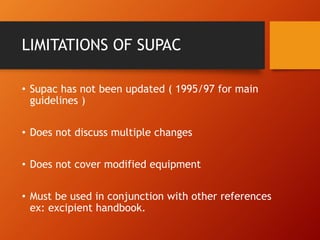
LIMITATIONS OF SUPAC
• Supac has not been updated ( 1995/97 for main
guidelines )
• Does not discuss multiple changes
• Does not cover modified equipment
• Must be used in conjunction with other references
ex: excipient handbook.
Supac

Supac

  • 1.
  • 2.
    What is supac? In the process of developing the new product , the batch size used in earliest human studies are small. The sizes of the batch is gradually increased(scale up). The scale up and the changes made after approval in the composition, manufacturing process , manufacturing equipment and change of site have become known as scale up and post approval changes (supac).
  • 3.
    SUPAC The FDA hasissued various guidance for supac changes designated as: Supac-IR ( for immediate release solid oral dosage form). Supac-MR (for modified release solid oral dosage form). Supac-SS (for non sterile semisolid dosage form including creams, ointments, gels and lotions).
  • 4.
    Supac guidelines-define Level of changes •Minor changes • Moderate changes • Major changes filing • Annual report • Changes being affected supplement • Prior approval supplement tests • Application/compendial tests • In-vitro dissolution/release • In-vivo
  • 5.
    Level of changes Likelihoodof impact on formulation quality and performance: • Level 1: Those changes that are unlikely to have any detectable impact on formulation quality and performance. • Example- Changes in the colour, flavours, Changes In the excipient expressed as percentage (w/w) of total formulation, less than or equal to the following range .
  • 6.
    • Level2: Changesare those that could have significant impact on the formulation quality and performance. • Example -Changes in the technical grade of excipient (Avicel PH102 vs Avicel PH200) Changes expressed as percent (w/w of total formulation) .
  • 7.
    • Level3:  Level3 : changes are those that are likely to have significant impact on formulation quality and performance. Example -Any qualitative or quantitative excipient changes a narrow therapeutic drug beyond the range for level 1 and All other drug not meeting the dissolution criteria as level 2.
  • 8.
    These guidelines providerecommdation for post approval changes in: • In component or compostion • The site of manufacture • The scale up of manufacture • The manufacturing(process and equipment)
  • 9.
    Component and composition changes SUPAC-IR: Focus on changes in the amount of excipients in the drug product. SUPAC-MR:  Excipient critical or non critical to the drug release. - Changes in non release controlling excipients - Changes in release controlling excipients. SUPAC-SS:  Changes in preservative.
  • 10.
  • 11.
    SUPAC-IR • 1)Focus onthe changes in amount of excipients in the drug product. • 2)Not focus on change in the amount of the drug substance .
  • 12.
    LEVEL CLASSIFICATION EXCIPIENT RANGES(%w/w of total formulation) TEST DOCUMENTATION FILING DOCUMENTA TION 1) • Delition or partial delition of an ingredient (colour , flavor or change in ingredient of the ink). • -Changes in excipients, expressed as % (w/w) of total formulation, less than or equal to excipient.  Filler  ±5 Disintegrant  Starch  ±1 Binder  ±0.5 Lubricant  Calcium (Ca)or Magnesium  (Mg) Stearate ±0.25  stability  Application/Co mpendial requirements  Annual report
  • 13.
    LEVEL CLASSIFICATION EXCIPIENT RANGES(%w/w of total formulation) TEST DOCUMENTATION FILING DOCUMEN TATION 2)  Change in technical grade of excipient.  Changes in excipients, expressed as % (w/w) of total formulation, greater than Level 1 changes.  Filler  ±10 Disintegrant  Starch  ±6 Other  ±1 Binder  ±1 Lubricant  Calcium (Ca) or  Magnesium (Mg)  Stearate ±0.5  Other ±2 Glidant Talc ±2 Other ±0.2  -stability application/co mpendial requirements.  Dissolution data depends on solubility, therapeutic range and permeability.  Case A(hp-hs)  Case B(lp-hs)  Case C(hp-ls) •Prior approval supplement •Annual report
  • 14.
    LEVEL CLASSIFICATION TESTDOCUMENTATION FILING DOCUMENTATION 3)  Higher than SUPAC- IR.  Level 1 and Level 2 excipient ranges.  stability application/compend ial requirements.  Case B dissolution profile (Multi-point dissolution profile in the application /compendial medium at 15, 30, 45, 60, and 120 minutes or until an asymptote is reached for the proposed and currently accepted formulation).   Biostudy or IVIVC •Prior approval supplement. •Annual report.
  • 15.
  • 16.
    SUPAC-MR Components and compositionof non-release controlling excipient and release controlling excipient.  Focuses on changes to non-release controlling excipients.  Changes in components or composition that have the effect of adding a new excipient or deleting an excipient are defined at level 3.
  • 17.
    Non-release controlling excipient LEVELCLASSIFICATION TEST DOCUMENTATION FILING 1)  Delition or partial delition of an ingredient –up to SUPAC-IR Level 1 excipient ranges.  stability- application/compen dial requirements.  Annual report
  • 18.
    LEVEL 2 2) change in technical grade of excipients  up to SUPAC-IR Level 2 excipient ranges  stability application/compen dial requirements.  Multi-point dissolution profiles (15,30,45,60 & 120 min) USP buffer media at pH 4.57.5 for extended release) Three different Media (e.g., Water, 0.1N HCl, and USP buffer media at Ph 4.5 And 6.8 for delayed release) •Prior approval supplement. •Annual report
  • 19.
    LEVEL 3 3) Higher than SUPAC-IR Level 1 and Level 2 excipient ranges.  -stability application/compen dial requirements.  Biostudy or IVIVC  Prior approval supplement
  • 20.
    SUPAC-MR (release controlling excipient) LEVELCLASSIFICATION TEST DOCUMENTATION FILING DOCUMENTATION 1)  ≤ 5% w/w change based on total release controlling excipient content.  No other changes  Stability  application/compendi al requirements  Annual report
  • 21.
    LEVEL 2 2) change in technical grade of excipients.  ≤ 10% w/w change based on total release controlling excipient content.  stability application/compendi al requirements.  Multi-point dissolution profiles (15,30,45,60 & 120 min) USP buffer pH 4.5-7.5 for extended release) Three different Media (e.g., Water, 0.1N HCl, and USP buffer media at Ph 4.5 And 6.8 for DR release)  Prior approval supplement  Annual report
  • 22.
  • 23.
    SUPAC-SS • for nonsterile semisolid dosage form including creams , ointments , gels and lotions.
  • 24.
    SUPAC-SS (Components and composition) LEVELCLASSIFICATION TEST DOCUMENTATION FILING DOCUMENTATION 1)  Delition or partial delition of an ingredient.  change in supplier or technical grade of any other excipient.  Up to 5 % change in approved amount of ingredient  Stability  application/ compendial requirements  Annual report
  • 25.
    LEVEL 2 2) Upto >5 % and ≤ 10 % change in approved amount of ingredient.  Change in particle size distribution of the drug substance, if the drug is in Suspension.  change in supplier or technical grade of any other excipient  stability application/compe ndial requirements  in vitro release test  Changes being effected supplement  Annual report
  • 26.
    LEVEL 3 3) change in approved amount of ingredient.  Change in crystalline form of ingredient  Stability  application/comp endial requirements  Prior approval supplement
  • 27.
    SUPAC-SS (preservative) LEVEL CLASSIFICATIONTEST DOCUMENTATION FILING DOCUMENTATION 1) Quantitatively 10% or less change in the approved amount of preservative.  application/comp endial requirements  Preservative effectiveness test at lowest specified preservative level Annual report
  • 28.
    LEVEL 2 2) 10% -20 % change in the approved amount of preservative  application/comp endial requirements.  Preservative effectiveness test at lowest specified preservative level  Changes being effected supplem ent  Annual report
  • 29.
    LEVEL 3 3) > 20% change in the approved amount of preservative (including deletion) or use of a different preservative.  application/compen dial requirements - executed batch records.  For new preservative, analytical method for identification and assay validation studies.  Preservative effectiveness test at lowest specified preservative.  Prior approval supplement  Annual report
  • 30.
    Site changes It includesthe changes in location of the site of manufacturing facilities for both company owner and contract manufacturer. It does not include scale up
  • 31.
    LEVEL 1 LEVEL CLASSIFICATIONTEST DOCUMENTATION FILING DOCUMENTATION 1)  Site change within a single facility.  No change in SOP, environmental conditions or equipment's used.  Common personnel's  application/co mpendial requirements Annual report
  • 32.
    Level 2 2) Same continuous campus  Common personnel  No other changes  application/compendial requirements.  Notification of Location of new site  Updated batch records.  SUPAC – MR : Multi-point dissolution profiles (15,30,45,60 & 120 min) USP buffer media at pH 4.5-7.5 for extended release) Three different Media (e.g., Water, 0.1N HCl, and USP buffer media at Ph 4.5 And 6.8 for delayed release)until 80% of Drug Released.  Annual report  Changes being Effected Supplement
  • 33.
    LEVEL 3 3) Different campus  Different personnel  application/compendial requirements  Notification of Location of new site  Updated batch record  SUPAC –IR : Multi-point dissolution profile in the application and compendial medium  SUPAC – MR : Multi-point dissolution profiles (15,30,45,60 & 120 min) USP buffer media at pH 4.5-7.5 for extended release) Three different Media (e.g., Water, 0.1N HCl, and USP buffer media at Ph 4.5 And 6.8 for delayed release).  Annual report  Prior approval supplement
  • 34.
    Change in batch size (scaleup of manufacture) Post approval changes in the size of a batch from the pivotal/pilot scale biobatch material to larger or smaller production. Post Scale down below 1,00,000 dosage units is not covered by this guideline. Scale down Scale up changes should be properly validated and if needed, inspected by appropriate agency personnel. Scale up
  • 35.
    Level 1 LEVEL CLASSIFICATIONTEST DOCUMENTATION FILING DOCUMENTATION 1)  Change in batch size, up to and including a factor of 10 times the size of the pilot/biobatch  Updated batch records application/compendial requirements stability Annual report
  • 36.
    Level 2 2) Changes in batch size beyond a factor of ten times the size of the pilot or biobatch  No other changes  -Updated batch records - application/compendial requirements  Stability  SUPAC –IR Multi-point dissolution profiles.  SUPAC – MR -Multi-point dissolution profiles in multiple medias (e.g., USP buffer media at pH 4.5-7.5 for extended release) three other media (e.g., Water, 0.1N HCl, and USP buffer media at Ph 4.5 And 6.8 for delayed o Annual report o Changes being effected by suppleme nt
  • 37.
    MANUFACTURING CHANGES (equipment) LEVEL CLASSIFICATIONTEST DOCUMENTATION FILING DOCUMENTATION 1)  Alternate equipment of same design and principles Automated equipment's  Updated batch records  application/compendial requirements stability Annual report
  • 38.
    LEVEL 2 2) Change to equipment of different design and principle  Updated batch records application/compendial requirements  Stability  SUPAC –IR Multi-point dissolution profiles in multiple medias  SUPAC – MR -Multi-point dissolution profiles in multiple medias  Annual report  Changes being Effected Suppleme nt
  • 39.
    MANUFACTURING CHANGES (PROCESS)  LEVEL CLASSIFICATIONTEST DOCUMENTATION FILING DOCUMENTATION 1)  Adjustment of equipment operating conditions (operating speeds, mixing times)  Within approved application ranges  Updated batch records  application/compendial requirements  Stability Annual report
  • 40.
    LEVEL 2 2) Adjustment of equipment operating conditions (operating speeds, mixing times)  Beyond approved application ranges  SUPAC – SS Change in the process of combining two phases  -Updated batch records - application/compendial requirements  Stability  SUPAC-IR Multi-point dissolution profile.  SUPAC-MR -Multi-point dissolution profiles in multiple medias (e.g., USP buffer media at pH 4.5-7.5 for extended release) three other media (e.g., Water, 0.1N HCl, and USP buffer media at Ph 4.5 And 6.8 for delayed release).  SUPAC-SS In vitro release test Documentation.  Annual report  Changes being Effected Suppleme nt
  • 41.
    LEVEL 3 3) Changes in the type of process used (e.g. wet granulation to direct compressio n  Updated batch records - application/compendial requirements -Stability - Biostudy or IVIVC.  SUPAC-IR Multi-point dissolution profile.  SUPAC-MR Multi-point dissolution profiles in multiple medias (e.g., USP buffer media at pH 4.5-7.5 for extended release) three other media (e.g., Water, 0.1N HCl, and USP buffer media at Ph 4.5 And 6.8 for delayed release)  Prior approval supplement  Annual report
  • 42.
    LIMITATIONS OF SUPAC •Supac has not been updated ( 1995/97 for main guidelines ) • Does not discuss multiple changes • Does not cover modified equipment • Must be used in conjunction with other references ex: excipient handbook.