BY SAYEDA SALMA
1ST M PHARM
DEPT OF PHARMACEUTICS
INDEX
› Introduction
› Manufacturing variables
› Pharmaceutical ingredients/excipients
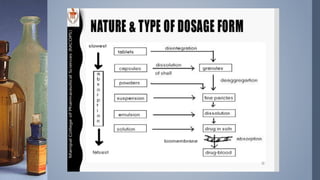
› Nature and type of dosage form
› Conclusion
› References
INTRODUCTION
› A drug injected intravascularly directly enters systemic
circulation & exerts its pharmacological effects.
› If intended to act systemically, such drugs can exert their
pharmacological actions only when they come into blood
circulation from their site of application.
› Majority of drugs are administered extravascular only.
› Absorption is an important step.
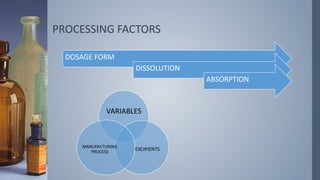
PROCESSING FACTORS
DOSAGE FORM
DISSOLUTION
ABSORPTION
VARIABLES
EXCIPIENTS
MANUFACTURING
PROCESS
MANUFACTURING PROCESSES
› Manufacturing processes that influence drug dissolution are:
1. Compression force
* density
* porosity
* hardness
* disintegration time
* dissolution of tablets
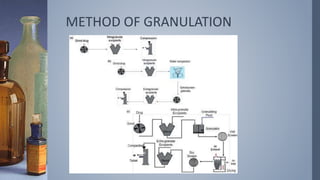
METHOD OF GRANULATION
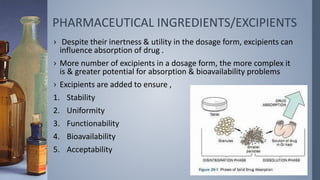
PHARMACEUTICAL INGREDIENTS/EXCIPIENTS
› Despite their inertness & utility in the dosage form, excipients can
influence absorption of drug .
› More number of excipients in a dosage form, the more complex it
is & greater potential for absorption & bioavailability problems
› Excipients are added to ensure ,
1. Stability
2. Uniformity
3. Functionability
4. Bioavailability
5. Acceptability
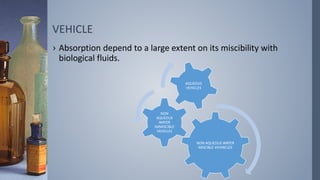
VEHICLE
› Absorption depend to a large extent on its miscibility with
biological fluids.
NON AQUEOUS WATER
MISCIBLE VEHINCLES
NON
AQUEOUS
WATER
IMMISCIBLE
VEHICLES
AQUEOUS
VEHICLES
DILUENTS
› Diluents are commonly added to tablet (and capsule)
formulations if the required dose is inadequate to produce the
necessary bulk.
› Eg of drug-diluent interaction resulting in poor bioavailability
is that of tetracycline & DCP
DILUENTS
BINDERS & GRANULATING AGENTS
› Promote cohesive compacts before & after compression.
› Eg polymeric materials like starch, cellulose derivatives, acacia,
PVP, etc.
COLOURANTS
› Very low concentration of water-soluble dye inhibitory effect
on dissolution
› Dye molecules get adsorbed onto the crystal faces & inhibit
drug dissolution
› E.g. brilliant blue retards dissolution of sulfathiazole
LUBRICANTS
› To aid flow of granules
› To reduce interparticle friction
› Sticking of particles to dies & punches
› Eg Hydrophobic in nature (several metallic stearates & waxes)
COATINGS
› Deleterious effect of various coatings on drug dissolution from a
tablet dosage form is enteric coat > sugar coat > nonenteric film
coat
› E.g. Shellac coated tablets, on prolonged storage, dissolve more
slowly in the GIT
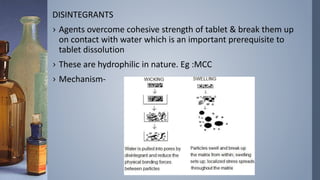
DISINTEGRANTS
› Agents overcome cohesive strength of tablet & break them up
on contact with water which is an important prerequisite to
tablet dissolution
› These are hydrophilic in nature. Eg :MCC
› Mechanism-
BUFFERS
› They create right atmosphere for dissolution. e.g. buffered
aspirin tablets.
› Buffer containing potassium cations inhibit the drug
absorption. e.g. vitamin B2 & sulphanilamide.
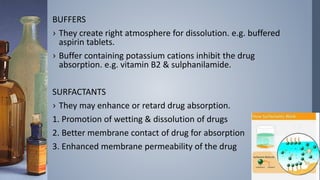
SURFACTANTS
› They may enhance or retard drug absorption.
1. Promotion of wetting & dissolution of drugs
2. Better membrane contact of drug for absorption
3. Enhanced membrane permeability of the drug
SUSPENDING AGENTS/VISCOSITY IMPARTERS
› Hydrophilic polymers like vegetable gums, semisynthetic gums
& synthetic gums.
› Stabilize drug particles by reducing their rate of settling & by
increasing viscosity of
› the medium they also affect palatability & pourability of
solution dosage forms. Eg Na-CMC complex amphetamine
increases drug absorption
CRYSTAL GROWTH INHIBITORS
› Eg crystal growth inhibitors like PVP & PEG inhibit conversion
of a high energy metastable polymorph into stable
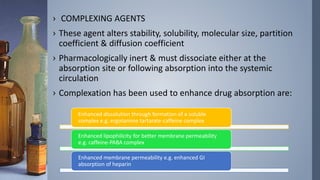
› COMPLEXING AGENTS
› These agent alters stability, solubility, molecular size, partition
coefficient & diffusion coefficient
› Pharmacologically inert & must dissociate either at the
absorption site or following absorption into the systemic
circulation
› Complexation has been used to enhance drug absorption are:
Enhanced dissolution through formation of a soluble
complex e.g. ergotamine tartarate-caffeine complex
Enhanced lipophilicity for better membrane permeability
e.g. caffeine-PABA complex
Enhanced membrane permeability e.g. enhanced GI
absorption of heparin
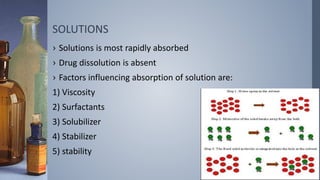
SOLUTIONS
› Solutions is most rapidly absorbed
› Drug dissolution is absent
› Factors influencing absorption of solution are:
1) Viscosity
2) Surfactants
3) Solubilizer
4) Stabilizer
5) stability
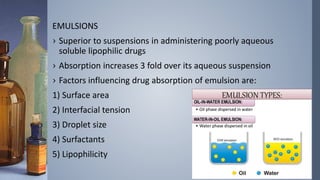
EMULSIONS
› Superior to suspensions in administering poorly aqueous
soluble lipophilic drugs
› Absorption increases 3 fold over its aqueous suspension
› Factors influencing drug absorption of emulsion are:
1) Surface area
2) Interfacial tension
3) Droplet size
4) Surfactants
5) Lipophilicity
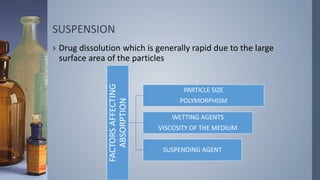
SUSPENSION
› Drug dissolution which is generally rapid due to the large
surface area of the particles
FACTORSAFFECTING
ABSORPTION
PARTICLE SIZE
POLYMORPHISM
WETTING AGENTS
VISCOSITY OF THE MEDIUM
SUSPENDING AGENT
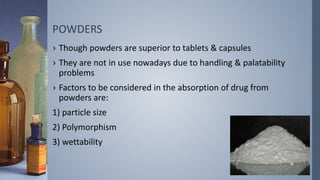
POWDERS
› Though powders are superior to tablets & capsules
› They are not in use nowadays due to handling & palatability
problems
› Factors to be considered in the absorption of drug from
powders are:
1) particle size
2) Polymorphism
3) wettability
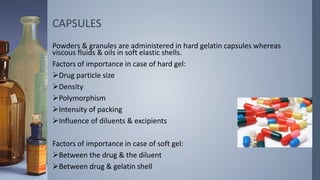
CAPSULES
Powders & granules are administered in hard gelatin capsules whereas
viscous fluids & oils in soft elastic shells.
Factors of importance in case of hard gel:
Drug particle size
Density
Polymorphism
Intensity of packing
Influence of diluents & excipients
Factors of importance in case of soft gel:
Between the drug & the diluent
Between drug & gelatin shell
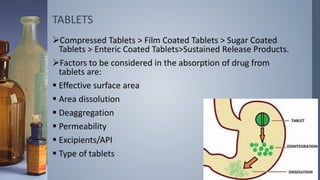
TABLETS
Compressed Tablets > Film Coated Tablets > Sugar Coated
Tablets > Enteric Coated Tablets>Sustained Release Products.
Factors to be considered in the absorption of drug from
tablets are:
 Effective surface area
 Area dissolution
 Deaggregation
 Permeability
 Excipients/API
 Type of tablets
CONCLUSION
› Absorption plays an major role to attain the desired
therapeutic action with minimal side effects at the given
period of time
› Formulation factors influencing drug absorption helps us to
focus on formulating drug with proper attainment of
permeability of drugs to systemic circulation at given time
REFERENCES
1) Brahmankar D.M., Jaiswal S.B., First edition, “Absorption of
Drugs” Biopharmaceutics and Pharmacokinetics – A treatise,
Vallabh Prakashan, Delhi 1995, page no. 27-77
2) Shargel L., Andrew B.C., Fourth edition “Physiologic factors
related to drug absorption” Applied Biopharmaceutics and
Pharmacokinetics, Prentice Hall International, INC., Stanford
1999, PageNo. 99-128
Formulation and processing factors

Formulation and processing factors

  • 1.
    BY SAYEDA SALMA 1STM PHARM DEPT OF PHARMACEUTICS
  • 2.
    INDEX › Introduction › Manufacturingvariables › Pharmaceutical ingredients/excipients › Nature and type of dosage form › Conclusion › References
  • 3.
    INTRODUCTION › A druginjected intravascularly directly enters systemic circulation & exerts its pharmacological effects. › If intended to act systemically, such drugs can exert their pharmacological actions only when they come into blood circulation from their site of application. › Majority of drugs are administered extravascular only. › Absorption is an important step.
  • 4.
  • 5.
    MANUFACTURING PROCESSES › Manufacturingprocesses that influence drug dissolution are: 1. Compression force * density * porosity * hardness * disintegration time * dissolution of tablets
  • 6.
  • 7.
    PHARMACEUTICAL INGREDIENTS/EXCIPIENTS › Despitetheir inertness & utility in the dosage form, excipients can influence absorption of drug . › More number of excipients in a dosage form, the more complex it is & greater potential for absorption & bioavailability problems › Excipients are added to ensure , 1. Stability 2. Uniformity 3. Functionability 4. Bioavailability 5. Acceptability
  • 8.
    VEHICLE › Absorption dependto a large extent on its miscibility with biological fluids. NON AQUEOUS WATER MISCIBLE VEHINCLES NON AQUEOUS WATER IMMISCIBLE VEHICLES AQUEOUS VEHICLES
  • 9.
    DILUENTS › Diluents arecommonly added to tablet (and capsule) formulations if the required dose is inadequate to produce the necessary bulk. › Eg of drug-diluent interaction resulting in poor bioavailability is that of tetracycline & DCP DILUENTS
  • 10.
    BINDERS & GRANULATINGAGENTS › Promote cohesive compacts before & after compression. › Eg polymeric materials like starch, cellulose derivatives, acacia, PVP, etc. COLOURANTS › Very low concentration of water-soluble dye inhibitory effect on dissolution › Dye molecules get adsorbed onto the crystal faces & inhibit drug dissolution › E.g. brilliant blue retards dissolution of sulfathiazole
  • 11.
    LUBRICANTS › To aidflow of granules › To reduce interparticle friction › Sticking of particles to dies & punches › Eg Hydrophobic in nature (several metallic stearates & waxes) COATINGS › Deleterious effect of various coatings on drug dissolution from a tablet dosage form is enteric coat > sugar coat > nonenteric film coat › E.g. Shellac coated tablets, on prolonged storage, dissolve more slowly in the GIT
  • 12.
    DISINTEGRANTS › Agents overcomecohesive strength of tablet & break them up on contact with water which is an important prerequisite to tablet dissolution › These are hydrophilic in nature. Eg :MCC › Mechanism-
  • 13.
    BUFFERS › They createright atmosphere for dissolution. e.g. buffered aspirin tablets. › Buffer containing potassium cations inhibit the drug absorption. e.g. vitamin B2 & sulphanilamide. SURFACTANTS › They may enhance or retard drug absorption. 1. Promotion of wetting & dissolution of drugs 2. Better membrane contact of drug for absorption 3. Enhanced membrane permeability of the drug
  • 14.
    SUSPENDING AGENTS/VISCOSITY IMPARTERS ›Hydrophilic polymers like vegetable gums, semisynthetic gums & synthetic gums. › Stabilize drug particles by reducing their rate of settling & by increasing viscosity of › the medium they also affect palatability & pourability of solution dosage forms. Eg Na-CMC complex amphetamine increases drug absorption CRYSTAL GROWTH INHIBITORS › Eg crystal growth inhibitors like PVP & PEG inhibit conversion of a high energy metastable polymorph into stable
  • 15.
    › COMPLEXING AGENTS ›These agent alters stability, solubility, molecular size, partition coefficient & diffusion coefficient › Pharmacologically inert & must dissociate either at the absorption site or following absorption into the systemic circulation › Complexation has been used to enhance drug absorption are: Enhanced dissolution through formation of a soluble complex e.g. ergotamine tartarate-caffeine complex Enhanced lipophilicity for better membrane permeability e.g. caffeine-PABA complex Enhanced membrane permeability e.g. enhanced GI absorption of heparin
  • 17.
    SOLUTIONS › Solutions ismost rapidly absorbed › Drug dissolution is absent › Factors influencing absorption of solution are: 1) Viscosity 2) Surfactants 3) Solubilizer 4) Stabilizer 5) stability
  • 18.
    EMULSIONS › Superior tosuspensions in administering poorly aqueous soluble lipophilic drugs › Absorption increases 3 fold over its aqueous suspension › Factors influencing drug absorption of emulsion are: 1) Surface area 2) Interfacial tension 3) Droplet size 4) Surfactants 5) Lipophilicity
  • 19.
    SUSPENSION › Drug dissolutionwhich is generally rapid due to the large surface area of the particles FACTORSAFFECTING ABSORPTION PARTICLE SIZE POLYMORPHISM WETTING AGENTS VISCOSITY OF THE MEDIUM SUSPENDING AGENT
  • 20.
    POWDERS › Though powdersare superior to tablets & capsules › They are not in use nowadays due to handling & palatability problems › Factors to be considered in the absorption of drug from powders are: 1) particle size 2) Polymorphism 3) wettability
  • 21.
    CAPSULES Powders & granulesare administered in hard gelatin capsules whereas viscous fluids & oils in soft elastic shells. Factors of importance in case of hard gel: Drug particle size Density Polymorphism Intensity of packing Influence of diluents & excipients Factors of importance in case of soft gel: Between the drug & the diluent Between drug & gelatin shell
  • 22.
    TABLETS Compressed Tablets >Film Coated Tablets > Sugar Coated Tablets > Enteric Coated Tablets>Sustained Release Products. Factors to be considered in the absorption of drug from tablets are:  Effective surface area  Area dissolution  Deaggregation  Permeability  Excipients/API  Type of tablets
  • 23.
    CONCLUSION › Absorption playsan major role to attain the desired therapeutic action with minimal side effects at the given period of time › Formulation factors influencing drug absorption helps us to focus on formulating drug with proper attainment of permeability of drugs to systemic circulation at given time
  • 24.
    REFERENCES 1) Brahmankar D.M.,Jaiswal S.B., First edition, “Absorption of Drugs” Biopharmaceutics and Pharmacokinetics – A treatise, Vallabh Prakashan, Delhi 1995, page no. 27-77 2) Shargel L., Andrew B.C., Fourth edition “Physiologic factors related to drug absorption” Applied Biopharmaceutics and Pharmacokinetics, Prentice Hall International, INC., Stanford 1999, PageNo. 99-128