BY SAYEDA SALMA
1ST M PHARM
GUIDELINES FOR EMOLLIENTS
• DRY SKIN
• INTRODUCTION
• PRESCRIBING RECOMMENDATION
• REQUIRED QUALITIES OF EMOLLIENTS AS PER CONSUMER NEEDS
• CHOOSING AN SUITABLE EMOLLIENT FOR SKIN TYPES
• SUITABLE QUANTITIES TO PRESCRIBE
• STEPS TO APPLY
• MARKETTED FORMULATIONS
• REACTIONS TO EMOLLIENTS
INDEX
DRY SKIN
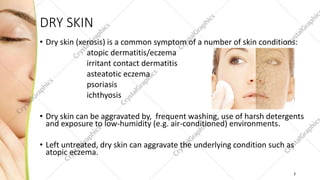
• Dry skin (xerosis) is a common symptom of a number of skin conditions:
atopic dermatitis/eczema
irritant contact dermatitis
asteatotic eczema
psoriasis
ichthyosis
• Dry skin can be aggravated by, frequent washing, use of harsh detergents
and exposure to low-humidity (e.g. air-conditioned) environments.
• Left untreated, dry skin can aggravate the underlying condition such as
atopic eczema.
3
INTRODUCTION
• Emollients are essential in the management of diagnosed
dermatological conditions but are often underused.
• When used correctly, emollients can help maintain and/or restore
skin suppleness, prevent dry skin & itching, reduce the number of
flare-ups there-by reducing the need for corticosteroid treatment, in
addition to other benefits.
• They should continue to be used even after the skin condition has
cleared if the clinical condition justifies continued use e.g. evidence of
chronic relapsing eczema
4
WHY USE EMOLLIENTS ?
• Applying emollients regularly can be time consuming but is
worthwhile as it can prevent eczema and other dry skin conditions
from flaring up.
• It may mean that other treatments that could cause side effects e.g.
steroid creams may not be needed as much or even at all.
• It can be continued after skin condition has cleared.
5
REQUIRED QUALITIES AS PER CONSUMER NEEDS
◾ Neutral or pleasant odour and colour
◾ Easy to spread and a pleasant feeling during application
◾ Non-oily/ non-greasy after application
◾ Non-comedogenic
◾ Provides effective hydration and prevent trans-epidermal water loss
◾ Provides protection from environmental factors, for example, wind,
cold temperature, UV light
◾ Reduces dryness, improve dull appearance
◾ Smoothens and softens the skin
◾ Well-tolerated and non-allergenic
6
The technical qualities of skin moisturizers can be summarized as
follows:
◾ Long-term stability
◾ No microbiological contamination and growth
◾ Appropriate rheological properties
◾ Smooth texture
◾ Appropriate performance
◾ Dermatological safet
PowerPlugs Templates for PowerPoint Preview 7
TYPES OF EMOLLIENTS
Emollients can be divided into three categories:
1. Ointments — greasy, oil-based emollients that contain no preservatives so
are less likely to cause irritation. They are ideal for night time usage and
when the skin has flared.
2. Creams — lighter emollients that are easier to apply than ointments; they
are good for daytime use but contain preservatives, which can cause
irritation.
3. Lotions — contain more water than oil so are very light and cooling; they
contain preservatives (so can irritate) and need to be applied more
frequently than other emollients, therefore larger quantities are often
needed.
8
PRESCRIBING RECOMMENDATION
• Choose a cost effective emollient taking into consideration patient
preference as well as the history, severity of condition and site of
application before making a suitable choice.
• Check sensitivities and previous emollients that have been unsuccessfully
tried before prescribing.
• Initially, prescribe a small amount of emollient on an acute prescription to
gauge suitability to patient.
• Advise the patient to use the emollient liberally and frequently (at least 2 –
4 times a day, very dry skin may require application every 2-3 hours).
• Ensure that the indication is a documented dermatological condition.
9
• Prescribing of emollients for non-clinical cosmetic purposes at NHS(national
health service) expense is not recommended and should be reviewed.
• Once a suitable emollient is found, prescribe a sufficient amount that can
be on a repeatable prescription.
• Ongoing prescribing must be reviewed on a regular basis. Prescribe a cost
effective alternative to soap for the patient to wash with.
• As with other types of emollient, trial a small quantity initially to establish
suitability before putting larger quantities on repeatable prescriptions.
• State criteria for using emollients containing antimicrobials to avoid routine
use, and avoid long term use.
10
• NICE recommend using topical antiseptics as adjunct therapy to
decrease bacterial load in children who have recurrent infected atopic
eczema. When indicated only use one formulation at a time.
• Urea is a keratin softener and hydrating agent used in the treatment
of dry, scaling conditions (including ichthyosis).
• Urea can cause stinging and irritation for some people and
preparations are generally more costly.
• It is therefore reasonable to target use to specific groups, e.g. those
with scaling skin, or those who have tried other emollients without
success
11
• Prescribe pump dispensers to minimize the risk of bacterial contamination,
when they are available for the patient’s selected emollient.
• For emollients that come in pots, using a clean spoon or spatula (rather
than fingers) to remove the emollient helps to minimize contamination.
• Review repeat prescriptions of individual products and combinations of
products with children with atopic eczema and their parents or carers at
least once a year to ensure that therapy remains appropriate.
• Prescriptions for adult patients should generally be reviewed annually,
although this may not be necessary in very mild conditions, e.g. people
with small areas of mild eczema that require minimal intervention.
12
CHOOSING AN EMOLLIENT
• Generally the greasier the product the more effective it is as an emollient,
as it is able to trap more moisture in the skin.
• However, greasier emollients can be less acceptable or tolerable.
Sometimes warming or cooling can make the product more acceptable.
Ointments are the greasiest preparations, being made up of oils or fats.
• They do not usually contain preservatives and may be more suitable for
those with sensitivities.
• However, they can exacerbate acne, can cause folliculitis when overused,
and they should not be used where infection is present.
• Emollients should be applied in the direction of hair growth to reduce the
risk of folliculitis.
13
Creams and gels are emulsions of oil and water and their less greasy
consistency often makes them more cosmetically acceptable.
• Lotions have a higher water content than creams, which makes them
easier to spread but less effective as emollients.
• They may be preferred for very mildly dry skin, as well as for hairy
areas of skin.
Aerosol formulations such as sprays and a mousse are also available.
They are generally more costly, but sprays may have a role where
application without touching the skin is advantageous.
Humectants (specifically reduce trans-epidermal water loss - TEWL)
Emollients containing humectants such as urea can also be applied to
more severe dry skin (e.g. ichthyosis).
14
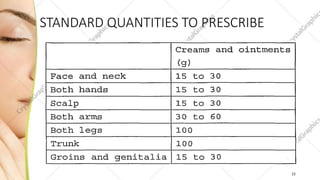
STANDARD QUANTITIES TO PRESCRIBE
15
STANDARD STEPS INVOLVED IN EMOLLIENT APPLICATION
• Wash hands and apply the emollient thinly (just so the skin glistens), gently
and quickly in smooth downward strokes in the direction of hair growth.
• Apply as often as needed to keep the skin supple and moist, usually at least
3 - 4 times a day but some people may need to increase this to up to every
hour if the skin is very dry.
• As a rule, ointments need to be applied less often than creams or lotions
for the same effect.
• Apply emollients within 3 minutes of washing to trap moisture in the skin.
16
• Avoid massaging creams or ointments in or applying too thickly as this
can block hair follicles, trap heat and cause itching.
• Emollients can be applied before or after any other treatments e.g.
steroid creams but it is important to leave at least 30 minutes before
applying the next treatment.
• Don’t stop using your emollient if your skin looks better as skin can
flare up again quickly
PowerPlugs Templates for PowerPoint Preview 17
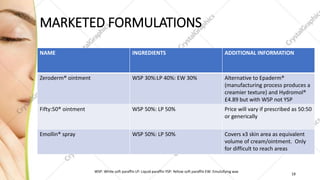
MARKETED FORMULATIONS
NAME INGREDIENTS ADDITIONAL INFORMATION
Zeroderm® ointment WSP 30%:LP 40%: EW 30% Alternative to Epaderm®
(manufacturing process produces a
creamier texture) and Hydromol®
£4.89 but with WSP not YSP
Fifty:50® ointment WSP 50%: LP 50% Price will vary if prescribed as 50:50
or generically
Emollin® spray WSP 50%: LP 50% Covers x3 skin area as equivalent
volume of cream/ointment. Only
for difficult to reach areas
18
WSP: White soft paraffin LP: Liquid paraffin YSP: Yellow soft paraffin EW: Emulsifying wax
REACTIONS OF EMOLLIENTS
Emollients with antimicrobials
• Risk of infection Reserve for where there is a concern about Staph colonization.
• Intermittent use can reduce frequency of infection related flares of atopic eczema.
• This should not be used long term.
Irritant reactions: These include an overheating, 'burning' sensation or stinging. It is
usually caused by a reaction to a certain ingredient contained in the cream or lotion.
If the stinging is painful and continues, try a different emollient.
Folliculitis: Some emollients that work by sealing wounds or cracks in the skin with a
protective barrier (occlusive) can occasionally cause hair follicles to become blocked
and inflamed (folliculitis) and cause boils (painful, red bumps on the skin).
Facial rashes: Some facial emollients can cause rashes on the face and can aggravate
acne (a skin condition that occurs on the face and commonly affects people during
their teenage years).
19
REFERENCES
• https://www.prescqipp.info/emollients/send/174-emollients/1951-
bulletin-76-cost-effective-and-appropriateprescribing-of-emollients
• https://cks.nice.org.uk/eczema-atopic#!prescribinginfosub:6
• http://www.eczema.org/emollients
• http://www.telfordccg.nhs.uk/dermatology.
20
21

Guidelines for emollients

  • 1.
    BY SAYEDA SALMA 1STM PHARM GUIDELINES FOR EMOLLIENTS
  • 2.
    • DRY SKIN •INTRODUCTION • PRESCRIBING RECOMMENDATION • REQUIRED QUALITIES OF EMOLLIENTS AS PER CONSUMER NEEDS • CHOOSING AN SUITABLE EMOLLIENT FOR SKIN TYPES • SUITABLE QUANTITIES TO PRESCRIBE • STEPS TO APPLY • MARKETTED FORMULATIONS • REACTIONS TO EMOLLIENTS INDEX
  • 3.
    DRY SKIN • Dryskin (xerosis) is a common symptom of a number of skin conditions: atopic dermatitis/eczema irritant contact dermatitis asteatotic eczema psoriasis ichthyosis • Dry skin can be aggravated by, frequent washing, use of harsh detergents and exposure to low-humidity (e.g. air-conditioned) environments. • Left untreated, dry skin can aggravate the underlying condition such as atopic eczema. 3
  • 4.
    INTRODUCTION • Emollients areessential in the management of diagnosed dermatological conditions but are often underused. • When used correctly, emollients can help maintain and/or restore skin suppleness, prevent dry skin & itching, reduce the number of flare-ups there-by reducing the need for corticosteroid treatment, in addition to other benefits. • They should continue to be used even after the skin condition has cleared if the clinical condition justifies continued use e.g. evidence of chronic relapsing eczema 4
  • 5.
    WHY USE EMOLLIENTS? • Applying emollients regularly can be time consuming but is worthwhile as it can prevent eczema and other dry skin conditions from flaring up. • It may mean that other treatments that could cause side effects e.g. steroid creams may not be needed as much or even at all. • It can be continued after skin condition has cleared. 5
  • 6.
    REQUIRED QUALITIES ASPER CONSUMER NEEDS ◾ Neutral or pleasant odour and colour ◾ Easy to spread and a pleasant feeling during application ◾ Non-oily/ non-greasy after application ◾ Non-comedogenic ◾ Provides effective hydration and prevent trans-epidermal water loss ◾ Provides protection from environmental factors, for example, wind, cold temperature, UV light ◾ Reduces dryness, improve dull appearance ◾ Smoothens and softens the skin ◾ Well-tolerated and non-allergenic 6
  • 7.
    The technical qualitiesof skin moisturizers can be summarized as follows: ◾ Long-term stability ◾ No microbiological contamination and growth ◾ Appropriate rheological properties ◾ Smooth texture ◾ Appropriate performance ◾ Dermatological safet PowerPlugs Templates for PowerPoint Preview 7
  • 8.
    TYPES OF EMOLLIENTS Emollientscan be divided into three categories: 1. Ointments — greasy, oil-based emollients that contain no preservatives so are less likely to cause irritation. They are ideal for night time usage and when the skin has flared. 2. Creams — lighter emollients that are easier to apply than ointments; they are good for daytime use but contain preservatives, which can cause irritation. 3. Lotions — contain more water than oil so are very light and cooling; they contain preservatives (so can irritate) and need to be applied more frequently than other emollients, therefore larger quantities are often needed. 8
  • 9.
    PRESCRIBING RECOMMENDATION • Choosea cost effective emollient taking into consideration patient preference as well as the history, severity of condition and site of application before making a suitable choice. • Check sensitivities and previous emollients that have been unsuccessfully tried before prescribing. • Initially, prescribe a small amount of emollient on an acute prescription to gauge suitability to patient. • Advise the patient to use the emollient liberally and frequently (at least 2 – 4 times a day, very dry skin may require application every 2-3 hours). • Ensure that the indication is a documented dermatological condition. 9
  • 10.
    • Prescribing ofemollients for non-clinical cosmetic purposes at NHS(national health service) expense is not recommended and should be reviewed. • Once a suitable emollient is found, prescribe a sufficient amount that can be on a repeatable prescription. • Ongoing prescribing must be reviewed on a regular basis. Prescribe a cost effective alternative to soap for the patient to wash with. • As with other types of emollient, trial a small quantity initially to establish suitability before putting larger quantities on repeatable prescriptions. • State criteria for using emollients containing antimicrobials to avoid routine use, and avoid long term use. 10
  • 11.
    • NICE recommendusing topical antiseptics as adjunct therapy to decrease bacterial load in children who have recurrent infected atopic eczema. When indicated only use one formulation at a time. • Urea is a keratin softener and hydrating agent used in the treatment of dry, scaling conditions (including ichthyosis). • Urea can cause stinging and irritation for some people and preparations are generally more costly. • It is therefore reasonable to target use to specific groups, e.g. those with scaling skin, or those who have tried other emollients without success 11
  • 12.
    • Prescribe pumpdispensers to minimize the risk of bacterial contamination, when they are available for the patient’s selected emollient. • For emollients that come in pots, using a clean spoon or spatula (rather than fingers) to remove the emollient helps to minimize contamination. • Review repeat prescriptions of individual products and combinations of products with children with atopic eczema and their parents or carers at least once a year to ensure that therapy remains appropriate. • Prescriptions for adult patients should generally be reviewed annually, although this may not be necessary in very mild conditions, e.g. people with small areas of mild eczema that require minimal intervention. 12
  • 13.
    CHOOSING AN EMOLLIENT •Generally the greasier the product the more effective it is as an emollient, as it is able to trap more moisture in the skin. • However, greasier emollients can be less acceptable or tolerable. Sometimes warming or cooling can make the product more acceptable. Ointments are the greasiest preparations, being made up of oils or fats. • They do not usually contain preservatives and may be more suitable for those with sensitivities. • However, they can exacerbate acne, can cause folliculitis when overused, and they should not be used where infection is present. • Emollients should be applied in the direction of hair growth to reduce the risk of folliculitis. 13
  • 14.
    Creams and gelsare emulsions of oil and water and their less greasy consistency often makes them more cosmetically acceptable. • Lotions have a higher water content than creams, which makes them easier to spread but less effective as emollients. • They may be preferred for very mildly dry skin, as well as for hairy areas of skin. Aerosol formulations such as sprays and a mousse are also available. They are generally more costly, but sprays may have a role where application without touching the skin is advantageous. Humectants (specifically reduce trans-epidermal water loss - TEWL) Emollients containing humectants such as urea can also be applied to more severe dry skin (e.g. ichthyosis). 14
  • 15.
  • 16.
    STANDARD STEPS INVOLVEDIN EMOLLIENT APPLICATION • Wash hands and apply the emollient thinly (just so the skin glistens), gently and quickly in smooth downward strokes in the direction of hair growth. • Apply as often as needed to keep the skin supple and moist, usually at least 3 - 4 times a day but some people may need to increase this to up to every hour if the skin is very dry. • As a rule, ointments need to be applied less often than creams or lotions for the same effect. • Apply emollients within 3 minutes of washing to trap moisture in the skin. 16
  • 17.
    • Avoid massagingcreams or ointments in or applying too thickly as this can block hair follicles, trap heat and cause itching. • Emollients can be applied before or after any other treatments e.g. steroid creams but it is important to leave at least 30 minutes before applying the next treatment. • Don’t stop using your emollient if your skin looks better as skin can flare up again quickly PowerPlugs Templates for PowerPoint Preview 17
  • 18.
    MARKETED FORMULATIONS NAME INGREDIENTSADDITIONAL INFORMATION Zeroderm® ointment WSP 30%:LP 40%: EW 30% Alternative to Epaderm® (manufacturing process produces a creamier texture) and Hydromol® £4.89 but with WSP not YSP Fifty:50® ointment WSP 50%: LP 50% Price will vary if prescribed as 50:50 or generically Emollin® spray WSP 50%: LP 50% Covers x3 skin area as equivalent volume of cream/ointment. Only for difficult to reach areas 18 WSP: White soft paraffin LP: Liquid paraffin YSP: Yellow soft paraffin EW: Emulsifying wax
  • 19.
    REACTIONS OF EMOLLIENTS Emollientswith antimicrobials • Risk of infection Reserve for where there is a concern about Staph colonization. • Intermittent use can reduce frequency of infection related flares of atopic eczema. • This should not be used long term. Irritant reactions: These include an overheating, 'burning' sensation or stinging. It is usually caused by a reaction to a certain ingredient contained in the cream or lotion. If the stinging is painful and continues, try a different emollient. Folliculitis: Some emollients that work by sealing wounds or cracks in the skin with a protective barrier (occlusive) can occasionally cause hair follicles to become blocked and inflamed (folliculitis) and cause boils (painful, red bumps on the skin). Facial rashes: Some facial emollients can cause rashes on the face and can aggravate acne (a skin condition that occurs on the face and commonly affects people during their teenage years). 19
  • 20.
  • 21.