SUPAC GUIDELINES
Scale-Up and post approval changes
Geethanjali College of Pharmacy, Hyd.
Presented by:
Gundlapally Yokshita
Jagati Saketh
K Vaishnav
Karamtod Devika
Kavali Sri Lakshmi
Kethavath Shashikala
Under the guidance:
P. NAGA CHANDRIKA, M.Pharm, (Ph.D)
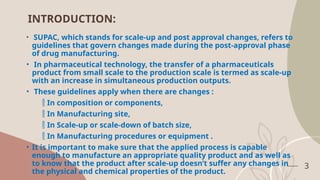
INTRODUCTION
1
SUPAC GUIDELINES -HISTORY
4
SUPAC GUIDELINES
5
ADVANTAGES AND
DISADVANTAGES
16
REFERENCE
18
INTRODUCTION:
• SUPAC, which stands for scale-up and post approval changes, refers to
guidelines that govern changes made during the post-approval phase
of drug manufacturing.
• In pharmaceutical technology, the transfer of a pharmaceuticals
product from small scale to the production scale is termed as scale-up
with an increase in simultaneous production outputs.
• These guidelines apply when there are changes :
 In composition or components,
 In Manufacturing site,
 In Scale-up or scale-down of batch size,
 In Manufacturing procedures or equipment .
• It is important to make sure that the applied process is capable
enough to manufacture an appropriate quality product and as well as
to know that the product after scale-up doesn’t suffer any changes in
the physical and chemical properties of the product.
3
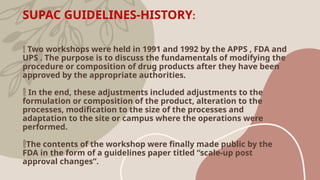
SUPAC GUIDELINES-HISTORY:
 Two workshops were held in 1991 and 1992 by the APPS , FDA and
UPS . The purpose is to discuss the fundamentals of modifying the
procedure or composition of drug products after they have been
approved by the appropriate authorities.
 In the end, these adjustments included adjustments to the
formulation or composition of the product, alteration to the
processes, modification to the size of the processes and
adaptation to the site or campus where the operations were
performed.
The contents of the workshop were finally made public by the
FDA in the form of a guidelines paper titled “scale-up post
approval changes”.
5
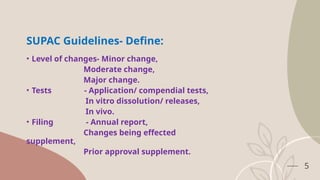
SUPAC Guidelines- Define:
• Level of changes- Minor change,
Moderate change,
Major change.
• Tests - Application/ compendial tests,
In vitro dissolution/ releases,
In vivo.
• Filing - Annual report,
Changes being effected
supplement,
Prior approval supplement.
6
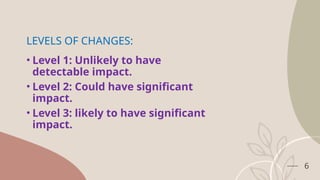
LEVELS OF CHANGES:
• Level 1: Unlikely to have
detectable impact.
• Level 2: Could have significant
impact.
• Level 3: likely to have significant
impact.
7
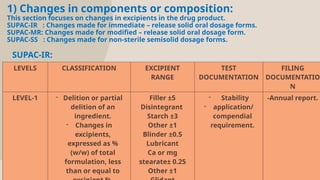
1) Changes in components or composition:
This section focuses on changes in excipients in the drug product.
SUPAC-IR : Changes made for immediate – release solid oral dosage forms.
SUPAC-MR: Changes made for modified – release solid oral dosage form.
SUPAC-SS : Changes made for non-sterile semisolid dosage forms.
SUPAC-IR:
LEVELS CLASSIFICATION EXCIPIENT
RANGE
TEST
DOCUMENTATION
FILING
DOCUMENTATIO
N
LEVEL-1 - Delition or partial
delition of an
ingredient.
- Changes in
excipients,
expressed as %
(w/w) of total
formulation, less
than or equal to
Filler ±5
Disintegrant
Starch ±3
Other ±1
Blinder ±0.5
Lubricant
Ca or mg
stearate± 0.25
Other ±1
- Stability
- application/
compendial
requirement.
-Annual report.
8
.
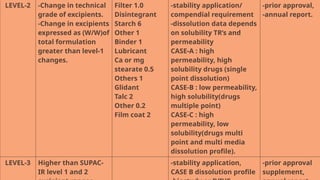
LEVEL-2 -Change in technical
grade of excipients.
-Change in excipients
expressed as (W/W)of
total formulation
greater than level-1
changes.
Filter 1.0
Disintegrant
Starch 6
Other 1
Binder 1
Lubricant
Ca or mg
stearate 0.5
Others 1
Glidant
Talc 2
Other 0.2
Film coat 2
-stability application/
compendial requirement
-dissolution data depends
on solubility TR’s and
permeability
CASE-A : high
permeability, high
solubility drugs (single
point dissolution)
CASE-B : low permeability,
high solubility(drugs
multiple point)
CASE-C : high
permeability, low
solubility(drugs multi
point and multi media
dissolution profile).
-prior approval,
-annual report.
LEVEL-3 Higher than SUPAC-
IR level 1 and 2
-stability application,
CASE B dissolution profile
-prior approval
supplement,
9
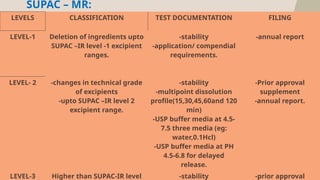
SUPAC – MR:
LEVELS CLASSIFICATION TEST DOCUMENTATION FILING
LEVEL-1 Deletion of ingredients upto
SUPAC –IR level -1 excipient
ranges.
-stability
-application/ compendial
requirements.
-annual report
LEVEL- 2 -changes in technical grade
of excipients
-upto SUPAC –IR level 2
excipient range.
-stability
-multipoint dissolution
profile(15,30,45,60and 120
min)
-USP buffer media at 4.5-
7.5 three media (eg:
water,0.1Hcl)
-USP buffer media at PH
4.5-6.8 for delayed
release.
-Prior approval
supplement
-annual report.
LEVEL-3 Higher than SUPAC-IR level -stability -prior approval
10
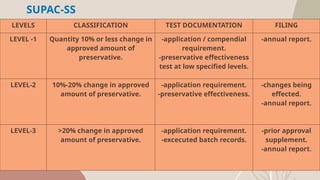
SUPAC-SS
LEVELS CLASSIFICATION TEST DOCUMENTATION FILING
LEVEL -1 Quantity 10% or less change in
approved amount of
preservative.
-application / compendial
requirement.
-preservative effectiveness
test at low specified levels.
-annual report.
LEVEL-2 10%-20% change in approved
amount of preservative.
-application requirement.
-preservative effectiveness.
-changes being
effected.
-annual report.
LEVEL-3 >20% change in approved
amount of preservative.
-application requirement.
-excecuted batch records.
-prior approval
supplement.
-annual report.
11
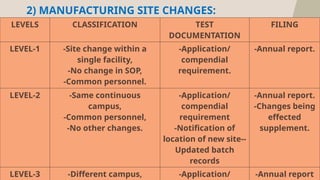
2) MANUFACTURING SITE CHANGES:
LEVELS CLASSIFICATION TEST
DOCUMENTATION
FILING
LEVEL-1 -Site change within a
single facility,
-No change in SOP,
-Common personnel.
-Application/
compendial
requirement.
-Annual report.
LEVEL-2 -Same continuous
campus,
-Common personnel,
-No other changes.
-Application/
compendial
requirement
-Notification of
location of new site--
Updated batch
records
-Annual report.
-Changes being
effected
supplement.
LEVEL-3 -Different campus, -Application/ -Annual report
12
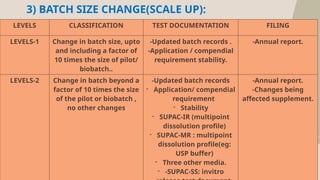
3) BATCH SIZE CHANGE(SCALE UP):
LEVELS CLASSIFICATION TEST DOCUMENTATION FILING
LEVELS-1 Change in batch size, upto
and including a factor of
10 times the size of pilot/
biobatch..
-Updated batch records .
-Application / compendial
requirement stability.
-Annual report.
LEVELS-2 Change in batch beyond a
factor of 10 times the size
of the pilot or biobatch ,
no other changes
-Updated batch records
- Application/ compendial
requirement
- Stability
- SUPAC-IR (multipoint
dissolution profile)
- SUPAC-MR : multipoint
dissolution profile(eg:
USP buffer)
- Three other media.
- -SUPAC-SS: invitro
-Annual report.
-Changes being
affected supplement.
13
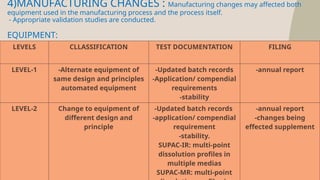
4)MANUFACTURING CHANGES : Manufacturing changes may affected both
equipment used in the manufacturing process and the process itself.
- Appropriate validation studies are conducted.
EQUIPMENT:
LEVELS CLLASSIFICATION TEST DOCUMENTATION FILING
LEVEL-1 -Alternate equipment of
same design and principles
automated equipment
-Updated batch records
-Application/ compendial
requirements
-stability
-annual report
LEVEL-2 Change to equipment of
different design and
principle
-Updated batch records
-application/ compendial
requirement
-stability.
SUPAC-IR: multi-point
dissolution profiles in
multiple medias
SUPAC-MR: multi-point
-annual report
-changes being
effected supplement
14
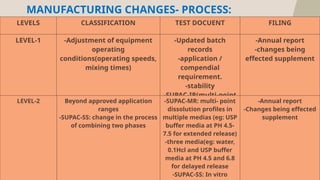
MANUFACTURING CHANGES- PROCESS:
LEVELS CLASSIFICATION TEST DOCUENT FILING
LEVEL-1 -Adjustment of equipment
operating
conditions(operating speeds,
mixing times)
-Updated batch
records
-application /
compendial
requirement.
-stability
-SUPAC-IR(multi-point
dissolution profile)
-Annual report
-changes being
effected supplement
LEVEL-2 Beyond approved application
ranges
-SUPAC-SS: change in the process
of combining two phases
-SUPAC-MR: multi- point
dissolution profiles in
multiple medias (eg: USP
buffer media at PH 4.5-
7.5 for extended release)
-three media(eg: water,
0.1Hcl and USP buffer
media at PH 4.5 and 6.8
for delayed release
-SUPAC-SS: In vitro
-Annual report
-Changes being effected
supplement
15
.
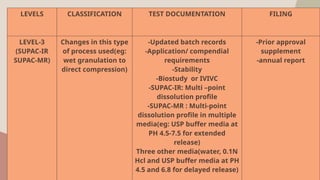
LEVELS CLASSIFICATION TEST DOCUMENTATION FILING
LEVEL-3
(SUPAC-IR
SUPAC-MR)
Changes in this type
of process used(eg:
wet granulation to
direct compression)
-Updated batch records
-Application/ compendial
requirements
-Stability
-Biostudy or IVIVC
-SUPAC-IR: Multi –point
dissolution profile
-SUPAC-MR : Multi-point
dissolution profile in multiple
media(eg: USP buffer media at
PH 4.5-7.5 for extended
release)
Three other media(water, 0.1N
Hcl and USP buffer media at PH
4.5 and 6.8 for delayed release)
-Prior approval
supplement
-annual report
16
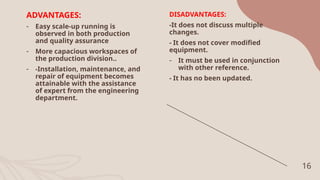
ADVANTAGES:
- Easy scale-up running is
observed in both production
and quality assurance
- More capacious workspaces of
the production division..
- -Installation, maintenance, and
repair of equipment becomes
attainable with the assistance
of expert from the engineering
department.
DISADVANTAGES:
-It does not discuss multiple
changes.
- It does not cover modified
equipment.
- It must be used in conjunction
with other reference.
- It has no been updated.
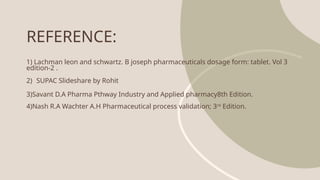
REFERENCE:
1) Lachman leon and schwartz. B joseph pharmaceuticals dosage form: tablet. Vol 3
edition-2 .
2) SUPAC Slideshare by Rohit
3)Savant D.A Pharma Pthway Industry and Applied pharmacy8th Edition.
4)Nash R.A Wachter A.H Pharmaceutical process validation; 3rd
Edition.
Thank you

SUPAC GUIDELINES, History, levels of changes, changes in components, batch size

  • 1.
    SUPAC GUIDELINES Scale-Up andpost approval changes Geethanjali College of Pharmacy, Hyd. Presented by: Gundlapally Yokshita Jagati Saketh K Vaishnav Karamtod Devika Kavali Sri Lakshmi Kethavath Shashikala Under the guidance: P. NAGA CHANDRIKA, M.Pharm, (Ph.D)
  • 2.
    INTRODUCTION 1 SUPAC GUIDELINES -HISTORY 4 SUPACGUIDELINES 5 ADVANTAGES AND DISADVANTAGES 16 REFERENCE 18
  • 3.
    INTRODUCTION: • SUPAC, whichstands for scale-up and post approval changes, refers to guidelines that govern changes made during the post-approval phase of drug manufacturing. • In pharmaceutical technology, the transfer of a pharmaceuticals product from small scale to the production scale is termed as scale-up with an increase in simultaneous production outputs. • These guidelines apply when there are changes :  In composition or components,  In Manufacturing site,  In Scale-up or scale-down of batch size,  In Manufacturing procedures or equipment . • It is important to make sure that the applied process is capable enough to manufacture an appropriate quality product and as well as to know that the product after scale-up doesn’t suffer any changes in the physical and chemical properties of the product. 3
  • 4.
    SUPAC GUIDELINES-HISTORY:  Twoworkshops were held in 1991 and 1992 by the APPS , FDA and UPS . The purpose is to discuss the fundamentals of modifying the procedure or composition of drug products after they have been approved by the appropriate authorities.  In the end, these adjustments included adjustments to the formulation or composition of the product, alteration to the processes, modification to the size of the processes and adaptation to the site or campus where the operations were performed. The contents of the workshop were finally made public by the FDA in the form of a guidelines paper titled “scale-up post approval changes”.
  • 5.
    5 SUPAC Guidelines- Define: •Level of changes- Minor change, Moderate change, Major change. • Tests - Application/ compendial tests, In vitro dissolution/ releases, In vivo. • Filing - Annual report, Changes being effected supplement, Prior approval supplement.
  • 6.
    6 LEVELS OF CHANGES: •Level 1: Unlikely to have detectable impact. • Level 2: Could have significant impact. • Level 3: likely to have significant impact.
  • 7.
    7 1) Changes incomponents or composition: This section focuses on changes in excipients in the drug product. SUPAC-IR : Changes made for immediate – release solid oral dosage forms. SUPAC-MR: Changes made for modified – release solid oral dosage form. SUPAC-SS : Changes made for non-sterile semisolid dosage forms. SUPAC-IR: LEVELS CLASSIFICATION EXCIPIENT RANGE TEST DOCUMENTATION FILING DOCUMENTATIO N LEVEL-1 - Delition or partial delition of an ingredient. - Changes in excipients, expressed as % (w/w) of total formulation, less than or equal to Filler ±5 Disintegrant Starch ±3 Other ±1 Blinder ±0.5 Lubricant Ca or mg stearate± 0.25 Other ±1 - Stability - application/ compendial requirement. -Annual report.
  • 8.
    8 . LEVEL-2 -Change intechnical grade of excipients. -Change in excipients expressed as (W/W)of total formulation greater than level-1 changes. Filter 1.0 Disintegrant Starch 6 Other 1 Binder 1 Lubricant Ca or mg stearate 0.5 Others 1 Glidant Talc 2 Other 0.2 Film coat 2 -stability application/ compendial requirement -dissolution data depends on solubility TR’s and permeability CASE-A : high permeability, high solubility drugs (single point dissolution) CASE-B : low permeability, high solubility(drugs multiple point) CASE-C : high permeability, low solubility(drugs multi point and multi media dissolution profile). -prior approval, -annual report. LEVEL-3 Higher than SUPAC- IR level 1 and 2 -stability application, CASE B dissolution profile -prior approval supplement,
  • 9.
    9 SUPAC – MR: LEVELSCLASSIFICATION TEST DOCUMENTATION FILING LEVEL-1 Deletion of ingredients upto SUPAC –IR level -1 excipient ranges. -stability -application/ compendial requirements. -annual report LEVEL- 2 -changes in technical grade of excipients -upto SUPAC –IR level 2 excipient range. -stability -multipoint dissolution profile(15,30,45,60and 120 min) -USP buffer media at 4.5- 7.5 three media (eg: water,0.1Hcl) -USP buffer media at PH 4.5-6.8 for delayed release. -Prior approval supplement -annual report. LEVEL-3 Higher than SUPAC-IR level -stability -prior approval
  • 10.
    10 SUPAC-SS LEVELS CLASSIFICATION TESTDOCUMENTATION FILING LEVEL -1 Quantity 10% or less change in approved amount of preservative. -application / compendial requirement. -preservative effectiveness test at low specified levels. -annual report. LEVEL-2 10%-20% change in approved amount of preservative. -application requirement. -preservative effectiveness. -changes being effected. -annual report. LEVEL-3 >20% change in approved amount of preservative. -application requirement. -excecuted batch records. -prior approval supplement. -annual report.
  • 11.
    11 2) MANUFACTURING SITECHANGES: LEVELS CLASSIFICATION TEST DOCUMENTATION FILING LEVEL-1 -Site change within a single facility, -No change in SOP, -Common personnel. -Application/ compendial requirement. -Annual report. LEVEL-2 -Same continuous campus, -Common personnel, -No other changes. -Application/ compendial requirement -Notification of location of new site-- Updated batch records -Annual report. -Changes being effected supplement. LEVEL-3 -Different campus, -Application/ -Annual report
  • 12.
    12 3) BATCH SIZECHANGE(SCALE UP): LEVELS CLASSIFICATION TEST DOCUMENTATION FILING LEVELS-1 Change in batch size, upto and including a factor of 10 times the size of pilot/ biobatch.. -Updated batch records . -Application / compendial requirement stability. -Annual report. LEVELS-2 Change in batch beyond a factor of 10 times the size of the pilot or biobatch , no other changes -Updated batch records - Application/ compendial requirement - Stability - SUPAC-IR (multipoint dissolution profile) - SUPAC-MR : multipoint dissolution profile(eg: USP buffer) - Three other media. - -SUPAC-SS: invitro -Annual report. -Changes being affected supplement.
  • 13.
    13 4)MANUFACTURING CHANGES :Manufacturing changes may affected both equipment used in the manufacturing process and the process itself. - Appropriate validation studies are conducted. EQUIPMENT: LEVELS CLLASSIFICATION TEST DOCUMENTATION FILING LEVEL-1 -Alternate equipment of same design and principles automated equipment -Updated batch records -Application/ compendial requirements -stability -annual report LEVEL-2 Change to equipment of different design and principle -Updated batch records -application/ compendial requirement -stability. SUPAC-IR: multi-point dissolution profiles in multiple medias SUPAC-MR: multi-point -annual report -changes being effected supplement
  • 14.
    14 MANUFACTURING CHANGES- PROCESS: LEVELSCLASSIFICATION TEST DOCUENT FILING LEVEL-1 -Adjustment of equipment operating conditions(operating speeds, mixing times) -Updated batch records -application / compendial requirement. -stability -SUPAC-IR(multi-point dissolution profile) -Annual report -changes being effected supplement LEVEL-2 Beyond approved application ranges -SUPAC-SS: change in the process of combining two phases -SUPAC-MR: multi- point dissolution profiles in multiple medias (eg: USP buffer media at PH 4.5- 7.5 for extended release) -three media(eg: water, 0.1Hcl and USP buffer media at PH 4.5 and 6.8 for delayed release -SUPAC-SS: In vitro -Annual report -Changes being effected supplement
  • 15.
    15 . LEVELS CLASSIFICATION TESTDOCUMENTATION FILING LEVEL-3 (SUPAC-IR SUPAC-MR) Changes in this type of process used(eg: wet granulation to direct compression) -Updated batch records -Application/ compendial requirements -Stability -Biostudy or IVIVC -SUPAC-IR: Multi –point dissolution profile -SUPAC-MR : Multi-point dissolution profile in multiple media(eg: USP buffer media at PH 4.5-7.5 for extended release) Three other media(water, 0.1N Hcl and USP buffer media at PH 4.5 and 6.8 for delayed release) -Prior approval supplement -annual report
  • 16.
    16 ADVANTAGES: - Easy scale-uprunning is observed in both production and quality assurance - More capacious workspaces of the production division.. - -Installation, maintenance, and repair of equipment becomes attainable with the assistance of expert from the engineering department. DISADVANTAGES: -It does not discuss multiple changes. - It does not cover modified equipment. - It must be used in conjunction with other reference. - It has no been updated.
  • 17.
    REFERENCE: 1) Lachman leonand schwartz. B joseph pharmaceuticals dosage form: tablet. Vol 3 edition-2 . 2) SUPAC Slideshare by Rohit 3)Savant D.A Pharma Pthway Industry and Applied pharmacy8th Edition. 4)Nash R.A Wachter A.H Pharmaceutical process validation; 3rd Edition.
  • 18.