BY SAYEDA SALMA
1ST M PHARM
DEPT OF PHARMACEUTICS
1
INDEX
• INTRODUCTION
• DEFINITION
• OBJECTIVE
• REASON FOR DRUG TARGETTING
• MERITS AND DEMERITS
• HISTORY
• CONCEPT (a description on targeted drug delivery)
2
INTRODUCTION
• Targeted drug delivery is a method of delivering
medication to a patient in a manner that increases the
concentration of the medication in some parts of the
body relative to others.
• Targeted drug delivery seeks to concentrate the
medication in the tissues of interest while reducing the
relative concentration of the medication in the remaining
tissues.
• This improves efficacy of the while by reducing side
effects.
3
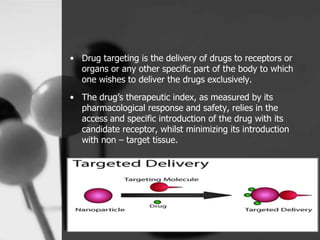
• Drug targeting is the delivery of drugs to receptors or
organs or any other specific part of the body to which
one wishes to deliver the drugs exclusively.
• The drug’s therapeutic index, as measured by its
pharmacological response and safety, relies in the
access and specific introduction of the drug with its
candidate receptor, whilst minimizing its introduction
with non – target tissue.
4
DEFINATION
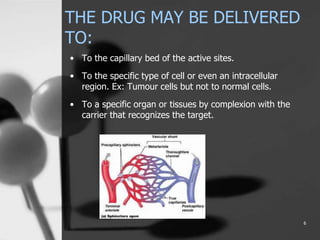
• ‘Targeted drug delivery system is a special form of drug
delivery system where the medicament is selectively
targeted or delivered only to its site of action or
absorption and not to the non-target organs or tissues
or cells.’
5
THE DRUG MAY BE DELIVERED
TO:
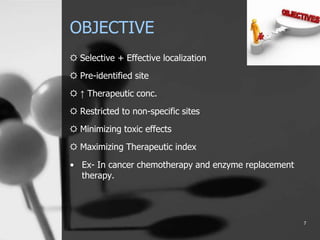
• To the capillary bed of the active sites.
• To the specific type of cell or even an intracellular
region. Ex: Tumour cells but not to normal cells.
• To a specific organ or tissues by complexion with the
carrier that recognizes the target.
6
OBJECTIVE
☼ Selective + Effective localization
☼ Pre-identified site
☼ ↑ Therapeutic conc.
☼ Restricted to non-specific sites
☼ Minimizing toxic effects
☼ Maximizing Therapeutic index
• Ex- In cancer chemotherapy and enzyme replacement
therapy.
7
REASON FOR DRUG
TARGETING :
• In the treatment or prevention of diseases.
• Pharmaceutical drug instability in conventional dosage
form solubility
• biopharmaceutical low absorption
• biological instability
• pharmacokinetic / pharmacodynamic short half life
• large volume of distribution
• clinical, low therapeutic index.
8
IDEAL TDDS
• 1) Biochemically inert, non-toxic& non-immunogenic
• 2) Stability(Physical& Chemical)
• 3) Restricted delivery to target site/organ
• 4) Uniform capillary distribution at the site
• 5) Controlled & predictable rate of delivery
• 6) Drug release vs Drug action
• 7) ↑ Therapeutic effect
• 8) Minimal or No – Drug leakage
• 9) Carrier properties
• 10)Cost of production 9
MERITS
• Simplified Drug administration protocol
• ↓ Dose of drug
• ↑ Drug concentration at target than non-target sites
• Selective targeting to infections cells than compared to
normal cells.
• Enhancement of the absorption of target molecules
such as peptides and particulates.
• Drug can be administered in a smaller dose to produce
the desired effect.
• No peak and valley plasma concentration.
10
DEMERITS
• Rapid Clearance
• Immune reactions (mostly against I.V .route)
• Insufficient localization in tumour cells
• Diffusion& redistribution of released drugs.
• Requires highly sophisticated technology for the
formulation.
• Difficult to maintain stability of dosage form.
E.g.: Resealed erythrocytes have to be stored at 4
degree Celsius.
11
HISTORY
The history of controlled release technology is divided into
three time periods.
• From 1950 to 1970 was the period of sustain drug
release .
• From 1970 to 1990 was involved in the determination of
the needs of the control drug delivery .
• first introduced Nano technology (1974).
• liposomes were introduced for the first time in 1978 .
• post 1990 became the modern era for controlled release
and drug targetting technology.
12
CONCEPT
• Targeting of drugs to special cells and tissues of the
body without their becoming a part of systemic
circulation is a very novel idea.
• If a drug can be administered in a form such that it
reaches the receptor sites in sufficient concentration
without disturbing in extraneous tissue cells.
Such products are prepared by considering-
1.specific properties of target cells.
2.nature of markers or transport carriers or vehicles, which
convey drug to specific receptors.
3.ligands and physically modulated component 13
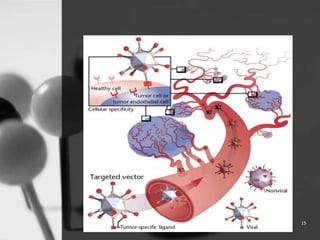
COMPONENTS
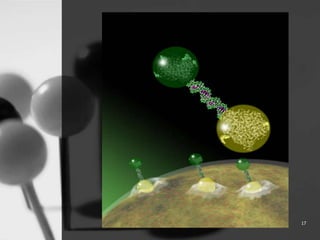
Target may be defined as a cell or group of cells in
minority, identified to be in the need of treatment.
• Carrier is one of the important entity essentially required
for effective transportation of loaded drugs.
• They are vectors, which sequester, retain drug and
transport or deliver it into the vicinity of the target cells.
• The ligands confer recognition and specificity upon
carrier/vector and lend them to approach the respective
target and deliver the drug.
• Ex-antibodies, polypeptides, endogenous hormones etc.14
15
CARRIERS
• Required for successful transportation of the loaded
drug.
• Delivers the drug within or in the vicinity of target.
• An inherent characteristic or acquired through structural
modification.
• Able to cross anatomical barriers
• Recognized specifically and selectively by the target
cells.
• The linkage and the directing unit (ligand) should be
stable in plasma, interstitial and other biofluids.
• Non-toxic, non-immunogenic and biodegradable
particulate or macromolecule.
• After recognition it releases the therapeutic moiety. 16
17
TYPES
1. Endogenous (LDL ,HDL Chylomicrons, Serum albumin,
Erythrocytes)
2. Exogenous (Microparticulates, Soluble polymeric and
Biodegradable polymeric drug carriers)
1. Colloidal carriers
2. Cellular carriers
3. Polymer based systems
4. Macromolecular carriers
18
COLLOIDALAND CELLULAR
CARRIERS
Ex: Liposomes, niosomes, pharmacosomes, virosomes,
immunoliposomes.
Ex: Microparticles, Nanoparticles, Magnetic microspheres,
Albumin microspheres, Nanocapsules.
It includes cellular or blood components:
Ex: Erythrocytes, Serum albumin, Antibodies, Platelets,
Leucocytes.
19
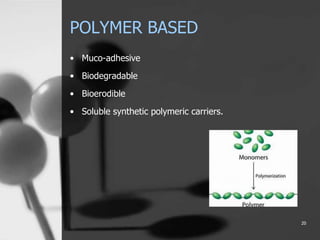
POLYMER BASED
• Muco-adhesive
• Biodegradable
• Bioerodible
• Soluble synthetic polymeric carriers.
20
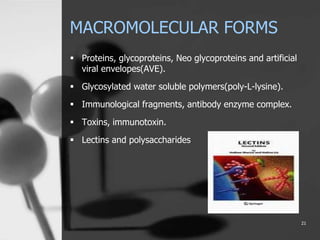
MACROMOLECULAR FORMS
 Proteins, glycoproteins, Neo glycoproteins and artificial
viral envelopes(AVE).
 Glycosylated water soluble polymers(poly-L-lysine).
 Immunological fragments, antibody enzyme complex.
 Toxins, immunotoxin.
 Lectins and polysaccharides
21
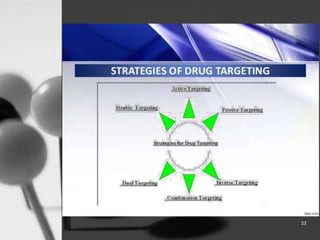
LEVELS OF TARGETTING
 Passive targeting
 Inverse targeting
 Active targeting
(a) Ligand mediated targeting
(b) Physical targeting
 Dual targeting
 Double targeting
 Combination targeting
22
23
24
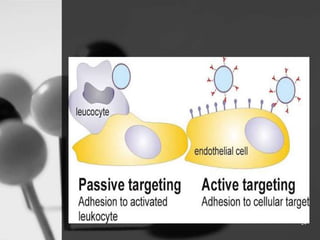
PASSIVE TARGETTING
• Systems that target the systemic circulation are
generally characterized as “passive” delivery systems
(i.e. targeting occurs because of the body’s natural
response to the physicochemical characteristic of the
drug or drug-carrier system).
• Passive capture of colloidal carriers by macrophages
offers therapeutic opportunities for the delivery of anti-
infectives for diseases that involve macrophage cells of
RES.
• Passive targeting also includes deliver of drug carriers
system directly to discrete compartment in the body.
• E.g. Different regions of GI tract, eye, nose, knee joints,
lungs, vagina, rectum and respiratory tract
25
ACTIVE TARGETTING
• In active targeting the natural disposition pattern of a
carrier is modified to target specific organs, tissues or
attachment of cells specific ligands .
• It adopts modified drug-drug carrier molecules capable
of recognizing and interacting with a specific cell, tissues
or organ in the body.
• Modification of the carrier system includes, a change in
the molecular size, alteration of the surface properties
by incorporation of antigen specific anti bodies or
attachment of cell receptor specific ligands.
26
TYPES OF ACTIVE
TARGETTING
 Achieved using specific mechanisms such as receptor
dependent uptake of natural LDL particles and synthetic
lipid microemulsions of partially reconstituted LDL
particles coated with the apoproteins.
 In this type of targeting some characteristics of
environment changes like pH, temperature, light
intensity, electric field, ionic strength small and even
specific stimuli like glucose concentration are used to
localize the drug carrier to predetermined site.
 This approach was found exceptional for tumor
targeting as well as cytosolic delivery of entrapped drug
or genetic material. 27
This targeting approach can further be classified it into
three different levels of targeting:
1) First Order Targeting: This describes delivery to a
discrete organ or a tissue.
2) Second Order Targeting: This represents targeting to
specific types of cells within an organ/tissue.
3) Third Order Targeting: This implies delivery to specific
intracellular compartment in the target cell,
E.g. Lysosomes.
28
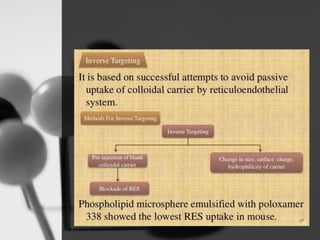
INVERSE TARGETTING
• It is based on successful attempts to circumvent and
avoid passive uptake of colloidal carrier by RES.
• This leads to biodistribution trend of the carrier and
hence the process is referred as inverse targeting.
• Strategy applied to achieve inverse targeting is to
suppress the function of RES and impair the host
defense.
• Alternative strategies includes modification of size,
surface charge, composition, surface rigidity and
hydrophilicity of carriers.
29
30
DUAL AND DOUBLE
TARGETTING
 In this targeting approach carrier molecule itself
have their own therapeutic activity and thus increase
the therapeutic effect of drug.
 example, a carrier molecule having its own antiviral
activity can be loaded with antiviral drug and the net
synergistic effect of drug conjugate was observed.
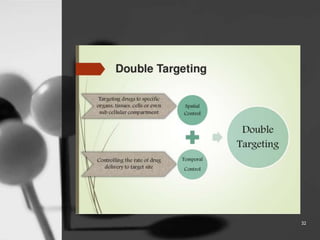
 Temporal and spatial methodologies are combined to
target a carrier system, then targeting may be called
double targeting.
 Spatial placement relates to targeting drugs to
specific organs, tissues, cells or even subcellular
compartment. whereas temporal delivery refers to
controlling the rate of drug delivery to target site.
31
32
33
REFERENCES
• Drug Targeting Organ-Specific Strategies Edited by
Grietje Molemaand Dirk K. F . Meijer, 2007.
• Targeted and Controlled drug delivery (Novel carrier
systems), S P Vyas and R K Khar, CBS publishers, 2002.
• Progress in Controlled and Novel drug delivery systems
by N K Jain, CBS publishers, 2008.
34
35

Targetted drug delivery

  • 1.
    BY SAYEDA SALMA 1STM PHARM DEPT OF PHARMACEUTICS 1
  • 2.
    INDEX • INTRODUCTION • DEFINITION •OBJECTIVE • REASON FOR DRUG TARGETTING • MERITS AND DEMERITS • HISTORY • CONCEPT (a description on targeted drug delivery) 2
  • 3.
    INTRODUCTION • Targeted drugdelivery is a method of delivering medication to a patient in a manner that increases the concentration of the medication in some parts of the body relative to others. • Targeted drug delivery seeks to concentrate the medication in the tissues of interest while reducing the relative concentration of the medication in the remaining tissues. • This improves efficacy of the while by reducing side effects. 3
  • 4.
    • Drug targetingis the delivery of drugs to receptors or organs or any other specific part of the body to which one wishes to deliver the drugs exclusively. • The drug’s therapeutic index, as measured by its pharmacological response and safety, relies in the access and specific introduction of the drug with its candidate receptor, whilst minimizing its introduction with non – target tissue. 4
  • 5.
    DEFINATION • ‘Targeted drugdelivery system is a special form of drug delivery system where the medicament is selectively targeted or delivered only to its site of action or absorption and not to the non-target organs or tissues or cells.’ 5
  • 6.
    THE DRUG MAYBE DELIVERED TO: • To the capillary bed of the active sites. • To the specific type of cell or even an intracellular region. Ex: Tumour cells but not to normal cells. • To a specific organ or tissues by complexion with the carrier that recognizes the target. 6
  • 7.
    OBJECTIVE ☼ Selective +Effective localization ☼ Pre-identified site ☼ ↑ Therapeutic conc. ☼ Restricted to non-specific sites ☼ Minimizing toxic effects ☼ Maximizing Therapeutic index • Ex- In cancer chemotherapy and enzyme replacement therapy. 7
  • 8.
    REASON FOR DRUG TARGETING: • In the treatment or prevention of diseases. • Pharmaceutical drug instability in conventional dosage form solubility • biopharmaceutical low absorption • biological instability • pharmacokinetic / pharmacodynamic short half life • large volume of distribution • clinical, low therapeutic index. 8
  • 9.
    IDEAL TDDS • 1)Biochemically inert, non-toxic& non-immunogenic • 2) Stability(Physical& Chemical) • 3) Restricted delivery to target site/organ • 4) Uniform capillary distribution at the site • 5) Controlled & predictable rate of delivery • 6) Drug release vs Drug action • 7) ↑ Therapeutic effect • 8) Minimal or No – Drug leakage • 9) Carrier properties • 10)Cost of production 9
  • 10.
    MERITS • Simplified Drugadministration protocol • ↓ Dose of drug • ↑ Drug concentration at target than non-target sites • Selective targeting to infections cells than compared to normal cells. • Enhancement of the absorption of target molecules such as peptides and particulates. • Drug can be administered in a smaller dose to produce the desired effect. • No peak and valley plasma concentration. 10
  • 11.
    DEMERITS • Rapid Clearance •Immune reactions (mostly against I.V .route) • Insufficient localization in tumour cells • Diffusion& redistribution of released drugs. • Requires highly sophisticated technology for the formulation. • Difficult to maintain stability of dosage form. E.g.: Resealed erythrocytes have to be stored at 4 degree Celsius. 11
  • 12.
    HISTORY The history ofcontrolled release technology is divided into three time periods. • From 1950 to 1970 was the period of sustain drug release . • From 1970 to 1990 was involved in the determination of the needs of the control drug delivery . • first introduced Nano technology (1974). • liposomes were introduced for the first time in 1978 . • post 1990 became the modern era for controlled release and drug targetting technology. 12
  • 13.
    CONCEPT • Targeting ofdrugs to special cells and tissues of the body without their becoming a part of systemic circulation is a very novel idea. • If a drug can be administered in a form such that it reaches the receptor sites in sufficient concentration without disturbing in extraneous tissue cells. Such products are prepared by considering- 1.specific properties of target cells. 2.nature of markers or transport carriers or vehicles, which convey drug to specific receptors. 3.ligands and physically modulated component 13
  • 14.
    COMPONENTS Target may bedefined as a cell or group of cells in minority, identified to be in the need of treatment. • Carrier is one of the important entity essentially required for effective transportation of loaded drugs. • They are vectors, which sequester, retain drug and transport or deliver it into the vicinity of the target cells. • The ligands confer recognition and specificity upon carrier/vector and lend them to approach the respective target and deliver the drug. • Ex-antibodies, polypeptides, endogenous hormones etc.14
  • 15.
  • 16.
    CARRIERS • Required forsuccessful transportation of the loaded drug. • Delivers the drug within or in the vicinity of target. • An inherent characteristic or acquired through structural modification. • Able to cross anatomical barriers • Recognized specifically and selectively by the target cells. • The linkage and the directing unit (ligand) should be stable in plasma, interstitial and other biofluids. • Non-toxic, non-immunogenic and biodegradable particulate or macromolecule. • After recognition it releases the therapeutic moiety. 16
  • 17.
  • 18.
    TYPES 1. Endogenous (LDL,HDL Chylomicrons, Serum albumin, Erythrocytes) 2. Exogenous (Microparticulates, Soluble polymeric and Biodegradable polymeric drug carriers) 1. Colloidal carriers 2. Cellular carriers 3. Polymer based systems 4. Macromolecular carriers 18
  • 19.
    COLLOIDALAND CELLULAR CARRIERS Ex: Liposomes,niosomes, pharmacosomes, virosomes, immunoliposomes. Ex: Microparticles, Nanoparticles, Magnetic microspheres, Albumin microspheres, Nanocapsules. It includes cellular or blood components: Ex: Erythrocytes, Serum albumin, Antibodies, Platelets, Leucocytes. 19
  • 20.
    POLYMER BASED • Muco-adhesive •Biodegradable • Bioerodible • Soluble synthetic polymeric carriers. 20
  • 21.
    MACROMOLECULAR FORMS  Proteins,glycoproteins, Neo glycoproteins and artificial viral envelopes(AVE).  Glycosylated water soluble polymers(poly-L-lysine).  Immunological fragments, antibody enzyme complex.  Toxins, immunotoxin.  Lectins and polysaccharides 21
  • 22.
    LEVELS OF TARGETTING Passive targeting  Inverse targeting  Active targeting (a) Ligand mediated targeting (b) Physical targeting  Dual targeting  Double targeting  Combination targeting 22
  • 23.
  • 24.
  • 25.
    PASSIVE TARGETTING • Systemsthat target the systemic circulation are generally characterized as “passive” delivery systems (i.e. targeting occurs because of the body’s natural response to the physicochemical characteristic of the drug or drug-carrier system). • Passive capture of colloidal carriers by macrophages offers therapeutic opportunities for the delivery of anti- infectives for diseases that involve macrophage cells of RES. • Passive targeting also includes deliver of drug carriers system directly to discrete compartment in the body. • E.g. Different regions of GI tract, eye, nose, knee joints, lungs, vagina, rectum and respiratory tract 25
  • 26.
    ACTIVE TARGETTING • Inactive targeting the natural disposition pattern of a carrier is modified to target specific organs, tissues or attachment of cells specific ligands . • It adopts modified drug-drug carrier molecules capable of recognizing and interacting with a specific cell, tissues or organ in the body. • Modification of the carrier system includes, a change in the molecular size, alteration of the surface properties by incorporation of antigen specific anti bodies or attachment of cell receptor specific ligands. 26
  • 27.
    TYPES OF ACTIVE TARGETTING Achieved using specific mechanisms such as receptor dependent uptake of natural LDL particles and synthetic lipid microemulsions of partially reconstituted LDL particles coated with the apoproteins.  In this type of targeting some characteristics of environment changes like pH, temperature, light intensity, electric field, ionic strength small and even specific stimuli like glucose concentration are used to localize the drug carrier to predetermined site.  This approach was found exceptional for tumor targeting as well as cytosolic delivery of entrapped drug or genetic material. 27
  • 28.
    This targeting approachcan further be classified it into three different levels of targeting: 1) First Order Targeting: This describes delivery to a discrete organ or a tissue. 2) Second Order Targeting: This represents targeting to specific types of cells within an organ/tissue. 3) Third Order Targeting: This implies delivery to specific intracellular compartment in the target cell, E.g. Lysosomes. 28
  • 29.
    INVERSE TARGETTING • Itis based on successful attempts to circumvent and avoid passive uptake of colloidal carrier by RES. • This leads to biodistribution trend of the carrier and hence the process is referred as inverse targeting. • Strategy applied to achieve inverse targeting is to suppress the function of RES and impair the host defense. • Alternative strategies includes modification of size, surface charge, composition, surface rigidity and hydrophilicity of carriers. 29
  • 30.
  • 31.
    DUAL AND DOUBLE TARGETTING In this targeting approach carrier molecule itself have their own therapeutic activity and thus increase the therapeutic effect of drug.  example, a carrier molecule having its own antiviral activity can be loaded with antiviral drug and the net synergistic effect of drug conjugate was observed.  Temporal and spatial methodologies are combined to target a carrier system, then targeting may be called double targeting.  Spatial placement relates to targeting drugs to specific organs, tissues, cells or even subcellular compartment. whereas temporal delivery refers to controlling the rate of drug delivery to target site. 31
  • 32.
  • 33.
  • 34.
    REFERENCES • Drug TargetingOrgan-Specific Strategies Edited by Grietje Molemaand Dirk K. F . Meijer, 2007. • Targeted and Controlled drug delivery (Novel carrier systems), S P Vyas and R K Khar, CBS publishers, 2002. • Progress in Controlled and Novel drug delivery systems by N K Jain, CBS publishers, 2008. 34
  • 35.