1
BUDGET :
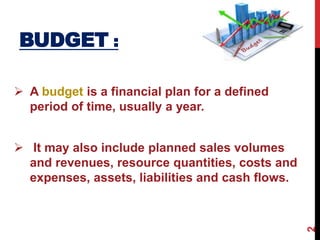
 A budget is a financial plan for a defined
period of time, usually a year.
 It may also include planned sales volumes
and revenues, resource quantities, costs and
expenses, assets, liabilities and cash flows.
2
PURPOSE :
 Budgeting tools provide a forecast of revenues
and expenditures, that is, construct a model of
how a business might perform financially if
certain strategies, events and plans are carried
out.
 These tools enable the actual financial
operation of the business to be measured
against the forecast.
3
TYPES :
 Sales budget – an estimate of future sales, often broken down into both
units and currency. It is used to create industries sales goals.
 Production budget - an estimate of the number of units that must be
manufactured to meet the sales goals. The production budget also
estimates the various costs involved with manufacturing, including labour
and material.
 Capital budget - used to determine whether an organization's long-term
investments such as new machinery, replacement machinery, new plants
and new products are worth pursuing.
 Revenue budget – consists of revenue receipts and the expenditure met
from these revenues.
4
 Expenditure budget – includes spending data items
 Flexibility budget - it is established for fixed cost and variable rate is
determined per activity measure for variable cost.
 Appropriation budget - a maximum amount is established for certain
expenditure based on management judgment.
 Cash flow/cash budget – a prediction of future cash receipts and
expenditures for a particular time period.
 Zero based budget - It has clear advantage when the limited
resources are to be allocated carefully and objectively.
5
 IMPORTANCE OF BUDGET :
 Since budgeting allows you to create a spending
plan for your money, it ensures that you will always
have enough money for the things you need and the
things that are important to you.
 Following a budget or spending plan will also keep
you out of debt or help you work your way out of
debt if you are currently in debt.
6
7
 COST CONTROL :
 Definition : The process or activity on controlling
costs associated with an activity, process, or
organization.
 From the sales forecast, the material management
group generates a production forecast that takes
into account seasonality, deals and promotions,
introduction of new products or product sizes, and
other factors that create a demand on inventory
equipment and personnel.
8
STEPS IN COST CONTROL
1) Establishing norms:
 The first step in cost control is to set norms
or standards which may serve as yardsticks
for measuring performance.
 These standards are set on the basis of past
performance adjusted for changes in future
and on the basis of studies conducted.
9
2) Comparison with actual:
 The actual cost incurred are compared with
established standard costs to know the level of
achievement.
 The variations are analyzed so as to arrive at the
causes which are controllable.
10
3) Corrective Action:
 Remedial measures are taken to avoid the
recurrence of variation in future and for revision
of standards wherever necessary.
11
12
CHARACTERISTICS OF COST
CONTROL
 The activity of maintaining cost as per the established
norms is known as cost control.
 Cost Control focuses on decreasing the total cost.
 Cost Control is temporary in nature.
 The process of cost control is completed when the
specified target is achieved.
 Cost Control is a preventive function as it ascertains
the cost before its occurrence.
 Cost control is the achievement of pre- determined
targets of costs.
13
THE BASIC ELEMENTS OF COST :
 MATERIAL
 LABOUR
 Direct labor.
 Indirect labor.
 OVERHEAD COST CONTROL
 BURDEN
 Direct burden
 Fixed burden
14
MATERIALS COST CONTROL:
 To control the cost of materials, make sure you are
getting the best possible prices, and also be
conscientious about reducing and eliminating waste.
 Control waste by tracking mistakes and developing
strategies to avoid similar errors in the future, and also
by developing processes that use your materials in the
most efficient ways.
15
LABOR COST CONTROL :
 To control the cost of labor, look for ways to improve
working efficiency.
 Keep track of how much product your operation
produces per person per hour, and look for variables
that correlate with increased productivity, such as the
number of workers on the floor at once, or the
particular workers participating in a manufacturing
process.
16
1) DIRECT LABOR
Involves cost of ,
 The production of any bulk or finished goods item
expressed as the number of “direct labour hours”
needed to produce 1000 bottles or 1000 bulk tablets
for every product made, including promotional
samples.
 This information is important to several groups, eg:
the accounting department, production planning an
operating managers.
17
INDIRECT LABOR
 It is easy to identify the direct labor needed for an
item, but to arrive at the true cost, indirect labor
hours are needed.
 It is in the interest of efficiency to break the work
standard down in to job skills. eg: machine
operators, table workers, and mechanics.
 Since in the scheduling of production these services
must be available when required
18
OVERHEAD COST CONTROL :
 Cut overhead costs by using your facility as fully
as possible, and looking for ways to save energy.
 Schedule a night shift if you have enough orders,
rather than taking additional days or weeks to fulfill
them.
19
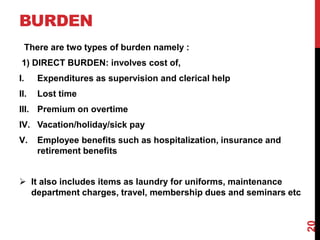
BURDEN
There are two types of burden namely :
1) DIRECT BURDEN: involves cost of,
I. Expenditures as supervision and clerical help
II. Lost time
III. Premium on overtime
IV. Vacation/holiday/sick pay
V. Employee benefits such as hospitalization, insurance and
retirement benefits
 It also includes items as laundry for uniforms, maintenance
department charges, travel, membership dues and seminars etc
20
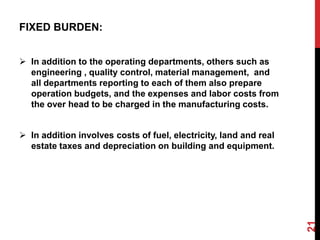
FIXED BURDEN:
 In addition to the operating departments, others such as
engineering , quality control, material management, and
all departments reporting to each of them also prepare
operation budgets, and the expenses and labor costs from
the over head to be charged in the manufacturing costs.
 In addition involves costs of fuel, electricity, land and real
estate taxes and depreciation on building and equipment.
21
22

Budget and cost control

  • 1.
  • 2.
    BUDGET :  Abudget is a financial plan for a defined period of time, usually a year.  It may also include planned sales volumes and revenues, resource quantities, costs and expenses, assets, liabilities and cash flows. 2
  • 3.
    PURPOSE :  Budgetingtools provide a forecast of revenues and expenditures, that is, construct a model of how a business might perform financially if certain strategies, events and plans are carried out.  These tools enable the actual financial operation of the business to be measured against the forecast. 3
  • 4.
    TYPES :  Salesbudget – an estimate of future sales, often broken down into both units and currency. It is used to create industries sales goals.  Production budget - an estimate of the number of units that must be manufactured to meet the sales goals. The production budget also estimates the various costs involved with manufacturing, including labour and material.  Capital budget - used to determine whether an organization's long-term investments such as new machinery, replacement machinery, new plants and new products are worth pursuing.  Revenue budget – consists of revenue receipts and the expenditure met from these revenues. 4
  • 5.
     Expenditure budget– includes spending data items  Flexibility budget - it is established for fixed cost and variable rate is determined per activity measure for variable cost.  Appropriation budget - a maximum amount is established for certain expenditure based on management judgment.  Cash flow/cash budget – a prediction of future cash receipts and expenditures for a particular time period.  Zero based budget - It has clear advantage when the limited resources are to be allocated carefully and objectively. 5
  • 6.
     IMPORTANCE OFBUDGET :  Since budgeting allows you to create a spending plan for your money, it ensures that you will always have enough money for the things you need and the things that are important to you.  Following a budget or spending plan will also keep you out of debt or help you work your way out of debt if you are currently in debt. 6
  • 7.
  • 8.
     COST CONTROL:  Definition : The process or activity on controlling costs associated with an activity, process, or organization.  From the sales forecast, the material management group generates a production forecast that takes into account seasonality, deals and promotions, introduction of new products or product sizes, and other factors that create a demand on inventory equipment and personnel. 8
  • 9.
    STEPS IN COSTCONTROL 1) Establishing norms:  The first step in cost control is to set norms or standards which may serve as yardsticks for measuring performance.  These standards are set on the basis of past performance adjusted for changes in future and on the basis of studies conducted. 9
  • 10.
    2) Comparison withactual:  The actual cost incurred are compared with established standard costs to know the level of achievement.  The variations are analyzed so as to arrive at the causes which are controllable. 10
  • 11.
    3) Corrective Action: Remedial measures are taken to avoid the recurrence of variation in future and for revision of standards wherever necessary. 11
  • 12.
  • 13.
    CHARACTERISTICS OF COST CONTROL The activity of maintaining cost as per the established norms is known as cost control.  Cost Control focuses on decreasing the total cost.  Cost Control is temporary in nature.  The process of cost control is completed when the specified target is achieved.  Cost Control is a preventive function as it ascertains the cost before its occurrence.  Cost control is the achievement of pre- determined targets of costs. 13
  • 14.
    THE BASIC ELEMENTSOF COST :  MATERIAL  LABOUR  Direct labor.  Indirect labor.  OVERHEAD COST CONTROL  BURDEN  Direct burden  Fixed burden 14
  • 15.
    MATERIALS COST CONTROL: To control the cost of materials, make sure you are getting the best possible prices, and also be conscientious about reducing and eliminating waste.  Control waste by tracking mistakes and developing strategies to avoid similar errors in the future, and also by developing processes that use your materials in the most efficient ways. 15
  • 16.
    LABOR COST CONTROL:  To control the cost of labor, look for ways to improve working efficiency.  Keep track of how much product your operation produces per person per hour, and look for variables that correlate with increased productivity, such as the number of workers on the floor at once, or the particular workers participating in a manufacturing process. 16
  • 17.
    1) DIRECT LABOR Involvescost of ,  The production of any bulk or finished goods item expressed as the number of “direct labour hours” needed to produce 1000 bottles or 1000 bulk tablets for every product made, including promotional samples.  This information is important to several groups, eg: the accounting department, production planning an operating managers. 17
  • 18.
    INDIRECT LABOR  Itis easy to identify the direct labor needed for an item, but to arrive at the true cost, indirect labor hours are needed.  It is in the interest of efficiency to break the work standard down in to job skills. eg: machine operators, table workers, and mechanics.  Since in the scheduling of production these services must be available when required 18
  • 19.
    OVERHEAD COST CONTROL:  Cut overhead costs by using your facility as fully as possible, and looking for ways to save energy.  Schedule a night shift if you have enough orders, rather than taking additional days or weeks to fulfill them. 19
  • 20.
    BURDEN There are twotypes of burden namely : 1) DIRECT BURDEN: involves cost of, I. Expenditures as supervision and clerical help II. Lost time III. Premium on overtime IV. Vacation/holiday/sick pay V. Employee benefits such as hospitalization, insurance and retirement benefits  It also includes items as laundry for uniforms, maintenance department charges, travel, membership dues and seminars etc 20
  • 21.
    FIXED BURDEN:  Inaddition to the operating departments, others such as engineering , quality control, material management, and all departments reporting to each of them also prepare operation budgets, and the expenses and labor costs from the over head to be charged in the manufacturing costs.  In addition involves costs of fuel, electricity, land and real estate taxes and depreciation on building and equipment. 21
  • 22.