Scale Up and Post
Approval Changes
(SUPAC)
Prepared by: Jagruti Kachchhi
M.Pharm, Pharmaceutical Quality
Assurance (Semester - 1)
Course Name: Product
Development and Technology
Transfer
Course code: MQA104T
Smt. B N B Swaminarayan Pharmacy College, Salvav, Vapi 2
INTRODUCTION
• Scale up is defined as
"process of increasing batch
size."
• The scale up process and the changes made
after approval in composition, manufacturing
process, manufacturing equipments and
change of site together known as Scale up
and post approval changes or SUPAC.
Smt. B N B Swaminarayan Pharmacy College, Salvav, Vapi 3
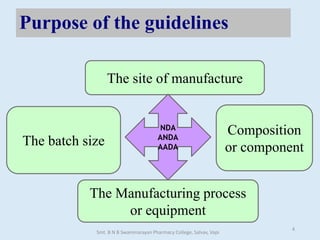
Purpose of the guidelines
The Manufacturing process
or equipment
Composition
or component
The site of manufacture
The batch size
NDA
ANDA
AADA
Smt. B N B Swaminarayan Pharmacy College, Salvav, Vapi
4
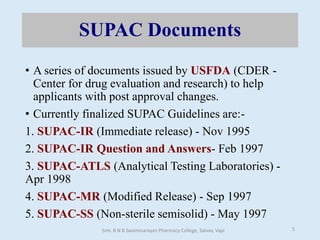
SUPAC Documents
• A series of documents issued by USFDA (CDER -
Center for drug evaluation and research) to help
applicants with post approval changes.
• Currently finalized SUPAC Guidelines are:-
1. SUPAC-IR (Immediate release) - Nov 1995
2. SUPAC-IR Question and Answers- Feb 1997
3. SUPAC-ATLS (Analytical Testing Laboratories) -
Apr 1998
4. SUPAC-MR (Modified Release) - Sep 1997
5. SUPAC-SS (Non-sterile semisolid) - May 1997
Smt. B N B Swaminarayan Pharmacy College, Salvav, Vapi 5
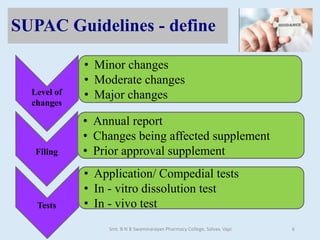
SUPAC Guidelines - define
• Minor changes
• Moderate changes
• Major changes
• Annual report
• Changes being affected supplement
• Prior approval supplement
• Application/ Compedial tests
• In - vitro dissolution test
• In - vivo test
Filing
Level of
changes
Tests
Smt. B N B Swaminarayan Pharmacy College, Salvav, Vapi 6
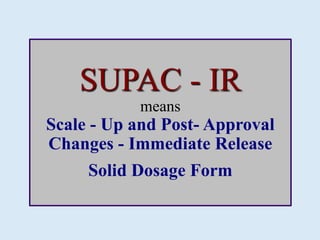
SUPAC - IR
means
Scale - Up and Post- Approval
Changes - Immediate Release
Solid Dosage Form
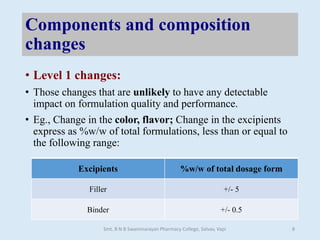
Components and composition
changes
• Level 1 changes:
• Those changes that are unlikely to have any detectable
impact on formulation quality and performance.
• Eg., Change in the color, flavor; Change in the excipients
express as %w/w of total formulations, less than or equal to
the following range:
Excipients %w/w of total dosage form
Filler +/- 5
Binder +/- 0.5
Smt. B N B Swaminarayan Pharmacy College, Salvav, Vapi 8
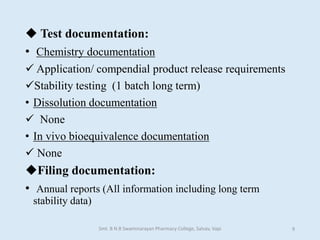
 Test documentation:
• Chemistry documentation
 Application/ compendial product release requirements
Stability testing (1 batch long term)
• Dissolution documentation
 None
• In vivo bioequivalence documentation
 None
Filing documentation:
• Annual reports (All information including long term
stability data)
Smt. B N B Swaminarayan Pharmacy College, Salvav, Vapi 9
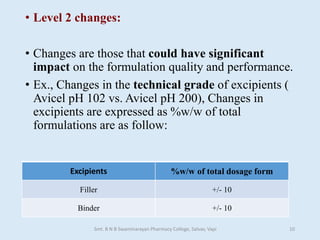
• Level 2 changes:
• Changes are those that could have significant
impact on the formulation quality and performance.
• Ex., Changes in the technical grade of excipients (
Avicel pH 102 vs. Avicel pH 200), Changes in
excipients are expressed as %w/w of total
formulations are as follow:
Excipients %w/w of total dosage form
Filler +/- 10
Binder +/- 10
Smt. B N B Swaminarayan Pharmacy College, Salvav, Vapi 10
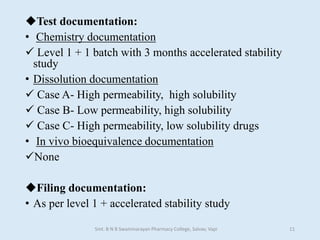
Test documentation:
• Chemistry documentation
 Level 1 + 1 batch with 3 months accelerated stability
study
• Dissolution documentation
 Case A- High permeability, high solubility
 Case B- Low permeability, high solubility
 Case C- High permeability, low solubility drugs
• In vivo bioequivalence documentation
None
Filing documentation:
• As per level 1 + accelerated stability study
Smt. B N B Swaminarayan Pharmacy College, Salvav, Vapi 11
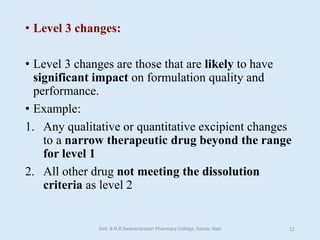
• Level 3 changes:
• Level 3 changes are those that are likely to have
significant impact on formulation quality and
performance.
• Example:
1. Any qualitative or quantitative excipient changes
to a narrow therapeutic drug beyond the range
for level 1
2. All other drug not meeting the dissolution
criteria as level 2
Smt. B N B Swaminarayan Pharmacy College, Salvav, Vapi 12
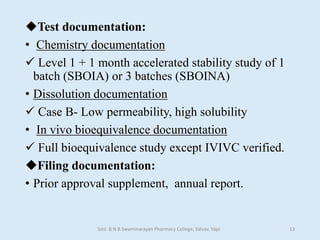
Test documentation:
• Chemistry documentation
 Level 1 + 1 month accelerated stability study of 1
batch (SBOIA) or 3 batches (SBOINA)
• Dissolution documentation
 Case B- Low permeability, high solubility
• In vivo bioequivalence documentation
 Full bioequivalence study except IVIVC verified.
Filing documentation:
• Prior approval supplement, annual report.
Smt. B N B Swaminarayan Pharmacy College, Salvav, Vapi 13
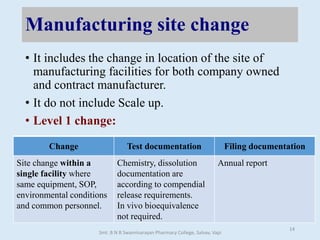
Manufacturing site change
• It includes the change in location of the site of
manufacturing facilities for both company owned
and contract manufacturer.
• It do not include Scale up.
• Level 1 change:
Change Test documentation Filing documentation
Site change within a
single facility where
same equipment, SOP,
environmental conditions
and common personnel.
Chemistry, dissolution
documentation are
according to compendial
release requirements.
In vivo bioequivalence
not required.
Annual report
Smt. B N B Swaminarayan Pharmacy College, Salvav, Vapi
14
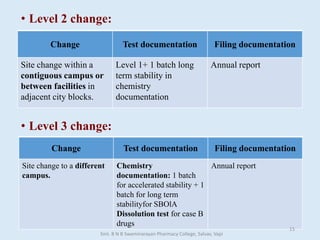
• Level 2 change:
• Level 3 change:
Change Test documentation Filing documentation
Site change within a
contiguous campus or
between facilities in
adjacent city blocks.
Level 1+ 1 batch long
term stability in
chemistry
documentation
Annual report
Change Test documentation Filing documentation
Site change to a different
campus.
Chemistry
documentation: 1 batch
for accelerated stability + 1
batch for long term
stabilityfor SBOlA
Dissolution test for case B
drugs
Annual report
Smt. B N B Swaminarayan Pharmacy College, Salvav, Vapi
15
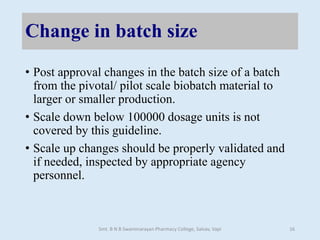
Change in batch size
• Post approval changes in the batch size of a batch
from the pivotal/ pilot scale biobatch material to
larger or smaller production.
• Scale down below 100000 dosage units is not
covered by this guideline.
• Scale up changes should be properly validated and
if needed, inspected by appropriate agency
personnel.
Smt. B N B Swaminarayan Pharmacy College, Salvav, Vapi 16
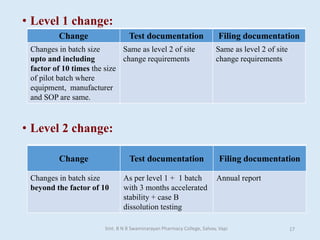
• Level 1 change:
• Level 2 change:
Change Test documentation Filing documentation
Changes in batch size
upto and including
factor of 10 times the size
of pilot batch where
equipment, manufacturer
and SOP are same.
Same as level 2 of site
change requirements
Same as level 2 of site
change requirements
Change Test documentation Filing documentation
Changes in batch size
beyond the factor of 10
As per level 1 + 1 batch
with 3 months accelerated
stability + case B
dissolution testing
Annual report
Smt. B N B Swaminarayan Pharmacy College, Salvav, Vapi 17
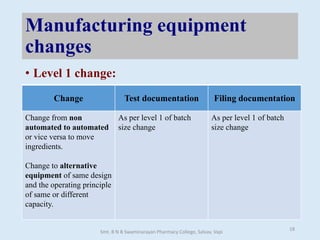
Manufacturing equipment
changes
• Level 1 change:
Change Test documentation Filing documentation
Change from non
automated to automated
or vice versa to move
ingredients.
Change to alternative
equipment of same design
and the operating principle
of same or different
capacity.
As per level 1 of batch
size change
As per level 1 of batch
size change
Smt. B N B Swaminarayan Pharmacy College, Salvav, Vapi
18
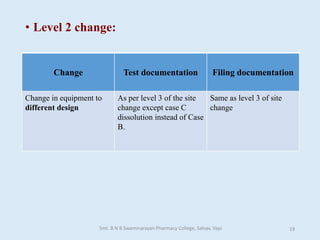
• Level 2 change:
Change Test documentation Filing documentation
Change in equipment to
different design
As per level 3 of the site
change except case C
dissolution instead of Case
B.
Same as level 3 of site
change
Smt. B N B Swaminarayan Pharmacy College, Salvav, Vapi 19
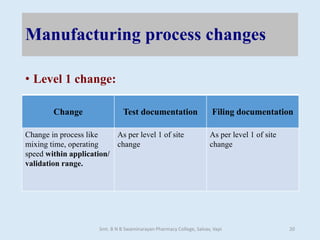
Manufacturing process changes
• Level 1 change:
Change Test documentation Filing documentation
Change in process like
mixing time, operating
speed within application/
validation range.
As per level 1 of site
change
As per level 1 of site
change
Smt. B N B Swaminarayan Pharmacy College, Salvav, Vapi 20
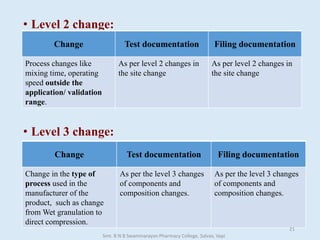
• Level 2 change:
• Level 3 change:
Change Test documentation Filing documentation
Process changes like
mixing time, operating
speed outside the
application/ validation
range.
As per level 2 changes in
the site change
As per level 2 changes in
the site change
Change Test documentation Filing documentation
Change in the type of
process used in the
manufacturer of the
product, such as change
from Wet granulation to
direct compression.
As per the level 3 changes
of components and
composition changes.
As per the level 3 changes
of components and
composition changes.
Smt. B N B Swaminarayan Pharmacy College, Salvav, Vapi
21
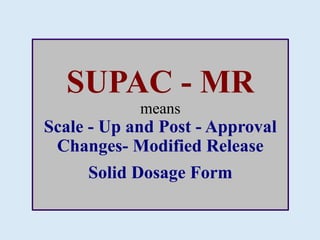
SUPAC - MR
means
Scale - Up and Post - Approval
Changes- Modified Release
Solid Dosage Form
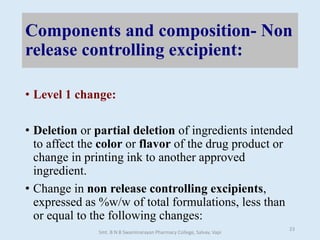
Components and composition- Non
release controlling excipient:
• Level 1 change:
• Deletion or partial deletion of ingredients intended
to affect the color or flavor of the drug product or
change in printing ink to another approved
ingredient.
• Change in non release controlling excipients,
expressed as %w/w of total formulations, less than
or equal to the following changes:
Smt. B N B Swaminarayan Pharmacy College, Salvav, Vapi
23
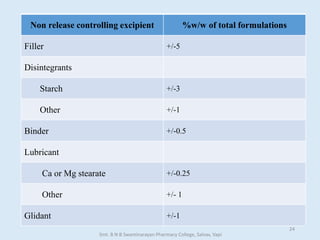
Non release controlling excipient %w/w of total formulations
Filler +/-5
Disintegrants
Starch +/-3
Other +/-1
Binder +/-0.5
Lubricant
Ca or Mg stearate +/-0.25
Other +/- 1
Glidant +/-1
Smt. B N B Swaminarayan Pharmacy College, Salvav, Vapi
24
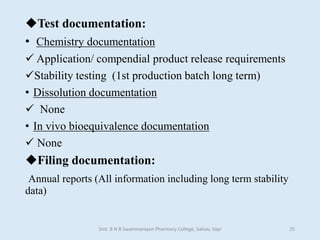
Test documentation:
• Chemistry documentation
 Application/ compendial product release requirements
Stability testing (1st production batch long term)
• Dissolution documentation
 None
• In vivo bioequivalence documentation
 None
Filing documentation:
Annual reports (All information including long term stability
data)
Smt. B N B Swaminarayan Pharmacy College, Salvav, Vapi 25
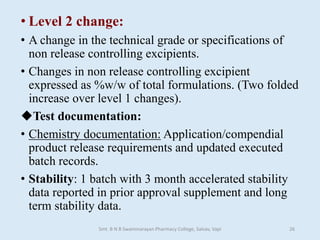
• Level 2 change:
• A change in the technical grade or specifications of
non release controlling excipients.
• Changes in non release controlling excipient
expressed as %w/w of total formulations. (Two folded
increase over level 1 changes).
Test documentation:
• Chemistry documentation: Application/compendial
product release requirements and updated executed
batch records.
• Stability: 1 batch with 3 month accelerated stability
data reported in prior approval supplement and long
term stability data.
Smt. B N B Swaminarayan Pharmacy College, Salvav, Vapi 26
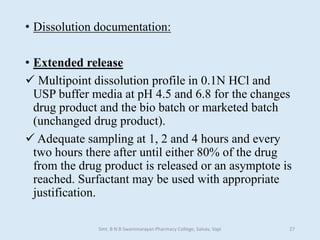
• Dissolution documentation:
• Extended release
 Multipoint dissolution profile in 0.1N HCl and
USP buffer media at pH 4.5 and 6.8 for the changes
drug product and the bio batch or marketed batch
(unchanged drug product).
 Adequate sampling at 1, 2 and 4 hours and every
two hours there after until either 80% of the drug
from the drug product is released or an asymptote is
reached. Surfactant may be used with appropriate
justification.
Smt. B N B Swaminarayan Pharmacy College, Salvav, Vapi 27
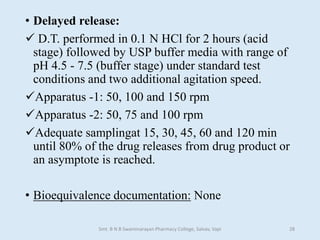
• Delayed release:
 D.T. performed in 0.1 N HCl for 2 hours (acid
stage) followed by USP buffer media with range of
pH 4.5 - 7.5 (buffer stage) under standard test
conditions and two additional agitation speed.
Apparatus -1: 50, 100 and 150 rpm
Apparatus -2: 50, 75 and 100 rpm
Adequate samplingat 15, 30, 45, 60 and 120 min
until 80% of the drug releases from drug product or
an asymptote is reached.
• Bioequivalence documentation: None
Smt. B N B Swaminarayan Pharmacy College, Salvav, Vapi 28
Filing documentation:
• Prior approval supplement (accelerated stability
data) annual report (long term stability data).
• Level 3 change:
• Changes are as level 2 changes. The total weightof
the dosage form may be within or outside the
approved original application range.
Smt. B N B Swaminarayan Pharmacy College, Salvav, Vapi 29
Test documentation:
• Chemistry documentation: Application/compendial
product release requirements and updated executed
batch records.
Stability: 1 batch with 3 month accelerated stability
data reported in prior approval supplement and long
term stability data of first 3 production batches reported
in annual report.
• Dissolution documentation: Same as level 2 changes
• Bioequivalence documentation: A single dose
bioequivalence study. It may be in presence of an
established IVIVC.
Filing documentation: Same as level 2 change
Smt. B N B Swaminarayan Pharmacy College, Salvav, Vapi 30
Components and composition-
Release controlling excipient:
• The sponsor should provide appropriate
justifications. ( i.e., Mechanism of drug release &
manufacturing process) for claiming any excipientas
a release controlling excipient in the formulation of
modified relea e solid oral dosage form.
• Level 1 Change:
• Same as non release controllingexcipient.
Smt. B N B Swaminarayan Pharmacy College, Salvav, Vapi 31
• Level 2 change:
• Same as non release controlling excipient.
• Test documentation for a level 2 changes would
vary depending on whether the product could be
considered to have a narrow therapeutic range.
Test documentation:
a) Chemistry documentation: Same as non release
controlling excipient.
Smt. B N B Swaminarayan Pharmacy College, Salvav, Vapi 32
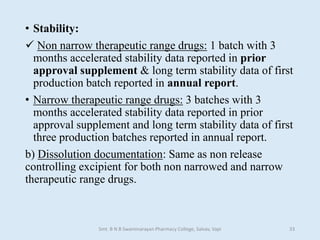
• Stability:
 Non narrow therapeutic range drugs: 1 batch with 3
months accelerated stability data reported in prior
approval supplement & long term stability data of first
production batch reported in annual report.
• Narrow therapeutic range drugs: 3 batches with 3
months accelerated stability data reported in prior
approval supplement and long term stability data of first
three production batches reported in annual report.
b) Dissolution documentation: Same as non release
controlling excipient for both non narrowed and narrow
therapeutic range drugs.
Smt. B N B Swaminarayan Pharmacy College, Salvav, Vapi 33
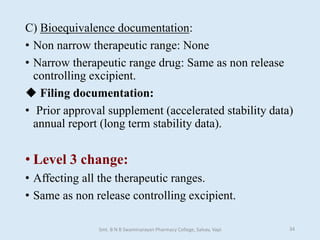
C) Bioequivalence documentation:
• Non narrow therapeutic range: None
• Narrow therapeutic range drug: Same as non release
controlling excipient.
 Filing documentation:
• Prior approval supplement (accelerated stability data)
annual report (long term stability data).
• Level 3 change:
• Affecting all the therapeutic ranges.
• Same as non release controlling excipient.
Smt. B N B Swaminarayan Pharmacy College, Salvav, Vapi 34
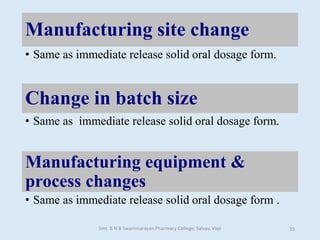
Manufacturing site change
• Same as immediate release solid oral dosage form.
Change in batch size
Manufacturing equipment &
process changes
• Same as immediate release solid oral dosage form.
• Same as immediate release solid oral dosage form .
Smt. B N B Swaminarayan Pharmacy College, Salvav, Vapi 35
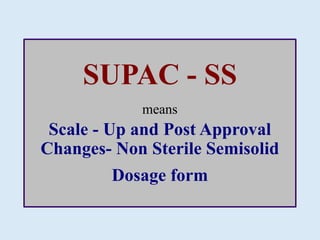
SUPAC - SS
means
Scale - Up and Post Approval
Changes- Non Sterile Semisolid
Dosage form
• Level 1 change:
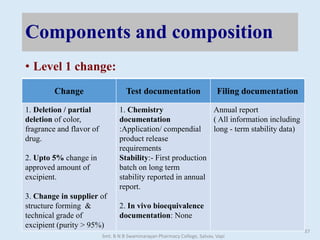
Components and composition
Change Test documentation Filing documentation
1. Deletion / partial
deletion of color,
fragrance and flavor of
drug.
2. Upto 5% change in
approved amount of
excipient.
3. Change in supplier of
structure forming &
technical grade of
excipient (purity > 95%)
1. Chemistry
documentation
:Application/ compendial
product release
requirements
Stability:- First production
batch on long term
stability reported in annual
report.
2. In vivo bioequivalence
documentation: None
Annual report
( All information including
long - term stability data)
Smt. B N B Swaminarayan Pharmacy College, Salvav, Vapi
37
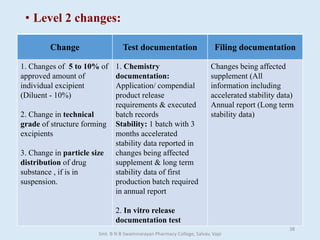
• Level 2 changes:
Change Test documentation Filing documentation
1. Changes of 5 to 10% of
approved amount of
individual excipient
(Diluent - 10%)
2. Change in technical
grade of structure forming
excipients
3. Change in particle size
distribution of drug
substance , if is in
suspension.
1. Chemistry
documentation:
Application/ compendial
product release
requirements & executed
batch records
Stability: 1 batch with 3
months accelerated
stability data reported in
changes being affected
supplement & long term
stability data of first
production batch required
in annual report
2. In vitro release
documentation test
Changes being affected
supplement (All
information including
accelerated stability data)
Annual report (Long term
stability data)
Smt. B N B Swaminarayan Pharmacy College, Salvav, Vapi
38
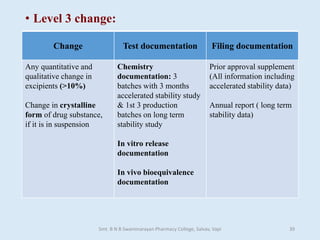
• Level 3 change:
Change Test documentation Filing documentation
Any quantitative and
qualitative change in
excipients (>10%)
Change in crystalline
form of drug substance,
if it is in suspension
Chemistry
documentation: 3
batches with 3 months
accelerated stability study
& 1st 3 production
batches on long term
stability study
In vitro release
documentation
In vivo bioequivalence
documentation
Prior approval supplement
(All information including
accelerated stability data)
Annual report ( long term
stability data)
Smt. B N B Swaminarayan Pharmacy College, Salvav, Vapi 39
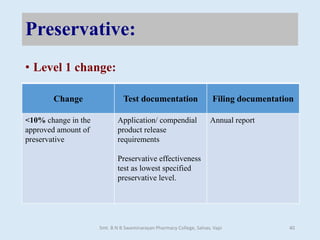
Preservative:
• Level 1 change:
Change Test documentation Filing documentation
<10% change in the
approved amount of
preservative
Application/ compendial
product release
requirements
Preservative effectiveness
test as lowest specified
preservative level.
Annual report
Smt. B N B Swaminarayan Pharmacy College, Salvav, Vapi 40
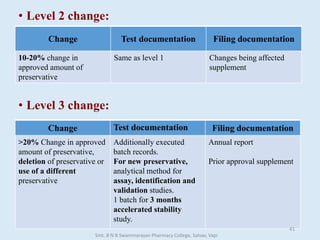
• Level 2 change:
• Level 3 change:
Change Test documentation Filing documentation
10-20% change in
approved amount of
preservative
Same as level 1 Changes being affected
supplement
Change Test documentation Filing documentation
>20% Change in approved
amount of preservative,
deletion of preservative or
use of a different
preservative
Additionally executed
batch records.
For new preservative,
analytical method for
assay, identification and
validation studies.
1 batch for 3 months
accelerated stability
study.
Annual report
Prior approval supplement
Smt. B N B Swaminarayan Pharmacy College, Salvav, Vapi
41
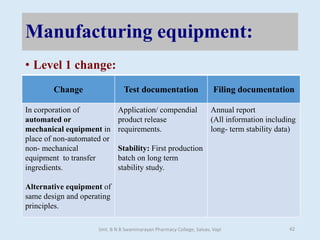
Manufacturing equipment:
• Level 1 change:
Change Test documentation Filing documentation
In corporation of
automated or
mechanical equipment in
place of non-automated or
non- mechanical
equipment to transfer
ingredients.
Alternative equipment of
same design and operating
principles.
Application/ compendial
product release
requirements.
Stability: First production
batch on long term
stability study.
Annual report
(All information including
long- term stability data)
Smt. B N B Swaminarayan Pharmacy College, Salvav, Vapi 42
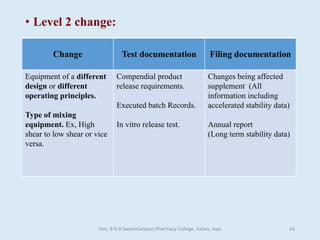
• Level 2 change:
Change Test documentation Filing documentation
Equipment of a different
design or different
operating principles.
Type of mixing
equipment. Ex, High
shear to low shear or vice
versa.
Compendial product
release requirements.
Executed batch Records.
In vitro release test.
Changes being affected
supplement (All
information including
accelerated stability data)
Annual report
(Long term stability data)
Smt. B N B Swaminarayan Pharmacy College, Salvav, Vapi 43
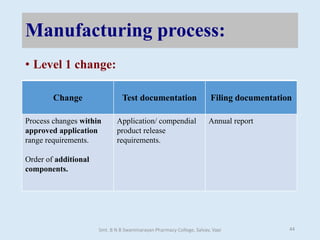
Manufacturing process:
• Level 1 change:
Change Test documentation Filing documentation
Process changes within
approved application
range requirements.
Order of additional
components.
Application/ compendial
product release
requirements.
Annual report
Smt. B N B Swaminarayan Pharmacy College, Salvav, Vapi 44
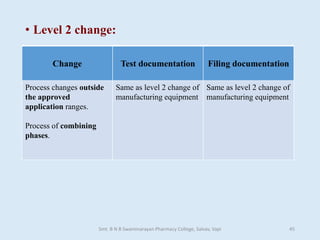
• Level 2 change:
Change Test documentation Filing documentation
Process changes outside
the approved
application ranges.
Process of combining
phases.
Same as level 2 change of
manufacturing equipment
Same as level 2 change of
manufacturing equipment
Smt. B N B Swaminarayan Pharmacy College, Salvav, Vapi 45
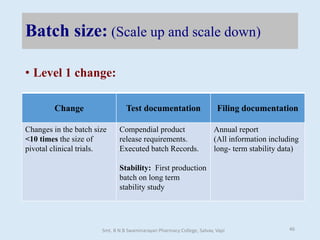
Batch size: (Scale up and scale down)
• Level 1 change:
Change Test documentation Filing documentation
Changes in the batch size
<10 times the size of
pivotal clinical trials.
Compendial product
release requirements.
Executed batch Records.
Stability: First production
batch on long term
stability study
Annual report
(All information including
long- term stability data)
Smt. B N B Swaminarayan Pharmacy College, Salvav, Vapi 46
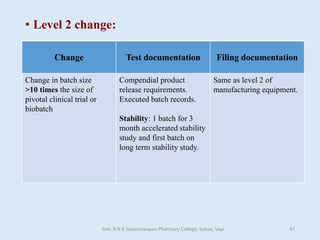
• Level 2 change:
Change Test documentation Filing documentation
Change in batch size
>10 times the size of
pivotal clinical trial or
biobatch
Compendial product
release requirements.
Executed batch records.
Stability: 1 batch for 3
month accelerated stability
study and first batch on
long term stability study.
Same as level 2 of
manufacturing equipment.
Smt. B N B Swaminarayan Pharmacy College, Salvav, Vapi 47
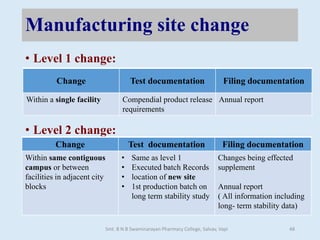
Manufacturing site change
• Level 1 change:
• Level 2 change:
Change Test documentation Filing documentation
Within a single facility Compendial product release
requirements
Annual report
Change Test documentation Filing documentation
Within same contiguous
campus or between
facilities in adjacent city
blocks
• Same as level 1
• Executed batch Records
• location of new site
• 1st production batch on
long term stability study
Changes being effected
supplement
Annual report
( All information including
long- term stability data)
Smt. B N B Swaminarayan Pharmacy College, Salvav, Vapi 48
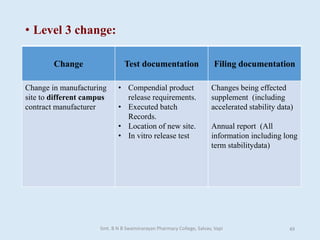
• Level 3 change:
Change Test documentation Filing documentation
Change in manufacturing
site to different campus
contract manufacturer
• Compendial product
release requirements.
• Executed batch
Records.
• Location of new site.
• In vitro release test
Changes being effected
supplement (including
accelerated stability data)
Annual report (All
information including long
term stabilitydata)
Smt. B N B Swaminarayan Pharmacy College, Salvav, Vapi 49
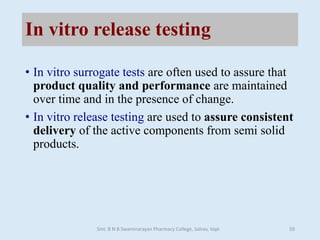
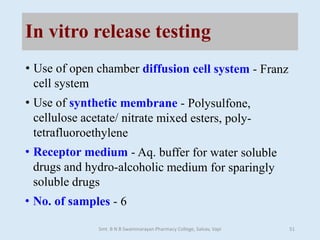
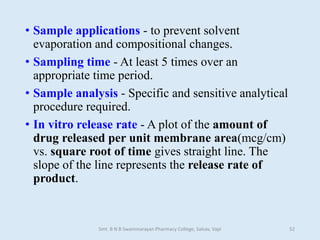
In vitro release testing
• In vitro surrogate tests are often used to assure that
product quality and performance are maintained
over time and in the presence of change.
• In vitro release testing are used to assure consistent
delivery of the active components from semi solid
products.
Smt. B N B Swaminarayan Pharmacy College, Salvav, Vapi 50
In vitro release testing
Smt. B N B Swaminarayan Pharmacy College, Salvav, Vapi 51
• Sample applications - to prevent solvent
evaporation and compositional changes.
• Sampling time - At least 5 times over an
appropriate time period.
• Sample analysis - Specific and sensitive analytical
procedure required.
• In vitro release rate - A plot of the amount of
drug released per unit membrane area(mcg/cm)
vs. square root of time gives straight line. The
slope of the line represents the release rate of
product.
Smt. B N B Swaminarayan Pharmacy College, Salvav, Vapi 52
In vivo Bioequivalence studies
• In vivo bioequivalence studies are performed for
new drug ti establish essential pharmacokinetic
parameters including rate of absorption, extent
of absorption, rate of excretion, metabolism and
elimination half life after a single and multiple
dose administration.
• In vivo bioequivalence studies are conducted in
the usual manner as discussed for bio-
availability studies. i.e., The pharmacokinetic
and pharmacodynamic methods.
Smt. B N B Swaminarayan Pharmacy College, Salvav, Vapi 53
Limitations of SUPAC
• SUPAC has not been updated(1995/97 for main
guidelines).
• It does not discuss multiple of changes.
• Does not cover modified equipment.
• Must be used in conjunction with other reference.
Ex, Excipient handbook
Smt. B N B Swaminarayan Pharmacy College, Salvav, Vapi 54
REFERENCE
• https://www.fda.gov
• Shah V P, skelly J P, Barr W H,Malinowski H, and
Amidon G L. "Scale up of controlled release
product - Preliminary considerations",
Pharmaceutical technology.1992; 16(5): 35-40.
Smt. B N B Swaminarayan Pharmacy College, Salvav, Vapi 55
Thank you

Scale up and post approval changes.pptx

  • 1.
    Scale Up andPost Approval Changes (SUPAC) Prepared by: Jagruti Kachchhi M.Pharm, Pharmaceutical Quality Assurance (Semester - 1) Course Name: Product Development and Technology Transfer Course code: MQA104T
  • 2.
    Smt. B NB Swaminarayan Pharmacy College, Salvav, Vapi 2
  • 3.
    INTRODUCTION • Scale upis defined as "process of increasing batch size." • The scale up process and the changes made after approval in composition, manufacturing process, manufacturing equipments and change of site together known as Scale up and post approval changes or SUPAC. Smt. B N B Swaminarayan Pharmacy College, Salvav, Vapi 3
  • 4.
    Purpose of theguidelines The Manufacturing process or equipment Composition or component The site of manufacture The batch size NDA ANDA AADA Smt. B N B Swaminarayan Pharmacy College, Salvav, Vapi 4
  • 5.
    SUPAC Documents • Aseries of documents issued by USFDA (CDER - Center for drug evaluation and research) to help applicants with post approval changes. • Currently finalized SUPAC Guidelines are:- 1. SUPAC-IR (Immediate release) - Nov 1995 2. SUPAC-IR Question and Answers- Feb 1997 3. SUPAC-ATLS (Analytical Testing Laboratories) - Apr 1998 4. SUPAC-MR (Modified Release) - Sep 1997 5. SUPAC-SS (Non-sterile semisolid) - May 1997 Smt. B N B Swaminarayan Pharmacy College, Salvav, Vapi 5
  • 6.
    SUPAC Guidelines -define • Minor changes • Moderate changes • Major changes • Annual report • Changes being affected supplement • Prior approval supplement • Application/ Compedial tests • In - vitro dissolution test • In - vivo test Filing Level of changes Tests Smt. B N B Swaminarayan Pharmacy College, Salvav, Vapi 6
  • 7.
    SUPAC - IR means Scale- Up and Post- Approval Changes - Immediate Release Solid Dosage Form
  • 8.
    Components and composition changes •Level 1 changes: • Those changes that are unlikely to have any detectable impact on formulation quality and performance. • Eg., Change in the color, flavor; Change in the excipients express as %w/w of total formulations, less than or equal to the following range: Excipients %w/w of total dosage form Filler +/- 5 Binder +/- 0.5 Smt. B N B Swaminarayan Pharmacy College, Salvav, Vapi 8
  • 9.
     Test documentation: •Chemistry documentation  Application/ compendial product release requirements Stability testing (1 batch long term) • Dissolution documentation  None • In vivo bioequivalence documentation  None Filing documentation: • Annual reports (All information including long term stability data) Smt. B N B Swaminarayan Pharmacy College, Salvav, Vapi 9
  • 10.
    • Level 2changes: • Changes are those that could have significant impact on the formulation quality and performance. • Ex., Changes in the technical grade of excipients ( Avicel pH 102 vs. Avicel pH 200), Changes in excipients are expressed as %w/w of total formulations are as follow: Excipients %w/w of total dosage form Filler +/- 10 Binder +/- 10 Smt. B N B Swaminarayan Pharmacy College, Salvav, Vapi 10
  • 11.
    Test documentation: • Chemistrydocumentation  Level 1 + 1 batch with 3 months accelerated stability study • Dissolution documentation  Case A- High permeability, high solubility  Case B- Low permeability, high solubility  Case C- High permeability, low solubility drugs • In vivo bioequivalence documentation None Filing documentation: • As per level 1 + accelerated stability study Smt. B N B Swaminarayan Pharmacy College, Salvav, Vapi 11
  • 12.
    • Level 3changes: • Level 3 changes are those that are likely to have significant impact on formulation quality and performance. • Example: 1. Any qualitative or quantitative excipient changes to a narrow therapeutic drug beyond the range for level 1 2. All other drug not meeting the dissolution criteria as level 2 Smt. B N B Swaminarayan Pharmacy College, Salvav, Vapi 12
  • 13.
    Test documentation: • Chemistrydocumentation  Level 1 + 1 month accelerated stability study of 1 batch (SBOIA) or 3 batches (SBOINA) • Dissolution documentation  Case B- Low permeability, high solubility • In vivo bioequivalence documentation  Full bioequivalence study except IVIVC verified. Filing documentation: • Prior approval supplement, annual report. Smt. B N B Swaminarayan Pharmacy College, Salvav, Vapi 13
  • 14.
    Manufacturing site change •It includes the change in location of the site of manufacturing facilities for both company owned and contract manufacturer. • It do not include Scale up. • Level 1 change: Change Test documentation Filing documentation Site change within a single facility where same equipment, SOP, environmental conditions and common personnel. Chemistry, dissolution documentation are according to compendial release requirements. In vivo bioequivalence not required. Annual report Smt. B N B Swaminarayan Pharmacy College, Salvav, Vapi 14
  • 15.
    • Level 2change: • Level 3 change: Change Test documentation Filing documentation Site change within a contiguous campus or between facilities in adjacent city blocks. Level 1+ 1 batch long term stability in chemistry documentation Annual report Change Test documentation Filing documentation Site change to a different campus. Chemistry documentation: 1 batch for accelerated stability + 1 batch for long term stabilityfor SBOlA Dissolution test for case B drugs Annual report Smt. B N B Swaminarayan Pharmacy College, Salvav, Vapi 15
  • 16.
    Change in batchsize • Post approval changes in the batch size of a batch from the pivotal/ pilot scale biobatch material to larger or smaller production. • Scale down below 100000 dosage units is not covered by this guideline. • Scale up changes should be properly validated and if needed, inspected by appropriate agency personnel. Smt. B N B Swaminarayan Pharmacy College, Salvav, Vapi 16
  • 17.
    • Level 1change: • Level 2 change: Change Test documentation Filing documentation Changes in batch size upto and including factor of 10 times the size of pilot batch where equipment, manufacturer and SOP are same. Same as level 2 of site change requirements Same as level 2 of site change requirements Change Test documentation Filing documentation Changes in batch size beyond the factor of 10 As per level 1 + 1 batch with 3 months accelerated stability + case B dissolution testing Annual report Smt. B N B Swaminarayan Pharmacy College, Salvav, Vapi 17
  • 18.
    Manufacturing equipment changes • Level1 change: Change Test documentation Filing documentation Change from non automated to automated or vice versa to move ingredients. Change to alternative equipment of same design and the operating principle of same or different capacity. As per level 1 of batch size change As per level 1 of batch size change Smt. B N B Swaminarayan Pharmacy College, Salvav, Vapi 18
  • 19.
    • Level 2change: Change Test documentation Filing documentation Change in equipment to different design As per level 3 of the site change except case C dissolution instead of Case B. Same as level 3 of site change Smt. B N B Swaminarayan Pharmacy College, Salvav, Vapi 19
  • 20.
    Manufacturing process changes •Level 1 change: Change Test documentation Filing documentation Change in process like mixing time, operating speed within application/ validation range. As per level 1 of site change As per level 1 of site change Smt. B N B Swaminarayan Pharmacy College, Salvav, Vapi 20
  • 21.
    • Level 2change: • Level 3 change: Change Test documentation Filing documentation Process changes like mixing time, operating speed outside the application/ validation range. As per level 2 changes in the site change As per level 2 changes in the site change Change Test documentation Filing documentation Change in the type of process used in the manufacturer of the product, such as change from Wet granulation to direct compression. As per the level 3 changes of components and composition changes. As per the level 3 changes of components and composition changes. Smt. B N B Swaminarayan Pharmacy College, Salvav, Vapi 21
  • 22.
    SUPAC - MR means Scale- Up and Post - Approval Changes- Modified Release Solid Dosage Form
  • 23.
    Components and composition-Non release controlling excipient: • Level 1 change: • Deletion or partial deletion of ingredients intended to affect the color or flavor of the drug product or change in printing ink to another approved ingredient. • Change in non release controlling excipients, expressed as %w/w of total formulations, less than or equal to the following changes: Smt. B N B Swaminarayan Pharmacy College, Salvav, Vapi 23
  • 24.
    Non release controllingexcipient %w/w of total formulations Filler +/-5 Disintegrants Starch +/-3 Other +/-1 Binder +/-0.5 Lubricant Ca or Mg stearate +/-0.25 Other +/- 1 Glidant +/-1 Smt. B N B Swaminarayan Pharmacy College, Salvav, Vapi 24
  • 25.
    Test documentation: • Chemistrydocumentation  Application/ compendial product release requirements Stability testing (1st production batch long term) • Dissolution documentation  None • In vivo bioequivalence documentation  None Filing documentation: Annual reports (All information including long term stability data) Smt. B N B Swaminarayan Pharmacy College, Salvav, Vapi 25
  • 26.
    • Level 2change: • A change in the technical grade or specifications of non release controlling excipients. • Changes in non release controlling excipient expressed as %w/w of total formulations. (Two folded increase over level 1 changes). Test documentation: • Chemistry documentation: Application/compendial product release requirements and updated executed batch records. • Stability: 1 batch with 3 month accelerated stability data reported in prior approval supplement and long term stability data. Smt. B N B Swaminarayan Pharmacy College, Salvav, Vapi 26
  • 27.
    • Dissolution documentation: •Extended release  Multipoint dissolution profile in 0.1N HCl and USP buffer media at pH 4.5 and 6.8 for the changes drug product and the bio batch or marketed batch (unchanged drug product).  Adequate sampling at 1, 2 and 4 hours and every two hours there after until either 80% of the drug from the drug product is released or an asymptote is reached. Surfactant may be used with appropriate justification. Smt. B N B Swaminarayan Pharmacy College, Salvav, Vapi 27
  • 28.
    • Delayed release: D.T. performed in 0.1 N HCl for 2 hours (acid stage) followed by USP buffer media with range of pH 4.5 - 7.5 (buffer stage) under standard test conditions and two additional agitation speed. Apparatus -1: 50, 100 and 150 rpm Apparatus -2: 50, 75 and 100 rpm Adequate samplingat 15, 30, 45, 60 and 120 min until 80% of the drug releases from drug product or an asymptote is reached. • Bioequivalence documentation: None Smt. B N B Swaminarayan Pharmacy College, Salvav, Vapi 28
  • 29.
    Filing documentation: • Priorapproval supplement (accelerated stability data) annual report (long term stability data). • Level 3 change: • Changes are as level 2 changes. The total weightof the dosage form may be within or outside the approved original application range. Smt. B N B Swaminarayan Pharmacy College, Salvav, Vapi 29
  • 30.
    Test documentation: • Chemistrydocumentation: Application/compendial product release requirements and updated executed batch records. Stability: 1 batch with 3 month accelerated stability data reported in prior approval supplement and long term stability data of first 3 production batches reported in annual report. • Dissolution documentation: Same as level 2 changes • Bioequivalence documentation: A single dose bioequivalence study. It may be in presence of an established IVIVC. Filing documentation: Same as level 2 change Smt. B N B Swaminarayan Pharmacy College, Salvav, Vapi 30
  • 31.
    Components and composition- Releasecontrolling excipient: • The sponsor should provide appropriate justifications. ( i.e., Mechanism of drug release & manufacturing process) for claiming any excipientas a release controlling excipient in the formulation of modified relea e solid oral dosage form. • Level 1 Change: • Same as non release controllingexcipient. Smt. B N B Swaminarayan Pharmacy College, Salvav, Vapi 31
  • 32.
    • Level 2change: • Same as non release controlling excipient. • Test documentation for a level 2 changes would vary depending on whether the product could be considered to have a narrow therapeutic range. Test documentation: a) Chemistry documentation: Same as non release controlling excipient. Smt. B N B Swaminarayan Pharmacy College, Salvav, Vapi 32
  • 33.
    • Stability:  Nonnarrow therapeutic range drugs: 1 batch with 3 months accelerated stability data reported in prior approval supplement & long term stability data of first production batch reported in annual report. • Narrow therapeutic range drugs: 3 batches with 3 months accelerated stability data reported in prior approval supplement and long term stability data of first three production batches reported in annual report. b) Dissolution documentation: Same as non release controlling excipient for both non narrowed and narrow therapeutic range drugs. Smt. B N B Swaminarayan Pharmacy College, Salvav, Vapi 33
  • 34.
    C) Bioequivalence documentation: •Non narrow therapeutic range: None • Narrow therapeutic range drug: Same as non release controlling excipient.  Filing documentation: • Prior approval supplement (accelerated stability data) annual report (long term stability data). • Level 3 change: • Affecting all the therapeutic ranges. • Same as non release controlling excipient. Smt. B N B Swaminarayan Pharmacy College, Salvav, Vapi 34
  • 35.
    Manufacturing site change •Same as immediate release solid oral dosage form. Change in batch size Manufacturing equipment & process changes • Same as immediate release solid oral dosage form. • Same as immediate release solid oral dosage form . Smt. B N B Swaminarayan Pharmacy College, Salvav, Vapi 35
  • 36.
    SUPAC - SS means Scale- Up and Post Approval Changes- Non Sterile Semisolid Dosage form
  • 37.
    • Level 1change: Components and composition Change Test documentation Filing documentation 1. Deletion / partial deletion of color, fragrance and flavor of drug. 2. Upto 5% change in approved amount of excipient. 3. Change in supplier of structure forming & technical grade of excipient (purity > 95%) 1. Chemistry documentation :Application/ compendial product release requirements Stability:- First production batch on long term stability reported in annual report. 2. In vivo bioequivalence documentation: None Annual report ( All information including long - term stability data) Smt. B N B Swaminarayan Pharmacy College, Salvav, Vapi 37
  • 38.
    • Level 2changes: Change Test documentation Filing documentation 1. Changes of 5 to 10% of approved amount of individual excipient (Diluent - 10%) 2. Change in technical grade of structure forming excipients 3. Change in particle size distribution of drug substance , if is in suspension. 1. Chemistry documentation: Application/ compendial product release requirements & executed batch records Stability: 1 batch with 3 months accelerated stability data reported in changes being affected supplement & long term stability data of first production batch required in annual report 2. In vitro release documentation test Changes being affected supplement (All information including accelerated stability data) Annual report (Long term stability data) Smt. B N B Swaminarayan Pharmacy College, Salvav, Vapi 38
  • 39.
    • Level 3change: Change Test documentation Filing documentation Any quantitative and qualitative change in excipients (>10%) Change in crystalline form of drug substance, if it is in suspension Chemistry documentation: 3 batches with 3 months accelerated stability study & 1st 3 production batches on long term stability study In vitro release documentation In vivo bioequivalence documentation Prior approval supplement (All information including accelerated stability data) Annual report ( long term stability data) Smt. B N B Swaminarayan Pharmacy College, Salvav, Vapi 39
  • 40.
    Preservative: • Level 1change: Change Test documentation Filing documentation <10% change in the approved amount of preservative Application/ compendial product release requirements Preservative effectiveness test as lowest specified preservative level. Annual report Smt. B N B Swaminarayan Pharmacy College, Salvav, Vapi 40
  • 41.
    • Level 2change: • Level 3 change: Change Test documentation Filing documentation 10-20% change in approved amount of preservative Same as level 1 Changes being affected supplement Change Test documentation Filing documentation >20% Change in approved amount of preservative, deletion of preservative or use of a different preservative Additionally executed batch records. For new preservative, analytical method for assay, identification and validation studies. 1 batch for 3 months accelerated stability study. Annual report Prior approval supplement Smt. B N B Swaminarayan Pharmacy College, Salvav, Vapi 41
  • 42.
    Manufacturing equipment: • Level1 change: Change Test documentation Filing documentation In corporation of automated or mechanical equipment in place of non-automated or non- mechanical equipment to transfer ingredients. Alternative equipment of same design and operating principles. Application/ compendial product release requirements. Stability: First production batch on long term stability study. Annual report (All information including long- term stability data) Smt. B N B Swaminarayan Pharmacy College, Salvav, Vapi 42
  • 43.
    • Level 2change: Change Test documentation Filing documentation Equipment of a different design or different operating principles. Type of mixing equipment. Ex, High shear to low shear or vice versa. Compendial product release requirements. Executed batch Records. In vitro release test. Changes being affected supplement (All information including accelerated stability data) Annual report (Long term stability data) Smt. B N B Swaminarayan Pharmacy College, Salvav, Vapi 43
  • 44.
    Manufacturing process: • Level1 change: Change Test documentation Filing documentation Process changes within approved application range requirements. Order of additional components. Application/ compendial product release requirements. Annual report Smt. B N B Swaminarayan Pharmacy College, Salvav, Vapi 44
  • 45.
    • Level 2change: Change Test documentation Filing documentation Process changes outside the approved application ranges. Process of combining phases. Same as level 2 change of manufacturing equipment Same as level 2 change of manufacturing equipment Smt. B N B Swaminarayan Pharmacy College, Salvav, Vapi 45
  • 46.
    Batch size: (Scaleup and scale down) • Level 1 change: Change Test documentation Filing documentation Changes in the batch size <10 times the size of pivotal clinical trials. Compendial product release requirements. Executed batch Records. Stability: First production batch on long term stability study Annual report (All information including long- term stability data) Smt. B N B Swaminarayan Pharmacy College, Salvav, Vapi 46
  • 47.
    • Level 2change: Change Test documentation Filing documentation Change in batch size >10 times the size of pivotal clinical trial or biobatch Compendial product release requirements. Executed batch records. Stability: 1 batch for 3 month accelerated stability study and first batch on long term stability study. Same as level 2 of manufacturing equipment. Smt. B N B Swaminarayan Pharmacy College, Salvav, Vapi 47
  • 48.
    Manufacturing site change •Level 1 change: • Level 2 change: Change Test documentation Filing documentation Within a single facility Compendial product release requirements Annual report Change Test documentation Filing documentation Within same contiguous campus or between facilities in adjacent city blocks • Same as level 1 • Executed batch Records • location of new site • 1st production batch on long term stability study Changes being effected supplement Annual report ( All information including long- term stability data) Smt. B N B Swaminarayan Pharmacy College, Salvav, Vapi 48
  • 49.
    • Level 3change: Change Test documentation Filing documentation Change in manufacturing site to different campus contract manufacturer • Compendial product release requirements. • Executed batch Records. • Location of new site. • In vitro release test Changes being effected supplement (including accelerated stability data) Annual report (All information including long term stabilitydata) Smt. B N B Swaminarayan Pharmacy College, Salvav, Vapi 49
  • 50.
    In vitro releasetesting • In vitro surrogate tests are often used to assure that product quality and performance are maintained over time and in the presence of change. • In vitro release testing are used to assure consistent delivery of the active components from semi solid products. Smt. B N B Swaminarayan Pharmacy College, Salvav, Vapi 50
  • 51.
    In vitro releasetesting Smt. B N B Swaminarayan Pharmacy College, Salvav, Vapi 51
  • 52.
    • Sample applications- to prevent solvent evaporation and compositional changes. • Sampling time - At least 5 times over an appropriate time period. • Sample analysis - Specific and sensitive analytical procedure required. • In vitro release rate - A plot of the amount of drug released per unit membrane area(mcg/cm) vs. square root of time gives straight line. The slope of the line represents the release rate of product. Smt. B N B Swaminarayan Pharmacy College, Salvav, Vapi 52
  • 53.
    In vivo Bioequivalencestudies • In vivo bioequivalence studies are performed for new drug ti establish essential pharmacokinetic parameters including rate of absorption, extent of absorption, rate of excretion, metabolism and elimination half life after a single and multiple dose administration. • In vivo bioequivalence studies are conducted in the usual manner as discussed for bio- availability studies. i.e., The pharmacokinetic and pharmacodynamic methods. Smt. B N B Swaminarayan Pharmacy College, Salvav, Vapi 53
  • 54.
    Limitations of SUPAC •SUPAC has not been updated(1995/97 for main guidelines). • It does not discuss multiple of changes. • Does not cover modified equipment. • Must be used in conjunction with other reference. Ex, Excipient handbook Smt. B N B Swaminarayan Pharmacy College, Salvav, Vapi 54
  • 55.
    REFERENCE • https://www.fda.gov • ShahV P, skelly J P, Barr W H,Malinowski H, and Amidon G L. "Scale up of controlled release product - Preliminary considerations", Pharmaceutical technology.1992; 16(5): 35-40. Smt. B N B Swaminarayan Pharmacy College, Salvav, Vapi 55
  • 56.