Scale Up And Post
Approval Changes
Presented by : Mr. Swapnil R Dudhkohar
M.PHARM 1ST SEMESTER
QUALITY ASSURANCE
INTRODUCTION
• In the process of developing the new product the batch size
used in the earliest human studies are small.
• The size of the batch is gradually increased (scale up)
• The scale up and the changes made after approval in the
composition manufacturing equipment and change of site
have become known as scale up and post approval changes
(supac).
Currently Finalized SUPAC Guidance Are As
Below
1. SUPAC – IR ( Immediate Release ) – Nov.1995.
2. SUPAC – IR Questions and Answer – Feb.1997.
3. PAC-ATLS ( Post Approval Changes – Analytical testing
Laboratories changes )- Apr.1998.
4. SUPAC – MR (Modified Release ) – Sep.1997.
5. SUPAC SS (Semisolid – Non sterile ) –May 1997.
COMPONENT AND COMPOSITION
CHANGES
Focus on the changes in amount of excipient in the
drug product.
Not focus on change in the amount of the drug
substance.
LEVEL 1 CHANGES
• Definition of level
These are unlikely to have any detectable impact on formulation
quality and performance
Examples :
a. Deletion or partial deletion of an ingredient intended to affect the
color or flavor of the drug product; or change in the ingredient of the
printing ink to another approved ingredient.
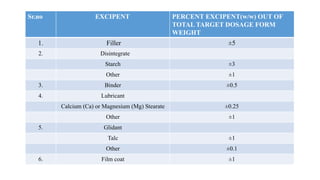
b. Changes in excipient, expressed as percentage (w/w) of total
formulation.
Sr.no EXCIPENT PERCENT EXCIPENT(w/w) OUT OF
TOTAL TARGET DOSAGE FORM
WEIGHT
1. Filler ±5
2. Disintegrate
Starch ±3
Other ±1
3. Binder ±0.5
4. Lubricant
Calcium (Ca) or Magnesium (Mg) Stearate ±0.25
Other ±1
5. Glidant
Talc ±1
Other ±0.1
6. Film coat ±1
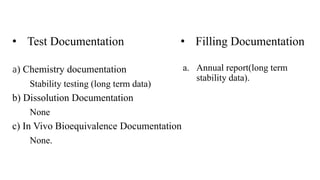
a) Chemistry documentation
Stability testing (long term data)
b) Dissolution Documentation
None
c) In Vivo Bioequivalence Documentation
None.
• Filling Documentation
a. Annual report(long term
stability data).
• Test Documentation
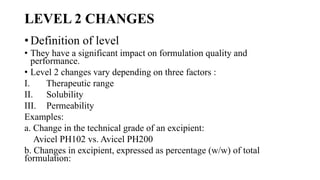
LEVEL 2 CHANGES
• Definition of level
• They have a significant impact on formulation quality and
performance.
• Level 2 changes vary depending on three factors :
I. Therapeutic range
II. Solubility
III. Permeability
Examples:
a. Change in the technical grade of an excipient:
Avicel PH102 vs. Avicel PH200
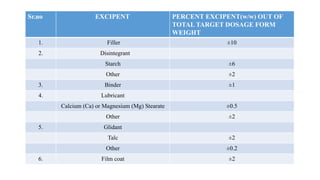
b. Changes in excipient, expressed as percentage (w/w) of total
formulation:
Sr.no EXCIPENT PERCENT EXCIPENT(w/w) OUT OF
TOTAL TARGET DOSAGE FORM
WEIGHT
1. Filler ±10
2. Disintegrant
Starch ±6
Other ±2
3. Binder ±1
4. Lubricant
Calcium (Ca) or Magnesium (Mg) Stearate ±0.5
Other ±2
5. Glidant
Talc ±2
Other ±0.2
6. Film coat ±2
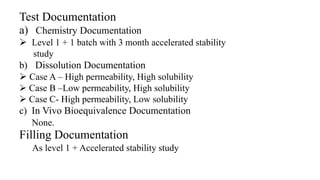
Test Documentation
a) Chemistry Documentation
 Level 1 + 1 batch with 3 month accelerated stability
study
b) Dissolution Documentation
 Case A – High permeability, High solubility
 Case B –Low permeability, High solubility
 Case C- High permeability, Low solubility
c) In Vivo Bioequivalence Documentation
None.
Filling Documentation
As level 1 + Accelerated stability study
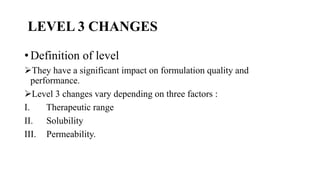
LEVEL 3 CHANGES
• Definition of level
They have a significant impact on formulation quality and
performance.
Level 3 changes vary depending on three factors :
I. Therapeutic range
II. Solubility
III. Permeability.
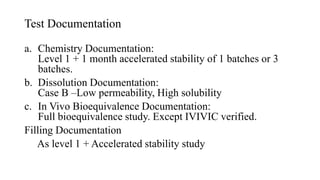
Test Documentation
a. Chemistry Documentation:
Level 1 + 1 month accelerated stability of 1 batches or 3
batches.
b. Dissolution Documentation:
Case B –Low permeability, High solubility
c. In Vivo Bioequivalence Documentation:
Full bioequivalence study. Except IVIVIC verified.
Filling Documentation
As level 1 + Accelerated stability study
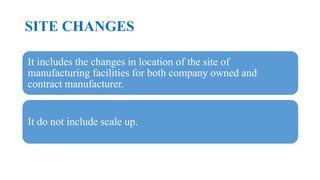
SITE CHANGES
It includes the changes in location of the site of
manufacturing facilities for both company owned and
contract manufacturer.
It do not include scale up.
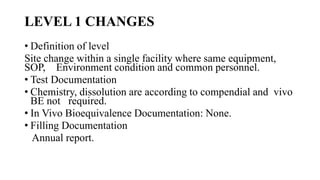
LEVEL 1 CHANGES
• Definition of level
Site change within a single facility where same equipment,
SOP, Environment condition and common personnel.
• Test Documentation
• Chemistry, dissolution are according to compendial and vivo
BE not required.
• In Vivo Bioequivalence Documentation: None.
• Filling Documentation
Annual report.
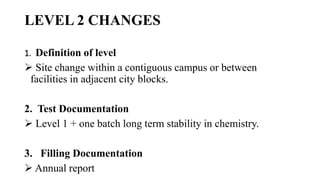
LEVEL 2 CHANGES
1. Definition of level
 Site change within a contiguous campus or between
facilities in adjacent city blocks.
2. Test Documentation
 Level 1 + one batch long term stability in chemistry.
3. Filling Documentation
 Annual report
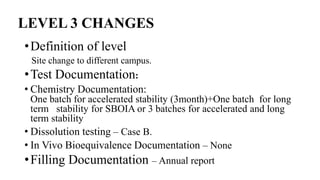
LEVEL 3 CHANGES
•Definition of level
Site change to different campus.
•Test Documentation:
• Chemistry Documentation:
One batch for accelerated stability (3month)+One batch for long
term stability for SBOIA or 3 batches for accelerated and long
term stability
• Dissolution testing – Case B.
• In Vivo Bioequivalence Documentation – None
•Filling Documentation – Annual report
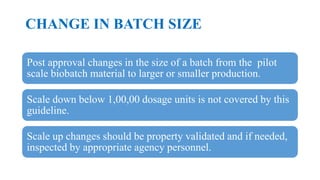
CHANGE IN BATCH SIZE
Post approval changes in the size of a batch from the pilot
scale biobatch material to larger or smaller production.
Scale down below 1,00,00 dosage units is not covered by this
guideline.
Scale up changes should be property validated and if needed,
inspected by appropriate agency personnel.
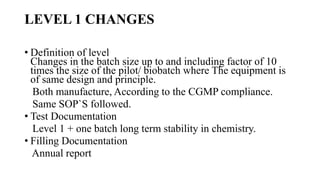
LEVEL 1 CHANGES
• Definition of level
Changes in the batch size up to and including factor of 10
times the size of the pilot/ biobatch where The equipment is
of same design and principle.
Both manufacture, According to the CGMP compliance.
Same SOP`S followed.
• Test Documentation
Level 1 + one batch long term stability in chemistry.
• Filling Documentation
Annual report
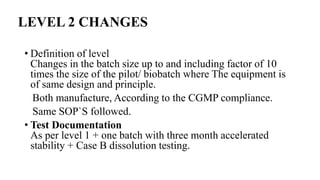
LEVEL 2 CHANGES
• Definition of level
Changes in the batch size up to and including factor of 10
times the size of the pilot/ biobatch where The equipment is
of same design and principle.
Both manufacture, According to the CGMP compliance.
Same SOP`S followed.
• Test Documentation
As per level 1 + one batch with three month accelerated
stability + Case B dissolution testing.
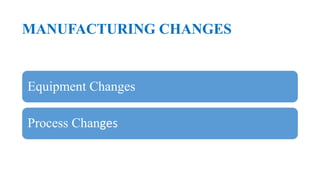
MANUFACTURING CHANGES
Equipment Changes
Process Changes
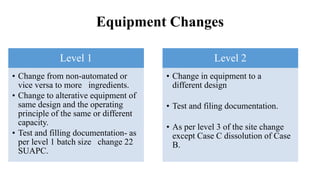
Equipment Changes
Level 1
• Change from non-automated or
vice versa to more ingredients.
• Change to alterative equipment of
same design and the operating
principle of the same or different
capacity.
• Test and filling documentation- as
per level 1 batch size change 22
SUAPC.
Level 2
• Change in equipment to a
different design
• Test and filing documentation.
• As per level 3 of the site change
except Case C dissolution of Case
B.
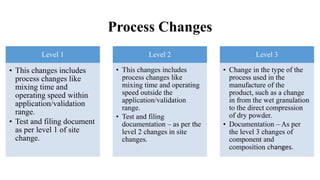
Process Changes
Level 1
• This changes includes
process changes like
mixing time and
operating speed within
application/validation
range.
• Test and filing document
as per level 1 of site
change.
Level 2
• This changes includes
process changes like
mixing time and operating
speed outside the
application/validation
range.
• Test and filing
documentation – as per the
level 2 changes in site
changes.
Level 3
• Change in the type of the
process used in the
manufacture of the
product, such as a change
in from the wet granulation
to the direct compression
of dry powder.
• Documentation – As per
the level 3 changes of
component and
composition changes.
REFERENCE
• The Pharmaceutical Sciences ; The Pharma Path Way ‘Pure
And Applied Pharmacy’ By D. A Sawant, Pragathi Books Pvt
.Ltd.
• Generic Drug Product Development Solid Oral Dosage Form
By James Swarbick Pharmaceutical Techniques, Inc.
Pinehurst, North Carolina.
2. SUPAC.pdf

2. SUPAC.pdf

  • 1.
    Scale Up AndPost Approval Changes Presented by : Mr. Swapnil R Dudhkohar M.PHARM 1ST SEMESTER QUALITY ASSURANCE
  • 2.
    INTRODUCTION • In theprocess of developing the new product the batch size used in the earliest human studies are small. • The size of the batch is gradually increased (scale up) • The scale up and the changes made after approval in the composition manufacturing equipment and change of site have become known as scale up and post approval changes (supac).
  • 3.
    Currently Finalized SUPACGuidance Are As Below 1. SUPAC – IR ( Immediate Release ) – Nov.1995. 2. SUPAC – IR Questions and Answer – Feb.1997. 3. PAC-ATLS ( Post Approval Changes – Analytical testing Laboratories changes )- Apr.1998. 4. SUPAC – MR (Modified Release ) – Sep.1997. 5. SUPAC SS (Semisolid – Non sterile ) –May 1997.
  • 4.
    COMPONENT AND COMPOSITION CHANGES Focuson the changes in amount of excipient in the drug product. Not focus on change in the amount of the drug substance.
  • 5.
    LEVEL 1 CHANGES •Definition of level These are unlikely to have any detectable impact on formulation quality and performance Examples : a. Deletion or partial deletion of an ingredient intended to affect the color or flavor of the drug product; or change in the ingredient of the printing ink to another approved ingredient. b. Changes in excipient, expressed as percentage (w/w) of total formulation.
  • 6.
    Sr.no EXCIPENT PERCENTEXCIPENT(w/w) OUT OF TOTAL TARGET DOSAGE FORM WEIGHT 1. Filler ±5 2. Disintegrate Starch ±3 Other ±1 3. Binder ±0.5 4. Lubricant Calcium (Ca) or Magnesium (Mg) Stearate ±0.25 Other ±1 5. Glidant Talc ±1 Other ±0.1 6. Film coat ±1
  • 7.
    a) Chemistry documentation Stabilitytesting (long term data) b) Dissolution Documentation None c) In Vivo Bioequivalence Documentation None. • Filling Documentation a. Annual report(long term stability data). • Test Documentation
  • 8.
    LEVEL 2 CHANGES •Definition of level • They have a significant impact on formulation quality and performance. • Level 2 changes vary depending on three factors : I. Therapeutic range II. Solubility III. Permeability Examples: a. Change in the technical grade of an excipient: Avicel PH102 vs. Avicel PH200 b. Changes in excipient, expressed as percentage (w/w) of total formulation:
  • 9.
    Sr.no EXCIPENT PERCENTEXCIPENT(w/w) OUT OF TOTAL TARGET DOSAGE FORM WEIGHT 1. Filler ±10 2. Disintegrant Starch ±6 Other ±2 3. Binder ±1 4. Lubricant Calcium (Ca) or Magnesium (Mg) Stearate ±0.5 Other ±2 5. Glidant Talc ±2 Other ±0.2 6. Film coat ±2
  • 10.
    Test Documentation a) ChemistryDocumentation  Level 1 + 1 batch with 3 month accelerated stability study b) Dissolution Documentation  Case A – High permeability, High solubility  Case B –Low permeability, High solubility  Case C- High permeability, Low solubility c) In Vivo Bioequivalence Documentation None. Filling Documentation As level 1 + Accelerated stability study
  • 11.
    LEVEL 3 CHANGES •Definition of level They have a significant impact on formulation quality and performance. Level 3 changes vary depending on three factors : I. Therapeutic range II. Solubility III. Permeability.
  • 12.
    Test Documentation a. ChemistryDocumentation: Level 1 + 1 month accelerated stability of 1 batches or 3 batches. b. Dissolution Documentation: Case B –Low permeability, High solubility c. In Vivo Bioequivalence Documentation: Full bioequivalence study. Except IVIVIC verified. Filling Documentation As level 1 + Accelerated stability study
  • 13.
    SITE CHANGES It includesthe changes in location of the site of manufacturing facilities for both company owned and contract manufacturer. It do not include scale up.
  • 14.
    LEVEL 1 CHANGES •Definition of level Site change within a single facility where same equipment, SOP, Environment condition and common personnel. • Test Documentation • Chemistry, dissolution are according to compendial and vivo BE not required. • In Vivo Bioequivalence Documentation: None. • Filling Documentation Annual report.
  • 15.
    LEVEL 2 CHANGES 1.Definition of level  Site change within a contiguous campus or between facilities in adjacent city blocks. 2. Test Documentation  Level 1 + one batch long term stability in chemistry. 3. Filling Documentation  Annual report
  • 16.
    LEVEL 3 CHANGES •Definitionof level Site change to different campus. •Test Documentation: • Chemistry Documentation: One batch for accelerated stability (3month)+One batch for long term stability for SBOIA or 3 batches for accelerated and long term stability • Dissolution testing – Case B. • In Vivo Bioequivalence Documentation – None •Filling Documentation – Annual report
  • 17.
    CHANGE IN BATCHSIZE Post approval changes in the size of a batch from the pilot scale biobatch material to larger or smaller production. Scale down below 1,00,00 dosage units is not covered by this guideline. Scale up changes should be property validated and if needed, inspected by appropriate agency personnel.
  • 18.
    LEVEL 1 CHANGES •Definition of level Changes in the batch size up to and including factor of 10 times the size of the pilot/ biobatch where The equipment is of same design and principle. Both manufacture, According to the CGMP compliance. Same SOP`S followed. • Test Documentation Level 1 + one batch long term stability in chemistry. • Filling Documentation Annual report
  • 19.
    LEVEL 2 CHANGES •Definition of level Changes in the batch size up to and including factor of 10 times the size of the pilot/ biobatch where The equipment is of same design and principle. Both manufacture, According to the CGMP compliance. Same SOP`S followed. • Test Documentation As per level 1 + one batch with three month accelerated stability + Case B dissolution testing.
  • 20.
  • 21.
    Equipment Changes Level 1 •Change from non-automated or vice versa to more ingredients. • Change to alterative equipment of same design and the operating principle of the same or different capacity. • Test and filling documentation- as per level 1 batch size change 22 SUAPC. Level 2 • Change in equipment to a different design • Test and filing documentation. • As per level 3 of the site change except Case C dissolution of Case B.
  • 22.
    Process Changes Level 1 •This changes includes process changes like mixing time and operating speed within application/validation range. • Test and filing document as per level 1 of site change. Level 2 • This changes includes process changes like mixing time and operating speed outside the application/validation range. • Test and filing documentation – as per the level 2 changes in site changes. Level 3 • Change in the type of the process used in the manufacture of the product, such as a change in from the wet granulation to the direct compression of dry powder. • Documentation – As per the level 3 changes of component and composition changes.
  • 23.
    REFERENCE • The PharmaceuticalSciences ; The Pharma Path Way ‘Pure And Applied Pharmacy’ By D. A Sawant, Pragathi Books Pvt .Ltd. • Generic Drug Product Development Solid Oral Dosage Form By James Swarbick Pharmaceutical Techniques, Inc. Pinehurst, North Carolina.