Babylon or The Sumerian Civilization
►   Around 3500 B.C., The
    Sumerians settled in the
    lower part of the Tigris-
    Euphrates river valley
    (now Iraq and Syria)
►   By 3000 B.C. they had
    formed 12 city-states in
    the valley.
►   The population of each
    city-state ranged from
    20,000 to 250,000

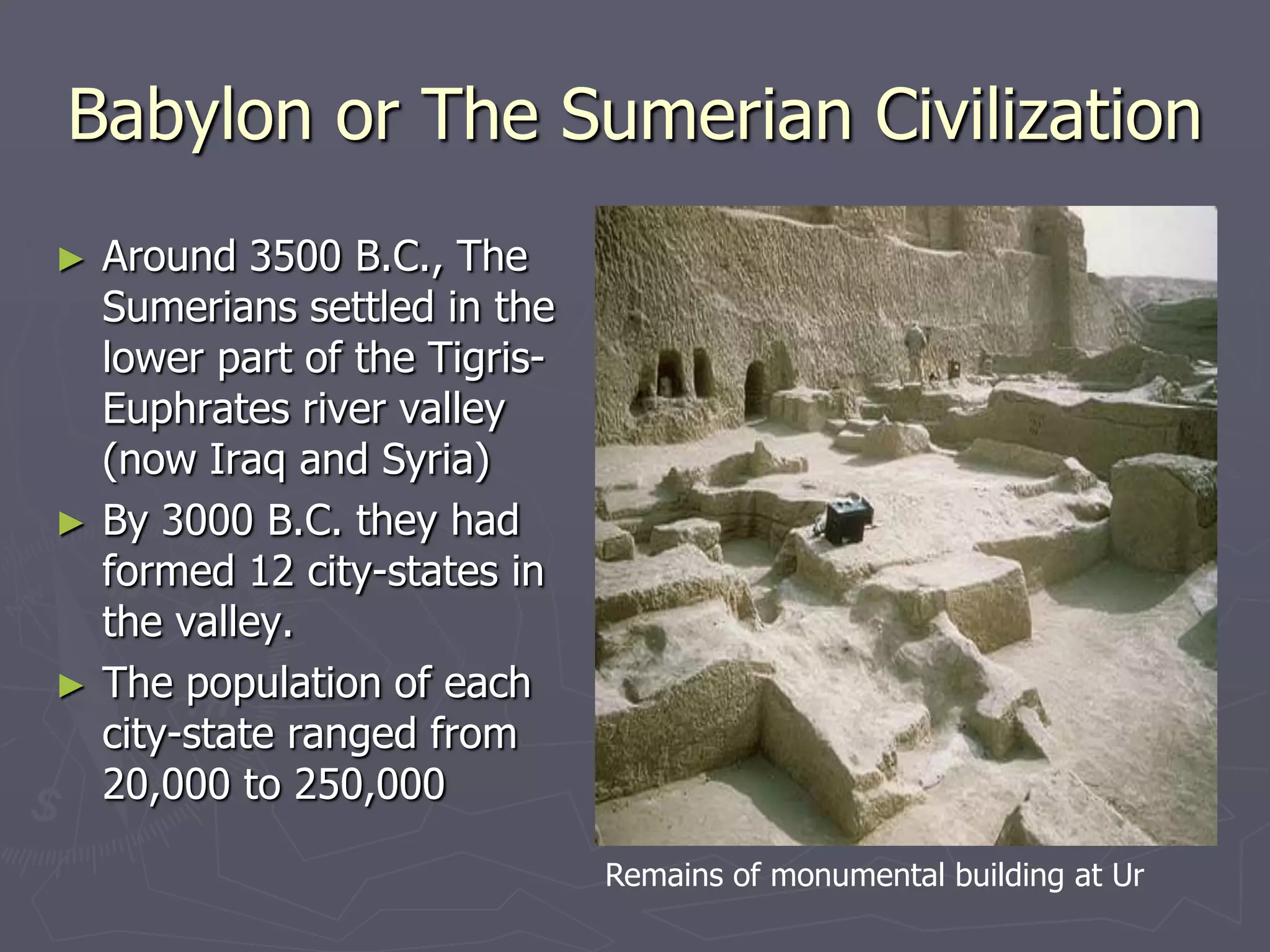
                                Remains of monumental building at Ur
Sumerian Government and Men and
          Women roles
► Each  sumerian city-state governed itself
  independently of the others.
► By 2700 B.C. the leaders of most city-states ruled
  as kings. (they served as military leader and
  highest priest or deity)
► Men exercised great authority over women and
  children (they could sell women and children if
  needed)
► Women could buy and sell property and operate
  their own businesses and own and sell slaves.
Economy and Writing


►   The economy was based mainly on commerce and trade,
    but they were good producers of grains and clothes.
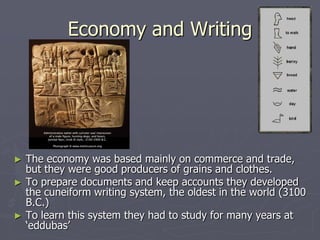
►   To prepare documents and keep accounts they developed
    the cuneiform writing system, the oldest in the world (3100
    B.C.)
►   To learn this system they had to study for many years at
    ‘eddubas’
RELIGION
► The  Sumerian as the
  Egyptians practiced a
  polytheistic religion.
► Each deity presided
  over a specific natural
  force or a human
  activity.
► Ex. An, responsible for
  the seasons, Enlil
  winds and agriculture

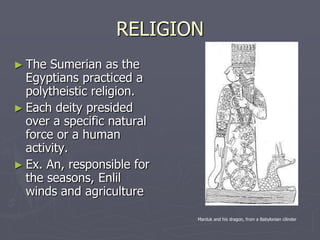
                            Marduk and his dragon, from a Babylonian cilinder
Sumerian inventions
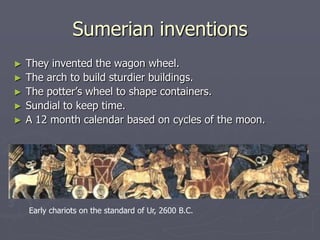
►   They invented the wagon wheel.
►   The arch to build sturdier buildings.
►   The potter’s wheel to shape containers.
►   Sundial to keep time.
►   A 12 month calendar based on cycles of the moon.


    Early chariots on the standard of Ur, 2600 B.C.
Mesopotamian Empires
► 1. Sargon I. Around 2300 B.C. The Akkadians
  united all the city-states in one empire.
► 2. Hammurabi’s Babylonian Empyre
The Amorites overran many Sumerian
  centers, including Babylon. The dynasty they
  founded at Babylon later produce a ruler who
  dominate Mesopotamia: Hamurabi. Under
  Hamurabi’s rule, Babylon became a major trade
  center. After Hamurabi’s death the Babylonian
  empire declined.
* The Hamurabi’s Law Code: A collection of laws
  from the various Mesopotamian city-states, dealed
  with most aspects of daily life.

Babylon

  • 1.
    Babylon or TheSumerian Civilization ► Around 3500 B.C., The Sumerians settled in the lower part of the Tigris- Euphrates river valley (now Iraq and Syria) ► By 3000 B.C. they had formed 12 city-states in the valley. ► The population of each city-state ranged from 20,000 to 250,000 Remains of monumental building at Ur
  • 2.
    Sumerian Government andMen and Women roles ► Each sumerian city-state governed itself independently of the others. ► By 2700 B.C. the leaders of most city-states ruled as kings. (they served as military leader and highest priest or deity) ► Men exercised great authority over women and children (they could sell women and children if needed) ► Women could buy and sell property and operate their own businesses and own and sell slaves.
  • 3.
    Economy and Writing ► The economy was based mainly on commerce and trade, but they were good producers of grains and clothes. ► To prepare documents and keep accounts they developed the cuneiform writing system, the oldest in the world (3100 B.C.) ► To learn this system they had to study for many years at ‘eddubas’
  • 4.
    RELIGION ► The Sumerian as the Egyptians practiced a polytheistic religion. ► Each deity presided over a specific natural force or a human activity. ► Ex. An, responsible for the seasons, Enlil winds and agriculture Marduk and his dragon, from a Babylonian cilinder
  • 5.
    Sumerian inventions ► They invented the wagon wheel. ► The arch to build sturdier buildings. ► The potter’s wheel to shape containers. ► Sundial to keep time. ► A 12 month calendar based on cycles of the moon. Early chariots on the standard of Ur, 2600 B.C.
  • 6.
    Mesopotamian Empires ► 1.Sargon I. Around 2300 B.C. The Akkadians united all the city-states in one empire. ► 2. Hammurabi’s Babylonian Empyre The Amorites overran many Sumerian centers, including Babylon. The dynasty they founded at Babylon later produce a ruler who dominate Mesopotamia: Hamurabi. Under Hamurabi’s rule, Babylon became a major trade center. After Hamurabi’s death the Babylonian empire declined. * The Hamurabi’s Law Code: A collection of laws from the various Mesopotamian city-states, dealed with most aspects of daily life.