Ancient Egypt & Kush
The water, fertile soil, and
protected setting of the Nile
Valley allowed a great
civilization to arise in Egypt
around 3200 BC
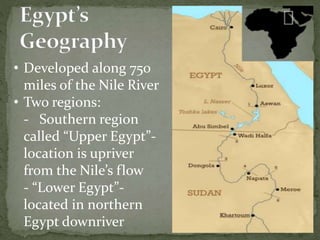
• Developed along 750
miles of the Nile River
• Two regions:
- Southern region
called “Upper Egypt”-
location is upriver
from the Nile’s flow
- “Lower Egypt”-
located in northern
Egypt downriver
 The Nile River created a 13 mile wide fertile river valley
in Upper Egypt (surrounded by hundreds of miles of
desert on both sides)
 Cataracts- First marks the border of upper Egypt, five
more downstream
 Delta- flow into the Mediterranean Sea, 2/3 of Egypt’s
fertile farmland was located in the Nile Delta
 Floods- easier to predict that those in the Tigris &
Euphrates
 flooded Upper Egypt midsummer
 Flooded Lower Egypt fall
 Coated land with rich silt
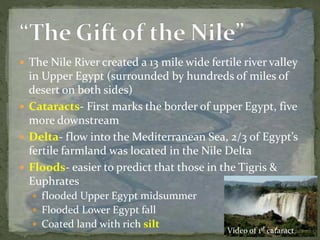
Video of 1st cataract
 Egypt was hard to invade!
 Vast deserts to the west
 Mediterranean & Red Seas
to the north
 Dangerous cataracts
 With little threat of invasion the villages of Egypt
grew as well as their social hierarchy.
 By 3200 BC, the villages banded together to create
two kingdoms: the Upper and Lower Kingdoms
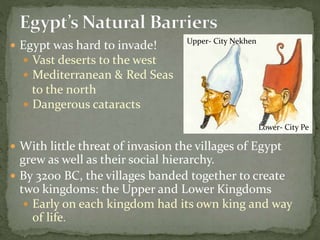
 Early on each kingdom had its own king and way
of life.
Upper- City Nekhen
Lower- City Pe
 Hunter-gathers moved in to the area about 12,000
years ago
 Farmers built:
 Irrigation systems
 Basins to collect flood water
 Canals attached to basins for
dry months
 Farmers grew:
 Wheat
 Barley
 Fruits
 Vegetables
 cattle
 sheep
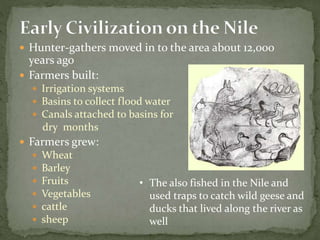
• The also fished in the Nile and
used traps to catch wild geese and
ducks that lived along the river as
well
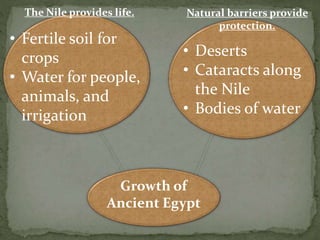
Growth of
Ancient Egypt
The Nile provides life. Natural barriers provide
protection.
• Fertile soil for
crops
• Water for people,
animals, and
irrigation
• Deserts
• Cataracts along
the Nile
• Bodies of water
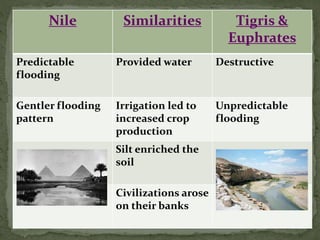
Nile Similarities Tigris &
Euphrates
Predictable
flooding
Provided water Destructive
Gentler flooding
pattern
Irrigation led to
increased crop
production
Unpredictable
flooding
Silt enriched the
soil
Civilizations arose
on their banks
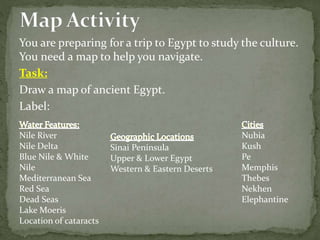
You are preparing for a trip to Egypt to study the culture.
You need a map to help you navigate.
Task:
Draw a map of ancient Egypt.
Label:
Nile River
Nile Delta
Blue Nile & White
Nile
Mediterranean Sea
Red Sea
Dead Seas
Lake Moeris
Location of cataracts
Sinai Peninsula
Upper & Lower Egypt
Western & Eastern Deserts
Nubia
Kush
Pe
Memphis
Thebes
Nekhen
Elephantine
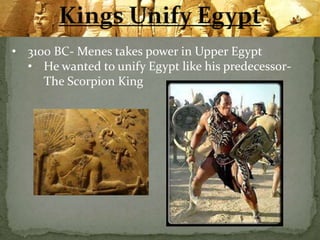
• 3100 BC- Menes takes power in Upper Egypt
• He wanted to unify Egypt like his predecessor-
The Scorpion King
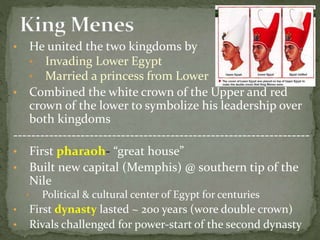
• He united the two kingdoms by
• Invading Lower Egypt
• Married a princess from Lower
• Combined the white crown of the Upper and red
crown of the lower to symbolize his leadership over
both kingdoms
------------------------------------------------------------------
• First pharaoh- “great house”
• Built new capital (Memphis) @ southern tip of the
Nile
• Political & cultural center of Egypt for centuries
• First dynasty lasted ~ 200 years (wore double crown)
• Rivals challenged for power-start of the second dynasty
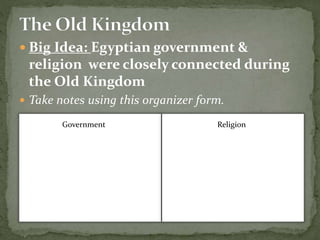
 Big Idea: Egyptian government &
religion were closely connected during
the Old Kingdom
 Take notes using this organizer form.
Government Religion
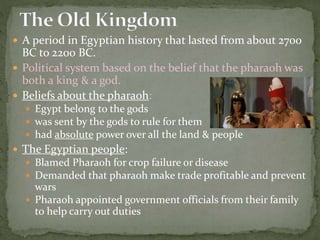
 A period in Egyptian history that lasted from about 2700
BC to 2200 BC.
 Political system based on the belief that the pharaoh was
both a king & a god.
 Beliefs about the pharaoh:
 Egypt belong to the gods
 was sent by the gods to rule for them
 had absolute power over all the land & people
 The Egyptian people:
 Blamed Pharaoh for crop failure or disease
 Demanded that pharaoh make trade profitable and prevent
wars
 Pharaoh appointed government officials from their family
to help carry out duties
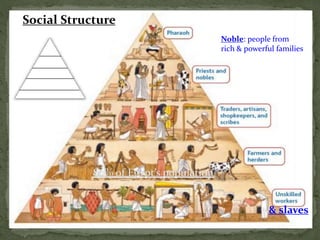
Social Structure
& slaves
Noble: people from
rich & powerful families
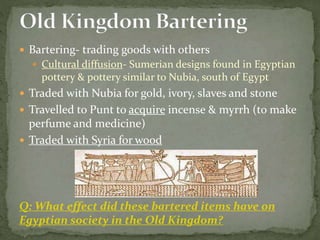
 Bartering- trading goods with others
 Cultural diffusion- Sumerian designs found in Egyptian
pottery & pottery similar to Nubia, south of Egypt
 Traded with Nubia for gold, ivory, slaves and stone
 Travelled to Punt to acquire incense & myrrh (to make
perfume and medicine)
 Traded with Syria for wood
Q: What effect did these bartered items have on
Egyptian society in the Old Kingdom?
 Worshipping the gods was part of everyday life
 Most customs & rituals focused on the Afterlife
 Like Mesopotamia, they were polytheistic
 Temples were built for the gods throughout Egypt
 Collected payments
 Led to their growing influence
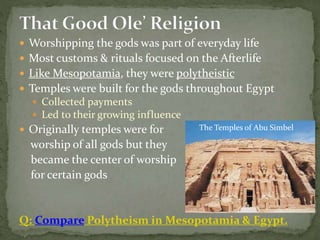
 Originally temples were for
worship of all gods but they
became the center of worship
for certain gods
Q: Compare Polytheism in Mesopotamia & Egypt.
The Temples of Abu Simbel
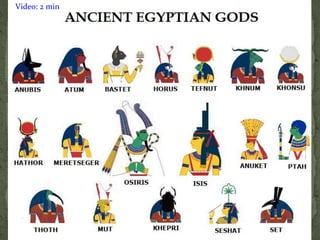
 had a god for nearly everything, including the earth’s four
elements
 Believed gods took the form of animals or half-human/
half- animals
Major gods:
 Anubis-God of the dead
 Re or Amon-Re- the sun god
 Osiris- god of the underworld: Very important to Egypt
 Isis- goddess of magic
 Horus- a sky god & god of the pharaohs
Video: 2 min
 Most Egyptian religion surrounded the Afterlife
 Believed the Afterlife was a much happier ideal
place where people were young and healthy
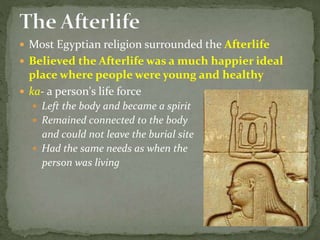
 ka- a person's life force
 Left the body and became a spirit
 Remained connected to the body
and could not leave the burial site
 Had the same needs as when the
person was living
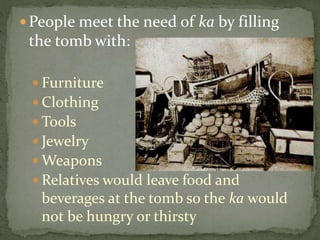
 People meet the need of ka by filling
the tomb with:
 Furniture
 Clothing
 Tools
 Jewelry
 Weapons
 Relatives would leave food and
beverages at the tomb so the ka would
not be hungry or thirsty
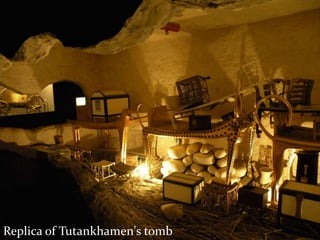
Replica of Tutankhamen's tomb
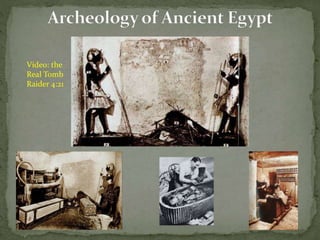
Video: the
Real Tomb
Raider 4:21
 Believed the body must be preserved for the afterlife
 if the body decayed the ka wouldn’t recognize it and the
link with the body would be severed
 that would led to the ka not being able to eat and drink
 To solve this they developed the method of
embalming- creating mummies
 Body was wrapped in cloths and bandages
 Placed in a coffin with magic spells written in it to help
ka find the food and beverages
 Only the royal and elite could afford to be mummified
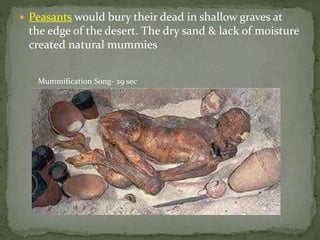
 Peasants would bury their dead in shallow graves at
the edge of the desert. The dry sand & lack of moisture
created natural mummies
Mummification Song- 29 sec
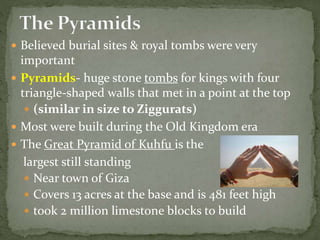
 Believed burial sites & royal tombs were very
important
 Pyramids- huge stone tombs for kings with four
triangle-shaped walls that met in a point at the top
 (similar in size to Ziggurats)
 Most were built during the Old Kingdom era
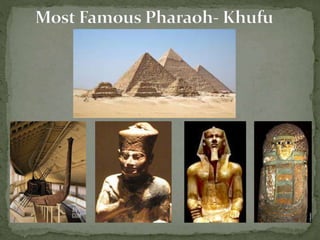
 The Great Pyramid of Kuhfu is the
largest still standing
 Near town of Giza
 Covers 13 acres at the base and is 481 feet high
 took 2 million limestone blocks to build
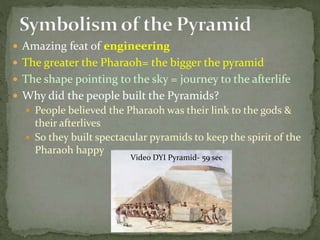
 Amazing feat of engineering
 The greater the Pharaoh= the bigger the pyramid
 The shape pointing to the sky = journey to the afterlife
 Why did the people built the Pyramids?
 People believed the Pharaoh was their link to the gods &
their afterlives
 So they built spectacular pyramids to keep the spirit of the
Pharaoh happy
Video DYI Pyramid- 59 sec
Egyptians had to have a good understanding of Geometry in
order to successfully build the pyramids. Each side of the
pyramid must have an upward and inward slope at the exact
some angle in order to support itself. Little miscalculations
or mistakes early in the building process could lead to huge
errors and/or disasters later!
Task:
- Imagine you are a designer/builder of Kuhfu’s pyramid.
You will need to research designs and geometry needed
to build a pyramid.
- Build and label a model pyramid to demonstrate your
findings. Included a brief written description of the
building process and the effect it may have had on the
actual people who built the pyramids.
 During the Middle and New Kingdoms
order, order and greatness were
restored in Egypt
 The Egyptians made lasting
achievements in writing, architecture,
and art.
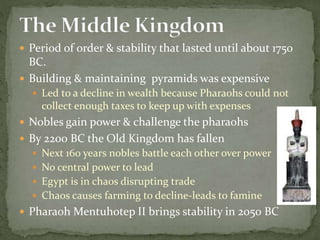
 Period of order & stability that lasted until about 1750
BC.
 Building & maintaining pyramids was expensive
 Led to a decline in wealth because Pharaohs could not
collect enough taxes to keep up with expenses
 Nobles gain power & challenge the pharaohs
 By 2200 BC the Old Kingdom has fallen
 Next 160 years nobles battle each other over power
 No central power to lead
 Egypt is in chaos disrupting trade
 Chaos causes farming to decline-leads to famine
 Pharaoh Mentuhotep II brings stability in 2050 BC
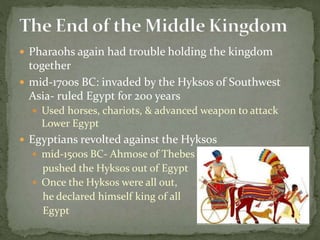
 Pharaohs again had trouble holding the kingdom
together
 mid-1700s BC: invaded by the Hyksos of Southwest
Asia- ruled Egypt for 200 years
 Used horses, chariots, & advanced weapon to attack
Lower Egypt
 Egyptians revolted against the Hyksos
 mid-1500s BC- Ahmose of Thebes
pushed the Hyksos out of Egypt
 Once the Hyksos were all out,
he declared himself king of all
Egypt
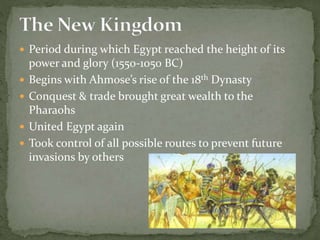
 Period during which Egypt reached the height of its
power and glory (1550-1050 BC)
 Begins with Ahmose’s rise of the 18th Dynasty
 Conquest & trade brought great wealth to the
Pharaohs
 United Egypt again
 Took control of all possible routes to prevent future
invasions by others
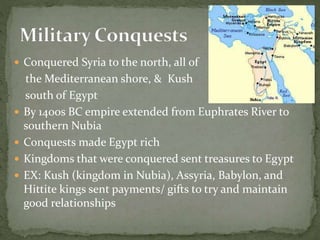
 Conquered Syria to the north, all of
the Mediterranean shore, & Kush
south of Egypt
 By 1400s BC empire extended from Euphrates River to
southern Nubia
 Conquests made Egypt rich
 Kingdoms that were conquered sent treasures to Egypt
 EX: Kush (kingdom in Nubia), Assyria, Babylon, and
Hittite kings sent payments/ gifts to try and maintain
good relationships
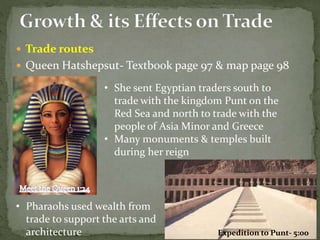
 Trade routes
 Queen Hatshepsut- Textbook page 97 & map page 98
• She sent Egyptian traders south to
trade with the kingdom Punt on the
Red Sea and north to trade with the
people of Asia Minor and Greece
• Many monuments & temples built
during her reign
• Pharaohs used wealth from
trade to support the arts and
architecture Expedition to Punt- 5:00
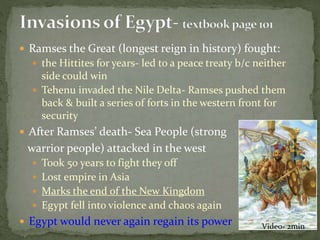
 Ramses the Great (longest reign in history) fought:
 the Hittites for years- led to a peace treaty b/c neither
side could win
 Tehenu invaded the Nile Delta- Ramses pushed them
back & built a series of forts in the western front for
security
 After Ramses’ death- Sea People (strong
warrior people) attacked in the west
 Took 50 years to fight they off
 Lost empire in Asia
 Marks the end of the New Kingdom
 Egypt fell into violence and chaos again
 Egypt would never again regain its power Video- 2min
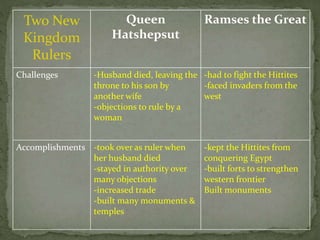
Two New
Kingdom
Rulers
Queen
Hatshepsut
Ramses the Great
Challenges -Husband died, leaving the
throne to his son by
another wife
-objections to rule by a
woman
-had to fight the Hittites
-faced invaders from the
west
Accomplishments -took over as ruler when
her husband died
-stayed in authority over
many objections
-increased trade
-built many monuments &
temples
-kept the Hittites from
conquering Egypt
-built forts to strengthen
western frontier
Built monuments
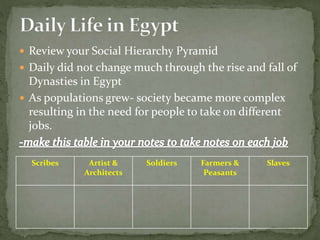
 Review your Social Hierarchy Pyramid
 Daily did not change much through the rise and fall of
Dynasties in Egypt
 As populations grew- society became more complex
resulting in the need for people to take on different
jobs.
Scribes Artist &
Architects
Soldiers Farmers &
Peasants
Slaves
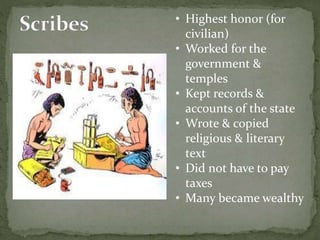
• Highest honor (for
civilian)
• Worked for the
government &
temples
• Kept records &
accounts of the state
• Wrote & copied
religious & literary
text
• Did not have to pay
taxes
• Many became wealthy
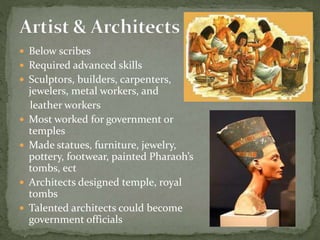
 Below scribes
 Required advanced skills
 Sculptors, builders, carpenters,
jewelers, metal workers, and
leather workers
 Most worked for government or
temples
 Made statues, furniture, jewelry,
pottery, footwear, painted Pharaoh’s
tombs, ect
 Architects designed temple, royal
tombs
 Talented architects could become
government officials
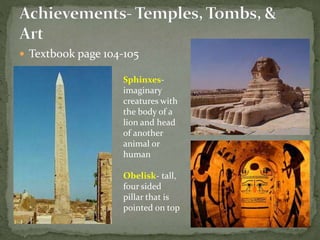
 Textbook page 104-105
Sphinxes-
imaginary
creatures with
the body of a
lion and head
of another
animal or
human
Obelisk- tall,
four sided
pillar that is
pointed on top
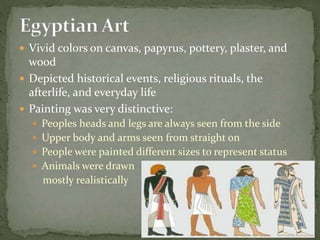
 Vivid colors on canvas, papyrus, pottery, plaster, and
wood
 Depicted historical events, religious rituals, the
afterlife, and everyday life
 Painting was very distinctive:
 Peoples heads and legs are always seen from the side
 Upper body and arms seen from straight on
 People were painted different sizes to represent status
 Animals were drawn
mostly realistically
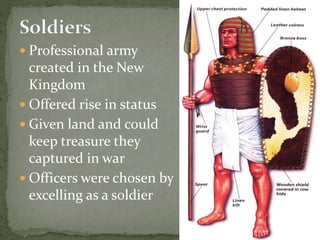
 Professional army
created in the New
Kingdom
 Offered rise in status
 Given land and could
keep treasure they
captured in war
 Officers were chosen by
excelling as a soldier
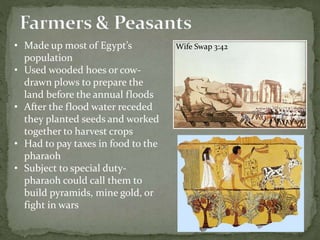
• Made up most of Egypt’s
population
• Used wooded hoes or cow-
drawn plows to prepare the
land before the annual floods
• After the flood water receded
they planted seeds and worked
together to harvest crops
• Had to pay taxes in food to the
pharaoh
• Subject to special duty-
pharaoh could call them to
build pyramids, mine gold, or
fight in wars
Wife Swap 3:42
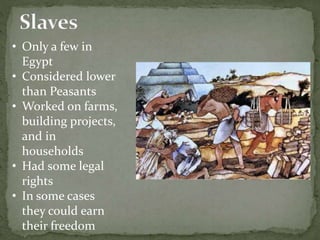
• Only a few in
Egypt
• Considered lower
than Peasants
• Worked on farms,
building projects,
and in
households
• Had some legal
rights
• In some cases
they could earn
their freedom
 Lived in own homes
 Expected to marry young so they could start having
children
 Women were devoted to the home and children
 Some served as priestess or worked as administrators &
artists
 Unlike other women of the ancient world- they had
certain legal rights:
 Own property, make legal contracts, & divorce their
husbands
 Children played with toys , had ball games, and hunted
 Most went to school to learn morals, writing, math , &
sports
 At age 14- Boys left school to enter their father’s profession
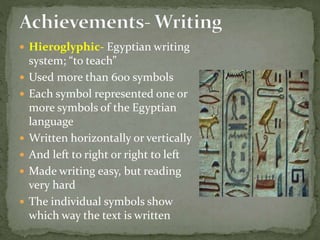
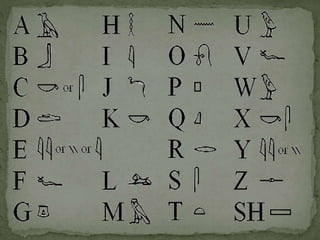
 Hieroglyphic- Egyptian writing
system; “to teach”
 Used more than 600 symbols
 Each symbol represented one or
more symbols of the Egyptian
language
 Written horizontally or vertically
 And left to right or right to left
 Made writing easy, but reading
very hard
 The individual symbols show
which way the text is written
 Earliest writing from 3300 BC- carved in stone/ hard
materials
 Papyrus-long lasting paper-like material made from
reeds
 Rolled it into a scroll
 Scribes sued brushes and ink to write on it
 Papyrus did not decay in the dry climate- many text
survived
 Historians have uncovered: government & historical
records, science texts, medical manuals, stories, poems,
and mythological tales
 Ex: The Book of the Dead- tell about the afterlife
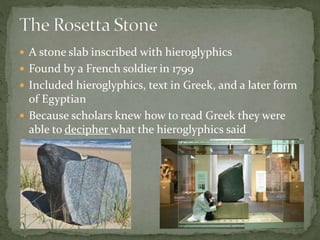
 A stone slab inscribed with hieroglyphics
 Found by a French soldier in 1799
 Included hieroglyphics, text in Greek, and a later form
of Egyptian
 Because scholars knew how to read Greek they were
able to decipher what the hieroglyphics said
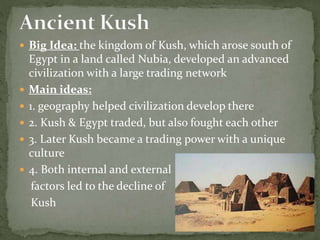
 Big Idea: the kingdom of Kush, which arose south of
Egypt in a land called Nubia, developed an advanced
civilization with a large trading network
 Main ideas:
 1. geography helped civilization develop there
 2. Kush & Egypt traded, but also fought each other
 3. Later Kush became a trading power with a unique
culture
 4. Both internal and external
factors led to the decline of
Kush
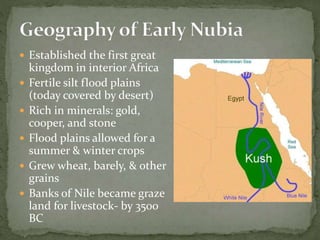
 Established the first great
kingdom in interior Africa
 Fertile silt flood plains
(today covered by desert)
 Rich in minerals: gold,
cooper, and stone
 Flood plains allowed for a
summer & winter crops
 Grew wheat, barely, & other
grains
 Banks of Nile became graze
land for livestock- by 3500
BC
 Through trade- Kush was introduced to many new
cultures and idea
 Influenced by Egyptians
 Similar temples, gods, clothes, Kush rulers called
themselves Pharaoh and were buried in pyramids
 Unique Kushite Culture:
 Houses in the city were formed by interweaving split
pieces of palm wood or bricks
 Had their own unique written language too- Meroitic
 Worshipped some of their own gods as well
Chapter 4
Standardized Test
Practice:
Textbook page 117
#1-7

Nile river valley egypt & kush

  • 1.
  • 2.
    The water, fertilesoil, and protected setting of the Nile Valley allowed a great civilization to arise in Egypt around 3200 BC
  • 4.
    • Developed along750 miles of the Nile River • Two regions: - Southern region called “Upper Egypt”- location is upriver from the Nile’s flow - “Lower Egypt”- located in northern Egypt downriver
  • 5.
     The NileRiver created a 13 mile wide fertile river valley in Upper Egypt (surrounded by hundreds of miles of desert on both sides)  Cataracts- First marks the border of upper Egypt, five more downstream  Delta- flow into the Mediterranean Sea, 2/3 of Egypt’s fertile farmland was located in the Nile Delta  Floods- easier to predict that those in the Tigris & Euphrates  flooded Upper Egypt midsummer  Flooded Lower Egypt fall  Coated land with rich silt Video of 1st cataract
  • 6.
     Egypt washard to invade!  Vast deserts to the west  Mediterranean & Red Seas to the north  Dangerous cataracts  With little threat of invasion the villages of Egypt grew as well as their social hierarchy.  By 3200 BC, the villages banded together to create two kingdoms: the Upper and Lower Kingdoms  Early on each kingdom had its own king and way of life. Upper- City Nekhen Lower- City Pe
  • 7.
     Hunter-gathers movedin to the area about 12,000 years ago  Farmers built:  Irrigation systems  Basins to collect flood water  Canals attached to basins for dry months  Farmers grew:  Wheat  Barley  Fruits  Vegetables  cattle  sheep • The also fished in the Nile and used traps to catch wild geese and ducks that lived along the river as well
  • 8.
    Growth of Ancient Egypt TheNile provides life. Natural barriers provide protection. • Fertile soil for crops • Water for people, animals, and irrigation • Deserts • Cataracts along the Nile • Bodies of water
  • 9.
    Nile Similarities Tigris& Euphrates Predictable flooding Provided water Destructive Gentler flooding pattern Irrigation led to increased crop production Unpredictable flooding Silt enriched the soil Civilizations arose on their banks
  • 10.
    You are preparingfor a trip to Egypt to study the culture. You need a map to help you navigate. Task: Draw a map of ancient Egypt. Label: Nile River Nile Delta Blue Nile & White Nile Mediterranean Sea Red Sea Dead Seas Lake Moeris Location of cataracts Sinai Peninsula Upper & Lower Egypt Western & Eastern Deserts Nubia Kush Pe Memphis Thebes Nekhen Elephantine
  • 11.
    • 3100 BC-Menes takes power in Upper Egypt • He wanted to unify Egypt like his predecessor- The Scorpion King
  • 12.
    • He unitedthe two kingdoms by • Invading Lower Egypt • Married a princess from Lower • Combined the white crown of the Upper and red crown of the lower to symbolize his leadership over both kingdoms ------------------------------------------------------------------ • First pharaoh- “great house” • Built new capital (Memphis) @ southern tip of the Nile • Political & cultural center of Egypt for centuries • First dynasty lasted ~ 200 years (wore double crown) • Rivals challenged for power-start of the second dynasty
  • 13.
     Big Idea:Egyptian government & religion were closely connected during the Old Kingdom  Take notes using this organizer form. Government Religion
  • 14.
     A periodin Egyptian history that lasted from about 2700 BC to 2200 BC.  Political system based on the belief that the pharaoh was both a king & a god.  Beliefs about the pharaoh:  Egypt belong to the gods  was sent by the gods to rule for them  had absolute power over all the land & people  The Egyptian people:  Blamed Pharaoh for crop failure or disease  Demanded that pharaoh make trade profitable and prevent wars  Pharaoh appointed government officials from their family to help carry out duties
  • 15.
    Social Structure & slaves Noble:people from rich & powerful families
  • 16.
     Bartering- tradinggoods with others  Cultural diffusion- Sumerian designs found in Egyptian pottery & pottery similar to Nubia, south of Egypt  Traded with Nubia for gold, ivory, slaves and stone  Travelled to Punt to acquire incense & myrrh (to make perfume and medicine)  Traded with Syria for wood Q: What effect did these bartered items have on Egyptian society in the Old Kingdom?
  • 17.
     Worshipping thegods was part of everyday life  Most customs & rituals focused on the Afterlife  Like Mesopotamia, they were polytheistic  Temples were built for the gods throughout Egypt  Collected payments  Led to their growing influence  Originally temples were for worship of all gods but they became the center of worship for certain gods Q: Compare Polytheism in Mesopotamia & Egypt. The Temples of Abu Simbel
  • 18.
     had agod for nearly everything, including the earth’s four elements  Believed gods took the form of animals or half-human/ half- animals Major gods:  Anubis-God of the dead  Re or Amon-Re- the sun god  Osiris- god of the underworld: Very important to Egypt  Isis- goddess of magic  Horus- a sky god & god of the pharaohs
  • 19.
  • 20.
     Most Egyptianreligion surrounded the Afterlife  Believed the Afterlife was a much happier ideal place where people were young and healthy  ka- a person's life force  Left the body and became a spirit  Remained connected to the body and could not leave the burial site  Had the same needs as when the person was living
  • 21.
     People meetthe need of ka by filling the tomb with:  Furniture  Clothing  Tools  Jewelry  Weapons  Relatives would leave food and beverages at the tomb so the ka would not be hungry or thirsty
  • 22.
  • 23.
  • 24.
     Believed thebody must be preserved for the afterlife  if the body decayed the ka wouldn’t recognize it and the link with the body would be severed  that would led to the ka not being able to eat and drink  To solve this they developed the method of embalming- creating mummies  Body was wrapped in cloths and bandages  Placed in a coffin with magic spells written in it to help ka find the food and beverages  Only the royal and elite could afford to be mummified
  • 25.
     Peasants wouldbury their dead in shallow graves at the edge of the desert. The dry sand & lack of moisture created natural mummies Mummification Song- 29 sec
  • 26.
     Believed burialsites & royal tombs were very important  Pyramids- huge stone tombs for kings with four triangle-shaped walls that met in a point at the top  (similar in size to Ziggurats)  Most were built during the Old Kingdom era  The Great Pyramid of Kuhfu is the largest still standing  Near town of Giza  Covers 13 acres at the base and is 481 feet high  took 2 million limestone blocks to build
  • 28.
     Amazing featof engineering  The greater the Pharaoh= the bigger the pyramid  The shape pointing to the sky = journey to the afterlife  Why did the people built the Pyramids?  People believed the Pharaoh was their link to the gods & their afterlives  So they built spectacular pyramids to keep the spirit of the Pharaoh happy Video DYI Pyramid- 59 sec
  • 29.
    Egyptians had tohave a good understanding of Geometry in order to successfully build the pyramids. Each side of the pyramid must have an upward and inward slope at the exact some angle in order to support itself. Little miscalculations or mistakes early in the building process could lead to huge errors and/or disasters later! Task: - Imagine you are a designer/builder of Kuhfu’s pyramid. You will need to research designs and geometry needed to build a pyramid. - Build and label a model pyramid to demonstrate your findings. Included a brief written description of the building process and the effect it may have had on the actual people who built the pyramids.
  • 30.
     During theMiddle and New Kingdoms order, order and greatness were restored in Egypt  The Egyptians made lasting achievements in writing, architecture, and art.
  • 31.
     Period oforder & stability that lasted until about 1750 BC.  Building & maintaining pyramids was expensive  Led to a decline in wealth because Pharaohs could not collect enough taxes to keep up with expenses  Nobles gain power & challenge the pharaohs  By 2200 BC the Old Kingdom has fallen  Next 160 years nobles battle each other over power  No central power to lead  Egypt is in chaos disrupting trade  Chaos causes farming to decline-leads to famine  Pharaoh Mentuhotep II brings stability in 2050 BC
  • 32.
     Pharaohs againhad trouble holding the kingdom together  mid-1700s BC: invaded by the Hyksos of Southwest Asia- ruled Egypt for 200 years  Used horses, chariots, & advanced weapon to attack Lower Egypt  Egyptians revolted against the Hyksos  mid-1500s BC- Ahmose of Thebes pushed the Hyksos out of Egypt  Once the Hyksos were all out, he declared himself king of all Egypt
  • 33.
     Period duringwhich Egypt reached the height of its power and glory (1550-1050 BC)  Begins with Ahmose’s rise of the 18th Dynasty  Conquest & trade brought great wealth to the Pharaohs  United Egypt again  Took control of all possible routes to prevent future invasions by others
  • 34.
     Conquered Syriato the north, all of the Mediterranean shore, & Kush south of Egypt  By 1400s BC empire extended from Euphrates River to southern Nubia  Conquests made Egypt rich  Kingdoms that were conquered sent treasures to Egypt  EX: Kush (kingdom in Nubia), Assyria, Babylon, and Hittite kings sent payments/ gifts to try and maintain good relationships
  • 35.
     Trade routes Queen Hatshepsut- Textbook page 97 & map page 98 • She sent Egyptian traders south to trade with the kingdom Punt on the Red Sea and north to trade with the people of Asia Minor and Greece • Many monuments & temples built during her reign • Pharaohs used wealth from trade to support the arts and architecture Expedition to Punt- 5:00
  • 36.
     Ramses theGreat (longest reign in history) fought:  the Hittites for years- led to a peace treaty b/c neither side could win  Tehenu invaded the Nile Delta- Ramses pushed them back & built a series of forts in the western front for security  After Ramses’ death- Sea People (strong warrior people) attacked in the west  Took 50 years to fight they off  Lost empire in Asia  Marks the end of the New Kingdom  Egypt fell into violence and chaos again  Egypt would never again regain its power Video- 2min
  • 37.
    Two New Kingdom Rulers Queen Hatshepsut Ramses theGreat Challenges -Husband died, leaving the throne to his son by another wife -objections to rule by a woman -had to fight the Hittites -faced invaders from the west Accomplishments -took over as ruler when her husband died -stayed in authority over many objections -increased trade -built many monuments & temples -kept the Hittites from conquering Egypt -built forts to strengthen western frontier Built monuments
  • 38.
     Review yourSocial Hierarchy Pyramid  Daily did not change much through the rise and fall of Dynasties in Egypt  As populations grew- society became more complex resulting in the need for people to take on different jobs. Scribes Artist & Architects Soldiers Farmers & Peasants Slaves
  • 39.
    • Highest honor(for civilian) • Worked for the government & temples • Kept records & accounts of the state • Wrote & copied religious & literary text • Did not have to pay taxes • Many became wealthy
  • 40.
     Below scribes Required advanced skills  Sculptors, builders, carpenters, jewelers, metal workers, and leather workers  Most worked for government or temples  Made statues, furniture, jewelry, pottery, footwear, painted Pharaoh’s tombs, ect  Architects designed temple, royal tombs  Talented architects could become government officials
  • 41.
     Textbook page104-105 Sphinxes- imaginary creatures with the body of a lion and head of another animal or human Obelisk- tall, four sided pillar that is pointed on top
  • 42.
     Vivid colorson canvas, papyrus, pottery, plaster, and wood  Depicted historical events, religious rituals, the afterlife, and everyday life  Painting was very distinctive:  Peoples heads and legs are always seen from the side  Upper body and arms seen from straight on  People were painted different sizes to represent status  Animals were drawn mostly realistically
  • 43.
     Professional army createdin the New Kingdom  Offered rise in status  Given land and could keep treasure they captured in war  Officers were chosen by excelling as a soldier
  • 44.
    • Made upmost of Egypt’s population • Used wooded hoes or cow- drawn plows to prepare the land before the annual floods • After the flood water receded they planted seeds and worked together to harvest crops • Had to pay taxes in food to the pharaoh • Subject to special duty- pharaoh could call them to build pyramids, mine gold, or fight in wars Wife Swap 3:42
  • 45.
    • Only afew in Egypt • Considered lower than Peasants • Worked on farms, building projects, and in households • Had some legal rights • In some cases they could earn their freedom
  • 46.
     Lived inown homes  Expected to marry young so they could start having children  Women were devoted to the home and children  Some served as priestess or worked as administrators & artists  Unlike other women of the ancient world- they had certain legal rights:  Own property, make legal contracts, & divorce their husbands  Children played with toys , had ball games, and hunted  Most went to school to learn morals, writing, math , & sports  At age 14- Boys left school to enter their father’s profession
  • 47.
     Hieroglyphic- Egyptianwriting system; “to teach”  Used more than 600 symbols  Each symbol represented one or more symbols of the Egyptian language  Written horizontally or vertically  And left to right or right to left  Made writing easy, but reading very hard  The individual symbols show which way the text is written
  • 48.
     Earliest writingfrom 3300 BC- carved in stone/ hard materials  Papyrus-long lasting paper-like material made from reeds  Rolled it into a scroll  Scribes sued brushes and ink to write on it  Papyrus did not decay in the dry climate- many text survived  Historians have uncovered: government & historical records, science texts, medical manuals, stories, poems, and mythological tales  Ex: The Book of the Dead- tell about the afterlife
  • 49.
     A stoneslab inscribed with hieroglyphics  Found by a French soldier in 1799  Included hieroglyphics, text in Greek, and a later form of Egyptian  Because scholars knew how to read Greek they were able to decipher what the hieroglyphics said
  • 51.
     Big Idea:the kingdom of Kush, which arose south of Egypt in a land called Nubia, developed an advanced civilization with a large trading network  Main ideas:  1. geography helped civilization develop there  2. Kush & Egypt traded, but also fought each other  3. Later Kush became a trading power with a unique culture  4. Both internal and external factors led to the decline of Kush
  • 52.
     Established thefirst great kingdom in interior Africa  Fertile silt flood plains (today covered by desert)  Rich in minerals: gold, cooper, and stone  Flood plains allowed for a summer & winter crops  Grew wheat, barely, & other grains  Banks of Nile became graze land for livestock- by 3500 BC
  • 53.
     Through trade-Kush was introduced to many new cultures and idea  Influenced by Egyptians  Similar temples, gods, clothes, Kush rulers called themselves Pharaoh and were buried in pyramids  Unique Kushite Culture:  Houses in the city were formed by interweaving split pieces of palm wood or bricks  Had their own unique written language too- Meroitic  Worshipped some of their own gods as well
  • 54.