•
Civilization of Mesopotamia
Origin
Geography
Timeline
Sumerian BY
Smit Pipaliya
Darshan Sukhdiya
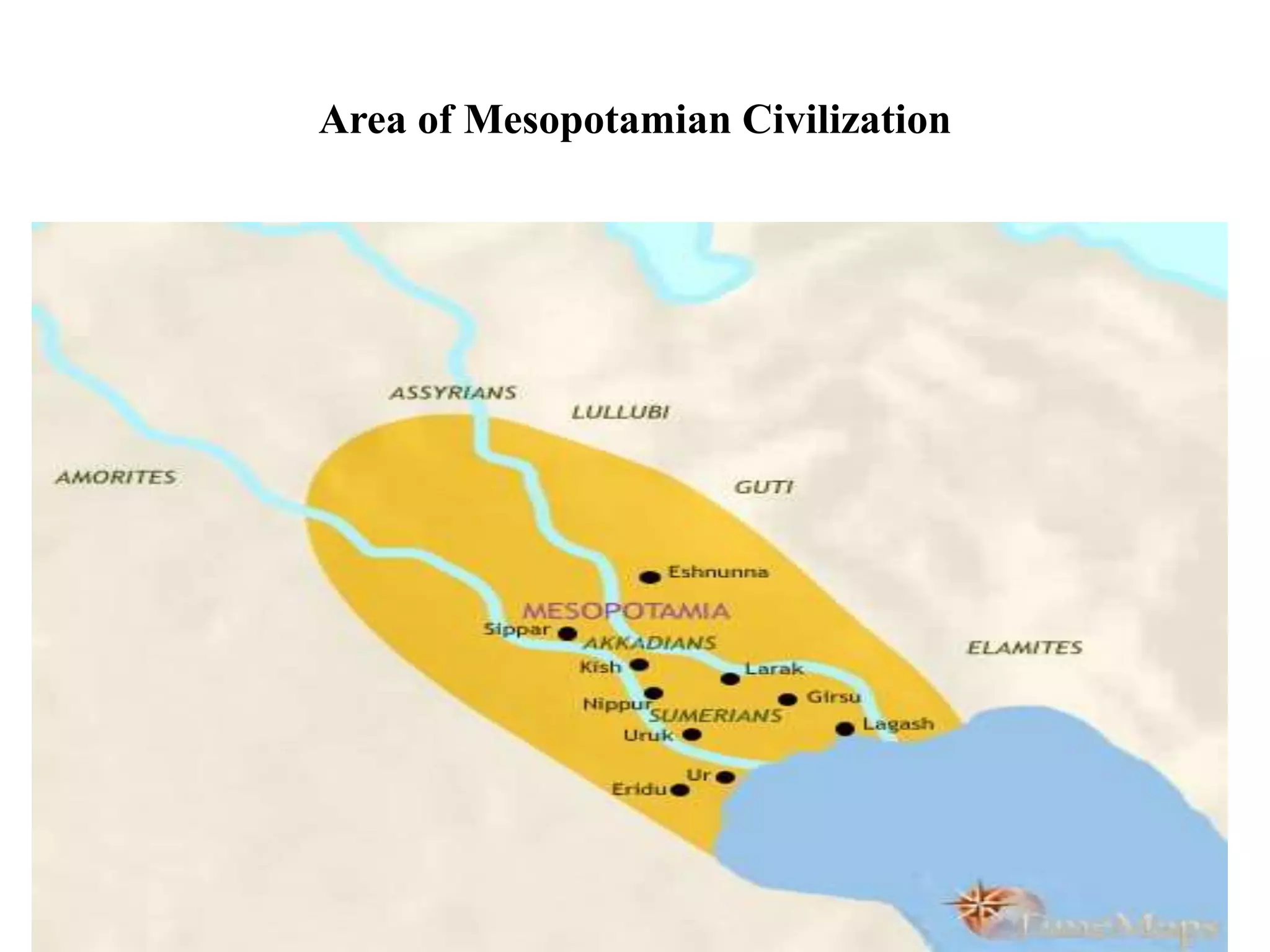
Area of Mesopotamian Civilization
Origin of Mesopotamia
• Mesopotamia which is the world's first civilization, also known as the cradle of
civilization was established a little earlier than 3100 BC.
Mesopotamia means `land between the rivers’.
• This civilization was settled on the edges of the marshes where the Tigris and the
Euphrates reach the Persian Gulf.
• These settlements existed even around the years as early as 4500 BC.
The civilization of Mesopotamia and Egypt developed almost simultaneously, and
they are very often referred to as the Fertile Crescent.
• The civilization of Mesopotamia has very unstable governance because there has
been a constant shifting empires.
• Mesopotamia was settled, and conquered, by numerous ancient civilizations.
• Mesopotamia was home to some of the oldest major ancient civilizations, including
the Sumerians, Akkadians, Babylonians and Assyrians.
• The Paleolithic occupation of Mesopotamia was limited to the mountainous regions of the
Zagros and the Taurus and a few oases in the Syrian steppe.
• Mesopotamia region has been a very diverse land. It comprised of plains in the North and rivers
in the south.
• It was the rich wildlife which prompted the human beings to get settled in the Mesopotamian
region. Also, the plains were very fertile and good for agriculture.
• Other necessities like wood, stone and metal were available in the nearby mountain region.
• All these factors made the region very favorable for the human settlement.
• It was after the settlement that writing, art, monumental architecture, and new political forms
were introduced in Mesopotamia.
• In the ancient Mesopotamia, the centre of life of the inhabitants used to be the cities.
Geography of mesopotamia
• Mesopotamia is called land between two rivers.
• This is because through it, we can find the Euphrates and Tigris.
• Because of two rivers mesopotamia land is rich nutrients ,making easy to
develop agriculture communities.
• “fertilize crecent” and “cradle of civilization” are different two names of
mesopotamia.
• The frist mesopotamia empire is called sumerians.
• The Northern Mesopotamia is made up of hills and plains.
• The land is quite fertile due to seasonal rains, and the rivers and streams flowing from
the mountains.
• Southern Mesopotamia is made up of marshy areas and wide, flat, barren plains. Cities
developed along the rivers which flow through the region.
• Mesopotamia is made up of different regions, each with its own geography.
•The geography of each area and the natural resources found there affected the ways
that people lived.
Impact of Geography
• The land is quite fertile due to seasonal rains, and the rivers and streams
flowing from the mountains.
• Early settlers farmed the land and used timber, metals and stone from the
mountains nearby.
• Southern Mesopotamia is made up of marshy areas and wide,flat,barren
plains.
• Tigris and Euphrates which flow through modern Iraq.
• The Euphrates also flows through much of Syria.
• Northen Mesopotamia is made up of hills and plains.
Timeline Of Mesopotamian
civilization
• Ancient Mesopotamia is called the cradle of civilization. The first cities and empires
formed here.
•As you will see from the timeline, power changed hands many times throughout the
ancient history of this area. It went from the Sumer to the Akkadians to the Babylonians
to the Assyrians back to the Babylonians back to the Assyrians and finally to the
Persians.
• 5000 BC - The Sumer form the first towns and cities. They use irrigation to farm large
areas of land.
• 4000 BC - The Sumer establish powerful city-states building large ziggurats at the
center of their cities as temples to their gods.
•3500 BC - Much of lower Mesopotamia is inhabited by numerous Sumer city-states
such as Ur, Uruk, Eridu, Kish, Lagash, and Nippur.
Timeline of Mesopotamian Civilization
• 3300 BC - The Sumerians invent the first writing. They use pictures for words and
inscribe them on clay tablets.
• 3200 BC - The Sumerians begin to use the wheel on vehicles.
• 2400 BC - The Sumerian language is replaced by the Akkadian language as the
primary spoken language in Mesopotamia.
• 2330 BC - Sargon I of the Akkadians conquers
• most of the Sumerian city states and creates
• the world's first empire, the Akkadian Empire.
• 2250 BC - King Naram-Sin of the Akkadians
• expands the empire to its largest state.
•rule for 50 years.
Akkadian Empire
• 1900 BC - The Assyrians rise to power in northern Mesopotamia.
• 1781 BC - The First Assyrian Empire is soon taken over by the Babylonians.
• 1750 BC - The First Babylonian Empire begins to fall apart.
• 1595 BC - The Kassites take the city of Babylon.
•1250 BC - The Assyrians begin to use iron weapons and chariots.
•1225 BC - The Assyrians capture Babylon.
• 1077 BC - Tiglath-Piliser dies and the Assyrian Empire becomes
weaker for time.
• 709 BC - Sargon II takes control of the city of Babylon.
• 705 BC - Sargon II dies and Sennacherib becomes king. He moves the capital to Nineveh.
• 616 BC - Nabopolassar takes control of Babylon back from the Assyrians and crowns himself
king. The neo-Babylonian empire begins.
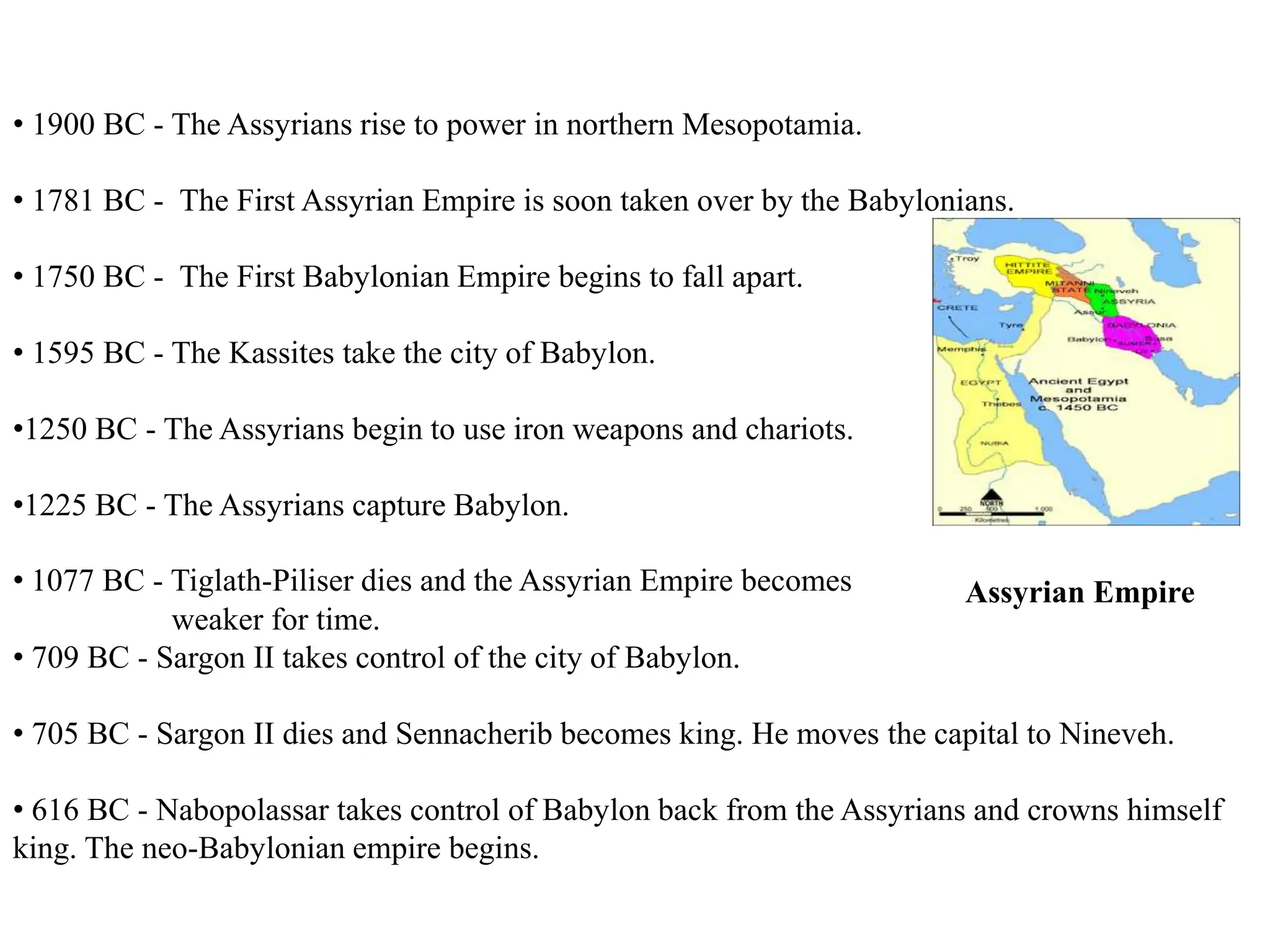
Assyrian Empire
• 604 BC - Nabopolassar dies and Nebuchadnezzar II becomes King of Babylon. He will rule for
43 years and bring the Babylonian Empire to its peak.
• 550 BC - Cyrus the Great rises to power and the Persian Empire begins
• 539 BC - Cyrus the Great takes the city of Babylon and lets the Jewish people return to Israel.
• 522 BC - Darius I becomes King of Persia. He expands the empire and divides it up into states
each ruled by a governor called a satrap.
Sumerians
.
• Sumer is the earliest known civilization in the historical region of southern Mesopotamia,
modern-day southern Iraq, during the Chalcolithic and Early Bronze ages, and arguably one of
the first civilizations in the world along with Ancient Egypt and the Indus Valley.
• Living along the valleys of the Tigris and Euphrates, Sumerian farmers were able to grow an
abundance of grain and other crops, the surplus of which enabled them to settle in one place.
Proto-writing in the prehistory dates back to c. 3000 BC.
• The earliest texts come from the cities of Uruk and Jemdet Nasr and date back to 3300 BC;
early cuneiform script writing emerged 3000BC.
Sumerian
civilization
Geographical
range
Near East, Middle
East
Period
Late Neolithic,
Middle
Bronze Age
Dates
c. 4500 – c. 1900
BC
Sumerian Civilization
• Sumer was first settled by humans from 4500 to 4000 B.C.
• This early population known as the Ubaid people was notable for strides in the development of
civilization such as farming and raising cattle, weaving textiles, working with carpentry and
pottery, and even enjoying beer. Villages and towns were built around Ubaid farming
communities.
• The people known as Sumerians were in control of the area by 3000 B.C. Their culture was
comprised of a group of city-states, including Eridu, Nippur, Lagash, Kish, Ur and the very
first true city, Uruk.
• Each city-state was surrounded by a wall, with villages settled on their outsides, and
distinguished by the worship of local deities.
• Sumer was the southernmost region of ancient Mesopotamia which is
generally considered the cradle of civilization.
• The name comes from Akkadian, the language of the north of
Mesopotamia, and means “land of the civilized kings”. The
Sumerians called themselves black headed people”.
• Sumer is also known as Shinar.
• The Sumerian city of Uruk is held to be the oldest city in the world,
the ancient Mesopotamians believed that it was Eridu and that it was
here that order was established and civilization began.
History
•"Pottery was very plentiful, and the forms of the vases, bowls and
dishes were manifold; there were special jars for honey, butter, oil and
wine, which was probably made from dates.
•"A feathered head-dress was worn. Beds, stools and chairs were used,
with carved legs resembling those of an ox. There were fire-places and
fire-altars."
•"Knives, drills, wedges and an instrument that looks like a saw were all
known. While spears, bows, arrows, and daggers were employed in war."
•"Tablets were used for writing purposes. Daggers with metal blades and
wooden handles were worn, and copper was hammered into plates, while
necklaces or collars were made of gold."
Culture
• The earliest writing of the Sumerians was picture writing similar in
some ways to Egyptian hieroglyphs. They began to develop their special
style when they found that on soft, wet clay it was easier to impress a
line than to scratch it.
• An unexpected result came about: the stylus could best
produce triangular forms and straight lines.
• Curved lines therefore had to be broken up into a series of straight strokes. Pictures lost their
form and became stylized symbols.
• Each sign then represented a syllable. Although cuneiform writing was still used long after the
alphabet appeared, it never fully developed an alphabet.
Writing system
• Sumerian religion has its roots in the worship of nature, such as
the wind and water.
• The ancient sages of Sumer found it necessary to bring order to
that which they did not understand and to this end they came to
the natural conclusion that a greater force was at work.
• The forces of nature were originally worshipped as themselves.
However, over time the human form became associated with
those forces.
• The Sumerians believed that the dead descended into the nether
world, also known as the under world.
• The souls of the dead entered the nether world from their graves,
but there were also special entrances in cities.
Religion
• A person could enter the nether world from one of these special entrances, but could not leave
unless a substitute was found to take their place in the world below.
• A person entering the nether world must adhere to certain rules:
1. He must not make any noise.
2. He must not carry any weapons.
3. He must not wear clean clothes.
4. He must not behave in a normal manner towards his family.
5. He must not wear sandals.
6. He must not douse himself with "good" oil.
Funerary practices
• It was believed that when people died, they would be confined to a gloomy world of
Ereshkigal, whose realm was guarded by gateways with various monsters designed to prevent
people entering or leaving.
• The dead were buried outside the city walls in graveyards where a small mound covered the
corpse, along with offerings to monsters and a small amount of food.
Temple and temple organization
• Ziggurats each had an individual name and consisted of a
forecourt, with a central pond for purification.
• The temple itself had a central nave with aisles along either side.
Flanking the aisles would be rooms for the priests.
• At one end would stand the podium and a mudbrick table
for animal and vegetable sacrifices.
• Granaries and storehouses were usually located near the
temples. After a time the Sumerians began to place the
temples on top of multi-layered square constructions
built as a series of rising terraces, giving rise to the Ziggurat style.
Agriculture and hunting
• By 5000 BC the Sumerians had developed core agricultural
techniques including large-scale intensive cultivation of land,
mono-cropping, organized irrigation, and the use of a
specialized labour force, particularly along the waterway now
known as the Shatt al-Arab, from its Persian Gulf delta to the
confluence of the Tigris and Euphrates.
• They grew barley, chickpeas, lentils, wheat, dates, onions, garlic, lettuce, leeks and mustard. They also raised cattle,
sheep, goats, and pigs.
• They used oxen as their primary beasts of burden and donkeys or equids as their primary transport animal. Sumerians
caught many fish and hunted fowl and gazelle.
Architecture
• The Tigris-Euphrates plain lacked minerals and trees. Sumerian structures were made of plano-convex mudbrick, not fixed
with mortar or cement.
• Sumerian era suggest that "Stone was scarce, but was already cut into blocks and seals.
Brick was the ordinary building material, and with it cities, forts, temples and houses were
constructed.
• The most impressive and famous of Sumerian buildings are the ziggurats, large layered
platforms that supported temples.
• The Sumerians also developed the arch, which enabled them to develop a strong type of dome.
They built this by constructing and linking several arches. Sumerian temples and palaces made
use of more advanced materials and techniques.
• The Sumerians developed a complex system of metrology .
• This advanced metrology resulted in the creation of arithmetic, geometry, and algebra. From
2600 BC onwards, the Sumerians wrote multiplication tables on clay tablets and dealt with
geometrical exercises and division problems.
Mathematics
• The Sumerians were the first to use a place value numeral system. There is also anecdotal
evidence the Sumerians may have used a type of slide rule in astronomical calculations.
They were the first to find the area of a triangle and the volume of a cube.
Technology
• Examples of Sumerian technology include: the wheel, cuneiform script, arithmetic and
geometry, irrigation systems, Sumerian boats, lunisolar calendar, bronze, leather, saws,
chisels, hammers, braces, bits, nails, pins, rings, hoes, axes, knives, lancepoints, arrowheads,
swords, glue, daggers, waterskins, bags, harnesses, armor, quivers, war chariots, scabbards,
boots, sandals, harpoons and beer. The Sumerians had three main types of boats:
1. clinker-built sailboats stitched together with hair, featuring bitumen waterproofing.
2. skin boats constructed from animal skins and reeds .
3. wooden-oared ships , sometimes pulled upstream by people and animals walking along the
nearby banks.
Mesopotamian civilization

Mesopotamian civilization

  • 1.
  • 2.
  • 3.
    Origin of Mesopotamia •Mesopotamia which is the world's first civilization, also known as the cradle of civilization was established a little earlier than 3100 BC. Mesopotamia means `land between the rivers’. • This civilization was settled on the edges of the marshes where the Tigris and the Euphrates reach the Persian Gulf. • These settlements existed even around the years as early as 4500 BC. The civilization of Mesopotamia and Egypt developed almost simultaneously, and they are very often referred to as the Fertile Crescent. • The civilization of Mesopotamia has very unstable governance because there has been a constant shifting empires. • Mesopotamia was settled, and conquered, by numerous ancient civilizations. • Mesopotamia was home to some of the oldest major ancient civilizations, including the Sumerians, Akkadians, Babylonians and Assyrians.
  • 4.
    • The Paleolithicoccupation of Mesopotamia was limited to the mountainous regions of the Zagros and the Taurus and a few oases in the Syrian steppe. • Mesopotamia region has been a very diverse land. It comprised of plains in the North and rivers in the south. • It was the rich wildlife which prompted the human beings to get settled in the Mesopotamian region. Also, the plains were very fertile and good for agriculture. • Other necessities like wood, stone and metal were available in the nearby mountain region. • All these factors made the region very favorable for the human settlement. • It was after the settlement that writing, art, monumental architecture, and new political forms were introduced in Mesopotamia. • In the ancient Mesopotamia, the centre of life of the inhabitants used to be the cities.
  • 5.
    Geography of mesopotamia •Mesopotamia is called land between two rivers. • This is because through it, we can find the Euphrates and Tigris. • Because of two rivers mesopotamia land is rich nutrients ,making easy to develop agriculture communities. • “fertilize crecent” and “cradle of civilization” are different two names of mesopotamia. • The frist mesopotamia empire is called sumerians.
  • 7.
    • The NorthernMesopotamia is made up of hills and plains. • The land is quite fertile due to seasonal rains, and the rivers and streams flowing from the mountains. • Southern Mesopotamia is made up of marshy areas and wide, flat, barren plains. Cities developed along the rivers which flow through the region. • Mesopotamia is made up of different regions, each with its own geography. •The geography of each area and the natural resources found there affected the ways that people lived.
  • 9.
    Impact of Geography •The land is quite fertile due to seasonal rains, and the rivers and streams flowing from the mountains. • Early settlers farmed the land and used timber, metals and stone from the mountains nearby. • Southern Mesopotamia is made up of marshy areas and wide,flat,barren plains. • Tigris and Euphrates which flow through modern Iraq. • The Euphrates also flows through much of Syria. • Northen Mesopotamia is made up of hills and plains.
  • 10.
  • 11.
    • Ancient Mesopotamiais called the cradle of civilization. The first cities and empires formed here. •As you will see from the timeline, power changed hands many times throughout the ancient history of this area. It went from the Sumer to the Akkadians to the Babylonians to the Assyrians back to the Babylonians back to the Assyrians and finally to the Persians. • 5000 BC - The Sumer form the first towns and cities. They use irrigation to farm large areas of land. • 4000 BC - The Sumer establish powerful city-states building large ziggurats at the center of their cities as temples to their gods. •3500 BC - Much of lower Mesopotamia is inhabited by numerous Sumer city-states such as Ur, Uruk, Eridu, Kish, Lagash, and Nippur. Timeline of Mesopotamian Civilization
  • 12.
    • 3300 BC- The Sumerians invent the first writing. They use pictures for words and inscribe them on clay tablets. • 3200 BC - The Sumerians begin to use the wheel on vehicles. • 2400 BC - The Sumerian language is replaced by the Akkadian language as the primary spoken language in Mesopotamia. • 2330 BC - Sargon I of the Akkadians conquers • most of the Sumerian city states and creates • the world's first empire, the Akkadian Empire. • 2250 BC - King Naram-Sin of the Akkadians • expands the empire to its largest state. •rule for 50 years. Akkadian Empire
  • 13.
    • 1900 BC- The Assyrians rise to power in northern Mesopotamia. • 1781 BC - The First Assyrian Empire is soon taken over by the Babylonians. • 1750 BC - The First Babylonian Empire begins to fall apart. • 1595 BC - The Kassites take the city of Babylon. •1250 BC - The Assyrians begin to use iron weapons and chariots. •1225 BC - The Assyrians capture Babylon. • 1077 BC - Tiglath-Piliser dies and the Assyrian Empire becomes weaker for time. • 709 BC - Sargon II takes control of the city of Babylon. • 705 BC - Sargon II dies and Sennacherib becomes king. He moves the capital to Nineveh. • 616 BC - Nabopolassar takes control of Babylon back from the Assyrians and crowns himself king. The neo-Babylonian empire begins. Assyrian Empire
  • 14.
    • 604 BC- Nabopolassar dies and Nebuchadnezzar II becomes King of Babylon. He will rule for 43 years and bring the Babylonian Empire to its peak. • 550 BC - Cyrus the Great rises to power and the Persian Empire begins • 539 BC - Cyrus the Great takes the city of Babylon and lets the Jewish people return to Israel. • 522 BC - Darius I becomes King of Persia. He expands the empire and divides it up into states each ruled by a governor called a satrap.
  • 15.
  • 16.
    . • Sumer isthe earliest known civilization in the historical region of southern Mesopotamia, modern-day southern Iraq, during the Chalcolithic and Early Bronze ages, and arguably one of the first civilizations in the world along with Ancient Egypt and the Indus Valley. • Living along the valleys of the Tigris and Euphrates, Sumerian farmers were able to grow an abundance of grain and other crops, the surplus of which enabled them to settle in one place. Proto-writing in the prehistory dates back to c. 3000 BC. • The earliest texts come from the cities of Uruk and Jemdet Nasr and date back to 3300 BC; early cuneiform script writing emerged 3000BC. Sumerian civilization
  • 17.
    Geographical range Near East, Middle East Period LateNeolithic, Middle Bronze Age Dates c. 4500 – c. 1900 BC
  • 18.
    Sumerian Civilization • Sumerwas first settled by humans from 4500 to 4000 B.C. • This early population known as the Ubaid people was notable for strides in the development of civilization such as farming and raising cattle, weaving textiles, working with carpentry and pottery, and even enjoying beer. Villages and towns were built around Ubaid farming communities. • The people known as Sumerians were in control of the area by 3000 B.C. Their culture was comprised of a group of city-states, including Eridu, Nippur, Lagash, Kish, Ur and the very first true city, Uruk. • Each city-state was surrounded by a wall, with villages settled on their outsides, and distinguished by the worship of local deities.
  • 19.
    • Sumer wasthe southernmost region of ancient Mesopotamia which is generally considered the cradle of civilization. • The name comes from Akkadian, the language of the north of Mesopotamia, and means “land of the civilized kings”. The Sumerians called themselves black headed people”. • Sumer is also known as Shinar. • The Sumerian city of Uruk is held to be the oldest city in the world, the ancient Mesopotamians believed that it was Eridu and that it was here that order was established and civilization began. History
  • 20.
    •"Pottery was veryplentiful, and the forms of the vases, bowls and dishes were manifold; there were special jars for honey, butter, oil and wine, which was probably made from dates. •"A feathered head-dress was worn. Beds, stools and chairs were used, with carved legs resembling those of an ox. There were fire-places and fire-altars." •"Knives, drills, wedges and an instrument that looks like a saw were all known. While spears, bows, arrows, and daggers were employed in war." •"Tablets were used for writing purposes. Daggers with metal blades and wooden handles were worn, and copper was hammered into plates, while necklaces or collars were made of gold." Culture
  • 21.
    • The earliestwriting of the Sumerians was picture writing similar in some ways to Egyptian hieroglyphs. They began to develop their special style when they found that on soft, wet clay it was easier to impress a line than to scratch it. • An unexpected result came about: the stylus could best produce triangular forms and straight lines. • Curved lines therefore had to be broken up into a series of straight strokes. Pictures lost their form and became stylized symbols. • Each sign then represented a syllable. Although cuneiform writing was still used long after the alphabet appeared, it never fully developed an alphabet. Writing system
  • 22.
    • Sumerian religionhas its roots in the worship of nature, such as the wind and water. • The ancient sages of Sumer found it necessary to bring order to that which they did not understand and to this end they came to the natural conclusion that a greater force was at work. • The forces of nature were originally worshipped as themselves. However, over time the human form became associated with those forces. • The Sumerians believed that the dead descended into the nether world, also known as the under world. • The souls of the dead entered the nether world from their graves, but there were also special entrances in cities. Religion • A person could enter the nether world from one of these special entrances, but could not leave unless a substitute was found to take their place in the world below.
  • 23.
    • A personentering the nether world must adhere to certain rules: 1. He must not make any noise. 2. He must not carry any weapons. 3. He must not wear clean clothes. 4. He must not behave in a normal manner towards his family. 5. He must not wear sandals. 6. He must not douse himself with "good" oil. Funerary practices • It was believed that when people died, they would be confined to a gloomy world of Ereshkigal, whose realm was guarded by gateways with various monsters designed to prevent people entering or leaving. • The dead were buried outside the city walls in graveyards where a small mound covered the corpse, along with offerings to monsters and a small amount of food.
  • 24.
    Temple and templeorganization • Ziggurats each had an individual name and consisted of a forecourt, with a central pond for purification. • The temple itself had a central nave with aisles along either side. Flanking the aisles would be rooms for the priests. • At one end would stand the podium and a mudbrick table for animal and vegetable sacrifices. • Granaries and storehouses were usually located near the temples. After a time the Sumerians began to place the temples on top of multi-layered square constructions built as a series of rising terraces, giving rise to the Ziggurat style.
  • 25.
    Agriculture and hunting •By 5000 BC the Sumerians had developed core agricultural techniques including large-scale intensive cultivation of land, mono-cropping, organized irrigation, and the use of a specialized labour force, particularly along the waterway now known as the Shatt al-Arab, from its Persian Gulf delta to the confluence of the Tigris and Euphrates. • They grew barley, chickpeas, lentils, wheat, dates, onions, garlic, lettuce, leeks and mustard. They also raised cattle, sheep, goats, and pigs. • They used oxen as their primary beasts of burden and donkeys or equids as their primary transport animal. Sumerians caught many fish and hunted fowl and gazelle. Architecture • The Tigris-Euphrates plain lacked minerals and trees. Sumerian structures were made of plano-convex mudbrick, not fixed with mortar or cement.
  • 26.
    • Sumerian erasuggest that "Stone was scarce, but was already cut into blocks and seals. Brick was the ordinary building material, and with it cities, forts, temples and houses were constructed. • The most impressive and famous of Sumerian buildings are the ziggurats, large layered platforms that supported temples. • The Sumerians also developed the arch, which enabled them to develop a strong type of dome. They built this by constructing and linking several arches. Sumerian temples and palaces made use of more advanced materials and techniques. • The Sumerians developed a complex system of metrology . • This advanced metrology resulted in the creation of arithmetic, geometry, and algebra. From 2600 BC onwards, the Sumerians wrote multiplication tables on clay tablets and dealt with geometrical exercises and division problems. Mathematics
  • 27.
    • The Sumerianswere the first to use a place value numeral system. There is also anecdotal evidence the Sumerians may have used a type of slide rule in astronomical calculations. They were the first to find the area of a triangle and the volume of a cube. Technology • Examples of Sumerian technology include: the wheel, cuneiform script, arithmetic and geometry, irrigation systems, Sumerian boats, lunisolar calendar, bronze, leather, saws, chisels, hammers, braces, bits, nails, pins, rings, hoes, axes, knives, lancepoints, arrowheads, swords, glue, daggers, waterskins, bags, harnesses, armor, quivers, war chariots, scabbards, boots, sandals, harpoons and beer. The Sumerians had three main types of boats: 1. clinker-built sailboats stitched together with hair, featuring bitumen waterproofing. 2. skin boats constructed from animal skins and reeds . 3. wooden-oared ships , sometimes pulled upstream by people and animals walking along the nearby banks.