
raling Asyano
A.Y. 2014 - 2015
Chapter 1:
The First River
Valley
Civilizations
Two Early City-States
Catal Huyuk
Jericho
Catal Huyuk is the oldest and the largest
Neolithic city found, so far. It dates to 8,000
years BCE and was occupied continuously
for 376 generations. No specific reasons for
its abandonment have been found.
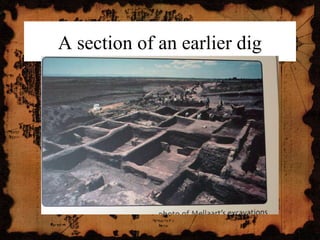
A section of an earlier dig
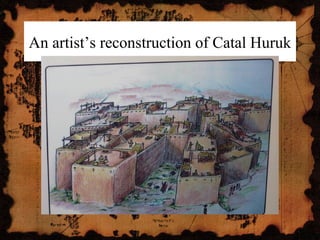
An artist’s reconstruction of Catal Huruk
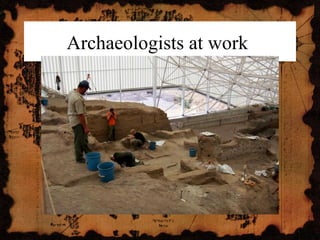
Archaeologists at work
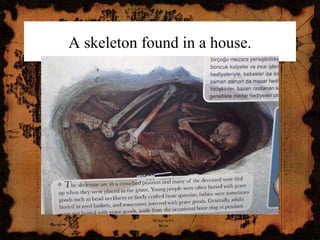
A skeleton found in a house.
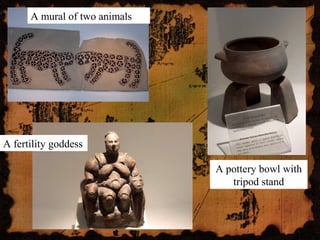
A fertility goddess
A pottery bowl with
tripod stand
A mural of two animals
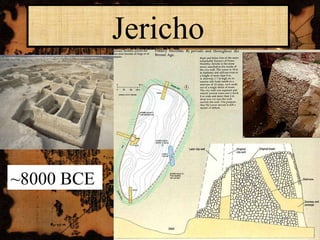
Jericho
~8000 BCE
Mesopotamia - The Land Between
Two Rivers
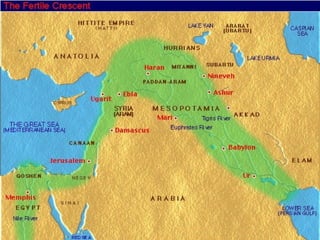
Mesopotamia was a place where many cities began to grow. As
its name suggests, Mesopotamia was located between two
rivers. The two rivers were the Tigris River and the Euphrates
River.
Mesopotamia was located in the Middle East, and surrounded
by desert. People came to Mesopotamia because the soil
between the two rivers was very fertile.
When a newborn baby begins life, he or she is placed in a
cradle. Mesopotamia is called the cradle of civilization
because the first civilizations began there, about 5,500 years
ago in 3500 B.C.
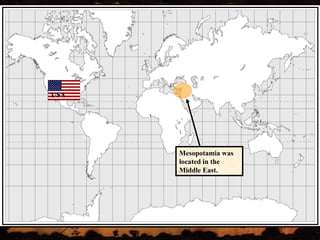
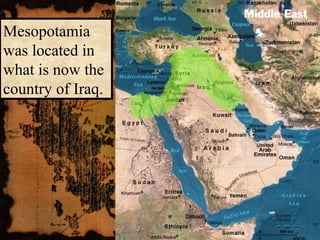
Mesopotamia was
located in the
Middle East.
USAUSA
Mesopotamia
was located in
what is now the
country of Iraq.
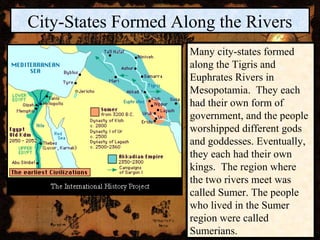
City-States Formed Along the Rivers
Many city-states formed
along the Tigris and
Euphrates Rivers in
Mesopotamia. They each
had their own form of
government, and the people
worshipped different gods
and goddesses. Eventually,
they each had their own
kings. The region where
the two rivers meet was
called Sumer. The people
who lived in the Sumer
region were called
Sumerians.
Why Did These Cities Develop?
Due to the fertile soil in
Mesopotamia, farming was
very successful. In fact,
people were able to create
surpluses of food. This
meant that some people
could stop farming and
begin doing other things,
like building a city.
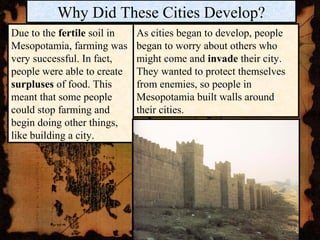
As cities began to develop, people
began to worry about others who
might come and invade their city.
They wanted to protect themselves
from enemies, so people in
Mesopotamia built walls around
their cities.
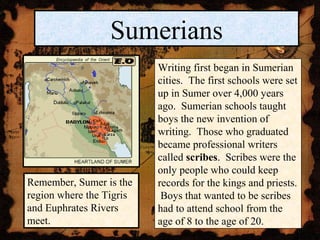
Sumerians
Remember, Sumer is the
region where the Tigris
and Euphrates Rivers
meet.
Writing first began in Sumerian
cities. The first schools were set
up in Sumer over 4,000 years
ago. Sumerian schools taught
boys the new invention of
writing. Those who graduated
became professional writers
called scribes. Scribes were the
only people who could keep
records for the kings and priests.
Boys that wanted to be scribes
had to attend school from the
age of 8 to the age of 20.
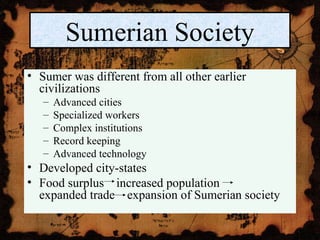
• Sumer was different from all other earlier
civilizations
– Advanced cities
– Specialized workers
– Complex institutions
– Record keeping
– Advanced technology
• Developed city-states
• Food surplus increased population
expanded trade expansion of Sumerian society
Sumerian Society
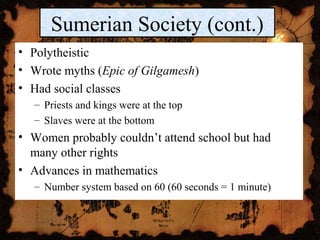
• Polytheistic
• Wrote myths (Epic of Gilgamesh)
• Had social classes
– Priests and kings were at the top
– Slaves were at the bottom
• Women probably couldn’t attend school but had
many other rights
• Advances in mathematics
– Number system based on 60 (60 seconds = 1 minute)
Sumerian Society (cont.)
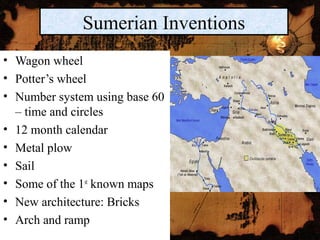
• Wagon wheel
• Potter’s wheel
• Number system using base 60
– time and circles
• 12 month calendar
• Metal plow
• Sail
• Some of the 1st
known maps
• New architecture: Bricks
• Arch and ramp
Sumerian Inventions
Sumerian Writing
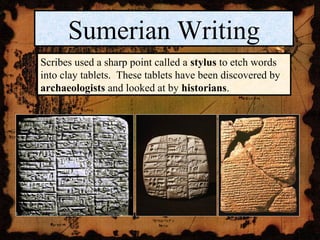
Scribes used a sharp point called a stylus to etch words
into clay tablets. These tablets have been discovered by
archaeologists and looked at by historians.
A Sumerian City
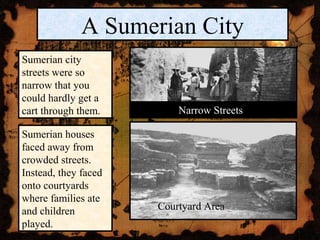
Sumerian city
streets were so
narrow that you
could hardly get a
cart through them.
Sumerian houses
faced away from
crowded streets.
Instead, they faced
onto courtyards
where families ate
and children
played.
Narrow Streets
Courtyard Area
Sumerian Cities
On hot nights,
people slept
outdoors on the top
of their house’s flat
roof.
Sumerians had a form of light
at night. They burned oil
lamps.
Sumerians even had plumbing!
Clay pipes that were buried
underground carried their waste
away. Inventions like plumbing
wouldn’t come around for
another thousand years in other
parts of the world!
Sumerian Religion
Sumerians
worshipped
many gods, not
just one. This
belief in many
gods is called
polytheism.
“Poly” means
many and
“Theism”
means gods.
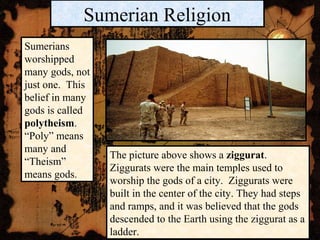
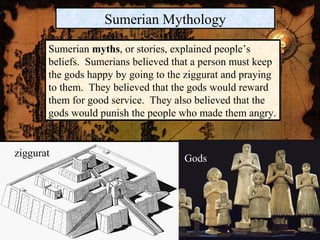
The picture above shows a ziggurat.
Ziggurats were the main temples used to
worship the gods of a city. Ziggurats were
built in the center of the city. They had steps
and ramps, and it was believed that the gods
descended to the Earth using the ziggurat as a
ladder.
ziggurat
Gods
Sumerian Mythology
Sumerian myths, or stories, explained people’s
beliefs. Sumerians believed that a person must keep
the gods happy by going to the ziggurat and praying
to them. They believed that the gods would reward
them for good service. They also believed that the
gods would punish the people who made them angry.
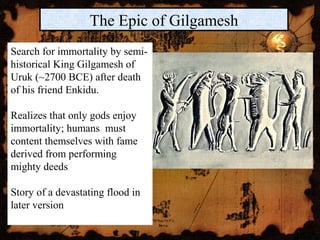
The Epic of Gilgamesh
Search for immortality by semi-
historical King Gilgamesh of
Uruk (~2700 BCE) after death
of his friend Enkidu.
Realizes that only gods enjoy
immortality; humans must
content themselves with fame
derived from performing
mighty deeds
Story of a devastating flood in
later version
The Epic of Gilgamesh Pow
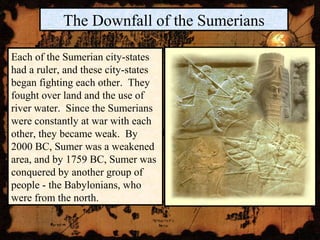
The Downfall of the Sumerians
Each of the Sumerian city-states
had a ruler, and these city-states
began fighting each other. They
fought over land and the use of
river water. Since the Sumerians
were constantly at war with each
other, they became weak. By
2000 BC, Sumer was a weakened
area, and by 1759 BC, Sumer was
conquered by another group of
people - the Babylonians, who
were from the north.
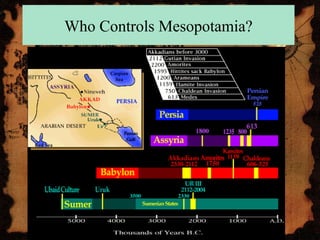
Who Controls Mesopotamia?
From Sumerians to Babylonians
• The Sumerian city-states eventually fell to
foreign invaders (2000s BC)
• The Akkadians:
– Semites- nomadic people from the Arabian
Peninsula that migrated to Mesopotamia
– Sargon I (2300-2200 BC) unites all
Mesopotamian cities (creates first empire)
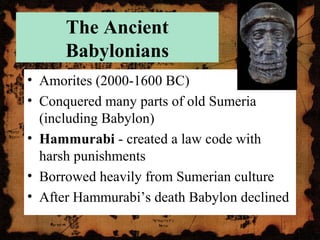
The Ancient
Babylonians
• Amorites (2000-1600 BC)
• Conquered many parts of old Sumeria
(including Babylon)
• Hammurabi - created a law code with
harsh punishments
• Borrowed heavily from Sumerian culture
• After Hammurabi’s death Babylon declined
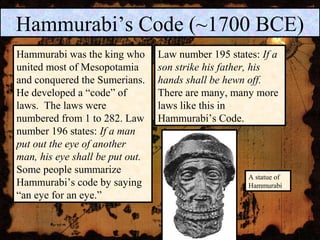
Hammurabi’s Code (~1700 BCE)
Hammurabi was the king who
united most of Mesopotamia
and conquered the Sumerians.
He developed a “code” of
laws. The laws were
numbered from 1 to 282. Law
number 196 states: If a man
put out the eye of another
man, his eye shall be put out.
Some people summarize
Hammurabi’s code by saying
“an eye for an eye.”
Law number 195 states: If a
son strike his father, his
hands shall be hewn off.
There are many, many more
laws like this in
Hammurabi’s Code.
A statue of
Hammurabi
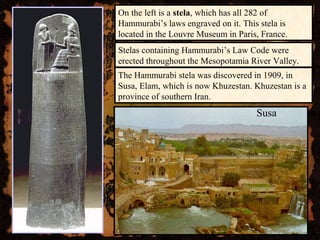
On the left is a stela, which has all 282 of
Hammurabi’s laws engraved on it. This stela is
located in the Louvre Museum in Paris, France.
The Hammurabi stela was discovered in 1909, in
Susa, Elam, which is now Khuzestan. Khuzestan is a
province of southern Iran.
Susa
Stelas containing Hammurabi’s Law Code were
erected throughout the Mesopotamia River Valley.
The Law Code of Hammu
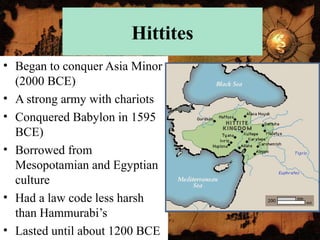
Hittites
• Began to conquer Asia Minor
(2000 BCE)
• A strong army with chariots
• Conquered Babylon in 1595
BCE)
• Borrowed from
Mesopotamian and Egyptian
culture
• Had a law code less harsh
than Hammurabi’s
• Lasted until about 1200 BCE
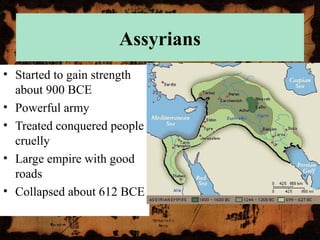
Assyrians
• Started to gain strength
about 900 BCE
• Powerful army
• Treated conquered people
cruelly
• Large empire with good
roads
• Collapsed about 612 BCE
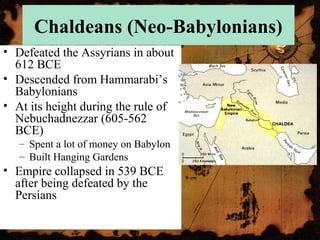
Chaldeans (Neo-Babylonians)
• Defeated the Assyrians in about
612 BCE
• Descended from Hammarabi’s
Babylonians
• At its height during the rule of
Nebuchadnezzar (605-562
BCE)
– Spent a lot of money on Babylon
– Built Hanging Gardens
• Empire collapsed in 539 BCE
after being defeated by the
Persians
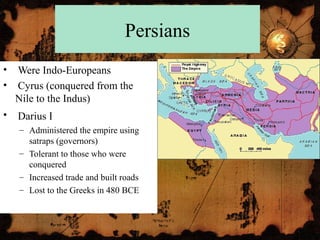
Persians
• Were Indo-Europeans
• Cyrus (conquered from the
Nile to the Indus)
• Darius I
– Administered the empire using
satraps (governors)
– Tolerant to those who were
conquered
– Increased trade and built roads
– Lost to the Greeks in 480 BCE

Mesopotamia

  • 1.
  • 2.
    Chapter 1: The FirstRiver Valley Civilizations
  • 3.
  • 4.
    Catal Huyuk isthe oldest and the largest Neolithic city found, so far. It dates to 8,000 years BCE and was occupied continuously for 376 generations. No specific reasons for its abandonment have been found.
  • 5.
    A section ofan earlier dig
  • 6.
  • 7.
  • 8.
    A skeleton foundin a house.
  • 9.
    A fertility goddess Apottery bowl with tripod stand A mural of two animals
  • 10.
  • 11.
    Mesopotamia - TheLand Between Two Rivers Mesopotamia was a place where many cities began to grow. As its name suggests, Mesopotamia was located between two rivers. The two rivers were the Tigris River and the Euphrates River. Mesopotamia was located in the Middle East, and surrounded by desert. People came to Mesopotamia because the soil between the two rivers was very fertile. When a newborn baby begins life, he or she is placed in a cradle. Mesopotamia is called the cradle of civilization because the first civilizations began there, about 5,500 years ago in 3500 B.C.
  • 12.
    Mesopotamia was located inthe Middle East. USAUSA
  • 14.
    Mesopotamia was located in whatis now the country of Iraq.
  • 15.
    City-States Formed Alongthe Rivers Many city-states formed along the Tigris and Euphrates Rivers in Mesopotamia. They each had their own form of government, and the people worshipped different gods and goddesses. Eventually, they each had their own kings. The region where the two rivers meet was called Sumer. The people who lived in the Sumer region were called Sumerians.
  • 16.
    Why Did TheseCities Develop? Due to the fertile soil in Mesopotamia, farming was very successful. In fact, people were able to create surpluses of food. This meant that some people could stop farming and begin doing other things, like building a city. As cities began to develop, people began to worry about others who might come and invade their city. They wanted to protect themselves from enemies, so people in Mesopotamia built walls around their cities.
  • 17.
    Sumerians Remember, Sumer isthe region where the Tigris and Euphrates Rivers meet. Writing first began in Sumerian cities. The first schools were set up in Sumer over 4,000 years ago. Sumerian schools taught boys the new invention of writing. Those who graduated became professional writers called scribes. Scribes were the only people who could keep records for the kings and priests. Boys that wanted to be scribes had to attend school from the age of 8 to the age of 20.
  • 18.
    • Sumer wasdifferent from all other earlier civilizations – Advanced cities – Specialized workers – Complex institutions – Record keeping – Advanced technology • Developed city-states • Food surplus increased population expanded trade expansion of Sumerian society Sumerian Society
  • 19.
    • Polytheistic • Wrotemyths (Epic of Gilgamesh) • Had social classes – Priests and kings were at the top – Slaves were at the bottom • Women probably couldn’t attend school but had many other rights • Advances in mathematics – Number system based on 60 (60 seconds = 1 minute) Sumerian Society (cont.)
  • 20.
    • Wagon wheel •Potter’s wheel • Number system using base 60 – time and circles • 12 month calendar • Metal plow • Sail • Some of the 1st known maps • New architecture: Bricks • Arch and ramp Sumerian Inventions
  • 21.
    Sumerian Writing Scribes useda sharp point called a stylus to etch words into clay tablets. These tablets have been discovered by archaeologists and looked at by historians.
  • 22.
    A Sumerian City Sumeriancity streets were so narrow that you could hardly get a cart through them. Sumerian houses faced away from crowded streets. Instead, they faced onto courtyards where families ate and children played. Narrow Streets Courtyard Area
  • 23.
    Sumerian Cities On hotnights, people slept outdoors on the top of their house’s flat roof. Sumerians had a form of light at night. They burned oil lamps. Sumerians even had plumbing! Clay pipes that were buried underground carried their waste away. Inventions like plumbing wouldn’t come around for another thousand years in other parts of the world!
  • 24.
    Sumerian Religion Sumerians worshipped many gods,not just one. This belief in many gods is called polytheism. “Poly” means many and “Theism” means gods. The picture above shows a ziggurat. Ziggurats were the main temples used to worship the gods of a city. Ziggurats were built in the center of the city. They had steps and ramps, and it was believed that the gods descended to the Earth using the ziggurat as a ladder.
  • 25.
    ziggurat Gods Sumerian Mythology Sumerian myths,or stories, explained people’s beliefs. Sumerians believed that a person must keep the gods happy by going to the ziggurat and praying to them. They believed that the gods would reward them for good service. They also believed that the gods would punish the people who made them angry.
  • 26.
    The Epic ofGilgamesh Search for immortality by semi- historical King Gilgamesh of Uruk (~2700 BCE) after death of his friend Enkidu. Realizes that only gods enjoy immortality; humans must content themselves with fame derived from performing mighty deeds Story of a devastating flood in later version
  • 27.
    The Epic ofGilgamesh Pow
  • 28.
    The Downfall ofthe Sumerians Each of the Sumerian city-states had a ruler, and these city-states began fighting each other. They fought over land and the use of river water. Since the Sumerians were constantly at war with each other, they became weak. By 2000 BC, Sumer was a weakened area, and by 1759 BC, Sumer was conquered by another group of people - the Babylonians, who were from the north.
  • 29.
  • 30.
    From Sumerians toBabylonians • The Sumerian city-states eventually fell to foreign invaders (2000s BC) • The Akkadians: – Semites- nomadic people from the Arabian Peninsula that migrated to Mesopotamia – Sargon I (2300-2200 BC) unites all Mesopotamian cities (creates first empire)
  • 31.
    The Ancient Babylonians • Amorites(2000-1600 BC) • Conquered many parts of old Sumeria (including Babylon) • Hammurabi - created a law code with harsh punishments • Borrowed heavily from Sumerian culture • After Hammurabi’s death Babylon declined
  • 32.
    Hammurabi’s Code (~1700BCE) Hammurabi was the king who united most of Mesopotamia and conquered the Sumerians. He developed a “code” of laws. The laws were numbered from 1 to 282. Law number 196 states: If a man put out the eye of another man, his eye shall be put out. Some people summarize Hammurabi’s code by saying “an eye for an eye.” Law number 195 states: If a son strike his father, his hands shall be hewn off. There are many, many more laws like this in Hammurabi’s Code. A statue of Hammurabi
  • 33.
    On the leftis a stela, which has all 282 of Hammurabi’s laws engraved on it. This stela is located in the Louvre Museum in Paris, France. The Hammurabi stela was discovered in 1909, in Susa, Elam, which is now Khuzestan. Khuzestan is a province of southern Iran. Susa Stelas containing Hammurabi’s Law Code were erected throughout the Mesopotamia River Valley.
  • 34.
    The Law Codeof Hammu
  • 35.
    Hittites • Began toconquer Asia Minor (2000 BCE) • A strong army with chariots • Conquered Babylon in 1595 BCE) • Borrowed from Mesopotamian and Egyptian culture • Had a law code less harsh than Hammurabi’s • Lasted until about 1200 BCE
  • 36.
    Assyrians • Started togain strength about 900 BCE • Powerful army • Treated conquered people cruelly • Large empire with good roads • Collapsed about 612 BCE
  • 37.
    Chaldeans (Neo-Babylonians) • Defeatedthe Assyrians in about 612 BCE • Descended from Hammarabi’s Babylonians • At its height during the rule of Nebuchadnezzar (605-562 BCE) – Spent a lot of money on Babylon – Built Hanging Gardens • Empire collapsed in 539 BCE after being defeated by the Persians
  • 38.
    Persians • Were Indo-Europeans •Cyrus (conquered from the Nile to the Indus) • Darius I – Administered the empire using satraps (governors) – Tolerant to those who were conquered – Increased trade and built roads – Lost to the Greeks in 480 BCE