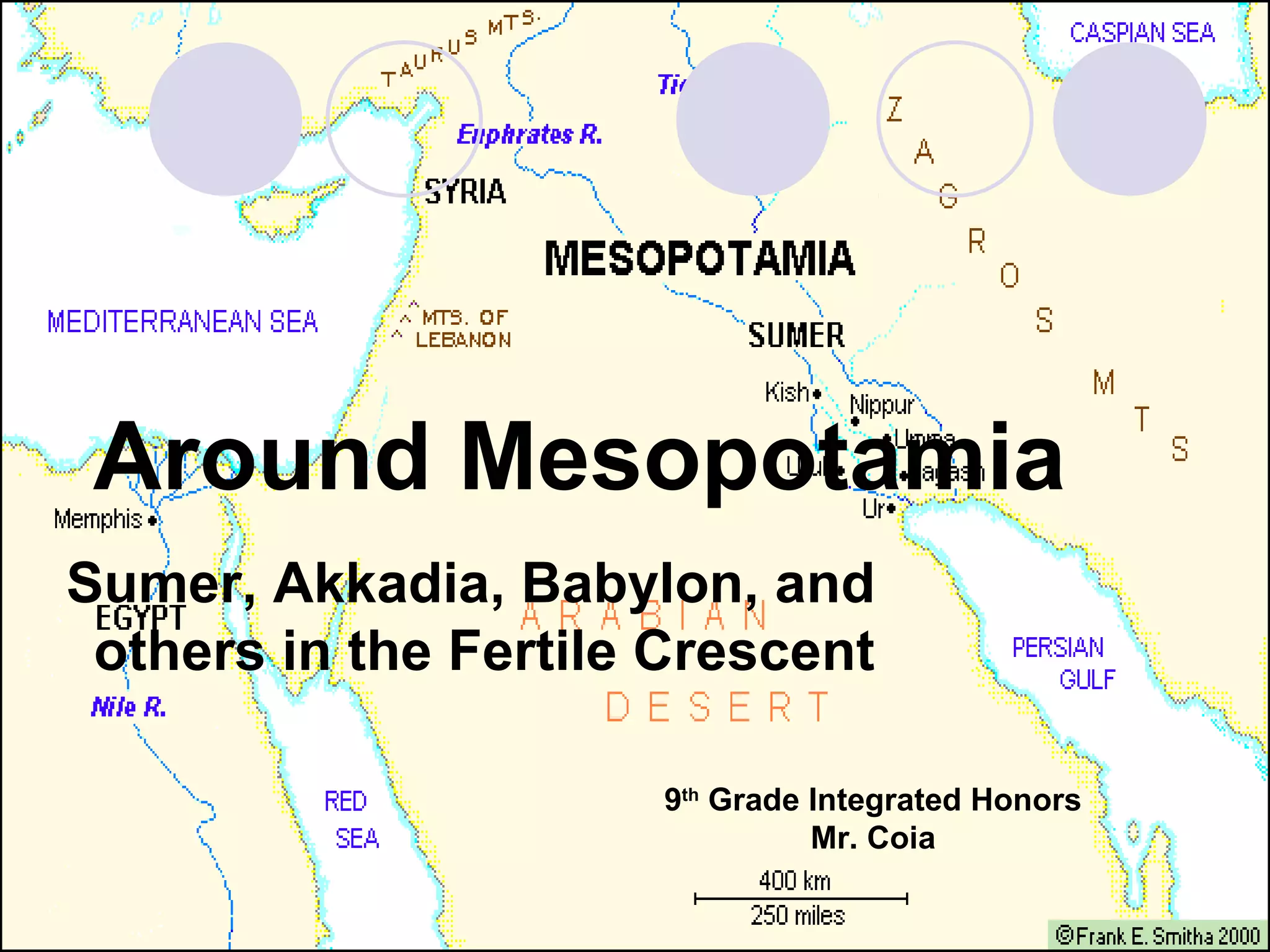
Around Mesopotamia
Sumer, Akkadia, Babylon, and
others in the Fertile Crescent
9th
Grade Integrated Honors
Mr. Coia
Key Terms
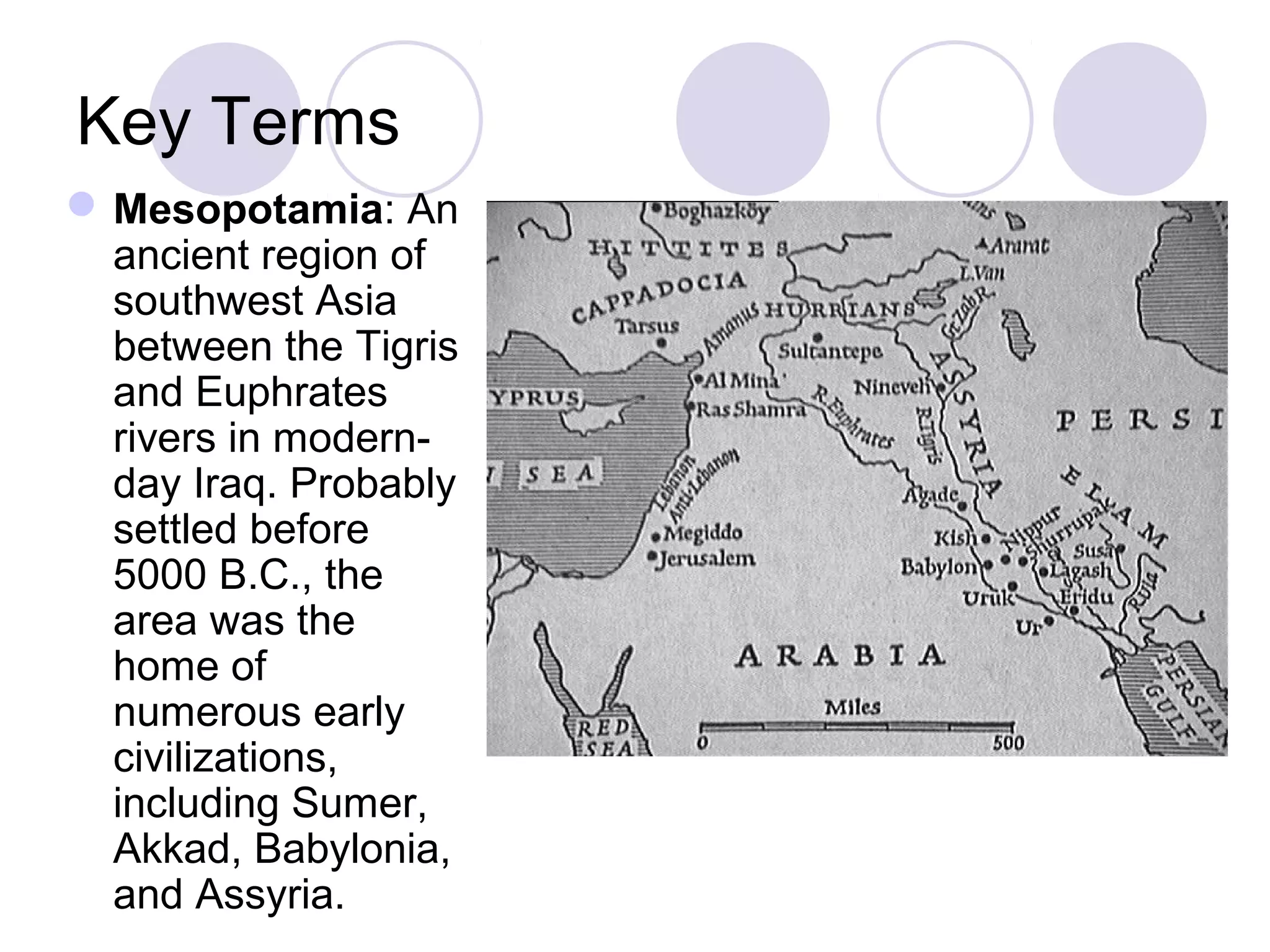
Mesopotamia: An
ancient region of
southwest Asia
between the Tigris
and Euphrates
rivers in modern-
day Iraq. Probably
settled before
5000 B.C., the
area was the
home of
numerous early
civilizations,
including Sumer,
Akkad, Babylonia,
and Assyria.
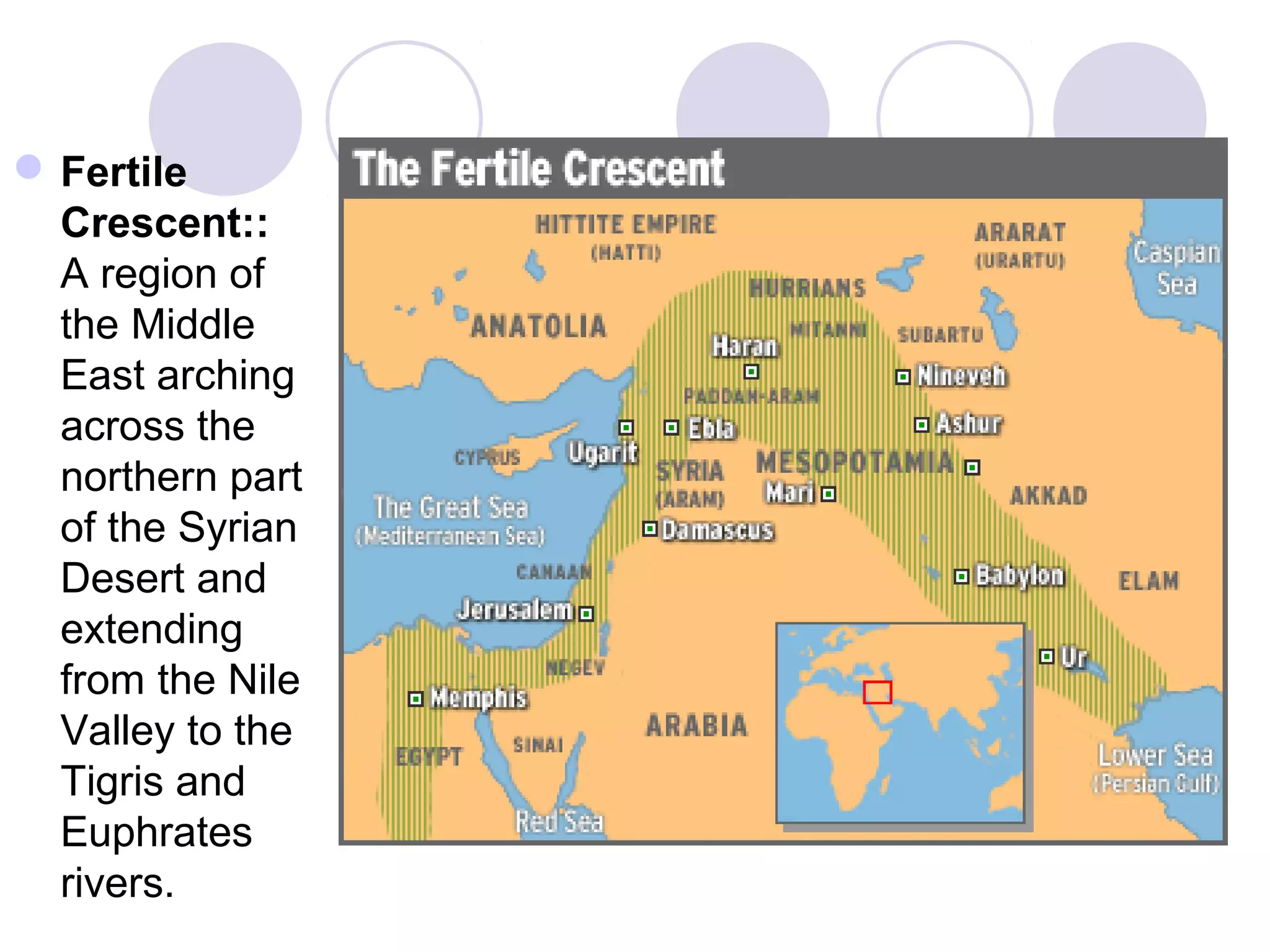
Fertile
Crescent::
A region of
the Middle
East arching
across the
northern part
of the Syrian
Desert and
extending
from the Nile
Valley to the
Tigris and
Euphrates
rivers.
Timeline
http://www.softschools.com/timelines/mesopo
Sumerian Civilization
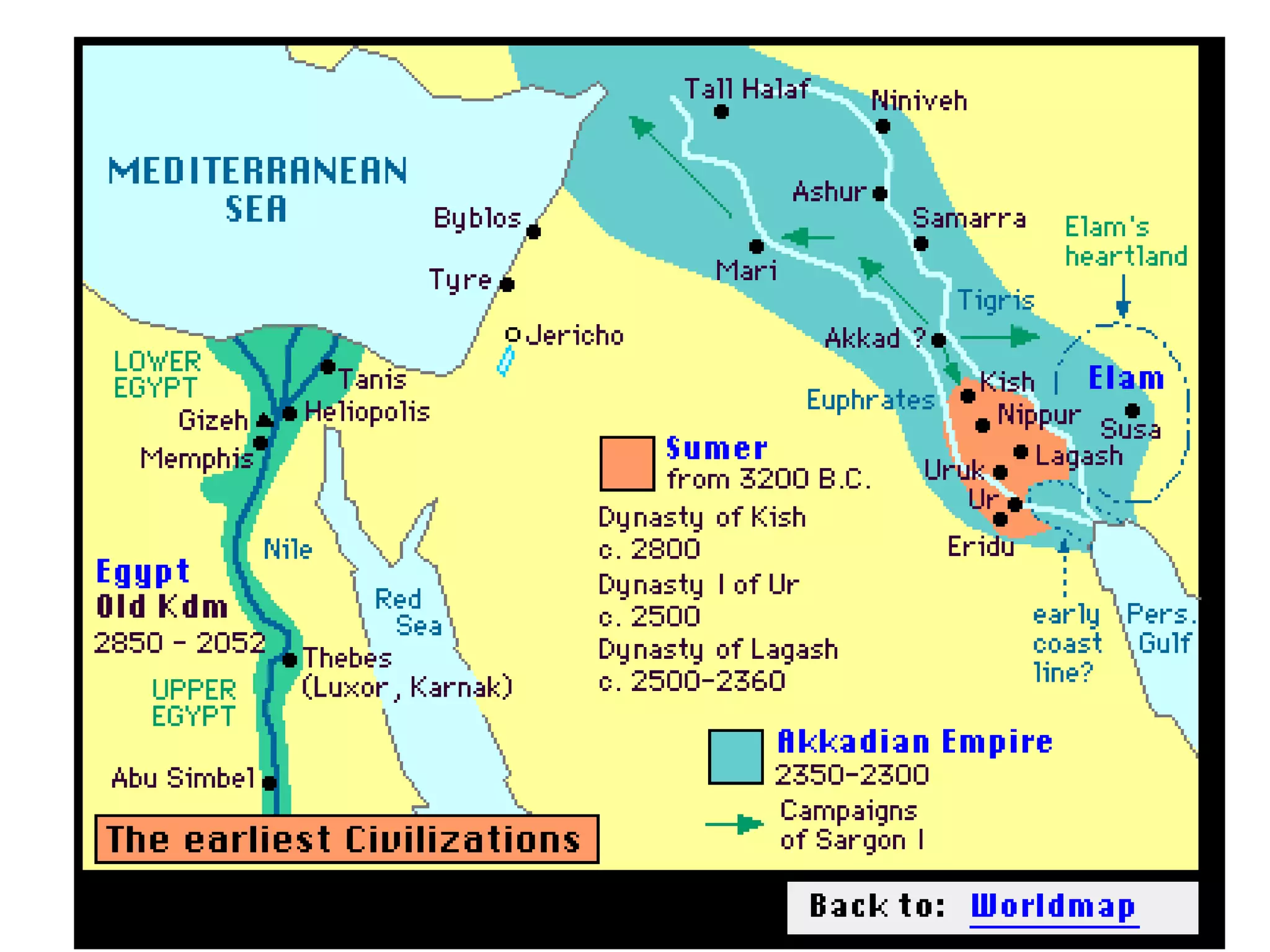
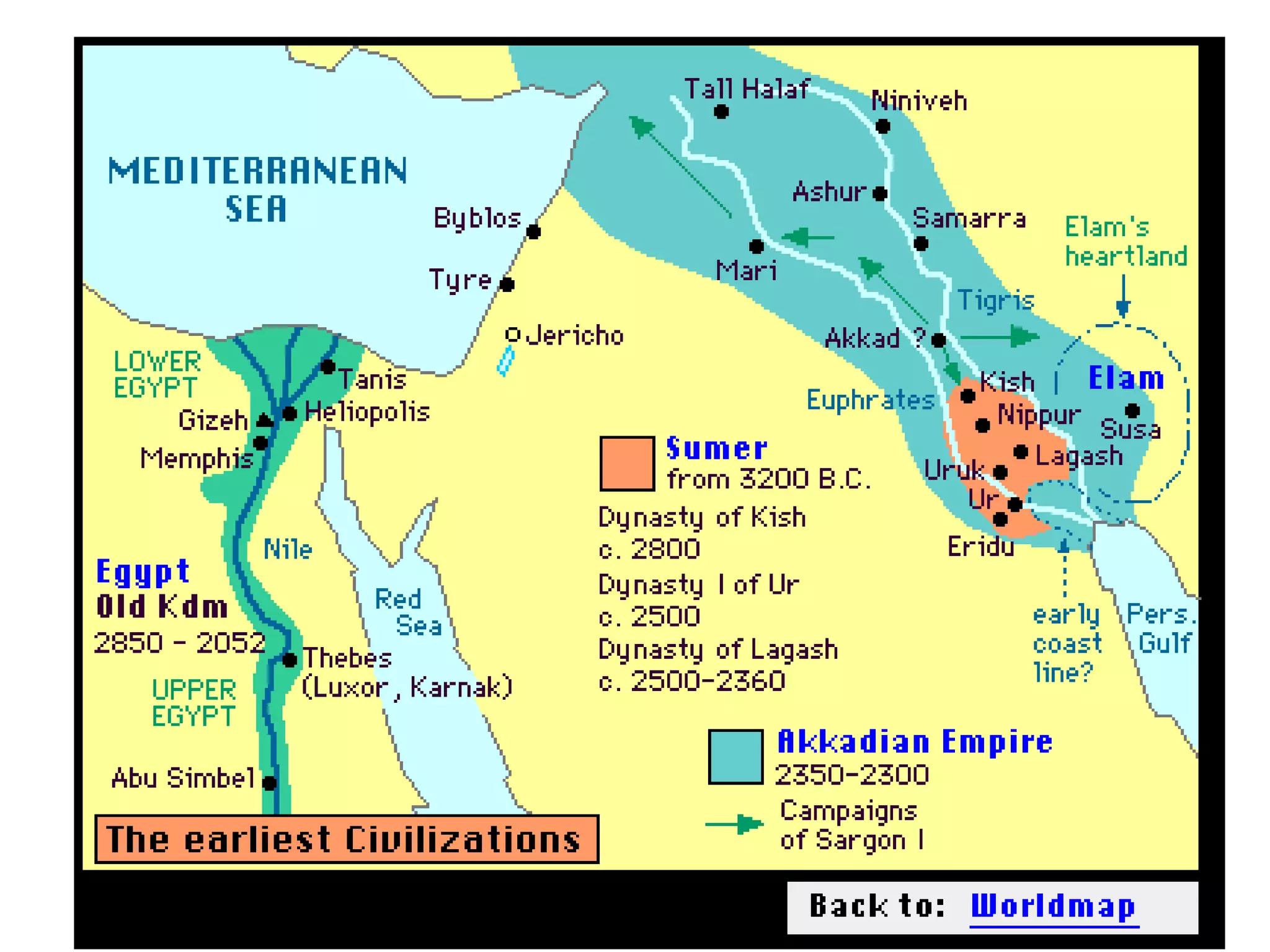
Located on an arc of land that curves from the Persian
Gulf to the eastern Mediterranean coast. The dark, rich
soils and golden wheat fields earned it the name Fertile
Crescent.
The first known civilization in the Fertile Crescent was
uncovered in the 1800s in Mesopotamia which means
“between the rivers” of Euphrates and Tigris.
Control of these rivers was key to developments in
Mesopotamia. To survive and protect their farmland,
villages along the riverbanks had to work together.
Temple priests or royal officials provided the leadership
that was necessary to ensure cooperation.
Social Structure in Sumer
Around 3200 B.C., the first Sumerian cities emerged in
the southern part of Mesopotamia. They used earth and
water to make bricks for building.
Trade brought riches to Sumerian cities. The Sumerians
were the first to make wheeled vehicles.
In each Sumerian city-state, the ruler was responsible for
maintaining the city walls and irrigations systems.
Each Sumerian city-state had a distinct social
hierarchy. At the base of society were the majority of
people, peasant farms.
Religion and Afterlife
Sumerians practiced
polytheistic and their
gods were thought to
control every aspect
of life.
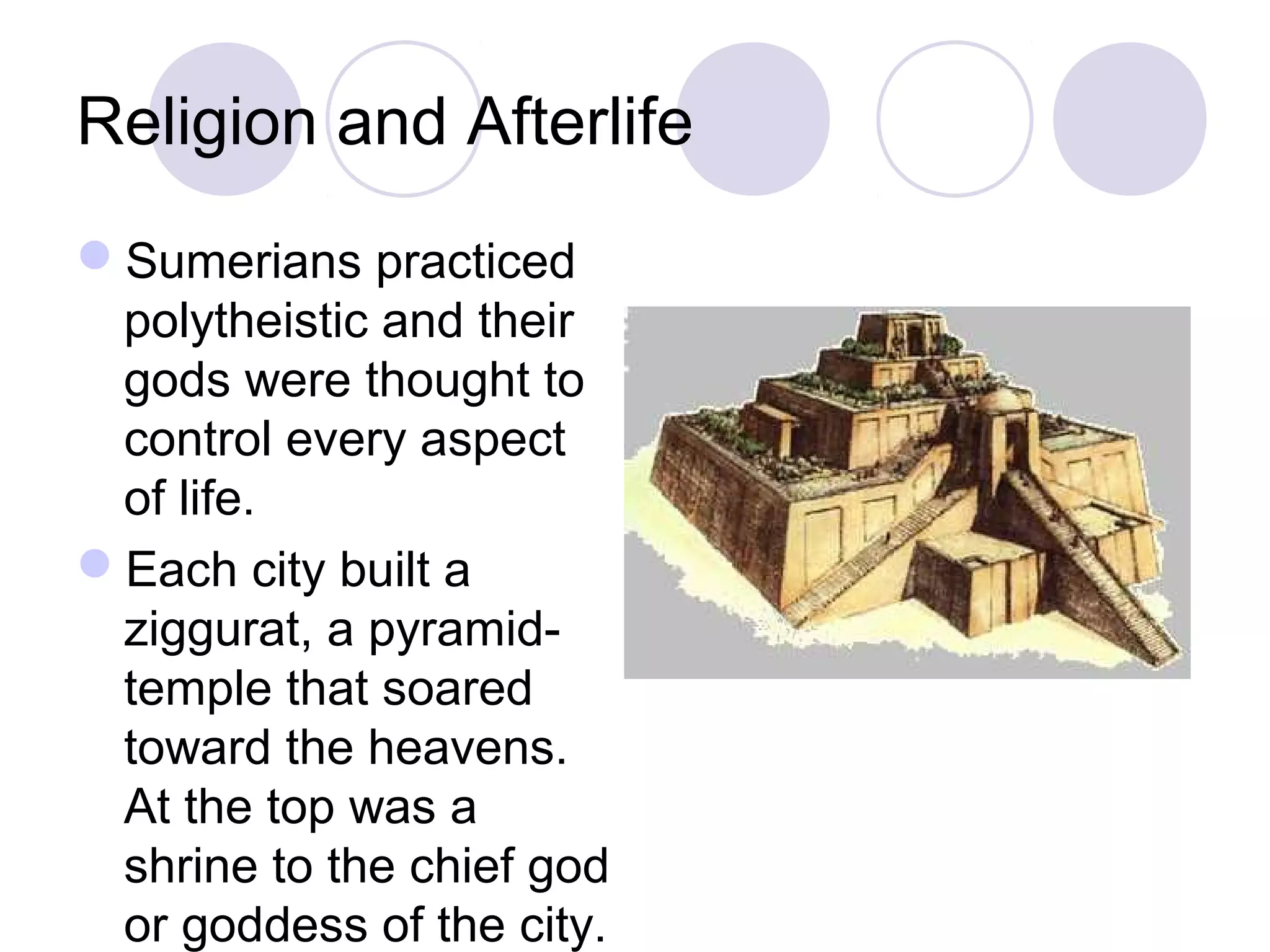
Each city built a
ziggurat, a pyramid-
temple that soared
toward the heavens.
At the top was a
shrine to the chief god
or goddess of the city.
Religion
The Sumerians believed in an afterlife, but
thought the underworld was a grim place
of no-release. They buried food and tools
with their dead.
Unlike the Egyptians, they did not imagine
the afterlife in detail.
They did not believe in rewards and
punishments.
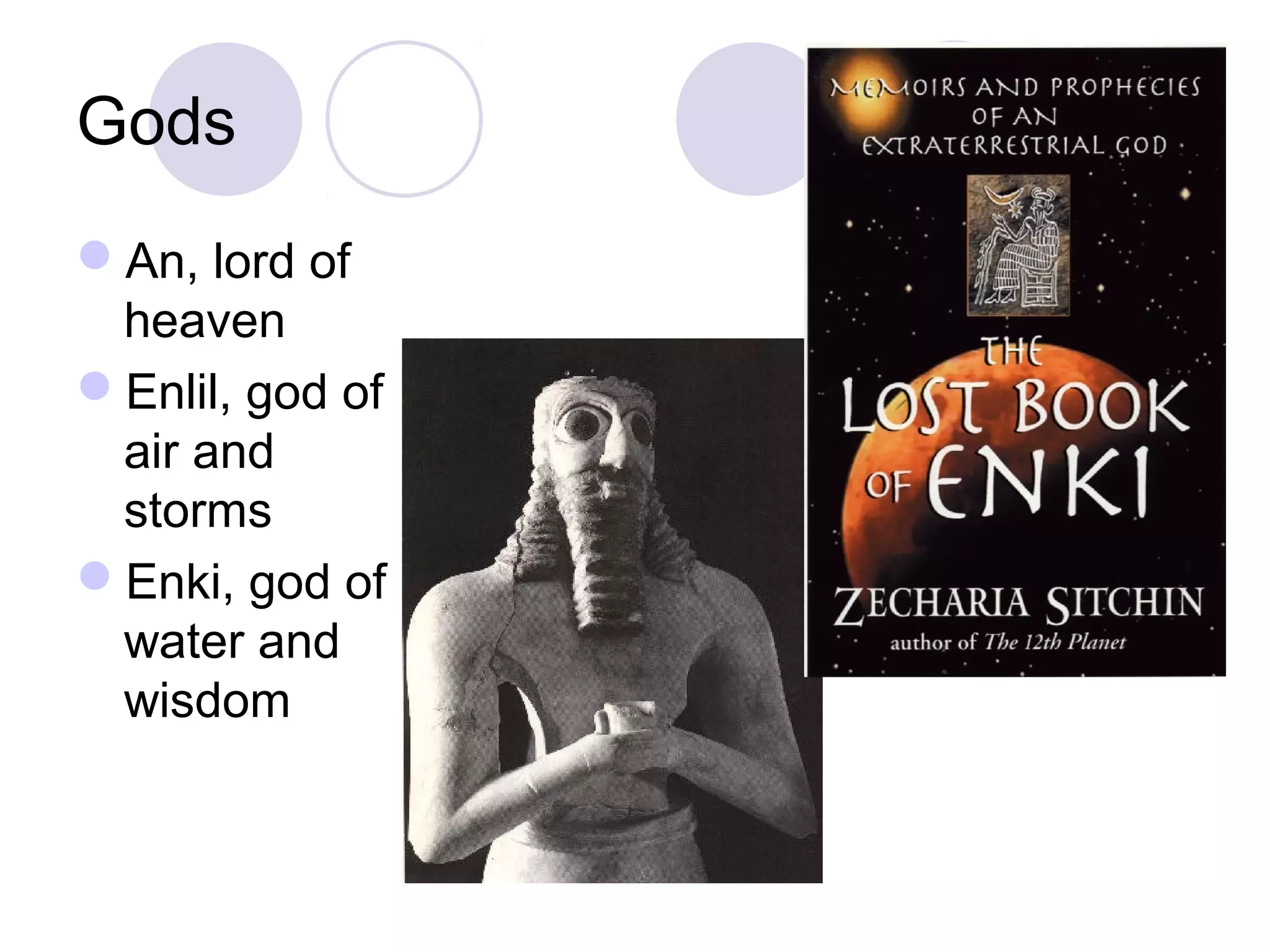
Gods
An, lord of
heaven
Enlil, god of
air and
storms
Enki, god of
water and
wisdom
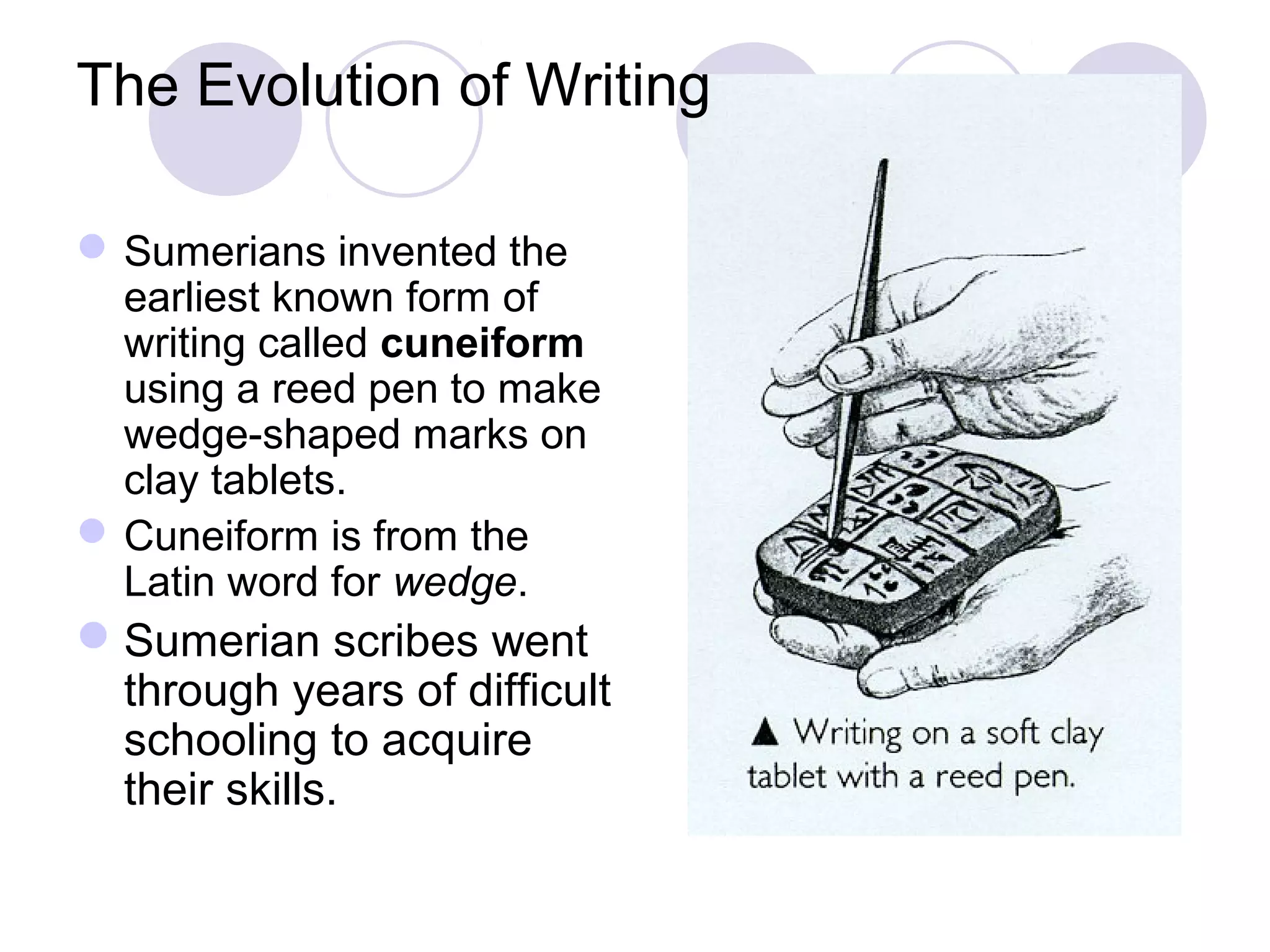
The Evolution of Writing
Sumerians invented the
earliest known form of
writing called cuneiform
using a reed pen to make
wedge-shaped marks on
clay tablets.
Cuneiform is from the
Latin word for wedge.
Sumerian scribes went
through years of difficult
schooling to acquire
their skills.
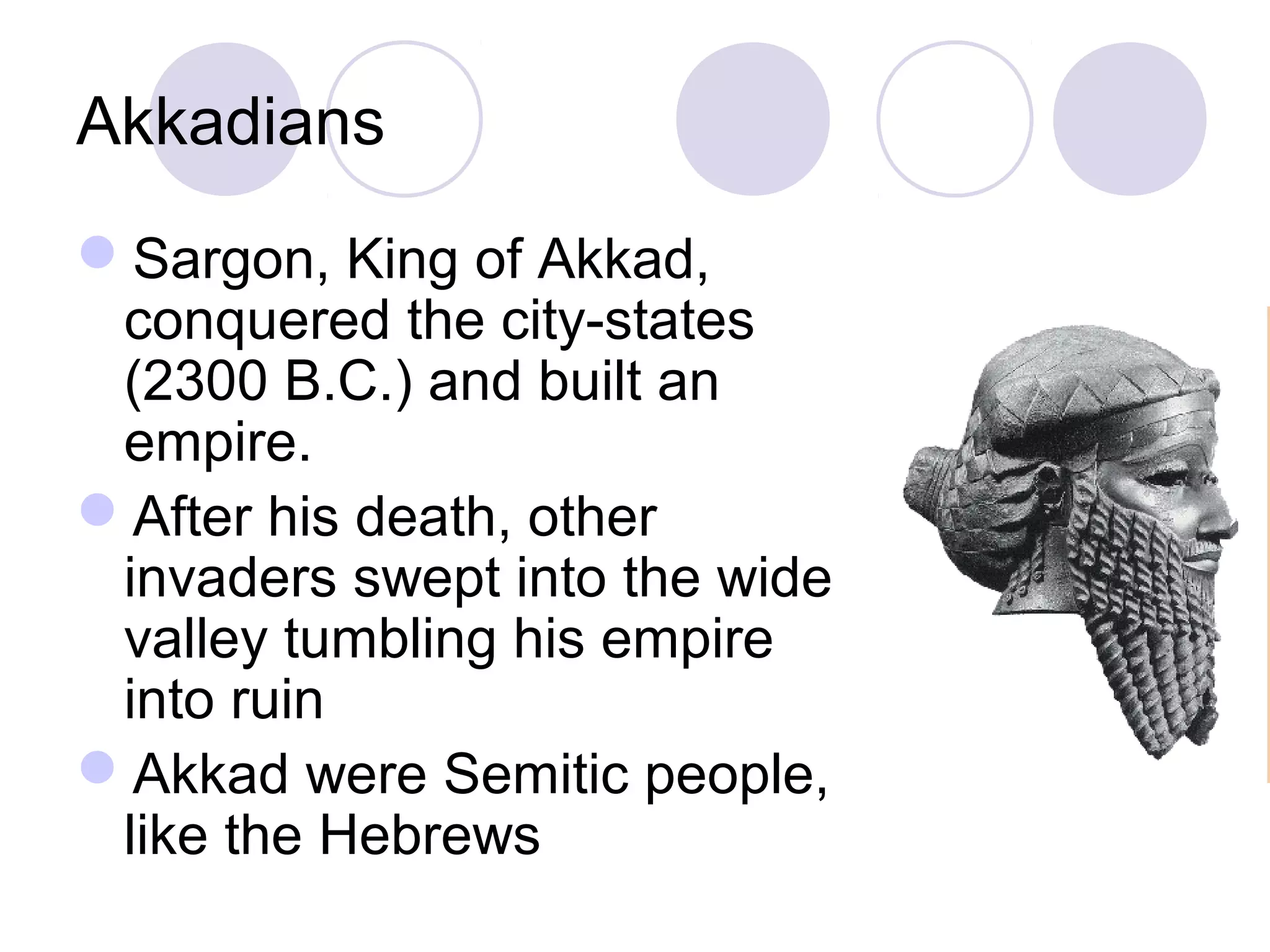
Akkadians
Sargon, King of Akkad,
conquered the city-states
(2300 B.C.) and built an
empire.
After his death, other
invaders swept into the wide
valley tumbling his empire
into ruin
Akkad were Semitic people,
like the Hebrews
The Babylonians
A Semitic people who spoke Akkadian,
conquered Mesopotamia in about 2000
B.C. Its capital, Babylon, was on the
Euphrates River
About 1790, the king of Babylon,
Hammurabi, brought the empire (much of
Mesopotamia) under his control and
established the first written laws, criminal
and civil.
The Babylonians
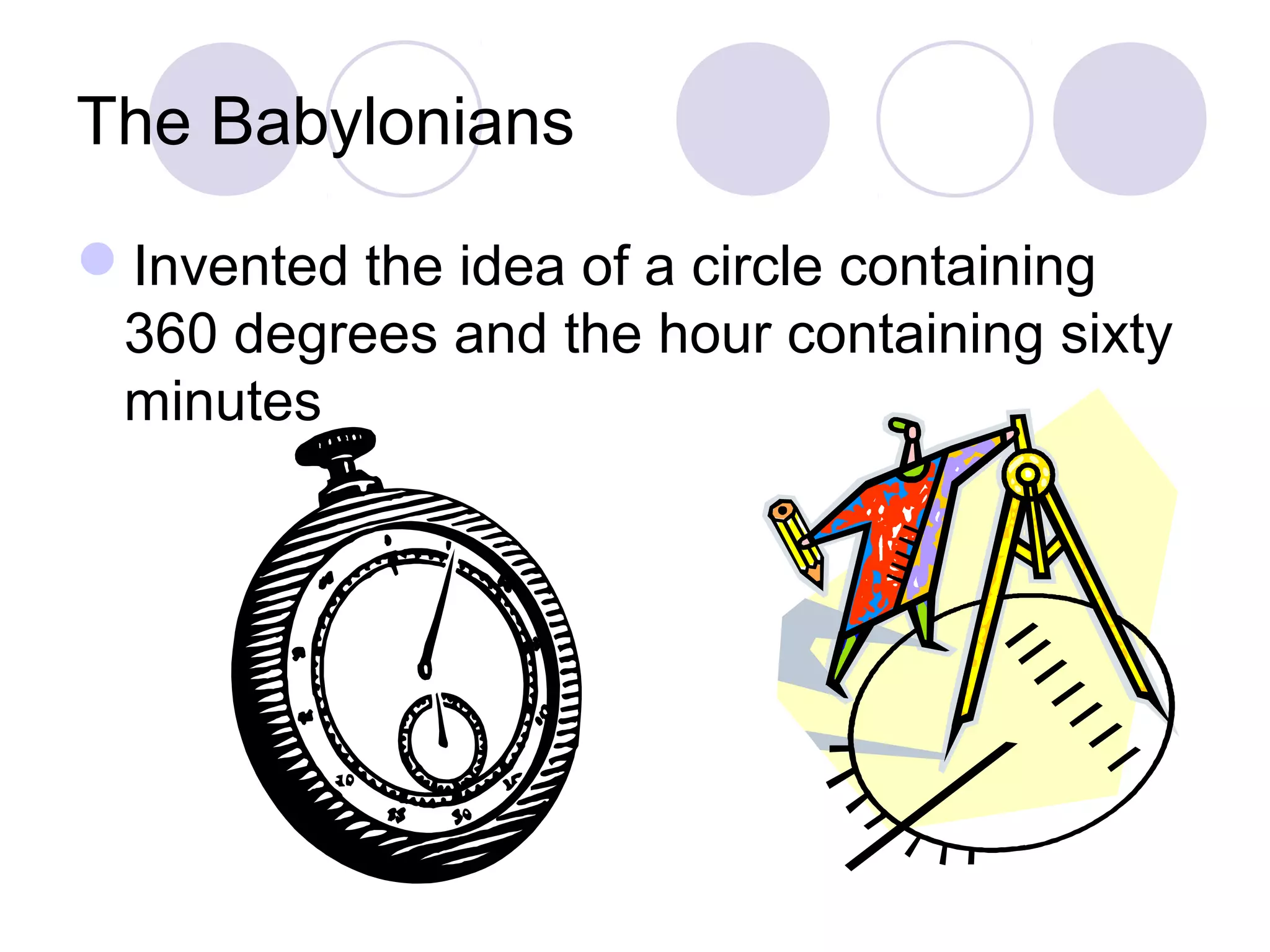
Invented the idea of a circle containing
360 degrees and the hour containing sixty
minutes
Hammurabi’s Code
Hammurabi was not the author of the code.
Most of the laws had been around since
Sumerian Times, but Hammurabi wanted
everyone in his empire to know the legal
principles his government would follow.
He had artisans carve nearly 300 laws on a
stone pillar for all to see.
This was the first time a ruler attempted to
solidify all of the laws that would govern a
state.
Hammurabi’s Code
Criminal laws dealt with offenses
against others. Hammurabi’s Code
limited personal vengeance and
encouraged social order.
Civil Law dealt with private rights and
matters, such as business contracts,
marriage, taxes, and divorce. Much of
Hummurabi’s Code was designed to
protect the powerless.
Law #196: “If a man put out
the eye of another man, his
eye shall be put out.”
Does this sound familiar?
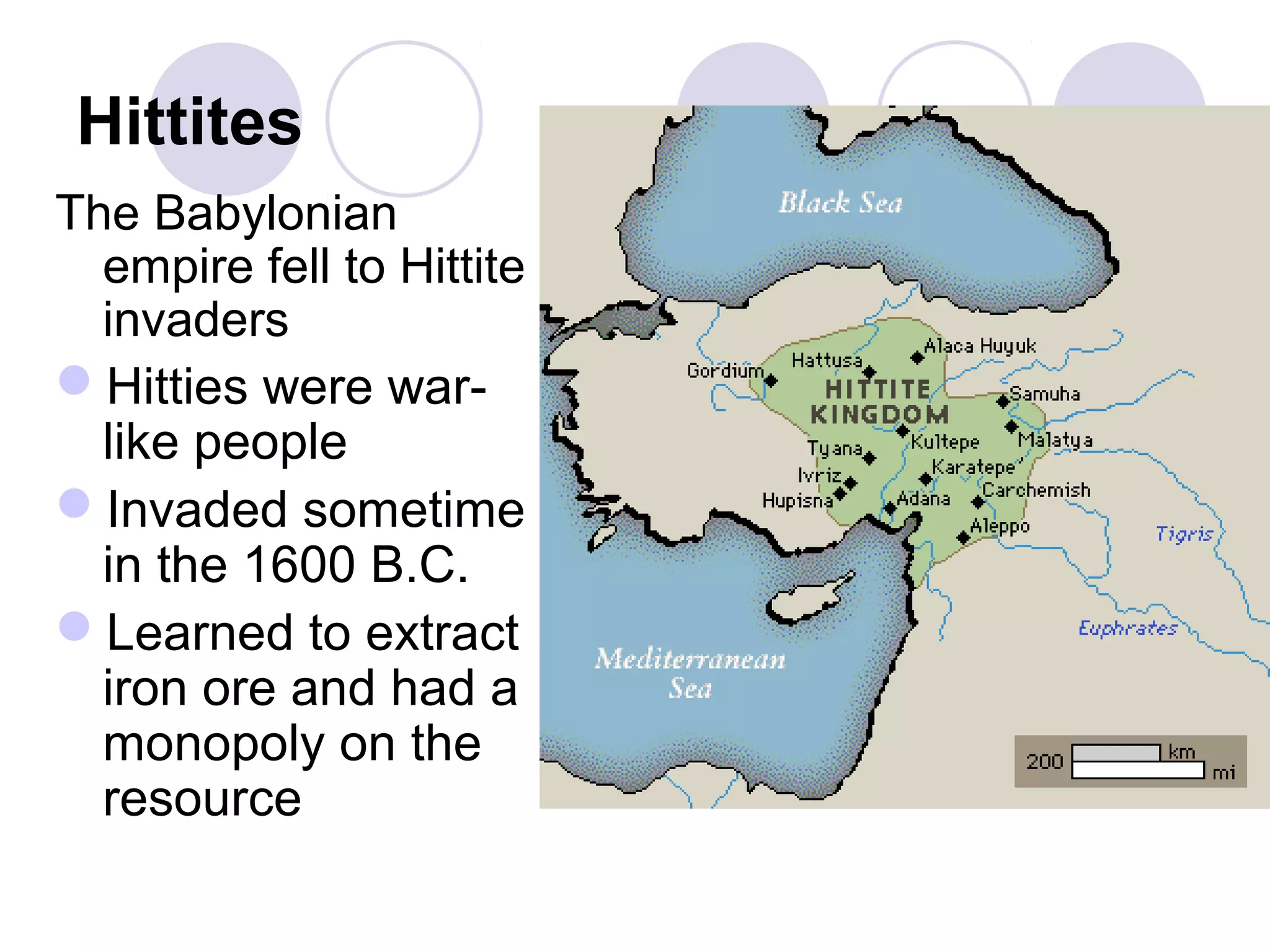
Hittites
The Babylonian
empire fell to Hittite
invaders
Hitties were war-
like people
Invaded sometime
in the 1600 B.C.
Learned to extract
iron ore and had a
monopoly on the
resource
The Assyrians
Warlike people from northern
Mesopotamia, the Assyrians began to
consolidate a great empire
For 500 years, they earned a reputation
for being among the most feared warriors
in history
After Assurbanipal’s death, people joined
forces to destroy the Assyrian armies.
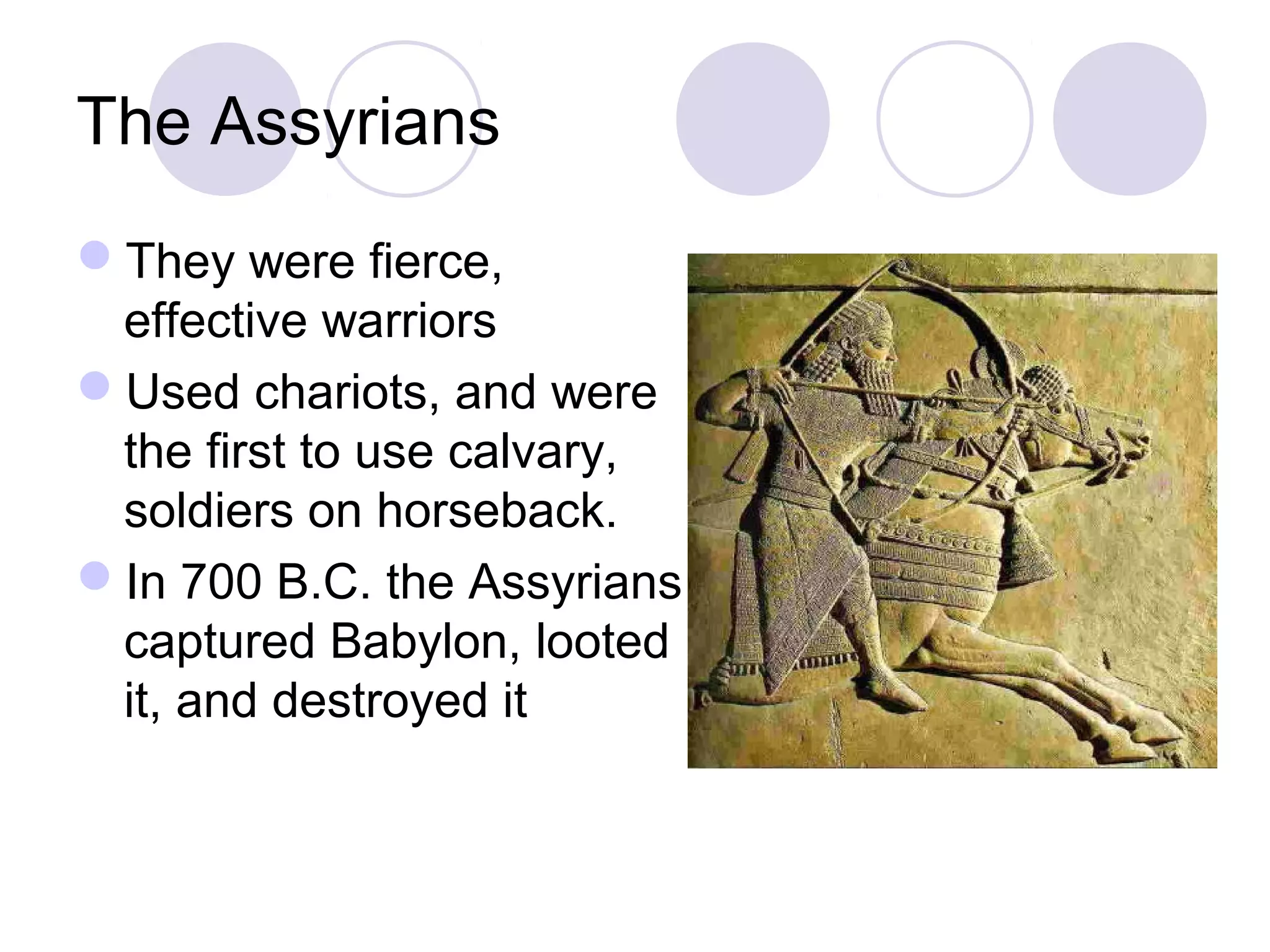
The Assyrians
They were fierce,
effective warriors
Used chariots, and were
the first to use calvary,
soldiers on horseback.
In 700 B.C. the Assyrians
captured Babylon, looted
it, and destroyed it
The Assyrians
At Nineveh, King Assurbanipal founded
one of the first libraries. He ordered his
scribes to collect cuneiform tablets from all
over the Fertile Crescent.
The library at Nineveh contained the Epic
of Gilgamesh, one of the oldest works of
literature. (we’ll read this in class)
Assyria fell in 612 B.C. due to a civil war
and foreign invaders.
Babylon Revived
Nebuchadnezzar revived the power of
Babylon, rebuilt the canals, temples, walls
and palaces of Babylon.
Also called the Chaldeans
Nebuchadnezzar built the Hanging
Gardens of Babylon for his homesick wife
In 587 B.C., he destroyed Jerusalem,
sending the tribes of Judah into exile.
Mentioned in the Book of Daniel
The Persian Empire
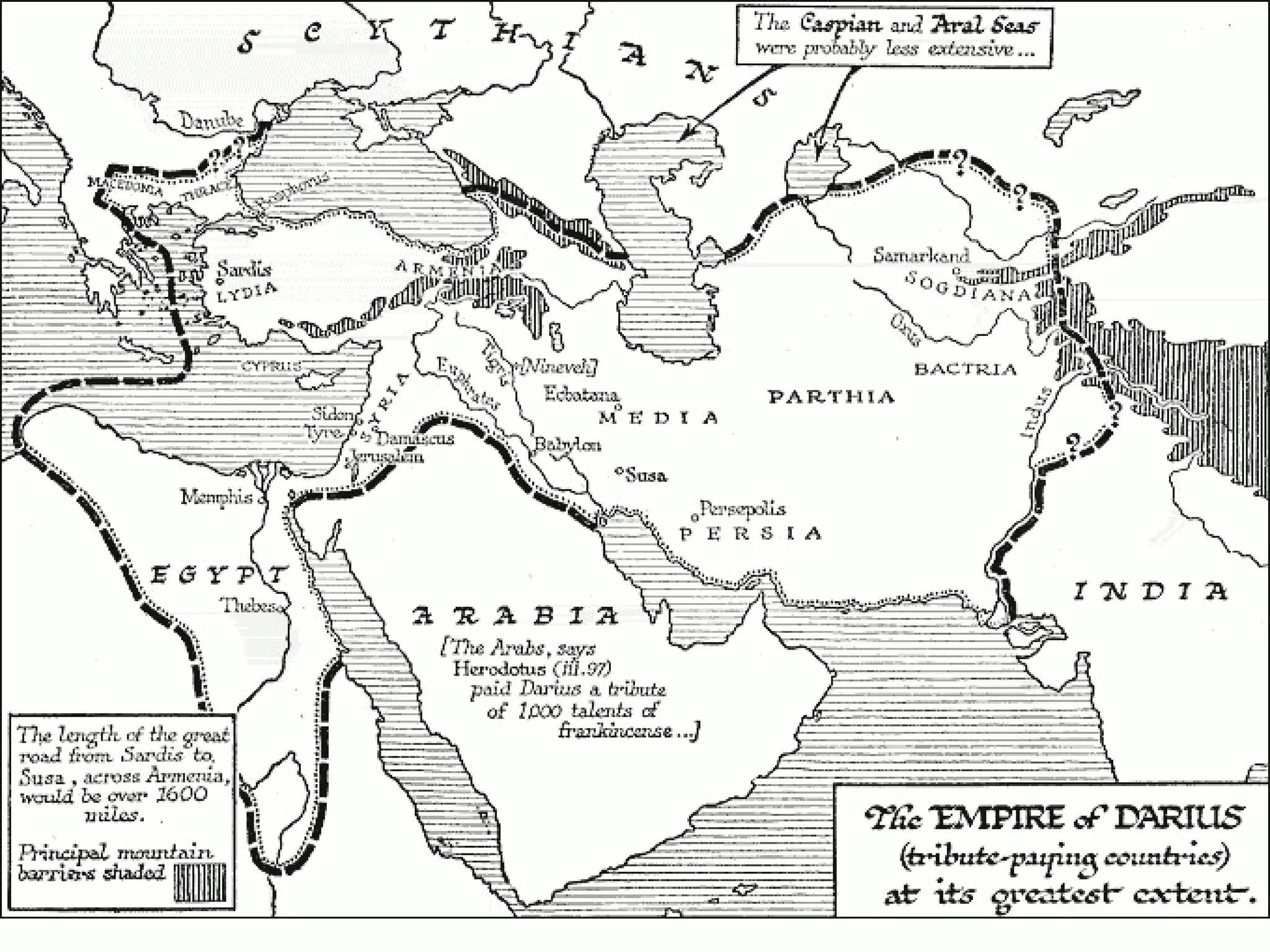
In 539 B.C. Babylon fell to the Persian armies of
Cyrus the Great. In general, Persian kings
pursued a policy of tolerance.
Darius unified the Persian Empire in 522. He
adapted laws from the people he conquered.
He had hundreds of miles of road built or
repaired
He set up a common set of weights and
measures and encouraged the use of coins
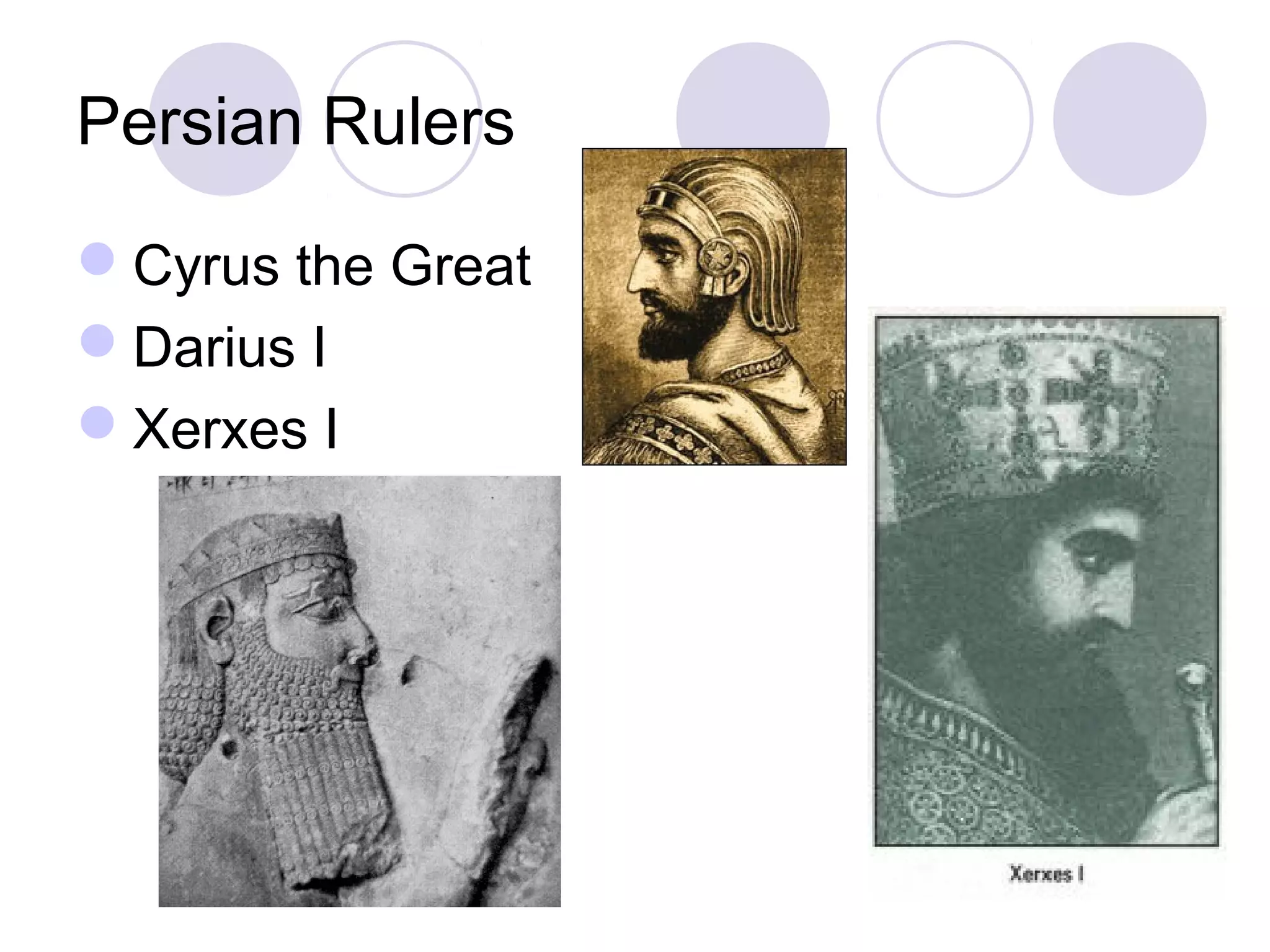
Persian Rulers
Cyrus the Great
Darius I
Xerxes I
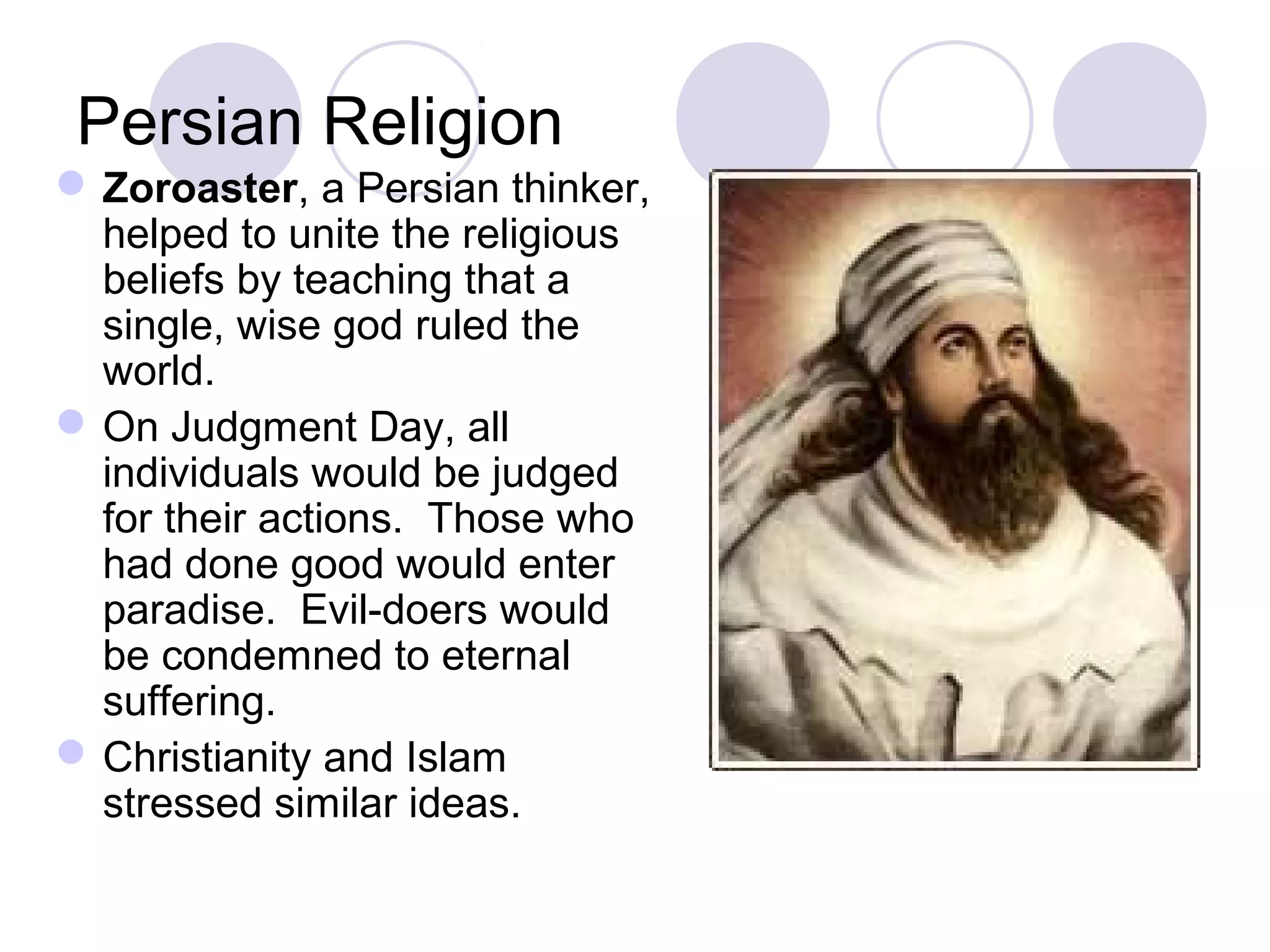
Persian Religion
Zoroaster, a Persian thinker,
helped to unite the religious
beliefs by teaching that a
single, wise god ruled the
world.
On Judgment Day, all
individuals would be judged
for their actions. Those who
had done good would enter
paradise. Evil-doers would
be condemned to eternal
suffering.
Christianity and Islam
stressed similar ideas.
The Defeat of the Persian Empire
Indians, Medes,
Babylonians, Lydians,
Greeks, Jews,
Phoenicians, and
Egyptians were for the
first time all governed by
one empire.
Persia never conquered
Greece.
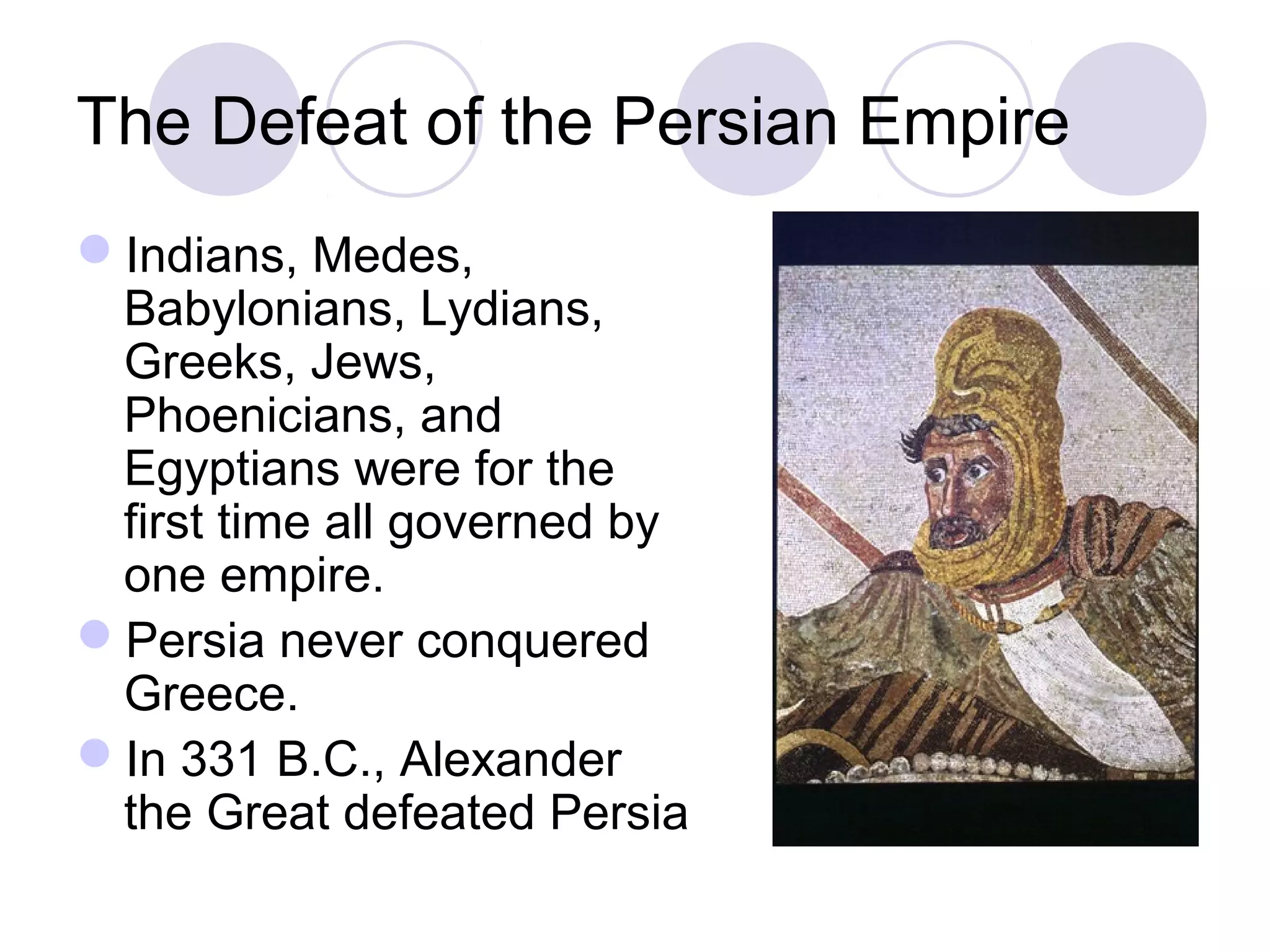
In 331 B.C., Alexander
the Great defeated Persia
More on Alexander the Great later…
The End

Mesopotamia "CRADLE OF CIVILIZATION"

  • 1.
    Around Mesopotamia Sumer, Akkadia,Babylon, and others in the Fertile Crescent 9th Grade Integrated Honors Mr. Coia
  • 2.
    Key Terms Mesopotamia: An ancientregion of southwest Asia between the Tigris and Euphrates rivers in modern- day Iraq. Probably settled before 5000 B.C., the area was the home of numerous early civilizations, including Sumer, Akkad, Babylonia, and Assyria.
  • 3.
    Fertile Crescent:: A region of theMiddle East arching across the northern part of the Syrian Desert and extending from the Nile Valley to the Tigris and Euphrates rivers.
  • 4.
  • 5.
    Sumerian Civilization Located onan arc of land that curves from the Persian Gulf to the eastern Mediterranean coast. The dark, rich soils and golden wheat fields earned it the name Fertile Crescent. The first known civilization in the Fertile Crescent was uncovered in the 1800s in Mesopotamia which means “between the rivers” of Euphrates and Tigris. Control of these rivers was key to developments in Mesopotamia. To survive and protect their farmland, villages along the riverbanks had to work together. Temple priests or royal officials provided the leadership that was necessary to ensure cooperation.
  • 6.
    Social Structure inSumer Around 3200 B.C., the first Sumerian cities emerged in the southern part of Mesopotamia. They used earth and water to make bricks for building. Trade brought riches to Sumerian cities. The Sumerians were the first to make wheeled vehicles. In each Sumerian city-state, the ruler was responsible for maintaining the city walls and irrigations systems. Each Sumerian city-state had a distinct social hierarchy. At the base of society were the majority of people, peasant farms.
  • 8.
    Religion and Afterlife Sumerianspracticed polytheistic and their gods were thought to control every aspect of life. Each city built a ziggurat, a pyramid- temple that soared toward the heavens. At the top was a shrine to the chief god or goddess of the city.
  • 9.
    Religion The Sumerians believedin an afterlife, but thought the underworld was a grim place of no-release. They buried food and tools with their dead. Unlike the Egyptians, they did not imagine the afterlife in detail. They did not believe in rewards and punishments.
  • 10.
    Gods An, lord of heaven Enlil,god of air and storms Enki, god of water and wisdom
  • 11.
    The Evolution ofWriting Sumerians invented the earliest known form of writing called cuneiform using a reed pen to make wedge-shaped marks on clay tablets. Cuneiform is from the Latin word for wedge. Sumerian scribes went through years of difficult schooling to acquire their skills.
  • 12.
    Akkadians Sargon, King ofAkkad, conquered the city-states (2300 B.C.) and built an empire. After his death, other invaders swept into the wide valley tumbling his empire into ruin Akkad were Semitic people, like the Hebrews
  • 14.
    The Babylonians A Semiticpeople who spoke Akkadian, conquered Mesopotamia in about 2000 B.C. Its capital, Babylon, was on the Euphrates River About 1790, the king of Babylon, Hammurabi, brought the empire (much of Mesopotamia) under his control and established the first written laws, criminal and civil.
  • 15.
    The Babylonians Invented theidea of a circle containing 360 degrees and the hour containing sixty minutes
  • 16.
    Hammurabi’s Code Hammurabi wasnot the author of the code. Most of the laws had been around since Sumerian Times, but Hammurabi wanted everyone in his empire to know the legal principles his government would follow. He had artisans carve nearly 300 laws on a stone pillar for all to see. This was the first time a ruler attempted to solidify all of the laws that would govern a state.
  • 17.
    Hammurabi’s Code Criminal lawsdealt with offenses against others. Hammurabi’s Code limited personal vengeance and encouraged social order. Civil Law dealt with private rights and matters, such as business contracts, marriage, taxes, and divorce. Much of Hummurabi’s Code was designed to protect the powerless.
  • 18.
    Law #196: “Ifa man put out the eye of another man, his eye shall be put out.” Does this sound familiar?
  • 19.
    Hittites The Babylonian empire fellto Hittite invaders Hitties were war- like people Invaded sometime in the 1600 B.C. Learned to extract iron ore and had a monopoly on the resource
  • 20.
    The Assyrians Warlike peoplefrom northern Mesopotamia, the Assyrians began to consolidate a great empire For 500 years, they earned a reputation for being among the most feared warriors in history After Assurbanipal’s death, people joined forces to destroy the Assyrian armies.
  • 21.
    The Assyrians They werefierce, effective warriors Used chariots, and were the first to use calvary, soldiers on horseback. In 700 B.C. the Assyrians captured Babylon, looted it, and destroyed it
  • 22.
    The Assyrians At Nineveh,King Assurbanipal founded one of the first libraries. He ordered his scribes to collect cuneiform tablets from all over the Fertile Crescent. The library at Nineveh contained the Epic of Gilgamesh, one of the oldest works of literature. (we’ll read this in class) Assyria fell in 612 B.C. due to a civil war and foreign invaders.
  • 23.
    Babylon Revived Nebuchadnezzar revivedthe power of Babylon, rebuilt the canals, temples, walls and palaces of Babylon. Also called the Chaldeans Nebuchadnezzar built the Hanging Gardens of Babylon for his homesick wife In 587 B.C., he destroyed Jerusalem, sending the tribes of Judah into exile. Mentioned in the Book of Daniel
  • 24.
    The Persian Empire In539 B.C. Babylon fell to the Persian armies of Cyrus the Great. In general, Persian kings pursued a policy of tolerance. Darius unified the Persian Empire in 522. He adapted laws from the people he conquered. He had hundreds of miles of road built or repaired He set up a common set of weights and measures and encouraged the use of coins
  • 25.
    Persian Rulers Cyrus theGreat Darius I Xerxes I
  • 27.
    Persian Religion Zoroaster, aPersian thinker, helped to unite the religious beliefs by teaching that a single, wise god ruled the world. On Judgment Day, all individuals would be judged for their actions. Those who had done good would enter paradise. Evil-doers would be condemned to eternal suffering. Christianity and Islam stressed similar ideas.
  • 28.
    The Defeat ofthe Persian Empire Indians, Medes, Babylonians, Lydians, Greeks, Jews, Phoenicians, and Egyptians were for the first time all governed by one empire. Persia never conquered Greece. In 331 B.C., Alexander the Great defeated Persia
  • 29.
    More on Alexanderthe Great later… The End