Babylonia Civilization
P.SindhuP.SINDHU
Growth of the Civilization
• Sumerian civilization declined – invasion of
Arabic nomads called Akkadians.
• Leader – Sargon I, a great warrior – extended
empire – Persian Gulf to the Mediterranean
sea.
• Akkadian adopted – Sumerian Civilization.
• About 2200 BC – Sumerian-Akkadian empire
declined.
• Elamites - Semitic tribe occupied southern
parts, whereas Amorites – tribe from Syria
occupied north.
• Amorites first settled in – Babylon.
• Leader – Hammurabi, empire which was
founded by Hammurabi – Babylonian.
• This civilization developed – village of
Babylon, i.e Babylonian civilization.
Hammurabi
• Came to prominence –
2100 BC.
• Economically –
prosperous.
• No scarcity of food.
• Weaving of woollen
cloths – important
industry.
• During his rule - happy
& prosperous.
Code of Hammurabi
• Greatest achievement – Hammurabi Code of
Laws – first law giver of mankind.
• Engraved the laws – piece of stone of 8 feet
high – written in Akkadian & Amorites.
• Top of the stone – Hammurabi received the
laws from the Sun god.
• First discovered – Susa in 1902.
• Law applicable to all from the nobles to the
slaves.
• 285 clauses – divided into four groups – civil
code, penal code, commercial code & code of
procedure.
• Aimed at securing justice to all – especially,
poor, widows, orphans & labourers.
• Prices of different commodities & wages for
different works were fixed.
Punishments
• Punishments – various offences like murder,
theft, negligence of duty, cheating, etc.
• Old conception of “an eye for an eye & a tooth
for a tooth”.
• If the son beat his father – his hands amputed.
• Similarly, doctor’s hands amputed –
negligence of work.
• People refined – due to these severe
punishments.
• He regulate the society – code of laws.
• Establish a rule of law – instead of personal
rule.
• All were equal before the law.
Administration
• Able administrator.
• 55 clay-tablets containing – orders to some of his
officers.
• In one tablet – he ordered to collect taxes from
poor cultivators.
• Another tablet – to clear the Euphrates river after
the flood.
• Ordered the officer to attend the Sheep-shearing
festival.
• Punished – bribery.
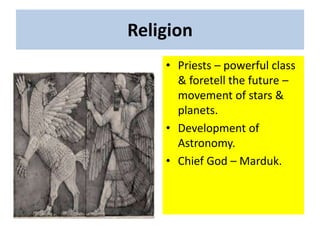
Religion
• Priests – powerful class
& foretell the future –
movement of stars &
planets.
• Development of
Astronomy.
• Chief God – Marduk.
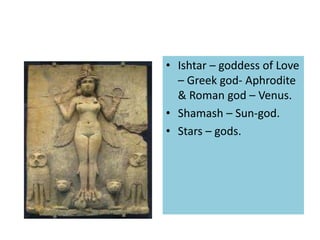
• Ishtar – goddess of Love
– Greek god- Aphrodite
& Roman god – Venus.
• Shamash – Sun-god.
• Stars – gods.
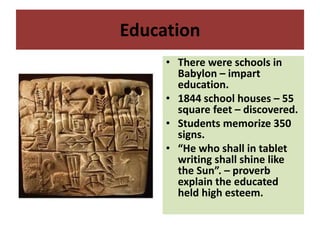
Education
• There were schools in
Babylon – impart
education.
• 1844 school houses – 55
square feet – discovered.
• Students memorize 350
signs.
• “He who shall in tablet
writing shall shine like
the Sun”. – proverb
explain the educated
held high esteem.
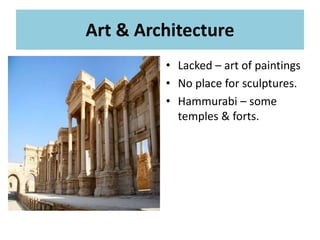
Art & Architecture
• Lacked – art of paintings
• No place for sculptures.
• Hammurabi – some
temples & forts.
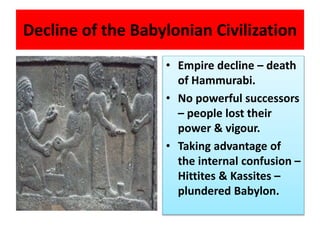
Decline of the Babylonian Civilization
• Empire decline – death
of Hammurabi.
• No powerful successors
– people lost their
power & vigour.
• Taking advantage of
the internal confusion –
Hittites & Kassites –
plundered Babylon.

Babylonia civilization

  • 1.
  • 2.
    Growth of theCivilization • Sumerian civilization declined – invasion of Arabic nomads called Akkadians. • Leader – Sargon I, a great warrior – extended empire – Persian Gulf to the Mediterranean sea. • Akkadian adopted – Sumerian Civilization. • About 2200 BC – Sumerian-Akkadian empire declined.
  • 3.
    • Elamites -Semitic tribe occupied southern parts, whereas Amorites – tribe from Syria occupied north. • Amorites first settled in – Babylon. • Leader – Hammurabi, empire which was founded by Hammurabi – Babylonian. • This civilization developed – village of Babylon, i.e Babylonian civilization.
  • 4.
    Hammurabi • Came toprominence – 2100 BC. • Economically – prosperous. • No scarcity of food. • Weaving of woollen cloths – important industry. • During his rule - happy & prosperous.
  • 5.
    Code of Hammurabi •Greatest achievement – Hammurabi Code of Laws – first law giver of mankind. • Engraved the laws – piece of stone of 8 feet high – written in Akkadian & Amorites. • Top of the stone – Hammurabi received the laws from the Sun god. • First discovered – Susa in 1902.
  • 6.
    • Law applicableto all from the nobles to the slaves. • 285 clauses – divided into four groups – civil code, penal code, commercial code & code of procedure. • Aimed at securing justice to all – especially, poor, widows, orphans & labourers. • Prices of different commodities & wages for different works were fixed.
  • 7.
    Punishments • Punishments –various offences like murder, theft, negligence of duty, cheating, etc. • Old conception of “an eye for an eye & a tooth for a tooth”. • If the son beat his father – his hands amputed. • Similarly, doctor’s hands amputed – negligence of work. • People refined – due to these severe punishments.
  • 8.
    • He regulatethe society – code of laws. • Establish a rule of law – instead of personal rule. • All were equal before the law.
  • 9.
    Administration • Able administrator. •55 clay-tablets containing – orders to some of his officers. • In one tablet – he ordered to collect taxes from poor cultivators. • Another tablet – to clear the Euphrates river after the flood. • Ordered the officer to attend the Sheep-shearing festival. • Punished – bribery.
  • 10.
    Religion • Priests –powerful class & foretell the future – movement of stars & planets. • Development of Astronomy. • Chief God – Marduk.
  • 11.
    • Ishtar –goddess of Love – Greek god- Aphrodite & Roman god – Venus. • Shamash – Sun-god. • Stars – gods.
  • 12.
    Education • There wereschools in Babylon – impart education. • 1844 school houses – 55 square feet – discovered. • Students memorize 350 signs. • “He who shall in tablet writing shall shine like the Sun”. – proverb explain the educated held high esteem.
  • 13.
    Art & Architecture •Lacked – art of paintings • No place for sculptures. • Hammurabi – some temples & forts.
  • 14.
    Decline of theBabylonian Civilization • Empire decline – death of Hammurabi. • No powerful successors – people lost their power & vigour. • Taking advantage of the internal confusion – Hittites & Kassites – plundered Babylon.