IP Addressing & Subnetting
IP Addressing
Subnetting
CIDR
VLSM
IP Addresses
• An IP address is an address used to uniquely identify a device on an
IP network.
• The address is made up of 32 binary bits which can be divisible into
a network portion and host portion with the help of a subnet mask.
• 32 binary bits are broken into four octets (1 octet = 8 bits)
• Dotted decimal format (for example, 172.16.81.100)
IP Address Classes
• Class A: The first octet is the network portion. Octets 2, 3, and 4 are
for subnets/hosts
• Class B: The first two octets are the network portion. Octets 3 and 4
are for subnets/hosts
• Class C: The first three octets are the network portion. Octet 4 is for
subnets/hosts
Network Masks
• Distinguishes which portion of the address identifies the network
and which portion of the address identifies the node.
• Default masks:
Class A: 255.0.0.0
Class B: 255.255.0.0
Class C: 255.255.255.0
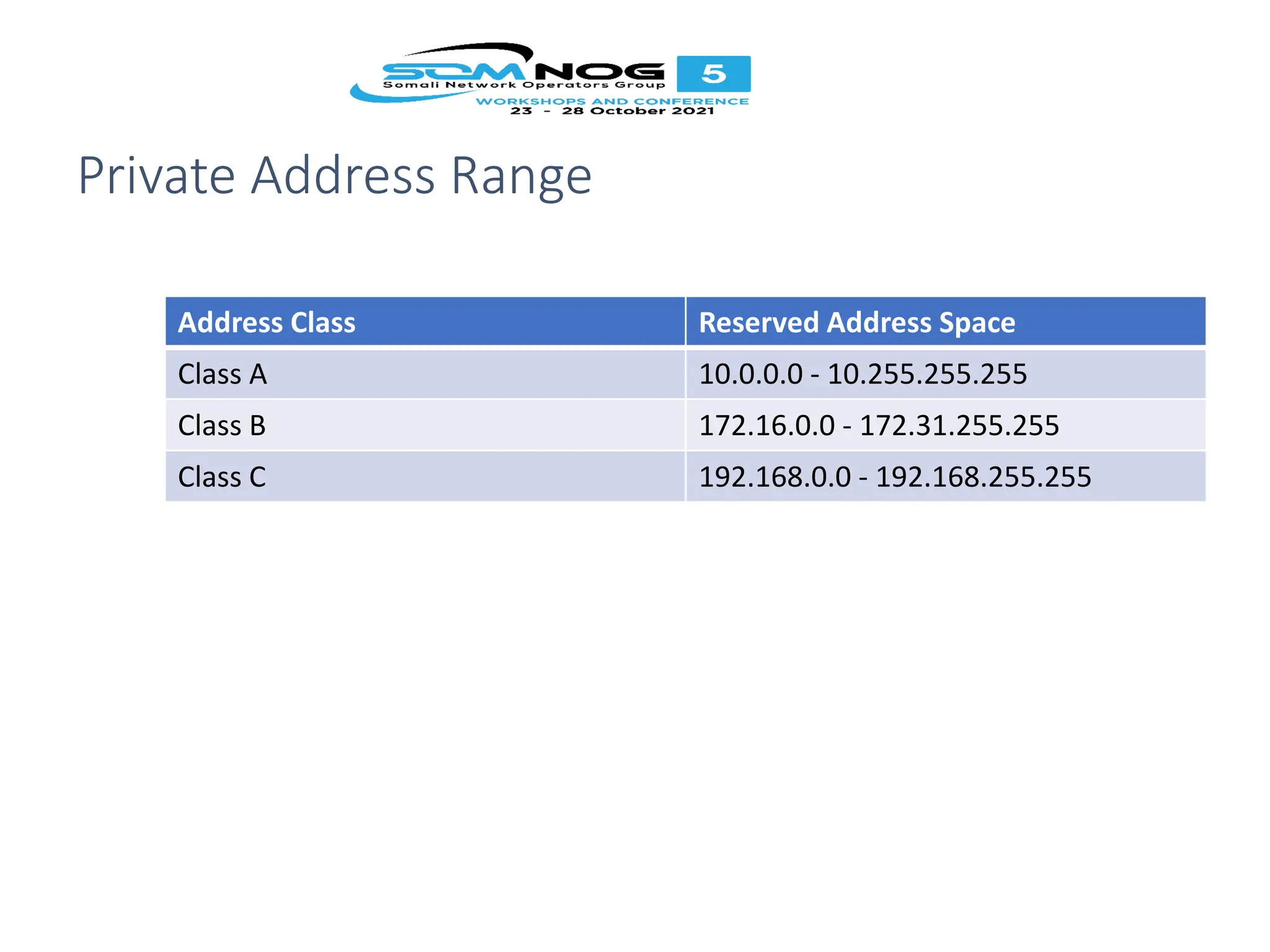
Private Address Range
Address Class Reserved Address Space
Class A 10.0.0.0 - 10.255.255.255
Class B 172.16.0.0 - 172.31.255.255
Class C 192.168.0.0 - 192.168.255.255
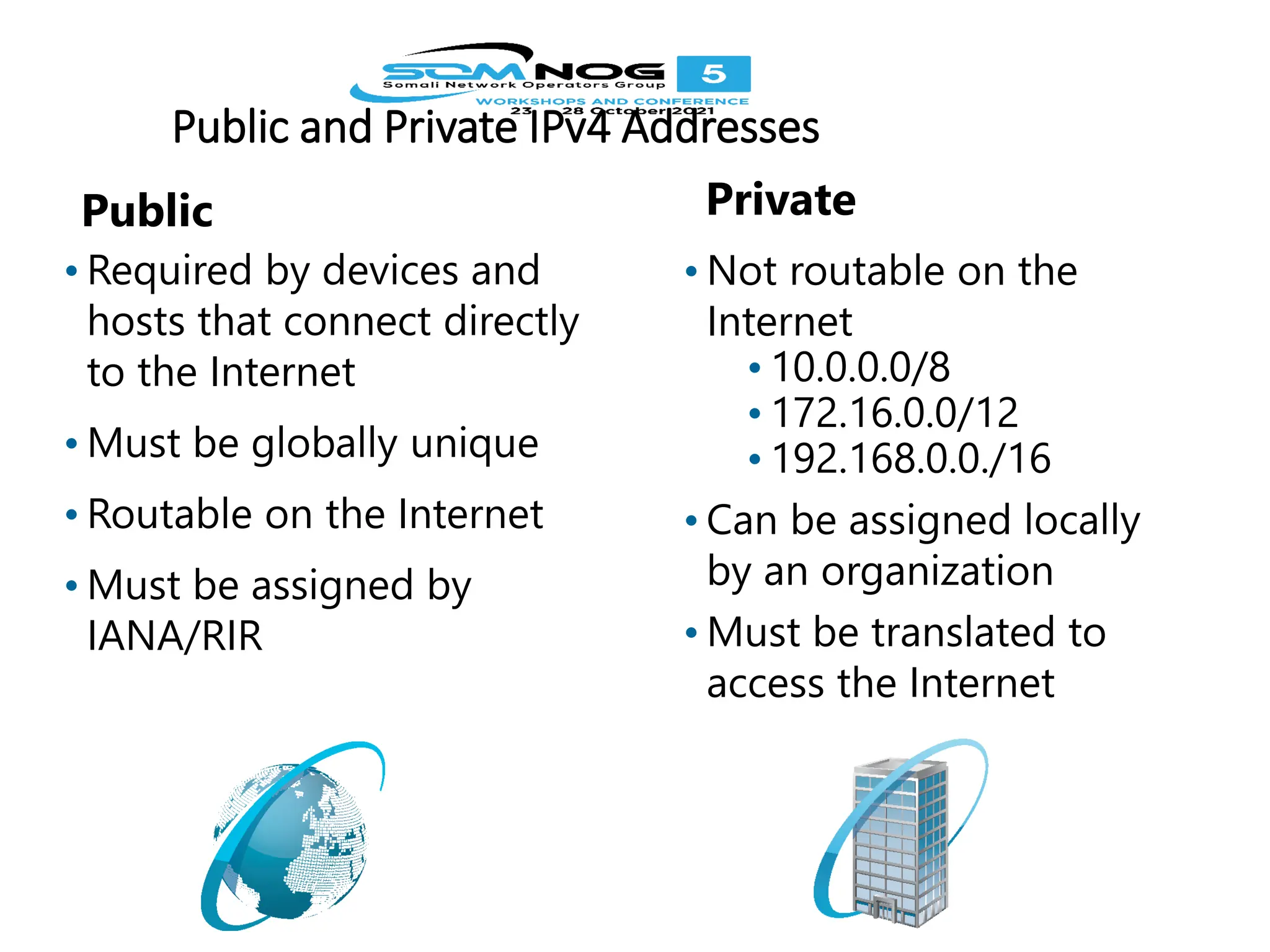
Public and Private IPv4 Addresses
Private
• Not routable on the
Internet
• 10.0.0.0/8
• 172.16.0.0/12
• 192.168.0.0./16
• Can be assigned locally
by an organization
• Must be translated to
access the Internet
Public
• Required by devices and
hosts that connect directly
to the Internet
• Must be globally unique
• Routable on the Internet
• Must be assigned by
IANA/RIR
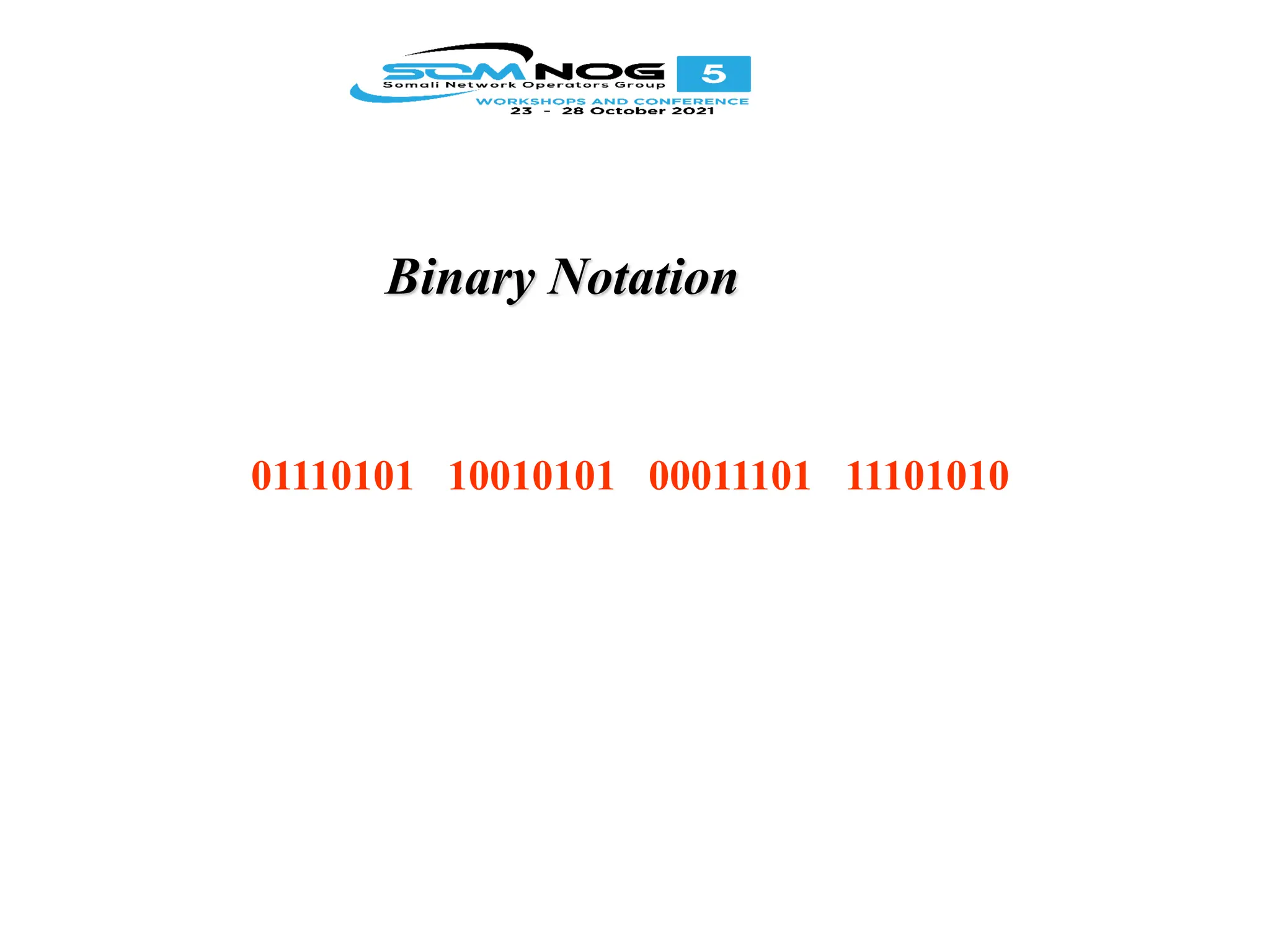
01110101 10010101 00011101 11101010
Binary Notation
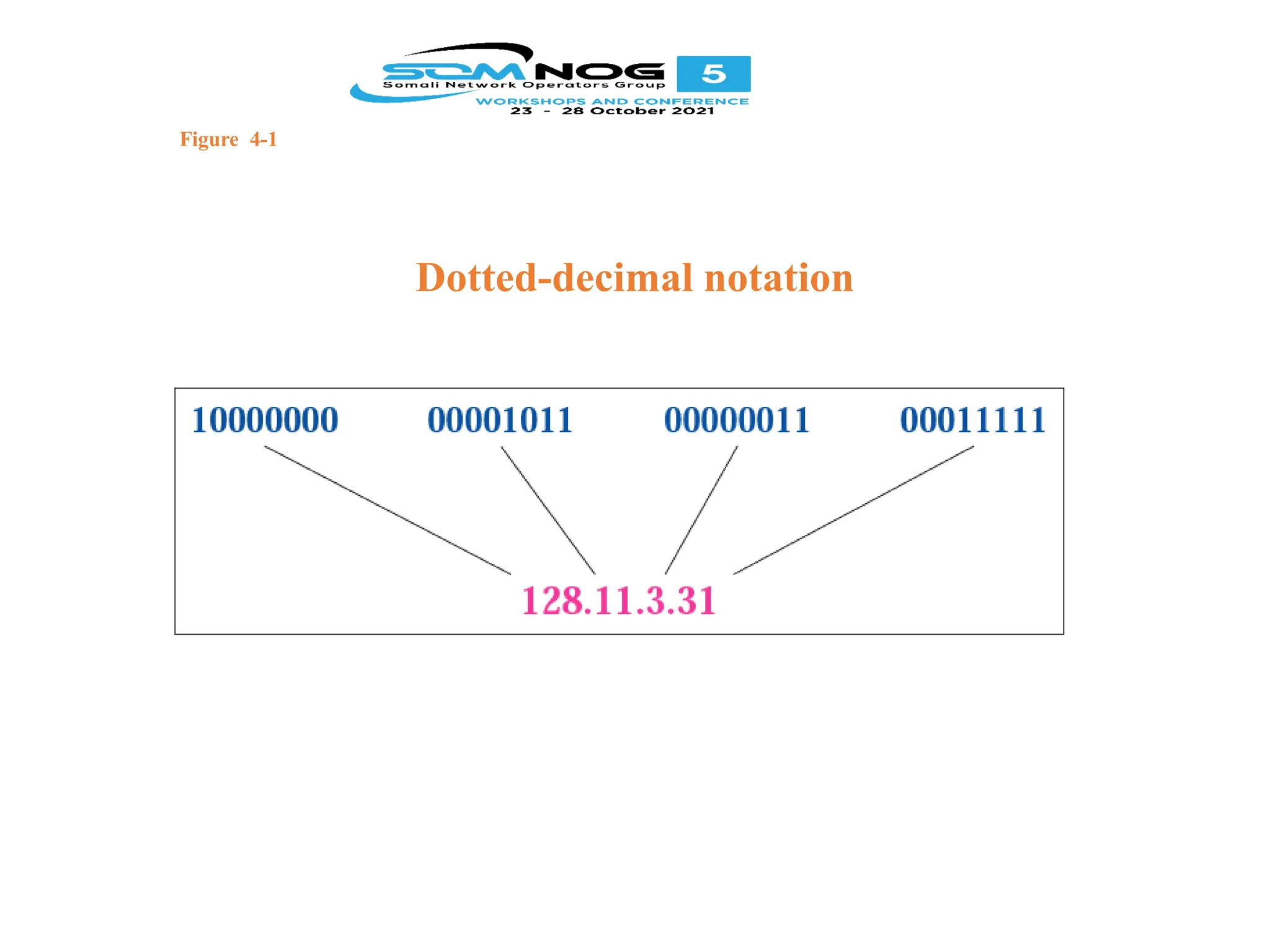
Figure 4-1
Dotted-decimal notation
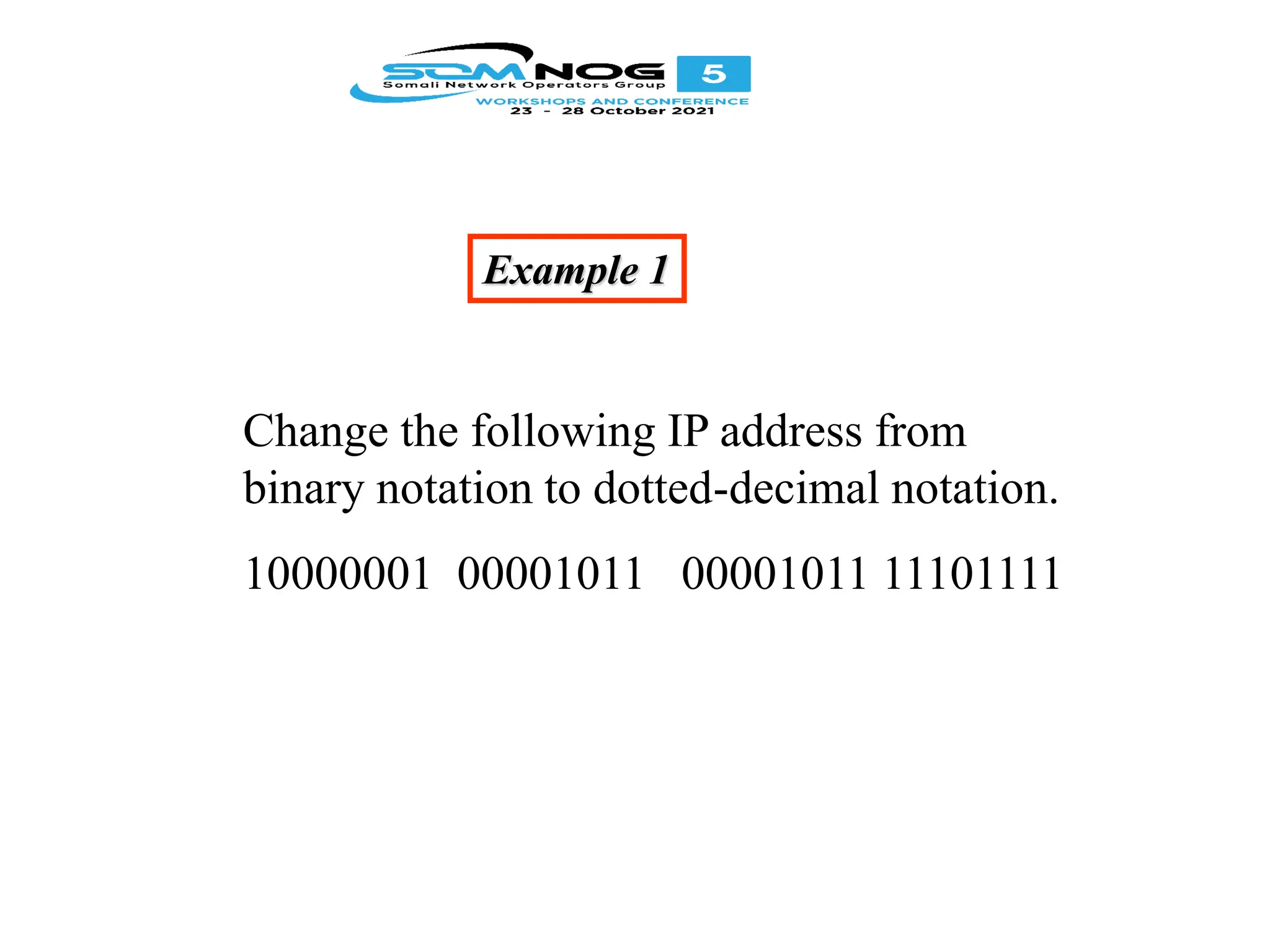
Example 1
Change the following IP address from
binary notation to dotted-decimal notation.
10000001 00001011 00001011 11101111
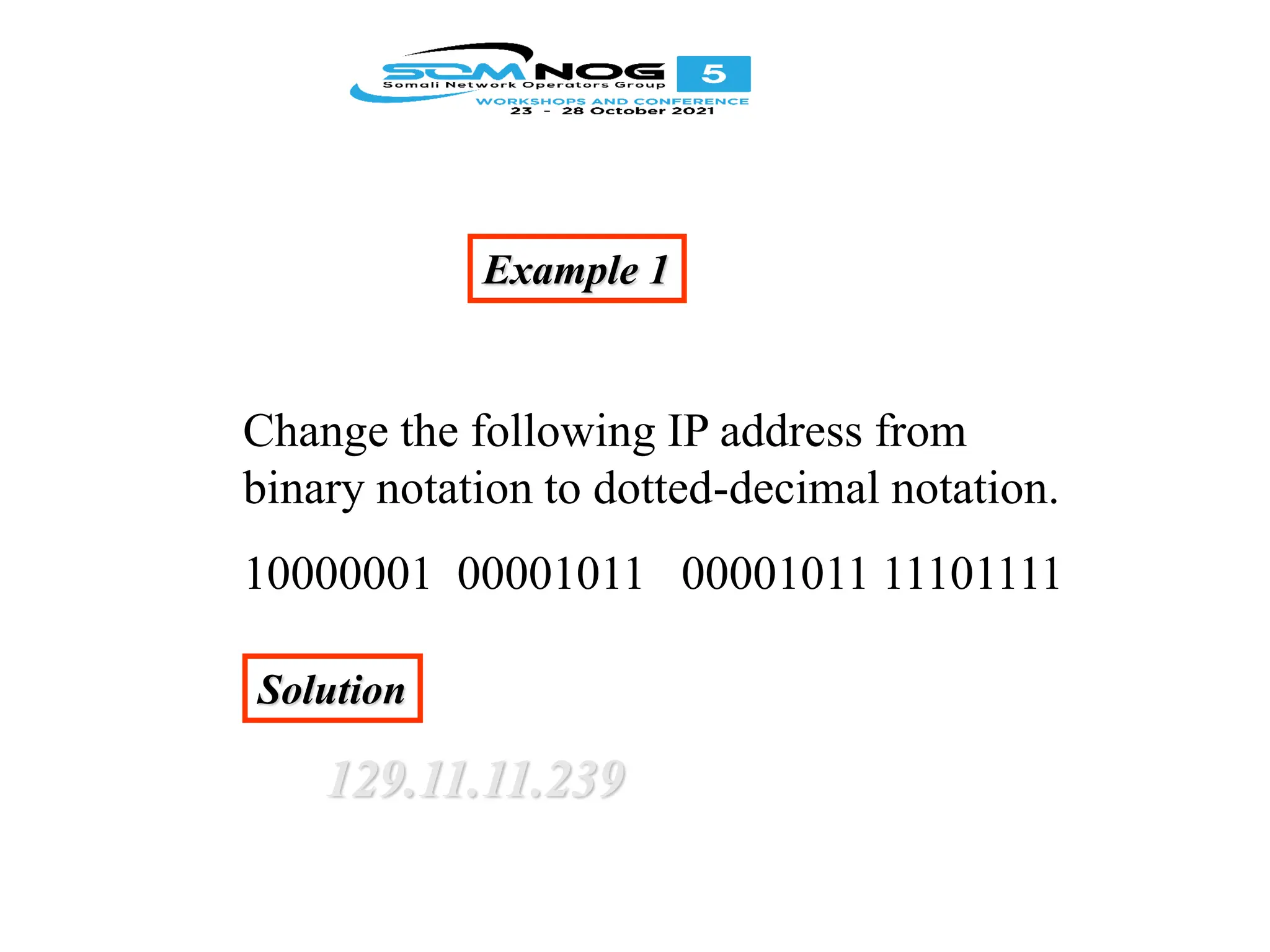
Example 1
Change the following IP address from
binary notation to dotted-decimal notation.
10000001 00001011 00001011 11101111
Solution
129.11.11.239
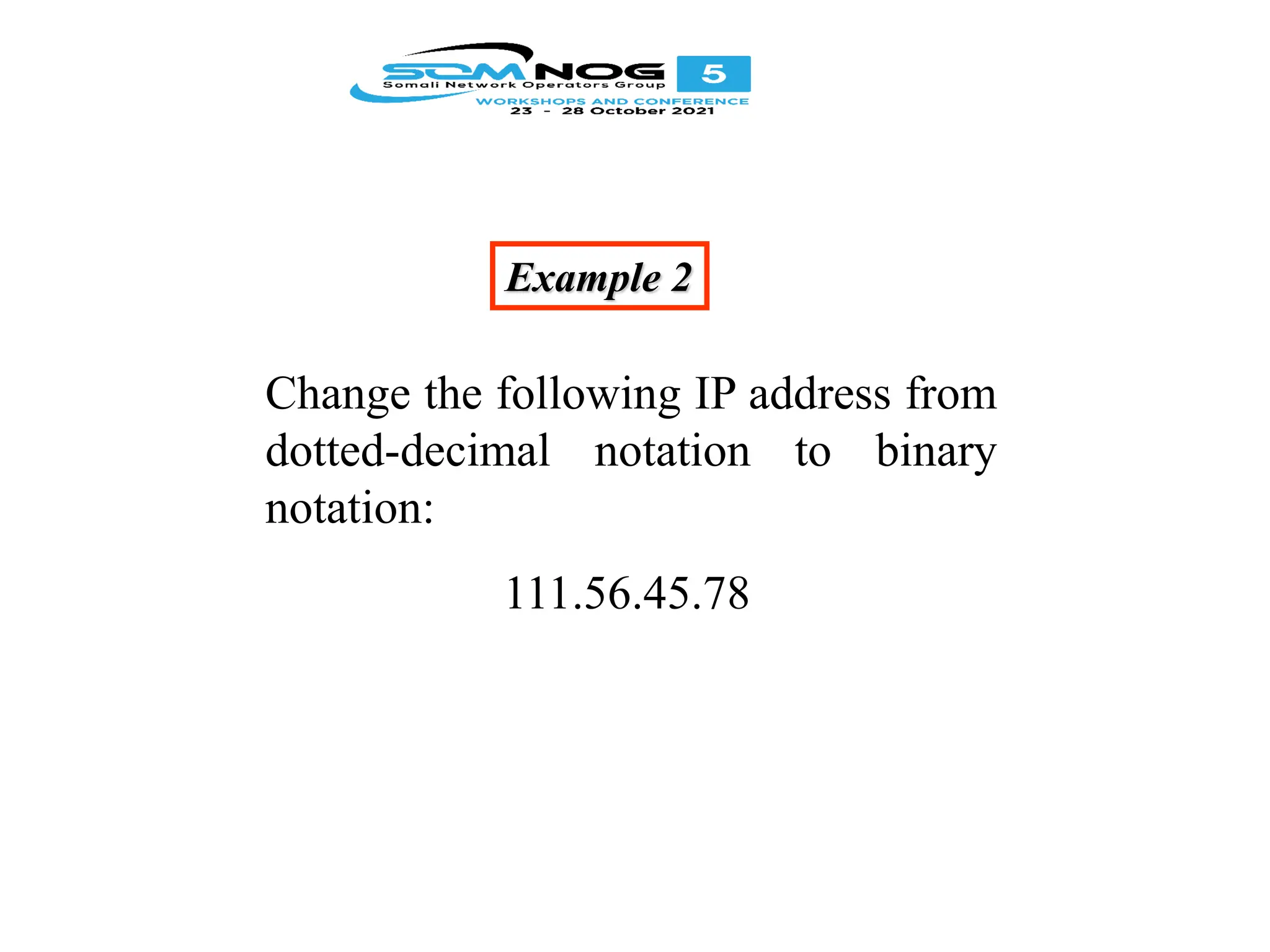
Example 2
Change the following IP address from
dotted-decimal notation to binary
notation:
111.56.45.78
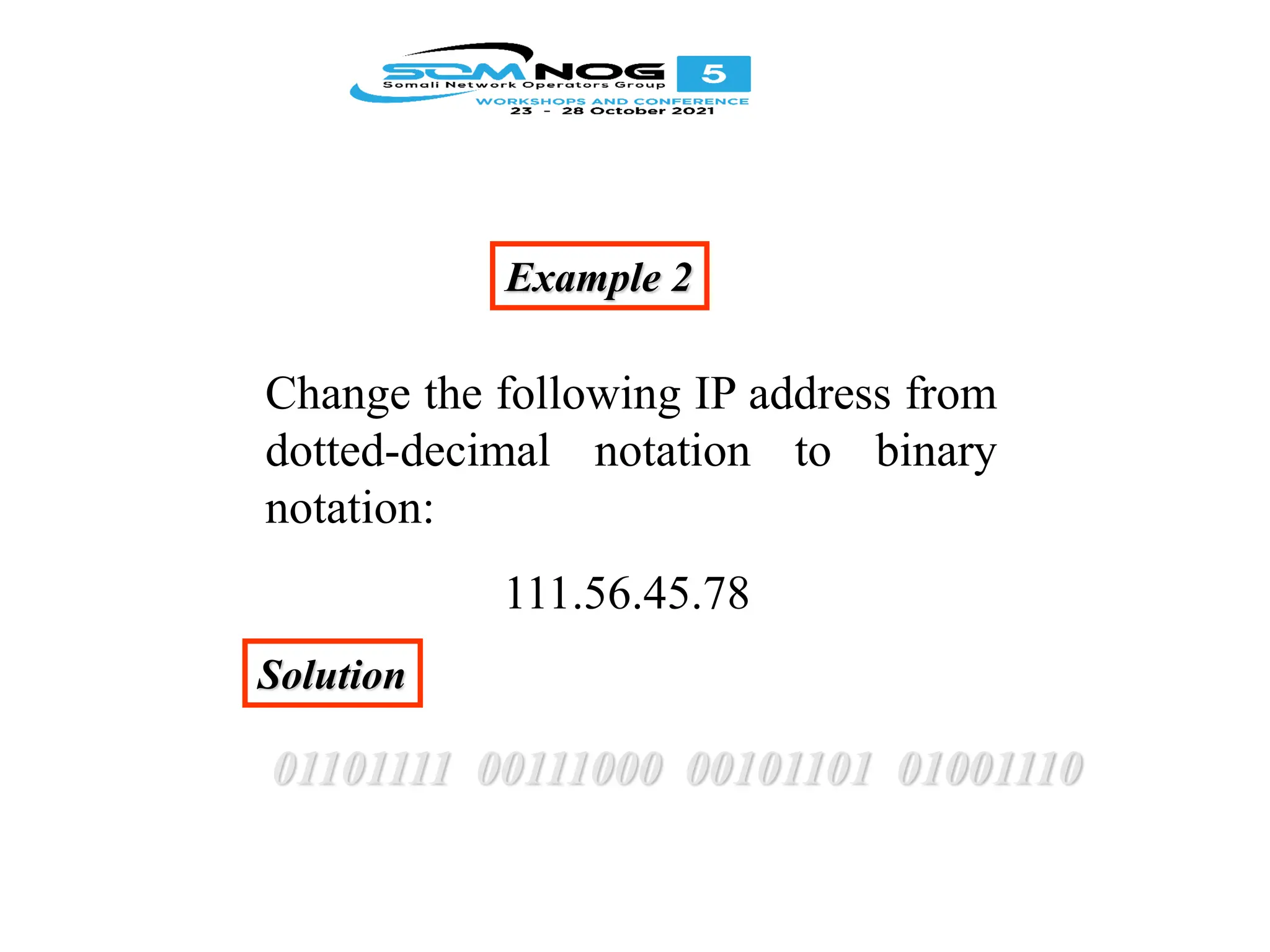
Example 2
Change the following IP address from
dotted-decimal notation to binary
notation:
111.56.45.78
Solution
01101111 00111000 00101101 01001110
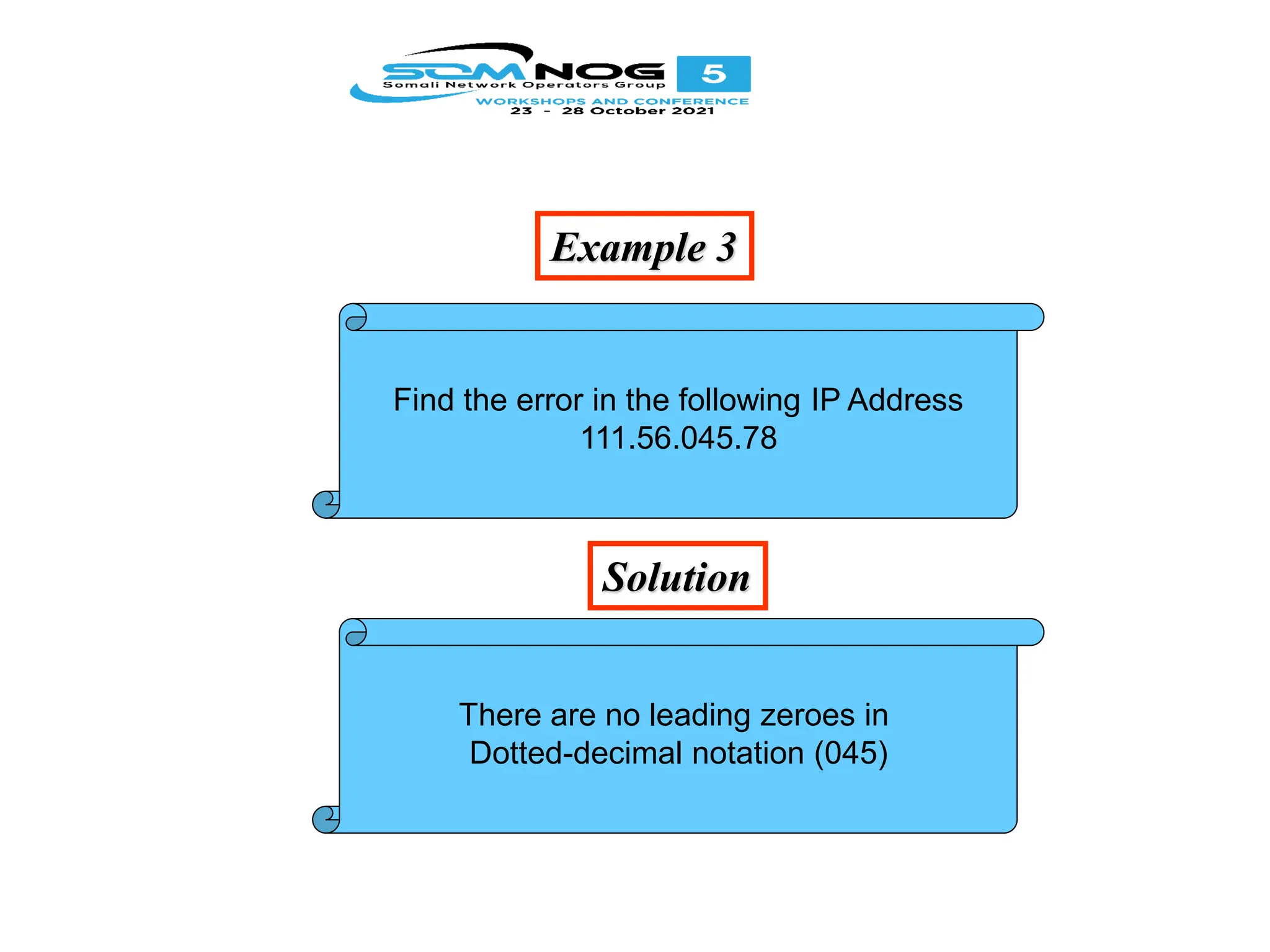
Example 3
Solution
Find the error in the following IP Address
111.56.045.78
There are no leading zeroes in
Dotted-decimal notation (045)
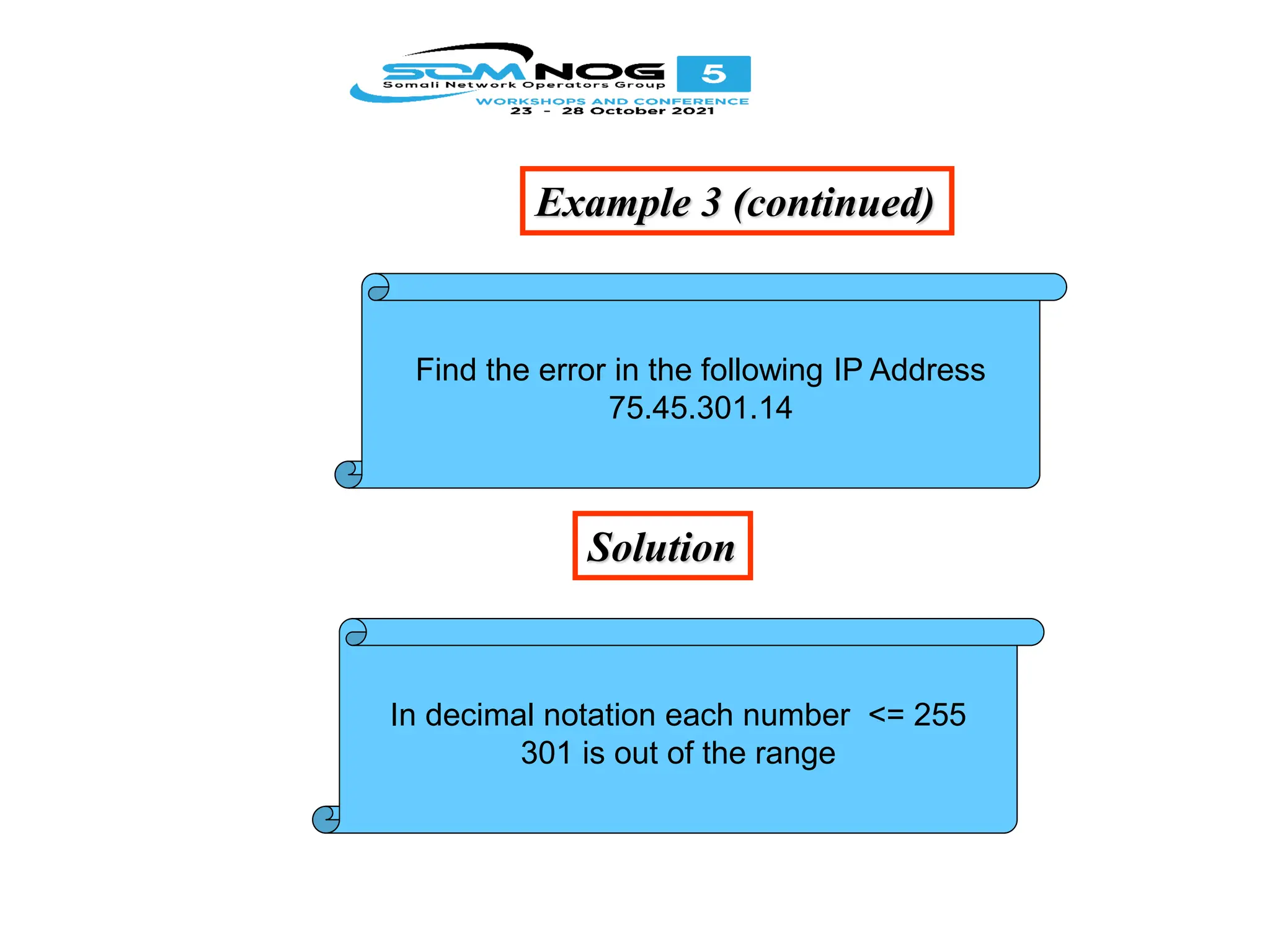
Example 3 (continued)
Solution
Find the error in the following IP Address
75.45.301.14
In decimal notation each number <= 255
301 is out of the range
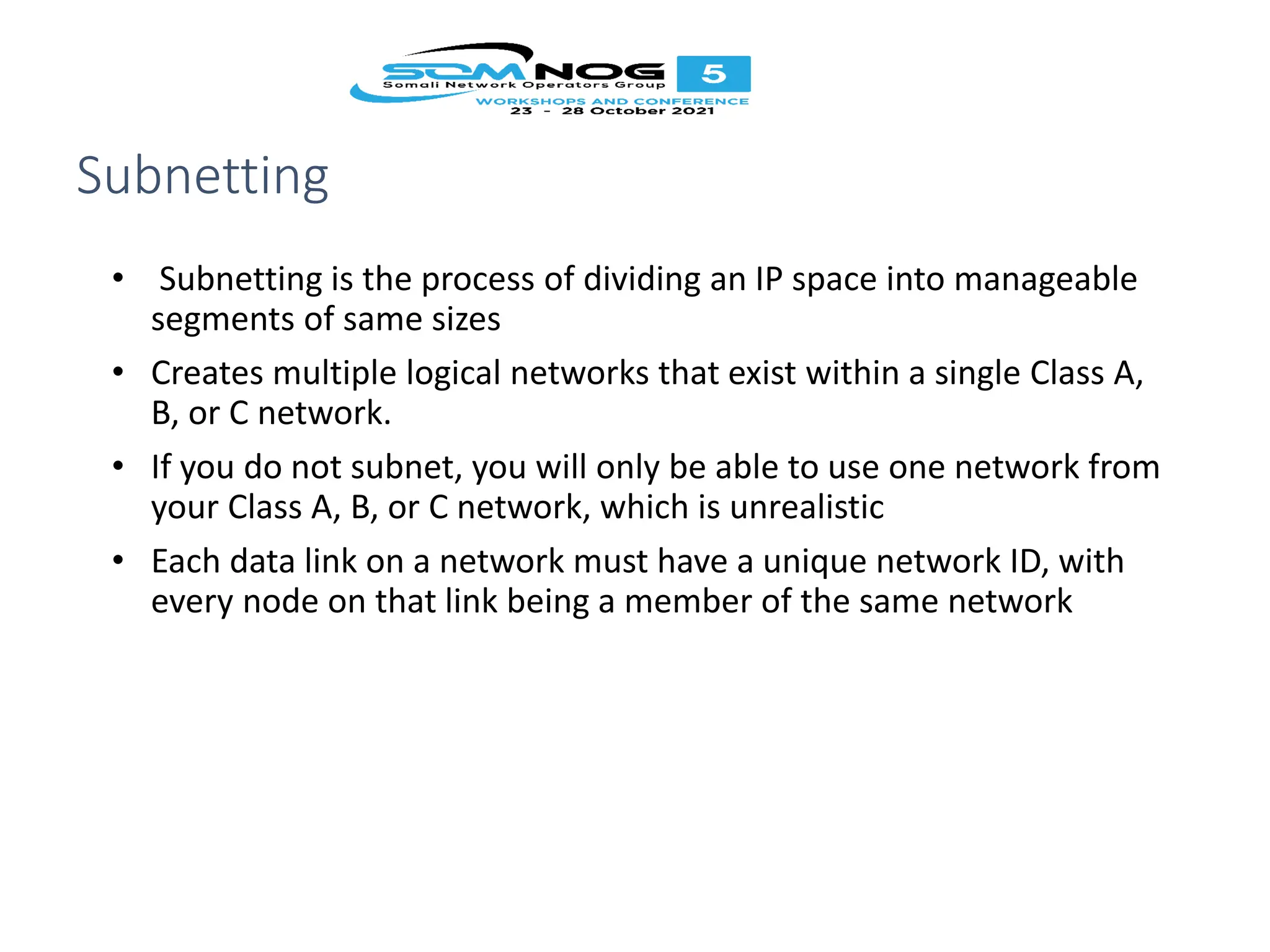
Subnetting
• Subnetting is the process of dividing an IP space into manageable
segments of same sizes
• Creates multiple logical networks that exist within a single Class A,
B, or C network.
• If you do not subnet, you will only be able to use one network from
your Class A, B, or C network, which is unrealistic
• Each data link on a network must have a unique network ID, with
every node on that link being a member of the same network
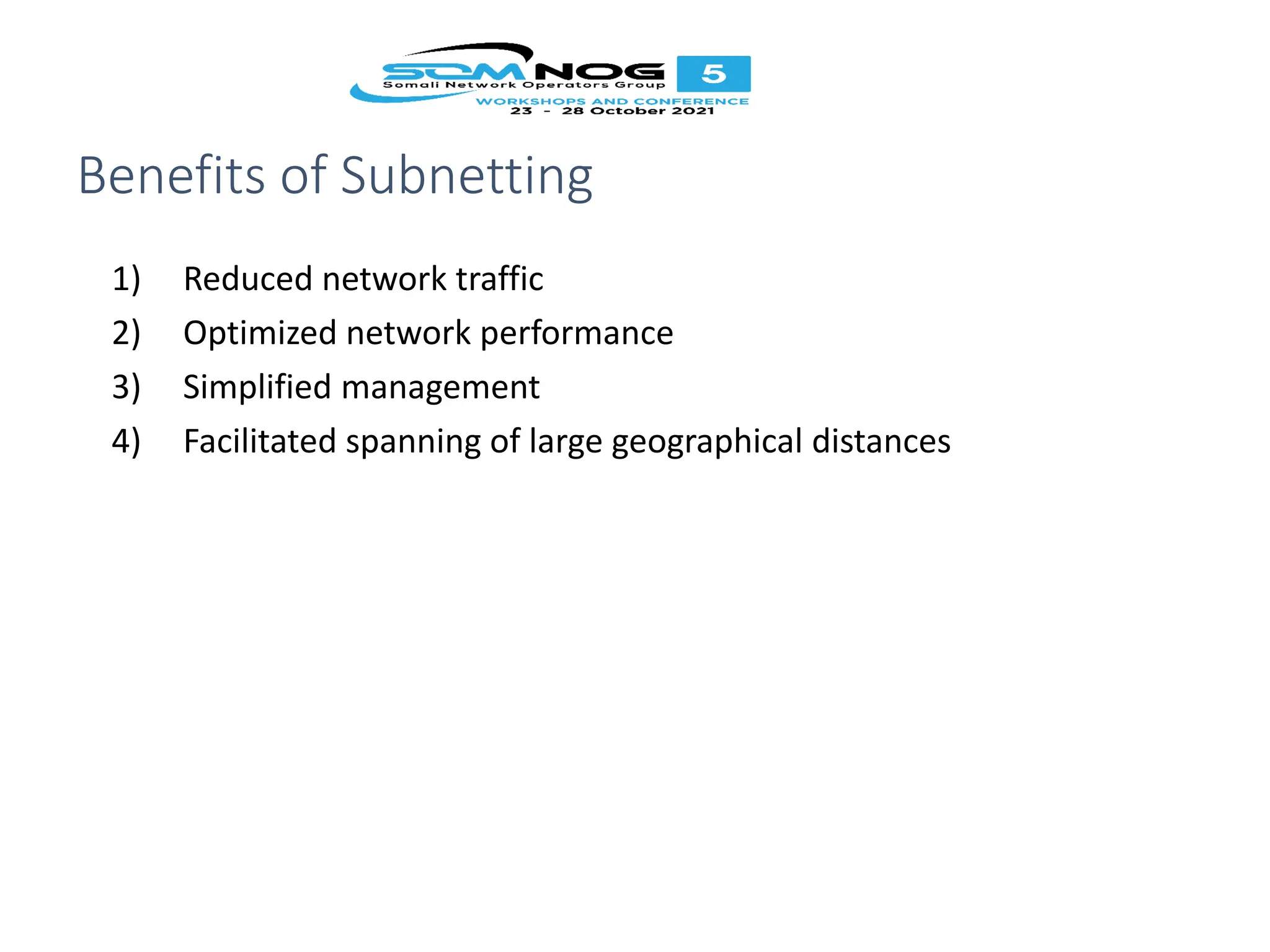
Benefits of Subnetting
1) Reduced network traffic
2) Optimized network performance
3) Simplified management
4) Facilitated spanning of large geographical distances
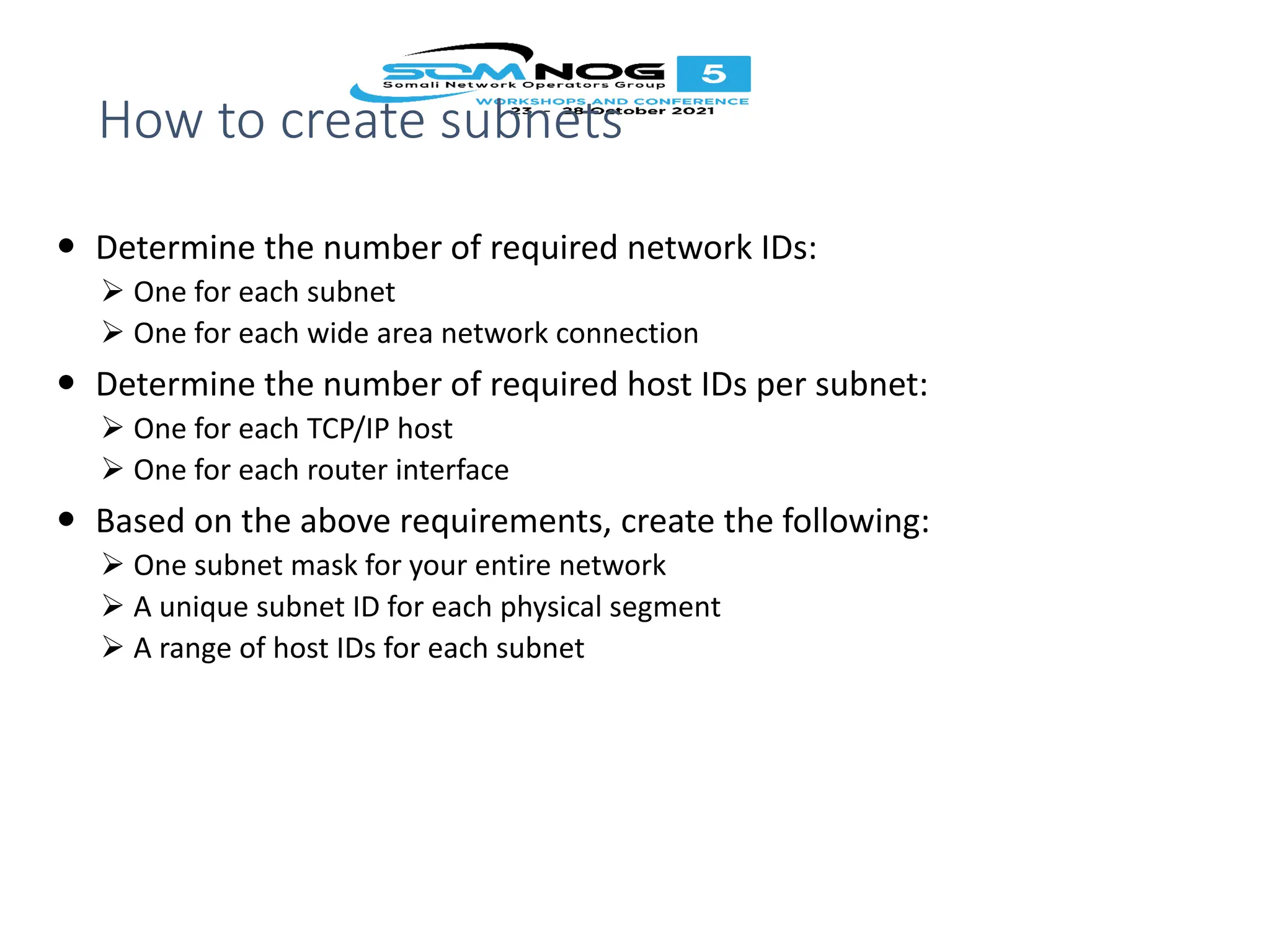
How to create subnets
 Determine the number of required network IDs:
 One for each subnet
 One for each wide area network connection
 Determine the number of required host IDs per subnet:
 One for each TCP/IP host
 One for each router interface
 Based on the above requirements, create the following:
 One subnet mask for your entire network
 A unique subnet ID for each physical segment
 A range of host IDs for each subnet
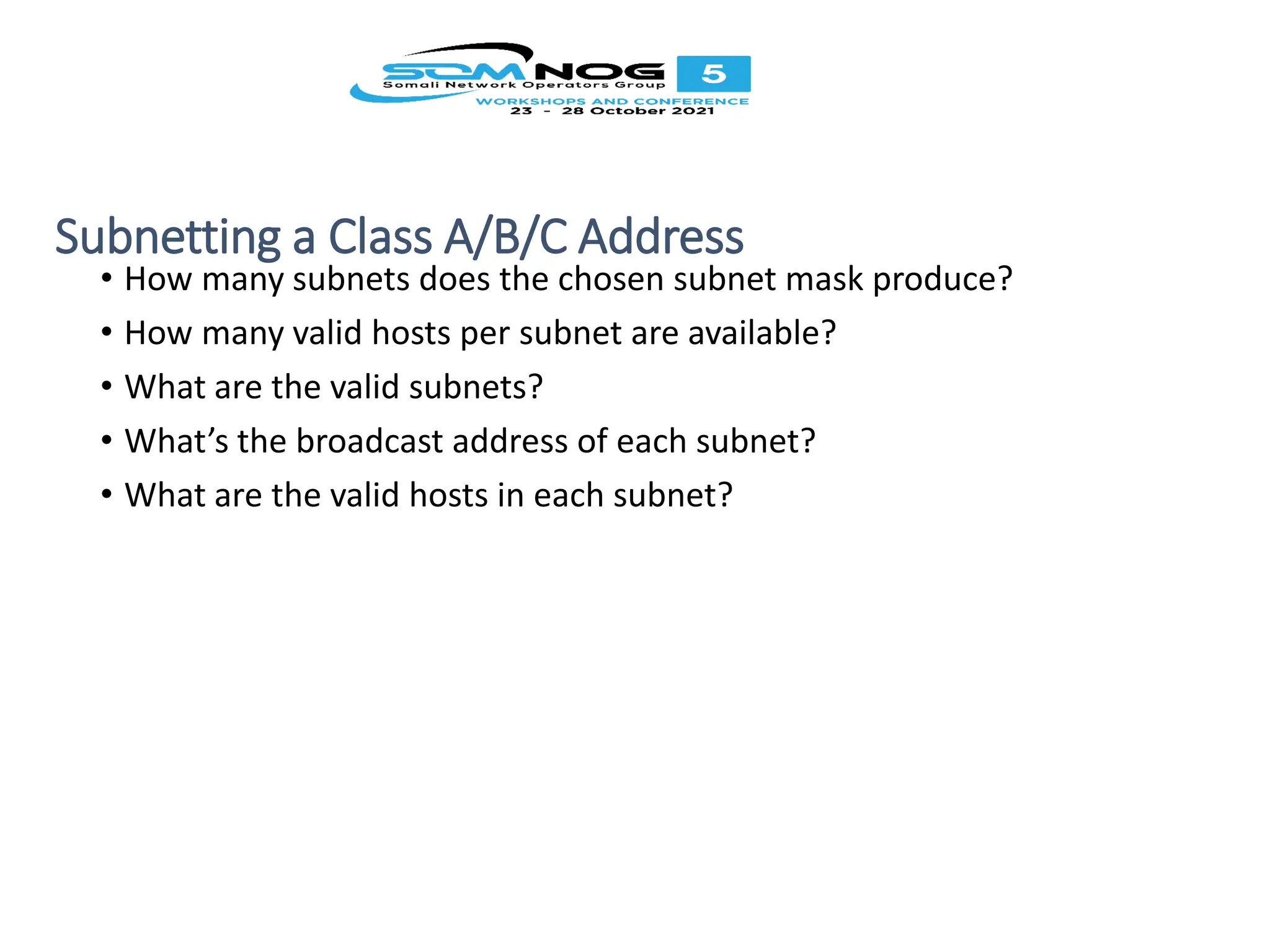
Subnetting a Class A/B/C Address
• How many subnets does the chosen subnet mask produce?
• How many valid hosts per subnet are available?
• What are the valid subnets?
• What’s the broadcast address of each subnet?
• What are the valid hosts in each subnet?
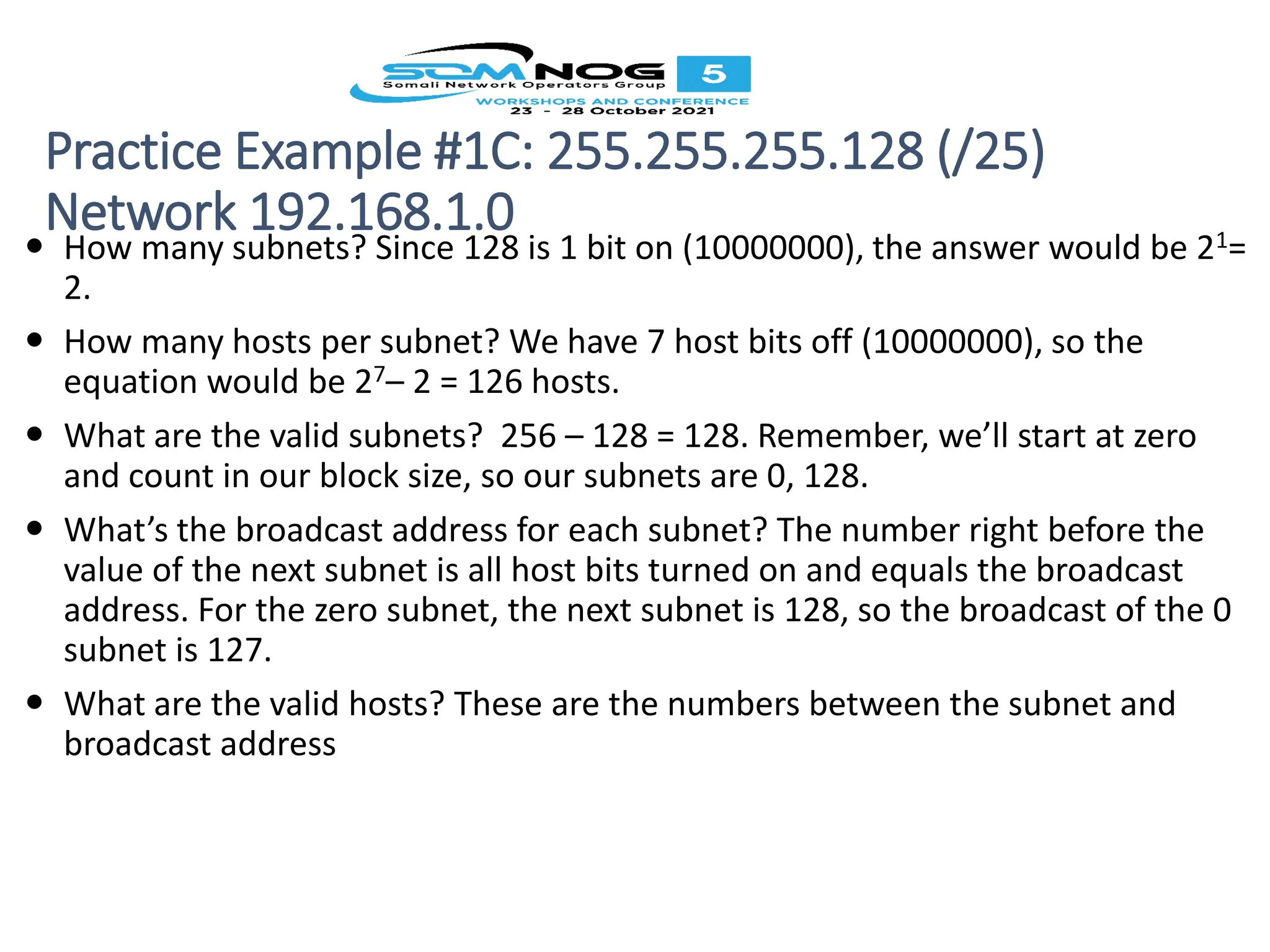
Practice Example #1C: 255.255.255.128 (/25)
Network 192.168.1.0
 How many subnets? Since 128 is 1 bit on (10000000), the answer would be 21=
2.
 How many hosts per subnet? We have 7 host bits off (10000000), so the
equation would be 27– 2 = 126 hosts.
 What are the valid subnets? 256 – 128 = 128. Remember, we’ll start at zero
and count in our block size, so our subnets are 0, 128.
 What’s the broadcast address for each subnet? The number right before the
value of the next subnet is all host bits turned on and equals the broadcast
address. For the zero subnet, the next subnet is 128, so the broadcast of the 0
subnet is 127.
 What are the valid hosts? These are the numbers between the subnet and
broadcast address
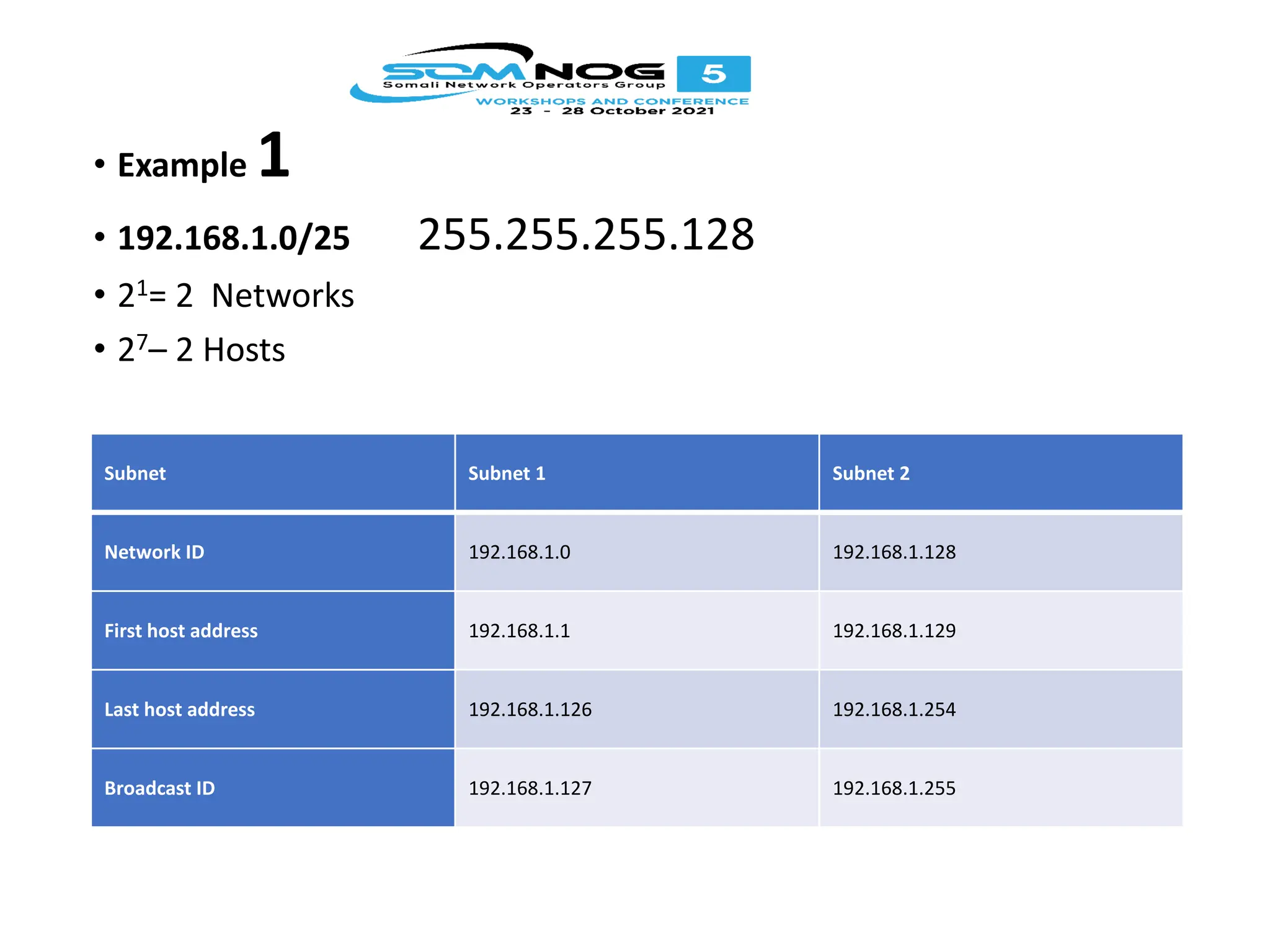
• Example 1
• 192.168.1.0/25 255.255.255.128
• 21= 2 Networks
• 27– 2 Hosts
Subnet Subnet 1 Subnet 2
Network ID 192.168.1.0 192.168.1.128
First host address 192.168.1.1 192.168.1.129
Last host address 192.168.1.126 192.168.1.254
Broadcast ID 192.168.1.127 192.168.1.255
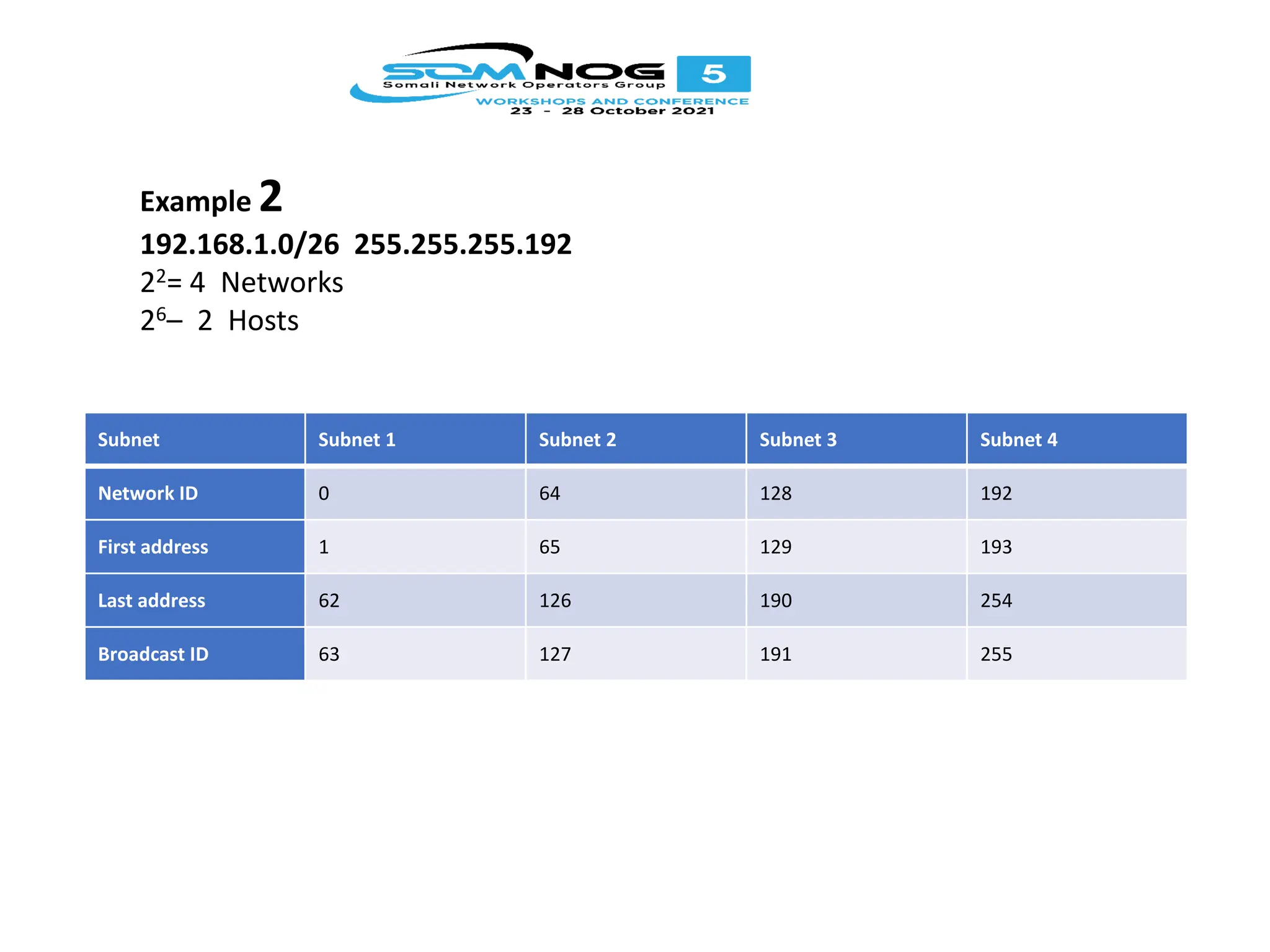
Subnet Subnet 1 Subnet 2 Subnet 3 Subnet 4
Network ID 0 64 128 192
First address 1 65 129 193
Last address 62 126 190 254
Broadcast ID 63 127 191 255
Example 2
192.168.1.0/26 255.255.255.192
22= 4 Networks
26– 2 Hosts
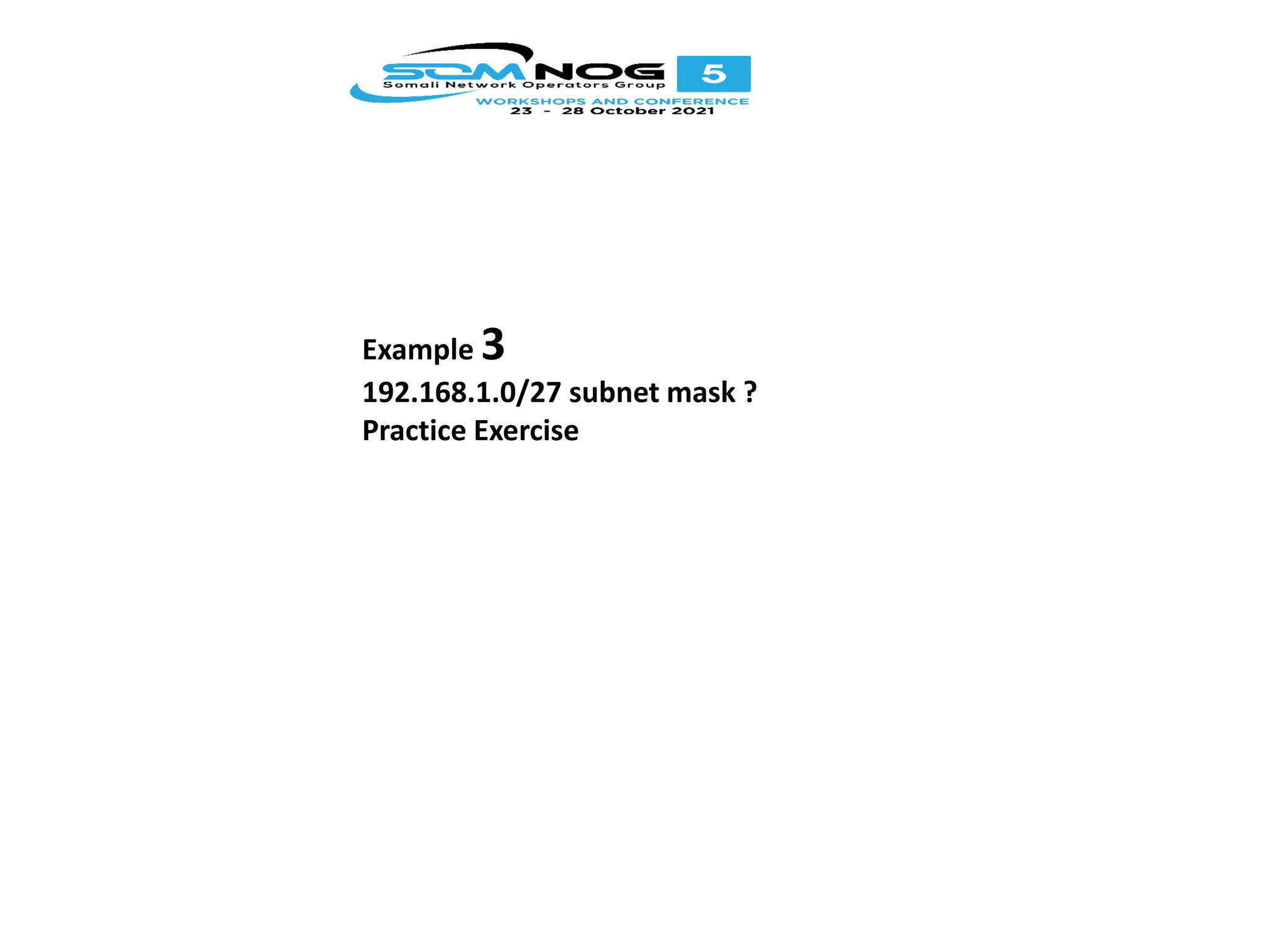
Example 3
192.168.1.0/27 subnet mask ?
Practice Exercise
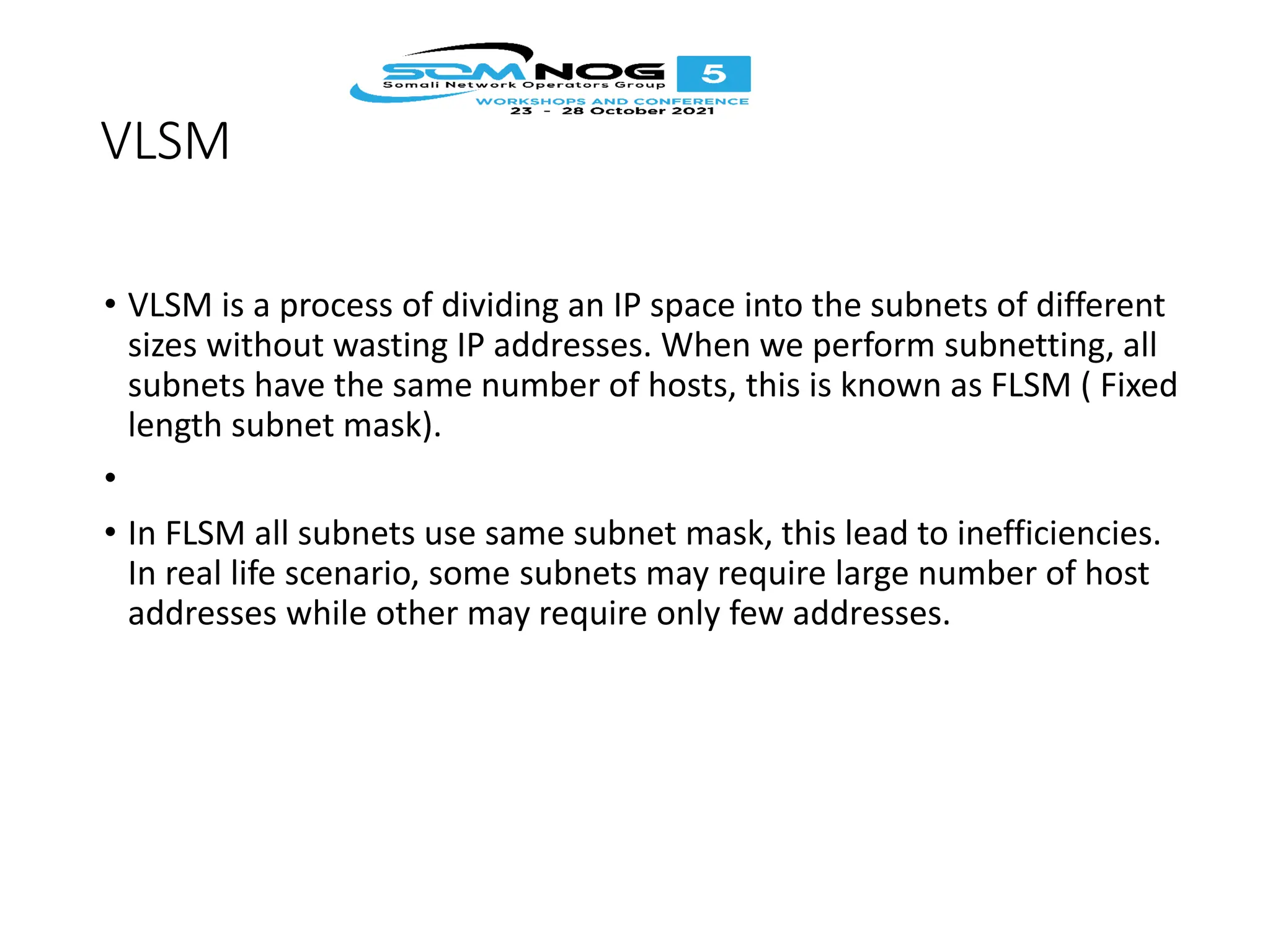
VLSM
• VLSM is a process of dividing an IP space into the subnets of different
sizes without wasting IP addresses. When we perform subnetting, all
subnets have the same number of hosts, this is known as FLSM ( Fixed
length subnet mask).
•
• In FLSM all subnets use same subnet mask, this lead to inefficiencies.
In real life scenario, some subnets may require large number of host
addresses while other may require only few addresses.
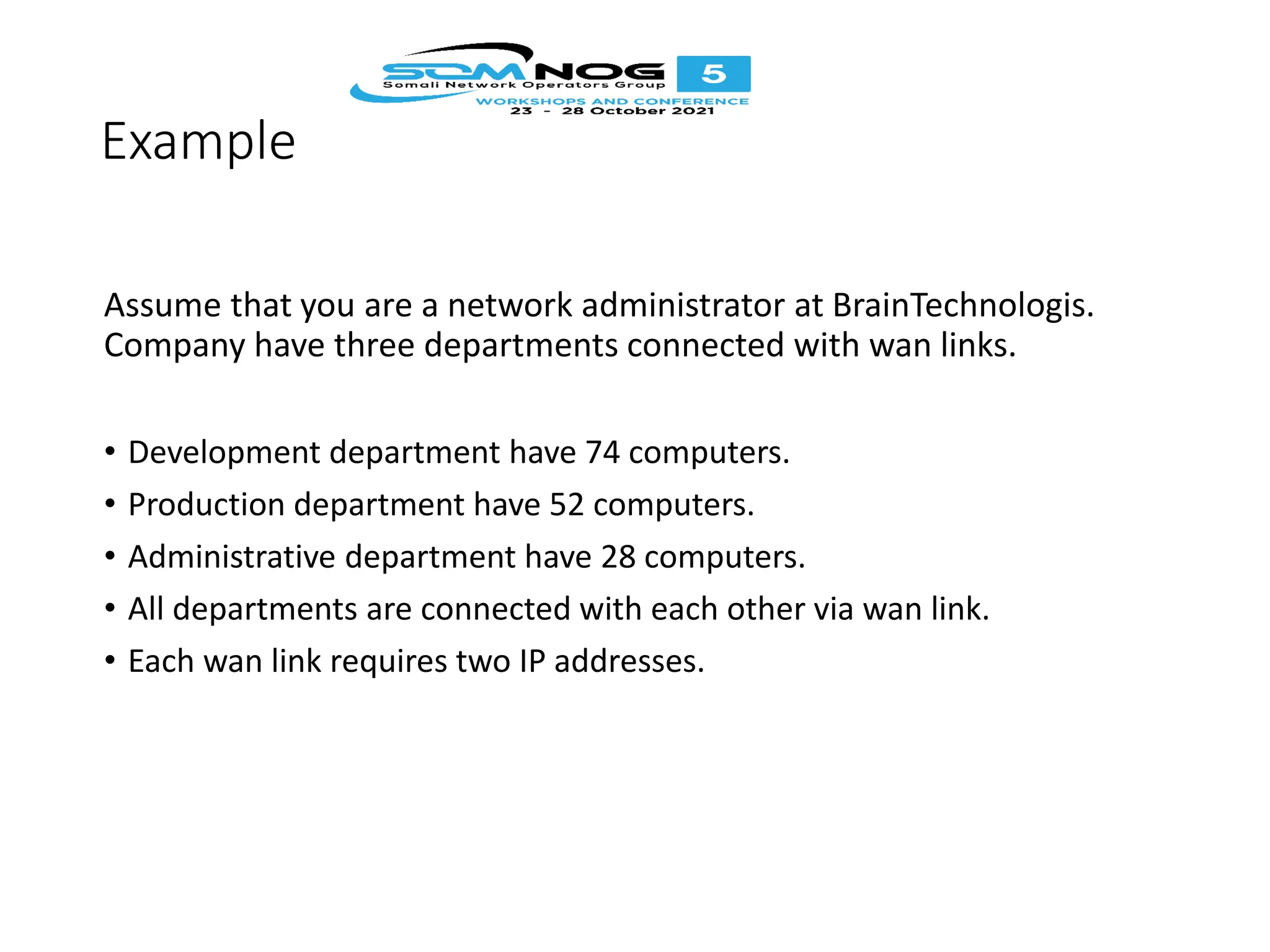
Example
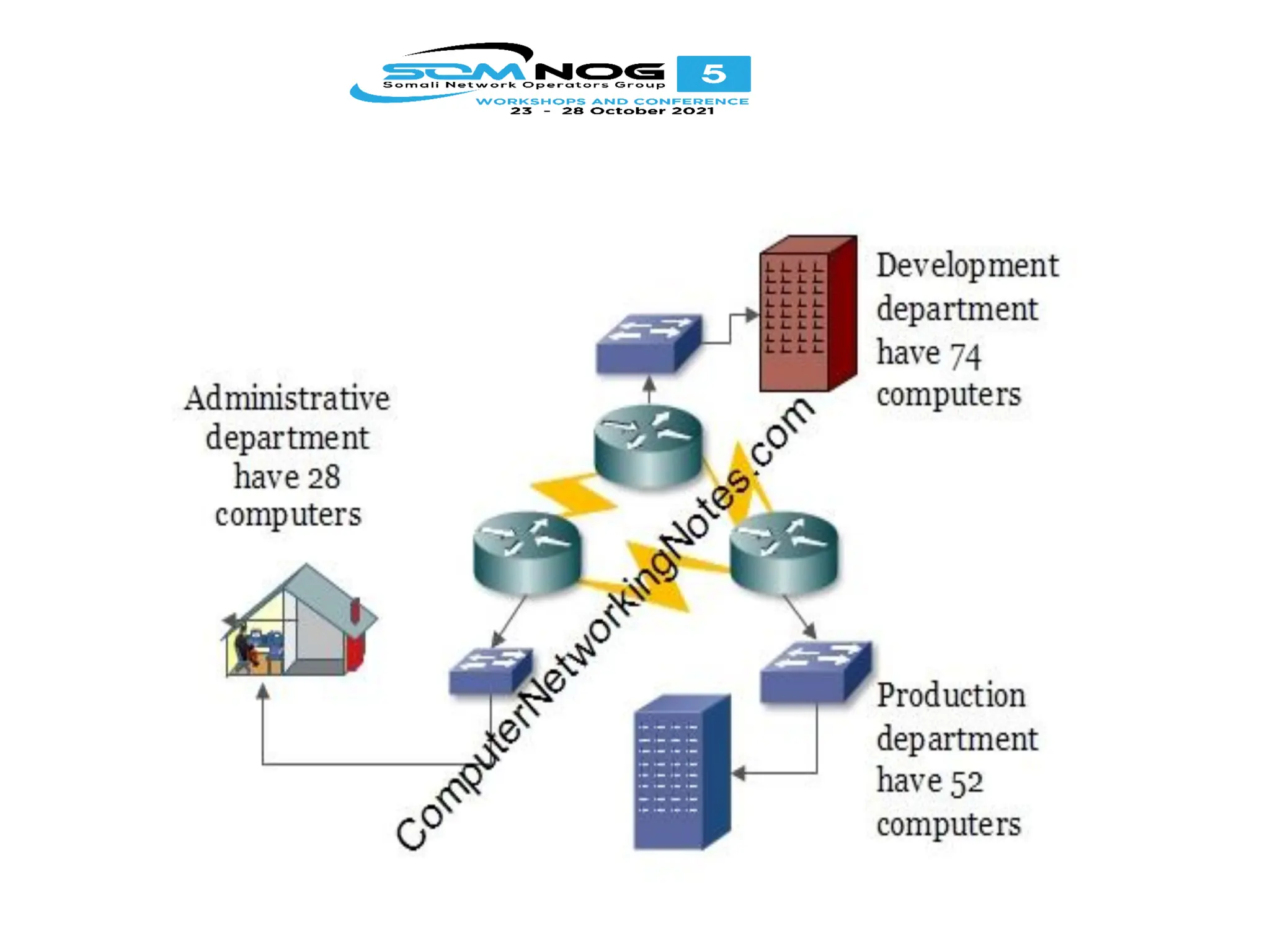
Assume that you are a network administrator at BrainTechnologis.
Company have three departments connected with wan links.
• Development department have 74 computers.
• Production department have 52 computers.
• Administrative department have 28 computers.
• All departments are connected with each other via wan link.
• Each wan link requires two IP addresses.
• First choice with a example class B address space
• 172.168.1.0/23
• Subnetting of this address space would give us 128 subnets and 512
hosts in each subnet. Our network requires only 6 subnets and 160
addresses.
• Every IP address add more dollars in company bill. You would have to
pay for 65356 addresses while you need only 160 addresses. Would
you consider this address space for company?
• Second choice with two example class C address spaces
• 192.168.1.0/25
• 192.168.2.0/26
• Subnetting of first address 192.168.1.0/25 would give us 2 subnets
and 128 hosts in each subnet.
• Subnetting of second address 192.168.2.0/26 would give us 4 subnets
and 64 hosts in each subnet.
• Collectively we are getting 6 subnets and 512 hosts from these two
address spaces. We are still wasting more than 300 IP address, and
we would have to purchase two address spaces.
Variable Length Subnet Mask
• Variable Length Subnet Mask (VLSM) extends classic subnetting.
• VLSM is a process of breaking down subnets into the smaller subnets,
according to the need of individual networks. In above example
company have requirement of 6 subnets and 160 host addresses.
With VSLM you can fulfill this requirement with single class C address
space.
• VLSM Subnetting
• In VLSM Subnetting, we do subnetting of subnets according the
network requirement.
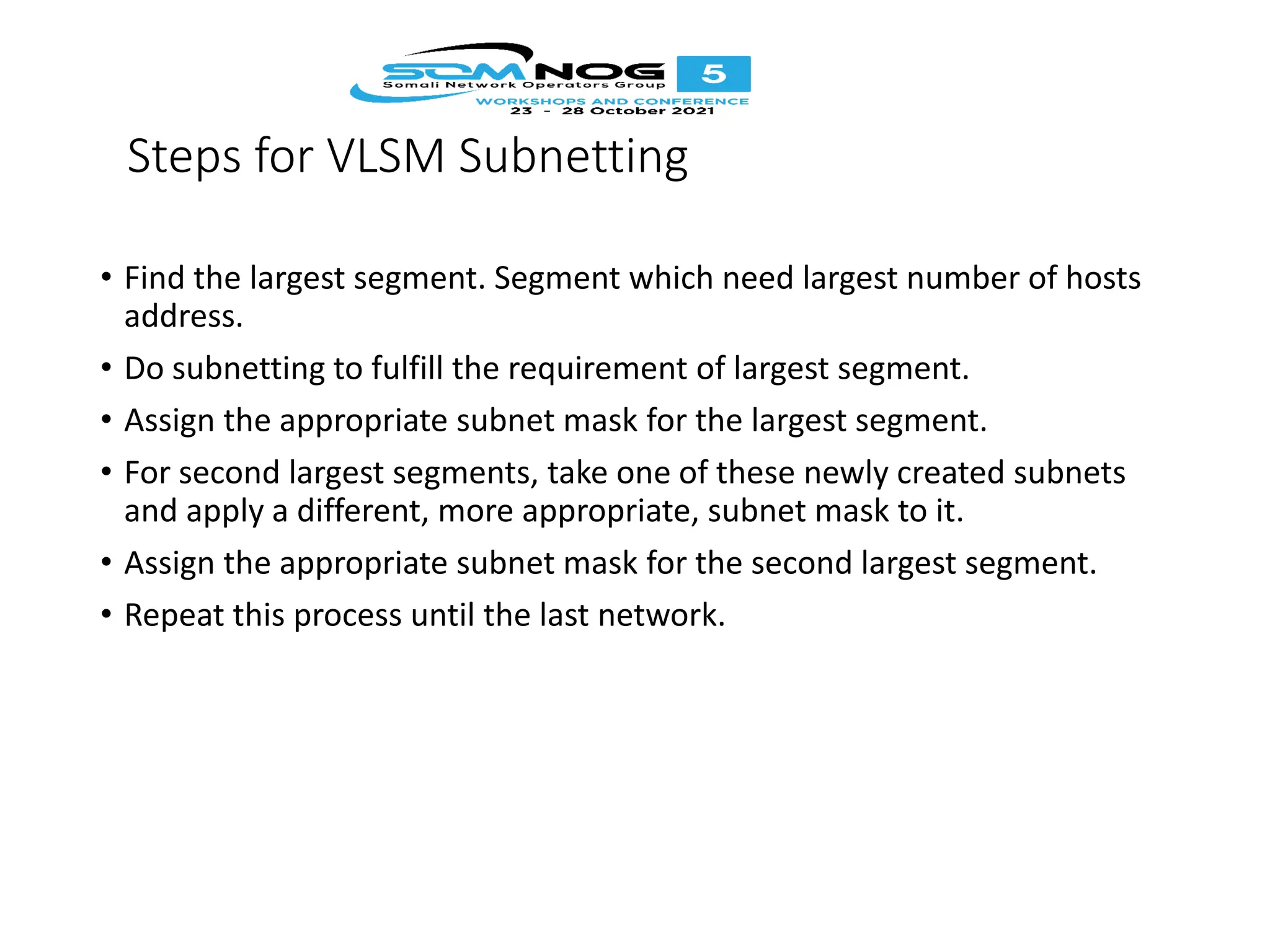
Steps for VLSM Subnetting
• Find the largest segment. Segment which need largest number of hosts
address.
• Do subnetting to fulfill the requirement of largest segment.
• Assign the appropriate subnet mask for the largest segment.
• For second largest segments, take one of these newly created subnets
and apply a different, more appropriate, subnet mask to it.
• Assign the appropriate subnet mask for the second largest segment.
• Repeat this process until the last network.
VLSM Example
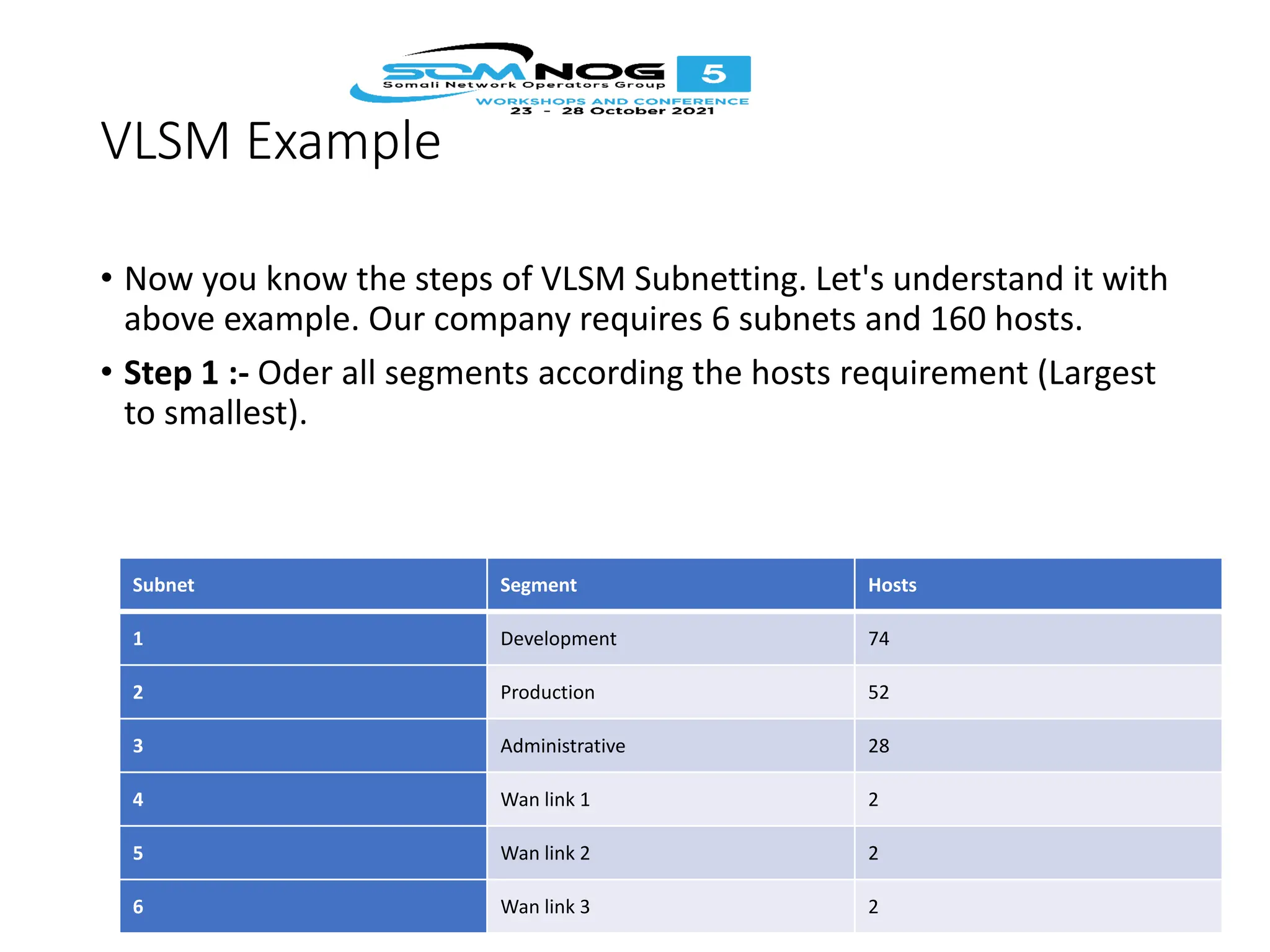
• Now you know the steps of VLSM Subnetting. Let's understand it with
above example. Our company requires 6 subnets and 160 hosts.
• Step 1 :- Oder all segments according the hosts requirement (Largest
to smallest).
Subnet Segment Hosts
1 Development 74
2 Production 52
3 Administrative 28
4 Wan link 1 2
5 Wan link 2 2
6 Wan link 3 2
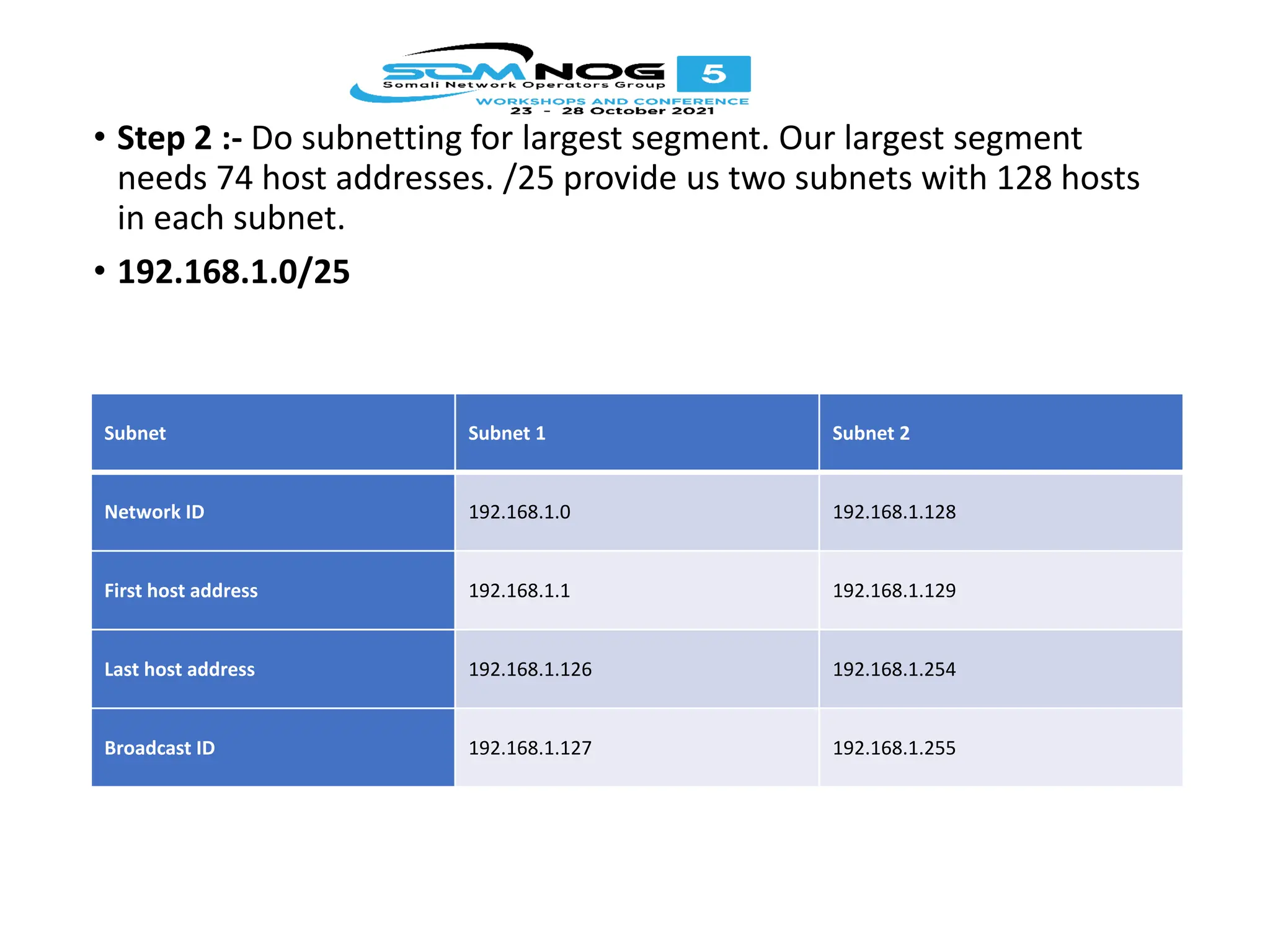
• Step 2 :- Do subnetting for largest segment. Our largest segment
needs 74 host addresses. /25 provide us two subnets with 128 hosts
in each subnet.
• 192.168.1.0/25
Subnet Subnet 1 Subnet 2
Network ID 192.168.1.0 192.168.1.128
First host address 192.168.1.1 192.168.1.129
Last host address 192.168.1.126 192.168.1.254
Broadcast ID 192.168.1.127 192.168.1.255
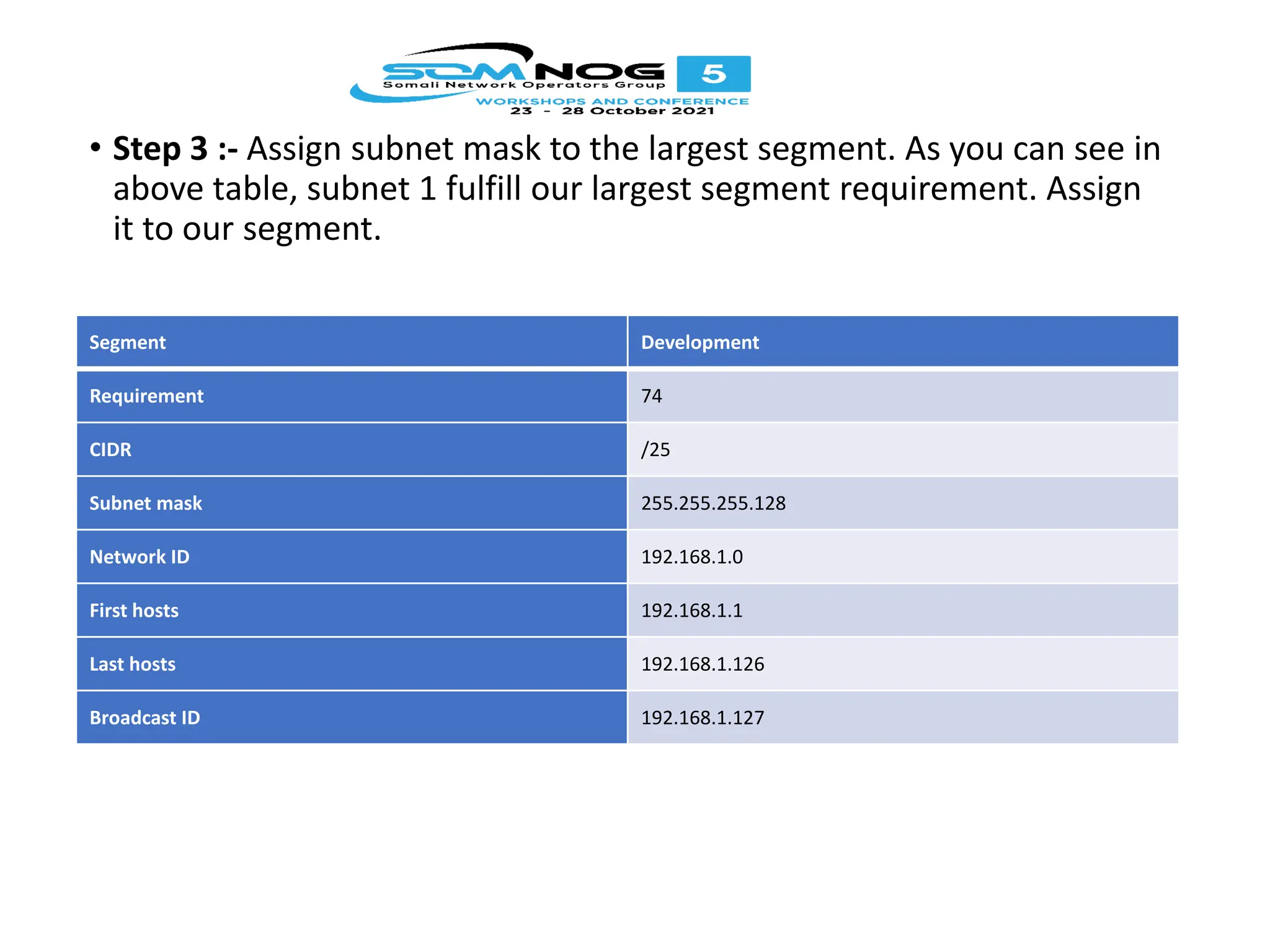
• Step 3 :- Assign subnet mask to the largest segment. As you can see in
above table, subnet 1 fulfill our largest segment requirement. Assign
it to our segment.
Segment Development
Requirement 74
CIDR /25
Subnet mask 255.255.255.128
Network ID 192.168.1.0
First hosts 192.168.1.1
Last hosts 192.168.1.126
Broadcast ID 192.168.1.127
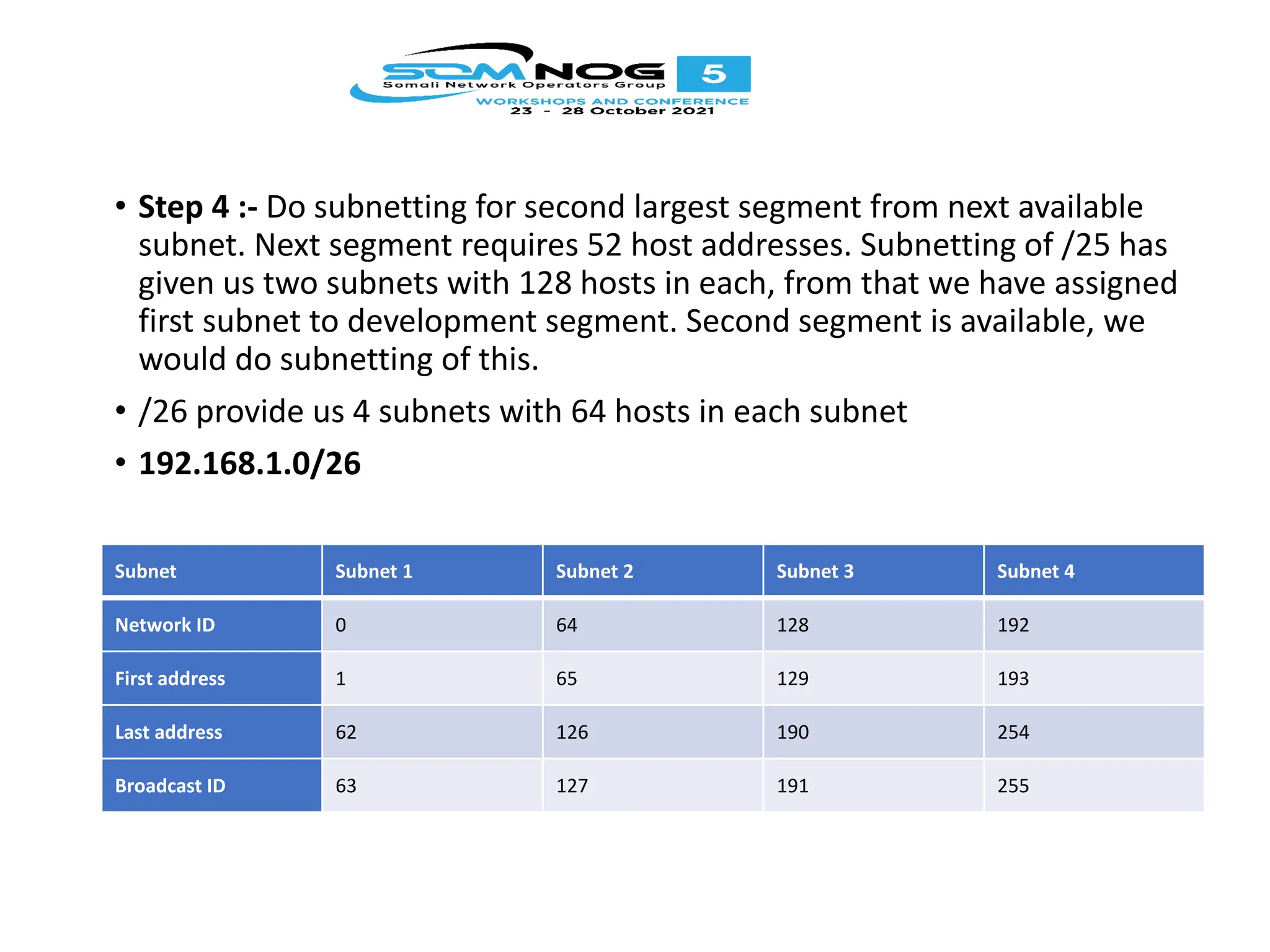
• Step 4 :- Do subnetting for second largest segment from next available
subnet. Next segment requires 52 host addresses. Subnetting of /25 has
given us two subnets with 128 hosts in each, from that we have assigned
first subnet to development segment. Second segment is available, we
would do subnetting of this.
• /26 provide us 4 subnets with 64 hosts in each subnet
• 192.168.1.0/26
Subnet Subnet 1 Subnet 2 Subnet 3 Subnet 4
Network ID 0 64 128 192
First address 1 65 129 193
Last address 62 126 190 254
Broadcast ID 63 127 191 255
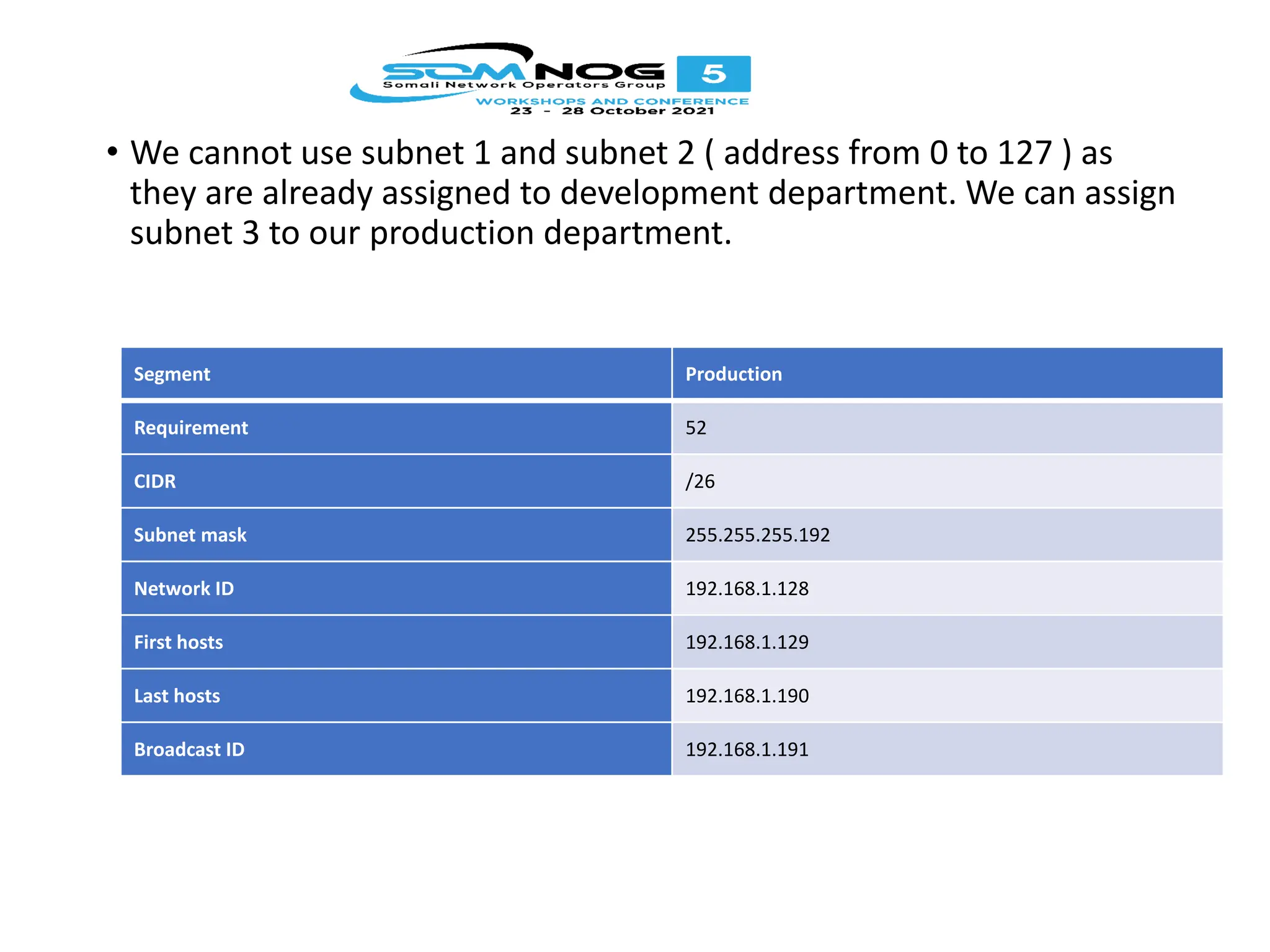
• We cannot use subnet 1 and subnet 2 ( address from 0 to 127 ) as
they are already assigned to development department. We can assign
subnet 3 to our production department.
Segment Production
Requirement 52
CIDR /26
Subnet mask 255.255.255.192
Network ID 192.168.1.128
First hosts 192.168.1.129
Last hosts 192.168.1.190
Broadcast ID 192.168.1.191
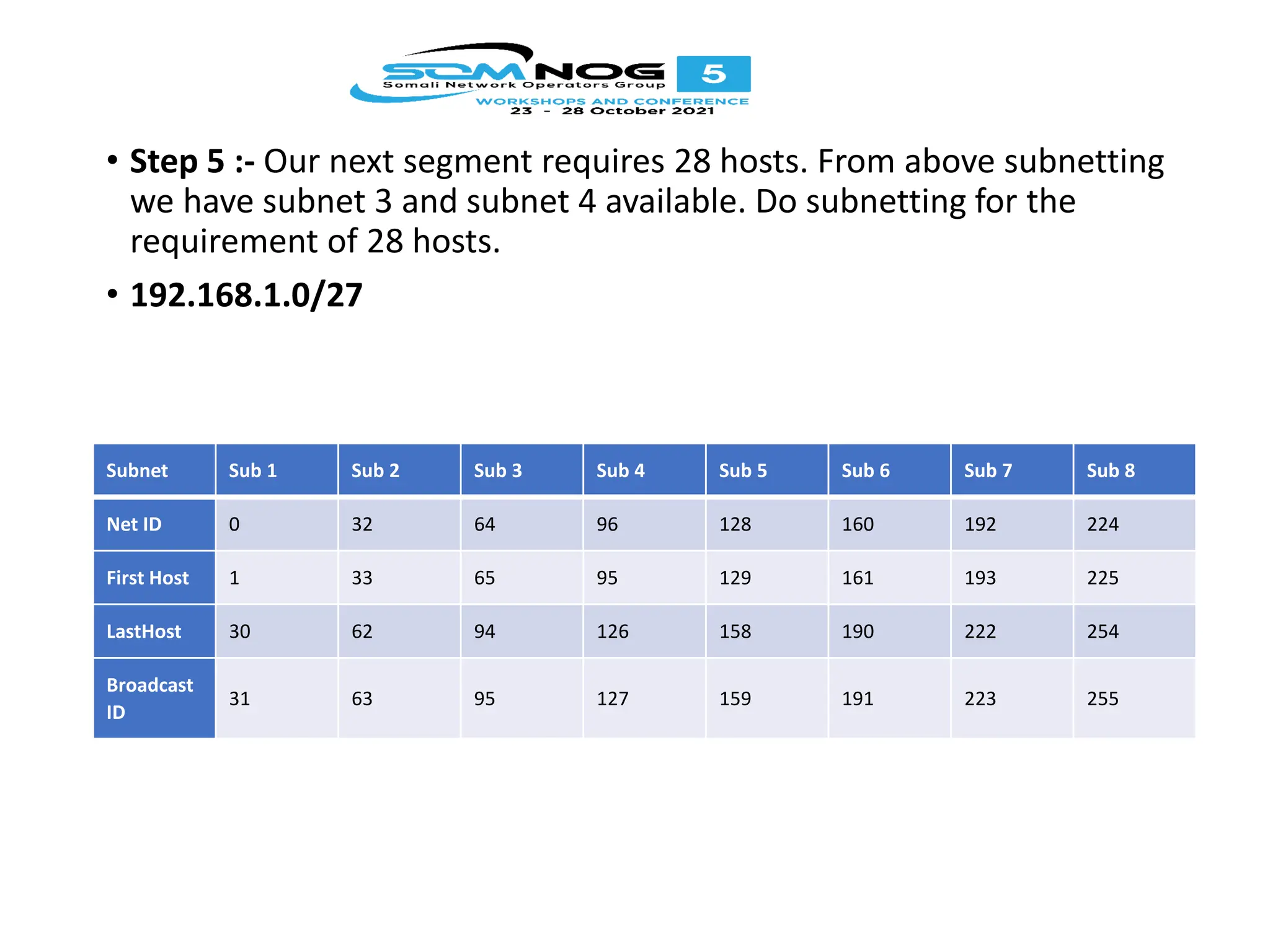
• Step 5 :- Our next segment requires 28 hosts. From above subnetting
we have subnet 3 and subnet 4 available. Do subnetting for the
requirement of 28 hosts.
• 192.168.1.0/27
Subnet Sub 1 Sub 2 Sub 3 Sub 4 Sub 5 Sub 6 Sub 7 Sub 8
Net ID 0 32 64 96 128 160 192 224
First Host 1 33 65 95 129 161 193 225
LastHost 30 62 94 126 158 190 222 254
Broadcast
ID
31 63 95 127 159 191 223 255
Subnets 1 to 6 [ address from 0 to 191] are already occupied by
previous segments. We can assign subnet 7 to this segment.
Segment Administrative
Requirement 28
CIDR /27
Subnet mask 255.255.255.224
Network ID 192.168.1.192
First hosts 192.168.1.193
Last hosts 192.168.1.222
Broadcast ID 192.168.1.223
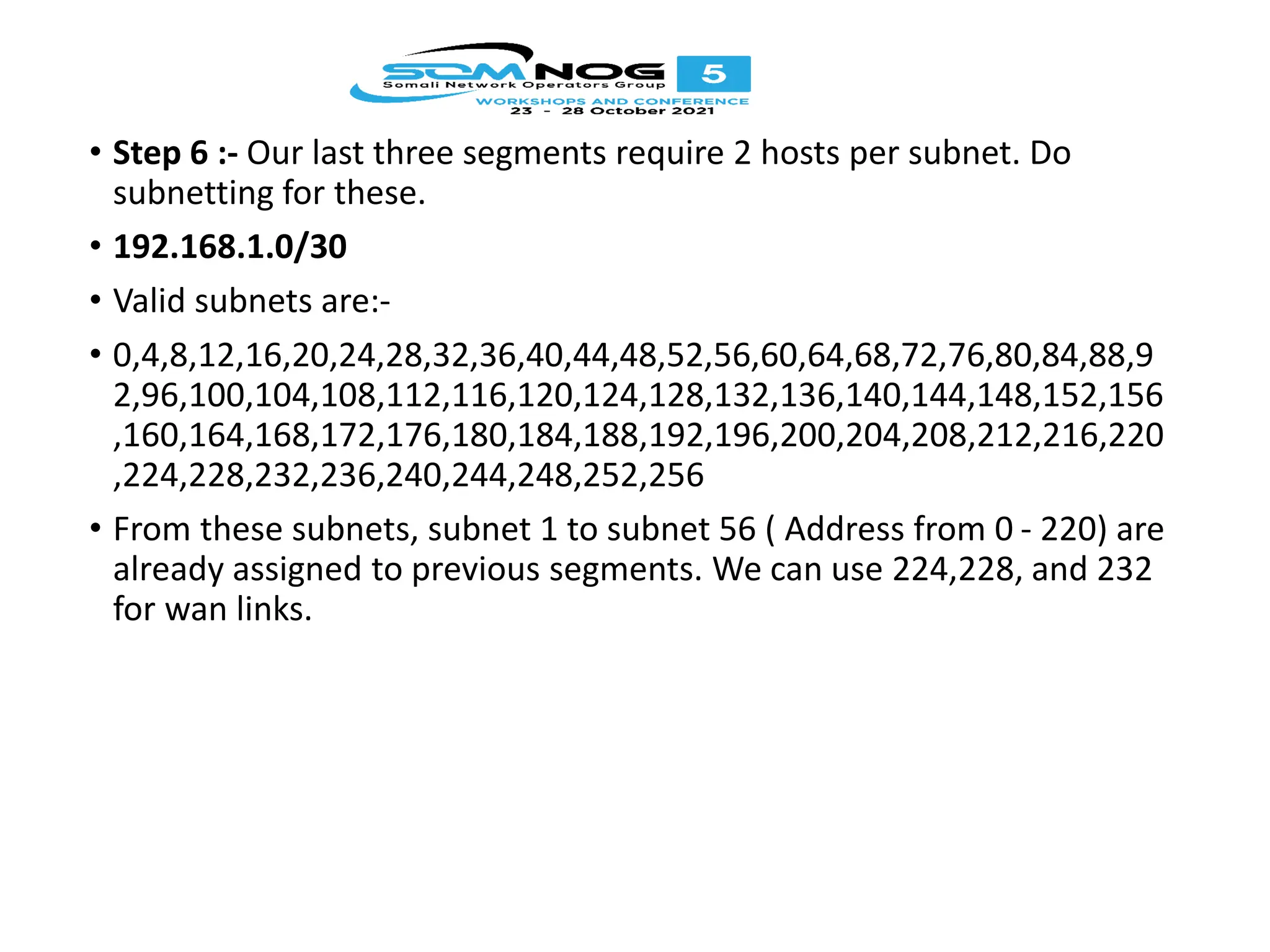
• Step 6 :- Our last three segments require 2 hosts per subnet. Do
subnetting for these.
• 192.168.1.0/30
• Valid subnets are:-
• 0,4,8,12,16,20,24,28,32,36,40,44,48,52,56,60,64,68,72,76,80,84,88,9
2,96,100,104,108,112,116,120,124,128,132,136,140,144,148,152,156
,160,164,168,172,176,180,184,188,192,196,200,204,208,212,216,220
,224,228,232,236,240,244,248,252,256
• From these subnets, subnet 1 to subnet 56 ( Address from 0 - 220) are
already assigned to previous segments. We can use 224,228, and 232
for wan links.
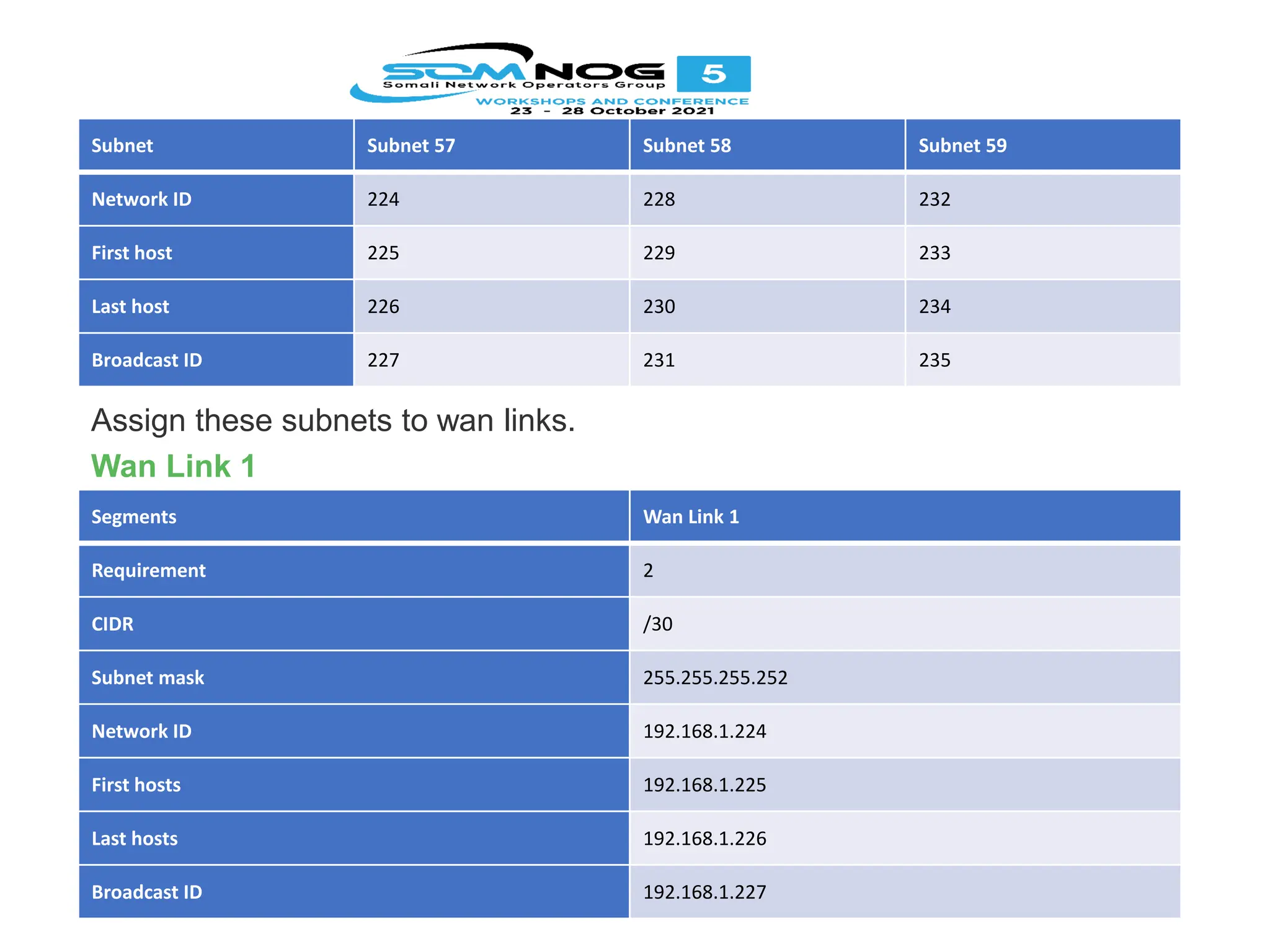
Subnet Subnet 57 Subnet 58 Subnet 59
Network ID 224 228 232
First host 225 229 233
Last host 226 230 234
Broadcast ID 227 231 235
Assign these subnets to wan links.
Wan Link 1
Segments Wan Link 1
Requirement 2
CIDR /30
Subnet mask 255.255.255.252
Network ID 192.168.1.224
First hosts 192.168.1.225
Last hosts 192.168.1.226
Broadcast ID 192.168.1.227
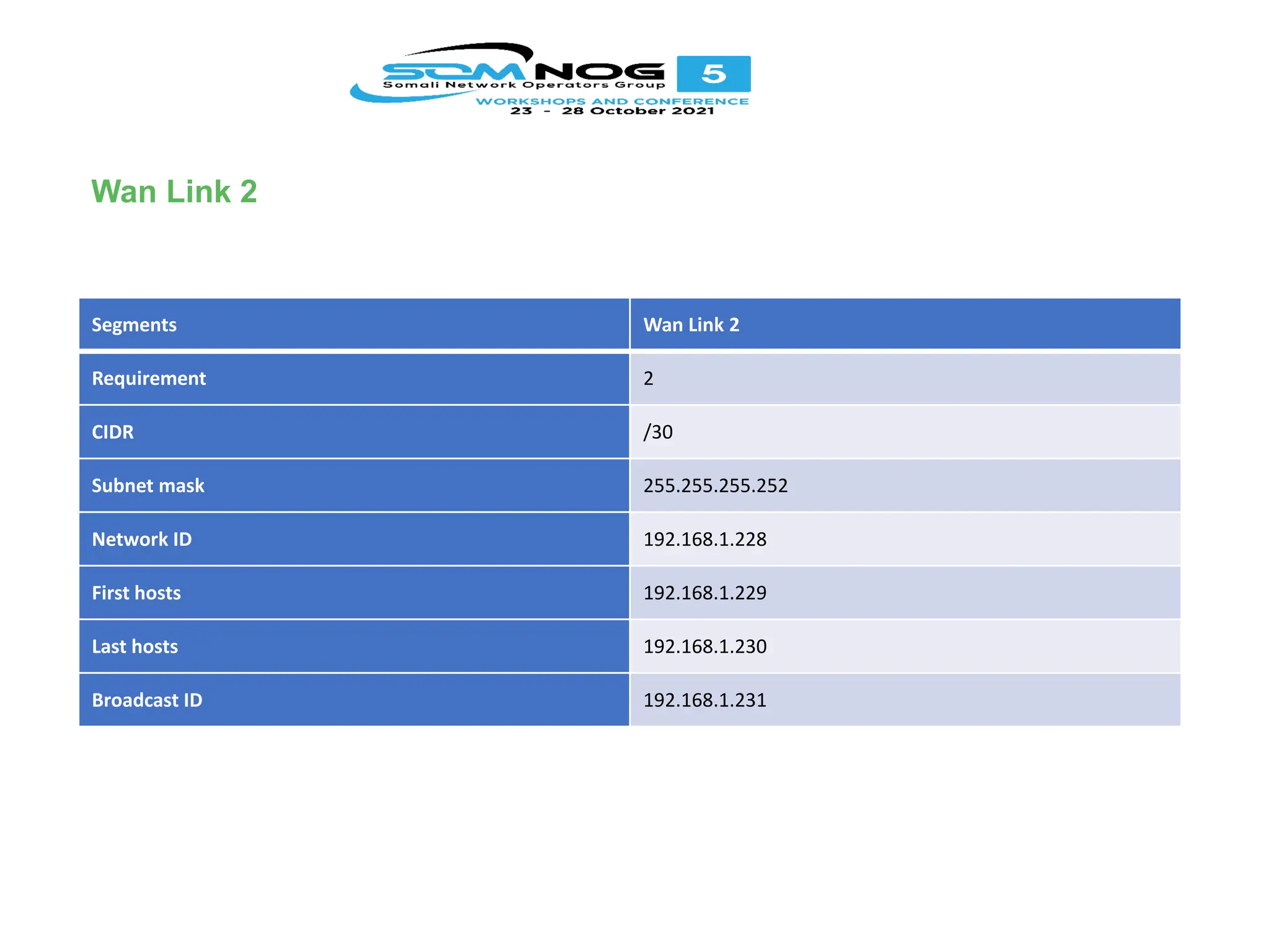
Segments Wan Link 2
Requirement 2
CIDR /30
Subnet mask 255.255.255.252
Network ID 192.168.1.228
First hosts 192.168.1.229
Last hosts 192.168.1.230
Broadcast ID 192.168.1.231
Wan Link 2
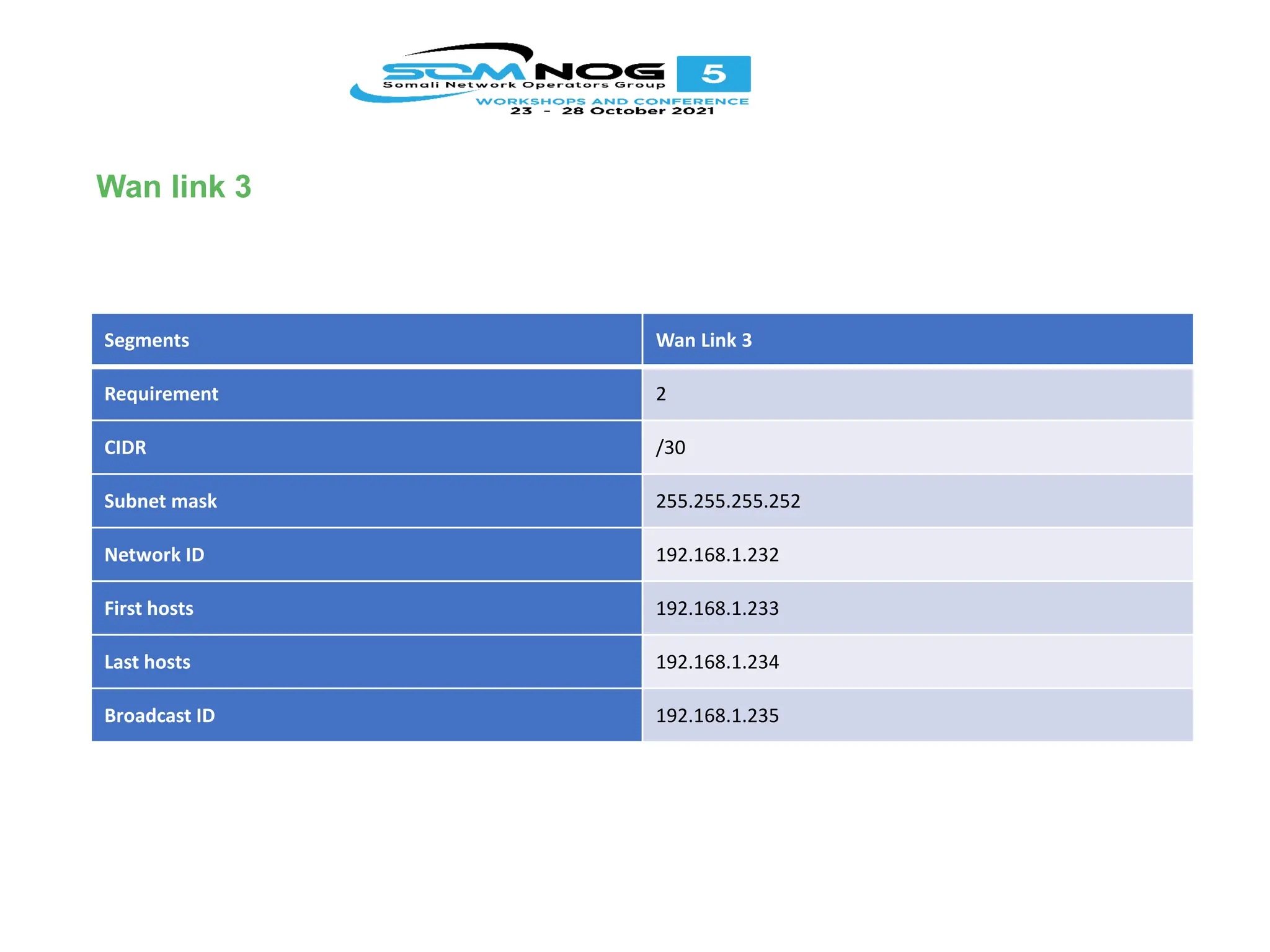
Segments Wan Link 3
Requirement 2
CIDR /30
Subnet mask 255.255.255.252
Network ID 192.168.1.232
First hosts 192.168.1.233
Last hosts 192.168.1.234
Broadcast ID 192.168.1.235
Wan link 3
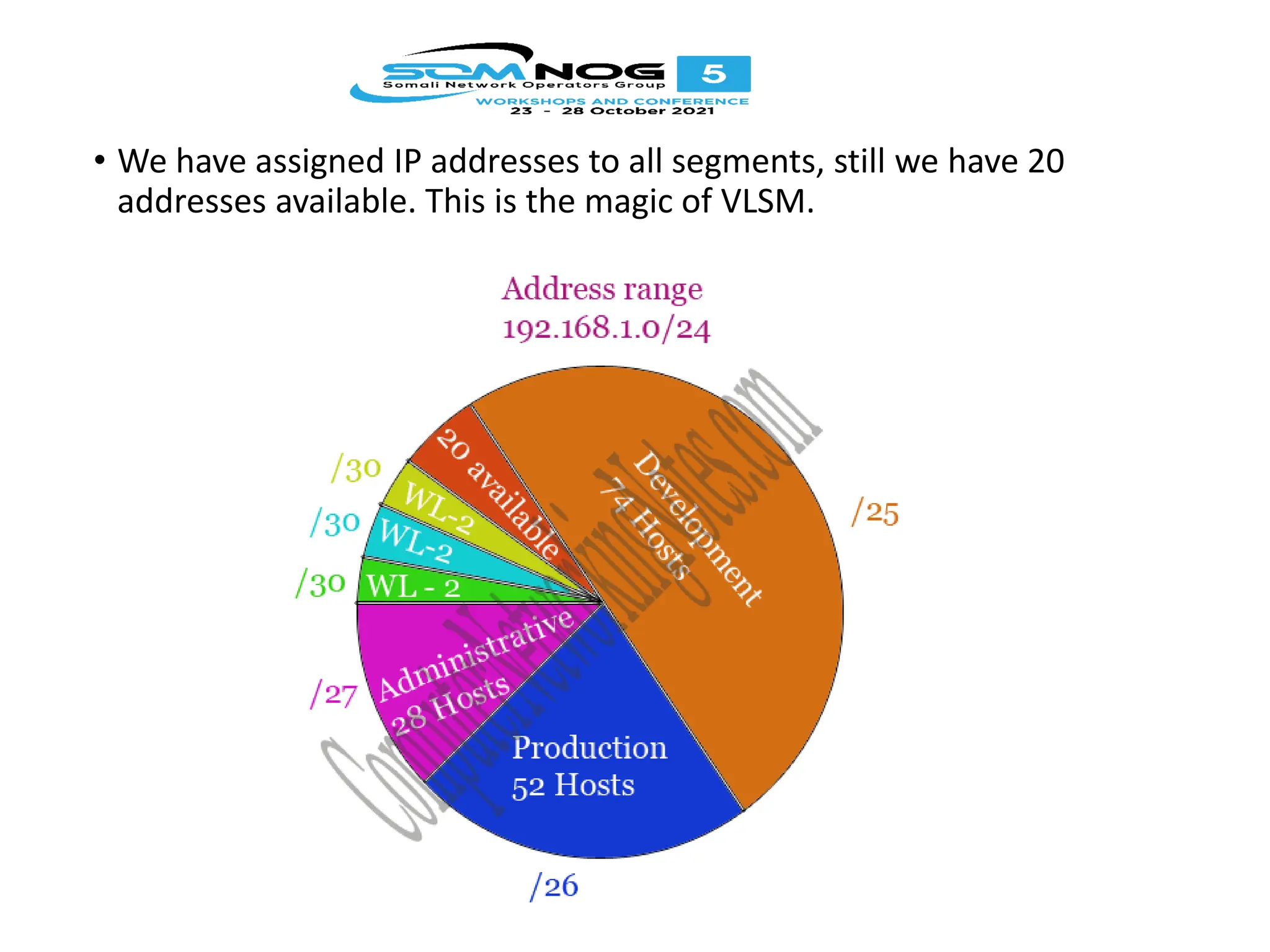
• We have assigned IP addresses to all segments, still we have 20
addresses available. This is the magic of VLSM.
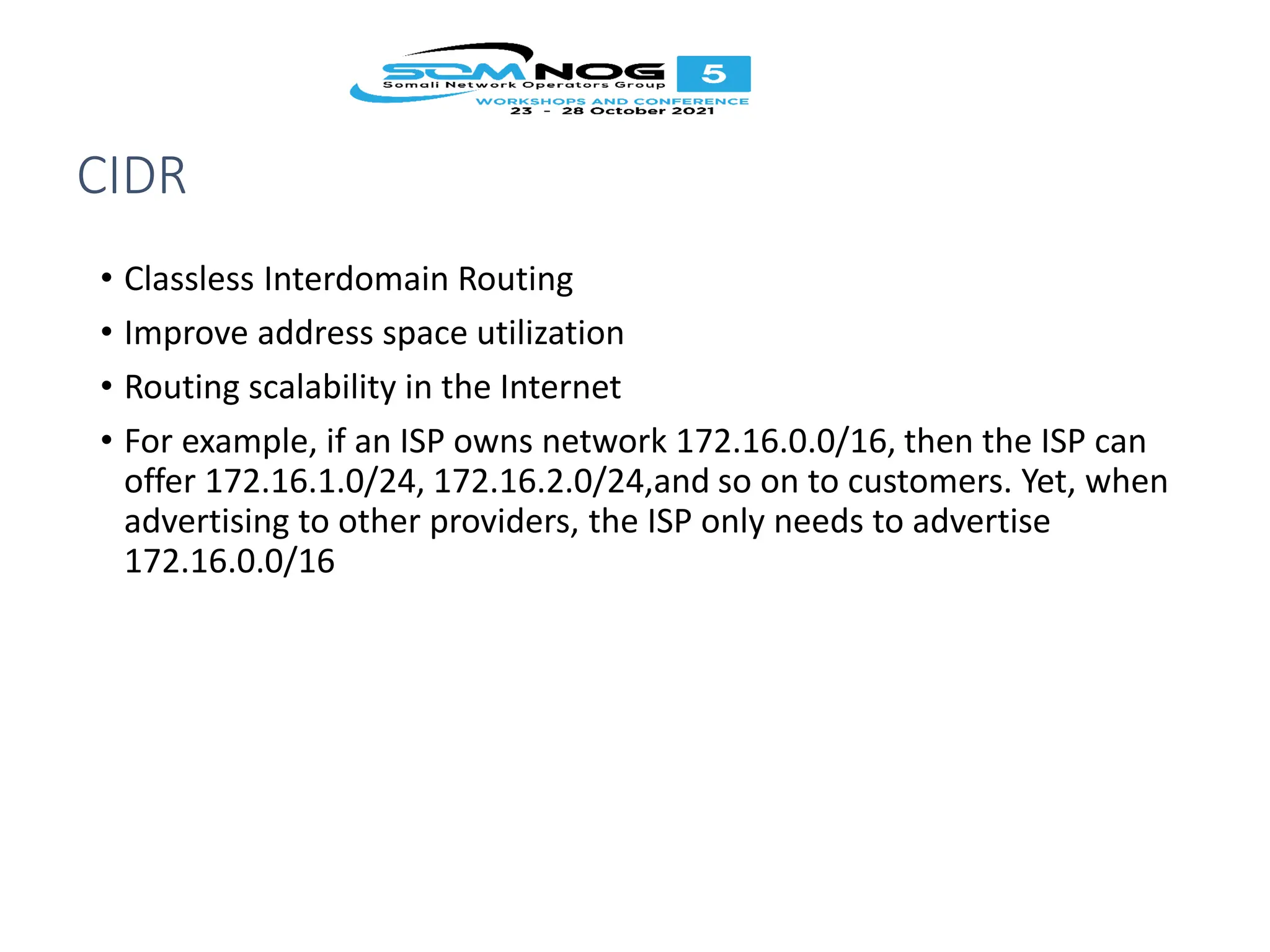
CIDR
• Classless Interdomain Routing
• Improve address space utilization
• Routing scalability in the Internet
• For example, if an ISP owns network 172.16.0.0/16, then the ISP can
offer 172.16.1.0/24, 172.16.2.0/24,and so on to customers. Yet, when
advertising to other providers, the ISP only needs to advertise
172.16.0.0/16
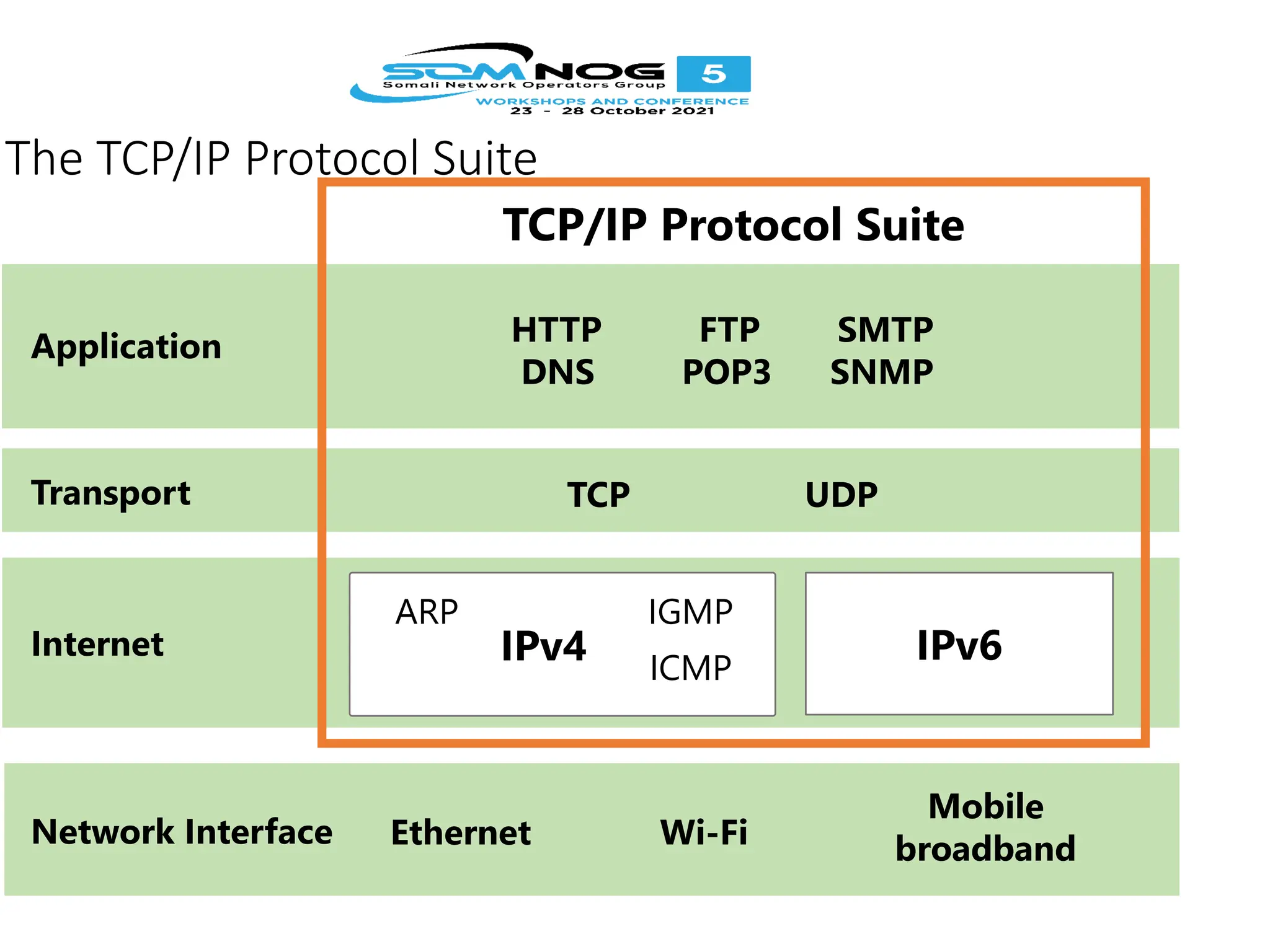
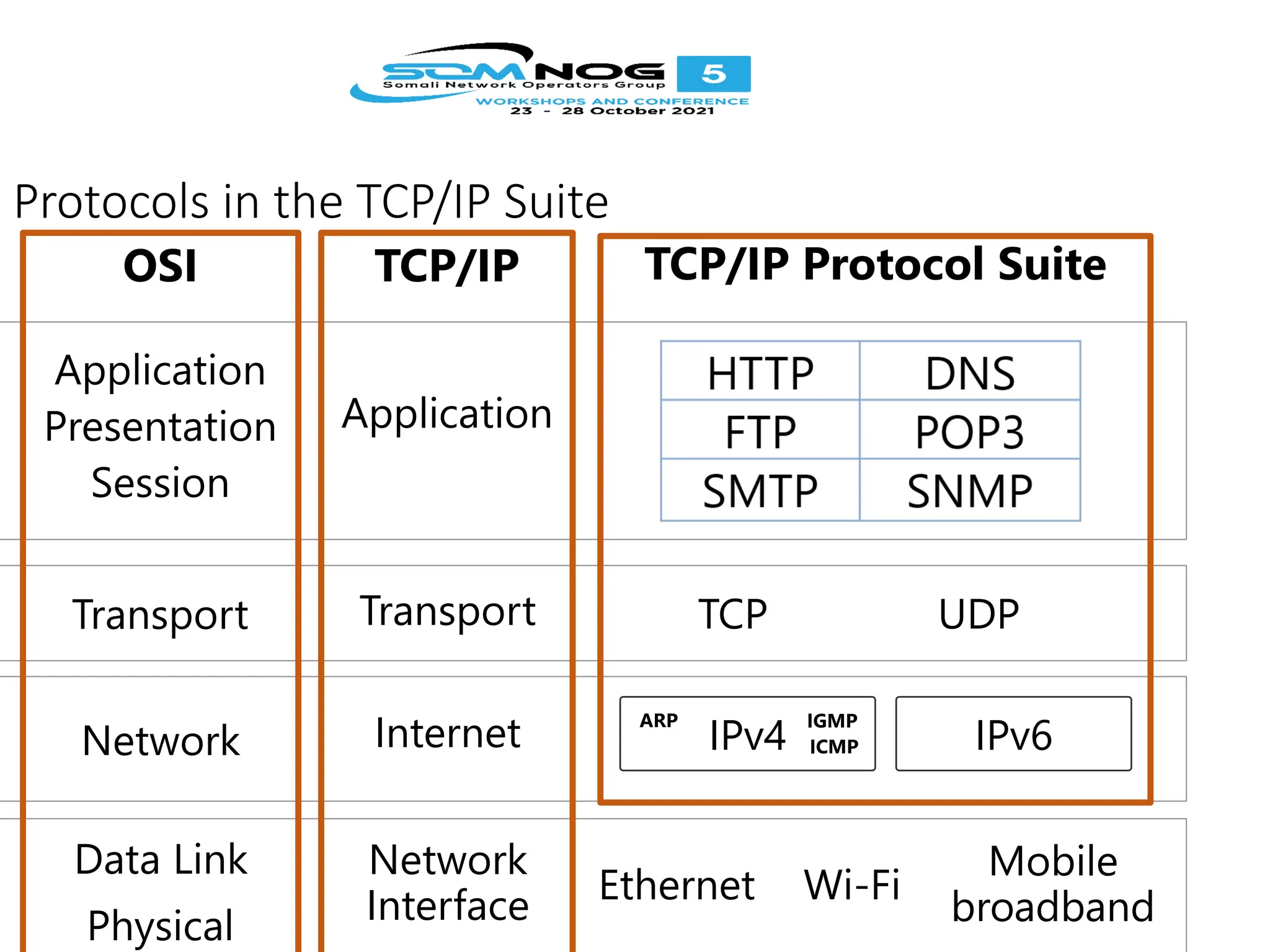
The TCP/IP Protocol Suite
Network Interface Ethernet
Mobile
broadband
Wi-Fi
Application HTTP FTP SMTP
DNS POP3 SNMP
TCP/IP Protocol Suite
Transport TCP UDP
Internet IPv6
IPv4
ARP IGMP
ICMP
Protocols in the TCP/IP Suite
TCP/IP Protocol Suite
TCP/IP
OSI
TCP UDP
Ethernet
Mobile
broadband
Wi-Fi
Application
Transport
Network
Interface
Application
Presentation
Session
Transport
Network
Data Link
Physical
Internet IPv6
IPv4
ARP IGMP
ICMP
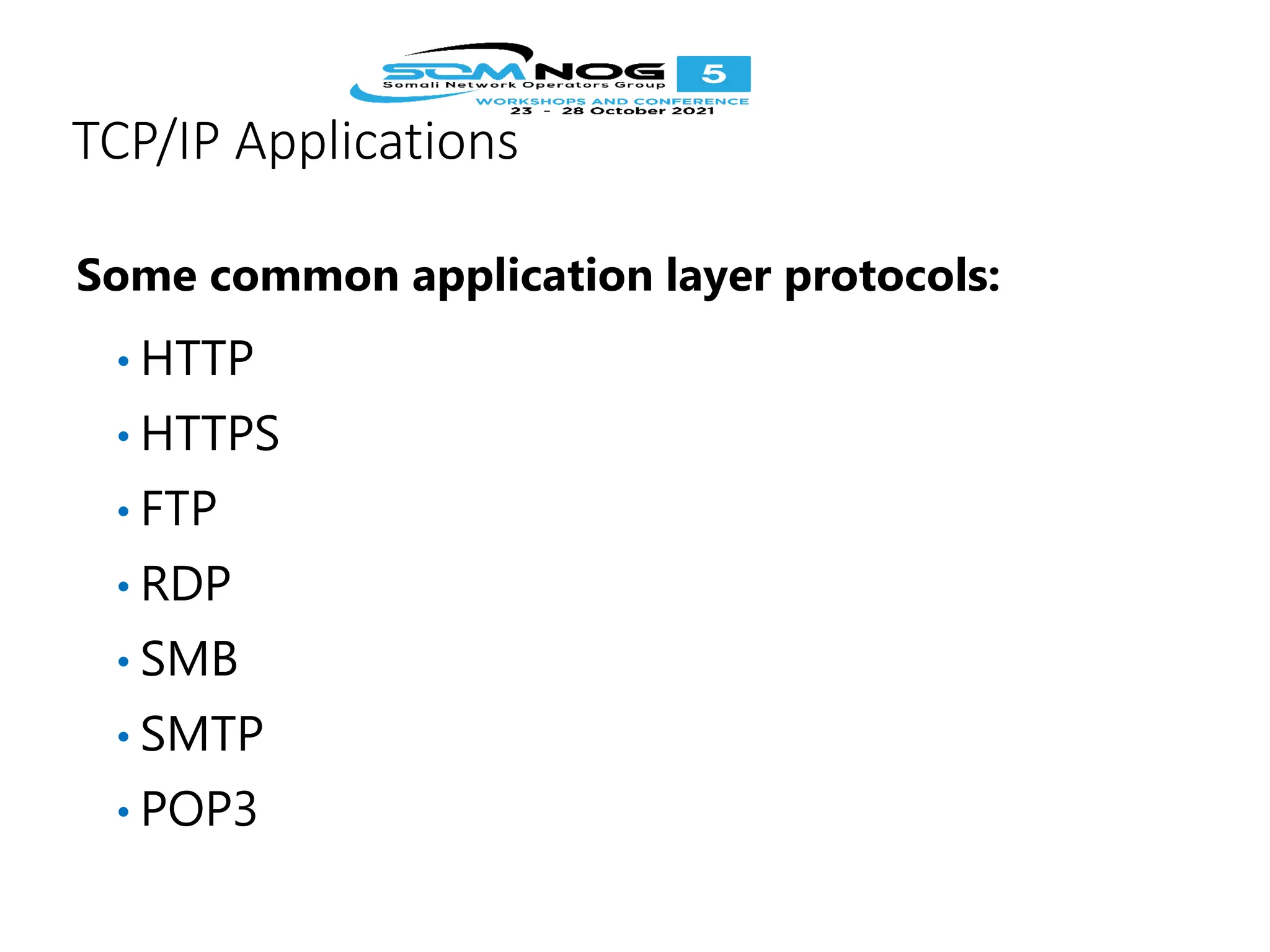
TCP/IP Applications
Some common application layer protocols:
• HTTP
• HTTPS
• FTP
• RDP
• SMB
• SMTP
• POP3
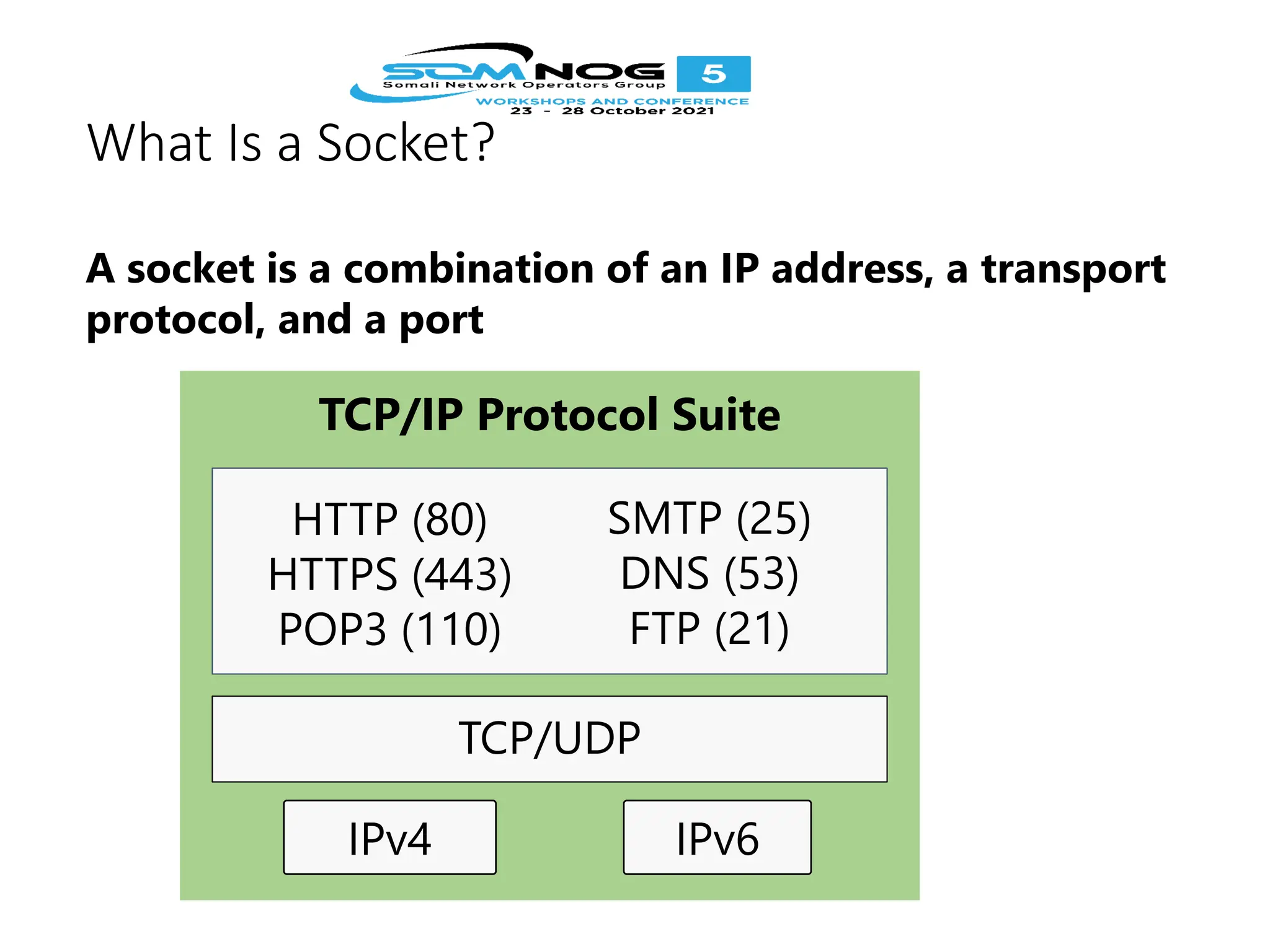
What Is a Socket?
A socket is a combination of an IP address, a transport
protocol, and a port
TCP/IP Protocol Suite
TCP/UDP
IPv6
IPv4
HTTP (80)
HTTPS (443)
POP3 (110)
SMTP (25)
DNS (53)
FTP (21)
SOMNOG5

subnet network Addressing Network v1.pdf

  • 1.
    IP Addressing &Subnetting IP Addressing Subnetting CIDR VLSM
  • 2.
    IP Addresses • AnIP address is an address used to uniquely identify a device on an IP network. • The address is made up of 32 binary bits which can be divisible into a network portion and host portion with the help of a subnet mask. • 32 binary bits are broken into four octets (1 octet = 8 bits) • Dotted decimal format (for example, 172.16.81.100)
  • 3.
    IP Address Classes •Class A: The first octet is the network portion. Octets 2, 3, and 4 are for subnets/hosts • Class B: The first two octets are the network portion. Octets 3 and 4 are for subnets/hosts • Class C: The first three octets are the network portion. Octet 4 is for subnets/hosts
  • 4.
    Network Masks • Distinguisheswhich portion of the address identifies the network and which portion of the address identifies the node. • Default masks: Class A: 255.0.0.0 Class B: 255.255.0.0 Class C: 255.255.255.0
  • 5.
    Private Address Range AddressClass Reserved Address Space Class A 10.0.0.0 - 10.255.255.255 Class B 172.16.0.0 - 172.31.255.255 Class C 192.168.0.0 - 192.168.255.255
  • 6.
    Public and PrivateIPv4 Addresses Private • Not routable on the Internet • 10.0.0.0/8 • 172.16.0.0/12 • 192.168.0.0./16 • Can be assigned locally by an organization • Must be translated to access the Internet Public • Required by devices and hosts that connect directly to the Internet • Must be globally unique • Routable on the Internet • Must be assigned by IANA/RIR
  • 7.
    01110101 10010101 0001110111101010 Binary Notation
  • 8.
  • 9.
    Example 1 Change thefollowing IP address from binary notation to dotted-decimal notation. 10000001 00001011 00001011 11101111
  • 10.
    Example 1 Change thefollowing IP address from binary notation to dotted-decimal notation. 10000001 00001011 00001011 11101111 Solution 129.11.11.239
  • 11.
    Example 2 Change thefollowing IP address from dotted-decimal notation to binary notation: 111.56.45.78
  • 12.
    Example 2 Change thefollowing IP address from dotted-decimal notation to binary notation: 111.56.45.78 Solution 01101111 00111000 00101101 01001110
  • 13.
    Example 3 Solution Find theerror in the following IP Address 111.56.045.78 There are no leading zeroes in Dotted-decimal notation (045)
  • 14.
    Example 3 (continued) Solution Findthe error in the following IP Address 75.45.301.14 In decimal notation each number <= 255 301 is out of the range
  • 15.
    Subnetting • Subnetting isthe process of dividing an IP space into manageable segments of same sizes • Creates multiple logical networks that exist within a single Class A, B, or C network. • If you do not subnet, you will only be able to use one network from your Class A, B, or C network, which is unrealistic • Each data link on a network must have a unique network ID, with every node on that link being a member of the same network
  • 16.
    Benefits of Subnetting 1)Reduced network traffic 2) Optimized network performance 3) Simplified management 4) Facilitated spanning of large geographical distances
  • 17.
    How to createsubnets  Determine the number of required network IDs:  One for each subnet  One for each wide area network connection  Determine the number of required host IDs per subnet:  One for each TCP/IP host  One for each router interface  Based on the above requirements, create the following:  One subnet mask for your entire network  A unique subnet ID for each physical segment  A range of host IDs for each subnet
  • 18.
    Subnetting a ClassA/B/C Address • How many subnets does the chosen subnet mask produce? • How many valid hosts per subnet are available? • What are the valid subnets? • What’s the broadcast address of each subnet? • What are the valid hosts in each subnet?
  • 19.
    Practice Example #1C:255.255.255.128 (/25) Network 192.168.1.0  How many subnets? Since 128 is 1 bit on (10000000), the answer would be 21= 2.  How many hosts per subnet? We have 7 host bits off (10000000), so the equation would be 27– 2 = 126 hosts.  What are the valid subnets? 256 – 128 = 128. Remember, we’ll start at zero and count in our block size, so our subnets are 0, 128.  What’s the broadcast address for each subnet? The number right before the value of the next subnet is all host bits turned on and equals the broadcast address. For the zero subnet, the next subnet is 128, so the broadcast of the 0 subnet is 127.  What are the valid hosts? These are the numbers between the subnet and broadcast address
  • 20.
    • Example 1 •192.168.1.0/25 255.255.255.128 • 21= 2 Networks • 27– 2 Hosts Subnet Subnet 1 Subnet 2 Network ID 192.168.1.0 192.168.1.128 First host address 192.168.1.1 192.168.1.129 Last host address 192.168.1.126 192.168.1.254 Broadcast ID 192.168.1.127 192.168.1.255
  • 21.
    Subnet Subnet 1Subnet 2 Subnet 3 Subnet 4 Network ID 0 64 128 192 First address 1 65 129 193 Last address 62 126 190 254 Broadcast ID 63 127 191 255 Example 2 192.168.1.0/26 255.255.255.192 22= 4 Networks 26– 2 Hosts
  • 22.
    Example 3 192.168.1.0/27 subnetmask ? Practice Exercise
  • 23.
    VLSM • VLSM isa process of dividing an IP space into the subnets of different sizes without wasting IP addresses. When we perform subnetting, all subnets have the same number of hosts, this is known as FLSM ( Fixed length subnet mask). • • In FLSM all subnets use same subnet mask, this lead to inefficiencies. In real life scenario, some subnets may require large number of host addresses while other may require only few addresses.
  • 24.
    Example Assume that youare a network administrator at BrainTechnologis. Company have three departments connected with wan links. • Development department have 74 computers. • Production department have 52 computers. • Administrative department have 28 computers. • All departments are connected with each other via wan link. • Each wan link requires two IP addresses.
  • 26.
    • First choicewith a example class B address space • 172.168.1.0/23 • Subnetting of this address space would give us 128 subnets and 512 hosts in each subnet. Our network requires only 6 subnets and 160 addresses. • Every IP address add more dollars in company bill. You would have to pay for 65356 addresses while you need only 160 addresses. Would you consider this address space for company?
  • 27.
    • Second choicewith two example class C address spaces • 192.168.1.0/25 • 192.168.2.0/26 • Subnetting of first address 192.168.1.0/25 would give us 2 subnets and 128 hosts in each subnet. • Subnetting of second address 192.168.2.0/26 would give us 4 subnets and 64 hosts in each subnet. • Collectively we are getting 6 subnets and 512 hosts from these two address spaces. We are still wasting more than 300 IP address, and we would have to purchase two address spaces.
  • 28.
    Variable Length SubnetMask • Variable Length Subnet Mask (VLSM) extends classic subnetting. • VLSM is a process of breaking down subnets into the smaller subnets, according to the need of individual networks. In above example company have requirement of 6 subnets and 160 host addresses. With VSLM you can fulfill this requirement with single class C address space. • VLSM Subnetting • In VLSM Subnetting, we do subnetting of subnets according the network requirement.
  • 29.
    Steps for VLSMSubnetting • Find the largest segment. Segment which need largest number of hosts address. • Do subnetting to fulfill the requirement of largest segment. • Assign the appropriate subnet mask for the largest segment. • For second largest segments, take one of these newly created subnets and apply a different, more appropriate, subnet mask to it. • Assign the appropriate subnet mask for the second largest segment. • Repeat this process until the last network.
  • 30.
    VLSM Example • Nowyou know the steps of VLSM Subnetting. Let's understand it with above example. Our company requires 6 subnets and 160 hosts. • Step 1 :- Oder all segments according the hosts requirement (Largest to smallest). Subnet Segment Hosts 1 Development 74 2 Production 52 3 Administrative 28 4 Wan link 1 2 5 Wan link 2 2 6 Wan link 3 2
  • 31.
    • Step 2:- Do subnetting for largest segment. Our largest segment needs 74 host addresses. /25 provide us two subnets with 128 hosts in each subnet. • 192.168.1.0/25 Subnet Subnet 1 Subnet 2 Network ID 192.168.1.0 192.168.1.128 First host address 192.168.1.1 192.168.1.129 Last host address 192.168.1.126 192.168.1.254 Broadcast ID 192.168.1.127 192.168.1.255
  • 32.
    • Step 3:- Assign subnet mask to the largest segment. As you can see in above table, subnet 1 fulfill our largest segment requirement. Assign it to our segment. Segment Development Requirement 74 CIDR /25 Subnet mask 255.255.255.128 Network ID 192.168.1.0 First hosts 192.168.1.1 Last hosts 192.168.1.126 Broadcast ID 192.168.1.127
  • 33.
    • Step 4:- Do subnetting for second largest segment from next available subnet. Next segment requires 52 host addresses. Subnetting of /25 has given us two subnets with 128 hosts in each, from that we have assigned first subnet to development segment. Second segment is available, we would do subnetting of this. • /26 provide us 4 subnets with 64 hosts in each subnet • 192.168.1.0/26 Subnet Subnet 1 Subnet 2 Subnet 3 Subnet 4 Network ID 0 64 128 192 First address 1 65 129 193 Last address 62 126 190 254 Broadcast ID 63 127 191 255
  • 34.
    • We cannotuse subnet 1 and subnet 2 ( address from 0 to 127 ) as they are already assigned to development department. We can assign subnet 3 to our production department. Segment Production Requirement 52 CIDR /26 Subnet mask 255.255.255.192 Network ID 192.168.1.128 First hosts 192.168.1.129 Last hosts 192.168.1.190 Broadcast ID 192.168.1.191
  • 35.
    • Step 5:- Our next segment requires 28 hosts. From above subnetting we have subnet 3 and subnet 4 available. Do subnetting for the requirement of 28 hosts. • 192.168.1.0/27 Subnet Sub 1 Sub 2 Sub 3 Sub 4 Sub 5 Sub 6 Sub 7 Sub 8 Net ID 0 32 64 96 128 160 192 224 First Host 1 33 65 95 129 161 193 225 LastHost 30 62 94 126 158 190 222 254 Broadcast ID 31 63 95 127 159 191 223 255
  • 36.
    Subnets 1 to6 [ address from 0 to 191] are already occupied by previous segments. We can assign subnet 7 to this segment. Segment Administrative Requirement 28 CIDR /27 Subnet mask 255.255.255.224 Network ID 192.168.1.192 First hosts 192.168.1.193 Last hosts 192.168.1.222 Broadcast ID 192.168.1.223
  • 37.
    • Step 6:- Our last three segments require 2 hosts per subnet. Do subnetting for these. • 192.168.1.0/30 • Valid subnets are:- • 0,4,8,12,16,20,24,28,32,36,40,44,48,52,56,60,64,68,72,76,80,84,88,9 2,96,100,104,108,112,116,120,124,128,132,136,140,144,148,152,156 ,160,164,168,172,176,180,184,188,192,196,200,204,208,212,216,220 ,224,228,232,236,240,244,248,252,256 • From these subnets, subnet 1 to subnet 56 ( Address from 0 - 220) are already assigned to previous segments. We can use 224,228, and 232 for wan links.
  • 38.
    Subnet Subnet 57Subnet 58 Subnet 59 Network ID 224 228 232 First host 225 229 233 Last host 226 230 234 Broadcast ID 227 231 235 Assign these subnets to wan links. Wan Link 1 Segments Wan Link 1 Requirement 2 CIDR /30 Subnet mask 255.255.255.252 Network ID 192.168.1.224 First hosts 192.168.1.225 Last hosts 192.168.1.226 Broadcast ID 192.168.1.227
  • 39.
    Segments Wan Link2 Requirement 2 CIDR /30 Subnet mask 255.255.255.252 Network ID 192.168.1.228 First hosts 192.168.1.229 Last hosts 192.168.1.230 Broadcast ID 192.168.1.231 Wan Link 2
  • 40.
    Segments Wan Link3 Requirement 2 CIDR /30 Subnet mask 255.255.255.252 Network ID 192.168.1.232 First hosts 192.168.1.233 Last hosts 192.168.1.234 Broadcast ID 192.168.1.235 Wan link 3
  • 41.
    • We haveassigned IP addresses to all segments, still we have 20 addresses available. This is the magic of VLSM.
  • 42.
    CIDR • Classless InterdomainRouting • Improve address space utilization • Routing scalability in the Internet • For example, if an ISP owns network 172.16.0.0/16, then the ISP can offer 172.16.1.0/24, 172.16.2.0/24,and so on to customers. Yet, when advertising to other providers, the ISP only needs to advertise 172.16.0.0/16
  • 43.
    The TCP/IP ProtocolSuite Network Interface Ethernet Mobile broadband Wi-Fi Application HTTP FTP SMTP DNS POP3 SNMP TCP/IP Protocol Suite Transport TCP UDP Internet IPv6 IPv4 ARP IGMP ICMP
  • 44.
    Protocols in theTCP/IP Suite TCP/IP Protocol Suite TCP/IP OSI TCP UDP Ethernet Mobile broadband Wi-Fi Application Transport Network Interface Application Presentation Session Transport Network Data Link Physical Internet IPv6 IPv4 ARP IGMP ICMP
  • 45.
    TCP/IP Applications Some commonapplication layer protocols: • HTTP • HTTPS • FTP • RDP • SMB • SMTP • POP3
  • 46.
    What Is aSocket? A socket is a combination of an IP address, a transport protocol, and a port TCP/IP Protocol Suite TCP/UDP IPv6 IPv4 HTTP (80) HTTPS (443) POP3 (110) SMTP (25) DNS (53) FTP (21)
  • 47.