LYCOPODIUM
Sub- Division- Lycopsida
Order- Lycopodiales
Family- Lycopodiaceae
LYCOPODIUM
Sub- Division- Lycopsida
Order- Lycopodiales
Family- Lycopodiaceae
LYCOPODIUM
Distribution and Occurrence
• Commonly called:
– Club moss
– Ground pine
– Trailing over green
• Represented by 400 species, worldwide in
distribution
• In India, represented by 33 species
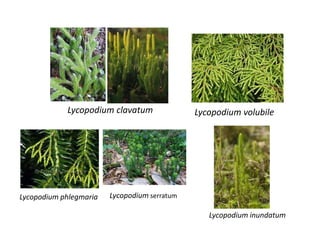
• Eg.- L.cernuum, L. clavatum, L.serratum,
L.volubile, L. inundatum, L. phlegmaria, L. selago
• Commonly called:
– Club moss
– Ground pine
– Trailing over green
• Represented by 400 species, worldwide in
distribution
• In India, represented by 33 species
• Eg.- L.cernuum, L. clavatum, L.serratum,
L.volubile, L. inundatum, L. phlegmaria, L. selago
Habit
• Found in open woodlands, in moist and acidic
soils
• Epiphytic eg.- L. phlegmaria
• Erect and shrubby eg.- L. clavatum
• Creeping forms eg.- L. cernuum- Gives out
erect branches at intervals
• Erect branches highly branched and bushy
• Found in open woodlands, in moist and acidic
soils
• Epiphytic eg.- L. phlegmaria
• Erect and shrubby eg.- L. clavatum
• Creeping forms eg.- L. cernuum- Gives out
erect branches at intervals
• Erect branches highly branched and bushy
Lycopodium clavatum Lycopodium volubile
Lycopodium phlegmaria Lycopodium serratum
Lycopodium inundatum
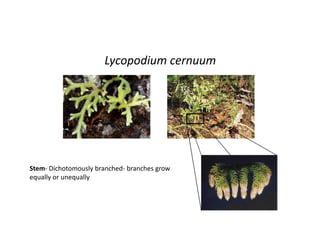
Morpholopgy of Lycopodium cernuum
Young Lycopodium cernuum Mature Lycopodium cernuum
Lycopodium cernuum
Lycopodium cernuum Strobili
Stem- Dichotomously branched- branches grow
equally or unequally
LYCOPODIUM
External Morphology
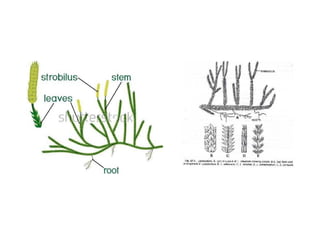
• Plant body is the sporophyte
• Differentiated into root, stem and leaves
• Considering the variation in habit of different
species, Pritzel (1900) divided the genus
Lycopodium into two sub-genera:
– Urostachya
– Rhopalostachya
• Plant body is the sporophyte
• Differentiated into root, stem and leaves
• Considering the variation in habit of different
species, Pritzel (1900) divided the genus
Lycopodium into two sub-genera:
– Urostachya
– Rhopalostachya
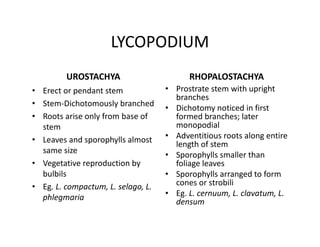
LYCOPODIUM
UROSTACHYA
• Erect or pendant stem
• Stem-Dichotomously branched
• Roots arise only from base of
stem
• Leaves and sporophylls almost
same size
• Vegetative reproduction by
bulbils
• Eg. L. compactum, L. selago, L.
phlegmaria
RHOPALOSTACHYA
• Prostrate stem with upright
branches
• Dichotomy noticed in first
formed branches; later
monopodial
• Adventitious roots along entire
length of stem
• Sporophylls smaller than
foliage leaves
• Sporophylls arranged to form
cones or strobili
• Eg. L. cernuum, L. clavatum, L.
densum
• Erect or pendant stem
• Stem-Dichotomously branched
• Roots arise only from base of
stem
• Leaves and sporophylls almost
same size
• Vegetative reproduction by
bulbils
• Eg. L. compactum, L. selago, L.
phlegmaria
• Prostrate stem with upright
branches
• Dichotomy noticed in first
formed branches; later
monopodial
• Adventitious roots along entire
length of stem
• Sporophylls smaller than
foliage leaves
• Sporophylls arranged to form
cones or strobili
• Eg. L. cernuum, L. clavatum, L.
densum
LYCOPODIUM
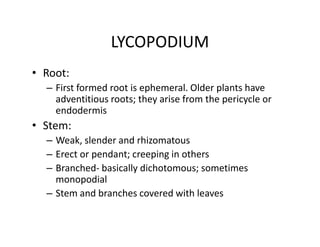
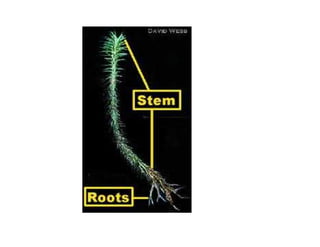
• Root:
– First formed root is ephemeral. Older plants have
adventitious roots; they arise from the pericycle or
endodermis
• Stem:
– Weak, slender and rhizomatous
– Erect or pendant; creeping in others
– Branched- basically dichotomous; sometimes
monopodial
– Stem and branches covered with leaves
• Root:
– First formed root is ephemeral. Older plants have
adventitious roots; they arise from the pericycle or
endodermis
• Stem:
– Weak, slender and rhizomatous
– Erect or pendant; creeping in others
– Branched- basically dichotomous; sometimes
monopodial
– Stem and branches covered with leaves
LYCOPODIUM
Leaf
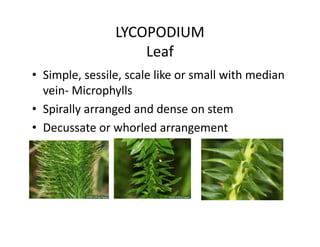
• Simple, sessile, scale like or small with median
vein- Microphylls
• Spirally arranged and dense on stem
• Decussate or whorled arrangement
• Simple, sessile, scale like or small with median
vein- Microphylls
• Spirally arranged and dense on stem
• Decussate or whorled arrangement
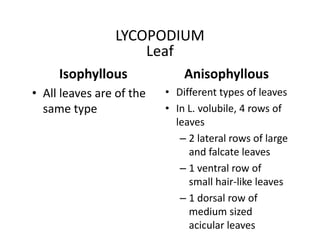
Isophyllous
• All leaves are of the
same type
Anisophyllous
• Different types of leaves
• In L. volubile, 4 rows of
leaves
– 2 lateral rows of large
and falcate leaves
– 1 ventral row of
small hair-like leaves
– 1 dorsal row of
medium sized
acicular leaves
LYCOPODIUM
Leaf
• All leaves are of the
same type
• Different types of leaves
• In L. volubile, 4 rows of
leaves
– 2 lateral rows of large
and falcate leaves
– 1 ventral row of
small hair-like leaves
– 1 dorsal row of
medium sized
acicular leaves
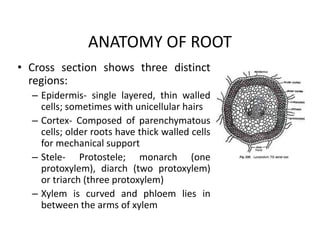
ANATOMY OF ROOT
• Cross section shows three distinct
regions:
– Epidermis- single layered, thin walled
cells; sometimes with unicellular hairs
– Cortex- Composed of parenchymatous
cells; older roots have thick walled cells
for mechanical support
– Stele- Protostele; monarch (one
protoxylem), diarch (two protoxylem)
or triarch (three protoxylem)
– Xylem is curved and phloem lies in
between the arms of xylem
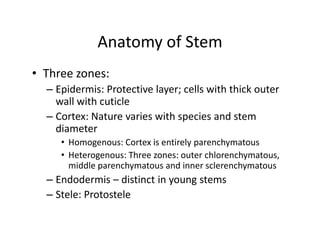
Anatomy of Stem
• Three zones:
– Epidermis: Protective layer; cells with thick outer
wall with cuticle
– Cortex: Nature varies with species and stem
diameter
• Homogenous: Cortex is entirely parenchymatous
• Heterogenous: Three zones: outer chlorenchymatous,
middle parenchymatous and inner sclerenchymatous
– Endodermis – distinct in young stems
– Stele: Protostele
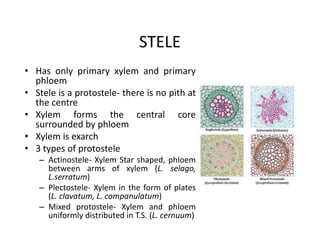
STELE
• Has only primary xylem and primary
phloem
• Stele is a protostele- there is no pith at
the centre
• Xylem forms the central core
surrounded by phloem
• Xylem is exarch
• 3 types of protostele
– Actinostele- Xylem Star shaped, phloem
between arms of xylem (L. selago,
L.serratum)
– Plectostele- Xylem in the form of plates
(L. clavatum, L. companulatum)
– Mixed protostele- Xylem and phloem
uniformly distributed in T.S. (L. cernuum)
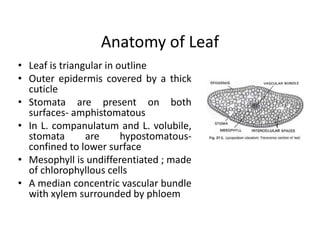
Anatomy of Leaf
• Leaf is triangular in outline
• Outer epidermis covered by a thick
cuticle
• Stomata are present on both
surfaces- amphistomatous
• In L. companulatum and L. volubile,
stomata are hypostomatous-
confined to lower surface
• Mesophyll is undifferentiated ; made
of chlorophyllous cells
• A median concentric vascular bundle
with xylem surrounded by phloem
REPRODUCTION
• Vegetative Reproduction
– Gemmae or Bulbils
– Fragmentation
– Formation of Resting Buds
– Formation of Root tubercles
– Formation of Adventitious Buds
• By Spores
– Homosporous condition
• Vegetative Reproduction
– Gemmae or Bulbils
– Fragmentation
– Formation of Resting Buds
– Formation of Root tubercles
– Formation of Adventitious Buds
• By Spores
– Homosporous condition
Vegetative Reproduction
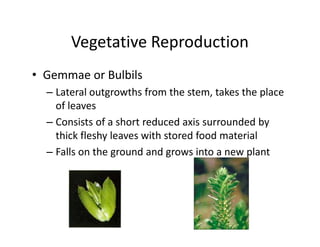
• Gemmae or Bulbils
– Lateral outgrowths from the stem, takes the place
of leaves
– Consists of a short reduced axis surrounded by
thick fleshy leaves with stored food material
– Falls on the ground and grows into a new plant
• Gemmae or Bulbils
– Lateral outgrowths from the stem, takes the place
of leaves
– Consists of a short reduced axis surrounded by
thick fleshy leaves with stored food material
– Falls on the ground and grows into a new plant
Vegetative Reproduction
• Fragmentation
– Death and decay of older parts of the stem leads
to separation of younger branches which grow
into new plants
• Formation of resting buds
– Tips of apical buds of rhizome and branches store
food material and is surrounded by a bunch of
leaves. In winter, rest of the plant dies and the
resting bud develops into new plants.
Vegetative Reproduction
• Formation of root tubercles
– Group of cells with stored food material and
protected by thick walls- germinates into new
plants
• Formation of Adventitious Buds
– In the leaves epidermal cells proliferate near the
base and grow into buds. These buds are capable
of germinating into new plants.
• Formation of root tubercles
– Group of cells with stored food material and
protected by thick walls- germinates into new
plants
• Formation of Adventitious Buds
– In the leaves epidermal cells proliferate near the
base and grow into buds. These buds are capable
of germinating into new plants.
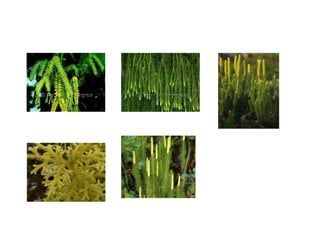
Strobilus in Lycopodium
• In Urostachya, every leaf on the plant is a
sporophyll
• In Rhopalostachya, the leaves near the apices
bear sporangia and are called sporophylls
• Sometimes sporophylls are distinctly smaller
than the foliage leaves
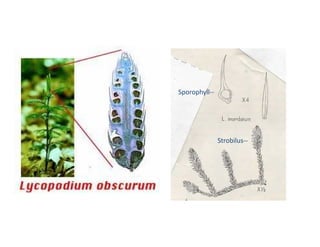
• Aggregation of sporophylls is called strobilus
• A strobilus has a central axis on which spirally
arranged sporophylls are present
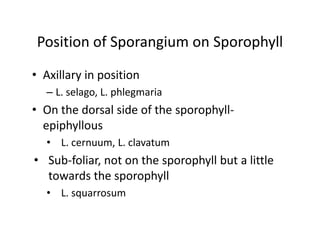
Position of Sporangium on Sporophyll
• Axillary in position
– L. selago, L. phlegmaria
• On the dorsal side of the sporophyll-
epiphyllous
• L. cernuum, L. clavatum
• Sub-foliar, not on the sporophyll but a little
towards the sporophyll
• L. squarrosum
• Axillary in position
– L. selago, L. phlegmaria
• On the dorsal side of the sporophyll-
epiphyllous
• L. cernuum, L. clavatum
• Sub-foliar, not on the sporophyll but a little
towards the sporophyll
• L. squarrosum
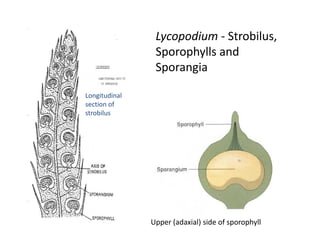
Sporophyll--
Strobilus--
Lycopodium - Strobilus,
Sporophylls and
Sporangia
Longitudinal
section of
strobilus
Upper (adaxial) side of sporophyll
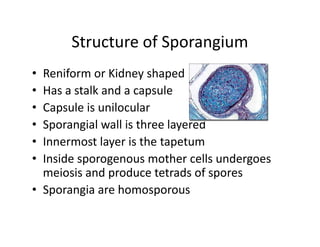
Structure of Sporangium
• Reniform or Kidney shaped
• Has a stalk and a capsule
• Capsule is unilocular
• Sporangial wall is three layered
• Innermost layer is the tapetum
• Inside sporogenous mother cells undergoes
meiosis and produce tetrads of spores
• Sporangia are homosporous
• Reniform or Kidney shaped
• Has a stalk and a capsule
• Capsule is unilocular
• Sporangial wall is three layered
• Innermost layer is the tapetum
• Inside sporogenous mother cells undergoes
meiosis and produce tetrads of spores
• Sporangia are homosporous
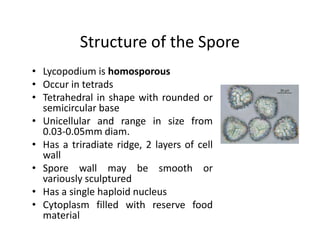
Structure of the Spore
• Lycopodium is homosporous
• Occur in tetrads
• Tetrahedral in shape with rounded or
semicircular base
• Unicellular and range in size from
0.03-0.05mm diam.
• Has a triradiate ridge, 2 layers of cell
wall
• Spore wall may be smooth or
variously sculptured
• Has a single haploid nucleus
• Cytoplasm filled with reserve food
material
Dehiscence of Sporangium
• Elongation of the internodes of strobilus
• Sporophylls spread out exposing sporangia
• A line of cells are differentiated on the sporangial
wall called stomium
• Inner walls of cells of stomium are thick and
lignified
• Exposed sporangia lose water and dry
• Split appears in the stomium and sporangia open
into two valves
• Air disseminates the spores
Germination of the Spore
• Time taken for germination varies from a few
days to several years after their liberation from
the sporangium
• Quickly germinating spores produce aerial short
lived and green prothalli
– L. cernuum, L. inundatum
• When spores take longer time to germinate, they
get buried under the soil and produce colourless
subterranean prothalli that are large, tuberous
and long lived
Germination of the Spore
• The spore germinates to produce the
gametophyte
• The gametophyte is called the prothallus
• It produces the antheridia and archegonia
• It is free living independent of the sporophyte
• 2 regions- lower region attaches to the soil
• Upper region- Generative zone containing
antheridia and archegonia
Gametophyte
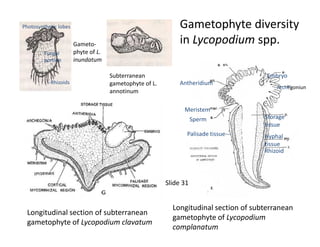
• Three types of Prothalli are present in
Lycopodium
– Cernuum Type
– Clavatum Type
– Phlegmaria Type
• Three types of Prothalli are present in
Lycopodium
– Cernuum Type
– Clavatum Type
– Phlegmaria Type
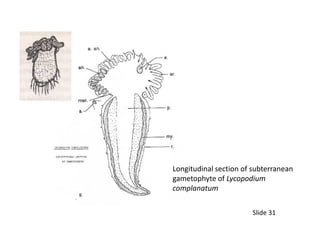
CERNUUM TYPE
• L. cernuum, L. inundatum
• Erect cylindrical body, 2-3 mm long
• Grows on the surface of the ground
• Colourless basal portion buried in the soil
• Lobed generative zone-green and bearing sex organs at
the base of the lobes
• Rhizoids restricted to lower buried portion
• Endophytic fungus is present in the basal portion
• Meristematic tissue present as a rim around upper part
• Prothallus is independent and prepares its own food
Longitudinal section of subterranean
gametophyte of Lycopodium
complanatum
Slide 31
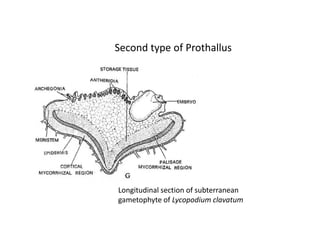
CLAVATUM TYPE
• Spore germination is delayed for a long time (one to
many years), thus the prothallus has a longer lifespan.
• Here the prothalli are fleshy, non-green, totally
saprophytic and completely subterranean and
perennial in nature.
• Development takes place beneath the surface of the
ground or within a layer of humus.
• The prothalli are large and may be up to 2 centimeters
in length. They may be top-shaped with a convolute
margin or carrot shaped
• The top of the prothallus are lobed and the sex organs
and the growing embryos are located on these lobes.
• All the gametophytic cells are parenchymatous
• Spore germination is delayed for a long time (one to
many years), thus the prothallus has a longer lifespan.
• Here the prothalli are fleshy, non-green, totally
saprophytic and completely subterranean and
perennial in nature.
• Development takes place beneath the surface of the
ground or within a layer of humus.
• The prothalli are large and may be up to 2 centimeters
in length. They may be top-shaped with a convolute
margin or carrot shaped
• The top of the prothallus are lobed and the sex organs
and the growing embryos are located on these lobes.
• All the gametophytic cells are parenchymatous
Second type of Prothallus
Longitudinal section of subterranean
gametophyte of Lycopodium clavatum
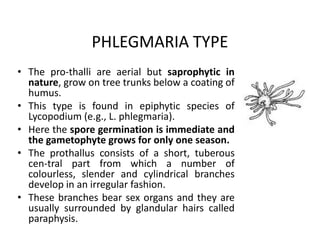
PHLEGMARIA TYPE
• The pro­thalli are aerial but saprophytic in
nature, grow on tree trunks below a coating of
humus.
• This type is found in epiphytic species of
Lycopodium (e.g., L. phlegmaria).
• Here the spore germination is immediate and
the gametophyte grows for only one season.
• The prothallus consists of a short, tuberous
cen­tral part from which a number of
colourless, slender and cylindrical branches
develop in an irregular fashion.
• These branches bear sex organs and they are
usually surrounded by glandular hairs called
paraphysis.
Antheridium
Embryo
Archegonium
Storage
tissue
Meristem
Sperm
-Rhizoids
Photosynthetic lobes
Fungal
portion
Gameto-
phyte of L.
inundatum
Subterranean
gametophyte of L.
annotinum
Gametophyte diversity
in Lycopodium spp.
Longitudinal section of subterranean
gametophyte of Lycopodium
complanatum
Longitudinal section of subterranean
gametophyte of Lycopodium clavatum
Storage
tissue
Hyphal
tissue
Rhizoid
Palisade tissue---
Slide 31
Vegetative Reproduction of the
Prothallus
• By formation of gemmae
– Borne on branches of prothallus
– Singly or in clusters
– Thick walled and stores food materials
– Capable of perennation
• By progressive death and decay of older parts
• Adventitious buds arise from injured parts of
the lobes
• By formation of gemmae
– Borne on branches of prothallus
– Singly or in clusters
– Thick walled and stores food materials
– Capable of perennation
• By progressive death and decay of older parts
• Adventitious buds arise from injured parts of
the lobes
PROTHALLI
• Prothalli are monoecious- male
antheridia and female archegonia
are borne on the same thallus
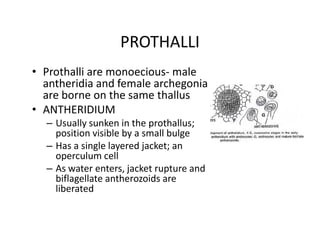
• ANTHERIDIUM
– Usually sunken in the prothallus;
position visible by a small bulge
– Has a single layered jacket; an
operculum cell
– As water enters, jacket rupture and
biflagellate antherozoids are
liberated
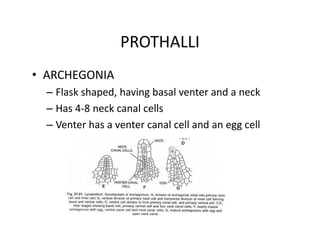
PROTHALLI
• ARCHEGONIA
– Flask shaped, having basal venter and a neck
– Has 4-8 neck canal cells
– Venter has a venter canal cell and an egg cell
• ARCHEGONIA
– Flask shaped, having basal venter and a neck
– Has 4-8 neck canal cells
– Venter has a venter canal cell and an egg cell
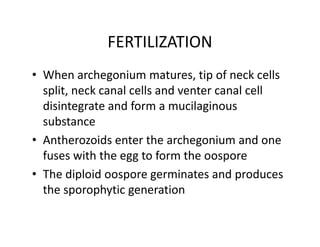
FERTILIZATION
• When archegonium matures, tip of neck cells
split, neck canal cells and venter canal cell
disintegrate and form a mucilaginous
substance
• Antherozoids enter the archegonium and one
fuses with the egg to form the oospore
• The diploid oospore germinates and produces
the sporophytic generation
• When archegonium matures, tip of neck cells
split, neck canal cells and venter canal cell
disintegrate and form a mucilaginous
substance
• Antherozoids enter the archegonium and one
fuses with the egg to form the oospore
• The diploid oospore germinates and produces
the sporophytic generation
II-UG-Core-IV-Sem-Lycopodium-AVJ.pdf,......