Lycopodium
Classification:
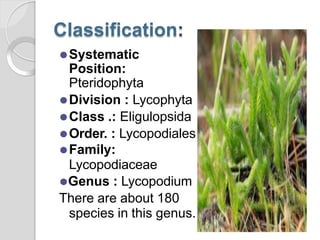
⚫Systematic
Position:
Pteridophyta
⚫Division : Lycophyta
⚫Class .: Eligulopsida
⚫Order. : Lycopodiales
⚫Family:
Lycopodiaceae
⚫Genus : Lycopodium
There are about 180
species in this genus.
LYCOPODIUM
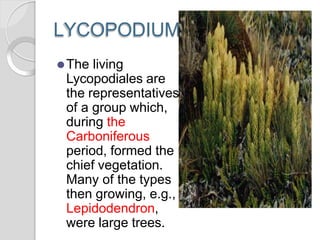
⚫The living
Lycopodiales are
the representatives
of a group which,
during the
Carboniferous
period, formed the
chief vegetation.
Many of the types
then growing, e.g.,
Lepidodendron,
were large trees.
⚫The modern representatives are
small and herbaceous
sporophytes
⚫The leaves are small and simple.
Each leaf possesses an
unbranched midrib.
⚫The leaves have no ligules. There
are no leaf gaps in the stele of the
stem.
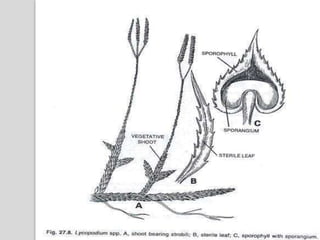
⚫The sporophylls may or may not
be restricted to the terminal
⚫The sporophylls and simple
vegetative leaves may be similar
or dissimilar. They possess
homosporous sporangia, i.e., all
the spores of one kind only.
⚫The gametophytes are wholly or
partly subterranean. The
antheridia remain embedded in
the tissue of the prothallus. The
antherozoids are biflagellate.
Distribution and habit
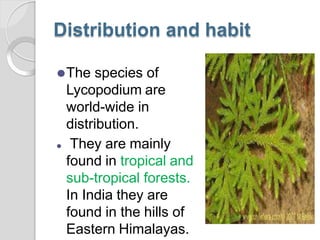
⚫The species of
Lycopodium are
world-wide in
distribution.
⚫ They are mainly
found in tropical and
sub-tropical forests.
In India they are
found in the hills of
Eastern Himalayas.
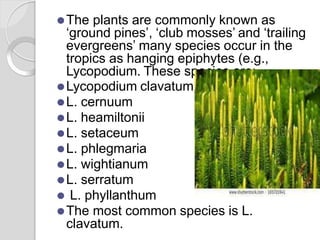
⚫The plants are commonly known as
‘ground pines’, ‘club mosses’ and ‘trailing
evergreens’ many species occur in the
tropics as hanging epiphytes (e.g.,
Lycopodium. These species are:
⚫Lycopodium clavatum
⚫L. cernuum
⚫L. heamiltonii
⚫L. setaceum
⚫L. phlegmaria
⚫L. wightianum
⚫L. serratum
⚫ L. phyllanthum
⚫The most common species is L.
clavatum.
Habit:
All species possess small,
herbaceous or shrubby
sporophytes. The stem in almost
all the species is delicate and
weak. Some species are
epiphytic and with erect or
pendant sporophytes while other
species are terrestrial and have a
trailing habit.(vines) The stem
and its branches are densely
covered with small leaves.
Stems:
Species referred to the sub-genus
Urostachya possess branched or
unbranched stems that are erect or
pendant but never creeping. This
subgenus includes the species, e.g.,
L. selago, L. lucidulum, L. phlegmaria
and others.
If the stem is branched, the branching
is always dichotomous. Usually the
successive dichotomies are found at
right angles to one another. The
species belonging to this subgenus do
Leaves:
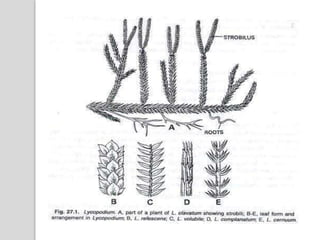
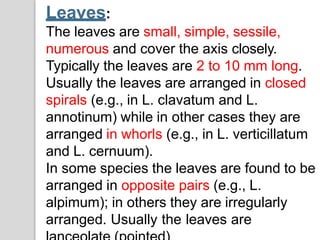
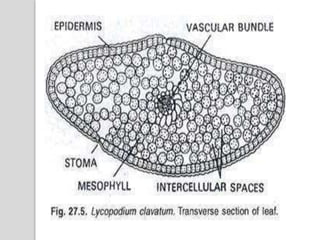
The leaves are small, simple, sessile,
numerous and cover the axis closely.
Typically the leaves are 2 to 10 mm long.
Usually the leaves are arranged in closed
spirals (e.g., in L. clavatum and L.
annotinum) while in other cases they are
arranged in whorls (e.g., in L. verticillatum
and L. cernuum).
In some species the leaves are found to be
arranged in opposite pairs (e.g., L.
alpimum); in others they are irregularly
arranged. Usually the leaves are
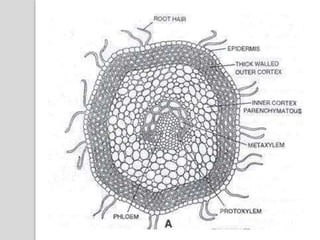
ROOTS:
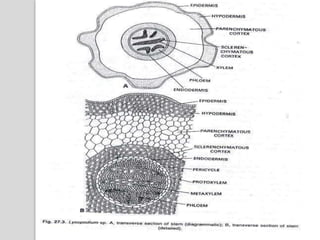
The roots that arise on the
outside of the stele do not
penetrate the cortical region of
the stem at once. These roots
turn downward and penetrate the
soft middle cortex making canals
through it, and ultimately they
emerge only at the stem. Such
roots are known as ‘cortical roots’
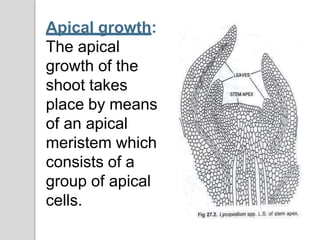
Apical growth:
The apical
growth of the
shoot takes
place by means
of an apical
meristem which
consists of a
group of apical
cells.
Vegetative propagation of the
sporophyte:
The new plants may be developed
from
•(a) vegetative propagation of the
gametophyte,
•(b) vegetative propagation of the
juvenile stage of the sporophyte,
•(c) gemmae produced from the
cortical cells of the root,
•(d) tubers developed at the apices of
roots and
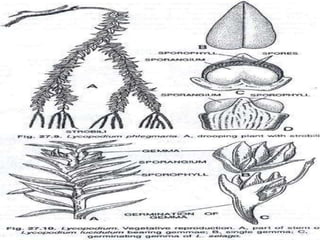
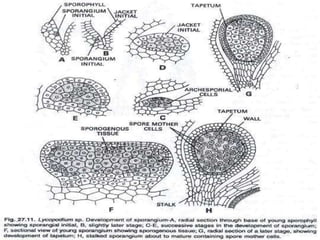
Development of sporangium:
•The sporangia begin to develop at a time
when the sporophyll is composed of
embryonic cells
•The inner daughter cells formed by this
periclinal division give rise to the stalk
and the basal portion of a sporangium.
The outer daughter cells contribute to the
formation to the bulk of the sporangium.
•The outer cells again divide periclinally
forming an outer layer, the jacket initials;
and an inner layer, the archesporial cells.
•The archesporial cells divide
periclinally and anticlinally forming a
massive sporogenous tissue.
•The cells of the last generation of
the sporogenous tissue act as spore
mother cells.
•They become rounded and are
being separated from one another.
•Now these spore mother cells float
about in a viscous liquid and divide
meiotically into tetrads of spores
•The jacket initials, which are
found external to the
sporogenous tissue divide
repeatedly forming a jacket
layer of three or more cells, in
thickness.
•Shortly before the
development of the spore
mother cells a nutritive tapetal
layer is formed around the
•This layer is partly formed from
the inner-most layer of jacket
cells and partly from sporangial
cells found just beneath the
sporogenous tissue.
•As found in most other
pteridophytes, in Lycopodium
there is no disintegration of the
Tapetum during spore
formation.
Dehiscence of sporangium:
The mature sporangium is about 2 mm across
and kidney-shaped. On the maturity of the
sporangium narrow transverse strip of cells,
the stomium is formed across the apical
portion of the outermost jacket layer.
The cell walls of the stomial portion become
thickened and may easily be differentiated
from those of other cells present in the jacket
layer of the sporangium. The mature
sporangium ruptures by a transverse slit at its
apex along the line of the stomium. The
sporangium divides into two valves which
remain united at the base and dehiscing the
yellow spores
The Gametophyte
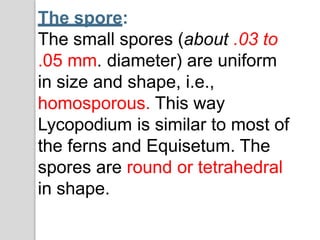
The spore:
The small spores (about .03 to
.05 mm. diameter) are uniform
in size and shape, i.e.,
homosporous. This way
Lycopodium is similar to most of
the ferns and Equisetum. The
spores are round or tetrahedral
in shape.
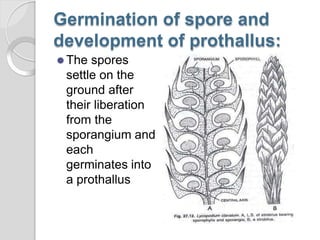
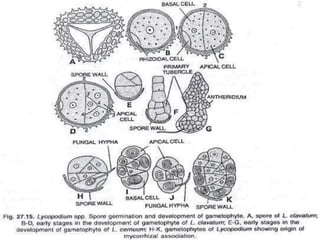
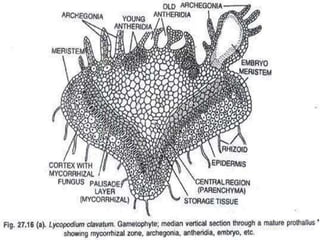
Germination of spore and
development of prothallus:
⚫ The spores
settle on the
ground after
their liberation
from the
sporangium and
each
germinates into
a prothallus
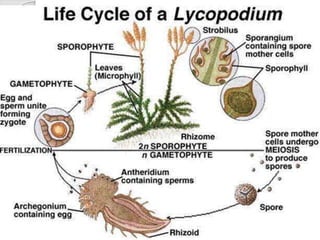
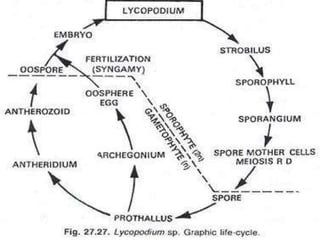
Life cycle Of Lycopodium
Life Cycle
Lycopodium sp. herb has been used in
the traditionalAustrian medicine internally

as tea or externally as compresses for
treatment of disorders of the locomotor
system, skin, liver and bile, kidneys and
urinary tract, infections, and gout.
Lycopodium powder is also used to
determine the molecular size of oleic acid.
Economic Importance.
Lycopodium.pptx

Lycopodium.pptx

  • 1.
  • 2.
    Classification: ⚫Systematic Position: Pteridophyta ⚫Division : Lycophyta ⚫Class.: Eligulopsida ⚫Order. : Lycopodiales ⚫Family: Lycopodiaceae ⚫Genus : Lycopodium There are about 180 species in this genus.
  • 3.
    LYCOPODIUM ⚫The living Lycopodiales are therepresentatives of a group which, during the Carboniferous period, formed the chief vegetation. Many of the types then growing, e.g., Lepidodendron, were large trees.
  • 4.
    ⚫The modern representativesare small and herbaceous sporophytes ⚫The leaves are small and simple. Each leaf possesses an unbranched midrib. ⚫The leaves have no ligules. There are no leaf gaps in the stele of the stem. ⚫The sporophylls may or may not be restricted to the terminal
  • 5.
    ⚫The sporophylls andsimple vegetative leaves may be similar or dissimilar. They possess homosporous sporangia, i.e., all the spores of one kind only. ⚫The gametophytes are wholly or partly subterranean. The antheridia remain embedded in the tissue of the prothallus. The antherozoids are biflagellate.
  • 6.
    Distribution and habit ⚫Thespecies of Lycopodium are world-wide in distribution. ⚫ They are mainly found in tropical and sub-tropical forests. In India they are found in the hills of Eastern Himalayas.
  • 7.
    ⚫The plants arecommonly known as ‘ground pines’, ‘club mosses’ and ‘trailing evergreens’ many species occur in the tropics as hanging epiphytes (e.g., Lycopodium. These species are: ⚫Lycopodium clavatum ⚫L. cernuum ⚫L. heamiltonii ⚫L. setaceum ⚫L. phlegmaria ⚫L. wightianum ⚫L. serratum ⚫ L. phyllanthum ⚫The most common species is L. clavatum.
  • 9.
    Habit: All species possesssmall, herbaceous or shrubby sporophytes. The stem in almost all the species is delicate and weak. Some species are epiphytic and with erect or pendant sporophytes while other species are terrestrial and have a trailing habit.(vines) The stem and its branches are densely covered with small leaves.
  • 10.
    Stems: Species referred tothe sub-genus Urostachya possess branched or unbranched stems that are erect or pendant but never creeping. This subgenus includes the species, e.g., L. selago, L. lucidulum, L. phlegmaria and others. If the stem is branched, the branching is always dichotomous. Usually the successive dichotomies are found at right angles to one another. The species belonging to this subgenus do
  • 14.
    Leaves: The leaves aresmall, simple, sessile, numerous and cover the axis closely. Typically the leaves are 2 to 10 mm long. Usually the leaves are arranged in closed spirals (e.g., in L. clavatum and L. annotinum) while in other cases they are arranged in whorls (e.g., in L. verticillatum and L. cernuum). In some species the leaves are found to be arranged in opposite pairs (e.g., L. alpimum); in others they are irregularly arranged. Usually the leaves are
  • 17.
    ROOTS: The roots thatarise on the outside of the stele do not penetrate the cortical region of the stem at once. These roots turn downward and penetrate the soft middle cortex making canals through it, and ultimately they emerge only at the stem. Such roots are known as ‘cortical roots’
  • 19.
    Apical growth: The apical growthof the shoot takes place by means of an apical meristem which consists of a group of apical cells.
  • 20.
    Vegetative propagation ofthe sporophyte: The new plants may be developed from •(a) vegetative propagation of the gametophyte, •(b) vegetative propagation of the juvenile stage of the sporophyte, •(c) gemmae produced from the cortical cells of the root, •(d) tubers developed at the apices of roots and
  • 21.
    Development of sporangium: •Thesporangia begin to develop at a time when the sporophyll is composed of embryonic cells •The inner daughter cells formed by this periclinal division give rise to the stalk and the basal portion of a sporangium. The outer daughter cells contribute to the formation to the bulk of the sporangium. •The outer cells again divide periclinally forming an outer layer, the jacket initials; and an inner layer, the archesporial cells.
  • 22.
    •The archesporial cellsdivide periclinally and anticlinally forming a massive sporogenous tissue. •The cells of the last generation of the sporogenous tissue act as spore mother cells. •They become rounded and are being separated from one another. •Now these spore mother cells float about in a viscous liquid and divide meiotically into tetrads of spores
  • 23.
    •The jacket initials,which are found external to the sporogenous tissue divide repeatedly forming a jacket layer of three or more cells, in thickness. •Shortly before the development of the spore mother cells a nutritive tapetal layer is formed around the
  • 24.
    •This layer ispartly formed from the inner-most layer of jacket cells and partly from sporangial cells found just beneath the sporogenous tissue. •As found in most other pteridophytes, in Lycopodium there is no disintegration of the Tapetum during spore formation.
  • 26.
    Dehiscence of sporangium: Themature sporangium is about 2 mm across and kidney-shaped. On the maturity of the sporangium narrow transverse strip of cells, the stomium is formed across the apical portion of the outermost jacket layer. The cell walls of the stomial portion become thickened and may easily be differentiated from those of other cells present in the jacket layer of the sporangium. The mature sporangium ruptures by a transverse slit at its apex along the line of the stomium. The sporangium divides into two valves which remain united at the base and dehiscing the yellow spores
  • 28.
  • 29.
    The spore: The smallspores (about .03 to .05 mm. diameter) are uniform in size and shape, i.e., homosporous. This way Lycopodium is similar to most of the ferns and Equisetum. The spores are round or tetrahedral in shape.
  • 30.
    Germination of sporeand development of prothallus: ⚫ The spores settle on the ground after their liberation from the sporangium and each germinates into a prothallus
  • 33.
    Life cycle OfLycopodium
  • 34.
  • 36.
    Lycopodium sp. herbhas been used in the traditionalAustrian medicine internally as tea or externally as compresses for treatment of disorders of the locomotor system, skin, liver and bile, kidneys and urinary tract, infections, and gout. Lycopodium powder is also used to determine the molecular size of oleic acid. Economic Importance.