CYCAS
Systematic Position
Division: CYCADOPHYTA
Class: CYCADOPSIDA
Order: CYCADALES
Family: CYCADACEAE
Genus: CYCAS
(Greek word Kycas= Cocopalm)
Distribution & Occurrence
 Includes 15 -20 Species
 Occurs wild or cultivated in tropical and sub-tropical
regions
 Common Indian Species:
 Cycas circinalis
 C. rumphii
 C.beddomei
 C.revoluta
 C.siamensis
 C.pectinata
GENERAL MORPHOLOGY
 Plants are low and
palm-like, height 4-8
feet
 Plant body consists of a
columnar aeriel trunk
with a crown of
pinnately compound
leaves at its top.
Roots – 2 types
 Normal tap roots
 Positively geotropic
 Grow deep into soil
 Possess no root hairs
 Function: fixation and
absorption
◼ Coralloid roots
◼ Arise from normal roots
near the ground surface
◼ Infected with bacteria
,fungi and algae
◼ Grow horizontally in the
soil become swollen at
tips
◼ Divide repeatedly to
form bunches- greenish
or brownish
◼ Coral like appearance
Stem
 Thick, woody and unbranched
 Tuberous when young but columnar erect and stout
at maturity
 Aerial part remains covered by thick large
rhomboidal leaf bases
 Larger leaf bases – foliage leaves
 Smaller ones – scale leaves
Leaves – 2 types
 Foliage leaves / assimilatory
fronds
 Green , large, pinnately
compound leaves with spiny
petiole and large strong rachis
 Rachis bears many leaflets
 Scaly leaves / Cataphylls
 Dry , brown coloured
,somewhat triangular leaves
 Present at the apex of the stem
Anatomy – Coralloid root
 Anatomically Coralloid
roots resemble normal
roots except some
differences:
 Secondary vascular tissue
is totally absent
 Cortex is wider
 Presence of a greenish algal
zone in the middle of the
cortex
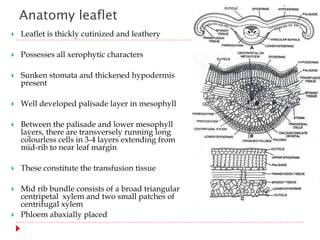
Anatomy leaflet
 Leaflet is thickly cutinized and leathery
 Possesses all xerophytic characters
 Sunken stomata and thickened hypodermis
present
 Well developed palisade layer in mesophyll
 Between the palisade and lower mesophyll
layers, there are transversely running long
colourless cells in 3-4 layers extending from
mid-rib to near leaf margin
 These constitute the transfusion tissue
 Mid rib bundle consists of a broad triangular
centripetal xylem and two small patches of
centrifugal xylem
 Phloem abaxially placed
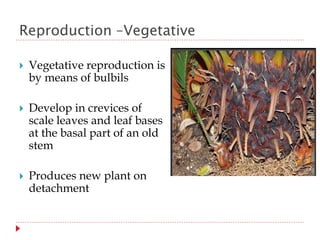
Reproduction –Vegetative
 Vegetative reproduction is
by means of bulbils
 Develop in crevices of
scale leaves and leaf bases
at the basal part of an old
stem
 Produces new plant on
detachment
Reproduction –Sexual
 Strictly dioecious plant
 Male strobilus or cone
borne singly at the apex of
the trunk
 Apical shoot apex utilized
in the development of
male cone, hence
branching sympodial
 Cone shortly stalked &
large(upto 50cm length or
more)
 Cones or strobili are
found at the apex of the
trunk
 Numerous micro-sporophylls
spirally arranged around the
central axis
 Each micro-sporophyll is
narrow below and broad
above terminating into
projection–the apophysis
 Microsporangia confined to
abaxial(lower) surface
 Usually present in sori–each
with 2-6 sporangia
 They contain a large number
of haploid microspores
(pollengrains)
Pollination -Development of male
gametophyte after pollination
 The pollen grains are carried by wind(Anemophily)
and caught by pollination drop secreted by ovule.
 Pollination is direct.
 The pollination drop is dehydrated and the pollen
grains are sucked in to the pollenchamber.
 Pollen grains take rest for some time in the pollen
chamber
 During the germination of pollen grain the exine is
ruptured and the inner intine comes out in the form of a
tube like structure known as pollentube.
 At this time the generative cell divides and forms a
larger,upper body cell and smaller,lower stalk cell.
 The pollen tube acts as haustorium to absorb food materials
from the nucellus besides as sperm carrier.
 During the germination of pollen grain the exine is ruptured and the inner intine comes
out in the form of a tube like structure known as pollentube.
 At this time the generative cell divides and forms a larger,upper body cell and
smaller,lower stalk cell.
 The pollen tube acts as haustorium to absorb food materials from the nucellus besides as
sperm carrier.
 The body cell divides and forms two naked,top shaped,motile,multiciliated
antherozoids.The cilia are in 4–5spirals.
 The male gametes of Cycas are 180–210μ in size and largest in the plant kingdom.
Female Reproductive Structures
 Female plant do not produce
definite cones
 A whorl of spirally arranged
megasporophylls arise
around the short apex
 Each megasporophyll
resembles the foliage leaf and
approximately 10-23 cms.
long
 Lower petiolar part bears the
naked ovules on the margins
Ovule Structure
 Ovules are orthotropous, sessile,
ovoid or spherical in shape and
unitegmic.
 The thick integument is
differentiated in threelayers-
outer and inner fleshy layers,
middle stony
 The integument remains fused
inside with nucellar tissue except
at the position where it forms the
micropylar opening.
 Ovule is well supplied with
vascular bundles.
Megasporangium
 The megaspore develops in the nucellus by meiotic
division and goes on to form female gametophyte
tissue.
 2-3 archegonia are formed in this haploid tissue
which is food laden.
 Egg cell in the venter of archegonia,undergoes
fertilization by the motile spermatozoid forming
diploid zygote
Young Sporophyte–Embryo
 Embryo development is meroblastic.
 Pro embryo shows upper haustorial part, middle
elongating suspensors and the basal meristematic
embryonal region.
Seed
 A mature embryo is straight and has a short hypocotyl.
 Embryonal axis has plumule at one end and radicle at the other.
 Radicle is covered by coleorhiza.
 Number of cotyledons may be 2-3..
 Nucellus is completely absorbed in the seed.
 Mature seed is large 2.5–5cm wide and usually orange or red in
colour.
 Germination is epigeal type
Germination of Seed (Seedling):
 The seeds have no resting period and germinate
immediately if placed on moist soil.
 The seed is large and longer than broad.
 It absorbs water from the moist soil and the
coleorhiza comes first and the tip of the primary
root makes its way through the coleorhiza.
 The major part of the cotyledons comes out of the
seed
 The leaves begin to develop singly on the new plants
 It has been observed that for a number of years only
one leaf is developed at a time.
CYCAS 1.pdf