Nucleus
Domain           Intercellular structures
                 Cytoskeleton
Eukarya          Linear chromosomes
                 Meiosis and Mitosis


                 Primary Endosimbiosis
Supergroup       Contain plastids
Archaeplastida   Chlorophyll A
                 Contain Cellulose in cell walls
                 Starch used as food storage


                 Chlorophyll B, Carotene, Xanthophyll
Kingdom          Flagella
Charophycean     Internal fertilization, egg retained
                 Form phragmoplast during cell plate formation
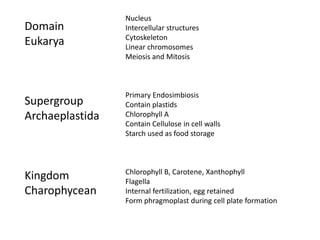
Nucleus
Domain           Intercellular structures
                 Cytoskeleton
Eukarya          Linear chromosomes
                 Meiosis and Mitosis


                 Primary Endosimbiosis
Supergroup       Contain plastids
Archaeplastida   Chlorophyll A
                 Contain Cellulose in cell walls
                 Starch used as food storage


                 Diplohaplontic life cycle
Kingdom          Apical meristem
Plantae          Cuticle
                 Dispersed by seeds or spores
Primary Endosimbiosis
Supergroup       Contain plastids
                 Chlorophyll A
Archaeplastida   Contain Cellulose in cell walls
                 Starch used as food storage


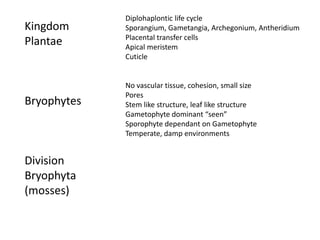
                 Diplohaplontic life cycle
Kingdom          Apical meristem
Plantae          Cuticle
                 Dispersed by seeds or spores


                 Homosporous
                 Non Vascular, small size
Bryophytes       Flagellated Sperm
                 Gametophyte dominant
                 Sporophyte dependant on gametophyte
                 No true leaves, stems or roots (anchors with rhizoids)
                 Have Gametangia: Antheridia & Archegonium
•   Bryophyte Life Cycle – Diplohaplontic, Homosporous
•   Gametophyte dominant, Sporophyte dependant on gametophyte
•   Gametangia (cluster of sex organs)
•   Sporangium
Female Gametangium
Male Gametangium
Moss Sporophyte

• Grows out of
  adult
  gametophyte

• Dependant on
  gametophyte

• Sporangium
  containing
  spores located
  on the top
Rhizoids

• A structure in plants
  that functions like a
  root in support or
  absorption.

• Not a true root due to
  lack of vascular tissue
Diplohaplontic life cycle
Kingdom        Apical meristem
               Cuticle
Plantae        Dispersed by seeds or spores


               Homosporous
               Non Vascular, small size
Bryophytes     Flagellated Sperm
               Gametophyte dominant
               Sporophyte dependant on gametophyte
               No true leaves, stems or roots (anchors with rhizoids)
               Have Gametangia: Antheridia & Archegonium

Division
Hepatophyta    Gametangia are antheridia and archegonia
(liverworts)   Just pores, no stomata
               Flattened leaf-like lobes
Division Hepatophyta
(liverworts)
• Flattened leaf-like lobes

• Looks like liver, originally
  thought to be good for the
  liver when eaten

• Just pores, no stomata
Diplohaplontic life cycle
Kingdom          Apical meristem
                 Cuticle
Plantae          Dispersed by seeds or spores


                 Homosporous
                 Non Vascular, small size
Bryophytes       Flagellated Sperm
                 Gametophyte dominant
                 Sporophyte dependant on gametophyte
                 No true leaves, stems or roots (anchors with rhizoids)
                 Have Gametangia: Antheridia & Archegonium

Division
Anthocerophyta   Hornlike sporangia
(hornworts)
Division Anthocerophyta (hornworts)
Green top parts: Sporangia (horns)
Dark slime looking bottom: Dominant Gametophyte
Diplohaplontic life cycle
Kingdom      Apical meristem
             Cuticle
Plantae      Dispersed by seeds or spores


             Homosporous
             Non Vascular, small size
             Flagellated Sperm
Bryophytes   Gametophyte dominant
             Sporophyte dependant on gametophyte
             No true leaves, stems or roots (anchors with rhizoids)
             Have Gametangia: Antheridia & Archegonium


Division
             Has Leaf like structures
Bryophyta    Sporophyte has a capsule with calyptras
(mosses)     Gametophyte grows from protonema
             Important part of the eco system
Division
Bryophyta
(moss)

Life Cycle
Division Bryophyta
(moss) capsule

• Operculum falls off
  when dry

• Teeth open

• Internal spores are
  released
Division Bryophyta (moss) capsule with calyptras
Division Bryophyta (moss) Protonema
• When a moss first grows from the spore, it grows as a
  protonema which develops into a leafy gametophyte.
Kingdom: Plantae
Domain: Bryophyta

Genus: Sphagnum

• Demonstrated moss
  absorbance in the
  lab

• Looked at the clear,
  non photosynthetic,
  absorbent cells

• Compared to green,
  photosynthetic cells

• Absorbance
  important in the
  global ecosystem
Division Bryophyta (mosses) gametophyte
Diplohaplontic life cycle
Kingdom             Apical meristem
                    Cuticle
Plantae             Dispersed by seeds or spores


                    Structure, grow larger, nutrient movement
                    Stomata
Seedless Vascular   Roots, shoots and leaves (micro/megaphylls)
Plants              Sporophyte dominant “seen”
                    Gametophyte dependant on Sporophyte
                    Contain Phloem and Xylem
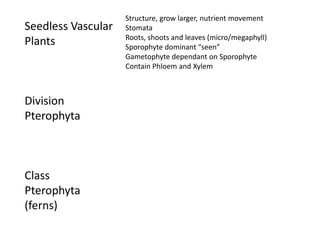
Structure, grow larger, nutrient movement
Seedless Vascular           Stomata
                            Roots, shoots and leaves (micro/megaphyll)
Plants                      Sporophyte dominant “seen”
                            Gametophyte dependant on Sporophyte
                            Contain Phloem and Xylem


Division
Lycophyta
(club moss, ground pines,
spike moss, quillworts)


Genus
Lycopodium
(club moss)
Lycopodium (club moss)
specimen
Lycopodium leaf cross section
Lycopodium Life Cycle
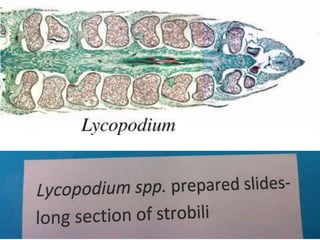
Lycopodium
Strobili
Unmagnified
and
Magnified
Structure, grow larger, nutrient movement
Seedless Vascular           Stomata
                            Roots, shoots and leaves (micro/megaphyll)
Plants                      Sporophyte dominant “seen”
                            Gametophyte dependant on Sporophyte
                            Contain Phloem and Xylem


Division
Lycophyta
(club moss, ground pines,
spike moss, quillworts)


Genus
Selaginella
Selaginella sporophyte
Selaginella Life Cycle
Diplohaplontic life cycle
Kingdom                     Apical meristem
                            Cuticle
Plantae                     Dispersed by seeds or spores


                            Structure, grow larger, nutrient movement
Seedless Vascular           Stomata
Plants                      Roots, shoots and leaves (micro/megaphyll)
                            Sporophyte dominant “seen”
                            Gametophyte dependant on Sporophyte
                            Contain Phloem and Xylem


Division
Pterophyta
(whisk ferns, horsetails,
ferns)
Structure, grow larger, nutrient movement
Seedless Vascular   Stomata
                    Roots, shoots and leaves (micro/megaphyll)
Plants              Sporophyte dominant “seen”
                    Gametophyte dependant on Sporophyte
                    Contain Phloem and Xylem


Division
Pterophyta


Class
Pterophyta
(ferns)
Fern Life cycle
Fern
Life
cycle
Below
Sporophyte growing from
gametophyte
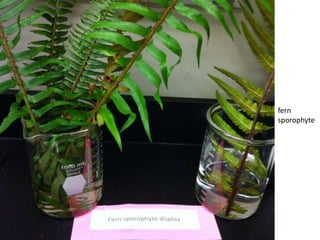
fern
sporophyte
fern
sorus
on
leaf
Fern sorus magnified
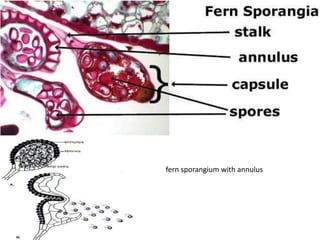
fern sporangium with annulus
Structure, grow larger, nutrient movement
Seedless Vascular   Stomata
                    Roots, shoots and leaves (micro/megaphyll)
Plants              Sporophyte dominant “seen”
                    Gametophyte dependant on Sporophyte
                    Contain Phloem and Xylem


Division
Pterophyta


Class
Psilophyta
(whisk ferns)
Psilophyta
Life cycle
Psilotum Sporangium
Structure, grow larger, nutrient movement
Seedless Vascular   Stomata
                    Roots, shoots and leaves (micro/megaphyll)
Plants              Sporophyte dominant “seen”
                    Gametophyte dependant on Sporophyte
                    Contain Phloem and Xylem


Division
Pterophyta


Class
Sphenophyta
(horsetails)
Life cycle shown in lab
Equisetum life cycle
1. Sporophyte plant
2. Strobilus
3. Sporangium
4. Spores
5. Antheridium
6. Sperm
7. Male gametophyte
8. Female gametophyte
9. Archegonium
10. Egg
11. Zygote
12. Young sporophyte
Equisetum sporophyte
Equisetum gametophyte
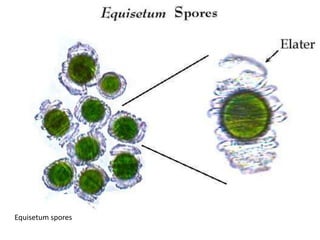
Equisetum spores
Structure, grow larger, nutrient movement
Seedless Vascular   Stomata
                    Roots, shoots and leaves (micro/megaphyll)
Plants              Sporophyte dominant “seen”
                    Gametophyte dependant on Sporophyte
                    Contain Phloem and Xylem


Division
Pterophyta


Class
Sphenophyta
(horsetails)
Kingdom Plantae           Moss gametophyte,
                          moss sporophyte,
Division Hepatophyta      moss capsule with calyptras,
Division Anthocerophyta   moss antheridium,
Division Bryophyta        moss archegonium,
                          moss protonema,
Division Lycophyta        moss rhizoids,
Division Pterophyta       Selaginella strobilis nonmagnified &
                          magnified,
Division Ginkgophyta      fern sporophyte,
Division Cycadophyta      fern sorus,
Division Gnetophyta       fern sporangium with annulus,
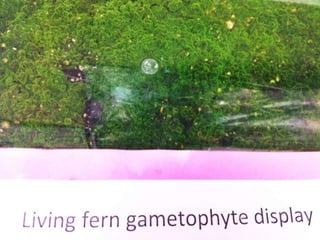
Division Coniferophyta    fern gametophyte,
Division Anthophyta       stomata,
                          megaphyll,
                          Lycopodium strobilis,
                          fern gametophyte,
                          Psilotum sporophyte,
                          Selaginella sporophyte,
                          Equisetum spores,
                          Equisetum sporophyte

Bio 124 Lab Exam 2 Study Guide

  • 1.
    Nucleus Domain Intercellular structures Cytoskeleton Eukarya Linear chromosomes Meiosis and Mitosis Primary Endosimbiosis Supergroup Contain plastids Archaeplastida Chlorophyll A Contain Cellulose in cell walls Starch used as food storage Chlorophyll B, Carotene, Xanthophyll Kingdom Flagella Charophycean Internal fertilization, egg retained Form phragmoplast during cell plate formation
  • 2.
    Nucleus Domain Intercellular structures Cytoskeleton Eukarya Linear chromosomes Meiosis and Mitosis Primary Endosimbiosis Supergroup Contain plastids Archaeplastida Chlorophyll A Contain Cellulose in cell walls Starch used as food storage Diplohaplontic life cycle Kingdom Apical meristem Plantae Cuticle Dispersed by seeds or spores
  • 3.
    Primary Endosimbiosis Supergroup Contain plastids Chlorophyll A Archaeplastida Contain Cellulose in cell walls Starch used as food storage Diplohaplontic life cycle Kingdom Apical meristem Plantae Cuticle Dispersed by seeds or spores Homosporous Non Vascular, small size Bryophytes Flagellated Sperm Gametophyte dominant Sporophyte dependant on gametophyte No true leaves, stems or roots (anchors with rhizoids) Have Gametangia: Antheridia & Archegonium
  • 4.
    Bryophyte Life Cycle – Diplohaplontic, Homosporous • Gametophyte dominant, Sporophyte dependant on gametophyte • Gametangia (cluster of sex organs) • Sporangium
  • 5.
  • 6.
  • 7.
    Moss Sporophyte • Growsout of adult gametophyte • Dependant on gametophyte • Sporangium containing spores located on the top
  • 8.
    Rhizoids • A structurein plants that functions like a root in support or absorption. • Not a true root due to lack of vascular tissue
  • 9.
    Diplohaplontic life cycle Kingdom Apical meristem Cuticle Plantae Dispersed by seeds or spores Homosporous Non Vascular, small size Bryophytes Flagellated Sperm Gametophyte dominant Sporophyte dependant on gametophyte No true leaves, stems or roots (anchors with rhizoids) Have Gametangia: Antheridia & Archegonium Division Hepatophyta Gametangia are antheridia and archegonia (liverworts) Just pores, no stomata Flattened leaf-like lobes
  • 10.
    Division Hepatophyta (liverworts) • Flattenedleaf-like lobes • Looks like liver, originally thought to be good for the liver when eaten • Just pores, no stomata
  • 11.
    Diplohaplontic life cycle Kingdom Apical meristem Cuticle Plantae Dispersed by seeds or spores Homosporous Non Vascular, small size Bryophytes Flagellated Sperm Gametophyte dominant Sporophyte dependant on gametophyte No true leaves, stems or roots (anchors with rhizoids) Have Gametangia: Antheridia & Archegonium Division Anthocerophyta Hornlike sporangia (hornworts)
  • 12.
    Division Anthocerophyta (hornworts) Greentop parts: Sporangia (horns) Dark slime looking bottom: Dominant Gametophyte
  • 13.
    Diplohaplontic life cycle Kingdom Apical meristem Cuticle Plantae Dispersed by seeds or spores Homosporous Non Vascular, small size Flagellated Sperm Bryophytes Gametophyte dominant Sporophyte dependant on gametophyte No true leaves, stems or roots (anchors with rhizoids) Have Gametangia: Antheridia & Archegonium Division Has Leaf like structures Bryophyta Sporophyte has a capsule with calyptras (mosses) Gametophyte grows from protonema Important part of the eco system
  • 14.
  • 15.
    Division Bryophyta (moss) capsule •Operculum falls off when dry • Teeth open • Internal spores are released
  • 16.
    Division Bryophyta (moss)capsule with calyptras
  • 17.
    Division Bryophyta (moss)Protonema • When a moss first grows from the spore, it grows as a protonema which develops into a leafy gametophyte.
  • 18.
    Kingdom: Plantae Domain: Bryophyta Genus:Sphagnum • Demonstrated moss absorbance in the lab • Looked at the clear, non photosynthetic, absorbent cells • Compared to green, photosynthetic cells • Absorbance important in the global ecosystem
  • 19.
  • 20.
    Diplohaplontic life cycle Kingdom Apical meristem Cuticle Plantae Dispersed by seeds or spores Structure, grow larger, nutrient movement Stomata Seedless Vascular Roots, shoots and leaves (micro/megaphylls) Plants Sporophyte dominant “seen” Gametophyte dependant on Sporophyte Contain Phloem and Xylem
  • 24.
    Structure, grow larger,nutrient movement Seedless Vascular Stomata Roots, shoots and leaves (micro/megaphyll) Plants Sporophyte dominant “seen” Gametophyte dependant on Sporophyte Contain Phloem and Xylem Division Lycophyta (club moss, ground pines, spike moss, quillworts) Genus Lycopodium (club moss)
  • 25.
  • 26.
  • 27.
  • 29.
  • 30.
    Structure, grow larger,nutrient movement Seedless Vascular Stomata Roots, shoots and leaves (micro/megaphyll) Plants Sporophyte dominant “seen” Gametophyte dependant on Sporophyte Contain Phloem and Xylem Division Lycophyta (club moss, ground pines, spike moss, quillworts) Genus Selaginella
  • 31.
  • 32.
  • 35.
    Diplohaplontic life cycle Kingdom Apical meristem Cuticle Plantae Dispersed by seeds or spores Structure, grow larger, nutrient movement Seedless Vascular Stomata Plants Roots, shoots and leaves (micro/megaphyll) Sporophyte dominant “seen” Gametophyte dependant on Sporophyte Contain Phloem and Xylem Division Pterophyta (whisk ferns, horsetails, ferns)
  • 36.
    Structure, grow larger,nutrient movement Seedless Vascular Stomata Roots, shoots and leaves (micro/megaphyll) Plants Sporophyte dominant “seen” Gametophyte dependant on Sporophyte Contain Phloem and Xylem Division Pterophyta Class Pterophyta (ferns)
  • 37.
  • 38.
  • 39.
  • 41.
  • 42.
  • 43.
  • 44.
  • 46.
    Structure, grow larger,nutrient movement Seedless Vascular Stomata Roots, shoots and leaves (micro/megaphyll) Plants Sporophyte dominant “seen” Gametophyte dependant on Sporophyte Contain Phloem and Xylem Division Pterophyta Class Psilophyta (whisk ferns)
  • 47.
  • 49.
  • 50.
    Structure, grow larger,nutrient movement Seedless Vascular Stomata Roots, shoots and leaves (micro/megaphyll) Plants Sporophyte dominant “seen” Gametophyte dependant on Sporophyte Contain Phloem and Xylem Division Pterophyta Class Sphenophyta (horsetails)
  • 51.
  • 52.
    Equisetum life cycle 1.Sporophyte plant 2. Strobilus 3. Sporangium 4. Spores 5. Antheridium 6. Sperm 7. Male gametophyte 8. Female gametophyte 9. Archegonium 10. Egg 11. Zygote 12. Young sporophyte
  • 54.
  • 55.
  • 56.
  • 57.
    Structure, grow larger,nutrient movement Seedless Vascular Stomata Roots, shoots and leaves (micro/megaphyll) Plants Sporophyte dominant “seen” Gametophyte dependant on Sporophyte Contain Phloem and Xylem Division Pterophyta Class Sphenophyta (horsetails)
  • 58.
    Kingdom Plantae Moss gametophyte, moss sporophyte, Division Hepatophyta moss capsule with calyptras, Division Anthocerophyta moss antheridium, Division Bryophyta moss archegonium, moss protonema, Division Lycophyta moss rhizoids, Division Pterophyta Selaginella strobilis nonmagnified & magnified, Division Ginkgophyta fern sporophyte, Division Cycadophyta fern sorus, Division Gnetophyta fern sporangium with annulus, Division Coniferophyta fern gametophyte, Division Anthophyta stomata, megaphyll, Lycopodium strobilis, fern gametophyte, Psilotum sporophyte, Selaginella sporophyte, Equisetum spores, Equisetum sporophyte

Editor's Notes

  • #9 roots (rhizoids) that anchor them to their substrate
  • #18 A protonema is a thread-like chain of cells that forms the earliest stage (the haploid phase) of a bryophyte life cycle. When a moss first grows from the spore, it grows as a protonema which develops into a leafy gametophyte.
  • #19 Sphagnum spp. specimen
  • #26 Kingdom: PlantaeDivision: LycopodiophytaClass: LycopodiopsidaOrder: LycopodialesFamily: LycopodiaceaeGenus: Lycopodium
  • #32 Kingdom: Plantae Division: Lycopodiophyta Class: Isoetopsida Order: Selaginellales Family: Selaginellaceae Genus: Selaginella
  • #49 Psilotum sporophyte