
Aman Ullah
B.Sc. Med. Lab. Technology
M. Phil. Microbiology
Certificate in Health Professional Education
Lecturer, Department of Medical Lab. Technology
Institute of Paramedical Sciences, Khyber Medical
University, Peshawar, Pakistan
#1. DNA Structure (an overview)
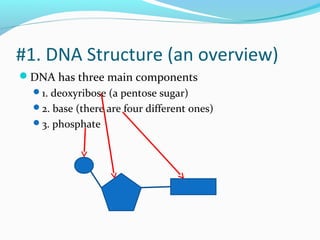
DNA has three main components
1. deoxyribose (a pentose sugar)
2. base (there are four different ones)
3. phosphate
#2. The Bases
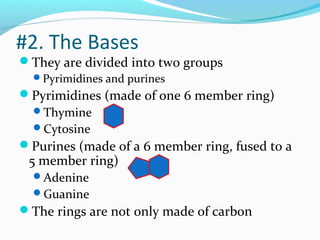
They are divided into two groups
Pyrimidines and purines
Pyrimidines (made of one 6 member ring)
Thymine
Cytosine
Purines (made of a 6 member ring, fused to a
5 member ring)
Adenine
Guanine
The rings are not only made of carbon
#3. Nucleotide Structure
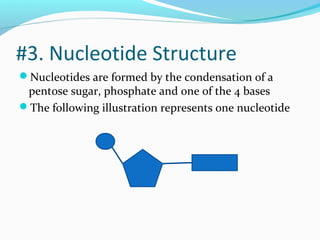
Nucleotides are formed by the condensation of a
pentose sugar, phosphate and one of the 4 bases
The following illustration represents one nucleotide
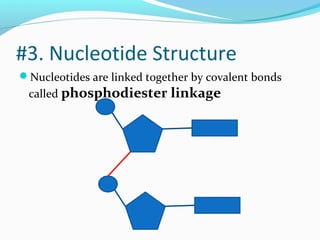
Nucleotides are linked together by covalent bonds
called phosphodiester linkage
#3. Nucleotide Structure
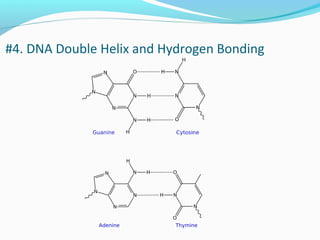
#4. DNA Double Helix and Hydrogen Bonding
Made of two strands of nucleotides that are joined
together by hydrogen bonding
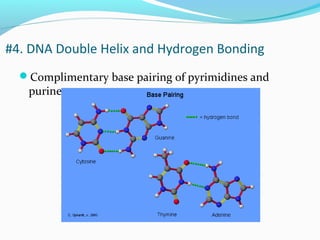
Hydrogen bonding occurs as a result of
complimentary base pairing
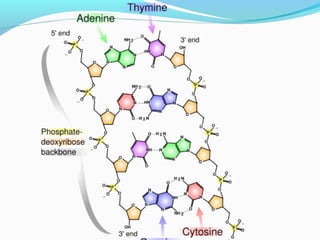
Adenine and thymine pair up
Cytosine and guanine pair up
Each pair is connected through hydrogen bonding
Hydrogen bonding always occurs between one
pyrimidine and one purine
Complimentary base pairing of pyrimidines and
purines
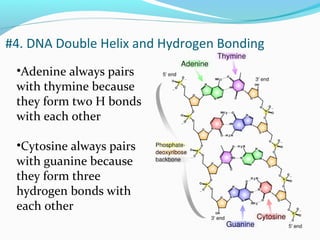
#4. DNA Double Helix and Hydrogen Bonding
•Adenine always pairs
with thymine because
they form two H bonds
with each other
•Cytosine always pairs
with guanine because
they form three
hydrogen bonds with
each other
#4. DNA Double Helix and Hydrogen Bonding
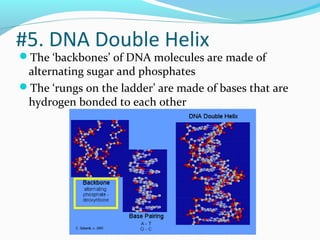
The ‘backbones’ of DNA molecules are made of
alternating sugar and phosphates
The ‘rungs on the ladder’ are made of bases that are
hydrogen bonded to each other
#5. DNA Double Helix
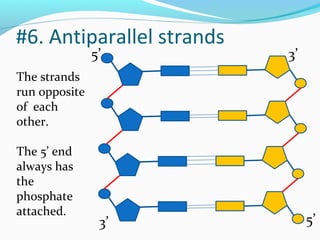
#6. Antiparallel strands
The strands
run opposite
of each
other.
The 5’ end
always has
the
phosphate
attached.
5’ 3’
3’ 5’
#6. When phosphodiester links
are formed . . .
A. When the covalent bonds are formed between
nucleotides the attach in the direction of 5’→3’
B. The 5’ end of one nucleotide attaches to the 3’ end
of the previous nucleotide
Structure of DNA

Structure of DNA

  • 1.
    Aman Ullah B.Sc. Med.Lab. Technology M. Phil. Microbiology Certificate in Health Professional Education Lecturer, Department of Medical Lab. Technology Institute of Paramedical Sciences, Khyber Medical University, Peshawar, Pakistan
  • 2.
    #1. DNA Structure(an overview) DNA has three main components 1. deoxyribose (a pentose sugar) 2. base (there are four different ones) 3. phosphate
  • 3.
    #2. The Bases Theyare divided into two groups Pyrimidines and purines Pyrimidines (made of one 6 member ring) Thymine Cytosine Purines (made of a 6 member ring, fused to a 5 member ring) Adenine Guanine The rings are not only made of carbon
  • 4.
    #3. Nucleotide Structure Nucleotidesare formed by the condensation of a pentose sugar, phosphate and one of the 4 bases The following illustration represents one nucleotide
  • 5.
    Nucleotides are linkedtogether by covalent bonds called phosphodiester linkage #3. Nucleotide Structure
  • 6.
    #4. DNA DoubleHelix and Hydrogen Bonding Made of two strands of nucleotides that are joined together by hydrogen bonding Hydrogen bonding occurs as a result of complimentary base pairing Adenine and thymine pair up Cytosine and guanine pair up Each pair is connected through hydrogen bonding Hydrogen bonding always occurs between one pyrimidine and one purine
  • 7.
    Complimentary base pairingof pyrimidines and purines #4. DNA Double Helix and Hydrogen Bonding
  • 8.
    #4. DNA DoubleHelix and Hydrogen Bonding
  • 9.
    •Adenine always pairs withthymine because they form two H bonds with each other •Cytosine always pairs with guanine because they form three hydrogen bonds with each other #4. DNA Double Helix and Hydrogen Bonding
  • 10.
    The ‘backbones’ ofDNA molecules are made of alternating sugar and phosphates The ‘rungs on the ladder’ are made of bases that are hydrogen bonded to each other #5. DNA Double Helix
  • 11.
    #6. Antiparallel strands Thestrands run opposite of each other. The 5’ end always has the phosphate attached. 5’ 3’ 3’ 5’
  • 13.
    #6. When phosphodiesterlinks are formed . . . A. When the covalent bonds are formed between nucleotides the attach in the direction of 5’→3’ B. The 5’ end of one nucleotide attaches to the 3’ end of the previous nucleotide