DNA Structure
Occurrence
• In eukaryotes: in nucleus
• DNA in nucleus is associated with simple
proteins (deoxyribonucleo proteins)
• Small quantity occurs in mitochondria and
chloroplast. (extranuclear DNA has no
proteins associated).
C-value is the amount, in picograms, of DNA
contained within a haploid nucleus (e.g. a gamete)
or one half the amount in a diploid somatic cell of a
eukaryotic organism.
C-value (quantity of DNA)
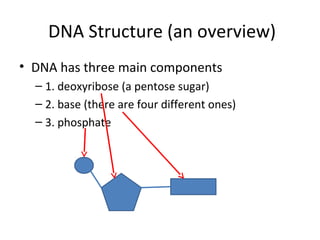
DNA Structure (an overview)
• DNA has three main components
– 1. deoxyribose (a pentose sugar)
– 2. base (there are four different ones)
– 3. phosphate
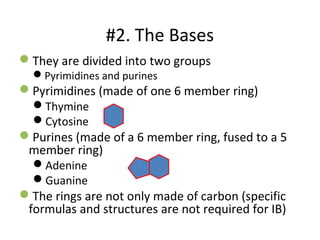
#2. The Bases
They are divided into two groups
Pyrimidines and purines
Pyrimidines (made of one 6 member ring)
Thymine
Cytosine
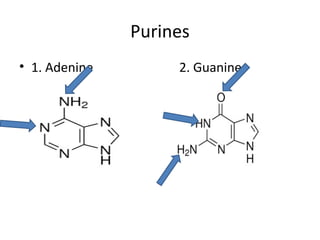
Purines (made of a 6 member ring, fused to a 5
member ring)
Adenine
Guanine
The rings are not only made of carbon (specific
formulas and structures are not required for IB)
Purines
• 1. Adenine 2. Guanine
Pyrimidines
• Thymine Cytosine
DNA Double Helix and Hydrogen Bonding
1- 3
6 - 4
6 - 4
1 - 3
2 - 2
Phospho-diester bond
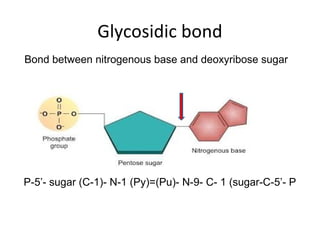
Glycosidic bond
Bond between nitrogenous base and deoxyribose sugar
P-5’- sugar (C-1)- N-1 (Py)=(Pu)- N-9- C- 1 (sugar-C-5’- P
•Adenine always pairs
with thymine because
they form two H bonds
with each other
•Cytosine always pairs
with guanine because
they form three
hydrogen bonds with
each other
DNA Double Helix and Hydrogen Bonding
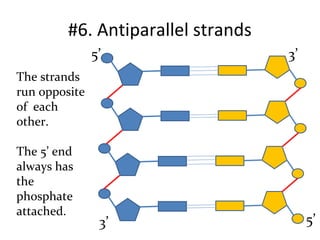
#6. Antiparallel strands
The strands
run opposite
of each
other.
The 5’ end
always has
the
phosphate
attached.
5’ 3’
3’ 5’
• The DNA has a negatively charged backbone
(because of the phosphate groups).
• Duameter= 20 A (2nm).
• 1 turn of spiral = 34 A contains 10 bases.
• The proteins (the histones) are positively
charged.
• DNA is dexrorotatory.
• The DNA and proteins are electromagnetically
attracted to each other to form chromatin
Charguff’s rule
• no. of A and T bp = G and C
• Purines and pyrimidines are equal in amount.
• Amount of A=T and G=C.
• Base ratio A+T/G+C is constant for a species.
• Deoxyribose sugar and phosphate occur in
equal proportions
The Structure of DNA.mp4

Dna structure

  • 1.
  • 2.
    Occurrence • In eukaryotes:in nucleus • DNA in nucleus is associated with simple proteins (deoxyribonucleo proteins) • Small quantity occurs in mitochondria and chloroplast. (extranuclear DNA has no proteins associated). C-value is the amount, in picograms, of DNA contained within a haploid nucleus (e.g. a gamete) or one half the amount in a diploid somatic cell of a eukaryotic organism. C-value (quantity of DNA)
  • 3.
    DNA Structure (anoverview) • DNA has three main components – 1. deoxyribose (a pentose sugar) – 2. base (there are four different ones) – 3. phosphate
  • 4.
    #2. The Bases Theyare divided into two groups Pyrimidines and purines Pyrimidines (made of one 6 member ring) Thymine Cytosine Purines (made of a 6 member ring, fused to a 5 member ring) Adenine Guanine The rings are not only made of carbon (specific formulas and structures are not required for IB)
  • 5.
  • 6.
  • 7.
    DNA Double Helixand Hydrogen Bonding 1- 3 6 - 4
  • 8.
    6 - 4 1- 3 2 - 2
  • 9.
  • 10.
    Glycosidic bond Bond betweennitrogenous base and deoxyribose sugar P-5’- sugar (C-1)- N-1 (Py)=(Pu)- N-9- C- 1 (sugar-C-5’- P
  • 12.
    •Adenine always pairs withthymine because they form two H bonds with each other •Cytosine always pairs with guanine because they form three hydrogen bonds with each other DNA Double Helix and Hydrogen Bonding
  • 13.
    #6. Antiparallel strands Thestrands run opposite of each other. The 5’ end always has the phosphate attached. 5’ 3’ 3’ 5’
  • 14.
    • The DNAhas a negatively charged backbone (because of the phosphate groups). • Duameter= 20 A (2nm). • 1 turn of spiral = 34 A contains 10 bases. • The proteins (the histones) are positively charged. • DNA is dexrorotatory. • The DNA and proteins are electromagnetically attracted to each other to form chromatin
  • 15.
    Charguff’s rule • no.of A and T bp = G and C • Purines and pyrimidines are equal in amount. • Amount of A=T and G=C. • Base ratio A+T/G+C is constant for a species. • Deoxyribose sugar and phosphate occur in equal proportions
  • 16.