STRUCTURAL
STEEL
WORK
STEEL
● Most popular and effective building material.
● Steel is an alloy made by combining iron and other elements, the
most common of these being carbon.
● wrought iron and cast iron
wrought iron - Carbon content: not greater than 0.15%
steel - Carbon content: 0.15% to 1.5%
cast iron - Carbon content :2% to 4%
Varieties of steel
● Based on carbon content
● Mild steel – 0.15 to 0.25%
● Medium carbon steel
- 0.25 to 0.6%
● High carbon steel - 0.6 to 1.5%
● Increase in carbon
content
● Increase strength
● Decrease ductility
MANUFACTURING PROCESS
● Hot rolling
Temperature above recrystallization by rolling hot steel
in semi solid state (900 to 12500).
● Cold rolling
Temperature below recrystallization rolling sheets from
sheets, plates or flats in rolling machines or by press breaking.
Mild Steel
● Carbon content – 0.25% (max)
● Sulphur – 0.055%
● Phosphorous - 0.055% ( I.S. 226: 1969)
● Dark bluish colour
● It is tough, elastic than cast iron and wrought iron.
● It is malleable and ductile.
Properties of Mild Steel
● Can be magnetized permanently.
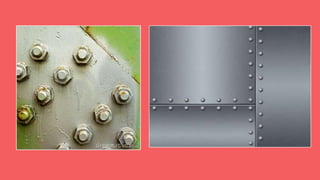
● Readily welded, riveted and bolted.
● Easily hardened or tempered.
● Malleable and ductile.
● Specific gravity 7.8.
● Melting point – above 1400°C.
Uses of Mild Steel
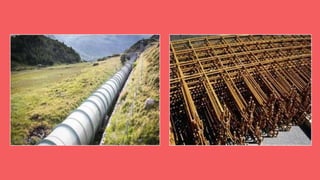
● Used as steel reinforcements (mild steel round bars).
● Mild steel tubes are used in construction.
● Mild steel sheets are used for roof coverings.
● Used in manufacture of various tools, machinery and other
equipments.
Steel is used structurally in two ways
● Reinforcement steel
● Structural steel
Reinforcement Steel
Reinforcement Steel
● Concrete – weak in tension – strong in compression
● Steel – strong in tension
● Steel bars embedded in concrete – reinforcement
● Develops good bond with concrete .
Reinforcement Steel
● Concrete – weak in tension – strong in compression
● Steel – strong in tension
● Steel bars embedded in concrete – reinforcement
● Develops good bond with concrete .
Types of Reinforcement Bars
Mild steel and medium tensile
steel / Plain steel bars
● Round sections
● Mild steel / medium tensile steel /
plain steel bars
● Plain steel bars – 5mm to 32mm
● Designated as Fe250
● Yield strength – 250 N/mm2
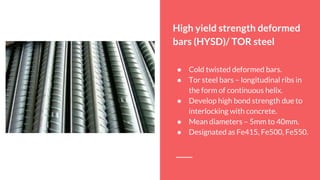
High yield strength deformed
bars (HYSD)/ TOR steel
● Cold twisted deformed bars.
● Tor steel bars – longitudinal ribs in
the form of continuous helix.
● Develop high bond strength due to
interlocking with concrete.
● Mean diameters – 5mm to 40mm.
● Designated as Fe415, Fe500, Fe550.
Advantages of tor steel
● Good bonding capabilities
● High yield strength
● Saving in reinforcement cost
● Better structural properties
● Bars can be welded
STRUCTURAL STEEL
SECTIONS / MARKET
FORMS OF STEEL
STRUCTURAL STEEL SECTIONS:
● Angle sections
● Channel sections
● I-sections
● T-sections
● Flat sections
● Steel plates
● Corrugated sheets
● Round bars
● Square bars
Rolled steel bar section:
Indian Standard Round Bars (ISRO):
● Designated as ISRO 10 (round bars
having diameter 10mm)
● Available in diameter varying from
6mm to 25mm.
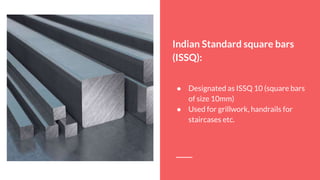
Indian Standard square bars
(ISSQ):
● Designated as ISSQ 10 (square bars
of size 10mm)
● Used for grillwork, handrails for
staircases etc.
Rolled Steel Plate Section ( ISPL):
● Designated as ISPL 500 x 5 (500mm
width and 5mm thickness)
● Used for construction of water tanks and
other storage structures, built up beams,
columns, base plate for foundations etc.
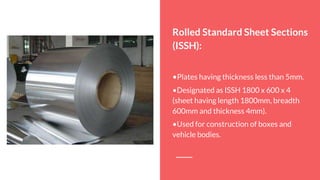
Rolled Standard Sheet Sections
(ISSH):
•Plates having thickness less than 5mm.
•Designated as ISSH 1800 x 600 x 4
(sheet having length 1800mm, breadth
600mm and thickness 4mm).
•Used for construction of boxes and
vehicle bodies.
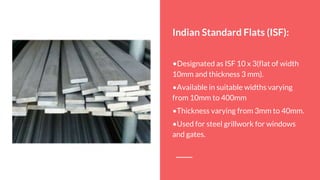
Indian Standard Flats (ISF):
•Designated as ISF 10 x 3(flat of width
10mm and thickness 3 mm).
•Available in suitable widths varying
from 10mm to 400mm
•Thickness varying from 3mm to 40mm.
•Used for steel grillwork for windows
and gates.
Rolled Steel Tubes:
● Inner diameter varying from 15 to
150mm.
● Thickness varying from 2 to 5.4mm.
● Efficient structural sections for
formwork and trusses.
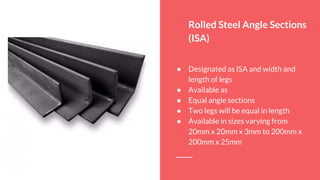
Rolled Steel Angle Sections
(ISA)
● Designated as ISA and width and
length of legs
● Available as
● Equal angle sections
● Two legs will be equal in length
● Available in sizes varying from
20mm x 20mm x 3mm to 200mm x
200mm x 25mm
Unequal angle sections
● Two legs will be unequal in length.
● Available in sizes varying from
30mm x 20mm x3mm x 3mm to
200mm x 150 mm x 18mm
Bulb angle sections
● Extensively used in structural steel
works like roof trusses, and as
connecting members for different
structures.
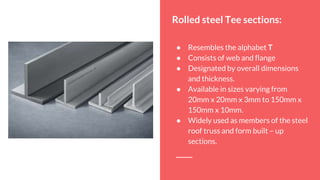
Rolled steel Tee sections:
● Resembles the alphabet T
● Consists of web and flange
● Designated by overall dimensions
and thickness.
● Available in sizes varying from
20mm x 20mm x 3mm to 150mm x
150mm x 10mm.
● Widely used as members of the steel
roof truss and form built – up
sections.
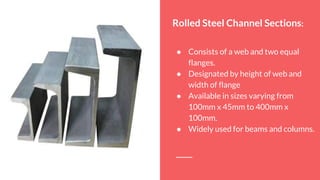
Rolled Steel Channel Sections:
● Consists of a web and two equal
flanges.
● Designated by height of web and
width of flange
● Available in sizes varying from
100mm x 45mm to 400mm x
100mm.
● Widely used for beams and columns.
The different types available are:
● Indian Standard Junior Channel (ISJC)
● Indian Standard Light Channel (ISLC)
● Indian Standard Medium Channels (ISMC)
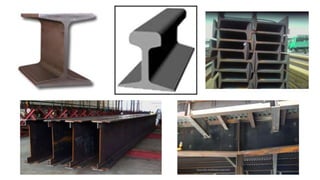
Rolled Steel I – Sections
● Known as rolled steel joists or beams.
● Consists of two flanges connected by a
web.
● Designated of overall depth and width
of flange.
● Available in sizes varying from 75mm x
50mm to 600mm x210mm.
Different types are:
● Indian Standard junior beam (ISJB)
● Indian Standard Light Beam (ISLB)
● Indian Standard Medium Beam (ISMB)
● Indian Standard Wide Flange Beam (ISWB)
● Indian Standard Heavy Beam (ISHB)
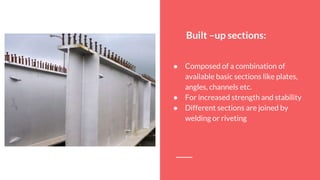
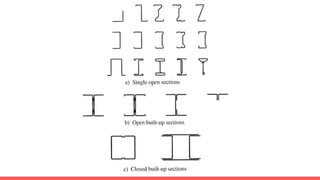
Built –up sections:
● Composed of a combination of
available basic sections like plates,
angles, channels etc.
● For increased strength and stability
● Different sections are joined by
welding or riveting
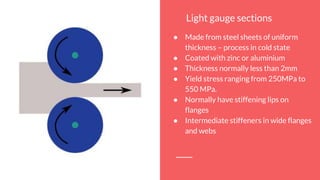
Light gauge sections
● Made from steel sheets of uniform
thickness – process in cold state
● Coated with zinc or aluminium
● Thickness normally less than 2mm
● Yield stress ranging from 250MPa to
550 MPa.
● Normally have stiffening lips on
flanges
● Intermediate stiffeners in wide flanges
and webs
Advantages of light gauge sections
● Lightness
● High strength and stiffness
● Ease of fabrication and mass production
● Fast and easy erection and installation
● High strength to weight ratio
● Substantial elimination of delays due to weather
● Formwork not needed
● Uniform quality
THANK YOU
PALUVADI MUKUNDA PRIYA
18031AA058

Structural steel work

  • 1.
  • 2.
    STEEL ● Most popularand effective building material. ● Steel is an alloy made by combining iron and other elements, the most common of these being carbon. ● wrought iron and cast iron wrought iron - Carbon content: not greater than 0.15% steel - Carbon content: 0.15% to 1.5% cast iron - Carbon content :2% to 4%
  • 3.
    Varieties of steel ●Based on carbon content ● Mild steel – 0.15 to 0.25% ● Medium carbon steel - 0.25 to 0.6% ● High carbon steel - 0.6 to 1.5% ● Increase in carbon content ● Increase strength ● Decrease ductility
  • 4.
    MANUFACTURING PROCESS ● Hotrolling Temperature above recrystallization by rolling hot steel in semi solid state (900 to 12500). ● Cold rolling Temperature below recrystallization rolling sheets from sheets, plates or flats in rolling machines or by press breaking.
  • 5.
    Mild Steel ● Carboncontent – 0.25% (max) ● Sulphur – 0.055% ● Phosphorous - 0.055% ( I.S. 226: 1969) ● Dark bluish colour ● It is tough, elastic than cast iron and wrought iron. ● It is malleable and ductile.
  • 6.
    Properties of MildSteel ● Can be magnetized permanently. ● Readily welded, riveted and bolted. ● Easily hardened or tempered. ● Malleable and ductile. ● Specific gravity 7.8. ● Melting point – above 1400°C.
  • 8.
    Uses of MildSteel ● Used as steel reinforcements (mild steel round bars). ● Mild steel tubes are used in construction. ● Mild steel sheets are used for roof coverings. ● Used in manufacture of various tools, machinery and other equipments.
  • 10.
    Steel is usedstructurally in two ways ● Reinforcement steel ● Structural steel
  • 11.
  • 12.
    Reinforcement Steel ● Concrete– weak in tension – strong in compression ● Steel – strong in tension ● Steel bars embedded in concrete – reinforcement ● Develops good bond with concrete .
  • 13.
    Reinforcement Steel ● Concrete– weak in tension – strong in compression ● Steel – strong in tension ● Steel bars embedded in concrete – reinforcement ● Develops good bond with concrete .
  • 14.
  • 15.
    Mild steel andmedium tensile steel / Plain steel bars ● Round sections ● Mild steel / medium tensile steel / plain steel bars ● Plain steel bars – 5mm to 32mm ● Designated as Fe250 ● Yield strength – 250 N/mm2
  • 16.
    High yield strengthdeformed bars (HYSD)/ TOR steel ● Cold twisted deformed bars. ● Tor steel bars – longitudinal ribs in the form of continuous helix. ● Develop high bond strength due to interlocking with concrete. ● Mean diameters – 5mm to 40mm. ● Designated as Fe415, Fe500, Fe550.
  • 17.
    Advantages of torsteel ● Good bonding capabilities ● High yield strength ● Saving in reinforcement cost ● Better structural properties ● Bars can be welded
  • 18.
    STRUCTURAL STEEL SECTIONS /MARKET FORMS OF STEEL
  • 19.
    STRUCTURAL STEEL SECTIONS: ●Angle sections ● Channel sections ● I-sections ● T-sections ● Flat sections ● Steel plates ● Corrugated sheets ● Round bars ● Square bars
  • 20.
    Rolled steel barsection: Indian Standard Round Bars (ISRO): ● Designated as ISRO 10 (round bars having diameter 10mm) ● Available in diameter varying from 6mm to 25mm.
  • 21.
    Indian Standard squarebars (ISSQ): ● Designated as ISSQ 10 (square bars of size 10mm) ● Used for grillwork, handrails for staircases etc.
  • 22.
    Rolled Steel PlateSection ( ISPL): ● Designated as ISPL 500 x 5 (500mm width and 5mm thickness) ● Used for construction of water tanks and other storage structures, built up beams, columns, base plate for foundations etc.
  • 23.
    Rolled Standard SheetSections (ISSH): •Plates having thickness less than 5mm. •Designated as ISSH 1800 x 600 x 4 (sheet having length 1800mm, breadth 600mm and thickness 4mm). •Used for construction of boxes and vehicle bodies.
  • 24.
    Indian Standard Flats(ISF): •Designated as ISF 10 x 3(flat of width 10mm and thickness 3 mm). •Available in suitable widths varying from 10mm to 400mm •Thickness varying from 3mm to 40mm. •Used for steel grillwork for windows and gates.
  • 25.
    Rolled Steel Tubes: ●Inner diameter varying from 15 to 150mm. ● Thickness varying from 2 to 5.4mm. ● Efficient structural sections for formwork and trusses.
  • 26.
    Rolled Steel AngleSections (ISA) ● Designated as ISA and width and length of legs ● Available as ● Equal angle sections ● Two legs will be equal in length ● Available in sizes varying from 20mm x 20mm x 3mm to 200mm x 200mm x 25mm
  • 27.
    Unequal angle sections ●Two legs will be unequal in length. ● Available in sizes varying from 30mm x 20mm x3mm x 3mm to 200mm x 150 mm x 18mm
  • 28.
    Bulb angle sections ●Extensively used in structural steel works like roof trusses, and as connecting members for different structures.
  • 29.
    Rolled steel Teesections: ● Resembles the alphabet T ● Consists of web and flange ● Designated by overall dimensions and thickness. ● Available in sizes varying from 20mm x 20mm x 3mm to 150mm x 150mm x 10mm. ● Widely used as members of the steel roof truss and form built – up sections.
  • 30.
    Rolled Steel ChannelSections: ● Consists of a web and two equal flanges. ● Designated by height of web and width of flange ● Available in sizes varying from 100mm x 45mm to 400mm x 100mm. ● Widely used for beams and columns.
  • 31.
    The different typesavailable are: ● Indian Standard Junior Channel (ISJC) ● Indian Standard Light Channel (ISLC) ● Indian Standard Medium Channels (ISMC)
  • 32.
    Rolled Steel I– Sections ● Known as rolled steel joists or beams. ● Consists of two flanges connected by a web. ● Designated of overall depth and width of flange. ● Available in sizes varying from 75mm x 50mm to 600mm x210mm.
  • 33.
    Different types are: ●Indian Standard junior beam (ISJB) ● Indian Standard Light Beam (ISLB) ● Indian Standard Medium Beam (ISMB) ● Indian Standard Wide Flange Beam (ISWB) ● Indian Standard Heavy Beam (ISHB)
  • 34.
    Built –up sections: ●Composed of a combination of available basic sections like plates, angles, channels etc. ● For increased strength and stability ● Different sections are joined by welding or riveting
  • 36.
    Light gauge sections ●Made from steel sheets of uniform thickness – process in cold state ● Coated with zinc or aluminium ● Thickness normally less than 2mm ● Yield stress ranging from 250MPa to 550 MPa. ● Normally have stiffening lips on flanges ● Intermediate stiffeners in wide flanges and webs
  • 38.
    Advantages of lightgauge sections ● Lightness ● High strength and stiffness ● Ease of fabrication and mass production ● Fast and easy erection and installation ● High strength to weight ratio ● Substantial elimination of delays due to weather ● Formwork not needed ● Uniform quality
  • 40.