Canadian International College
Building Construction 2
Steel Structure
Presented by:-
• Ahmed Rabea Qenawy 20146063
• Kerollos Melad Fekry 20146169
• Mustafa Mohamed 20146040
• Omar Elshahawy 20146065
• Zyad Zakaria El-Rosassy 20146442
Presented to:-
• Dr. Maged George
• Eng. Reham Atif
• Eng. Alaa Samy
• Eng. Miram Turky
Table Of Content:-
• Introduction
• Manufacturing
• Standards
• Common Shapes
• Steel Vs Concrete
• Thermal Properties
• Thermal insulation
• Installation
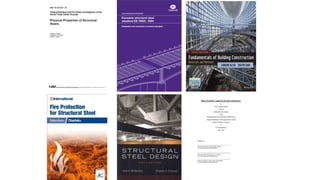
• References
General Introduction
•Introduction
• Historical Background
General Introduction,Cont1
• Advantages of Steel
• High strength per unit weight.
• High elasticity.
• Performance.
• Ductility.
• Toughness.
• Disadvantages of Steel
• Corrosion.
• Fireproofing cost.
• Susceptibility to buckling.
• Fatigue.
Manufacturing
•The manufacturing process
•Iron is converted to steel by two main steps.
• The production of molting iron.
• The steel making process.
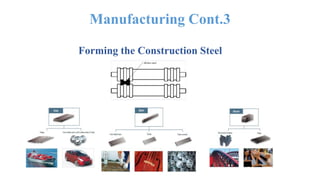
Forming the Construction Steel
Manufacturing Cont.3
Structural Steel Standards
•What are the standards in general?
• Definition.
• Purposes of standards.
• The organizations of setting standards.
• The standards of structural steel in US and Europe.
Definition
• Building standards or codes are the rules which control the process of building
construction
Purposes
• Codes are guide to architects, engineers, constructors.
• Codes determine the safety of structures and protect the public health.
•The organizations that set standards
• In US ( international )
American society of testing and materials (ASTM).
• In Europe ( international )
European Committee for standardization (CEN).
Structural Steel Standards Cont.2
•In US
• The formula
• Examples.
•In Europe
• The formula
• Examples.
Structural Steel Standards Cont.3
Structural Steel Standards in US
•Structural steel standards:
• Example:
A514 (Quenched and tempered alloy steel)
Structural Steel Standards in Europe
•Structural steel standards:
• Example:
S275J2 (Quenched and tempered alloy steel)
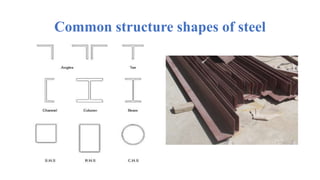
Common structure shapes of steel
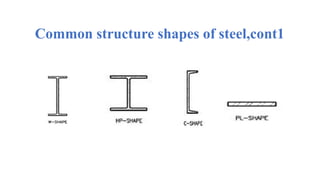
Common structure shapes of steel,cont1
Steel Vs Concrete
• Cost
• Design possibilities
• Construction scheduling
• Material availability
• Safety
•Heat capacity or thermal capacity
•Thermal expansion
• Volume coefficients of thermal expansion
• Linear coefficients of thermal expansion
•Thermal conductivity
• Definition
• The conductive heat transfer
Thermal properties, Cont.1
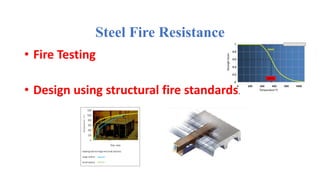
Steel Fire Resistance
• Fire Testing
• Design using structural fire standards.
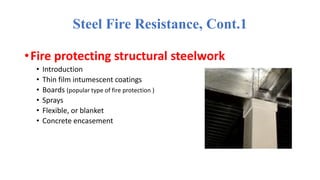
•Fire protecting structural steelwork
• Introduction
• Thin film intumescent coatings
• Boards (popular type of fire protection )
• Sprays
• Flexible, or blanket
• Concrete encasement
Steel Fire Resistance, Cont.1
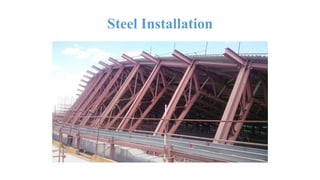
Steel Installation
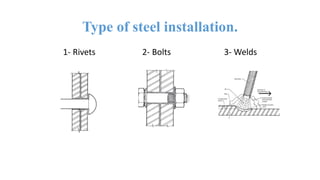
Type of steel installation.
1- Rivets 2- Bolts 3- Welds
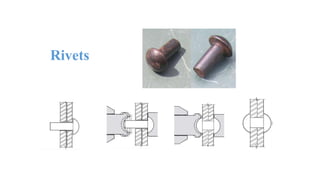
Rivets
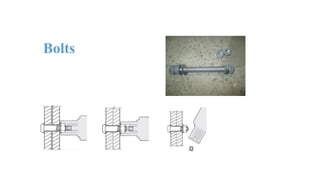
Bolts
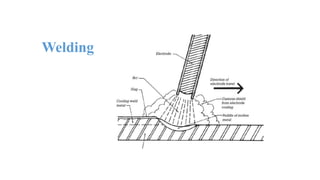
Welding
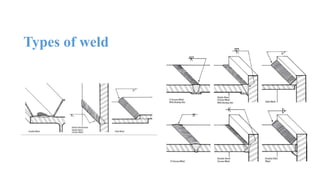
Types of weld
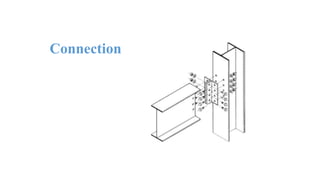
Connection
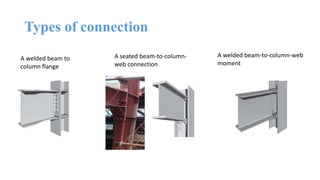
Types of connection
A welded beam to
column flange
A seated beam-to-column-
web connection
A welded beam-to-column-web
moment
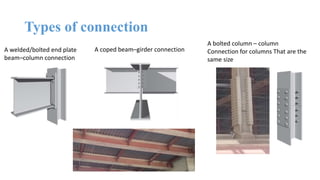
Types of connection
A welded/bolted end plate
beam–column connection
A coped beam–girder connection
A bolted column – column
Connection for columns That are the
same size
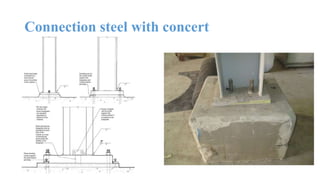
Connection steel with concert
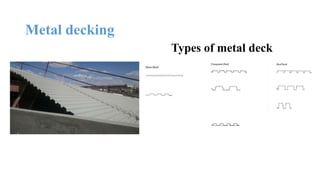
Metal decking
Types of metal deck
Steel structure
Steel structure
Steel structure
Steel structure

Steel structure