STEEL STRUCTURES
STEEL STRUCTURES
Steel construction is most often used in
• High rise buildings because of its strength, low weight, and
speed of construction.
• Long span Structures such as Sports Stadiums, airport
terminal, Bridges and other Infrastructure.
•
• Industrial buildings & warehouses because of its ability
to create large span spaces at low cost
• Residential buildings in a technique called light
gauge steel construction, also because of its speed of
construction.
• Temporary Structures as these are quick to set up and
remove
STEEL STRUCTURES
STEEL STRUCTURES
ADVANTAGES OFSTEELSTRUCTURES
• Strength - Most steel construction is done with Mild steel. Mild steel is a material that is
immensely strong.
• Speed of construction - They are super-quick to build at site, as a lot of work can be pre-
fabricated at the factory.
• Flexible - which makes them very good at resisting dynamic (changing) forces such
as wind or earthquake forces.
• Plasticity or ductility - This means that when subjected to great force, it will not suddenly
crack like glass, but slowly bend out of shape or deform, thus giving warning to inhabitants
to escape.
• Structural Stability - Failure in steel frames is not sudden - a steel structure rarely
collapses
• Earthquake resistant - Steel in most cases performs far better in earthquake than
most other materials because of these properties.
• Less Raw material - Because of the high strength grade of steel, this structure requires
less raw materials than other types of structure like concrete structure and timber
structure.
ADVANTAGES OFSTEELSTRUCTURES
• They can be made to take any kind of shape, and clad with any type of material.
• Multiple joining methods - A wide range of joining methods is available, such as
bolting, welding, and riveting.
• Light weight Construction –
Consider a single storey building measuring 5 x 8m. Let us first construct this in
concrete, with four columns at the corners, beams spanning between the columns, and a
150mm thick concrete slab at the top. Such a structure would weigh about 32 Tons (32,000
kg) in total.
If we build this of steel instead, with a sloping roof covered with corrugated metal
sheeting with insulation, this would weigh only about only 2.6 Tons (2,600 kg). So the
concrete building is over 12 times heavier! This is for single storey structures - in multi-
storey structures, the difference will be less, as the floors in multi-storey steel buildings are
built of concrete slabs for economy - but the difference is still significant.
DISADVANTAGES OFSTEEL STRUCTURES
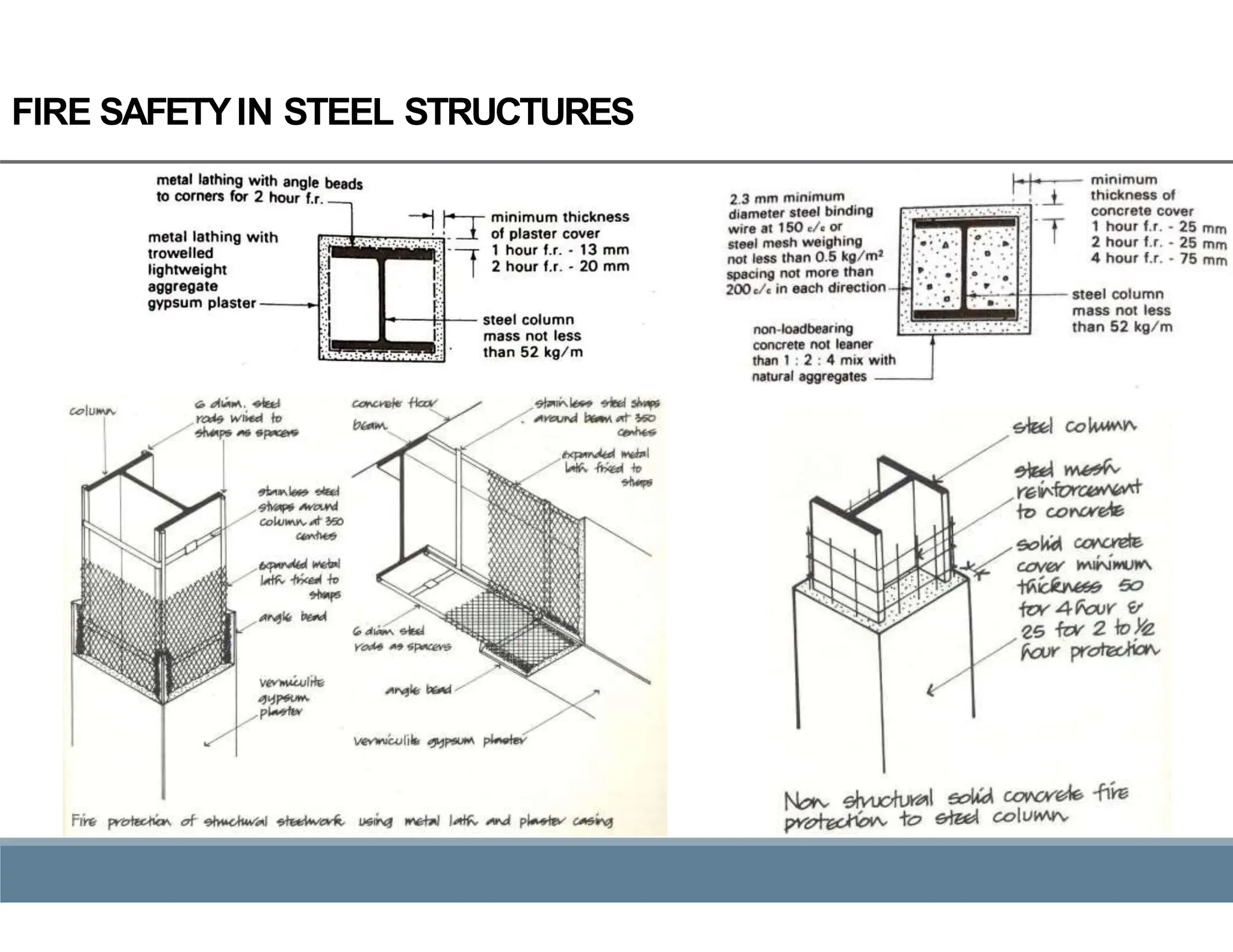
• They lose strength at high temperatures, and are susceptible to fire.
At 500 degrees Celsius (930 degrees F), mild steel can lose almost half its strength.
This is what happened at the collapse of the World Trade Towers in 2001
• They are prone to corrosion in humid or marine environments.
STEEL AS A MATERIAL
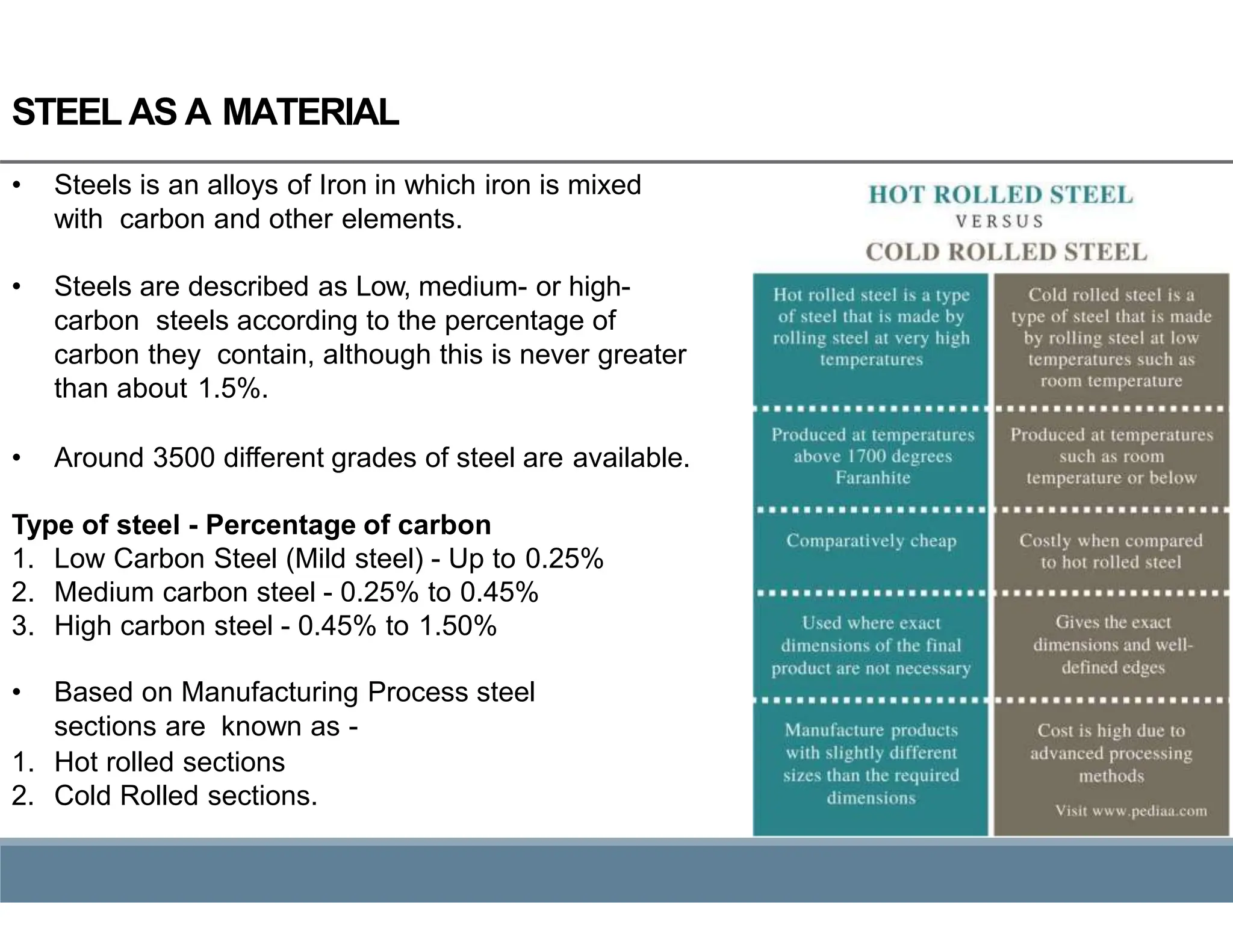
• Steels is an alloys of Iron in which iron is mixed
with carbon and other elements.
• Steels are described as Low, medium- or high-
carbon steels according to the percentage of
carbon they contain, although this is never greater
than about 1.5%.
• Around 3500 different grades of steel are available.
Type of steel - Percentage of carbon
1. Low Carbon Steel (Mild steel) - Up to 0.25%
2. Medium carbon steel - 0.25% to 0.45%
3. High carbon steel - 0.45% to 1.50%
• Based on Manufacturing Process steel
sections are known as -
1. Hot rolled sections
2. Cold Rolled sections.
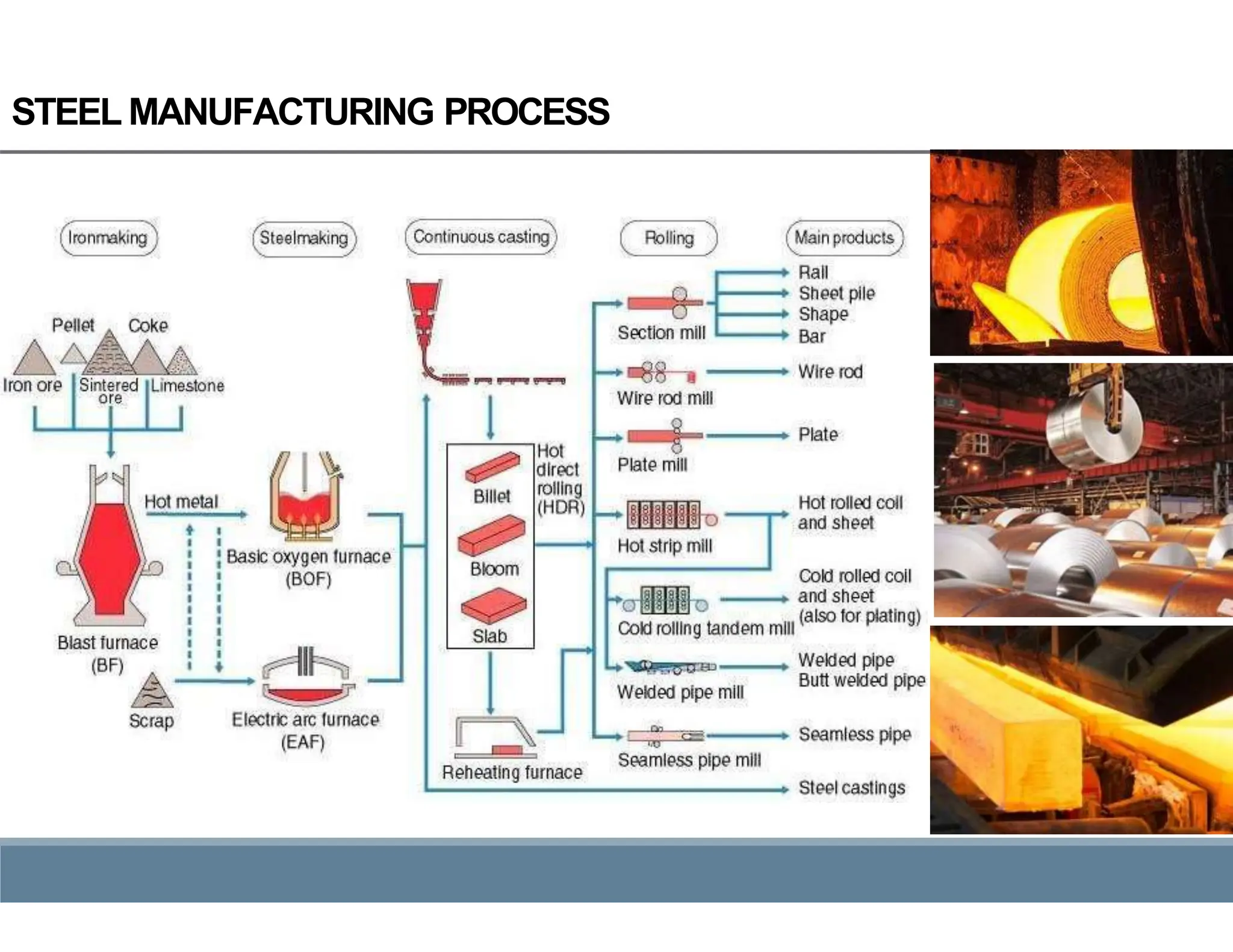
STEEL MANUFACTURING PROCESS
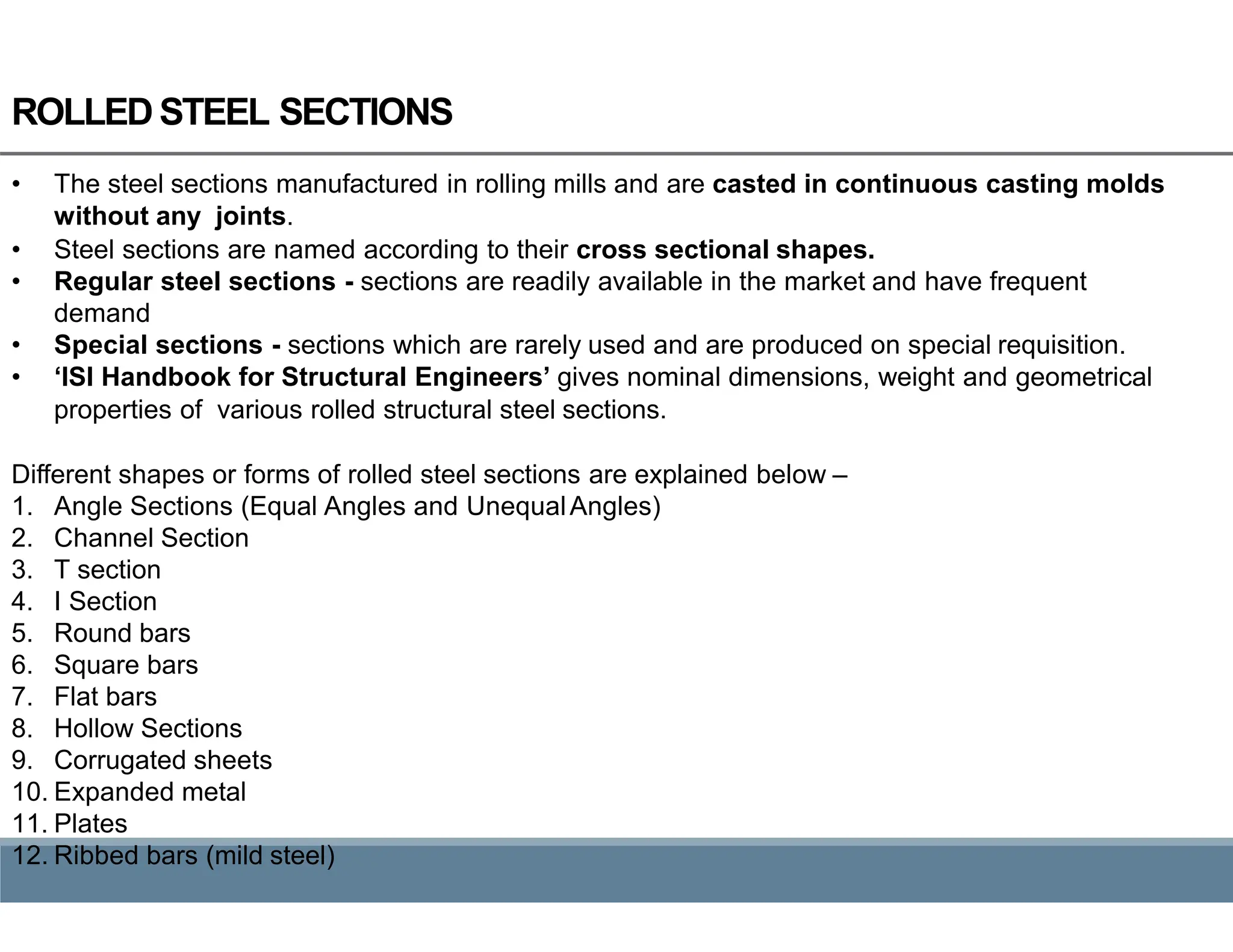
ROLLED STEEL SECTIONS
• The steel sections manufactured in rolling mills and are casted in continuous casting molds
without any joints.
• Steel sections are named according to their cross sectional shapes.
• Regular steel sections - sections are readily available in the market and have frequent
demand
• Special sections - sections which are rarely used and are produced on special requisition.
• ‘ISI Handbook for Structural Engineers’ gives nominal dimensions, weight and geometrical
properties of various rolled structural steel sections.
Different shapes or forms of rolled steel sections are explained below –
1. Angle Sections (Equal Angles and UnequalAngles)
2. Channel Section
3. T section
4. I Section
5. Round bars
6. Square bars
7. Flat bars
8. Hollow Sections
9. Corrugated sheets
10. Expanded metal
11. Plates
12. Ribbed bars (mild steel)
ROLLED STEEL SECTIONS
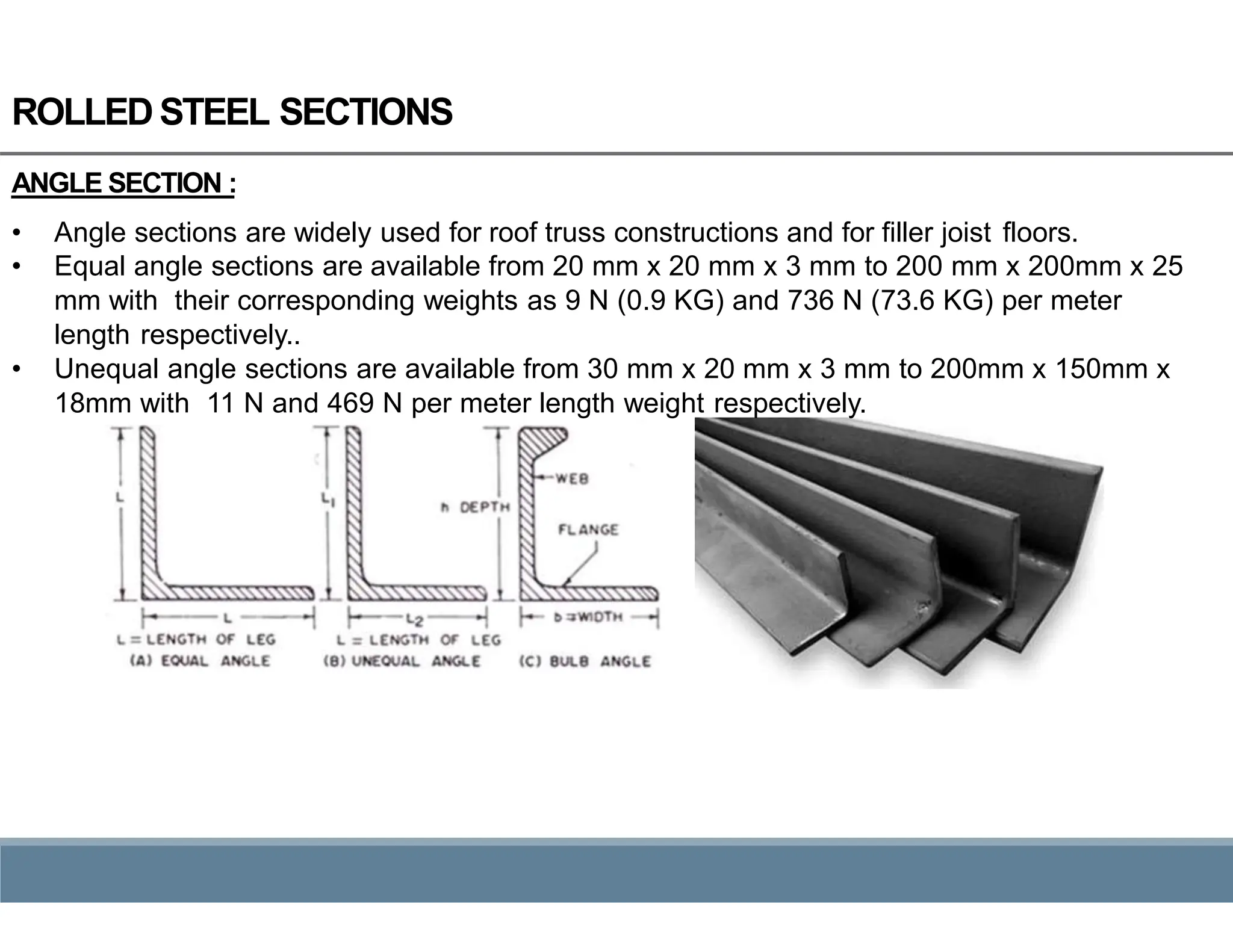
ANGLE SECTION :
• Angle sections are widely used for roof truss constructions and for filler joist floors.
• Equal angle sections are available from 20 mm x 20 mm x 3 mm to 200 mm x 200mm x 25
mm with their corresponding weights as 9 N (0.9 KG) and 736 N (73.6 KG) per meter
length respectively..
• Unequal angle sections are available from 30 mm x 20 mm x 3 mm to 200mm x 150mm x
18mm with 11 N and 469 N per meter length weight respectively.
ROLLED STEEL SECTIONS
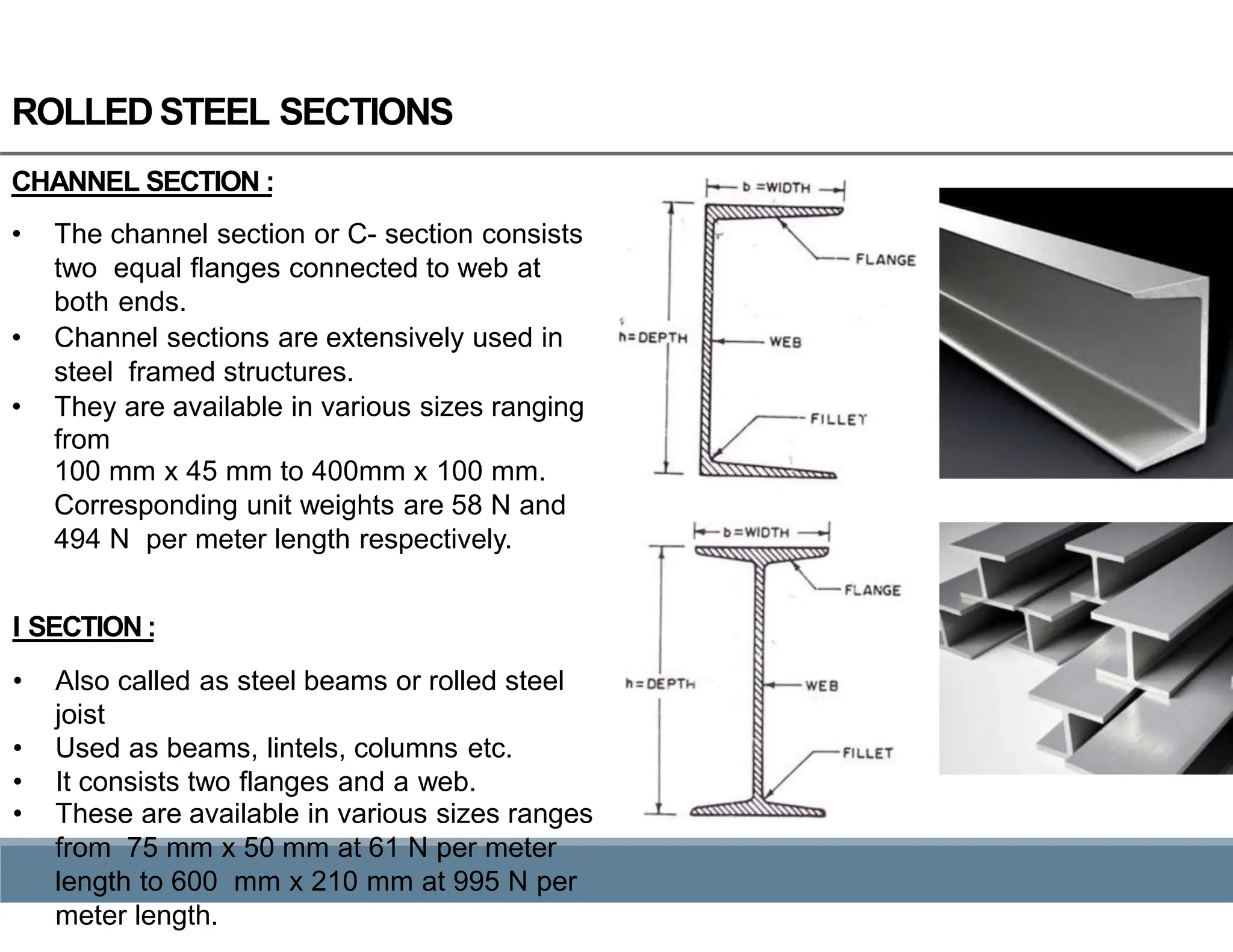
CHANNEL SECTION :
• The channel section or C- section consists
two equal flanges connected to web at
both ends.
• Channel sections are extensively used in
steel framed structures.
• They are available in various sizes ranging
from
100 mm x 45 mm to 400mm x 100 mm.
Corresponding unit weights are 58 N and
494 N per meter length respectively.
I SECTION :
• Also called as steel beams or rolled steel
joist
• Used as beams, lintels, columns etc.
• It consists two flanges and a web.
• These are available in various sizes ranges
from 75 mm x 50 mm at 61 N per meter
length to 600 mm x 210 mm at 995 N per
meter length.
ROLLED STEEL SECTIONS
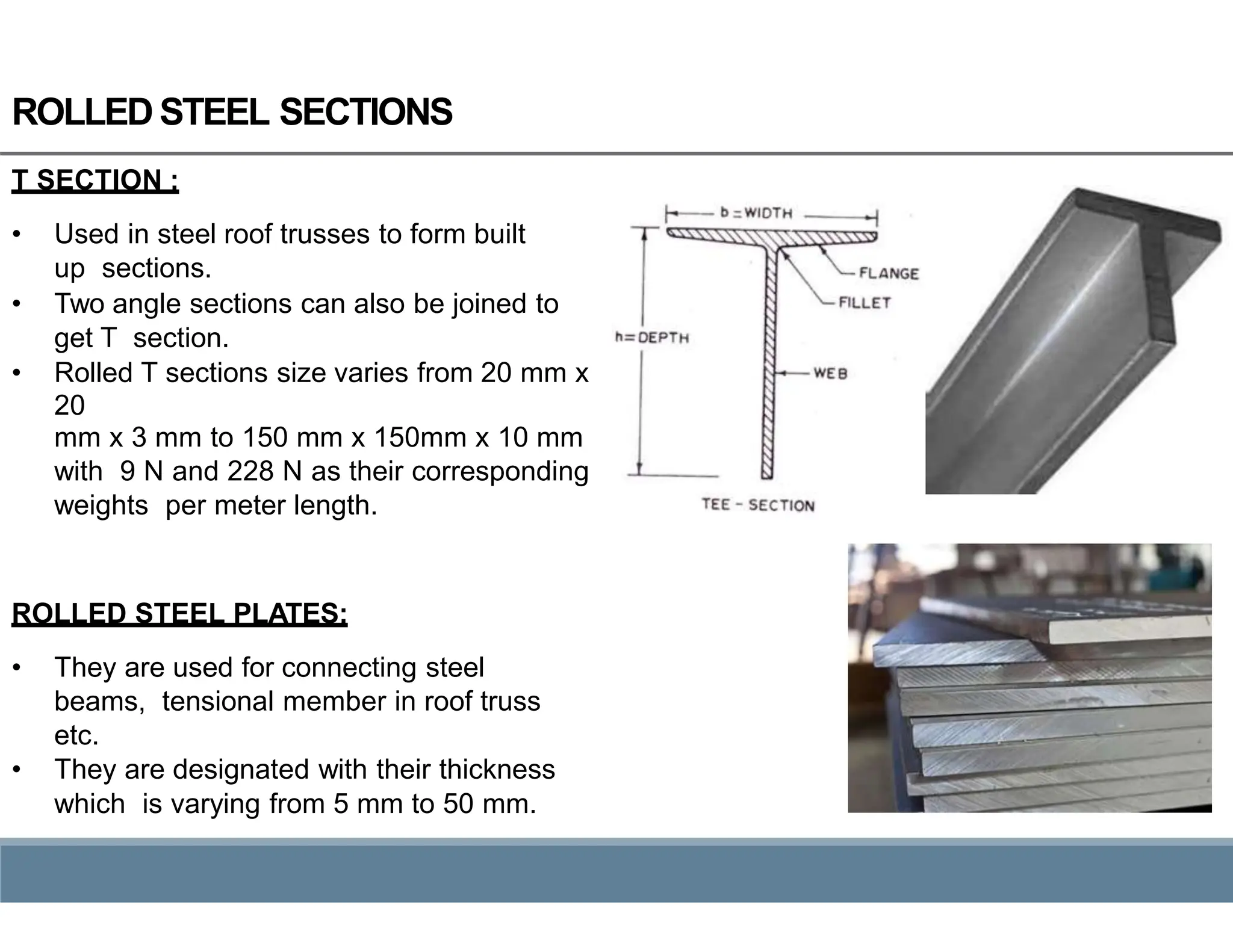
T SECTION :
• Used in steel roof trusses to form built
up sections.
• Two angle sections can also be joined to
get T section.
• Rolled T sections size varies from 20 mm x
20
mm x 3 mm to 150 mm x 150mm x 10 mm
with 9 N and 228 N as their corresponding
weights per meter length.
ROLLED STEEL PLATES:
• They are used for connecting steel
beams, tensional member in roof truss
etc.
• They are designated with their thickness
which is varying from 5 mm to 50 mm.
ROLLED STEEL SECTIONS
ROLLED ROUND BARS :
• Used as reinforcement in concrete and steel
grill work etc.
• Available in various diameters varies from 5
mm to 250 mm.
ROLLED SQUARE BARS :
• Used for gates, windows, grill works etc.
• Sides of square cross section ranges from 5
mm to 250 mm.
ROLLED FLAT BARS :
• Flat bars are also used for gates, windows,
grill works etc.
• Width of the bar varies from 10 mm to 400
mm. thickness of flat bars will be from 3 mm
to 40 mm.
• Hollow sections-
• Rectangular hollow sections • Square hollow sections • Tube sections
ROLLED STEEL SECTIONS
CORRGATED SHEETS:
• Plain steel sheets are passed through
machines which produce bends by
pressing them called corrugations.
• These sheets are used for roof coverings.
EXPANDED METAL :
• Expanded metal sheets are made from mild steel
sheets Which are cut through machine and
expanded.
• Generally, Diamond shaped mesh is appeared
in this type of sheets
COMPOUNDAND BUILT UP SECTIONS
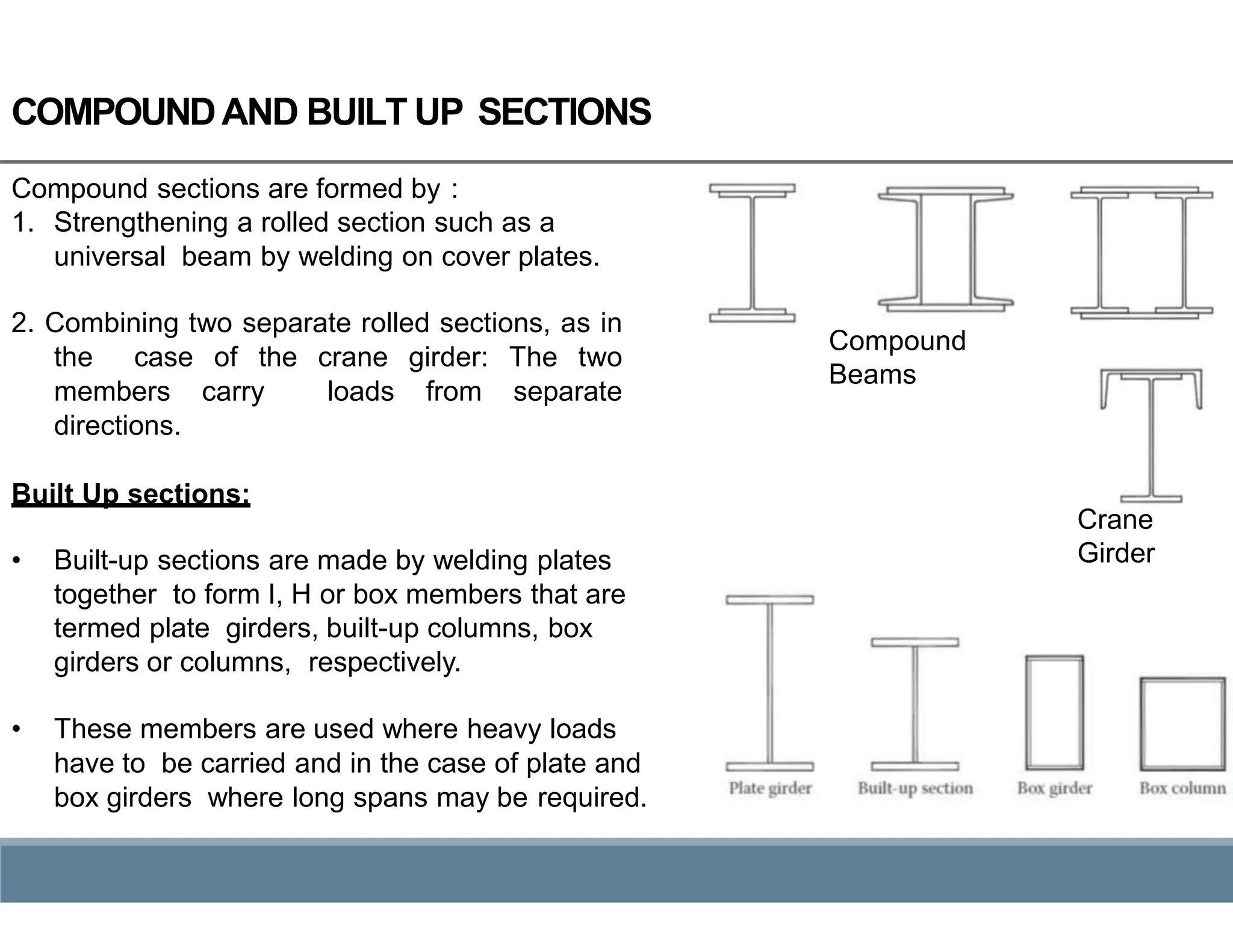
Compound sections are formed by :
1. Strengthening a rolled section such as a
universal beam by welding on cover plates.
2. Combining two separate rolled sections, as in
the case of the crane girder: The two
members carry loads from separate
directions.
Compound
Beams
Crane
Girder
Built Up sections:
• Built-up sections are made by welding plates
together to form I, H or box members that are
termed plate girders, built-up columns, box
girders or columns, respectively.
• These members are used where heavy loads
have to be carried and in the case of plate and
box girders where long spans may be required.
COLDROLLED OPEN SECTIONS
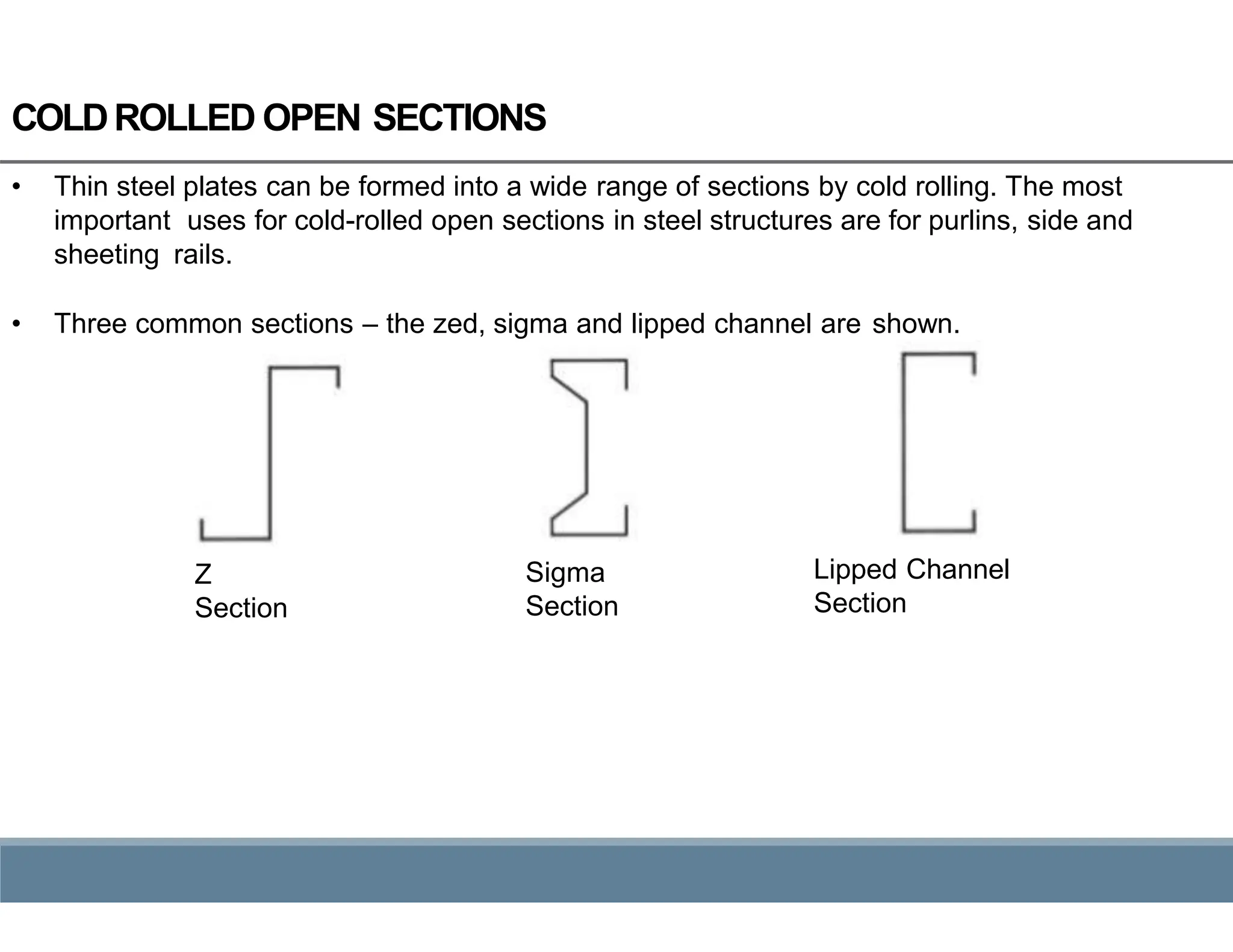
• Thin steel plates can be formed into a wide range of sections by cold rolling. The most
important uses for cold-rolled open sections in steel structures are for purlins, side and
sheeting rails.
• Three common sections – the zed, sigma and lipped channel are shown.
Z
Section
Sigma
Section
Lipped Channel
Section
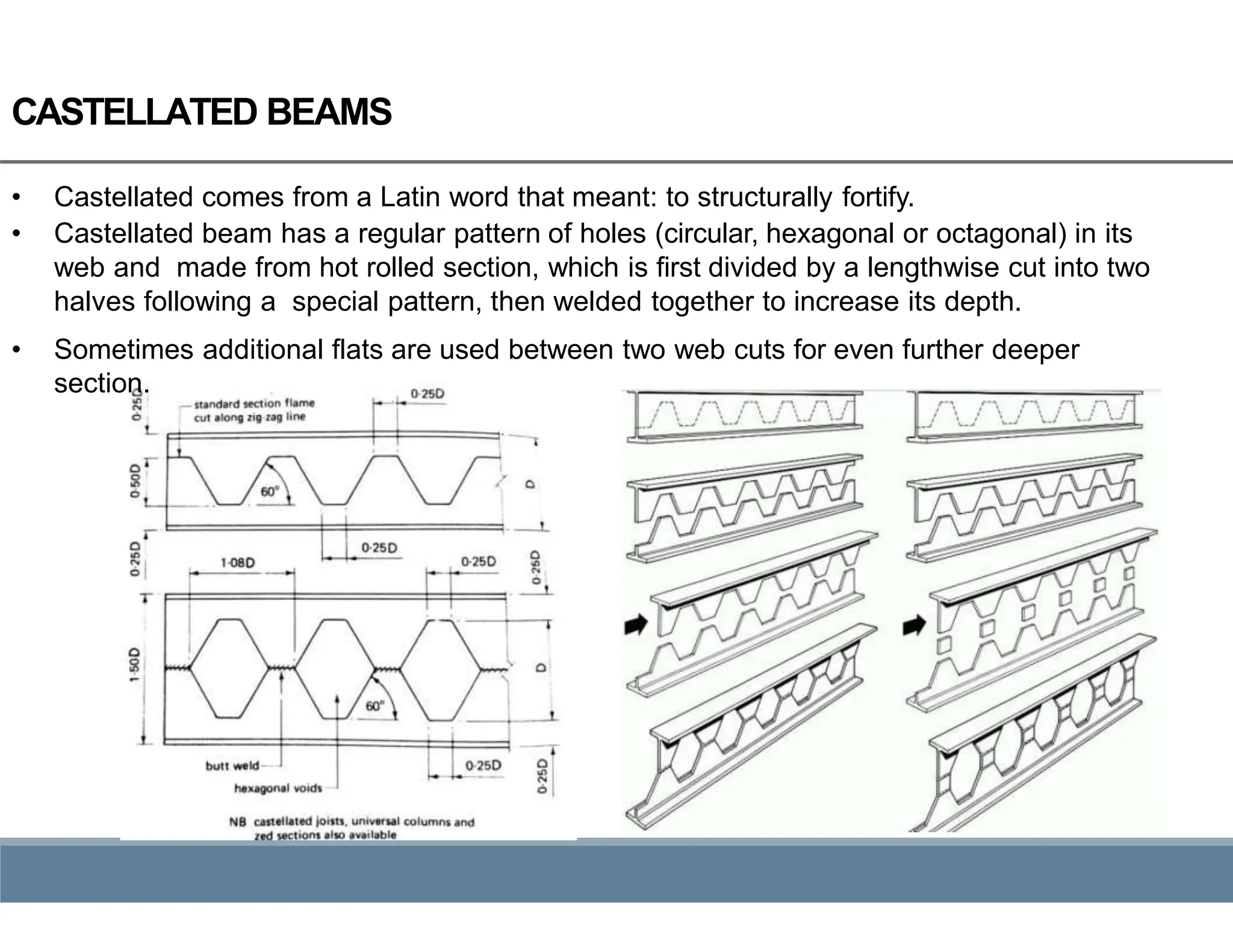
CASTELLATED BEAMS
• Castellated comes from a Latin word that meant: to structurally fortify.
• Castellated beam has a regular pattern of holes (circular, hexagonal or octagonal) in its
web and made from hot rolled section, which is first divided by a lengthwise cut into two
halves following a special pattern, then welded together to increase its depth.
• Sometimes additional flats are used between two web cuts for even further deeper
section.
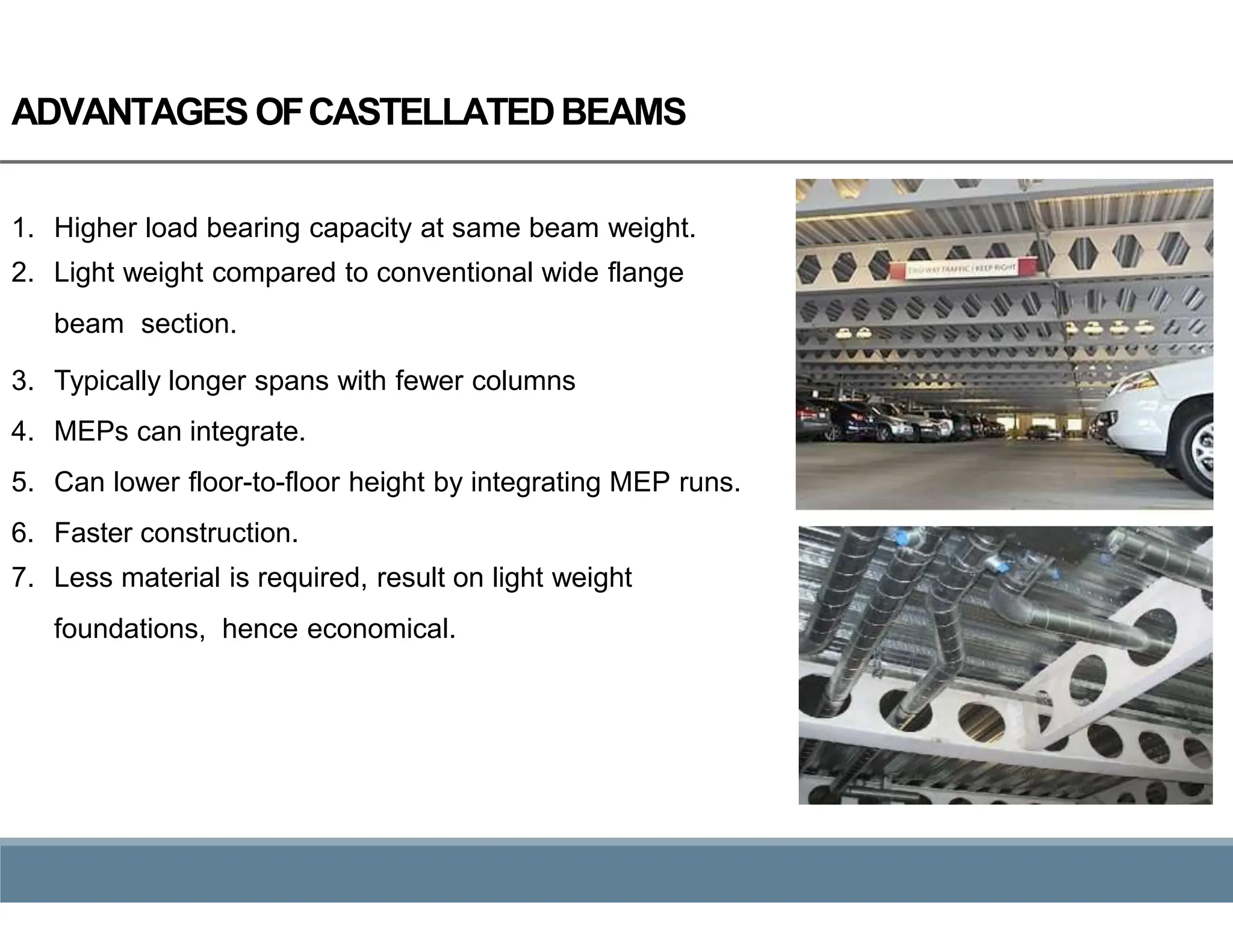
ADVANTAGES OFCASTELLATEDBEAMS
1. Higher load bearing capacity at same beam weight.
2. Light weight compared to conventional wide flange
beam section.
3. Typically longer spans with fewer columns
4. MEPs can integrate.
5. Can lower floor-to-floor height by integrating MEP runs.
6. Faster construction.
7. Less material is required, result on light weight
foundations, hence economical.
METHODSOFCONNECTION IN STEEL WORK
The various members of steel framed structure are to be suitably connected for transfer
of load. Following are the methods adopted for connecting the members in steelwork
1. Bolts
2. Rivets
3. Welding
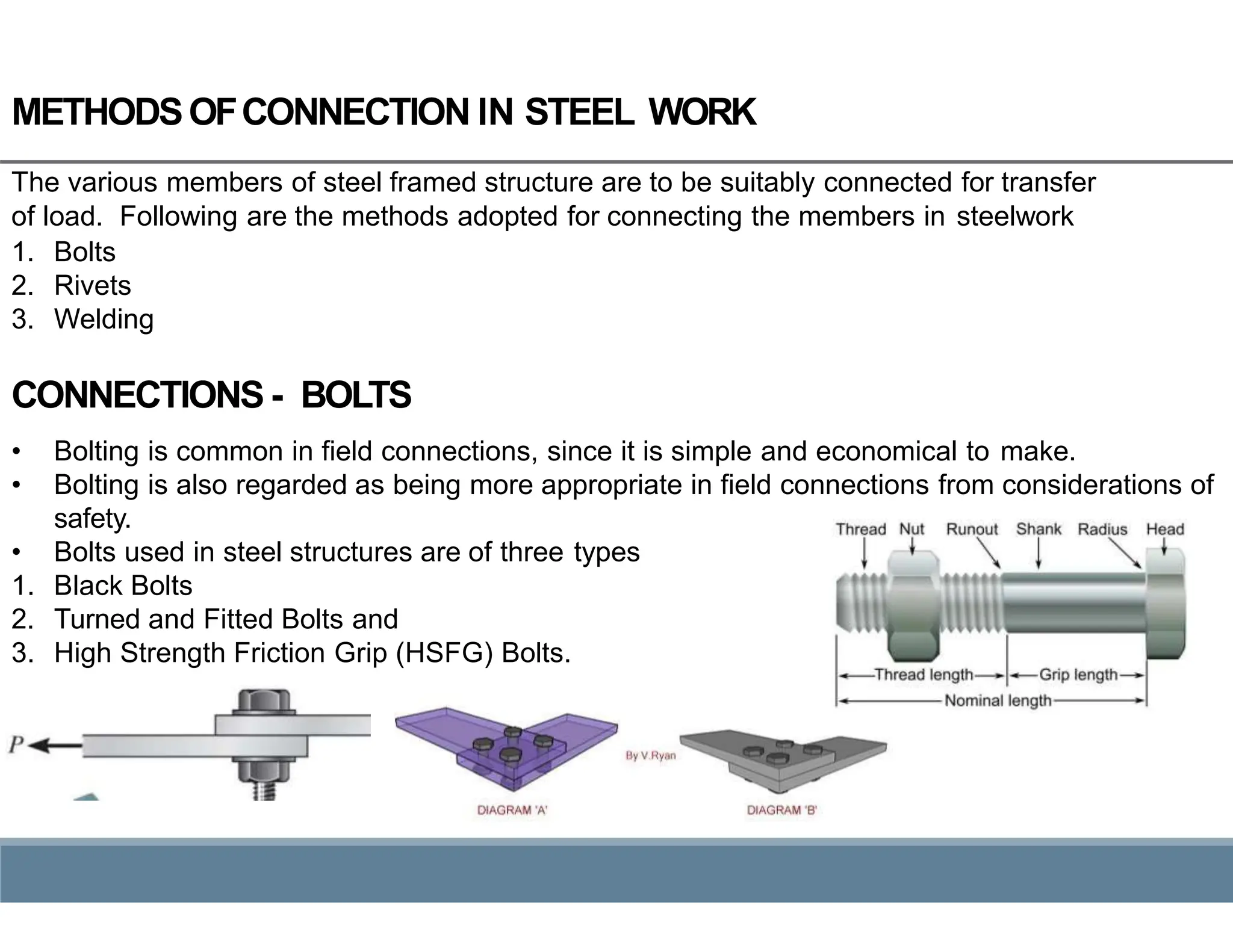
CONNECTIONS - BOLTS
• Bolting is common in field connections, since it is simple and economical to make.
• Bolting is also regarded as being more appropriate in field connections from considerations of
safety.
• Bolts used in steel structures are of three types
1. Black Bolts
2. Turned and Fitted Bolts and
3. High Strength Friction Grip (HSFG) Bolts.
CONNECTIONS - RIVETS
Rivets generally are made of low carbon steel. Riveting is used
1. To avoid after thermal effects, as in case of welding
2. Used for metals which have poor weldability
3. Used for heterogeneous materials like asbestos friction lining and
steel.
Types of Rivets
Advantages of riveted joints:
1. Cheaper fabrication cost
2. Low maintenance cost
3. Dissimilar metals can also be joined, even non-metallic joints are possible with riveted
joints.
4. Ease of riveting process.
Disadvantages of riveted joints:
1. Skilled workers required
2. Leakage may be a problem for this type of joints, but this is overcome by special
techniques.
Types of Riveting
1. Hot Riveting
2. Cold Riveting
3. Hand Riveting
4. Machine Riveting
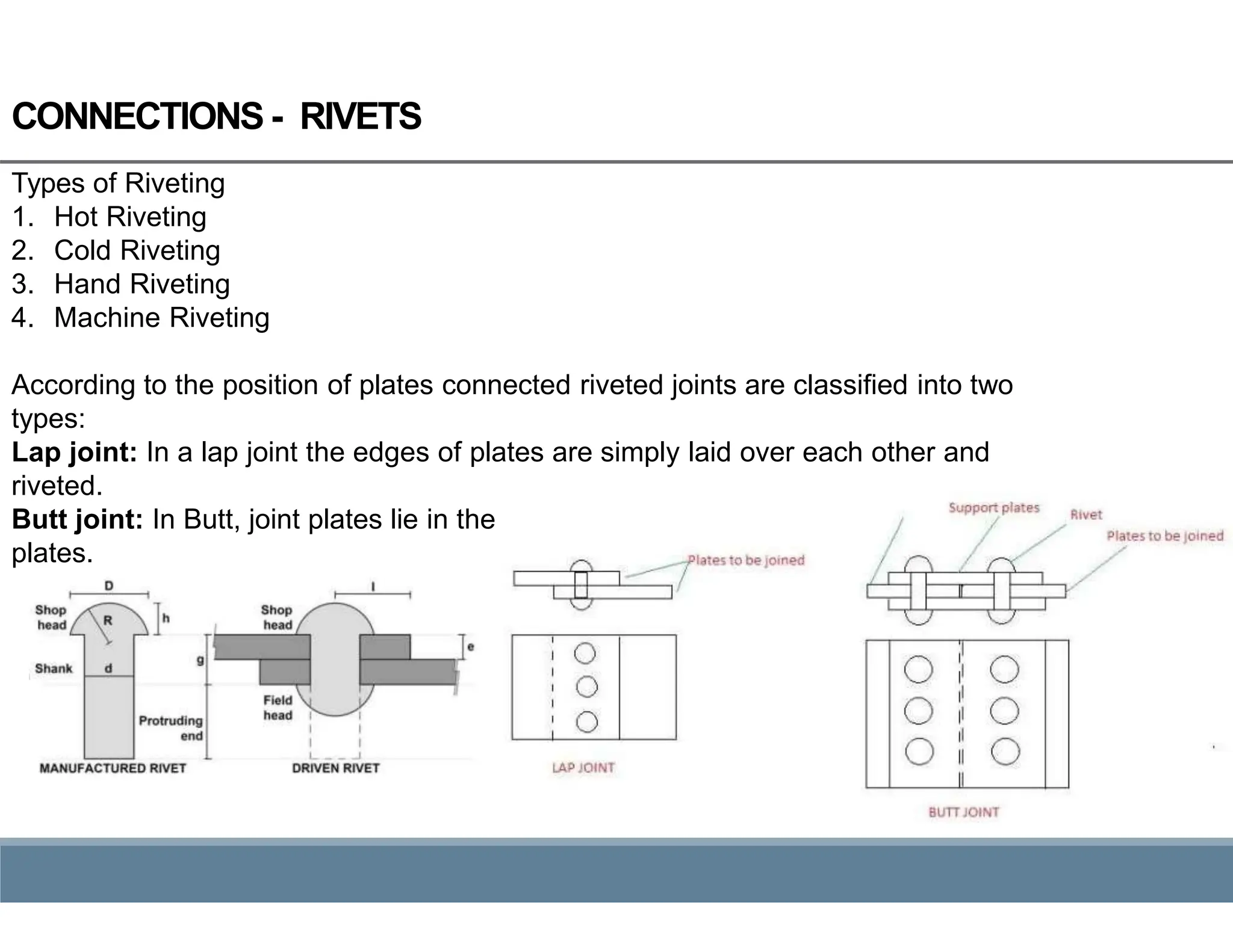
According to the position of plates connected riveted joints are classified into two
types:
Lap joint: In a lap joint the edges of plates are simply laid over each other and
riveted.
Butt joint: In Butt, joint plates lie in the same plane and joined through cover
plates.
CONNECTIONS - RIVETS
CONNECTIONS - WELDING
• There are five different types of welded
joints
1. Butt joint : In Butt welded type, the parts
lie in the same plane and are joined at
their edges.
2. Corner joint : The parts in a corner joint
form a right angle and are joined at the
center of the angle.
3. Lap joint : Lap joint consists of two
overlapping parts.
4. Tee-joint : In a Tee-joint, one joint is the
right angle to the other joint in the
approximate shape of the letter “T”.
5. Edge joint: The parts in edge joint are
parallel with at least one of their edges in
common and the joint is made at the
common edge(s).
CONNECTIONS - WELDING
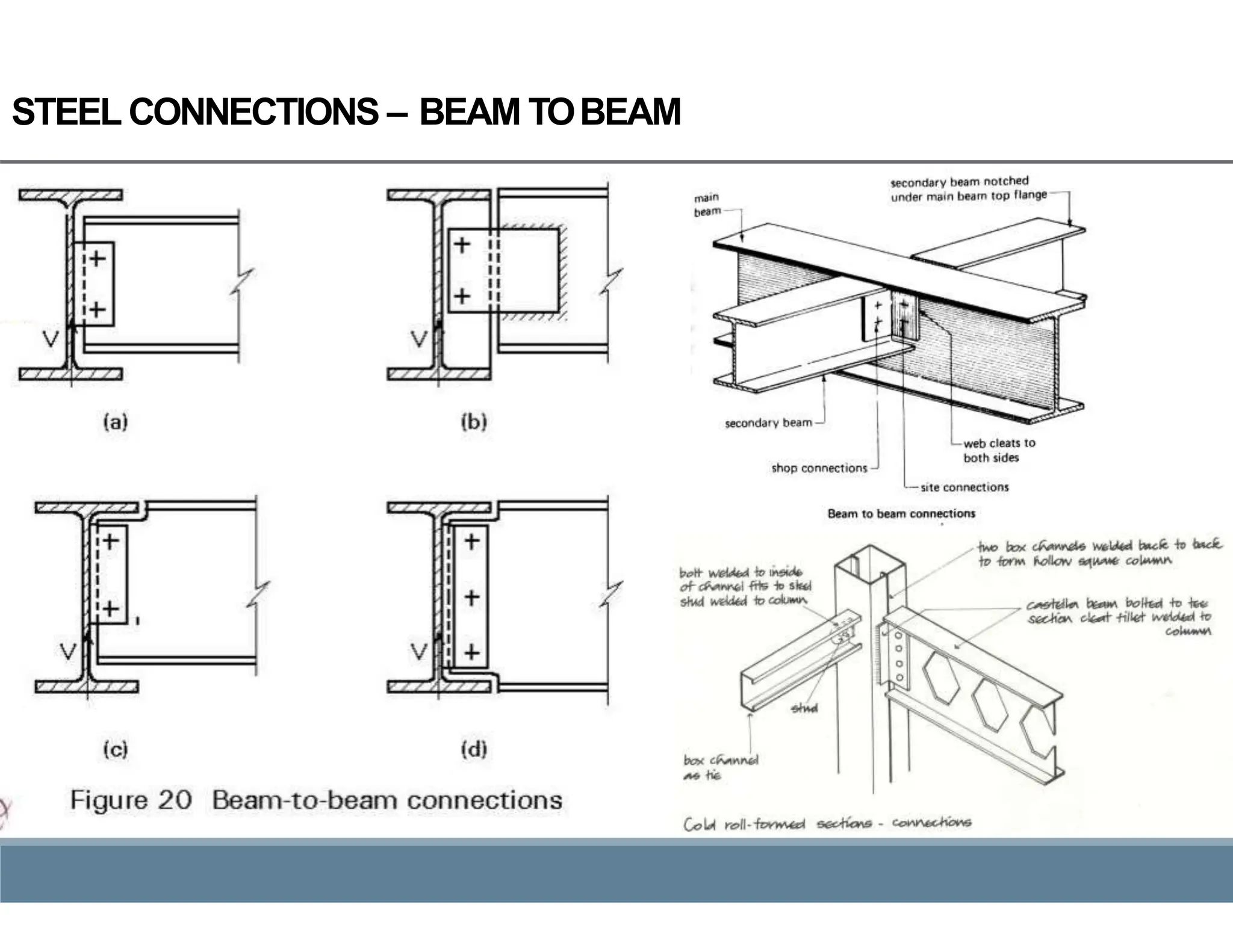
STEEL CONNECTION
• Design of connections is an integral and important part of design of steel structures. They
are also critical components of steel structures, since
• They have the potential for greater variability in behavior and strength.
• They are more complex to design than members
• They are usually the most vulnerable components, failure of which may lead to the failure
of the whole structure.
Many types based on function
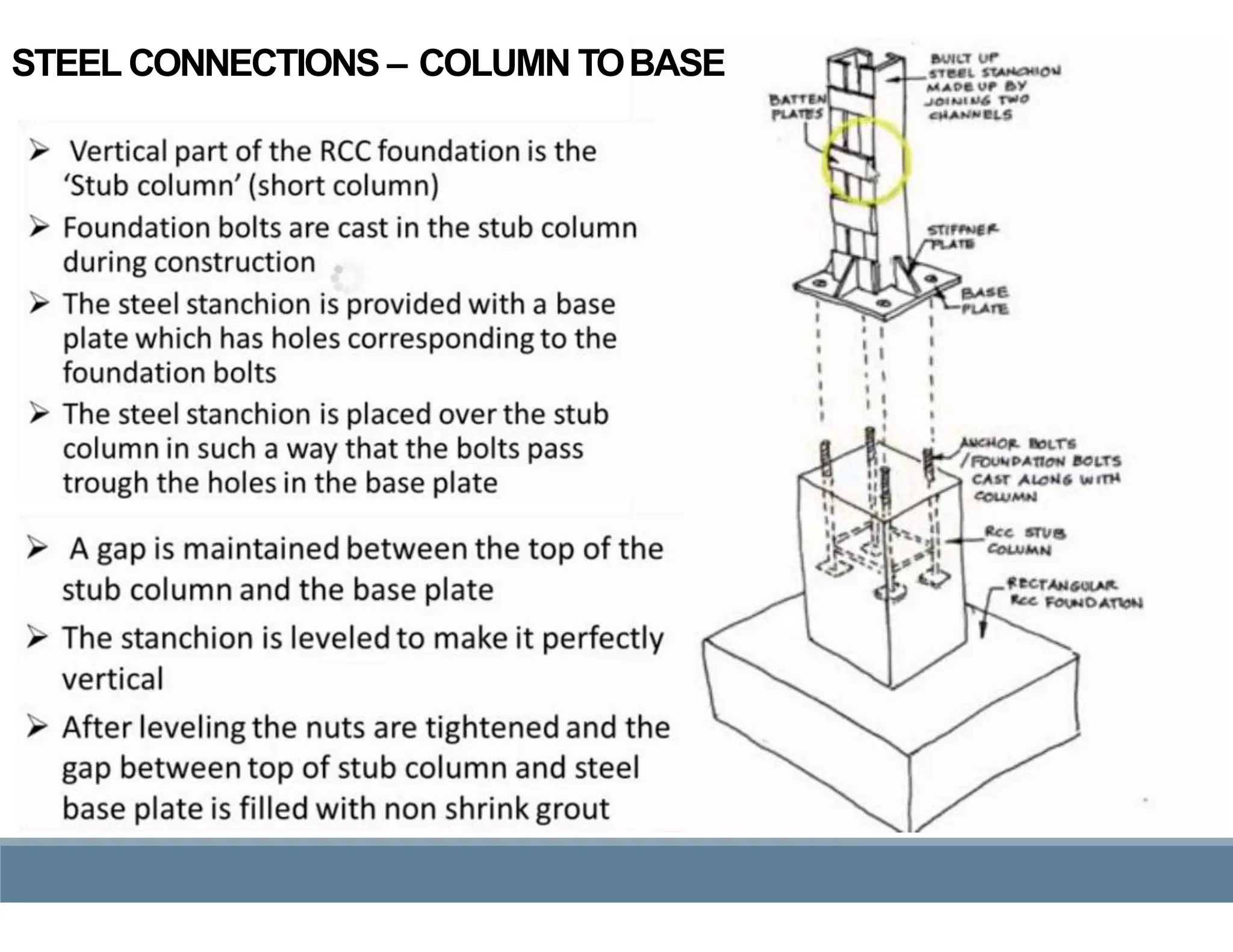
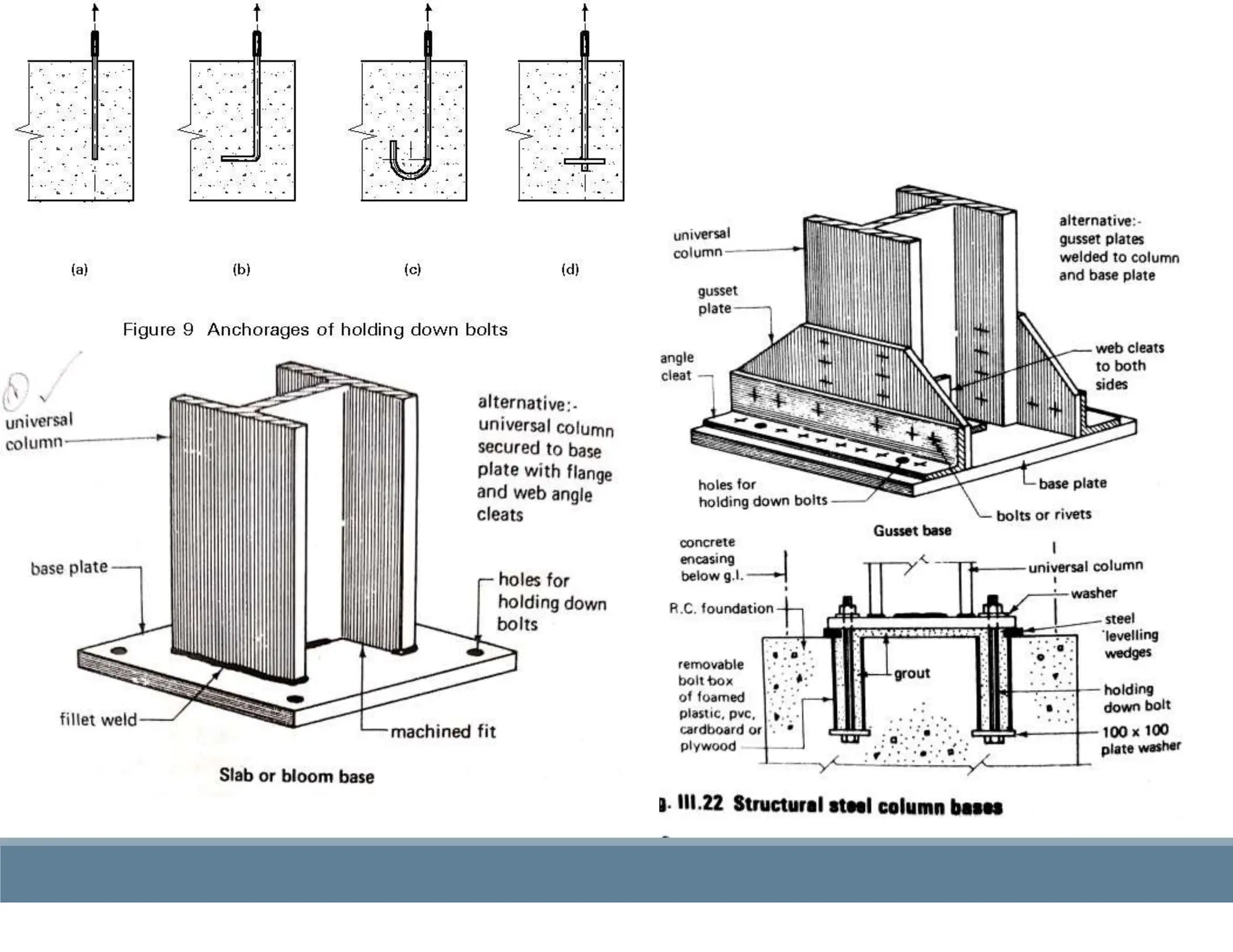
1. Column to Base Plates to foundation
2. Column-to-Column Connections
3. Column to Beam
4. Beam-to-Beam Connections
STEEL CONNECTIONS – COLUMN TOBASE
STEEL CONNECTIONS – COLUMN TOCOLUMN
CONNECTIONS – COLUMN TOBEAM
STEEL CONNECTIONS – BEAM TOBEAM
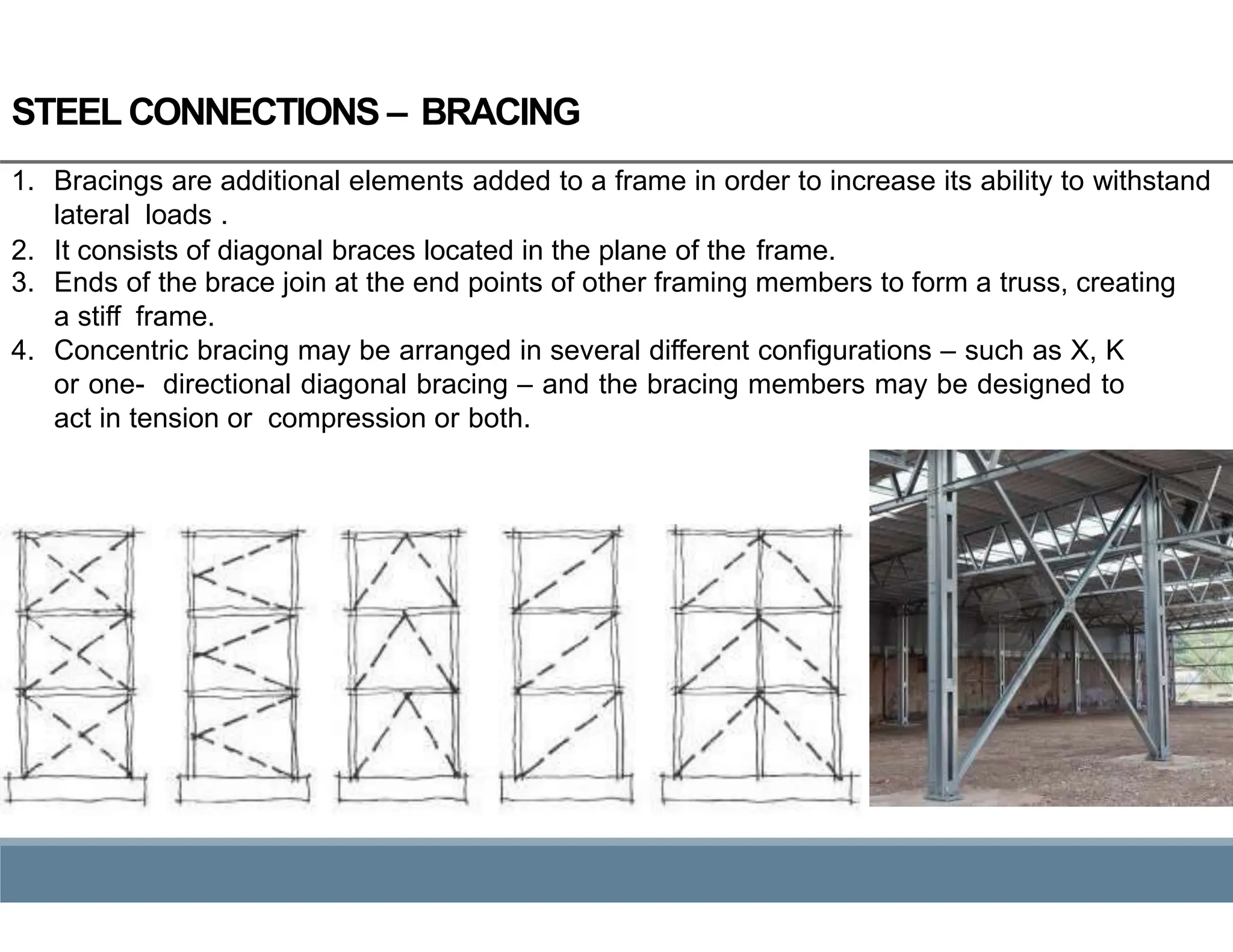
STEEL CONNECTIONS – BRACING
1. Bracings are additional elements added to a frame in order to increase its ability to withstand
lateral loads .
2. It consists of diagonal braces located in the plane of the frame.
3. Ends of the brace join at the end points of other framing members to form a truss, creating
a stiff frame.
4. Concentric bracing may be arranged in several different configurations – such as X, K
or one- directional diagonal bracing – and the bracing members may be designed to
act in tension or compression or both.
COMPOSITESLABS ORMETAL DECK FLOORING
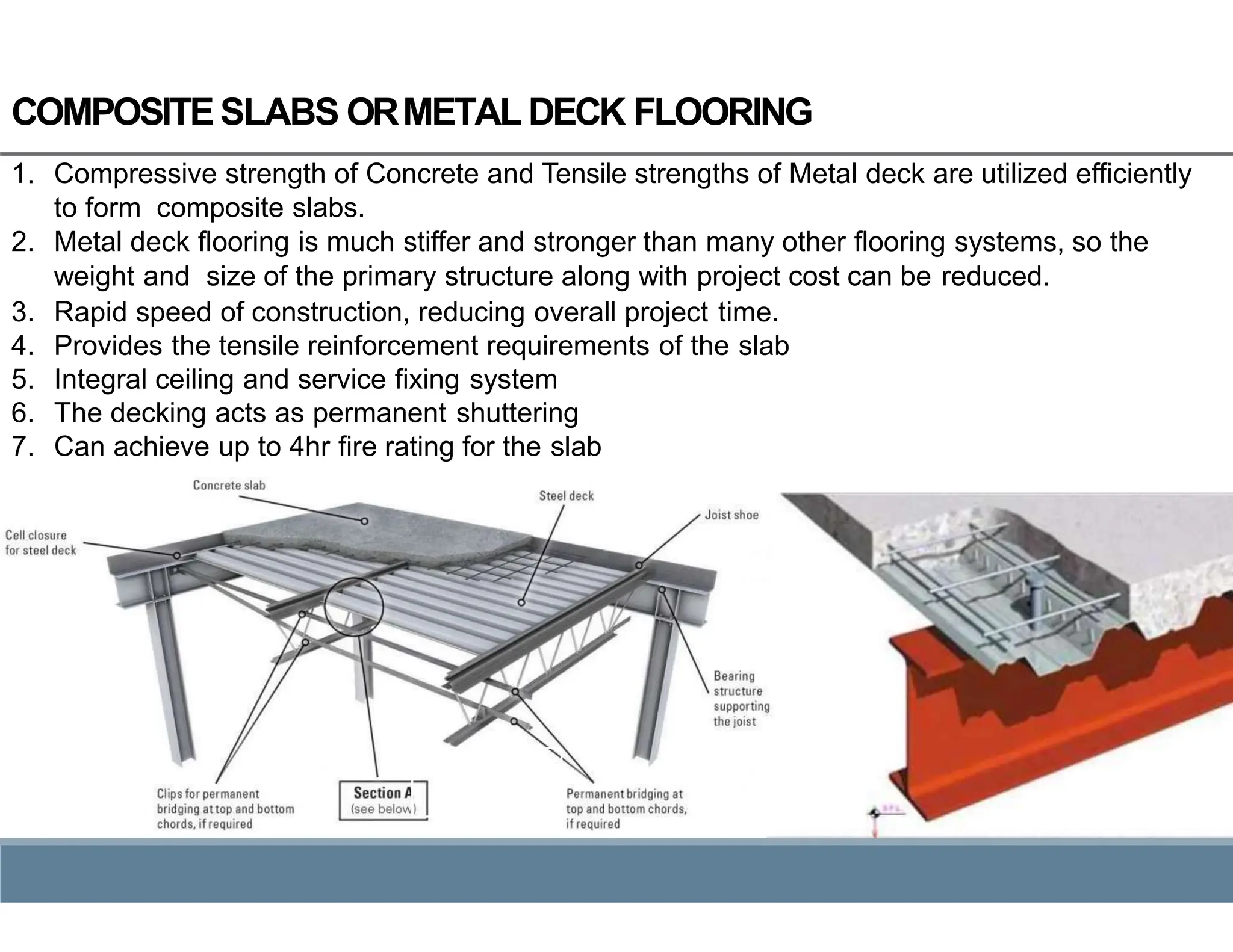
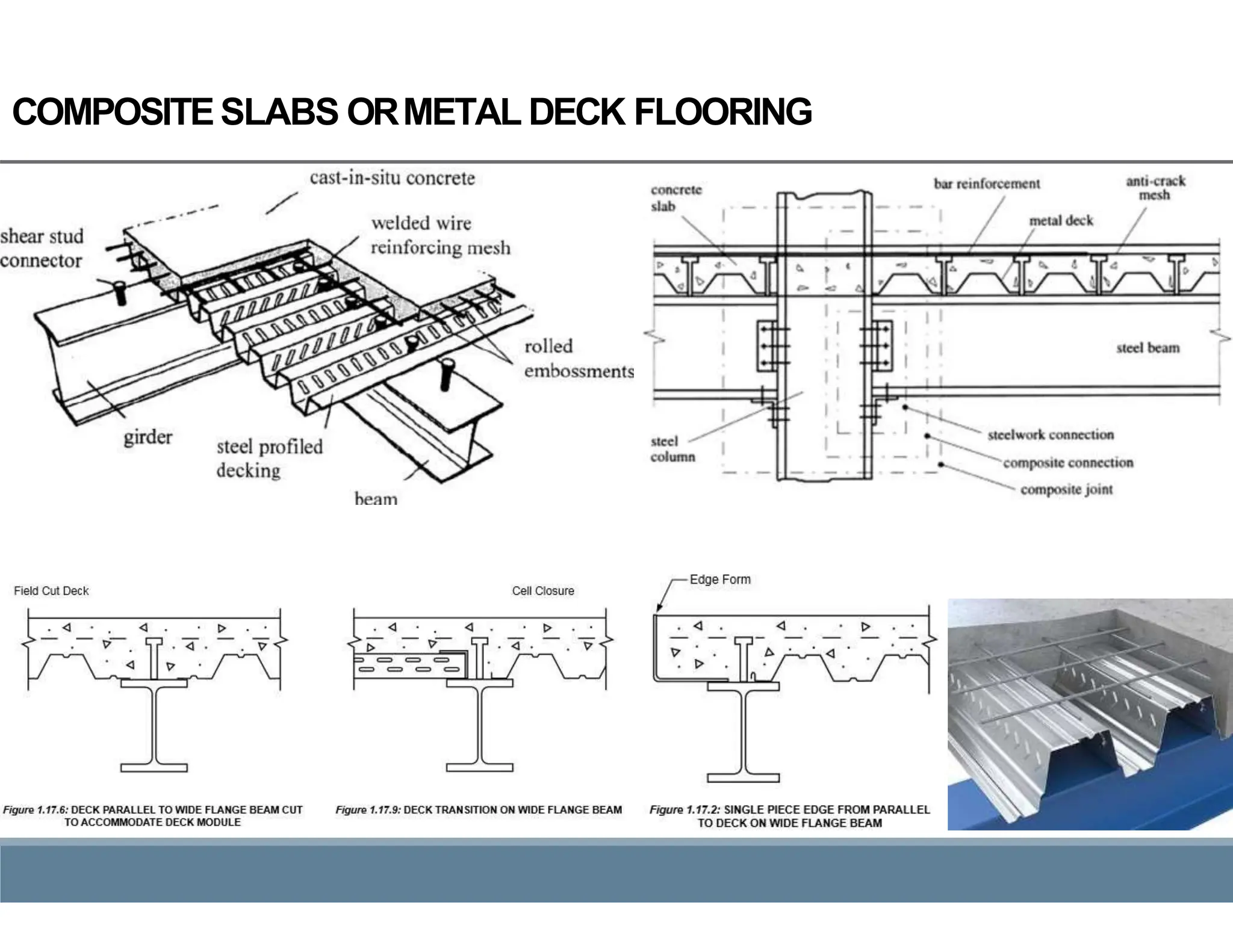
1. Compressive strength of Concrete and Tensile strengths of Metal deck are utilized efficiently
to form composite slabs.
2. Metal deck flooring is much stiffer and stronger than many other flooring systems, so the
weight and size of the primary structure along with project cost can be reduced.
3. Rapid speed of construction, reducing overall project time.
4. Provides the tensile reinforcement requirements of the slab
5. Integral ceiling and service fixing system
6. The decking acts as permanent shuttering
7. Can achieve up to 4hr fire rating for the slab
COMPOSITESLABS ORMETAL DECK FLOORING
WALLS – USING BUILDING BLOCKS/ CONCRETE BLOCKS
FIRE SAFETYIN STEEL STRUCTURES
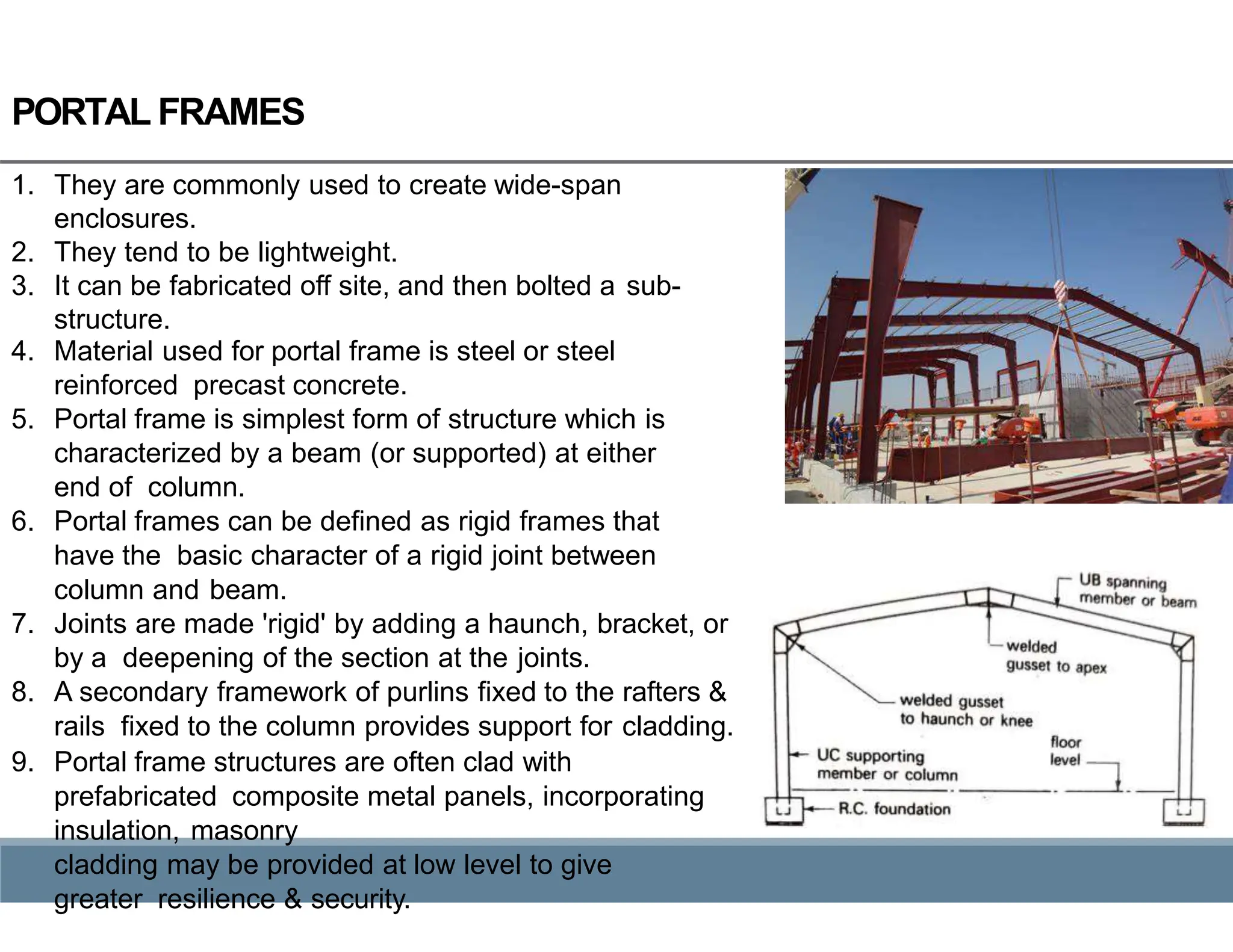
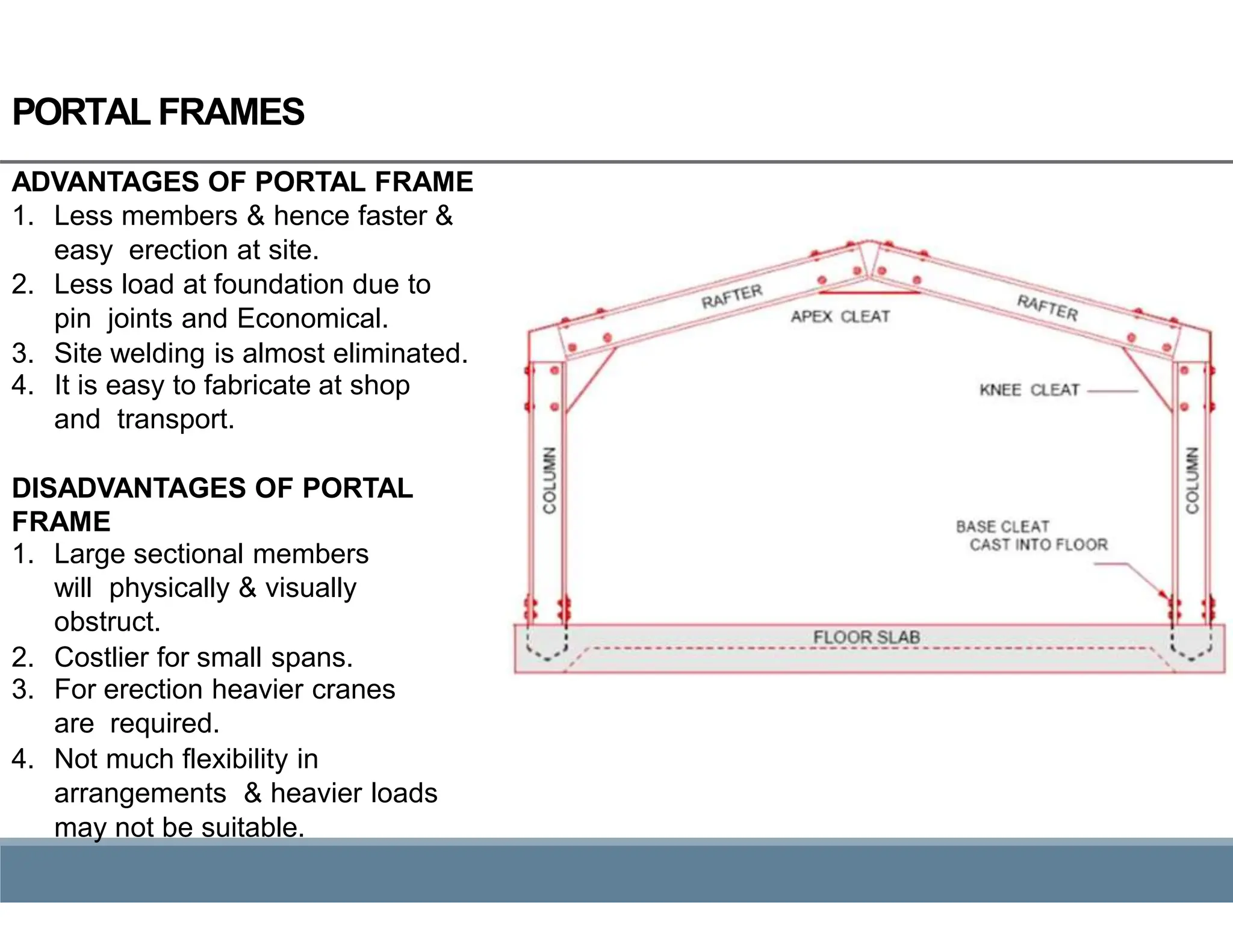
PORTAL FRAMES
1. They are commonly used to create wide-span
enclosures.
2. They tend to be lightweight.
3. It can be fabricated off site, and then bolted a sub-
structure.
4. Material used for portal frame is steel or steel
reinforced precast concrete.
5. Portal frame is simplest form of structure which is
characterized by a beam (or supported) at either
end of column.
6. Portal frames can be defined as rigid frames that
have the basic character of a rigid joint between
column and beam.
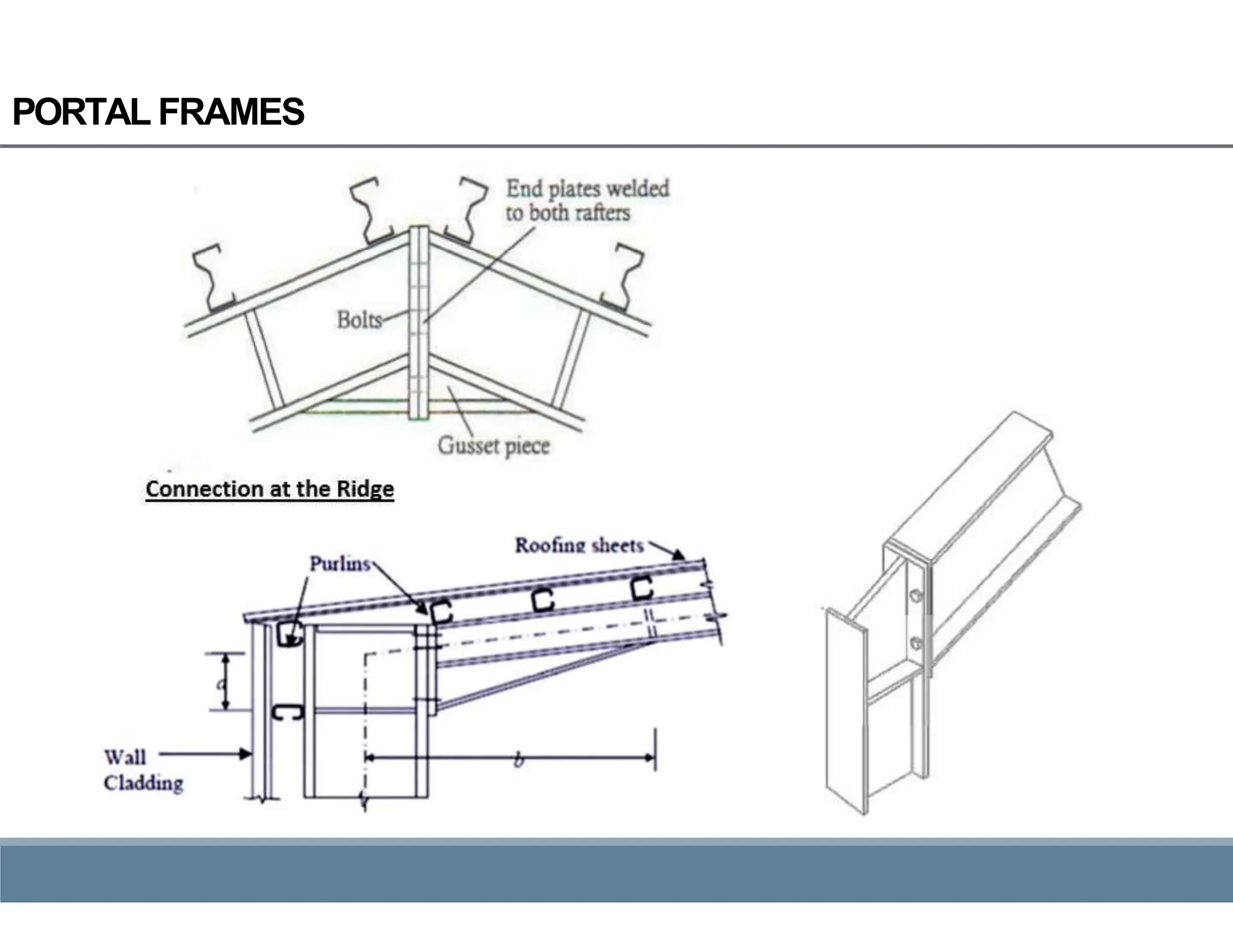
7. Joints are made 'rigid' by adding a haunch, bracket, or
by a deepening of the section at the joints.
8. A secondary framework of purlins fixed to the rafters &
rails fixed to the column provides support for cladding.
9. Portal frame structures are often clad with
prefabricated composite metal panels, incorporating
insulation, masonry
cladding may be provided at low level to give
greater resilience & security.
PORTAL FRAMES
ADVANTAGES OF PORTAL FRAME
1. Less members & hence faster &
easy erection at site.
2. Less load at foundation due to
pin joints and Economical.
3. Site welding is almost eliminated.
4. It is easy to fabricate at shop
and transport.
DISADVANTAGES OF PORTAL
FRAME
1. Large sectional members
will physically & visually
obstruct.
2. Costlier for small spans.
3. For erection heavier cranes
are required.
4. Not much flexibility in
arrangements & heavier loads
may not be suitable.
PORTAL FRAMES
TYPES OF PORTAL FRAME
1. Duo-pitch portal frame.
2. Mono-pitched portal frame.
3. Curved portal frame.
4. Portal with crane.
5. Portal frame with
mezzanine.
6. Two span portal frame.
7. Tied portal frame.
PORTAL FRAMES

Steel Structures - Building technology.pptx

  • 1.
  • 2.
    STEEL STRUCTURES Steel constructionis most often used in • High rise buildings because of its strength, low weight, and speed of construction. • Long span Structures such as Sports Stadiums, airport terminal, Bridges and other Infrastructure. • • Industrial buildings & warehouses because of its ability to create large span spaces at low cost • Residential buildings in a technique called light gauge steel construction, also because of its speed of construction. • Temporary Structures as these are quick to set up and remove
  • 3.
  • 4.
  • 5.
    ADVANTAGES OFSTEELSTRUCTURES • Strength- Most steel construction is done with Mild steel. Mild steel is a material that is immensely strong. • Speed of construction - They are super-quick to build at site, as a lot of work can be pre- fabricated at the factory. • Flexible - which makes them very good at resisting dynamic (changing) forces such as wind or earthquake forces. • Plasticity or ductility - This means that when subjected to great force, it will not suddenly crack like glass, but slowly bend out of shape or deform, thus giving warning to inhabitants to escape. • Structural Stability - Failure in steel frames is not sudden - a steel structure rarely collapses • Earthquake resistant - Steel in most cases performs far better in earthquake than most other materials because of these properties. • Less Raw material - Because of the high strength grade of steel, this structure requires less raw materials than other types of structure like concrete structure and timber structure.
  • 6.
    ADVANTAGES OFSTEELSTRUCTURES • Theycan be made to take any kind of shape, and clad with any type of material. • Multiple joining methods - A wide range of joining methods is available, such as bolting, welding, and riveting. • Light weight Construction – Consider a single storey building measuring 5 x 8m. Let us first construct this in concrete, with four columns at the corners, beams spanning between the columns, and a 150mm thick concrete slab at the top. Such a structure would weigh about 32 Tons (32,000 kg) in total. If we build this of steel instead, with a sloping roof covered with corrugated metal sheeting with insulation, this would weigh only about only 2.6 Tons (2,600 kg). So the concrete building is over 12 times heavier! This is for single storey structures - in multi- storey structures, the difference will be less, as the floors in multi-storey steel buildings are built of concrete slabs for economy - but the difference is still significant.
  • 7.
    DISADVANTAGES OFSTEEL STRUCTURES •They lose strength at high temperatures, and are susceptible to fire. At 500 degrees Celsius (930 degrees F), mild steel can lose almost half its strength. This is what happened at the collapse of the World Trade Towers in 2001 • They are prone to corrosion in humid or marine environments.
  • 8.
    STEEL AS AMATERIAL • Steels is an alloys of Iron in which iron is mixed with carbon and other elements. • Steels are described as Low, medium- or high- carbon steels according to the percentage of carbon they contain, although this is never greater than about 1.5%. • Around 3500 different grades of steel are available. Type of steel - Percentage of carbon 1. Low Carbon Steel (Mild steel) - Up to 0.25% 2. Medium carbon steel - 0.25% to 0.45% 3. High carbon steel - 0.45% to 1.50% • Based on Manufacturing Process steel sections are known as - 1. Hot rolled sections 2. Cold Rolled sections.
  • 9.
  • 10.
    ROLLED STEEL SECTIONS •The steel sections manufactured in rolling mills and are casted in continuous casting molds without any joints. • Steel sections are named according to their cross sectional shapes. • Regular steel sections - sections are readily available in the market and have frequent demand • Special sections - sections which are rarely used and are produced on special requisition. • ‘ISI Handbook for Structural Engineers’ gives nominal dimensions, weight and geometrical properties of various rolled structural steel sections. Different shapes or forms of rolled steel sections are explained below – 1. Angle Sections (Equal Angles and UnequalAngles) 2. Channel Section 3. T section 4. I Section 5. Round bars 6. Square bars 7. Flat bars 8. Hollow Sections 9. Corrugated sheets 10. Expanded metal 11. Plates 12. Ribbed bars (mild steel)
  • 11.
    ROLLED STEEL SECTIONS ANGLESECTION : • Angle sections are widely used for roof truss constructions and for filler joist floors. • Equal angle sections are available from 20 mm x 20 mm x 3 mm to 200 mm x 200mm x 25 mm with their corresponding weights as 9 N (0.9 KG) and 736 N (73.6 KG) per meter length respectively.. • Unequal angle sections are available from 30 mm x 20 mm x 3 mm to 200mm x 150mm x 18mm with 11 N and 469 N per meter length weight respectively.
  • 12.
    ROLLED STEEL SECTIONS CHANNELSECTION : • The channel section or C- section consists two equal flanges connected to web at both ends. • Channel sections are extensively used in steel framed structures. • They are available in various sizes ranging from 100 mm x 45 mm to 400mm x 100 mm. Corresponding unit weights are 58 N and 494 N per meter length respectively. I SECTION : • Also called as steel beams or rolled steel joist • Used as beams, lintels, columns etc. • It consists two flanges and a web. • These are available in various sizes ranges from 75 mm x 50 mm at 61 N per meter length to 600 mm x 210 mm at 995 N per meter length.
  • 13.
    ROLLED STEEL SECTIONS TSECTION : • Used in steel roof trusses to form built up sections. • Two angle sections can also be joined to get T section. • Rolled T sections size varies from 20 mm x 20 mm x 3 mm to 150 mm x 150mm x 10 mm with 9 N and 228 N as their corresponding weights per meter length. ROLLED STEEL PLATES: • They are used for connecting steel beams, tensional member in roof truss etc. • They are designated with their thickness which is varying from 5 mm to 50 mm.
  • 14.
    ROLLED STEEL SECTIONS ROLLEDROUND BARS : • Used as reinforcement in concrete and steel grill work etc. • Available in various diameters varies from 5 mm to 250 mm. ROLLED SQUARE BARS : • Used for gates, windows, grill works etc. • Sides of square cross section ranges from 5 mm to 250 mm. ROLLED FLAT BARS : • Flat bars are also used for gates, windows, grill works etc. • Width of the bar varies from 10 mm to 400 mm. thickness of flat bars will be from 3 mm to 40 mm.
  • 15.
    • Hollow sections- •Rectangular hollow sections • Square hollow sections • Tube sections
  • 16.
    ROLLED STEEL SECTIONS CORRGATEDSHEETS: • Plain steel sheets are passed through machines which produce bends by pressing them called corrugations. • These sheets are used for roof coverings. EXPANDED METAL : • Expanded metal sheets are made from mild steel sheets Which are cut through machine and expanded. • Generally, Diamond shaped mesh is appeared in this type of sheets
  • 17.
    COMPOUNDAND BUILT UPSECTIONS Compound sections are formed by : 1. Strengthening a rolled section such as a universal beam by welding on cover plates. 2. Combining two separate rolled sections, as in the case of the crane girder: The two members carry loads from separate directions. Compound Beams Crane Girder Built Up sections: • Built-up sections are made by welding plates together to form I, H or box members that are termed plate girders, built-up columns, box girders or columns, respectively. • These members are used where heavy loads have to be carried and in the case of plate and box girders where long spans may be required.
  • 18.
    COLDROLLED OPEN SECTIONS •Thin steel plates can be formed into a wide range of sections by cold rolling. The most important uses for cold-rolled open sections in steel structures are for purlins, side and sheeting rails. • Three common sections – the zed, sigma and lipped channel are shown. Z Section Sigma Section Lipped Channel Section
  • 19.
    CASTELLATED BEAMS • Castellatedcomes from a Latin word that meant: to structurally fortify. • Castellated beam has a regular pattern of holes (circular, hexagonal or octagonal) in its web and made from hot rolled section, which is first divided by a lengthwise cut into two halves following a special pattern, then welded together to increase its depth. • Sometimes additional flats are used between two web cuts for even further deeper section.
  • 20.
    ADVANTAGES OFCASTELLATEDBEAMS 1. Higherload bearing capacity at same beam weight. 2. Light weight compared to conventional wide flange beam section. 3. Typically longer spans with fewer columns 4. MEPs can integrate. 5. Can lower floor-to-floor height by integrating MEP runs. 6. Faster construction. 7. Less material is required, result on light weight foundations, hence economical.
  • 21.
    METHODSOFCONNECTION IN STEELWORK The various members of steel framed structure are to be suitably connected for transfer of load. Following are the methods adopted for connecting the members in steelwork 1. Bolts 2. Rivets 3. Welding CONNECTIONS - BOLTS • Bolting is common in field connections, since it is simple and economical to make. • Bolting is also regarded as being more appropriate in field connections from considerations of safety. • Bolts used in steel structures are of three types 1. Black Bolts 2. Turned and Fitted Bolts and 3. High Strength Friction Grip (HSFG) Bolts.
  • 22.
    CONNECTIONS - RIVETS Rivetsgenerally are made of low carbon steel. Riveting is used 1. To avoid after thermal effects, as in case of welding 2. Used for metals which have poor weldability 3. Used for heterogeneous materials like asbestos friction lining and steel. Types of Rivets Advantages of riveted joints: 1. Cheaper fabrication cost 2. Low maintenance cost 3. Dissimilar metals can also be joined, even non-metallic joints are possible with riveted joints. 4. Ease of riveting process. Disadvantages of riveted joints: 1. Skilled workers required 2. Leakage may be a problem for this type of joints, but this is overcome by special techniques.
  • 23.
    Types of Riveting 1.Hot Riveting 2. Cold Riveting 3. Hand Riveting 4. Machine Riveting According to the position of plates connected riveted joints are classified into two types: Lap joint: In a lap joint the edges of plates are simply laid over each other and riveted. Butt joint: In Butt, joint plates lie in the same plane and joined through cover plates. CONNECTIONS - RIVETS
  • 24.
    CONNECTIONS - WELDING •There are five different types of welded joints 1. Butt joint : In Butt welded type, the parts lie in the same plane and are joined at their edges. 2. Corner joint : The parts in a corner joint form a right angle and are joined at the center of the angle. 3. Lap joint : Lap joint consists of two overlapping parts. 4. Tee-joint : In a Tee-joint, one joint is the right angle to the other joint in the approximate shape of the letter “T”. 5. Edge joint: The parts in edge joint are parallel with at least one of their edges in common and the joint is made at the common edge(s).
  • 25.
  • 26.
    STEEL CONNECTION • Designof connections is an integral and important part of design of steel structures. They are also critical components of steel structures, since • They have the potential for greater variability in behavior and strength. • They are more complex to design than members • They are usually the most vulnerable components, failure of which may lead to the failure of the whole structure. Many types based on function 1. Column to Base Plates to foundation 2. Column-to-Column Connections 3. Column to Beam 4. Beam-to-Beam Connections
  • 27.
    STEEL CONNECTIONS –COLUMN TOBASE
  • 30.
    STEEL CONNECTIONS –COLUMN TOCOLUMN
  • 31.
  • 33.
  • 34.
    STEEL CONNECTIONS –BRACING 1. Bracings are additional elements added to a frame in order to increase its ability to withstand lateral loads . 2. It consists of diagonal braces located in the plane of the frame. 3. Ends of the brace join at the end points of other framing members to form a truss, creating a stiff frame. 4. Concentric bracing may be arranged in several different configurations – such as X, K or one- directional diagonal bracing – and the bracing members may be designed to act in tension or compression or both.
  • 35.
    COMPOSITESLABS ORMETAL DECKFLOORING 1. Compressive strength of Concrete and Tensile strengths of Metal deck are utilized efficiently to form composite slabs. 2. Metal deck flooring is much stiffer and stronger than many other flooring systems, so the weight and size of the primary structure along with project cost can be reduced. 3. Rapid speed of construction, reducing overall project time. 4. Provides the tensile reinforcement requirements of the slab 5. Integral ceiling and service fixing system 6. The decking acts as permanent shuttering 7. Can achieve up to 4hr fire rating for the slab
  • 36.
  • 38.
    WALLS – USINGBUILDING BLOCKS/ CONCRETE BLOCKS
  • 39.
  • 41.
  • 42.
    PORTAL FRAMES 1. Theyare commonly used to create wide-span enclosures. 2. They tend to be lightweight. 3. It can be fabricated off site, and then bolted a sub- structure. 4. Material used for portal frame is steel or steel reinforced precast concrete. 5. Portal frame is simplest form of structure which is characterized by a beam (or supported) at either end of column. 6. Portal frames can be defined as rigid frames that have the basic character of a rigid joint between column and beam. 7. Joints are made 'rigid' by adding a haunch, bracket, or by a deepening of the section at the joints. 8. A secondary framework of purlins fixed to the rafters & rails fixed to the column provides support for cladding. 9. Portal frame structures are often clad with prefabricated composite metal panels, incorporating insulation, masonry cladding may be provided at low level to give greater resilience & security.
  • 43.
    PORTAL FRAMES ADVANTAGES OFPORTAL FRAME 1. Less members & hence faster & easy erection at site. 2. Less load at foundation due to pin joints and Economical. 3. Site welding is almost eliminated. 4. It is easy to fabricate at shop and transport. DISADVANTAGES OF PORTAL FRAME 1. Large sectional members will physically & visually obstruct. 2. Costlier for small spans. 3. For erection heavier cranes are required. 4. Not much flexibility in arrangements & heavier loads may not be suitable.
  • 44.
    PORTAL FRAMES TYPES OFPORTAL FRAME 1. Duo-pitch portal frame. 2. Mono-pitched portal frame. 3. Curved portal frame. 4. Portal with crane. 5. Portal frame with mezzanine. 6. Two span portal frame. 7. Tied portal frame.
  • 45.