Subject : Advance Construction
Equipments
Prepared By:
Bambhroliya Rishabh 151103106001
Dudhat Pritesh 151103106002
Gain Yogesh 151103106004
Gohil Harish 151103106005
Kansara Abhishek 151103106007
Guided by:
Assi. Prof. Mihir Naik
Civil Engg. Dept.
Assi. Prof. Nafisa Shaikh
Civil Engg. Dept.
Formwork
Formwork
o It should be capable of carrying all imposed dead and live loads
apart from its own weight.
o Formwork is a temporary structure or a support constructed in the
form of support or mould for laying concrete until it becomes harder.
Formwork is commonly made of
o Steel
o Timber
TIMBER FORMWORK
STEEL FORMWORK
Qualities of Formwork
It should be water tight.
It should be strong.
It can be reusable.
Its contact surface should be uniform.
It should be according to the size of member.
Major objectives considered in formwork:
Quality
Safety
Economy
Quality:
Forms must be designed and built with sufficient stiffness and accuracy so that
the size, shape, position, and finish of the cast concrete are maintained.
Safety:
Forms must be built sufficient strength and factor of safety so that they have
the capable of all supporting loads.
Economy:
Forms must be built efficiently, minimizing time and cost.
Requirements of formwork:
 Material should be cheap and re usable,
 It should be practically water proof, so that it should not
absorb water from concrete,
 Swelling and shrinkage should be minimum,
 Strong enough to with stand all external loads,
 Deflection should be minimum,
 Surface should be smooth, and afford easy striping,
 Light in weight, so that easy to transfer,
 Joints should be stiff, so that lateral deformation and leak is
minimum .
a) Centering.
b) Shuttering.
c) Provision of Camber.
d) Finishing.
Construction Steps for Formwork:
Formwork detail for different structural
members
In concrete construction formwork is
commonly provided for the following structural
members.
o Wall
o Column
o Slabs & Beams
o Stairs
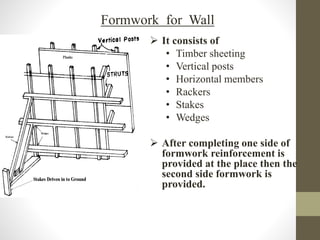
Formwork for Wall
 It consists of
• Timber sheeting
• Vertical posts
• Horizontal members
• Rackers
• Stakes
• Wedges
 After completing one side of
formwork reinforcement is
provided at the place then the
second side formwork is
provided.
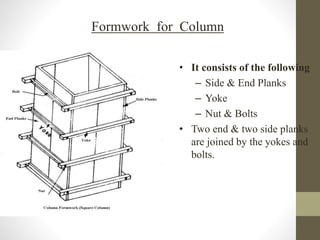
Formwork for Column
• It consists of the following
– Side & End Planks
– Yoke
– Nut & Bolts
• Two end & two side planks
are joined by the yokes and
bolts.
Formwork for columns
Formwork for Slabs & beams:
• It consists of
– Sole plates
– Wedges
– Props
– Head tree
– Planks
– Batten
– Ledgers
• Beam formwork rests
on head tree
• Slab form work rests on
battens and joists
• If prop height are more
than 8’ provide
horizontal braces.
Lintel or Beam Formwork:
FORMWORK FOR SLAB:
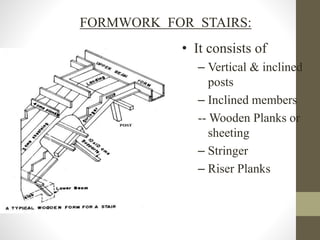
FORMWORK FOR STAIRS:
• It consists of
– Vertical & inclined
posts
– Inclined members
-- Wooden Planks or
sheeting
– Stringer
– Riser Planks
FORMWORK FOR STAIRS:
Removal of formwork:
 Time of formwork removal depends on the following factors
1. Type of Cement
1. Rapid hardening cements require lesser time as compared to OPC
(Ordinary Portland Cement)
2. Ratio of concrete mix
1. Rich ratio concrete gain strength earlier as compared to weak
ratio concrete.
3. Weather condition
1. Hydration process accelerates in hot weather conditions as
compared to cold and humid weather conditions.
Time of Removal of formwork:
Maintenance of formwork:
• Due to continuous use wooden planks & steel plates
surfaces become uneven and require maintenance.
• For wooden formwork use cardboard or plastic fiber
board. Bolt hole places must also be repaired.
• For steel formwork plates must be leveled by mallet
and loose corners must be welded.
Cost of formwork
 For normal works cost of formwork is about 30%-40% of the concrete cost.
 For special works cost of formwork is about 50%-60% of the concrete cost.
 Formwork cost is controlled by the following factors
• Formwork Material cost
• Formwork erecting cost
• Formwork removal cost
• Formwork jointing cost (Nails and Cables)
• Labor charges.
Advantages of steel form work:
 It can be used for a no. of times.
 It is non absorbent.
 Smooth finish surface obtained.
 No shrinkage of formwork occurs.
 Easy to use.
 Its volume is less
 Its strength is more.
LOADS ON FORMWORK:
• Dead load
 Self weight of formwork
 Pressure and loads from fresh concrete
 Reinforcement
• Imposed load
 Construction workers
 Stacking of materials
• Horizontal loads
• Environmental loads
 Accidental loads
 Wind loads
Thank You

FormWork

  • 1.
    Subject : AdvanceConstruction Equipments
  • 2.
    Prepared By: Bambhroliya Rishabh151103106001 Dudhat Pritesh 151103106002 Gain Yogesh 151103106004 Gohil Harish 151103106005 Kansara Abhishek 151103106007 Guided by: Assi. Prof. Mihir Naik Civil Engg. Dept. Assi. Prof. Nafisa Shaikh Civil Engg. Dept.
  • 3.
  • 4.
    Formwork o It shouldbe capable of carrying all imposed dead and live loads apart from its own weight. o Formwork is a temporary structure or a support constructed in the form of support or mould for laying concrete until it becomes harder. Formwork is commonly made of o Steel o Timber
  • 5.
  • 6.
  • 7.
    Qualities of Formwork Itshould be water tight. It should be strong. It can be reusable. Its contact surface should be uniform. It should be according to the size of member.
  • 8.
    Major objectives consideredin formwork: Quality Safety Economy
  • 9.
    Quality: Forms must bedesigned and built with sufficient stiffness and accuracy so that the size, shape, position, and finish of the cast concrete are maintained. Safety: Forms must be built sufficient strength and factor of safety so that they have the capable of all supporting loads. Economy: Forms must be built efficiently, minimizing time and cost.
  • 10.
    Requirements of formwork: Material should be cheap and re usable,  It should be practically water proof, so that it should not absorb water from concrete,  Swelling and shrinkage should be minimum,  Strong enough to with stand all external loads,  Deflection should be minimum,  Surface should be smooth, and afford easy striping,  Light in weight, so that easy to transfer,  Joints should be stiff, so that lateral deformation and leak is minimum .
  • 11.
    a) Centering. b) Shuttering. c)Provision of Camber. d) Finishing. Construction Steps for Formwork:
  • 12.
    Formwork detail fordifferent structural members In concrete construction formwork is commonly provided for the following structural members. o Wall o Column o Slabs & Beams o Stairs
  • 13.
    Formwork for Wall It consists of • Timber sheeting • Vertical posts • Horizontal members • Rackers • Stakes • Wedges  After completing one side of formwork reinforcement is provided at the place then the second side formwork is provided.
  • 14.
    Formwork for Column •It consists of the following – Side & End Planks – Yoke – Nut & Bolts • Two end & two side planks are joined by the yokes and bolts.
  • 15.
  • 16.
    Formwork for Slabs& beams: • It consists of – Sole plates – Wedges – Props – Head tree – Planks – Batten – Ledgers • Beam formwork rests on head tree • Slab form work rests on battens and joists • If prop height are more than 8’ provide horizontal braces.
  • 17.
    Lintel or BeamFormwork:
  • 18.
  • 19.
    FORMWORK FOR STAIRS: •It consists of – Vertical & inclined posts – Inclined members -- Wooden Planks or sheeting – Stringer – Riser Planks
  • 20.
  • 21.
    Removal of formwork: Time of formwork removal depends on the following factors 1. Type of Cement 1. Rapid hardening cements require lesser time as compared to OPC (Ordinary Portland Cement) 2. Ratio of concrete mix 1. Rich ratio concrete gain strength earlier as compared to weak ratio concrete. 3. Weather condition 1. Hydration process accelerates in hot weather conditions as compared to cold and humid weather conditions.
  • 22.
    Time of Removalof formwork:
  • 23.
    Maintenance of formwork: •Due to continuous use wooden planks & steel plates surfaces become uneven and require maintenance. • For wooden formwork use cardboard or plastic fiber board. Bolt hole places must also be repaired. • For steel formwork plates must be leveled by mallet and loose corners must be welded.
  • 24.
    Cost of formwork For normal works cost of formwork is about 30%-40% of the concrete cost.  For special works cost of formwork is about 50%-60% of the concrete cost.  Formwork cost is controlled by the following factors • Formwork Material cost • Formwork erecting cost • Formwork removal cost • Formwork jointing cost (Nails and Cables) • Labor charges.
  • 25.
    Advantages of steelform work:  It can be used for a no. of times.  It is non absorbent.  Smooth finish surface obtained.  No shrinkage of formwork occurs.  Easy to use.  Its volume is less  Its strength is more.
  • 26.
    LOADS ON FORMWORK: •Dead load  Self weight of formwork  Pressure and loads from fresh concrete  Reinforcement • Imposed load  Construction workers  Stacking of materials • Horizontal loads • Environmental loads  Accidental loads  Wind loads
  • 27.