HISTORY
OF
LANDSCAPE
MUGHAL
AND
PERSIAN
GARDENS
BACKGROUND
Mughal art forms were a blend of Persian, Central Asian, and Indian styles.
When Timur conquered Iran in the 14th century, expanding his Central Asian
empire, the nomadic Mongols adopted Persian cultural traditions.
TIMURID GARDEN CITIES
 The close relationship between gardens and urban form in 15th-century
Central Asia is exemplified by the planned city of Samarkand, where the
managed landscape formed an integral part of the ordered city.
Located on the important Silk Route between China and the Mediterranean,
Samarkand reveals the influences of many different cultures.
 Founded by the Persians in the 8th century BCE, the city was conquered by
Alexander in the 4th century BCE, overrun by the Turks in the 6th century
CE, and dominated by the Arabs in the 8th century, when it became a center
of Islamic scholarship.
Samarkand was sacked by the Mongols in 1220. Timur (1336–1405, also
known as Tamerlane) established Samarkand as the capital of his empire in
1370, and rebuilt the city as a cultural mecca.
A nomadic tribesman from Central Asia, Timur wanted to control lucrative
trade routes, and through ruthless warfare subjugated lands from India to
Turkey, including parts of Russia.
He weakened Mongol power in Central Asia and crippled the Ottoman Turks
who were threatening Europe. The King of Castile (northern Spain) sent an
envoy, Ruy Gonzalez de Clavijo, to establish diplomatic ties with Timur.
Clavijo’s descriptions remain an important source of information on the
lush gardens and fertile plains of Samarkand.
The court moved to Herat after Timur’s death. The Timurid period, from the
late 14th to early 15th centuries, was described by Timur’s descendent
Babur as the Golden Age for art and science.10 Observatories were built and
constellations mapped; Herat and Samarkand blossomed under the
leadership of Timur’s heirs.
SILK ROUTE: Material goods, scientific concepts, and philosophical ideologies
were transferred between continents, enriching cultures worldwide.
FOUR-FOLD GARDEN GEOMETRY
Once surrounded by forests, orchards, and meadows, the gardens at Samarkand have
vanished. But the pleasure gardens and royal encampments described by Clavijo and
Babur established a prototype for later gardens: the four-square garden with water
axis and central pavilion.
Although the rectangular subdivision of space is evidenced in ancient Persian gardens,
the fi rst reference to this form as chahar-bagh (literally, “four gardens”) was during
Timur’s reign.
In Islam, as in many other religions, paradise is symbolized as a garden. A chahar-bagh
is often called a paradise garden (its runnels representing the rivers of milk, honey,
water, and wine mentioned in the Quran), but the symbolic geometry predates the
advent of Islam.
In pre-Islamic Persian iconography, crossed axes represented the four corners of the
world, marked with a spring at its center. The evolution of the chaharbagh
as a model of paradise parallels the etymology of the English word
paradise: its Greek root, paradeisos (park) derives from the Persian pairidaeza (walled
enclosure). The elaborate paradise gardens of the Mughal Empire in India and Kashmir,
founded by Babur, are described inchapter five.
TRANSOXIAN VALLEY: Clavijo described the city of Herat: “It stands in
the plain, and on all sides the land is well irrigated by streams and water
channels, while round and about the city there are orchards with many
homesteads.
Clavijo described many royal fetese garden is veryd with many others that
throughout are paths…. In thece here was built and plan of which
The Mughal Empire
The Mughal empire at its height stretched from the base of the Himalayas to the
Bay of Bengal, covering territories in present day Afghanistan and northwest
India. The landscape differs widely in these regions, from dry desert plains to
lush river valleys. Garden forms were adapted to changes in climate and terrain.
Persian styles, including the chahar bagh form, were carried to India after
Timur’s descendent Babur captured Delhi in 1526, forming the Mughal dynasty.
Babur’s grandson Akbar (1542–1605) expanded the Mughal empire when he
invaded Kashmir in the late 16th century.
Seventeenth-century Mughal art shows the influence of both Hindu and Islamic
cultures: aspects of a Buddhist aesthetic based on organic patterns and
sculptural ornamentation were combined with the Islamic sense of mathematical
order and geometry.
These infl uences can be seen in the architectural features and built forms of Mughal
gardens, and in the painted miniatures produced during this period. The tomb garden was
a distinctive combination of landscape and architecture that joined aspectsof the Islamic
paradise garden with the Central Asian tradition of garden burial.Construction of a tomb
garden began during an emperor’s lifetime; it was used as a park before his death and as
a temple ground after.
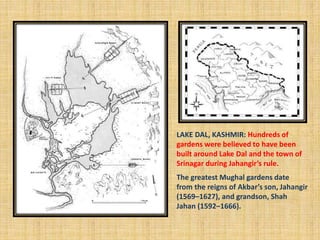
LAKE DAL, KASHMIR: Hundreds of
gardens were believed to have been
built around Lake Dal and the town of
Srinagar during Jahangir’s rule.
The greatest Mughal gardens date
from the reigns of Akbar’s son, Jahangir
(1569–1627), and grandson, Shah
Jahan (1592–1666).
THE CELEBRATION OF WATER
CHADAR: Patterns carved on the surface of the water chute
created different effects in the cascade.
CHINI-KANA: Candles or fl owers placed in the niches enhanced the effect of the
falling water.
SHALAMAR,KASHMIR
Shalamar, built as a
summer palace along the
shores of Lake Dal by
Jahangir in 1619, was
expanded by Shah Jahan
in 1630. Set in a wide
ravine and framed by the
mountains, Shalamar
consists of three terraces
connected by a central
axis of water punctuated
with jets. The main canal
is bordered by pathways
on both sides, shaded by
chenar trees. Turf, fl
owers, and fruit trees
grew on the terraces. At
each level change,
shallow falls were
highlighted by chini
kanas.
NISHAT BAGH, KASHMIR
Nishat Bagh was built in 1620, most likely by a relative of Jahangir’s
wife, hence it had no offi cial function.Twelve terraces (representing the
astrological signs) climbed up the slope, visually uniting with the
distant mountains. Unlike the hierarchical division of space at
Shalamar, the terraces at Nishat Bagh formed a large pleasure garden
with a separate zenana at the top.
A 13-foot-wide canal, lined with jets, bisects the stepped terraces.
Changes in level are marked by narrow chadars, steps, pools, and
chabutras. A tall, arcaded retaining wall forms the base of the zenana
terrace. Three-story baridari are located at each end of the wall. The
watercourse passes right through the pavilion at the top of the zenana.
BUOYANT APPROACH: The garden was entered directly from an inner
lagoon separated from Lake Dal by an arched bridge.
AKBAR’S TOMB: The
grounds of the tomb
garden typify the
char-bagh form.
AKBAR’S TOMB, SIKANDRA
(AGRA)
Completed in 1632, this large mausoleum
sits atop the center of the two crossing water
axes like a monumental chabutra.
The tomb is built as a series
of concentric rectangles: the fi rst
three stories are made of red sandstone,
the top level is white marble.
Four raised causeways subdivide the
char bagh. Water fl owed across the
fl at platforms in narrow, shallow runnels
from four central basins. Cypress
trees (representing death) lined the
avenue. Fruit trees (representing life)
fi lled the terraces.
TAJ MAHAL, AGRA
The tomb garden for Shah Jahan’s wife, Mumtaz Mahal, was begun in 1632 and
completed in 1648. It is an enormous char bagh, unique in that the tomb is located
at the far end of the garden, above the Yamuna river, rather than at the
intersection of the water canals. Legend has it that Shah Jahan had one day hoped
to build his tomb garden (out of black marble) as a mirror image on the
opposite side of the river. Thus the river itself would form the cross-axis, and both
tombs would occupy the center.
As it is, a raised tank of water marks the center of the garden at the Taj Mahal,
reflecting the white marble dome and its minarets. Tree-lined canals divide the
garden into the typical four-square pattern. Trees and fl owers once graced each
parterre.
The tomb stands isolated on aterrace paved with black-and-whitewave patterns.
Minarets stand at the corners of the elevated terrace, countering the bulk of the
architecture and creating a restful void space. The mosque and assembly hall at
either side of the tomb are made from red sandstone, as is the entry gatehouse
and the two small pavilions at the
end of the cross-axis.
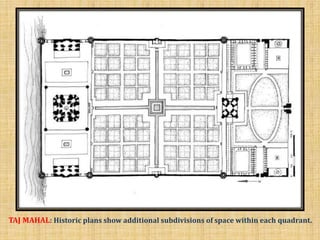
TAJ MAHAL: Historic plans show additional subdivisions of space within each quadrant.
THANK YOU
PALUVADI MUKUNDA PRIYA
18031AA058

Landscape

  • 1.
  • 2.
  • 3.
    BACKGROUND Mughal art formswere a blend of Persian, Central Asian, and Indian styles. When Timur conquered Iran in the 14th century, expanding his Central Asian empire, the nomadic Mongols adopted Persian cultural traditions. TIMURID GARDEN CITIES  The close relationship between gardens and urban form in 15th-century Central Asia is exemplified by the planned city of Samarkand, where the managed landscape formed an integral part of the ordered city. Located on the important Silk Route between China and the Mediterranean, Samarkand reveals the influences of many different cultures.  Founded by the Persians in the 8th century BCE, the city was conquered by Alexander in the 4th century BCE, overrun by the Turks in the 6th century CE, and dominated by the Arabs in the 8th century, when it became a center of Islamic scholarship.
  • 4.
    Samarkand was sackedby the Mongols in 1220. Timur (1336–1405, also known as Tamerlane) established Samarkand as the capital of his empire in 1370, and rebuilt the city as a cultural mecca. A nomadic tribesman from Central Asia, Timur wanted to control lucrative trade routes, and through ruthless warfare subjugated lands from India to Turkey, including parts of Russia. He weakened Mongol power in Central Asia and crippled the Ottoman Turks who were threatening Europe. The King of Castile (northern Spain) sent an envoy, Ruy Gonzalez de Clavijo, to establish diplomatic ties with Timur. Clavijo’s descriptions remain an important source of information on the lush gardens and fertile plains of Samarkand. The court moved to Herat after Timur’s death. The Timurid period, from the late 14th to early 15th centuries, was described by Timur’s descendent Babur as the Golden Age for art and science.10 Observatories were built and constellations mapped; Herat and Samarkand blossomed under the leadership of Timur’s heirs.
  • 5.
    SILK ROUTE: Materialgoods, scientific concepts, and philosophical ideologies were transferred between continents, enriching cultures worldwide.
  • 6.
    FOUR-FOLD GARDEN GEOMETRY Oncesurrounded by forests, orchards, and meadows, the gardens at Samarkand have vanished. But the pleasure gardens and royal encampments described by Clavijo and Babur established a prototype for later gardens: the four-square garden with water axis and central pavilion. Although the rectangular subdivision of space is evidenced in ancient Persian gardens, the fi rst reference to this form as chahar-bagh (literally, “four gardens”) was during Timur’s reign. In Islam, as in many other religions, paradise is symbolized as a garden. A chahar-bagh is often called a paradise garden (its runnels representing the rivers of milk, honey, water, and wine mentioned in the Quran), but the symbolic geometry predates the advent of Islam. In pre-Islamic Persian iconography, crossed axes represented the four corners of the world, marked with a spring at its center. The evolution of the chaharbagh as a model of paradise parallels the etymology of the English word paradise: its Greek root, paradeisos (park) derives from the Persian pairidaeza (walled enclosure). The elaborate paradise gardens of the Mughal Empire in India and Kashmir, founded by Babur, are described inchapter five.
  • 7.
    TRANSOXIAN VALLEY: Clavijodescribed the city of Herat: “It stands in the plain, and on all sides the land is well irrigated by streams and water channels, while round and about the city there are orchards with many homesteads.
  • 8.
    Clavijo described manyroyal fetese garden is veryd with many others that throughout are paths…. In thece here was built and plan of which
  • 9.
    The Mughal Empire TheMughal empire at its height stretched from the base of the Himalayas to the Bay of Bengal, covering territories in present day Afghanistan and northwest India. The landscape differs widely in these regions, from dry desert plains to lush river valleys. Garden forms were adapted to changes in climate and terrain. Persian styles, including the chahar bagh form, were carried to India after Timur’s descendent Babur captured Delhi in 1526, forming the Mughal dynasty. Babur’s grandson Akbar (1542–1605) expanded the Mughal empire when he invaded Kashmir in the late 16th century. Seventeenth-century Mughal art shows the influence of both Hindu and Islamic cultures: aspects of a Buddhist aesthetic based on organic patterns and sculptural ornamentation were combined with the Islamic sense of mathematical order and geometry. These infl uences can be seen in the architectural features and built forms of Mughal gardens, and in the painted miniatures produced during this period. The tomb garden was a distinctive combination of landscape and architecture that joined aspectsof the Islamic paradise garden with the Central Asian tradition of garden burial.Construction of a tomb garden began during an emperor’s lifetime; it was used as a park before his death and as a temple ground after.
  • 10.
    LAKE DAL, KASHMIR:Hundreds of gardens were believed to have been built around Lake Dal and the town of Srinagar during Jahangir’s rule. The greatest Mughal gardens date from the reigns of Akbar’s son, Jahangir (1569–1627), and grandson, Shah Jahan (1592–1666).
  • 11.
    THE CELEBRATION OFWATER CHADAR: Patterns carved on the surface of the water chute created different effects in the cascade.
  • 12.
    CHINI-KANA: Candles orfl owers placed in the niches enhanced the effect of the falling water.
  • 13.
    SHALAMAR,KASHMIR Shalamar, built asa summer palace along the shores of Lake Dal by Jahangir in 1619, was expanded by Shah Jahan in 1630. Set in a wide ravine and framed by the mountains, Shalamar consists of three terraces connected by a central axis of water punctuated with jets. The main canal is bordered by pathways on both sides, shaded by chenar trees. Turf, fl owers, and fruit trees grew on the terraces. At each level change, shallow falls were highlighted by chini kanas.
  • 14.
    NISHAT BAGH, KASHMIR NishatBagh was built in 1620, most likely by a relative of Jahangir’s wife, hence it had no offi cial function.Twelve terraces (representing the astrological signs) climbed up the slope, visually uniting with the distant mountains. Unlike the hierarchical division of space at Shalamar, the terraces at Nishat Bagh formed a large pleasure garden with a separate zenana at the top. A 13-foot-wide canal, lined with jets, bisects the stepped terraces. Changes in level are marked by narrow chadars, steps, pools, and chabutras. A tall, arcaded retaining wall forms the base of the zenana terrace. Three-story baridari are located at each end of the wall. The watercourse passes right through the pavilion at the top of the zenana. BUOYANT APPROACH: The garden was entered directly from an inner lagoon separated from Lake Dal by an arched bridge.
  • 16.
    AKBAR’S TOMB: The groundsof the tomb garden typify the char-bagh form. AKBAR’S TOMB, SIKANDRA (AGRA) Completed in 1632, this large mausoleum sits atop the center of the two crossing water axes like a monumental chabutra. The tomb is built as a series of concentric rectangles: the fi rst three stories are made of red sandstone, the top level is white marble. Four raised causeways subdivide the char bagh. Water fl owed across the fl at platforms in narrow, shallow runnels from four central basins. Cypress trees (representing death) lined the avenue. Fruit trees (representing life) fi lled the terraces.
  • 17.
    TAJ MAHAL, AGRA Thetomb garden for Shah Jahan’s wife, Mumtaz Mahal, was begun in 1632 and completed in 1648. It is an enormous char bagh, unique in that the tomb is located at the far end of the garden, above the Yamuna river, rather than at the intersection of the water canals. Legend has it that Shah Jahan had one day hoped to build his tomb garden (out of black marble) as a mirror image on the opposite side of the river. Thus the river itself would form the cross-axis, and both tombs would occupy the center. As it is, a raised tank of water marks the center of the garden at the Taj Mahal, reflecting the white marble dome and its minarets. Tree-lined canals divide the garden into the typical four-square pattern. Trees and fl owers once graced each parterre. The tomb stands isolated on aterrace paved with black-and-whitewave patterns. Minarets stand at the corners of the elevated terrace, countering the bulk of the architecture and creating a restful void space. The mosque and assembly hall at either side of the tomb are made from red sandstone, as is the entry gatehouse and the two small pavilions at the end of the cross-axis.
  • 18.
    TAJ MAHAL: Historicplans show additional subdivisions of space within each quadrant.
  • 19.