

DESIGN CONSIDERATIONS FOR
CHASSIS
PRESENTED BY,
MOHAMMED IBZHAN
SANDESH SHETTY
Tuesday, February 13, 2018
1
INTRODUCTION :
• Chassis is the significant structure which propel and control an
automobile.
• A skeletal frame with various mechanical parts like engine, tires, brakes,
steering and axle assemblies.
• Usually made of a light metal or composite plastic which provides
strength needed for supporting vehicle components and load on it.
Tuesday, February 13, 20182
FUNCTIONS :
• Provide capability to steer the vehicle.
• Provide capability to brake the vehicle safely.
• Provide isolations between road and passenger.
• To whithstand the centrifugal force by cornering.
Tuesday, February 13, 20183
TYPES OF CHASSIS :
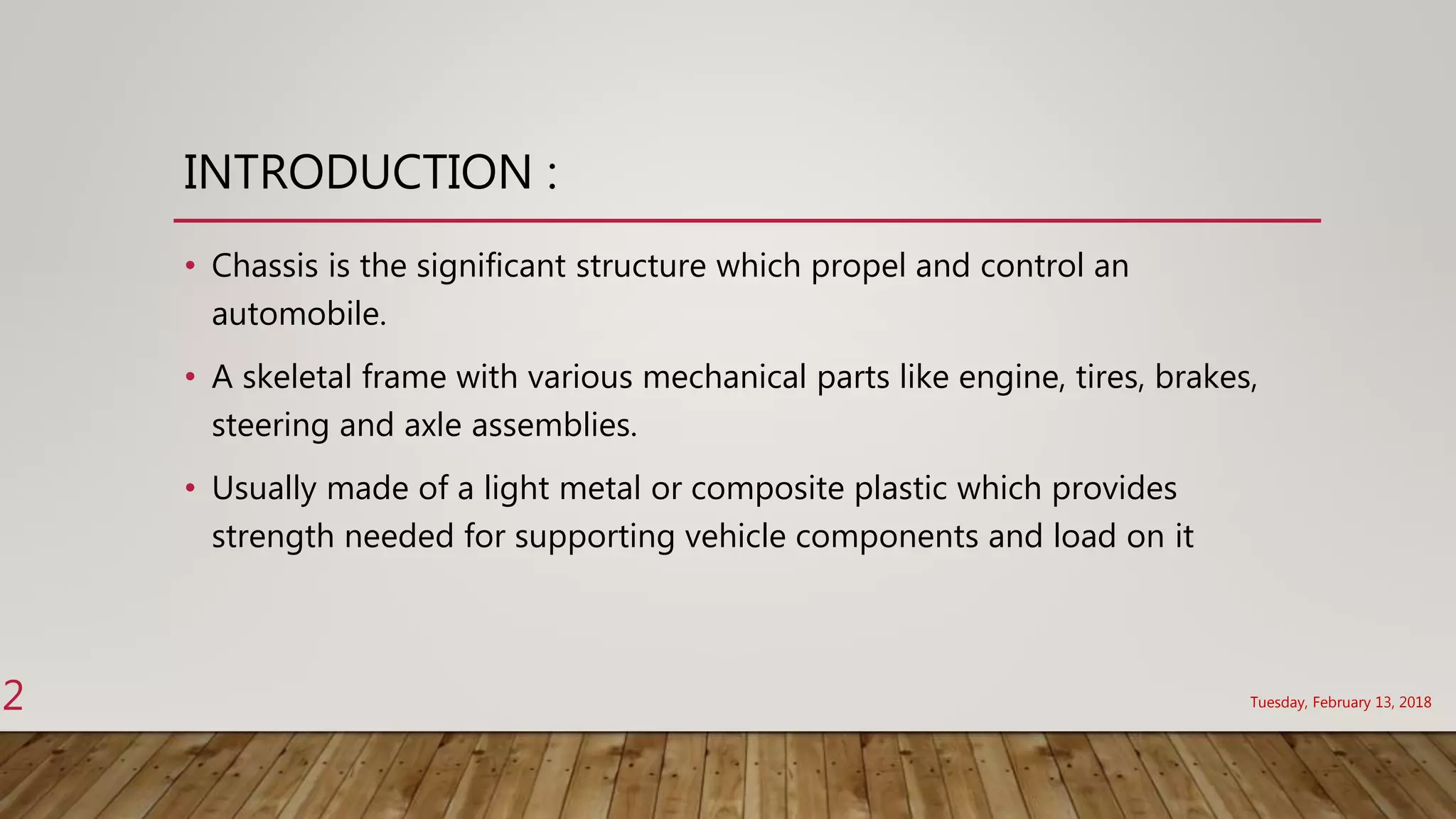
• Ladder frame chassis:
One of the oldest form of chassis that is still
used by most of the SUVs till today.
Resembles a shape of ladder which having
two longitudinal rails interlinked by several
lateral and cross braces.
The lateral and cross members provides
rigidity to the structure.
Tuesday, February 13, 20184
Tuesday, February 13, 20185
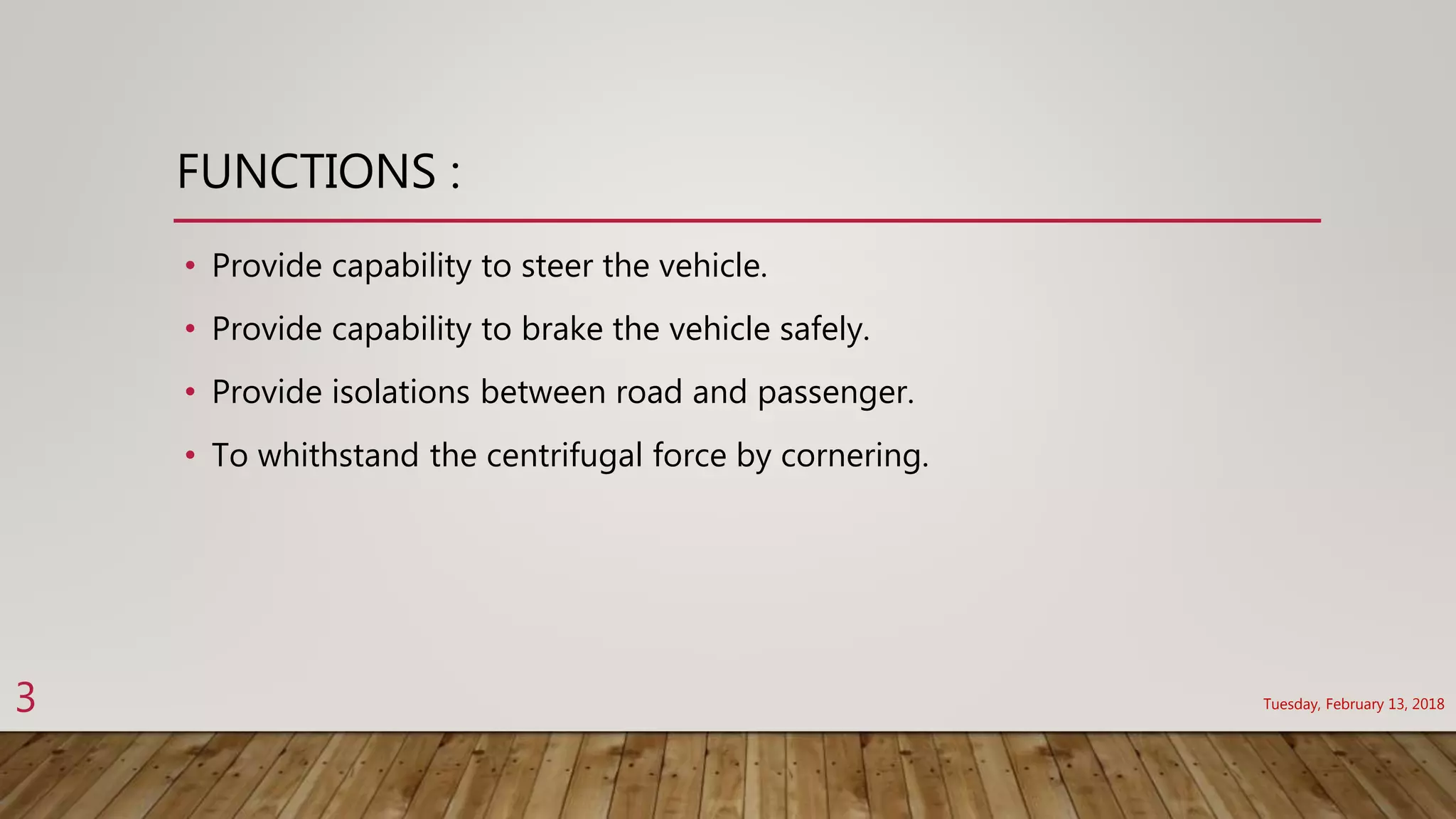
• Backbone chassis:
Has a rectangular tube like a backbone and simple in
structure.
Made of glass fibre is used for joining front and rear
axle and responsible for the strength.
Space within structure used for positioning drive shaft
in case of rear wheel drive.
Drive train, engine and suspensions are connected at
the ends of the chassis.
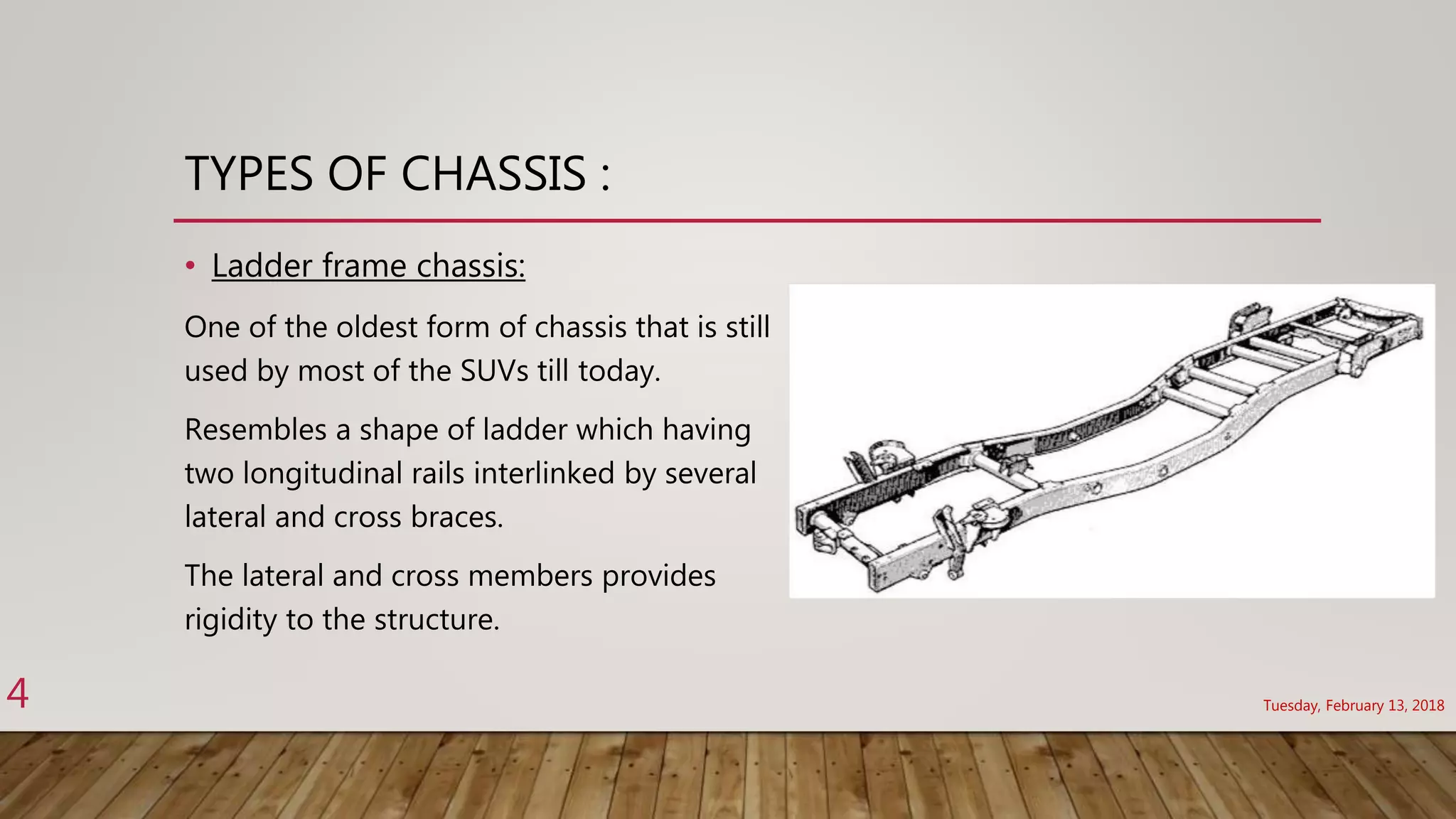
• Monocoque chassis:
Most modern cars use this type.
A single piece of frame work that give shape to the
entire car and built by welding several pieces
together.
Demand for monocoque chassis is increased
because it is suitable for robotized production
Tuesday, February 13, 20186
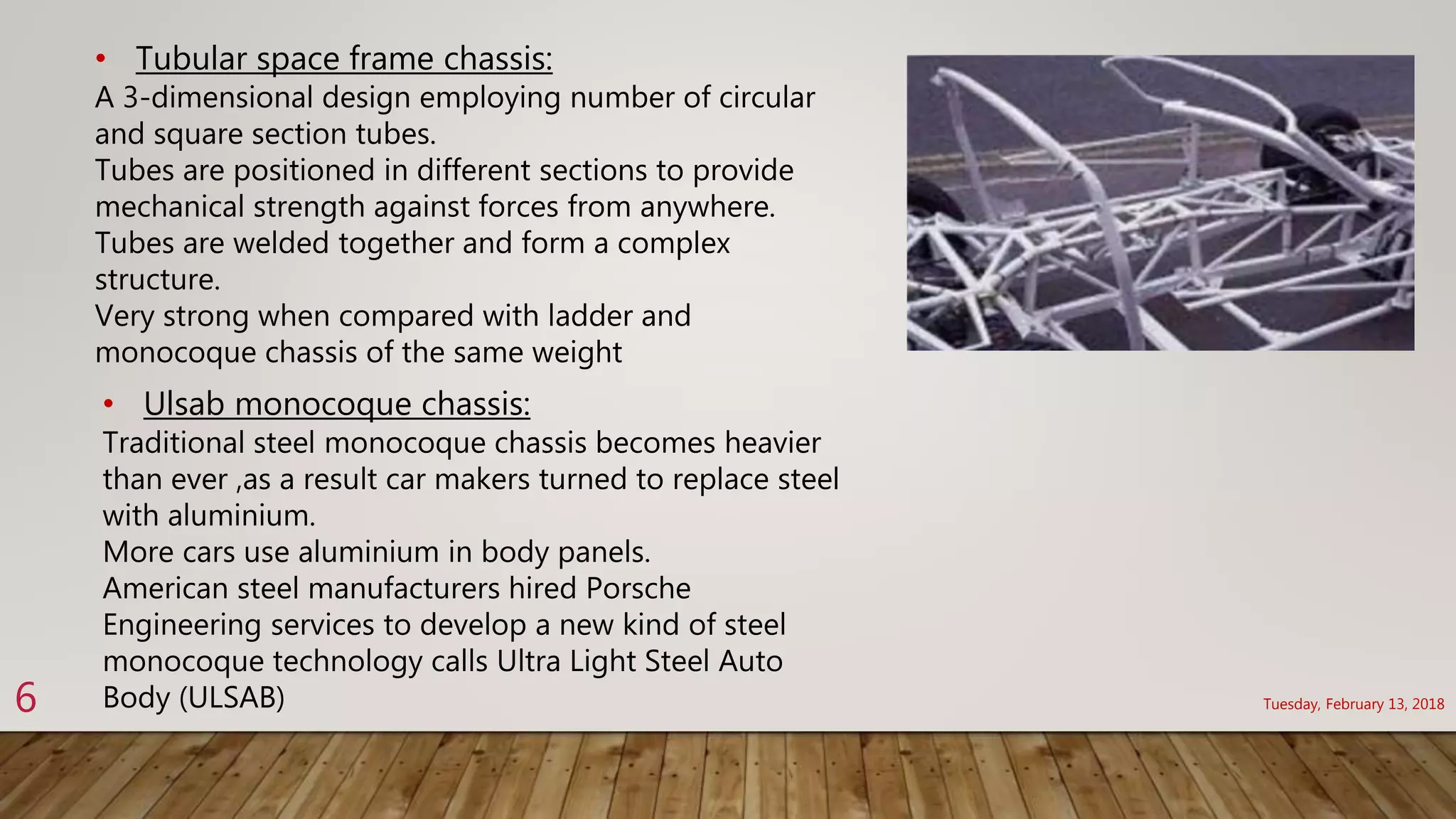
• Tubular space frame chassis:
A 3-dimensional design employing number of circular
and square section tubes.
Tubes are positioned in different sections to provide
mechanical strength against forces from anywhere.
Tubes are welded together and form a complex
structure.
Very strong when compared with ladder and
monocoque chassis of the same weight
• Ulsab monocoque chassis:
Traditional steel monocoque chassis becomes heavier
than ever ,as a result car makers turned to replace steel
with aluminium.
More cars use aluminium in body panels.
American steel manufacturers hired Porsche
Engineering services to develop a new kind of steel
monocoque technology calls Ultra Light Steel Auto
Body (ULSAB)
Tuesday, February 13, 2018
7
• Carbon fibre monocoque chassis:
Carbon fibre is the most sophisticated material
using in aircrafts, spaceships and racing cars.
Because of its superior rigidity to weight ratio.
Several carbon fibres used in motor industry like
Kelvar which has rigidity to weight ratio among
them and can be found in body panels of many
exiotic cars.
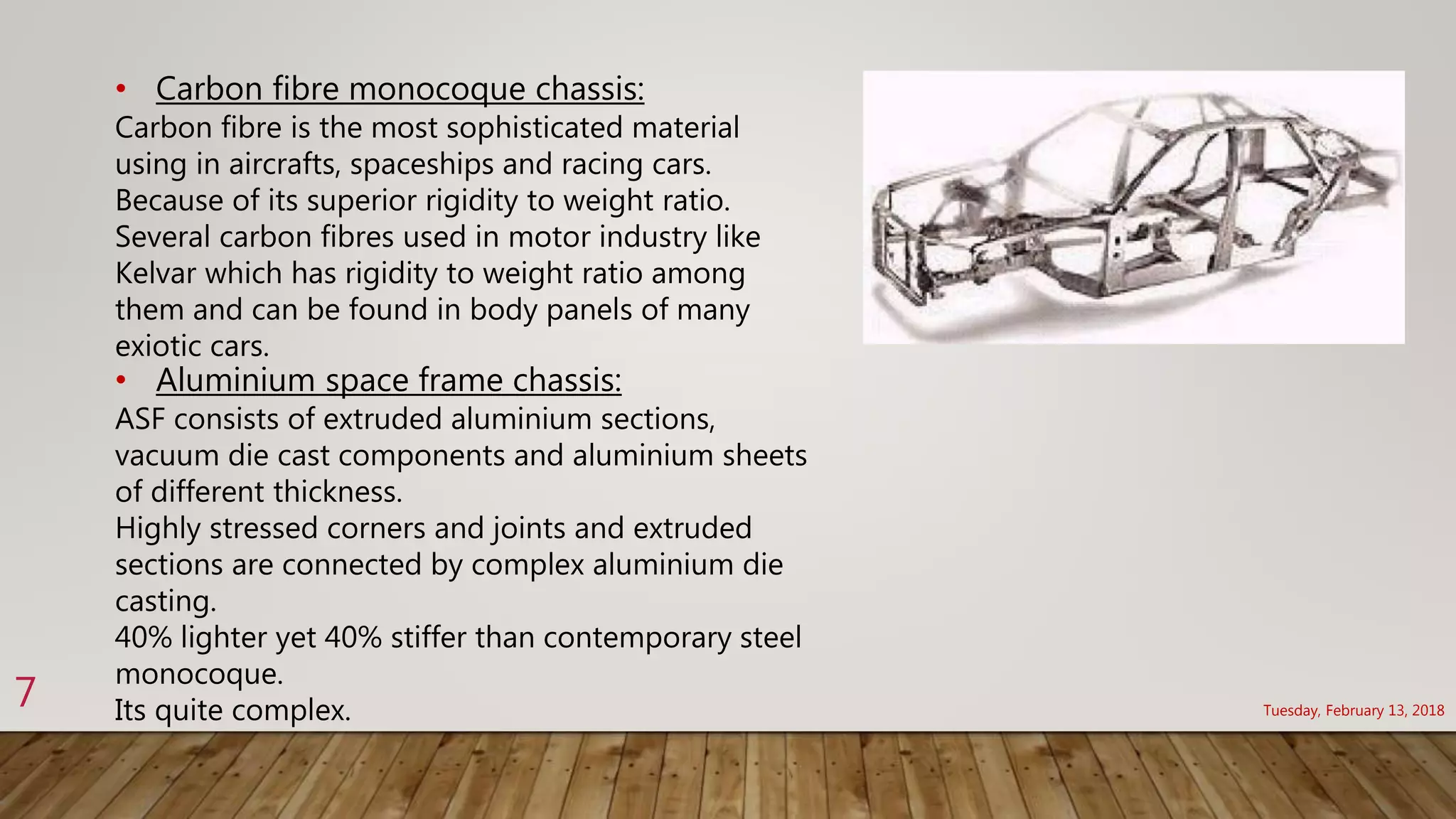
• Aluminium space frame chassis:
ASF consists of extruded aluminium sections,
vacuum die cast components and aluminium sheets
of different thickness.
Highly stressed corners and joints and extruded
sections are connected by complex aluminium die
casting.
40% lighter yet 40% stiffer than contemporary steel
monocoque.
Its quite complex.
CHASSIS CLASSIFICATION BASED ON ENGINE LOCATION:
• Engine fitted at front.
• Engine fitted at back.
• Engine fitted at centre.
• Engine fitted at front but crosswise.
Tuesday, February 13, 20188
General considerations related to chassis :
Body of most of the vehicle should fulfil the following requirements:
• The body should be light in weight.
• It should have minimum number of components.
• It should provide sufficient space for passengers and luggage.
• It should withstand the vibrations while in motion.
• It should offer minimum resistance to air.
• It should be cheap and easy in manufacturing.
• It should be attractive in shape and colour.
• It should have uniformly distributed load.
• It should have long fatigue life.
• It should provide good vision and ventilation.
Tuesday, February 13, 20189
DEPENDING ON LOAD ACTING ON CHASSIS :
• Short duration load: While crossing a broken patch.
• Momentary duration load: While taking a curve.
• Impact load: Due to collision of the vehicle.
• Inertia load: While applying brakes.
• Static loads: Loads due to chassis parts.
• Overloads: Beyond design capacity.
Tuesday, February 13, 2018
10
THANK YOU

Design considerations for chassis

  • 1.
    DESIGN CONSIDERATIONS FOR CHASSIS PRESENTEDBY, MOHAMMED IBZHAN SANDESH SHETTY Tuesday, February 13, 2018 1
  • 2.
    INTRODUCTION : • Chassisis the significant structure which propel and control an automobile. • A skeletal frame with various mechanical parts like engine, tires, brakes, steering and axle assemblies. • Usually made of a light metal or composite plastic which provides strength needed for supporting vehicle components and load on it. Tuesday, February 13, 20182
  • 3.
    FUNCTIONS : • Providecapability to steer the vehicle. • Provide capability to brake the vehicle safely. • Provide isolations between road and passenger. • To whithstand the centrifugal force by cornering. Tuesday, February 13, 20183
  • 4.
    TYPES OF CHASSIS: • Ladder frame chassis: One of the oldest form of chassis that is still used by most of the SUVs till today. Resembles a shape of ladder which having two longitudinal rails interlinked by several lateral and cross braces. The lateral and cross members provides rigidity to the structure. Tuesday, February 13, 20184
  • 5.
    Tuesday, February 13,20185 • Backbone chassis: Has a rectangular tube like a backbone and simple in structure. Made of glass fibre is used for joining front and rear axle and responsible for the strength. Space within structure used for positioning drive shaft in case of rear wheel drive. Drive train, engine and suspensions are connected at the ends of the chassis. • Monocoque chassis: Most modern cars use this type. A single piece of frame work that give shape to the entire car and built by welding several pieces together. Demand for monocoque chassis is increased because it is suitable for robotized production
  • 6.
    Tuesday, February 13,20186 • Tubular space frame chassis: A 3-dimensional design employing number of circular and square section tubes. Tubes are positioned in different sections to provide mechanical strength against forces from anywhere. Tubes are welded together and form a complex structure. Very strong when compared with ladder and monocoque chassis of the same weight • Ulsab monocoque chassis: Traditional steel monocoque chassis becomes heavier than ever ,as a result car makers turned to replace steel with aluminium. More cars use aluminium in body panels. American steel manufacturers hired Porsche Engineering services to develop a new kind of steel monocoque technology calls Ultra Light Steel Auto Body (ULSAB)
  • 7.
    Tuesday, February 13,2018 7 • Carbon fibre monocoque chassis: Carbon fibre is the most sophisticated material using in aircrafts, spaceships and racing cars. Because of its superior rigidity to weight ratio. Several carbon fibres used in motor industry like Kelvar which has rigidity to weight ratio among them and can be found in body panels of many exiotic cars. • Aluminium space frame chassis: ASF consists of extruded aluminium sections, vacuum die cast components and aluminium sheets of different thickness. Highly stressed corners and joints and extruded sections are connected by complex aluminium die casting. 40% lighter yet 40% stiffer than contemporary steel monocoque. Its quite complex.
  • 8.
    CHASSIS CLASSIFICATION BASEDON ENGINE LOCATION: • Engine fitted at front. • Engine fitted at back. • Engine fitted at centre. • Engine fitted at front but crosswise. Tuesday, February 13, 20188
  • 9.
    General considerations relatedto chassis : Body of most of the vehicle should fulfil the following requirements: • The body should be light in weight. • It should have minimum number of components. • It should provide sufficient space for passengers and luggage. • It should withstand the vibrations while in motion. • It should offer minimum resistance to air. • It should be cheap and easy in manufacturing. • It should be attractive in shape and colour. • It should have uniformly distributed load. • It should have long fatigue life. • It should provide good vision and ventilation. Tuesday, February 13, 20189
  • 10.
    DEPENDING ON LOADACTING ON CHASSIS : • Short duration load: While crossing a broken patch. • Momentary duration load: While taking a curve. • Impact load: Due to collision of the vehicle. • Inertia load: While applying brakes. • Static loads: Loads due to chassis parts. • Overloads: Beyond design capacity. Tuesday, February 13, 2018 10
  • 11.