ALA on Suspension System
Guided by: prof. D.C.Gosai
Prepared by: Mihir Patel (130450119107)
INTRODUCTION
• The suspension system of an automobile is one which seprates the wheel/axel
assembly from body. The primary function of the suspension system is to isolate
the vehicle structure from shocks and vibrations due to irregularities of road
surface.
• It mainly consists of
1. Spring and
2. Damper
• The energy of road shock cause the spring to oscillate. These oscillations are
restricted to reasonable level by damper, commonly called shock absorber.
• The suspension system of vehicle is divided into Rear end suspension and Front
end suspension.
• The function of isolation between road and carriage is achieved by different
elements at different sages:
1) Tyre,
2) Suspension system( springs, dampers, linkages and tie bars) and
3) Seats of automobile
• Functions/Objects of A suspension System:
1. To prevent the road shocks from being transmitted to the vehicle frame.
2. To preserve the stability of the vehicle in pitching or rolling, while in motion.
3. To safeguard the occupants from road shocks.
4. To maintain proper steering geometry
5. To provide good road holding while driving, cornering and braking.
• Requirements of a Suspension System:
1. Low maintenance cost.
2. Minimum-weight.
3. Minimum wheel hop
4. Minimum tyre wear.
5. Minimum defection consistent with required stability.
6. compatibility with vehicle components-tyre, frame, wheel base, steering linkage.
7. Low maintenance and operating costs.
TERMS IN SUSPENSION SYSTEM
• Camber: Looking directly at the front of the vehicle, camber refers to the tilt in
(+) or out (‐) of the bottom half of the tire.
• Caster: Looking directly at the side of the vehicle, caster refers to the tilt
rearward (+) of the bottom half of the tire.
• Toe: Looking directly at the top of the vehicle, toe refers to the slant in (+) or out
(‐) of the front half of the tire.
• Jounce: Jounce refers to the bounce or vertical movement of the vehicle
suspension upward when it contacts a bump in the road.
• Rebound: Rebound refers to the movement of the vehicle suspension in the
opposite direction of jounce.
• Shimmy: Shimmy is an uncontrollable oscillation of the steering system
experienced by two opposing wheels.
• Ball Joint: A ball joint is a fastener or connector that allows movement in all directions.
• Tie Rod: A tie rod is a component that firmly connects one wheel of a vehicle to the wheel on
the opposite end to provide steering.
• Track Bar: A track bar is a rod that connects a suspension beam to the frame to give lateral
support.
• Unsprung Weight: Unsprung weight is the total weight of all components in a vehicle that
are not dampened by the springs and shocks like the wheels and other closely associated
equipment.
• Scrub: Scrub is the lateral movement of a tire against the pavement due to suspension system
camber changes during jounce and rebound.
• Knuckle: The knuckle is the suspension component that incorporates the spindle or hub that
the wheel bearings and wheels mount on.
• King Pin: The king pin is the vertical component in the knuckle that the wheels turn on when
the vehicle is steered.
• Spindle: The spindle is the long tapered bar‐shaped piece that is fitted to the knuckle on
which the wheel bearings and wheels are mounted.
• Hub: The hub is the hollow part of the knuckle that replaces the spindle in mounting the
bearings that support the wheel.
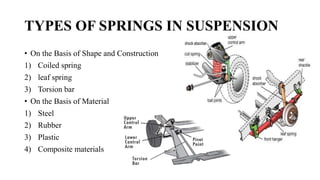
TYPES OF SPRINGS IN SUSPENSION
• On the Basis of Shape and Construction
1) Coiled spring
2) leaf spring
3) Torsion bar
• On the Basis of Material
1) Steel
2) Rubber
3) Plastic
4) Composite materials
• On the Basis of Fluid Used:
1) Hydraulic
2) Air
• On the basis of Specialized Consideration
1) Taper
2) Helper and
3) Spiral
TYPES OF DAMPERS
• Based on working principle:
1) Friction type
2) Hydraulic
• Based on type of fluid:
1) Liquid filled
2) Gas filled
• Based on damping acting cycle:
1) Single acting
2) Double acting
Hydraulic Damper
• Without a damper structure a car spring will
extend and release the energy it absorbs from a
bump at an uncontrolled rate.
• The spring will continue to bounce at its natural
frequency until all of the energy originally put into
it is used up.
• A suspension built on springs alone would make
for an extremely bouncy ride and, depending on
the terrain, an uncontrollable car
TYPES OF SUSPENSION SYSTEMS
• Conventional(rigid axel) suspension system
• Independent suspension system
• Linked suspension system
• Rubber suspension system
SUSPENSION SYSTEM – ASSEMBLY
INDEPENDENT SUSPENSION SYSTEM
Double wishbone type
• The double wishbone suspension can also be referred to as double 'A' arms, and short
long arm (SLA) suspension if the upper and lower arms are of unequal length. A
single wishbone or A-arm can also be used in various other suspension types, such as
MacPherson strut and Chapman strut. The upper arm is usually shorter to induce
negative camber as the suspension jounces (rises). When the vehicle is in a turn, body
roll results in positive camber gain on the inside wheel. The outside wheel also
jounces and gains negative camber due to the shorter upper arm. The suspension
designer attempts to balance these two effects to cancel out and keep the tire
perpendicular to the ground. This is especially important for the outer tire because of
the weight transfer to this tire during a turn.
• Between the outboard end of the arms is a knuckle with a spindle (the kingpin), hub,
or upright which carries the wheel bearing and wheel. Knuckles with an integral
spindle usually do not allow the wheel to be driven. A bolt on hub design is
commonly used if the wheel is to be driven. In order to resist fore-aft loads such as
acceleration and braking, the arms need two bushings or ball joints at the body.
MacPherson Strut Type
• The most widely used front suspension system in cars comprises of a strut-type
spring and shock absorber combo, which pivots on a ball joint on the single, lower
arm. The steering gear is either connected directly to the lower shock absorber
housing, or to an arm from the front or back of the spindle. In this case, when you
steer, it physically twists the strut and shock absorber housing and consequently
the spring to turn the wheel.
Suspension system
Suspension system

Suspension system

  • 1.
    ALA on SuspensionSystem Guided by: prof. D.C.Gosai Prepared by: Mihir Patel (130450119107)
  • 2.
    INTRODUCTION • The suspensionsystem of an automobile is one which seprates the wheel/axel assembly from body. The primary function of the suspension system is to isolate the vehicle structure from shocks and vibrations due to irregularities of road surface. • It mainly consists of 1. Spring and 2. Damper • The energy of road shock cause the spring to oscillate. These oscillations are restricted to reasonable level by damper, commonly called shock absorber. • The suspension system of vehicle is divided into Rear end suspension and Front end suspension.
  • 3.
    • The functionof isolation between road and carriage is achieved by different elements at different sages: 1) Tyre, 2) Suspension system( springs, dampers, linkages and tie bars) and 3) Seats of automobile • Functions/Objects of A suspension System: 1. To prevent the road shocks from being transmitted to the vehicle frame. 2. To preserve the stability of the vehicle in pitching or rolling, while in motion. 3. To safeguard the occupants from road shocks. 4. To maintain proper steering geometry 5. To provide good road holding while driving, cornering and braking.
  • 4.
    • Requirements ofa Suspension System: 1. Low maintenance cost. 2. Minimum-weight. 3. Minimum wheel hop 4. Minimum tyre wear. 5. Minimum defection consistent with required stability. 6. compatibility with vehicle components-tyre, frame, wheel base, steering linkage. 7. Low maintenance and operating costs.
  • 5.
    TERMS IN SUSPENSIONSYSTEM • Camber: Looking directly at the front of the vehicle, camber refers to the tilt in (+) or out (‐) of the bottom half of the tire. • Caster: Looking directly at the side of the vehicle, caster refers to the tilt rearward (+) of the bottom half of the tire. • Toe: Looking directly at the top of the vehicle, toe refers to the slant in (+) or out (‐) of the front half of the tire. • Jounce: Jounce refers to the bounce or vertical movement of the vehicle suspension upward when it contacts a bump in the road. • Rebound: Rebound refers to the movement of the vehicle suspension in the opposite direction of jounce. • Shimmy: Shimmy is an uncontrollable oscillation of the steering system experienced by two opposing wheels.
  • 6.
    • Ball Joint:A ball joint is a fastener or connector that allows movement in all directions. • Tie Rod: A tie rod is a component that firmly connects one wheel of a vehicle to the wheel on the opposite end to provide steering. • Track Bar: A track bar is a rod that connects a suspension beam to the frame to give lateral support. • Unsprung Weight: Unsprung weight is the total weight of all components in a vehicle that are not dampened by the springs and shocks like the wheels and other closely associated equipment. • Scrub: Scrub is the lateral movement of a tire against the pavement due to suspension system camber changes during jounce and rebound. • Knuckle: The knuckle is the suspension component that incorporates the spindle or hub that the wheel bearings and wheels mount on. • King Pin: The king pin is the vertical component in the knuckle that the wheels turn on when the vehicle is steered. • Spindle: The spindle is the long tapered bar‐shaped piece that is fitted to the knuckle on which the wheel bearings and wheels are mounted. • Hub: The hub is the hollow part of the knuckle that replaces the spindle in mounting the bearings that support the wheel.
  • 7.
    TYPES OF SPRINGSIN SUSPENSION • On the Basis of Shape and Construction 1) Coiled spring 2) leaf spring 3) Torsion bar • On the Basis of Material 1) Steel 2) Rubber 3) Plastic 4) Composite materials
  • 8.
    • On theBasis of Fluid Used: 1) Hydraulic 2) Air • On the basis of Specialized Consideration 1) Taper 2) Helper and 3) Spiral
  • 9.
    TYPES OF DAMPERS •Based on working principle: 1) Friction type 2) Hydraulic • Based on type of fluid: 1) Liquid filled 2) Gas filled • Based on damping acting cycle: 1) Single acting 2) Double acting
  • 10.
    Hydraulic Damper • Withouta damper structure a car spring will extend and release the energy it absorbs from a bump at an uncontrolled rate. • The spring will continue to bounce at its natural frequency until all of the energy originally put into it is used up. • A suspension built on springs alone would make for an extremely bouncy ride and, depending on the terrain, an uncontrollable car
  • 11.
    TYPES OF SUSPENSIONSYSTEMS • Conventional(rigid axel) suspension system • Independent suspension system • Linked suspension system • Rubber suspension system
  • 12.
  • 13.
  • 14.
    Double wishbone type •The double wishbone suspension can also be referred to as double 'A' arms, and short long arm (SLA) suspension if the upper and lower arms are of unequal length. A single wishbone or A-arm can also be used in various other suspension types, such as MacPherson strut and Chapman strut. The upper arm is usually shorter to induce negative camber as the suspension jounces (rises). When the vehicle is in a turn, body roll results in positive camber gain on the inside wheel. The outside wheel also jounces and gains negative camber due to the shorter upper arm. The suspension designer attempts to balance these two effects to cancel out and keep the tire perpendicular to the ground. This is especially important for the outer tire because of the weight transfer to this tire during a turn. • Between the outboard end of the arms is a knuckle with a spindle (the kingpin), hub, or upright which carries the wheel bearing and wheel. Knuckles with an integral spindle usually do not allow the wheel to be driven. A bolt on hub design is commonly used if the wheel is to be driven. In order to resist fore-aft loads such as acceleration and braking, the arms need two bushings or ball joints at the body.
  • 16.
    MacPherson Strut Type •The most widely used front suspension system in cars comprises of a strut-type spring and shock absorber combo, which pivots on a ball joint on the single, lower arm. The steering gear is either connected directly to the lower shock absorber housing, or to an arm from the front or back of the spindle. In this case, when you steer, it physically twists the strut and shock absorber housing and consequently the spring to turn the wheel.