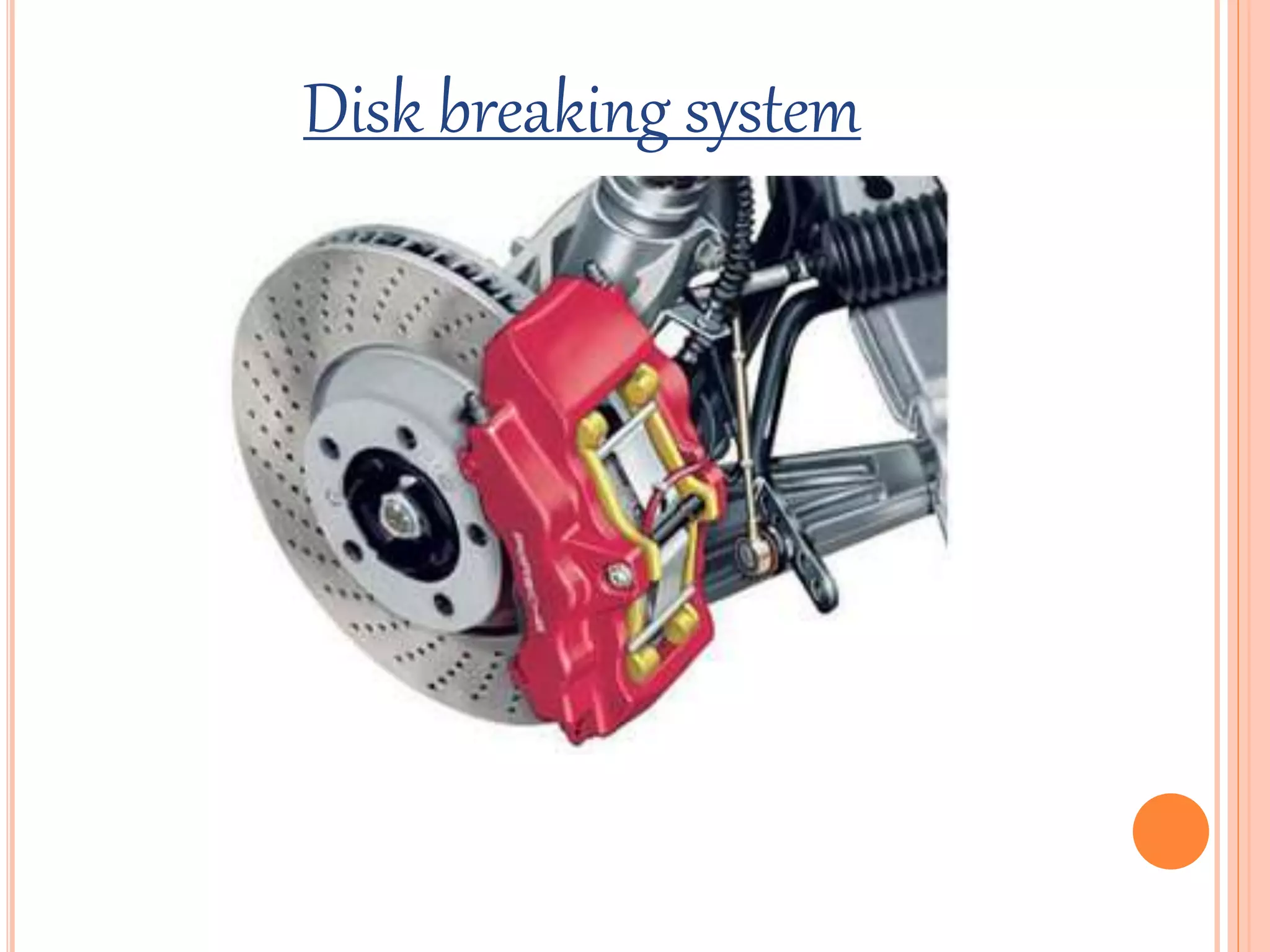
Disk breaking system
CONTENT
Introduction
History
Why Disk Brakes?
Types
How They Work
Why are disk brakes more efficient?
Advantages
Disadvantages
Conclusion
INTRODUCTION
 Disc brakes are a brake system that slows a wheel’s
rotation by squeezing an attached metal disc in a viselike
hydraulic caliper.
 Disc brakes use the same principle as bicycle
handbrakes, but on a bike the brake pads press against
the wheel itself.
 On a car, the disc is part of the hub to which the wheel is
mounted. The disc, technically called a rotor, is clearly
visible through spoked wheels.
HISTORY OF DISK BRAKES
 Ever since the invention of the wheel, while
moving we have to stop the movement, so for
that we invented breaks.
 As the level of technology of human
transportation has increased, the mechanical
devices used to slow down and stop vehicles has
also become more complex.
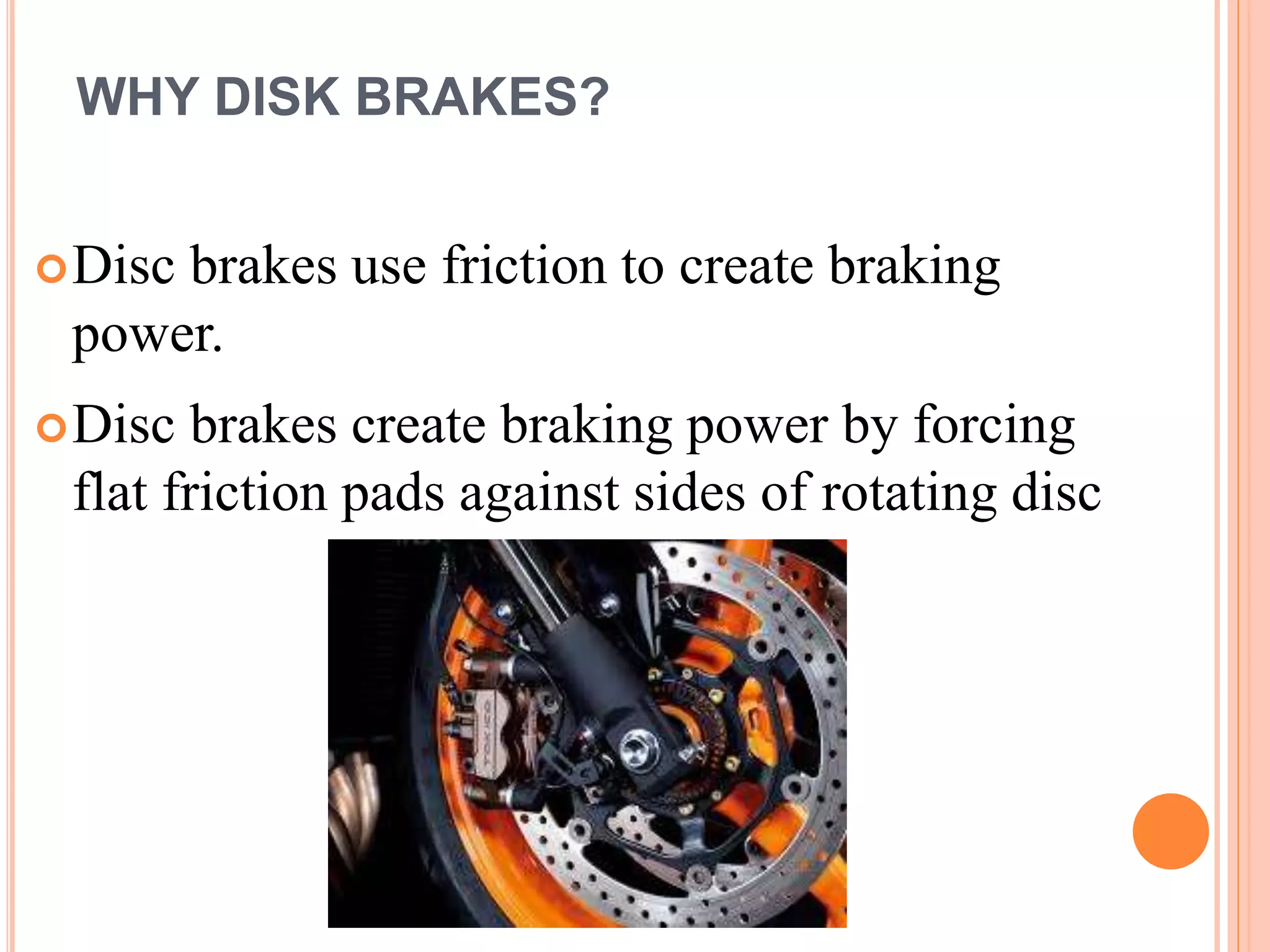
WHY DISK BRAKES?
Disc brakes use friction to create braking
power.
Disc brakes create braking power by forcing
flat friction pads against sides of rotating disc
DISC BRAKES TYPES
 Opposed Piston Type Disc Brakes
 Floating Caliper Type Disc Brakes
OPPOSED PISTON TYPE DISC BRAKES
 This type of disc brake has pistons on both sides of the
brake rotor, and there are no moving parts in the caliper
assembly other than the pistons themselves.
 This type of caliper provides very even pressure
distribution between pads and rotor providing better
braking performance, especially under severe braking
conditions.
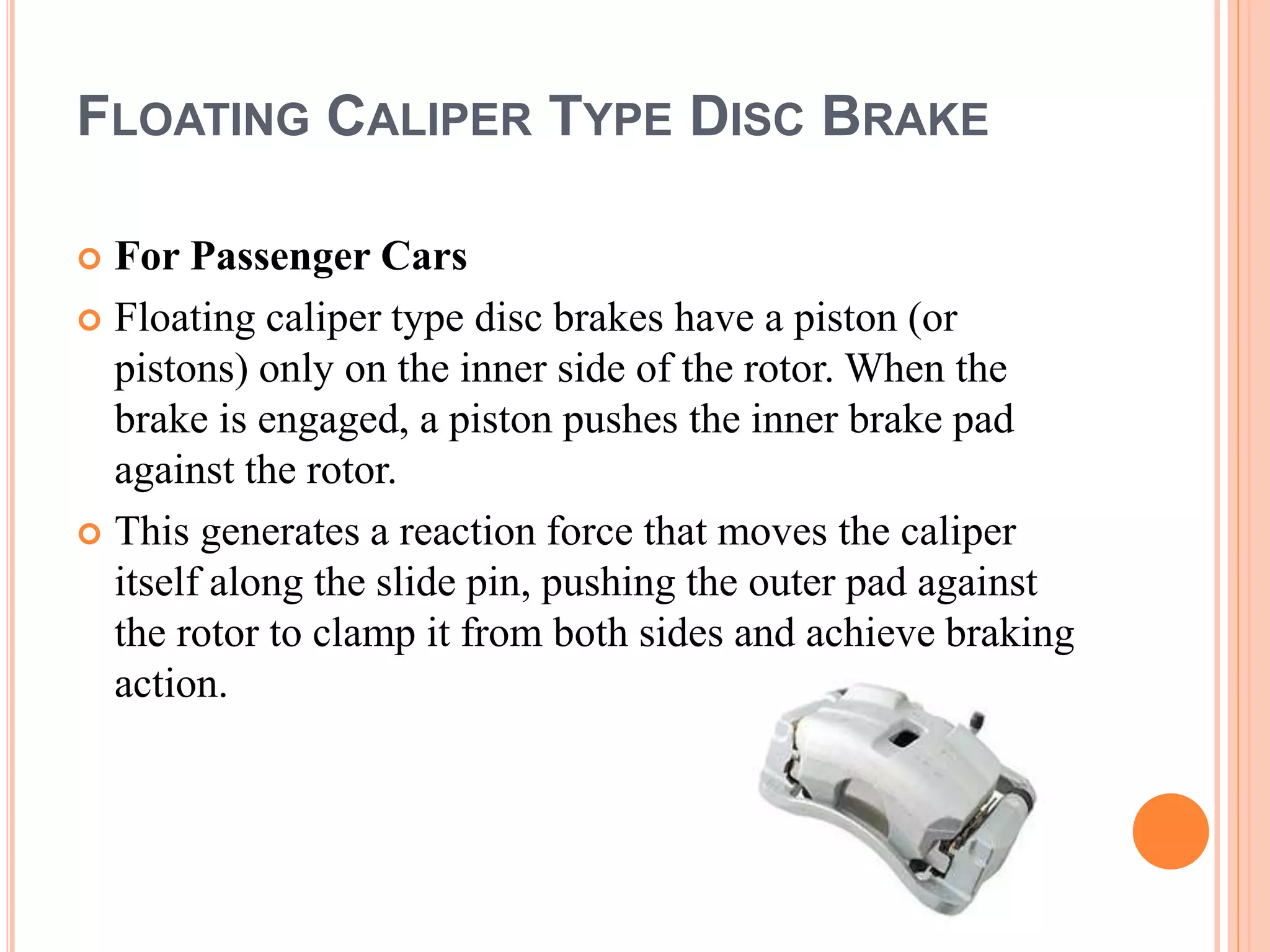
FLOATING CALIPER TYPE DISC BRAKE
 For Passenger Cars
 Floating caliper type disc brakes have a piston (or
pistons) only on the inner side of the rotor. When the
brake is engaged, a piston pushes the inner brake pad
against the rotor.
 This generates a reaction force that moves the caliper
itself along the slide pin, pushing the outer pad against
the rotor to clamp it from both sides and achieve braking
action.
HOW THEY WORK
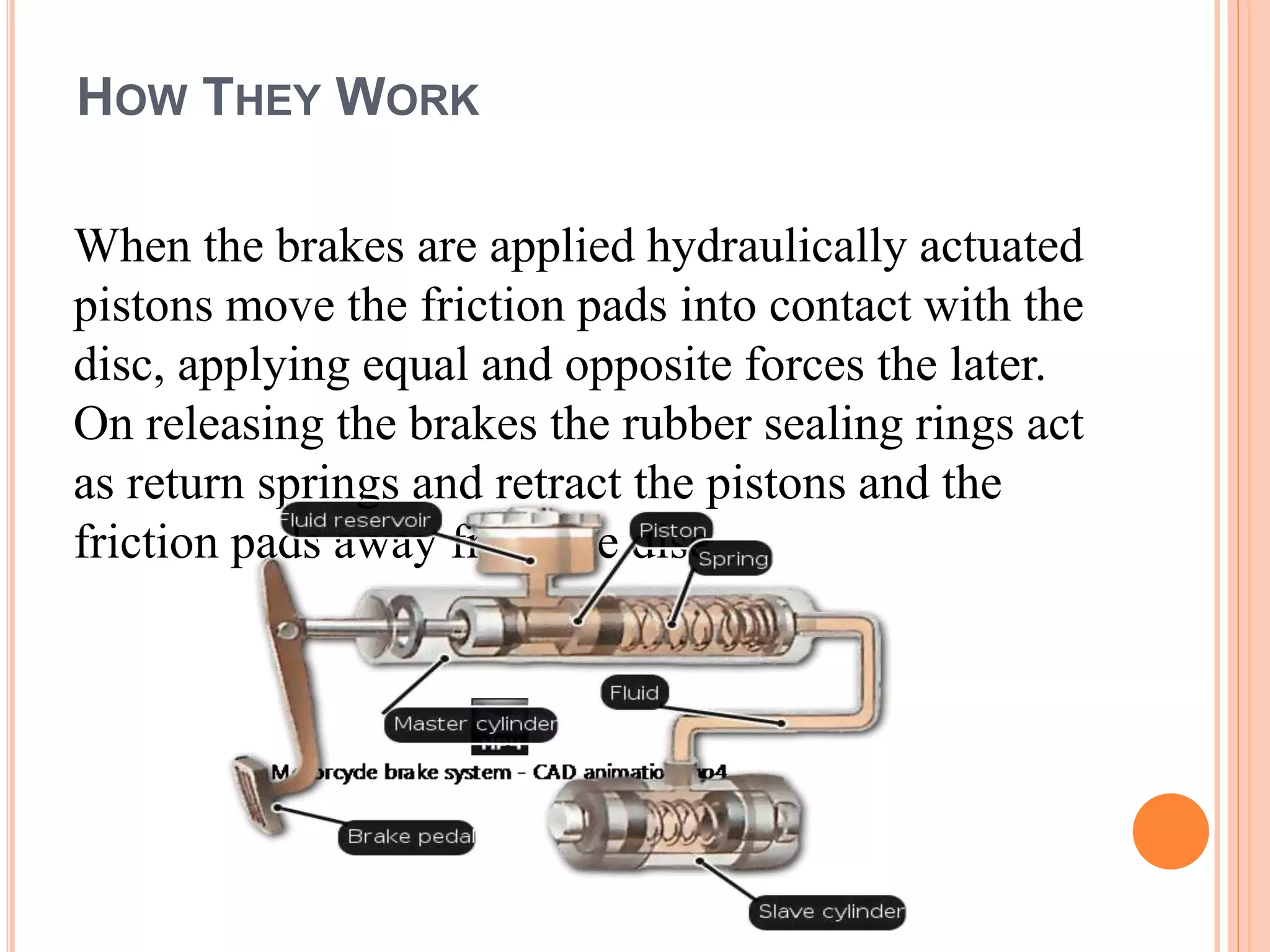
When the brakes are applied hydraulically actuated
pistons move the friction pads into contact with the
disc, applying equal and opposite forces the later.
On releasing the brakes the rubber sealing rings act
as return springs and retract the pistons and the
friction pads away from the disc.
WHY ARE DISK BRAKES MORE EFFICIENT?
 Disk brakes under high pressure on Drum brakes during
braking, disk brakes are more efficient.
 No loss of brake power due to overheating or partial
contact from brake drum parts expansion.
 Disk brakes can withstand higher loads and its efficiency
is maintained considerably longer even under the highest
stresses.
ADVANTAGES OF DISK BRAKE
– Greater amounts of heat to
atmosphere
– Cooling more rapid
– Self-adjusting
– Don’t need periodic
maintenance
– Easier to service
DISADVANTAGES OF DISK BRAKE
 Prone to noise
 Rotors warp easier
 Not self-energizing
 Hard to use as parking brakes
CONCLUSION
Many automobiles are equipped with air
actuated sliding caliper disk brakes. By
using these, we can get higher
performance rate in braking .
THANKS 
ANY QUIRES

Ppt on ceramic disc brakes

  • 1.
  • 2.
    CONTENT Introduction History Why Disk Brakes? Types HowThey Work Why are disk brakes more efficient? Advantages Disadvantages Conclusion
  • 3.
    INTRODUCTION  Disc brakesare a brake system that slows a wheel’s rotation by squeezing an attached metal disc in a viselike hydraulic caliper.  Disc brakes use the same principle as bicycle handbrakes, but on a bike the brake pads press against the wheel itself.  On a car, the disc is part of the hub to which the wheel is mounted. The disc, technically called a rotor, is clearly visible through spoked wheels.
  • 4.
    HISTORY OF DISKBRAKES  Ever since the invention of the wheel, while moving we have to stop the movement, so for that we invented breaks.  As the level of technology of human transportation has increased, the mechanical devices used to slow down and stop vehicles has also become more complex.
  • 5.
    WHY DISK BRAKES? Discbrakes use friction to create braking power. Disc brakes create braking power by forcing flat friction pads against sides of rotating disc
  • 6.
    DISC BRAKES TYPES Opposed Piston Type Disc Brakes  Floating Caliper Type Disc Brakes
  • 7.
    OPPOSED PISTON TYPEDISC BRAKES  This type of disc brake has pistons on both sides of the brake rotor, and there are no moving parts in the caliper assembly other than the pistons themselves.  This type of caliper provides very even pressure distribution between pads and rotor providing better braking performance, especially under severe braking conditions.
  • 8.
    FLOATING CALIPER TYPEDISC BRAKE  For Passenger Cars  Floating caliper type disc brakes have a piston (or pistons) only on the inner side of the rotor. When the brake is engaged, a piston pushes the inner brake pad against the rotor.  This generates a reaction force that moves the caliper itself along the slide pin, pushing the outer pad against the rotor to clamp it from both sides and achieve braking action.
  • 9.
    HOW THEY WORK Whenthe brakes are applied hydraulically actuated pistons move the friction pads into contact with the disc, applying equal and opposite forces the later. On releasing the brakes the rubber sealing rings act as return springs and retract the pistons and the friction pads away from the disc.
  • 10.
    WHY ARE DISKBRAKES MORE EFFICIENT?  Disk brakes under high pressure on Drum brakes during braking, disk brakes are more efficient.  No loss of brake power due to overheating or partial contact from brake drum parts expansion.  Disk brakes can withstand higher loads and its efficiency is maintained considerably longer even under the highest stresses.
  • 11.
    ADVANTAGES OF DISKBRAKE – Greater amounts of heat to atmosphere – Cooling more rapid – Self-adjusting – Don’t need periodic maintenance – Easier to service
  • 12.
    DISADVANTAGES OF DISKBRAKE  Prone to noise  Rotors warp easier  Not self-energizing  Hard to use as parking brakes
  • 13.
    CONCLUSION Many automobiles areequipped with air actuated sliding caliper disk brakes. By using these, we can get higher performance rate in braking .
  • 14.
  • 15.

Editor's Notes