International Research Journal of Engineering and Technology (IRJET) e-ISSN: 2395 -0056
Volume: 04 Issue: 07 | July -2017 www.irjet.net p-ISSN: 2395-0072
Design and Thermal Analysis of Disc Brake for Minimizing
Temperature
Deepak S. Hugar1, Prof. U. B. Kadabadi2.
1Department of Mechanical Engineering (M.Tech in Design Engineering)
KLE Dr. M S Sheshgiri College of Engineering and Technology Udyambhag, Belagavi, Karnataka, India 590008
2Department of Mechanical Engineering (Professor)
KLE Dr. M S Sheshgiri College of Engineering and Technology Udyambhag, Belagavi, Karnataka, India 590008
---------------------------------------------------------------------***---------------------------------------------------------------------
Abstract – These day technologies go beyond us. For
automotive field, the technology of engine develops very fast
even the system of the bike, car, luxury or comforts everything
that develops by the innovation of engineer. Thus, safety is the
first important thing we must focus. This paper is presented
with “Design and Thermal analysis of disc brake for minimizing
temperature” which studies about on disc brake rotor by
analysis of different shapes of slot of different vehicles Disc
brake rotor. Therefore, we can optimize number of shapes of
slot to estimate the good thermal conductivity of the disc brake
rotor. In this paper, Thermal analysis done on real model of disc
brake rotor of Bajaj Pulsar 220 and Thermal analysis of disc
brake rotor. Different shapes of slot are because of to reduce
the weight of disc rotor and for good thermal conductivity.
Hopefully this paper will help everyone to understand Thermal
analysis of disc brake rotor and how disc brake work more
efficiently, which can help to reduce the accident that may
happen in each day. Modeling was done using CATIA V5R21
software and Static and Transient Thermal Analysis was done
using ANSYS 15 software.
Key Words: Disc brake rotor, Thermal analysis etc
1.INTRODUCTION
A brake is a device used to generate an artificial frictional
which is applied to moving member of machine, for
stopping motion. For execution of braking operation, the
brakes pad and disc absorb the kinetic energy from wheel.
The energy absorbed by brake is generating heat. This
heat is passing in to the atmosphere and stops the vehicle,
so the braking system should have the following ability;
1. The brake disc having ability to transfer heat to
atmosphere and maintain constant temperature
to improve performance of disc.
2. Anti-wear property of the brakes must be good.
3. The driver must have have proper control on the
vehicle during brake applied and the vehicle
should not skid.
4. The brakes must be having enough power to stop
the vehicle with in a minimum distance in case
emergency.
1.1 CLASSIFICATION OF BRAKES
The classification of mechanical braking system in 2
subgroups according to the direction of acting forces are
Axial brake
Radial brake
Axial brake: In this brake, the force acting on the
braking system is only in the axial direction to the brake.
For example, Disc brake is acting in axial direction.
Radial brake: In this brake, the force acting on the
braking system is in perpendicular to axial direction. The
radial brakes subdivided into internal and external brake.
2. PROBLEM DEFINATION AND OBJECTIVES
Extreme thermal environments are an important issue in
the design of sliding contact systems such as brakes and
clutches. Thermal stresses due to high temperatures may
induce a number of unfavorable conditions such as surface
cracks and permanent distortions. Frictional heating,
thermal deformation and elastic contact in sliding contact
systems affect the contact pressure and temperature on
the friction surfaces. If the sliding speed is excessively
high, these coupled thermal and mechanical behaviors can
be unstable leading to localized high temperature contact
regions called “hot spots” on the sliding interface.
The appearance of these hot spots is known as
frictionally excited thermo elastic instability or TEI and is
observed in many practical applications, especially brakes
and clutches. Hot spots can cause material damage and
thermal crack, and induce an undesirable frictional vibration
known as “hot judder” in automotive disk brake systems.
© 2017, IRJET | Impact Factor value: 5.181 | ISO 9001:2008 Certified Journal | Page 3483
International Research Journal of Engineering and Technology (IRJET) e-ISSN: 2395 -0056
Volume: 04 Issue: 07 | July -2017 www.irjet.net p-ISSN: 2395-0072
2.1 OBJECTIVES
• Design of the disc for a disc brake system using
load analysis, stress analysis and thermal analysis
system approach.
• The disc brake rotor is to be rigidity and stability.
• Heat absorption and dispersion.
• Federal safety requirements.
• Increase the rotor and pad life.
3. LITERATURE REVIEW
Before starting with actual working, it's always helpful to
study literature and work already carried out in similar
field. This study helps to decide project outline and flow.
Some research papers, articles are available in which
similar type of issues, case studies have discussed. In this
chapter, summary of such papers and literature published
by various researchers is described.
1. N. Balasubramanyam, Smt. G. Prasanthi In this
project, three-dimensional modeling and meshing
Structural & thermal analysis using the simulation
program ANSYS were successfully implemented. This has
allowed for greater flexibility and accuracy in the results
achieved. They were taken 3 different materials of disc
brake using constant hydraulic pressure 1 Mpa at time of
running condition & analysis. On the basis of various
results gathered from the analysis, it is decided that grey
Cast Iron is the suitable material for disc brake.
2. Subhasis Sarkar, Pravin P. Rathod In automobile brake
system ventilated disc brake is the art of technology. This
research paper reviews work of previous investigators on
transient thermal analysis on the design rotor and ventilated
rotor disc is to compare and evaluate their performance. The
aim of this research paper review work is to study various
research done in past to improve heat transfer rate of
ventilated disc brake by changing material and vane
geometry. If vane is angled and of alternate length other than
straight radial vane. Contact time between air flow and vanes
(time between air inlet and outlet flow through vanes) is also
important factor in heat transfer from Disc rotor. There is
also scope of research in improvement of heat transfer of
rotor by increasing the contact time between vanes and air
flow by design modification of vanes in such way that fulfils
the requirement.
3. Atul Sharma and M. L. Aggarwal This research paper
explains the design and finite element analysis (FEA)model of
brake disc by which deflections in X, Y, Z direction and Von
mises stress can be calculated by applying boundary
conditions. The FEA outcomes are correlated with
experimental data. The model is safe under the practical
loading condition and our factor of safety is 20.34.
4. Ameer Fareed Basha Shaik, Ch. Lakshmi Srinivas The
paper presented here is a study of model of a disc brake of
Honda Civic. In this paper Structural & Thermal analysis was
done in the brake disc. After changing the design of disc brake
analysis was done. The material used as Cast Iron. Actual disc
brake has no holes, changing the design of the disc brake by
giving certain holes for more heat dissipation. Modelling was
done in Catia and Analysis is done in ANSYS. Study the
amount of deformation due to pressure loading and
tangential Force. The modular brake was then analysed using
a nodal temperature of 300ºF. These results were used to
study the increase in deformation in the caliper at high
temperatures. The displacement increased as compared with
the previous case. Since race cars brakes always operate at
high temperature the thermal deformation/displacement
results are important.
5. Zheng han In this final year project, three-dimensional
modeling and meshing using the simulation program ANSYS
were successfully implemented. This has allowed for greater
flexibility and accuracy in the results achieved. The
mechanical performances of a conventional disc brake system
and the Perimetria disc brake system under three different
simulation environments were studied and compared. Under
torsional strength simulation, the Perimetria disc brake
performs better with its maximum values of First Principal
Stress and Von Mises Stress being significantly lower than
those in the conventional brake-disk. Under lateral strength
simulation, the Perimetria brake-disk yielded almost similar
results to that of the conventional brake-disk. For both the
static tests mentioned, the maximum stresses (weak points)
in the Perimetria brake-disk occur at the mounting holes.
These maximum stresses occur at the holes. This is due to the
design of the brake-disk which concentrates the stress on the
inner diameter during expansion and contraction. This
indicates that the number of potential points for crack
initiation is higher.
6. Daniel Das.A, Christo Reegan Raj.V, Preethy.S,Ramya
Bharani.G The aim of this paper was to investigate the
temperature fields and also structural fields of the solid disc
brake during short and emergency braking with four different
materials. The distribution of the temperature depends on
the various factors such as friction, surface roughness and
speed. The effect of the angular velocity and the contact
pressure induces the temperature rise of disc brake. The
finite element simulation for two-dimensional model was
preferred due to the heat flux ratio constantly distributed in
circumferential direction. We will take down the value of
temperature, and deformation for different pressure
condition using analysis software with four materials . The
Disc brakes are made up of cast iron.
© 2017, IRJET | Impact Factor value: 5.181 | ISO 9001:2008 Certified Journal | Page 3484
International Research Journal of Engineering and Technology (IRJET) e-ISSN: 2395 -0056
Volume: 04 Issue: 07 | July -2017 www.irjet.net p-ISSN: 2395-0072
4. DESIGN PARAMETERS OF DISC BRAKE
Standard parameters of two-wheeler in Bajaj 220cc
are Brake rotor material = Grey cast iron (ASTM grade
25) Brake rotor dimension = 240mm
Yield stress of grey cast iron = 110
Mpa Pad brake area = 2000 * 10-6 m2
Maximum pressure = 1 Mpa Maximum
temperature = 250o C
5. ANALYSIS OF DISC BRAKE
In this paper we analyzed static and transient thermal
analysis of disc brake system. In material section of disc
brake is to be Grey cast iron. Both analysis has done using
ANSYS 15 software.
5.1 STATIC STRUCTURE ANALYSIS
Static structure analysis is the most common application in
FEM. Static analysis determines the displacement, stress,
strain, force in structure or component caused by loads that
do not induce inertia and damping effects. This project deals
with the study of stress, deformation on rotor disc under
static condition. After completion of finite element model it
must constrain and load must be applied to the model. User
can define constrain and load in various way. The following
figure shows the result of static analysis.
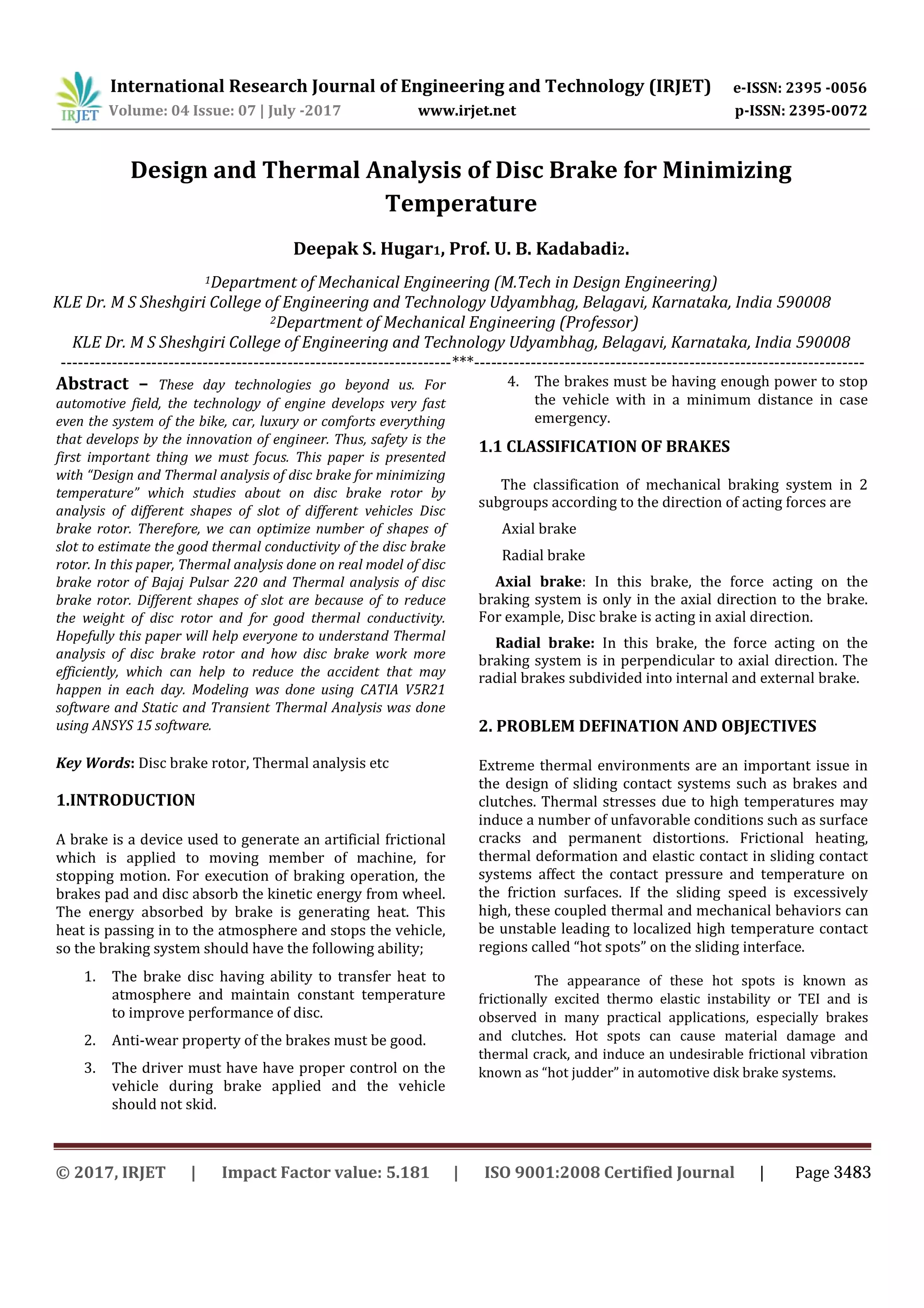
Fig 5.1 Original disc brake
From the above figure shows stress distribution of original
disc brake, it is observed that maximum stress is 19.03 Mpa.
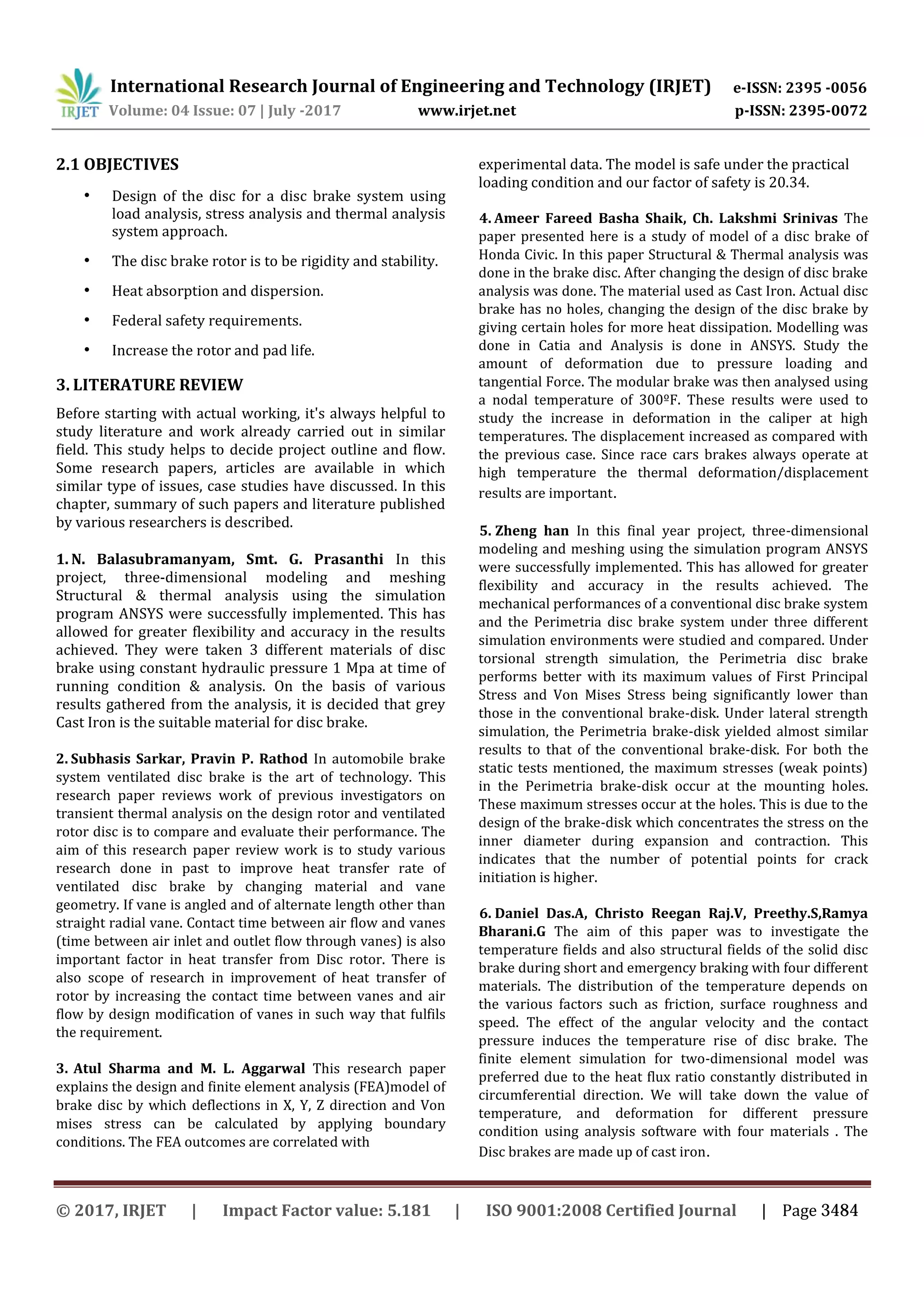
Above figure shows the stress distribution of new disc 1, it
is observed that maximum stress is 19.67 Mpa.
Fig 5.3 New disc 2
Above figure shows the stress distribution of new disc 2, it
is observed that maximum stress is 29.917 Mpa.
Fig 5.4 New disc 3
Above figure shows the stress distribution of new disc 3, it
is observed that maximum stress is 27.456 Mpa.
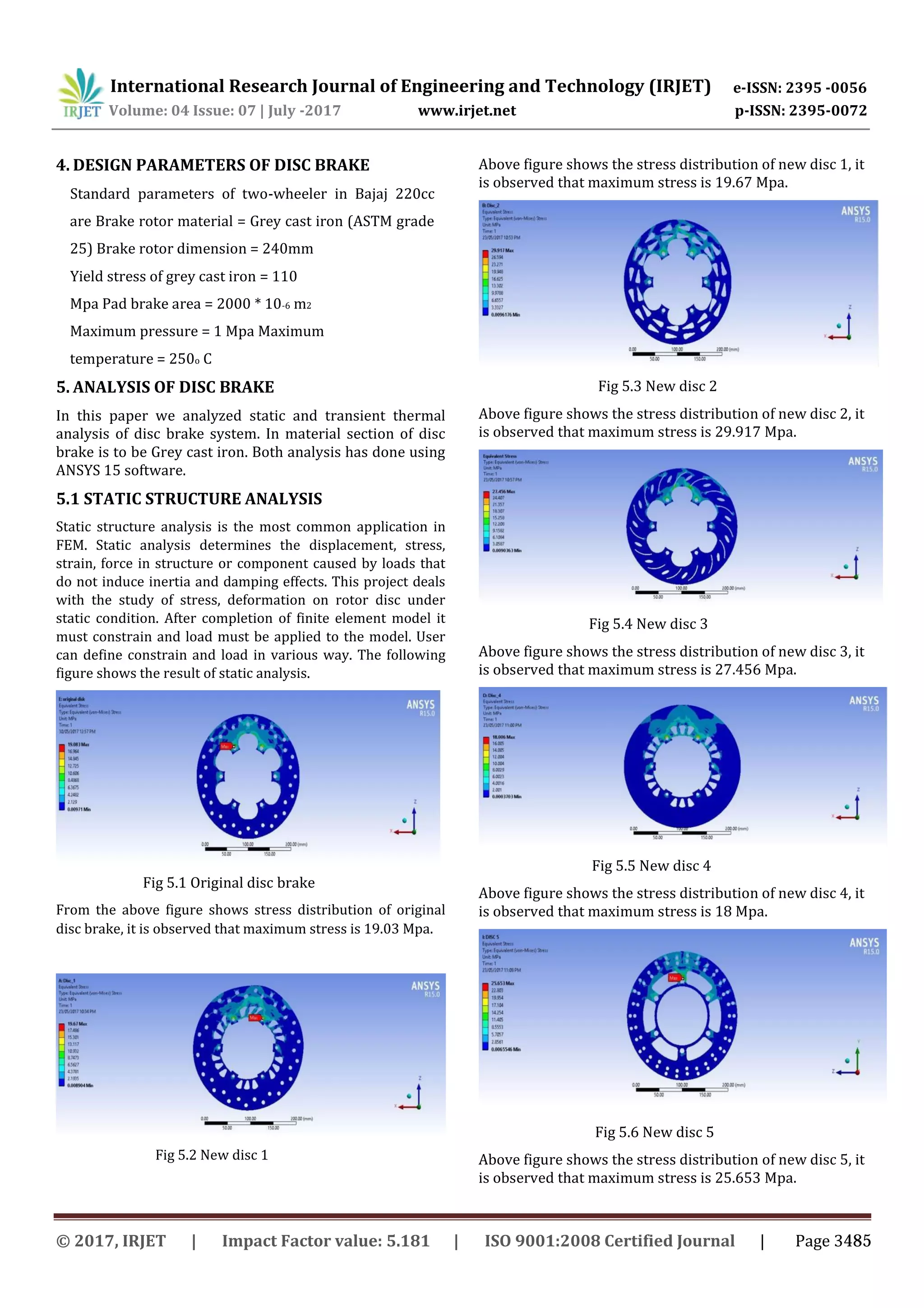
Fig 5.5 New disc 4
Above figure shows the stress distribution of new disc 4, it
is observed that maximum stress is 18 Mpa.
Fig 5.2 New disc 1
Fig 5.6 New disc 5
Above figure shows the stress distribution of new disc 5, it
is observed that maximum stress is 25.653 Mpa.
© 2017, IRJET | Impact Factor value: 5.181 | ISO 9001:2008 Certified Journal | Page 3485
International Research Journal of Engineering and Technology (IRJET) e-ISSN: 2395 -0056
Volume: 04 Issue: 07 | July -2017 www.irjet.net p-ISSN: 2395-0072
From computational analysis result for different design it
shows that new disc 5 maximum stresses of 25.653 Mpa
respectively. So, design is safe for Grey cast iron material.
5.2 TRANSIENT THERMAL ANALYSIS
Transient thermal analysis is used to determine temperature
and other thermal quantities that change over time.The
change in temperature distribution over time is important in
many applications such as in quenching analysis for heat
treatment. Also of interest are the temperature distribution
results in thermal stresses that can cause the failure. In such
cases temperature from the transient thermal analysis for
thermal stress evaluation. Heat flux is applied for different
design structure discs is 0.0211 W/mm2.The following figure
shows the result of transient analysis in various discs.
Fig 5.9 Transient thermal analysis on new disc 2
As shown in above figure transient thermal analysis was
conducted on the disc and maximum temperature observed is
238.98oC and minimum temperature observed is 21.99oC.
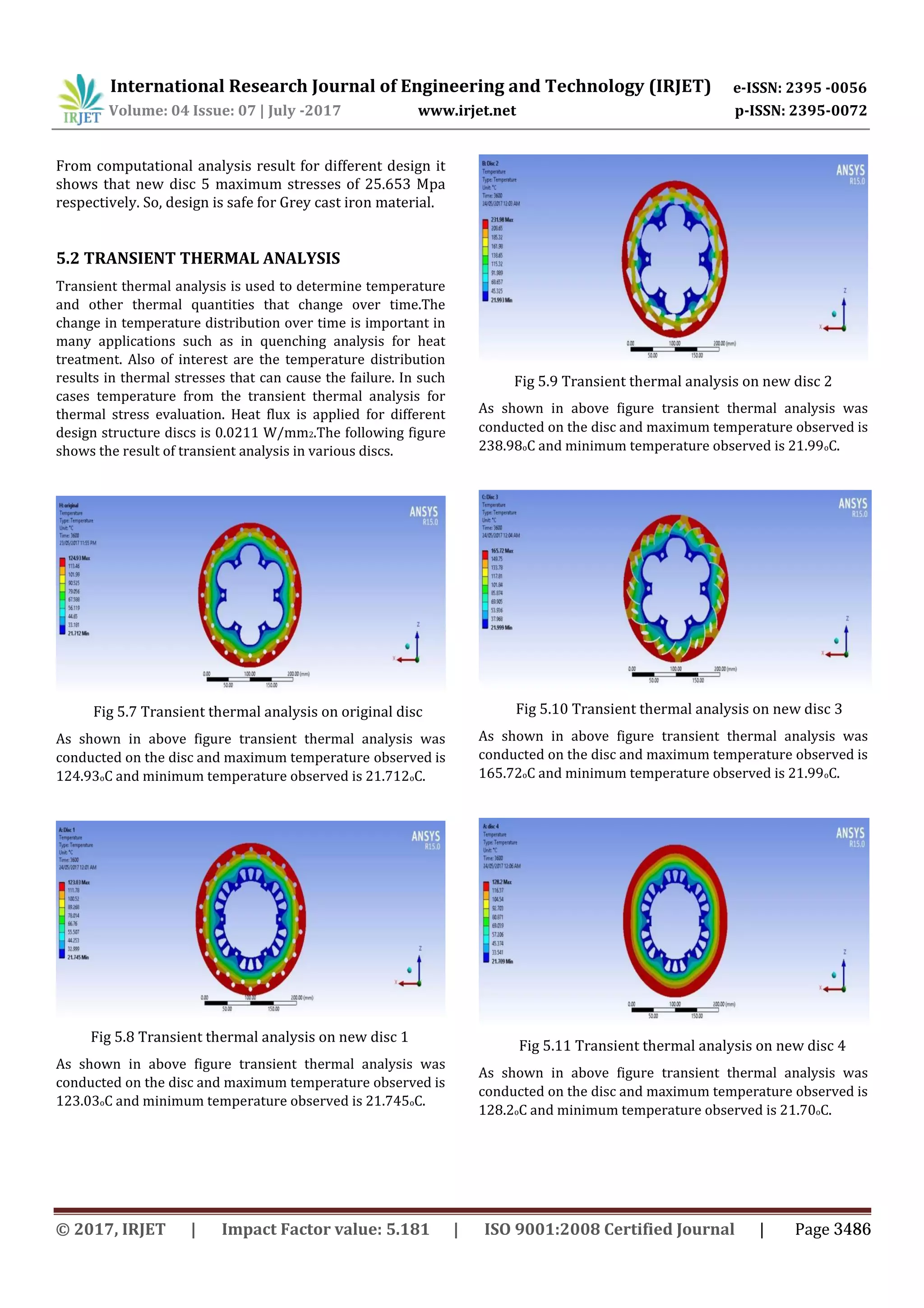
Fig 5.7 Transient thermal analysis on original disc
As shown in above figure transient thermal analysis was
conducted on the disc and maximum temperature observed is
124.93oC and minimum temperature observed is 21.712oC.
Fig 5.10 Transient thermal analysis on new disc 3
As shown in above figure transient thermal analysis was
conducted on the disc and maximum temperature observed is
165.72oC and minimum temperature observed is 21.99oC.
Fig 5.8 Transient thermal analysis on new disc 1
As shown in above figure transient thermal analysis was
conducted on the disc and maximum temperature observed is
123.03oC and minimum temperature observed is 21.745oC.
Fig 5.11 Transient thermal analysis on new disc 4
As shown in above figure transient thermal analysis was
conducted on the disc and maximum temperature observed is
128.2oC and minimum temperature observed is 21.70oC.
© 2017, IRJET | Impact Factor value: 5.181 | ISO 9001:2008 Certified Journal | Page 3486
International Research Journal of Engineering and Technology (IRJET) e-ISSN: 2395 -0056
Volume: 04 Issue: 07 | July -2017 www.irjet.net p-ISSN: 2395-0072
Fig 5.12 Transient thermal analysis on new disc 4
As shown in above figure transient thermal analysis was
conducted on the disc and maximum temperature observed is
95.603oC and minimum temperature observed is 21.59oC
From transient thermal analysis for different design it
shows that the new disc 5 generates the minimum
temperature 95.6030C. Hence new disc 5 is the best among
all.
6. RESULT AND COMPARISON
6.1 STATIC STRUCTURE
Table 6.1 comparison of stress and deformation for
different discs
Stress Deformation
Original disc 19.083 0.003695
New disc 1 19.67 0.003829
New disc 2 29.917 0.00568
New disc 3 27.456 0.005342
New disc 4 18.006 0.003519
New disc 5 25.653 0.00585
Above table shows the comparison of stresses between
different discs where the maximum stress developed in
original disc is 19.083 Mpa while that in the new disc 5 is
25.653 Mpa which is well below the yield limit of 110 Mpa.
Hence the design is safe.
6.2 TRANSIENT THERMAL ANALYSIS
Table 6.2 Comparison of temperature and weight for
different discs
Temperature(0C) Weight (kg)
Original disc 124.93 0.985
New disc 1 123.03 1.0811
New disc 2 231.98 0.877
New disc 3 165.72 0.965
New disc 4 128.2 1.148
New disc 5 95.603 0.895
Above table 6.2 shows the comparison of temperature and
weight in different discs as shown the temperature
maximum generated in original disc is 124.930C while that
in new disc 5 is 95.6030C. As it seen the weight of original
disc is 0.985kg while that of new disc 5 is 0.895kg.
7. CONCLUSIONS
The above study can provide a useful design and help to
improve the brake performance of disc brake system. From
the above result, we can say that minimum temperature
distribution occurs in modify (new disc 5) as compare to
actual standard Bajaj pulsar 2wheeler and other new discs.
Also for structural analysis result of computational we found
the new brake disc design is safe based on strength and
rigidity criterion. On the basis of various results gathered
from the analysis, it is decided that grey cast iron is the
suitable material for disc brake. New disc 5 is good brake disc
compared to original brake disc of Bajaj pulsar of two-
wheeler and other new disc brake for heat dissipation. New
disc 5 carrying high brake force during running condition
without any cracks, buckling.
REFERENCES
[1] Smt. G. Prasanthi, N. Balasubramanyam, “Design and
Analysis of Disc Brake for a Two-Wheeler”, International
Journal of Mechanical and Industrial Technology
(IJMIT)Vol. 1, Issue ,October 2013- March 2014.
[2] Subhasis Sarkar, Pravin P. Rathod, “Review paper on
Thermal Analysis of Ventilated Disc Brake by varying
Design parameter”, International Journal of Engineering
Research and Technology (IJERT) Vol. 2, Issue 12,
December – 2013.
[3] M. L. Aggarwal, Atul Sharma, “Deflection and stress
Analysis of Brake Disc using Finite Element Method”, Oct
19-20, 2012.
[4] Ch. Lakshmi Srinivas, Ameer Fareed Basha Shaik,
“Structural and Thermal Analysis of Disc Brake with and
without cross drilled rotor of race car”, International
Journal of Advanced Engineering Research and
Studies IJAERS/ Vol. 1/Issue 4 / July-sept., 2012.
[5] Daniel Das. A, Christo Reegan Raj. V, Preethy. S, Ramya
Bharani. G, “Structutal and Thermal Analysis of Disc
Brake in Automobile”, International Journal of Latest
Trends in Engineering and Technology (IJLTET) Vol. 2,
Issue 3 May 2013.
© 2017, IRJET | Impact Factor value: 5.181 | ISO 9001:2008 Certified Journal | Page 3487

Design and Thermal Analysis of Disc Brake for Minimizing Temperature

  • 1.
    International Research Journalof Engineering and Technology (IRJET) e-ISSN: 2395 -0056 Volume: 04 Issue: 07 | July -2017 www.irjet.net p-ISSN: 2395-0072 Design and Thermal Analysis of Disc Brake for Minimizing Temperature Deepak S. Hugar1, Prof. U. B. Kadabadi2. 1Department of Mechanical Engineering (M.Tech in Design Engineering) KLE Dr. M S Sheshgiri College of Engineering and Technology Udyambhag, Belagavi, Karnataka, India 590008 2Department of Mechanical Engineering (Professor) KLE Dr. M S Sheshgiri College of Engineering and Technology Udyambhag, Belagavi, Karnataka, India 590008 ---------------------------------------------------------------------***--------------------------------------------------------------------- Abstract – These day technologies go beyond us. For automotive field, the technology of engine develops very fast even the system of the bike, car, luxury or comforts everything that develops by the innovation of engineer. Thus, safety is the first important thing we must focus. This paper is presented with “Design and Thermal analysis of disc brake for minimizing temperature” which studies about on disc brake rotor by analysis of different shapes of slot of different vehicles Disc brake rotor. Therefore, we can optimize number of shapes of slot to estimate the good thermal conductivity of the disc brake rotor. In this paper, Thermal analysis done on real model of disc brake rotor of Bajaj Pulsar 220 and Thermal analysis of disc brake rotor. Different shapes of slot are because of to reduce the weight of disc rotor and for good thermal conductivity. Hopefully this paper will help everyone to understand Thermal analysis of disc brake rotor and how disc brake work more efficiently, which can help to reduce the accident that may happen in each day. Modeling was done using CATIA V5R21 software and Static and Transient Thermal Analysis was done using ANSYS 15 software. Key Words: Disc brake rotor, Thermal analysis etc 1.INTRODUCTION A brake is a device used to generate an artificial frictional which is applied to moving member of machine, for stopping motion. For execution of braking operation, the brakes pad and disc absorb the kinetic energy from wheel. The energy absorbed by brake is generating heat. This heat is passing in to the atmosphere and stops the vehicle, so the braking system should have the following ability; 1. The brake disc having ability to transfer heat to atmosphere and maintain constant temperature to improve performance of disc. 2. Anti-wear property of the brakes must be good. 3. The driver must have have proper control on the vehicle during brake applied and the vehicle should not skid. 4. The brakes must be having enough power to stop the vehicle with in a minimum distance in case emergency. 1.1 CLASSIFICATION OF BRAKES The classification of mechanical braking system in 2 subgroups according to the direction of acting forces are Axial brake Radial brake Axial brake: In this brake, the force acting on the braking system is only in the axial direction to the brake. For example, Disc brake is acting in axial direction. Radial brake: In this brake, the force acting on the braking system is in perpendicular to axial direction. The radial brakes subdivided into internal and external brake. 2. PROBLEM DEFINATION AND OBJECTIVES Extreme thermal environments are an important issue in the design of sliding contact systems such as brakes and clutches. Thermal stresses due to high temperatures may induce a number of unfavorable conditions such as surface cracks and permanent distortions. Frictional heating, thermal deformation and elastic contact in sliding contact systems affect the contact pressure and temperature on the friction surfaces. If the sliding speed is excessively high, these coupled thermal and mechanical behaviors can be unstable leading to localized high temperature contact regions called “hot spots” on the sliding interface. The appearance of these hot spots is known as frictionally excited thermo elastic instability or TEI and is observed in many practical applications, especially brakes and clutches. Hot spots can cause material damage and thermal crack, and induce an undesirable frictional vibration known as “hot judder” in automotive disk brake systems. © 2017, IRJET | Impact Factor value: 5.181 | ISO 9001:2008 Certified Journal | Page 3483
  • 2.
    International Research Journalof Engineering and Technology (IRJET) e-ISSN: 2395 -0056 Volume: 04 Issue: 07 | July -2017 www.irjet.net p-ISSN: 2395-0072 2.1 OBJECTIVES • Design of the disc for a disc brake system using load analysis, stress analysis and thermal analysis system approach. • The disc brake rotor is to be rigidity and stability. • Heat absorption and dispersion. • Federal safety requirements. • Increase the rotor and pad life. 3. LITERATURE REVIEW Before starting with actual working, it's always helpful to study literature and work already carried out in similar field. This study helps to decide project outline and flow. Some research papers, articles are available in which similar type of issues, case studies have discussed. In this chapter, summary of such papers and literature published by various researchers is described. 1. N. Balasubramanyam, Smt. G. Prasanthi In this project, three-dimensional modeling and meshing Structural & thermal analysis using the simulation program ANSYS were successfully implemented. This has allowed for greater flexibility and accuracy in the results achieved. They were taken 3 different materials of disc brake using constant hydraulic pressure 1 Mpa at time of running condition & analysis. On the basis of various results gathered from the analysis, it is decided that grey Cast Iron is the suitable material for disc brake. 2. Subhasis Sarkar, Pravin P. Rathod In automobile brake system ventilated disc brake is the art of technology. This research paper reviews work of previous investigators on transient thermal analysis on the design rotor and ventilated rotor disc is to compare and evaluate their performance. The aim of this research paper review work is to study various research done in past to improve heat transfer rate of ventilated disc brake by changing material and vane geometry. If vane is angled and of alternate length other than straight radial vane. Contact time between air flow and vanes (time between air inlet and outlet flow through vanes) is also important factor in heat transfer from Disc rotor. There is also scope of research in improvement of heat transfer of rotor by increasing the contact time between vanes and air flow by design modification of vanes in such way that fulfils the requirement. 3. Atul Sharma and M. L. Aggarwal This research paper explains the design and finite element analysis (FEA)model of brake disc by which deflections in X, Y, Z direction and Von mises stress can be calculated by applying boundary conditions. The FEA outcomes are correlated with experimental data. The model is safe under the practical loading condition and our factor of safety is 20.34. 4. Ameer Fareed Basha Shaik, Ch. Lakshmi Srinivas The paper presented here is a study of model of a disc brake of Honda Civic. In this paper Structural & Thermal analysis was done in the brake disc. After changing the design of disc brake analysis was done. The material used as Cast Iron. Actual disc brake has no holes, changing the design of the disc brake by giving certain holes for more heat dissipation. Modelling was done in Catia and Analysis is done in ANSYS. Study the amount of deformation due to pressure loading and tangential Force. The modular brake was then analysed using a nodal temperature of 300ºF. These results were used to study the increase in deformation in the caliper at high temperatures. The displacement increased as compared with the previous case. Since race cars brakes always operate at high temperature the thermal deformation/displacement results are important. 5. Zheng han In this final year project, three-dimensional modeling and meshing using the simulation program ANSYS were successfully implemented. This has allowed for greater flexibility and accuracy in the results achieved. The mechanical performances of a conventional disc brake system and the Perimetria disc brake system under three different simulation environments were studied and compared. Under torsional strength simulation, the Perimetria disc brake performs better with its maximum values of First Principal Stress and Von Mises Stress being significantly lower than those in the conventional brake-disk. Under lateral strength simulation, the Perimetria brake-disk yielded almost similar results to that of the conventional brake-disk. For both the static tests mentioned, the maximum stresses (weak points) in the Perimetria brake-disk occur at the mounting holes. These maximum stresses occur at the holes. This is due to the design of the brake-disk which concentrates the stress on the inner diameter during expansion and contraction. This indicates that the number of potential points for crack initiation is higher. 6. Daniel Das.A, Christo Reegan Raj.V, Preethy.S,Ramya Bharani.G The aim of this paper was to investigate the temperature fields and also structural fields of the solid disc brake during short and emergency braking with four different materials. The distribution of the temperature depends on the various factors such as friction, surface roughness and speed. The effect of the angular velocity and the contact pressure induces the temperature rise of disc brake. The finite element simulation for two-dimensional model was preferred due to the heat flux ratio constantly distributed in circumferential direction. We will take down the value of temperature, and deformation for different pressure condition using analysis software with four materials . The Disc brakes are made up of cast iron. © 2017, IRJET | Impact Factor value: 5.181 | ISO 9001:2008 Certified Journal | Page 3484
  • 3.
    International Research Journalof Engineering and Technology (IRJET) e-ISSN: 2395 -0056 Volume: 04 Issue: 07 | July -2017 www.irjet.net p-ISSN: 2395-0072 4. DESIGN PARAMETERS OF DISC BRAKE Standard parameters of two-wheeler in Bajaj 220cc are Brake rotor material = Grey cast iron (ASTM grade 25) Brake rotor dimension = 240mm Yield stress of grey cast iron = 110 Mpa Pad brake area = 2000 * 10-6 m2 Maximum pressure = 1 Mpa Maximum temperature = 250o C 5. ANALYSIS OF DISC BRAKE In this paper we analyzed static and transient thermal analysis of disc brake system. In material section of disc brake is to be Grey cast iron. Both analysis has done using ANSYS 15 software. 5.1 STATIC STRUCTURE ANALYSIS Static structure analysis is the most common application in FEM. Static analysis determines the displacement, stress, strain, force in structure or component caused by loads that do not induce inertia and damping effects. This project deals with the study of stress, deformation on rotor disc under static condition. After completion of finite element model it must constrain and load must be applied to the model. User can define constrain and load in various way. The following figure shows the result of static analysis. Fig 5.1 Original disc brake From the above figure shows stress distribution of original disc brake, it is observed that maximum stress is 19.03 Mpa. Above figure shows the stress distribution of new disc 1, it is observed that maximum stress is 19.67 Mpa. Fig 5.3 New disc 2 Above figure shows the stress distribution of new disc 2, it is observed that maximum stress is 29.917 Mpa. Fig 5.4 New disc 3 Above figure shows the stress distribution of new disc 3, it is observed that maximum stress is 27.456 Mpa. Fig 5.5 New disc 4 Above figure shows the stress distribution of new disc 4, it is observed that maximum stress is 18 Mpa. Fig 5.2 New disc 1 Fig 5.6 New disc 5 Above figure shows the stress distribution of new disc 5, it is observed that maximum stress is 25.653 Mpa. © 2017, IRJET | Impact Factor value: 5.181 | ISO 9001:2008 Certified Journal | Page 3485
  • 4.
    International Research Journalof Engineering and Technology (IRJET) e-ISSN: 2395 -0056 Volume: 04 Issue: 07 | July -2017 www.irjet.net p-ISSN: 2395-0072 From computational analysis result for different design it shows that new disc 5 maximum stresses of 25.653 Mpa respectively. So, design is safe for Grey cast iron material. 5.2 TRANSIENT THERMAL ANALYSIS Transient thermal analysis is used to determine temperature and other thermal quantities that change over time.The change in temperature distribution over time is important in many applications such as in quenching analysis for heat treatment. Also of interest are the temperature distribution results in thermal stresses that can cause the failure. In such cases temperature from the transient thermal analysis for thermal stress evaluation. Heat flux is applied for different design structure discs is 0.0211 W/mm2.The following figure shows the result of transient analysis in various discs. Fig 5.9 Transient thermal analysis on new disc 2 As shown in above figure transient thermal analysis was conducted on the disc and maximum temperature observed is 238.98oC and minimum temperature observed is 21.99oC. Fig 5.7 Transient thermal analysis on original disc As shown in above figure transient thermal analysis was conducted on the disc and maximum temperature observed is 124.93oC and minimum temperature observed is 21.712oC. Fig 5.10 Transient thermal analysis on new disc 3 As shown in above figure transient thermal analysis was conducted on the disc and maximum temperature observed is 165.72oC and minimum temperature observed is 21.99oC. Fig 5.8 Transient thermal analysis on new disc 1 As shown in above figure transient thermal analysis was conducted on the disc and maximum temperature observed is 123.03oC and minimum temperature observed is 21.745oC. Fig 5.11 Transient thermal analysis on new disc 4 As shown in above figure transient thermal analysis was conducted on the disc and maximum temperature observed is 128.2oC and minimum temperature observed is 21.70oC. © 2017, IRJET | Impact Factor value: 5.181 | ISO 9001:2008 Certified Journal | Page 3486
  • 5.
    International Research Journalof Engineering and Technology (IRJET) e-ISSN: 2395 -0056 Volume: 04 Issue: 07 | July -2017 www.irjet.net p-ISSN: 2395-0072 Fig 5.12 Transient thermal analysis on new disc 4 As shown in above figure transient thermal analysis was conducted on the disc and maximum temperature observed is 95.603oC and minimum temperature observed is 21.59oC From transient thermal analysis for different design it shows that the new disc 5 generates the minimum temperature 95.6030C. Hence new disc 5 is the best among all. 6. RESULT AND COMPARISON 6.1 STATIC STRUCTURE Table 6.1 comparison of stress and deformation for different discs Stress Deformation Original disc 19.083 0.003695 New disc 1 19.67 0.003829 New disc 2 29.917 0.00568 New disc 3 27.456 0.005342 New disc 4 18.006 0.003519 New disc 5 25.653 0.00585 Above table shows the comparison of stresses between different discs where the maximum stress developed in original disc is 19.083 Mpa while that in the new disc 5 is 25.653 Mpa which is well below the yield limit of 110 Mpa. Hence the design is safe. 6.2 TRANSIENT THERMAL ANALYSIS Table 6.2 Comparison of temperature and weight for different discs Temperature(0C) Weight (kg) Original disc 124.93 0.985 New disc 1 123.03 1.0811 New disc 2 231.98 0.877 New disc 3 165.72 0.965 New disc 4 128.2 1.148 New disc 5 95.603 0.895 Above table 6.2 shows the comparison of temperature and weight in different discs as shown the temperature maximum generated in original disc is 124.930C while that in new disc 5 is 95.6030C. As it seen the weight of original disc is 0.985kg while that of new disc 5 is 0.895kg. 7. CONCLUSIONS The above study can provide a useful design and help to improve the brake performance of disc brake system. From the above result, we can say that minimum temperature distribution occurs in modify (new disc 5) as compare to actual standard Bajaj pulsar 2wheeler and other new discs. Also for structural analysis result of computational we found the new brake disc design is safe based on strength and rigidity criterion. On the basis of various results gathered from the analysis, it is decided that grey cast iron is the suitable material for disc brake. New disc 5 is good brake disc compared to original brake disc of Bajaj pulsar of two- wheeler and other new disc brake for heat dissipation. New disc 5 carrying high brake force during running condition without any cracks, buckling. REFERENCES [1] Smt. G. Prasanthi, N. Balasubramanyam, “Design and Analysis of Disc Brake for a Two-Wheeler”, International Journal of Mechanical and Industrial Technology (IJMIT)Vol. 1, Issue ,October 2013- March 2014. [2] Subhasis Sarkar, Pravin P. Rathod, “Review paper on Thermal Analysis of Ventilated Disc Brake by varying Design parameter”, International Journal of Engineering Research and Technology (IJERT) Vol. 2, Issue 12, December – 2013. [3] M. L. Aggarwal, Atul Sharma, “Deflection and stress Analysis of Brake Disc using Finite Element Method”, Oct 19-20, 2012. [4] Ch. Lakshmi Srinivas, Ameer Fareed Basha Shaik, “Structural and Thermal Analysis of Disc Brake with and without cross drilled rotor of race car”, International Journal of Advanced Engineering Research and Studies IJAERS/ Vol. 1/Issue 4 / July-sept., 2012. [5] Daniel Das. A, Christo Reegan Raj. V, Preethy. S, Ramya Bharani. G, “Structutal and Thermal Analysis of Disc Brake in Automobile”, International Journal of Latest Trends in Engineering and Technology (IJLTET) Vol. 2, Issue 3 May 2013. © 2017, IRJET | Impact Factor value: 5.181 | ISO 9001:2008 Certified Journal | Page 3487