STREAM SEMINAR
VISHAL CHATURANI
B. TECH (MECHANICAL)
114089
Dayalbagh Educational Institute
Automobile
Tyres
2
INTRODUCTION
Tyre is a rubber member which gives the
cushion to the automobile. It consists of outer
cover i.e. tyre proper and tube inside.
The tyre-tube assembly is mounted over the
wheel rim and air inside the tube carries
entire load and provides cushion.

3
Functions of tyre
To support the vehicle load.

To provide cushion against the shocks.
To transmit driving and braking forces to the
road.
To provide cornering power for smooth steering.

4
Properties of tyres
Non-skidding
Uniform wear
Load-carrying
Cushioning
Power consumption
Tyre noise
Balancing

5
Types of tyres
Conventional tubed tyre.
Tubeless tyre.

6
Advantages of tubeless tyres
Lesser unsprung weight.
Better cooling.
Lesser rolling resistance.
Comfortable ride.
Slower leakage of air.
Simpler assembly.
Improved safety.
NON PNEUMATIC TYRES


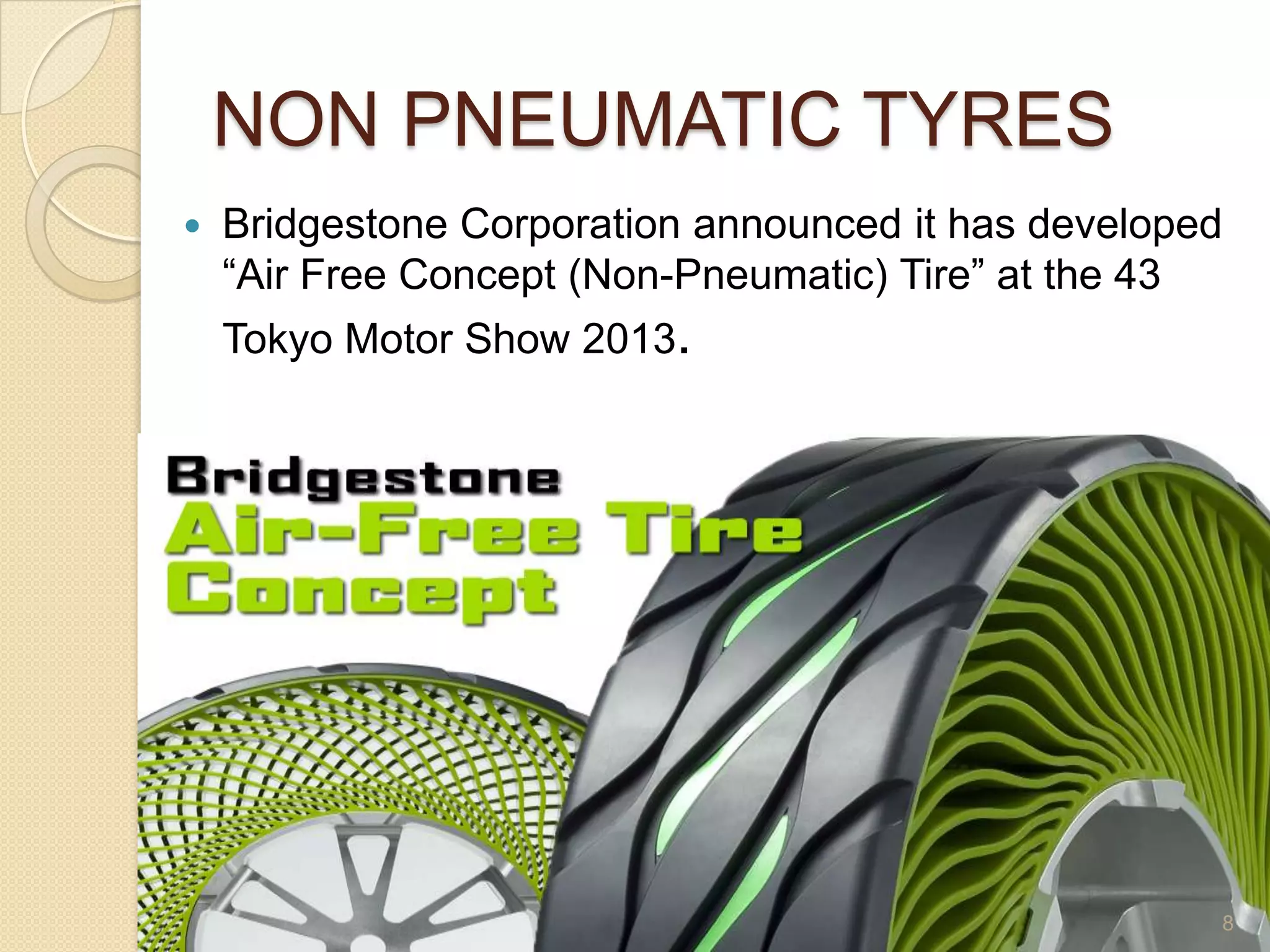
Bridgestone Corporation announced it has developed
“Air Free Concept (Non-Pneumatic) Tire” at the 43

Tokyo Motor Show 2013.

8
INTRODUCTION
Since the earlier invention of a non-pneumatic wheel in
1920’s, the non-pneumatic tire (NPT) is getting more
attention due to its advantages over the pneumatic
counterpart.
Many design studies are still needed from the viewpoint
of material, pattern, and structures.
However, no systematic research for such important
design issues has been reported in the literature up to
now.

9
The airless tire is not a new idea –
“MichelinTweel” is just another example - but
Bridgestone claims that this is the first design of its
kind that is ready for mass production.

10
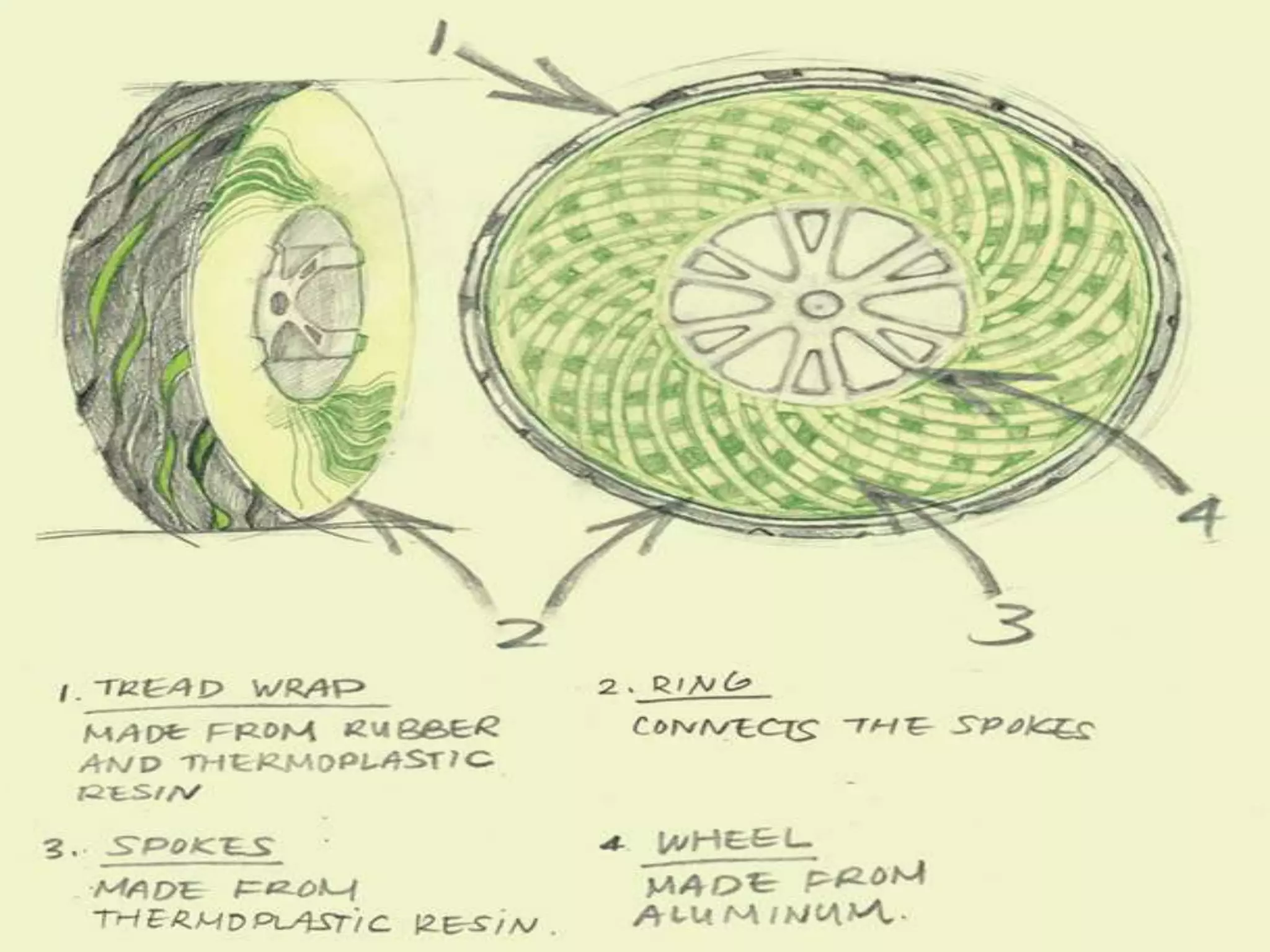
What makes tyres “AIR LESS”
• Structure of spokes stretching along the inner
sides of the tires supporting the weight of the
vehicle.
• A synthetic resin that becomes flexible when
heated, can be processed into a variety of
shapes, and becomes hard when cooled. The
changes from heating and cooling can generally
be repeated, making it easy to both mold and
recycle the material.Untitled.mp4
Flexing of
spokes
13
ADVANTAGES
The tires require less maintenance
The worry of punctures is eliminated.
The materials used in the tires and the spoke
structure are 100% recyclable.
Provides low rolling resistance and
contributing to reductions in co2 emissions.
Nothing to do with fuel efficiency in a direct
way, only offering the benefit that it will never
influence consumption.
Increased versatility
Using high-strength but flexible highperformance resin as a material has increased
versatility through improved load-bearing
capabilities and driving performance.
High-speed travel (maximum 60 km/h) in
ultralight vehicles has also become possible.

15
Low rolling resistance
• About 90% of energy loss from tire
rolling resistance comes from
repeated changes in the shape of tires
as they roll. Bridgestone has
succeeded in making a significant
reduction in energy loss by using
proprietary materials technologies
and simplifying the structure of the
NOTE: 1. Still in the A result, these “Air free
tires. As testing phase
2. There is no word on price or a release date for standard vehicle
ConCept tire” hAve AChieved the same
versions.
TWEEL by Michelin
Tweel for
Segway.
Tweel for
construction
vehicle

17
3D model of airless tire

18
Michelin first announced the Tweel in 2005
The name is a combination of the words tire
and wheel because the Tweel doesn’t use a
traditional wheel hub assembly.
A solid inner hub mounts to the axle. That’s
surrounded by polyurethane spokes arrayed in
a pattern of wedges. A shear band is stretched
across the spokes, forming the outer edge of
the tire (the part that comes in contact with the
road).
The tension of the shear band on the spokes
and the strength of the spokes themselves
replace the air pressure of a traditional tire.
The tread is then attached to the shear band.
The Tweel looks sort of like a very
large, futuristic bicycle wheel.
When the Tweel is put to the road, the spokes absorb
road impacts the same way air pressure does in
pneumatic tires. The tread and shear bands deform
temporarily as the spokes bend, then quickly spring
back into shape.
22
Bridgestone vs Michelin
Bridgestone’s prototype version looks very
similar to that of Michelin.
In Michelin’s design the thermoplastic fins are
staggered so that the connections to the hub
and the rim won’t torque causing complete
structural breakdown.

23
The biggest difference between the two tire maker’s
wheels, as pictured above, is the size of the supporting
ribs. Michelin focused on allowing the tires to be able to
deform over obstacles, making them more suitable for
military applications
where as
Bridgestone has approached its tire from the consumer
24
angle, creating a highly recyclable tire that will cut down
FUTURE CHALLENGES
• Goodyear in collaboration with
NASA Glenn Research Center
(GRC), develop non-pneumatic
tyres for use first on the moon,
and eventually on Mars.

25
• “The basic rubber-pneumatic design used on
Earth does not have the same utility on the moon,”
said NASA Principal Investigator Vivake Asnani.
• There are no lunar roads. Lunar tyres need to be
designed to develop traction on sandy undulated
terrain, in regions that humans have never even
seen up close.

26
• The Spring Tire has now been recognized
with a so-called “Oscar of Innovation” at
the 44th Annual R&D 100 Awards in
Orlando, Florida.

27
REFERENCES
• www.google.com
• http://www.bridgestone.co.in/
• http://www.newindianexpress.com/business/
news/article284682.ece
• http://gizmodo.com/tag/tires
• http://www.toxel.com/tech/2009/07/05/innov
ative-airless-tires-by-michelin/.
THANK YOU

NON PNEUMATIC TIRES- "THE AIRLESS TIRE"

  • 1.
    STREAM SEMINAR VISHAL CHATURANI B.TECH (MECHANICAL) 114089 Dayalbagh Educational Institute
  • 2.
  • 3.
    INTRODUCTION Tyre is arubber member which gives the cushion to the automobile. It consists of outer cover i.e. tyre proper and tube inside. The tyre-tube assembly is mounted over the wheel rim and air inside the tube carries entire load and provides cushion. 3
  • 4.
    Functions of tyre Tosupport the vehicle load. To provide cushion against the shocks. To transmit driving and braking forces to the road. To provide cornering power for smooth steering. 4
  • 5.
    Properties of tyres Non-skidding Uniformwear Load-carrying Cushioning Power consumption Tyre noise Balancing 5
  • 6.
    Types of tyres Conventionaltubed tyre. Tubeless tyre. 6
  • 7.
    Advantages of tubelesstyres Lesser unsprung weight. Better cooling. Lesser rolling resistance. Comfortable ride. Slower leakage of air. Simpler assembly. Improved safety.
  • 8.
    NON PNEUMATIC TYRES  BridgestoneCorporation announced it has developed “Air Free Concept (Non-Pneumatic) Tire” at the 43 Tokyo Motor Show 2013. 8
  • 9.
    INTRODUCTION Since the earlierinvention of a non-pneumatic wheel in 1920’s, the non-pneumatic tire (NPT) is getting more attention due to its advantages over the pneumatic counterpart. Many design studies are still needed from the viewpoint of material, pattern, and structures. However, no systematic research for such important design issues has been reported in the literature up to now. 9
  • 10.
    The airless tireis not a new idea – “MichelinTweel” is just another example - but Bridgestone claims that this is the first design of its kind that is ready for mass production. 10
  • 11.
    What makes tyres“AIR LESS” • Structure of spokes stretching along the inner sides of the tires supporting the weight of the vehicle. • A synthetic resin that becomes flexible when heated, can be processed into a variety of shapes, and becomes hard when cooled. The changes from heating and cooling can generally be repeated, making it easy to both mold and recycle the material.Untitled.mp4
  • 13.
  • 14.
    ADVANTAGES The tires requireless maintenance The worry of punctures is eliminated. The materials used in the tires and the spoke structure are 100% recyclable. Provides low rolling resistance and contributing to reductions in co2 emissions. Nothing to do with fuel efficiency in a direct way, only offering the benefit that it will never influence consumption.
  • 15.
    Increased versatility Using high-strengthbut flexible highperformance resin as a material has increased versatility through improved load-bearing capabilities and driving performance. High-speed travel (maximum 60 km/h) in ultralight vehicles has also become possible. 15
  • 16.
    Low rolling resistance •About 90% of energy loss from tire rolling resistance comes from repeated changes in the shape of tires as they roll. Bridgestone has succeeded in making a significant reduction in energy loss by using proprietary materials technologies and simplifying the structure of the NOTE: 1. Still in the A result, these “Air free tires. As testing phase 2. There is no word on price or a release date for standard vehicle ConCept tire” hAve AChieved the same versions.
  • 17.
    TWEEL by Michelin Tweelfor Segway. Tweel for construction vehicle 17
  • 18.
    3D model ofairless tire 18
  • 19.
    Michelin first announcedthe Tweel in 2005 The name is a combination of the words tire and wheel because the Tweel doesn’t use a traditional wheel hub assembly. A solid inner hub mounts to the axle. That’s surrounded by polyurethane spokes arrayed in a pattern of wedges. A shear band is stretched across the spokes, forming the outer edge of the tire (the part that comes in contact with the road).
  • 20.
    The tension ofthe shear band on the spokes and the strength of the spokes themselves replace the air pressure of a traditional tire. The tread is then attached to the shear band. The Tweel looks sort of like a very large, futuristic bicycle wheel.
  • 21.
    When the Tweelis put to the road, the spokes absorb road impacts the same way air pressure does in pneumatic tires. The tread and shear bands deform temporarily as the spokes bend, then quickly spring back into shape.
  • 22.
  • 23.
    Bridgestone vs Michelin Bridgestone’sprototype version looks very similar to that of Michelin. In Michelin’s design the thermoplastic fins are staggered so that the connections to the hub and the rim won’t torque causing complete structural breakdown. 23
  • 24.
    The biggest differencebetween the two tire maker’s wheels, as pictured above, is the size of the supporting ribs. Michelin focused on allowing the tires to be able to deform over obstacles, making them more suitable for military applications where as Bridgestone has approached its tire from the consumer 24 angle, creating a highly recyclable tire that will cut down
  • 25.
    FUTURE CHALLENGES • Goodyearin collaboration with NASA Glenn Research Center (GRC), develop non-pneumatic tyres for use first on the moon, and eventually on Mars. 25
  • 26.
    • “The basicrubber-pneumatic design used on Earth does not have the same utility on the moon,” said NASA Principal Investigator Vivake Asnani. • There are no lunar roads. Lunar tyres need to be designed to develop traction on sandy undulated terrain, in regions that humans have never even seen up close. 26
  • 27.
    • The SpringTire has now been recognized with a so-called “Oscar of Innovation” at the 44th Annual R&D 100 Awards in Orlando, Florida. 27
  • 28.
    REFERENCES • www.google.com • http://www.bridgestone.co.in/ •http://www.newindianexpress.com/business/ news/article284682.ece • http://gizmodo.com/tag/tires • http://www.toxel.com/tech/2009/07/05/innov ative-airless-tires-by-michelin/.
  • 29.

Editor's Notes

  • #9 The airless tire is not a new concept and is under investigation by several tire manufacturers since a while
  • #12 Tubeless tire technology does away with the need for an inner tube thereby increasing safety.[citation needed] In a tubeless tire, the tire and the rim of the wheel form an airtight seal, with the valve being directly mounted on the rim. If a tubeless tire gets a small puncture, air escapes only through the hole, leading to a gentle deflation. Conversely, an inner tube could potentially burst like a balloon, leading to a rapid deflation of the tire which could result in sudden loss of control of the vehicle.
  • #15 no need to periodically refill the tires with air
  • #16  “cradle to cradle” process that maximizes the cyclical use of resources from worn tires into new tires and the use of recyclable resources.
  • #26 the innovator of innovative tyre technology on Earth