Brake System
By Group Y: Anthony Briones, Lenny Nivar, Tyler
Radzyminski, Chris Colucci, & Clarence Uzoho
Motivation
Why did we choose a brake system ?
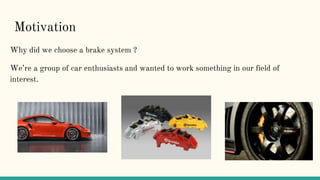
We’re a group of car enthusiasts and wanted to work something in our field of
interest.
Brake System
Purpose: A brake is a mechanical device that inhibits motion by absorbing energy from a moving system.
It is used for slowing or stopping a moving vehicle, wheel, axle, or to prevent its motion, most often
accomplished by means of friction.
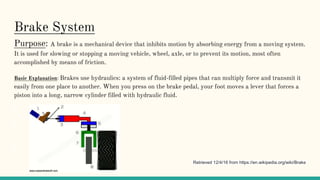
Basic Explanation: Brakes use hydraulics: a system of fluid-filled pipes that can multiply force and transmit it
easily from one place to another. When you press on the brake pedal, your foot moves a lever that forces a
piston into a long, narrow cylinder filled with hydraulic fluid.
Retrieved 12/4/16 from https://en.wikipedia.org/wiki/Brake
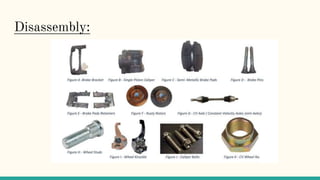
Disassembly:
Single Piston Caliper
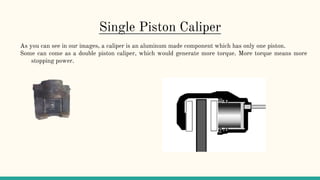
As you can see in our images, a caliper is an aluminum made component which has only one piston.
Some can come as a double piston caliper, which would generate more torque. More torque means more
stopping power.
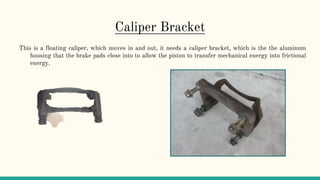
Caliper Bracket
This is a floating caliper, which moves in and out, it needs a caliper bracket, which is the the aluminum
housing that the brake pads close into to allow the piston to transfer mechanical energy into frictional
energy.
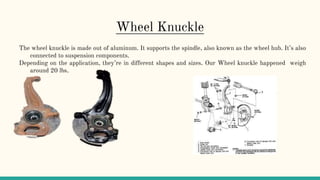
Wheel Knuckle
The wheel knuckle is made out of aluminum. It supports the spindle, also known as the wheel hub. It’s also
connected to suspension components.
Depending on the application, they’re in different shapes and sizes. Our Wheel knuckle happened weigh
around 20 lbs.
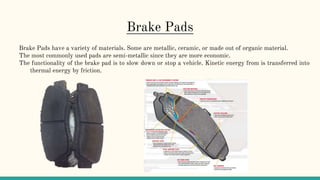
Brake Pads
Brake Pads have a variety of materials. Some are metallic, ceramic, or made out of organic material.
The most commonly used pads are semi-metallic since they are more economic.
The functionality of the brake pad is to slow down or stop a vehicle. Kinetic energy from is transferred into
thermal energy by friction.
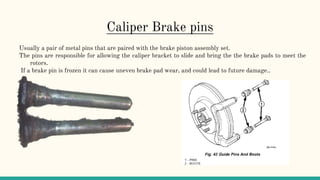
Caliper Brake pins
Usually a pair of metal pins that are paired with the brake piston assembly set.
The pins are responsible for allowing the caliper bracket to slide and bring the the brake pads to meet the
rotors.
If a brake pin is frozen it can cause uneven brake pad wear, and could lead to future damage..
Brake Pads Retainers
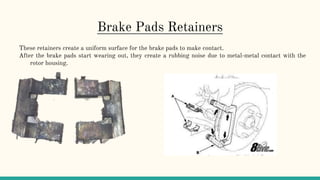
These retainers create a uniform surface for the brake pads to make contact.
After the brake pads start wearing out, they create a rubbing noise due to metal-metal contact with the
rotor housing.
Brake Rotors
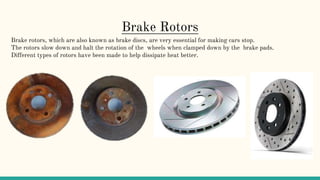
Brake rotors, which are also known as brake discs, are very essential for making cars stop.
The rotors slow down and halt the rotation of the wheels when clamped down by the brake pads.
Different types of rotors have been made to help dissipate heat better.
Caliper Bolts
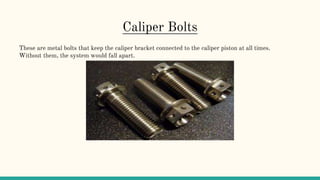
These are metal bolts that keep the caliper bracket connected to the caliper piston at all times.
Without them, the system would fall apart.
CV Axle
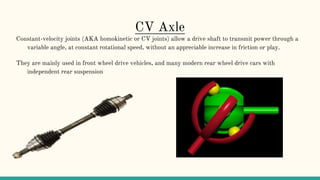
Constant-velocity joints (AKA homokinetic or CV joints) allow a drive shaft to transmit power through a
variable angle, at constant rotational speed, without an appreciable increase in friction or play.
They are mainly used in front wheel drive vehicles, and many modern rear wheel drive cars with
independent rear suspension
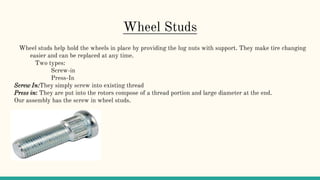
Wheel Studs
Wheel studs help hold the wheels in place by providing the lug nuts with support. They make tire changing
easier and can be replaced at any time.
Two types:
Screw-in
Press-In
Screw In:They simply screw into existing thread
Press in: They are put into the rotors compose of a thread portion and large diameter at the end.
Our assembly has the screw in wheel studs.
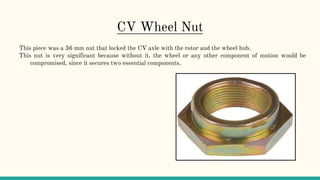
CV Wheel Nut
This piece was a 36 mm nut that locked the CV axle with the rotor and the wheel hub.
This nut is very significant because without it, the wheel or any other component of motion would be
compromised, since it secures two essential components.
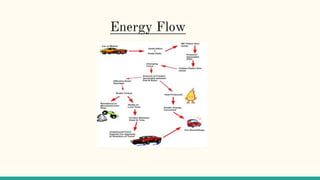
Energy Flow
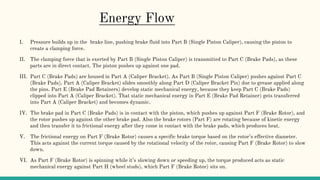
I. Pressure builds up in the brake line, pushing brake fluid into Part B (Single Piston Caliper), causing the piston to
create a clamping force.
II. The clamping force that is exerted by Part B (Single Piston Caliper) is transmitted to Part C (Brake Pads), as these
parts are in direct contact. The piston pushes up against one pad.
III. Part C (Brake Pads) are housed in Part A (Caliper Bracket). As Part B (Single Piston Caliper) pushes against Part C
(Brake Pads), Part A (Caliper Bracket) slides smoothly along Part D (Caliper Bracket Pin) due to grease applied along
the pins. Part E (Brake Pad Retainers) develop static mechanical energy, because they keep Part C (Brake Pads)
clipped into Part A (Caliper Bracket). That static mechanical energy in Part E (Brake Pad Retainer) gets transferred
into Part A (Caliper Bracket) and becomes dynamic.
IV. The brake pad in Part C (Brake Pads) is in contact with the piston, which pushes up against Part F (Brake Rotor), and
the rotor pushes up against the other brake pad. Also the brake rotors (Part F) are rotating because of kinetic energy
and then transfer it to frictional energy after they come in contact with the brake pads, which produces heat.
V. The frictional energy on Part F (Brake Rotor) causes a specific brake torque based on the rotor’s effective diameter.
This acts against the current torque caused by the rotational velocity of the rotor, causing Part F (Brake Rotor) to slow
down.
VI. As Part F (Brake Rotor) is spinning while it’s slowing down or speeding up, the torque produced acts as static
mechanical energy against Part H (wheel studs), which Part F (Brake Rotor) sits on.
Energy Flow
Global, Societal, Economic and Environmental
Factors
Global: This product is used in almost every nation in some shape or form, making transportation safer
and simpler for everyday drivers.
Societal: On the other hand, without this product the brakes on cars wouldn’t work, making them
somewhat useless and negatively impacting today’s society.
Economic: The components of the disk brake are made as inexpensively as possible, while still meeting
their design and performance requirements in order to meet all consumer desire. There will always be
a market for disk brakes as long as cars are the primary form of transportation among the world’s
population.
Environmental: Production leads to emission of toxins that factories exhaust into the atmosphere,
lowering the air quality and damaging the atmosphere..
Short Video
https://www.youtube.com/watch?v=MAuVDB-G-HQ
Fin
The End !
Any Questions?

Brake System Presentation

  • 1.
    Brake System By GroupY: Anthony Briones, Lenny Nivar, Tyler Radzyminski, Chris Colucci, & Clarence Uzoho
  • 2.
    Motivation Why did wechoose a brake system ? We’re a group of car enthusiasts and wanted to work something in our field of interest.
  • 3.
    Brake System Purpose: Abrake is a mechanical device that inhibits motion by absorbing energy from a moving system. It is used for slowing or stopping a moving vehicle, wheel, axle, or to prevent its motion, most often accomplished by means of friction. Basic Explanation: Brakes use hydraulics: a system of fluid-filled pipes that can multiply force and transmit it easily from one place to another. When you press on the brake pedal, your foot moves a lever that forces a piston into a long, narrow cylinder filled with hydraulic fluid. Retrieved 12/4/16 from https://en.wikipedia.org/wiki/Brake
  • 4.
  • 5.
    Single Piston Caliper Asyou can see in our images, a caliper is an aluminum made component which has only one piston. Some can come as a double piston caliper, which would generate more torque. More torque means more stopping power.
  • 6.
    Caliper Bracket This isa floating caliper, which moves in and out, it needs a caliper bracket, which is the the aluminum housing that the brake pads close into to allow the piston to transfer mechanical energy into frictional energy.
  • 7.
    Wheel Knuckle The wheelknuckle is made out of aluminum. It supports the spindle, also known as the wheel hub. It’s also connected to suspension components. Depending on the application, they’re in different shapes and sizes. Our Wheel knuckle happened weigh around 20 lbs.
  • 8.
    Brake Pads Brake Padshave a variety of materials. Some are metallic, ceramic, or made out of organic material. The most commonly used pads are semi-metallic since they are more economic. The functionality of the brake pad is to slow down or stop a vehicle. Kinetic energy from is transferred into thermal energy by friction.
  • 9.
    Caliper Brake pins Usuallya pair of metal pins that are paired with the brake piston assembly set. The pins are responsible for allowing the caliper bracket to slide and bring the the brake pads to meet the rotors. If a brake pin is frozen it can cause uneven brake pad wear, and could lead to future damage..
  • 10.
    Brake Pads Retainers Theseretainers create a uniform surface for the brake pads to make contact. After the brake pads start wearing out, they create a rubbing noise due to metal-metal contact with the rotor housing.
  • 11.
    Brake Rotors Brake rotors,which are also known as brake discs, are very essential for making cars stop. The rotors slow down and halt the rotation of the wheels when clamped down by the brake pads. Different types of rotors have been made to help dissipate heat better.
  • 12.
    Caliper Bolts These aremetal bolts that keep the caliper bracket connected to the caliper piston at all times. Without them, the system would fall apart.
  • 13.
    CV Axle Constant-velocity joints(AKA homokinetic or CV joints) allow a drive shaft to transmit power through a variable angle, at constant rotational speed, without an appreciable increase in friction or play. They are mainly used in front wheel drive vehicles, and many modern rear wheel drive cars with independent rear suspension
  • 14.
    Wheel Studs Wheel studshelp hold the wheels in place by providing the lug nuts with support. They make tire changing easier and can be replaced at any time. Two types: Screw-in Press-In Screw In:They simply screw into existing thread Press in: They are put into the rotors compose of a thread portion and large diameter at the end. Our assembly has the screw in wheel studs.
  • 15.
    CV Wheel Nut Thispiece was a 36 mm nut that locked the CV axle with the rotor and the wheel hub. This nut is very significant because without it, the wheel or any other component of motion would be compromised, since it secures two essential components.
  • 16.
  • 17.
    I. Pressure buildsup in the brake line, pushing brake fluid into Part B (Single Piston Caliper), causing the piston to create a clamping force. II. The clamping force that is exerted by Part B (Single Piston Caliper) is transmitted to Part C (Brake Pads), as these parts are in direct contact. The piston pushes up against one pad. III. Part C (Brake Pads) are housed in Part A (Caliper Bracket). As Part B (Single Piston Caliper) pushes against Part C (Brake Pads), Part A (Caliper Bracket) slides smoothly along Part D (Caliper Bracket Pin) due to grease applied along the pins. Part E (Brake Pad Retainers) develop static mechanical energy, because they keep Part C (Brake Pads) clipped into Part A (Caliper Bracket). That static mechanical energy in Part E (Brake Pad Retainer) gets transferred into Part A (Caliper Bracket) and becomes dynamic. IV. The brake pad in Part C (Brake Pads) is in contact with the piston, which pushes up against Part F (Brake Rotor), and the rotor pushes up against the other brake pad. Also the brake rotors (Part F) are rotating because of kinetic energy and then transfer it to frictional energy after they come in contact with the brake pads, which produces heat. V. The frictional energy on Part F (Brake Rotor) causes a specific brake torque based on the rotor’s effective diameter. This acts against the current torque caused by the rotational velocity of the rotor, causing Part F (Brake Rotor) to slow down. VI. As Part F (Brake Rotor) is spinning while it’s slowing down or speeding up, the torque produced acts as static mechanical energy against Part H (wheel studs), which Part F (Brake Rotor) sits on. Energy Flow
  • 18.
    Global, Societal, Economicand Environmental Factors Global: This product is used in almost every nation in some shape or form, making transportation safer and simpler for everyday drivers. Societal: On the other hand, without this product the brakes on cars wouldn’t work, making them somewhat useless and negatively impacting today’s society. Economic: The components of the disk brake are made as inexpensively as possible, while still meeting their design and performance requirements in order to meet all consumer desire. There will always be a market for disk brakes as long as cars are the primary form of transportation among the world’s population. Environmental: Production leads to emission of toxins that factories exhaust into the atmosphere, lowering the air quality and damaging the atmosphere..
  • 19.
  • 20.

Editor's Notes