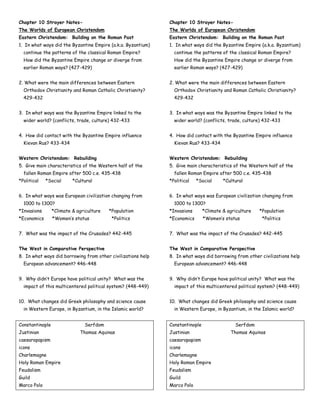
The document summarizes key aspects of Eastern and Western Christendom between 500-1300 CE. It discusses how the Byzantine Empire built upon Roman traditions while diverging in religion and governance. Eastern Orthodoxy differed from Catholicism in allowing marriage of clergy and recognizing the authority of the patriarch of Constantinople. The Byzantine Empire engaged in trade and spread its culture, influencing Kievan Rus. Western Europe fragmented after the fall of Rome, adopting feudalism and experiencing economic and population changes between 1000-1300 CE. The Crusades had cultural and political impacts on Europe and the Near East. Borrowing of knowledge from other civilizations supported advances in Western Europe.


![Ap Byzantine Empire[1]](https://cdn.slidesharecdn.com/ss_thumbnails/ap-byzantine-empire1-1232483765475404-1-thumbnail.jpg?width=640&height=640&fit=bounds)


