Aim :  How does Byzantine Art express the values of Byzantine culture and society? Do Now :  Evaluate the mosaic.  How did the Byzantines express their devotion to Jesus? How did their artistic methods differ from Roman society?
 
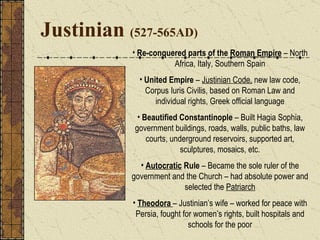
Justinian  (527-565AD) Re-conquered parts of the  Roman Empire  – North Africa, Italy, Southern Spain United Empire  –  Justinian Code,  new law code, Corpus Iuris Civilis, based on Roman Law and individual rights, Greek official language Beautified Constantinople  – Built Hagia Sophia, government buildings, roads, walls, public baths, law courts, underground reservoirs, supported art, sculptures, mosaics, etc. Autocratic  Rule  – Became the sole ruler of the government and the Church – had absolute power and selected the  Patriarch Theodora   – Justinian’s wife – worked for peace with Persia, fought for women’s rights, built hospitals and schools for the poor
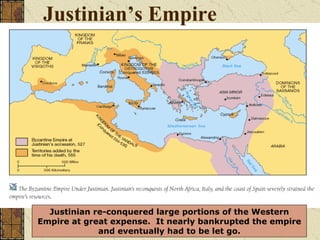
Justinian’s Empire Justinian re-conquered large portions of the Western Empire at great expense.  It nearly bankrupted the empire and eventually had to be let go.
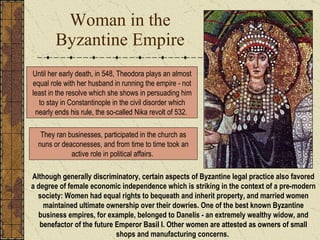
Woman in the Byzantine Empire Until her early death, in 548, Theodora plays an almost equal role with her husband in running the empire - not least in the resolve which she shows in persuading him to stay in Constantinople in the civil disorder which nearly ends his rule, the so-called Nika revolt of 532.  They ran businesses, participated in the church as nuns or deaconesses, and from time to time took an active role in political affairs.  Although generally discriminatory, certain aspects of Byzantine legal practice also favored a degree of female economic independence which is striking in the context of a pre-modern society: Women had equal rights to bequeath and inherit property, and married women maintained ultimate ownership over their dowries. One of the best known Byzantine business empires, for example, belonged to Danelis - an extremely wealthy widow, and benefactor of the future Emperor Basil I. Other women are attested as owners of small shops and manufacturing concerns.
The Orthodox Church
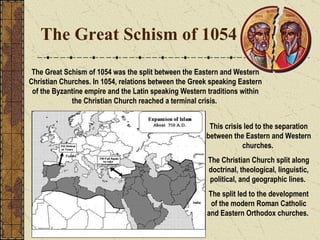
The Great Schism of 1054 The Great Schism of 1054 was the split between the Eastern and Western Christian Churches. In 1054, relations between the Greek speaking Eastern of the Byzantine empire and the Latin speaking Western traditions within the Christian Church reached a terminal crisis.  This crisis led to the separation between the Eastern and Western churches.  The Christian Church split along doctrinal, theological, linguistic, political, and geographic lines.  The split led to the development of the modern Roman Catholic and Eastern Orthodox churches.
The Orthodox Church Often referred to as the Eastern Church. Official language is Greek, but other languages are used as well including Ancient Syrian. Does not recognize the Pope as the ultimate authority for the Church on earth. There are four main patriarchs (bishops considered to be more important because the of the cities they are connected to): Constantinople, Alexandria, Antioch and Jerusalem. In some ways more mystical than the Roman Catholics.
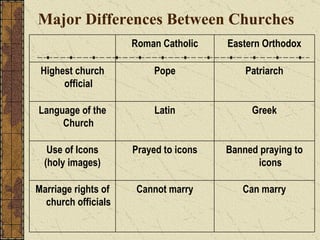
Major Differences Between Churches Roman Catholic Eastern Orthodox Highest church official Pope Patriarch Language of the Church Latin Greek Use of Icons (holy images) Prayed to icons Banned praying to icons Marriage rights of church officials Cannot marry Can marry
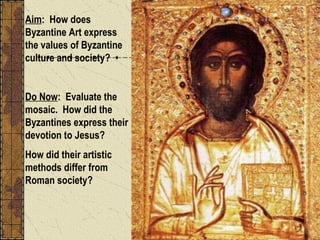
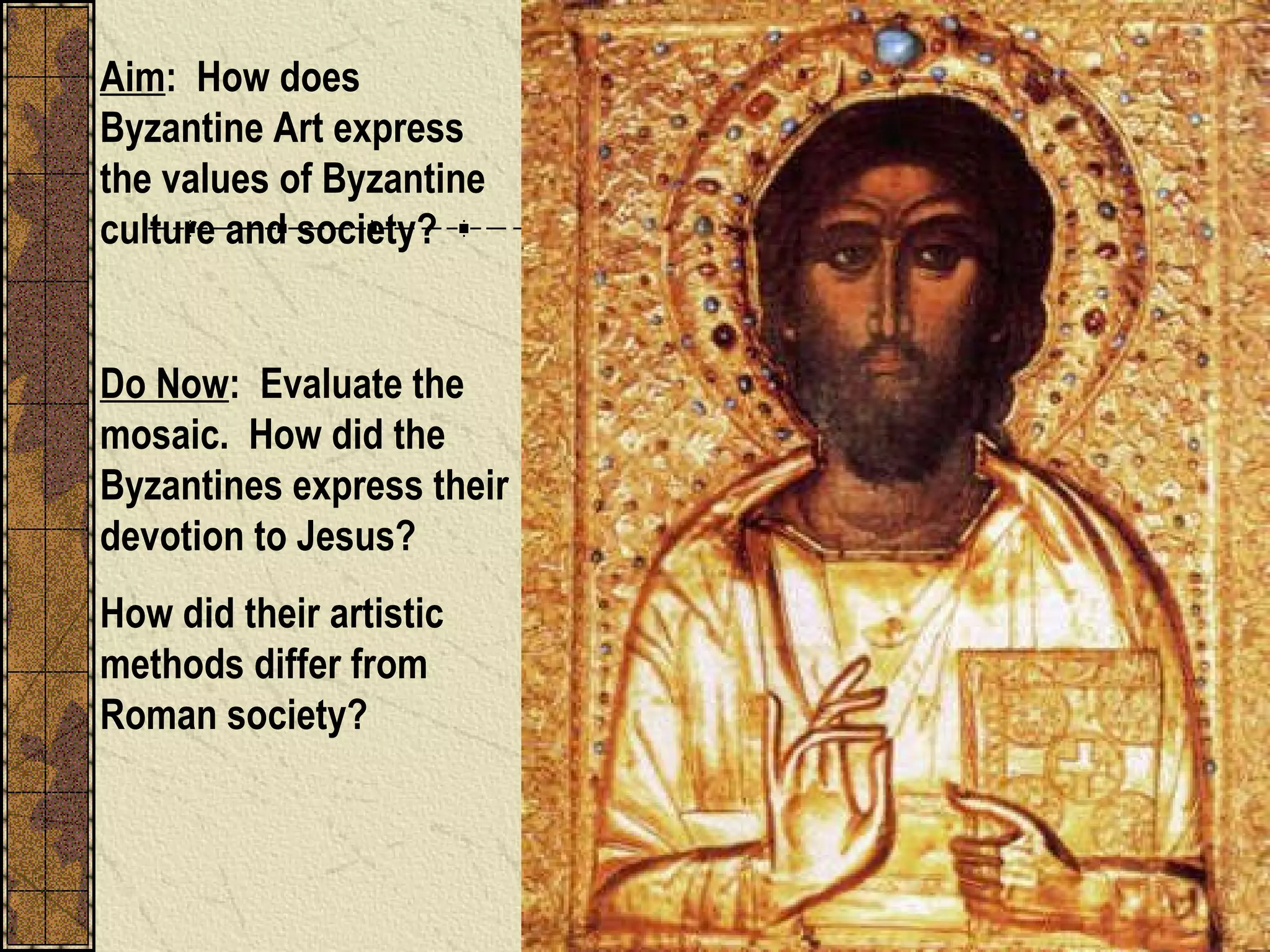
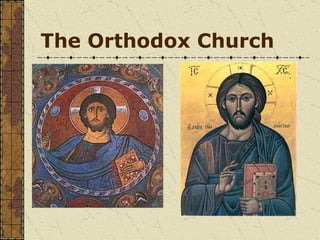
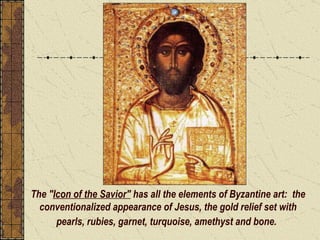
The " Icon of the Savior"  has all the elements of Byzantine art:  the conventionalized appearance of Jesus, the gold relief set with pearls, rubies, garnet, turquoise, amethyst and bone.
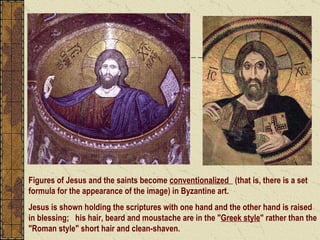
Figures of Jesus and the saints become  conventionalized   (that is, there is a set formula for the appearance of the image) in Byzantine art.   Jesus is shown holding the scriptures with one hand and the other hand is raised in blessing;  his hair, beard and moustache are in the " Greek style " rather than the "Roman style" short hair and clean-shaven.
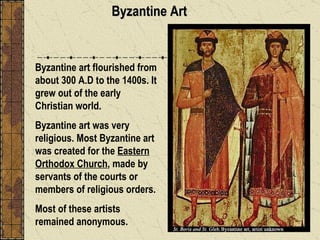
Byzantine art flourished from about 300 A.D to the 1400s. It grew out of the early Christian world.  Byzantine art was very religious. Most Byzantine art was created for the  Eastern Orthodox Church , made by servants of the courts or members of religious orders.  Most of these artists remained anonymous.   Byzantine Art
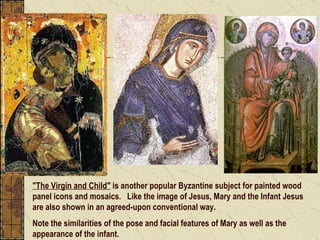
"The Virgin and Child"  is another popular Byzantine subject for painted wood panel icons and mosaics.  Like the image of Jesus, Mary and the Infant Jesus are also shown in an agreed-upon conventional way.   Note the similarities of the pose and facial features of Mary as well as the appearance of the infant.
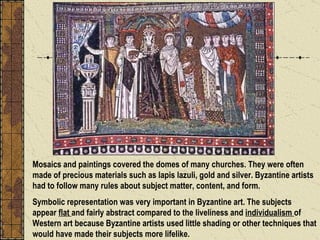
Mosaics and paintings covered the domes of many churches. They were often made of precious materials such as lapis lazuli, gold and silver. Byzantine artists had to follow many rules about subject matter, content, and form.  Symbolic representation was very important in Byzantine art. The subjects appear  flat  and fairly abstract compared to the liveliness and  individualism  of Western art because Byzantine artists used little shading or other techniques that would have made their subjects more lifelike.
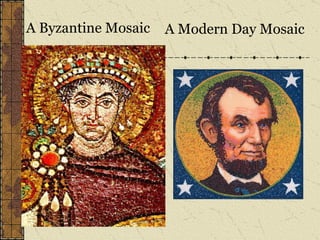
A Byzantine Mosaic A Modern Day Mosaic
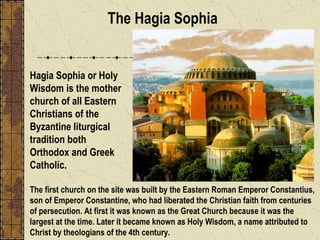
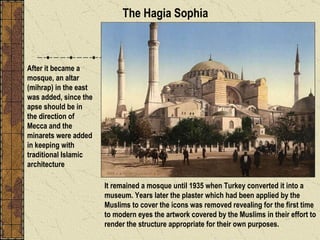
The first church on the site was built by the Eastern Roman Emperor Constantius, son of Emperor Constantine, who had liberated the Christian faith from centuries of persecution. At first it was known as the Great Church because it was the largest at the time. Later it became known as Holy Wisdom, a name attributed to Christ by theologians of the 4th century. Hagia Sophia or Holy Wisdom is the mother church of all Eastern Christians of the Byzantine liturgical tradition both Orthodox and Greek Catholic.  The Hagia Sophia
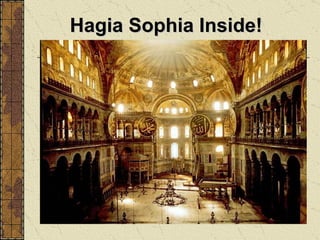
Hagia Sophia Inside!
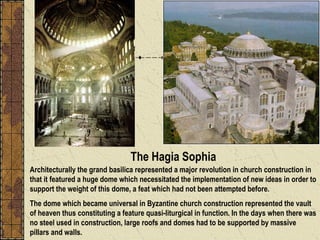
Architecturally the grand basilica represented a major revolution in church construction in that it featured a huge dome which necessitated the implementation of new ideas in order to support the weight of this dome, a feat which had not been attempted before.  The dome which became universal in Byzantine church construction represented the vault of heaven thus constituting a feature quasi-liturgical in function. In the days when there was no steel used in construction, large roofs and domes had to be supported by massive pillars and walls.  The Hagia Sophia
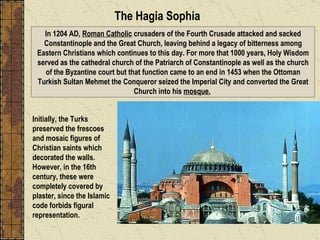
In 1204 AD,  Roman Catholic  crusaders of the Fourth Crusade attacked and sacked Constantinople and the Great Church, leaving behind a legacy of bitterness among Eastern Christians which continues to this day. For more that 1000 years, Holy Wisdom served as the cathedral church of the Patriarch of Constantinople as well as the church of the Byzantine court but that function came to an end in 1453 when the Ottoman Turkish Sultan Mehmet the Conqueror seized the Imperial City and converted the Great Church into his  mosque.   The Hagia Sophia Initially, the Turks preserved the frescoes and mosaic figures of Christian saints which decorated the walls. However, in the 16th century, these were completely covered by plaster, since the Islamic code forbids figural representation.
It remained a mosque until 1935 when Turkey converted it into a museum. Years later the plaster which had been applied by the Muslims to cover the icons was removed revealing for the first time to modern eyes the artwork covered by the Muslims in their effort to render the structure appropriate for their own purposes.  After it became a mosque, an altar (mihrap) in the east was added, since the apse should be in the direction of Mecca and the minarets were added in keeping with traditional Islamic architecture The Hagia Sophia
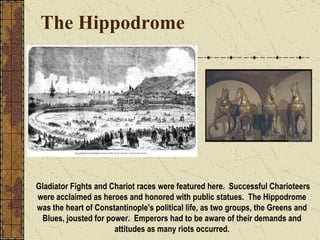
The Hippodrome Gladiator Fights and Chariot races were featured here.  Successful Charioteers were acclaimed as heroes and honored with public statues.  The Hippodrome was the heart of Constantinople's political life, as two groups, the Greens and Blues, jousted for power.  Emperors had to be aware of their demands and attitudes as many riots occurred.
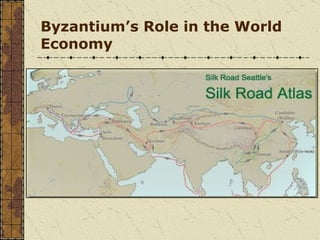
Byzantium’s Role in the World Economy
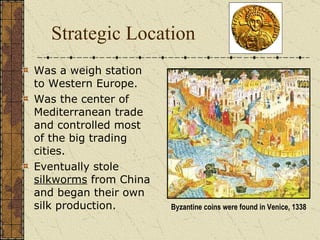
Strategic Location Was a weigh station to Western Europe. Was the center of Mediterranean trade and controlled most of the big trading cities. Eventually stole  silkworms  from China and began their own silk production.  Byzantine coins were found in Venice, 1338
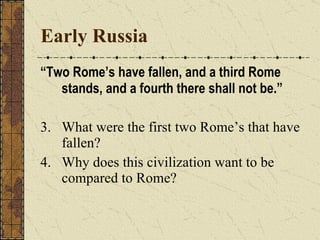
Early Russia “ Two Rome’s have fallen, and a third Rome stands, and a fourth there shall not be.” What were the first two Rome’s that have fallen? Why does this civilization want to be compared to Rome?
 
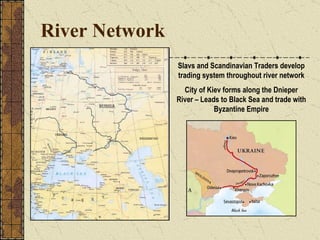
River Network Slavs and Scandinavian Traders develop trading system throughout river network City of Kiev forms along the Dnieper River – Leads to Black Sea and trade with Byzantine Empire
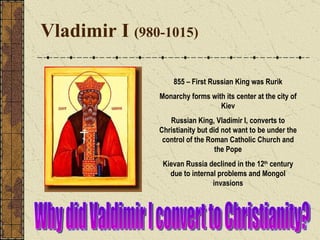
Vladimir I  (980-1015) 855 – First Russian King was Rurik Monarchy forms with its center at the city of Kiev Russian King, Vladimir I, converts to Christianity but did not want to be under the control of the Roman Catholic Church and the Pope Kievan Russia declined in the 12 th  century due to internal problems and Mongol invasions Why did Valdimir I convert to Christianity?
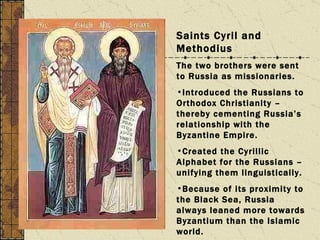
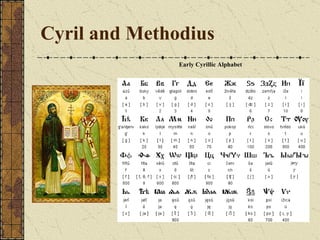
Saints Cyril and Methodius  The two brothers were sent to Russia as missionaries. Introduced the Russians to Orthodox Christianity – thereby cementing Russia’s relationship with the Byzantine Empire. Created the Cyrillic Alphabet for the Russians – unifying them linguistically. Because of its proximity to the Black Sea, Russia always leaned more towards Byzantium than the Islamic world.
Cyril and Methodius Early Cyrillic Alphabet
 
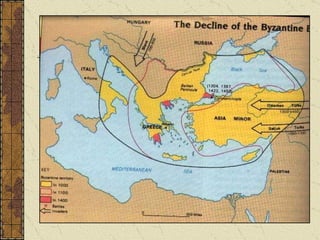
Reasons For Decline The  ____________  became too complex and inefficient.  Why complicated meaningless paperwork today is called “Byzantine”. Cost of defending borders became too expensive. Growing power and popularity of Islam. The Fourth Crusade – Sack of Constantinople in 1204 by the Latin Christians and Venetians.  __________ from Arabs, Persians and eventually the Turks (Seljuk and Ottoman) were too much. Ottoman gunpowder weapons destroyed Constantinople’s legendary walls and the empire came to an end in 1453. Bureaucracy Invasions
The Fourth Crusade 
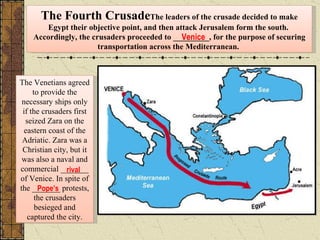
The leaders of the crusade decided to make Egypt their objective point, and then attack Jerusalem form the south.  Accordingly, the crusaders proceeded to _________, for the purpose of securing transportation across the Mediterranean.  The Venetians agreed to provide the necessary ships only if the crusaders first seized Zara on the eastern coast of the Adriatic. Zara was a Christian city, but it was also a naval and commercial _______ of Venice. In spite of the _______ protests, the crusaders besieged and captured the city. Venice rival Pope’s
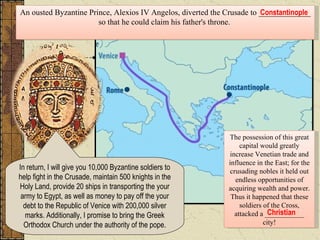
An ousted Byzantine Prince, Alexios IV Angelos, diverted the Crusade to _____________ so that he could claim his father's throne.  In return, I will give you 10,000 Byzantine soldiers to help fight in the Crusade, maintain 500 knights in the Holy Land, provide 20 ships in transporting the your army to Egypt, as well as money to pay off the your debt to the Republic of Venice with 200,000 silver marks. Additionally, I promise to bring the Greek Orthodox Church under the authority of the pope. The possession of this great capital would greatly increase Venetian trade and influence in the East; for the crusading nobles it held out endless opportunities of acquiring wealth and power. Thus it happened that these soldiers of the Cross, attacked a ___________ city! Constantinople Christian
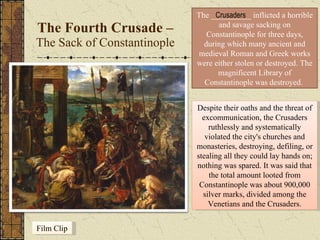
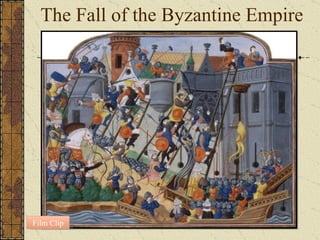
The Fourth Crusade –  The Sack of Constantinople Film Clip Despite their oaths and the threat of excommunication, the Crusaders ruthlessly and systematically violated the city's churches and monasteries, destroying, defiling, or stealing all they could lay hands on; nothing was spared. It was said that the total amount looted from Constantinople was about 900,000 silver marks, divided among the Venetians and the Crusaders. The __________ inflicted a horrible and savage sacking on Constantinople for three days, during which many ancient and medieval Roman and Greek works were either stolen or destroyed. The magnificent Library of Constantinople was destroyed.  Crusaders
Primary Sources No one was without a share in the grief. In the alleys, in the streets, in the temples, complaints, weeping, lamentations, grief, the groaning of men, the shrieks of women, wounds, rape, captivity, the separation of those most closely united. Nobles wandered about ignominiously [shamefully], those of venerable age in tears, the rich in poverty. Thus it was in the streets, on the corners, in the temple, in the dens, for no place remained unassailed or defended the suppliants. All places everywhere were filled full of all kinds of crime. Oh, immortal God, how great the afflictions of the men, how great the distress! Below is a Byzantine account of the sack of Constantinople by Nicetas Chroniates. Then the bishops preached to the army, … and they showed to the pilgrims that the war was a righteous one; for the Greeks were traitors and murderers, and also disloyal, since they had murdered their rightful lord.  Moreover, the bishops said that, by the authority of God and in the name of the pope, they would absolve all who attacked the Greeks. Then the bishops commanded the pilgrims to confess their sins and receive the communion devoutly; and said that they ought not to hesitate to attack the Greeks, for the latter were enemies of God.  Robert of Clari of the sermons given by the Latin bishops before the final attack on Constantinople Document #1 Document #2
 
Film Clip The Fall of the Byzantine Empire
 

Byzantine Empire

  • 1.
    Aim : How does Byzantine Art express the values of Byzantine culture and society? Do Now : Evaluate the mosaic. How did the Byzantines express their devotion to Jesus? How did their artistic methods differ from Roman society?
  • 2.
  • 3.
    Justinian (527-565AD)Re-conquered parts of the Roman Empire – North Africa, Italy, Southern Spain United Empire – Justinian Code, new law code, Corpus Iuris Civilis, based on Roman Law and individual rights, Greek official language Beautified Constantinople – Built Hagia Sophia, government buildings, roads, walls, public baths, law courts, underground reservoirs, supported art, sculptures, mosaics, etc. Autocratic Rule – Became the sole ruler of the government and the Church – had absolute power and selected the Patriarch Theodora – Justinian’s wife – worked for peace with Persia, fought for women’s rights, built hospitals and schools for the poor
  • 4.
    Justinian’s Empire Justinianre-conquered large portions of the Western Empire at great expense. It nearly bankrupted the empire and eventually had to be let go.
  • 5.
    Woman in theByzantine Empire Until her early death, in 548, Theodora plays an almost equal role with her husband in running the empire - not least in the resolve which she shows in persuading him to stay in Constantinople in the civil disorder which nearly ends his rule, the so-called Nika revolt of 532. They ran businesses, participated in the church as nuns or deaconesses, and from time to time took an active role in political affairs. Although generally discriminatory, certain aspects of Byzantine legal practice also favored a degree of female economic independence which is striking in the context of a pre-modern society: Women had equal rights to bequeath and inherit property, and married women maintained ultimate ownership over their dowries. One of the best known Byzantine business empires, for example, belonged to Danelis - an extremely wealthy widow, and benefactor of the future Emperor Basil I. Other women are attested as owners of small shops and manufacturing concerns.
  • 6.
  • 7.
    The Great Schismof 1054 The Great Schism of 1054 was the split between the Eastern and Western Christian Churches. In 1054, relations between the Greek speaking Eastern of the Byzantine empire and the Latin speaking Western traditions within the Christian Church reached a terminal crisis. This crisis led to the separation between the Eastern and Western churches. The Christian Church split along doctrinal, theological, linguistic, political, and geographic lines. The split led to the development of the modern Roman Catholic and Eastern Orthodox churches.
  • 8.
    The Orthodox ChurchOften referred to as the Eastern Church. Official language is Greek, but other languages are used as well including Ancient Syrian. Does not recognize the Pope as the ultimate authority for the Church on earth. There are four main patriarchs (bishops considered to be more important because the of the cities they are connected to): Constantinople, Alexandria, Antioch and Jerusalem. In some ways more mystical than the Roman Catholics.
  • 9.
    Major Differences BetweenChurches Roman Catholic Eastern Orthodox Highest church official Pope Patriarch Language of the Church Latin Greek Use of Icons (holy images) Prayed to icons Banned praying to icons Marriage rights of church officials Cannot marry Can marry
  • 10.
    The " Iconof the Savior" has all the elements of Byzantine art:  the conventionalized appearance of Jesus, the gold relief set with pearls, rubies, garnet, turquoise, amethyst and bone.
  • 11.
    Figures of Jesusand the saints become conventionalized  (that is, there is a set formula for the appearance of the image) in Byzantine art.  Jesus is shown holding the scriptures with one hand and the other hand is raised in blessing;  his hair, beard and moustache are in the " Greek style " rather than the "Roman style" short hair and clean-shaven.
  • 12.
    Byzantine art flourishedfrom about 300 A.D to the 1400s. It grew out of the early Christian world. Byzantine art was very religious. Most Byzantine art was created for the Eastern Orthodox Church , made by servants of the courts or members of religious orders. Most of these artists remained anonymous. Byzantine Art
  • 13.
    "The Virgin andChild" is another popular Byzantine subject for painted wood panel icons and mosaics.  Like the image of Jesus, Mary and the Infant Jesus are also shown in an agreed-upon conventional way.  Note the similarities of the pose and facial features of Mary as well as the appearance of the infant.
  • 14.
    Mosaics and paintingscovered the domes of many churches. They were often made of precious materials such as lapis lazuli, gold and silver. Byzantine artists had to follow many rules about subject matter, content, and form. Symbolic representation was very important in Byzantine art. The subjects appear flat and fairly abstract compared to the liveliness and individualism of Western art because Byzantine artists used little shading or other techniques that would have made their subjects more lifelike.
  • 15.
    A Byzantine MosaicA Modern Day Mosaic
  • 16.
    The first churchon the site was built by the Eastern Roman Emperor Constantius, son of Emperor Constantine, who had liberated the Christian faith from centuries of persecution. At first it was known as the Great Church because it was the largest at the time. Later it became known as Holy Wisdom, a name attributed to Christ by theologians of the 4th century. Hagia Sophia or Holy Wisdom is the mother church of all Eastern Christians of the Byzantine liturgical tradition both Orthodox and Greek Catholic. The Hagia Sophia
  • 17.
  • 18.
    Architecturally the grandbasilica represented a major revolution in church construction in that it featured a huge dome which necessitated the implementation of new ideas in order to support the weight of this dome, a feat which had not been attempted before. The dome which became universal in Byzantine church construction represented the vault of heaven thus constituting a feature quasi-liturgical in function. In the days when there was no steel used in construction, large roofs and domes had to be supported by massive pillars and walls. The Hagia Sophia
  • 19.
    In 1204 AD, Roman Catholic crusaders of the Fourth Crusade attacked and sacked Constantinople and the Great Church, leaving behind a legacy of bitterness among Eastern Christians which continues to this day. For more that 1000 years, Holy Wisdom served as the cathedral church of the Patriarch of Constantinople as well as the church of the Byzantine court but that function came to an end in 1453 when the Ottoman Turkish Sultan Mehmet the Conqueror seized the Imperial City and converted the Great Church into his mosque. The Hagia Sophia Initially, the Turks preserved the frescoes and mosaic figures of Christian saints which decorated the walls. However, in the 16th century, these were completely covered by plaster, since the Islamic code forbids figural representation.
  • 20.
    It remained amosque until 1935 when Turkey converted it into a museum. Years later the plaster which had been applied by the Muslims to cover the icons was removed revealing for the first time to modern eyes the artwork covered by the Muslims in their effort to render the structure appropriate for their own purposes. After it became a mosque, an altar (mihrap) in the east was added, since the apse should be in the direction of Mecca and the minarets were added in keeping with traditional Islamic architecture The Hagia Sophia
  • 21.
    The Hippodrome GladiatorFights and Chariot races were featured here. Successful Charioteers were acclaimed as heroes and honored with public statues. The Hippodrome was the heart of Constantinople's political life, as two groups, the Greens and Blues, jousted for power. Emperors had to be aware of their demands and attitudes as many riots occurred.
  • 22.
    Byzantium’s Role inthe World Economy
  • 23.
    Strategic Location Wasa weigh station to Western Europe. Was the center of Mediterranean trade and controlled most of the big trading cities. Eventually stole silkworms from China and began their own silk production. Byzantine coins were found in Venice, 1338
  • 24.
    Early Russia “Two Rome’s have fallen, and a third Rome stands, and a fourth there shall not be.” What were the first two Rome’s that have fallen? Why does this civilization want to be compared to Rome?
  • 25.
  • 26.
    River Network Slavsand Scandinavian Traders develop trading system throughout river network City of Kiev forms along the Dnieper River – Leads to Black Sea and trade with Byzantine Empire
  • 27.
    Vladimir I (980-1015) 855 – First Russian King was Rurik Monarchy forms with its center at the city of Kiev Russian King, Vladimir I, converts to Christianity but did not want to be under the control of the Roman Catholic Church and the Pope Kievan Russia declined in the 12 th century due to internal problems and Mongol invasions Why did Valdimir I convert to Christianity?
  • 28.
    Saints Cyril andMethodius The two brothers were sent to Russia as missionaries. Introduced the Russians to Orthodox Christianity – thereby cementing Russia’s relationship with the Byzantine Empire. Created the Cyrillic Alphabet for the Russians – unifying them linguistically. Because of its proximity to the Black Sea, Russia always leaned more towards Byzantium than the Islamic world.
  • 29.
    Cyril and MethodiusEarly Cyrillic Alphabet
  • 30.
  • 31.
    Reasons For DeclineThe ____________ became too complex and inefficient. Why complicated meaningless paperwork today is called “Byzantine”. Cost of defending borders became too expensive. Growing power and popularity of Islam. The Fourth Crusade – Sack of Constantinople in 1204 by the Latin Christians and Venetians. __________ from Arabs, Persians and eventually the Turks (Seljuk and Ottoman) were too much. Ottoman gunpowder weapons destroyed Constantinople’s legendary walls and the empire came to an end in 1453. Bureaucracy Invasions
  • 32.
    The Fourth Crusade
The leaders of the crusade decided to make Egypt their objective point, and then attack Jerusalem form the south. Accordingly, the crusaders proceeded to _________, for the purpose of securing transportation across the Mediterranean. The Venetians agreed to provide the necessary ships only if the crusaders first seized Zara on the eastern coast of the Adriatic. Zara was a Christian city, but it was also a naval and commercial _______ of Venice. In spite of the _______ protests, the crusaders besieged and captured the city. Venice rival Pope’s
  • 33.
    An ousted ByzantinePrince, Alexios IV Angelos, diverted the Crusade to _____________ so that he could claim his father's throne. In return, I will give you 10,000 Byzantine soldiers to help fight in the Crusade, maintain 500 knights in the Holy Land, provide 20 ships in transporting the your army to Egypt, as well as money to pay off the your debt to the Republic of Venice with 200,000 silver marks. Additionally, I promise to bring the Greek Orthodox Church under the authority of the pope. The possession of this great capital would greatly increase Venetian trade and influence in the East; for the crusading nobles it held out endless opportunities of acquiring wealth and power. Thus it happened that these soldiers of the Cross, attacked a ___________ city! Constantinople Christian
  • 34.
    The Fourth Crusade– The Sack of Constantinople Film Clip Despite their oaths and the threat of excommunication, the Crusaders ruthlessly and systematically violated the city's churches and monasteries, destroying, defiling, or stealing all they could lay hands on; nothing was spared. It was said that the total amount looted from Constantinople was about 900,000 silver marks, divided among the Venetians and the Crusaders. The __________ inflicted a horrible and savage sacking on Constantinople for three days, during which many ancient and medieval Roman and Greek works were either stolen or destroyed. The magnificent Library of Constantinople was destroyed. Crusaders
  • 35.
    Primary Sources Noone was without a share in the grief. In the alleys, in the streets, in the temples, complaints, weeping, lamentations, grief, the groaning of men, the shrieks of women, wounds, rape, captivity, the separation of those most closely united. Nobles wandered about ignominiously [shamefully], those of venerable age in tears, the rich in poverty. Thus it was in the streets, on the corners, in the temple, in the dens, for no place remained unassailed or defended the suppliants. All places everywhere were filled full of all kinds of crime. Oh, immortal God, how great the afflictions of the men, how great the distress! Below is a Byzantine account of the sack of Constantinople by Nicetas Chroniates. Then the bishops preached to the army, … and they showed to the pilgrims that the war was a righteous one; for the Greeks were traitors and murderers, and also disloyal, since they had murdered their rightful lord. Moreover, the bishops said that, by the authority of God and in the name of the pope, they would absolve all who attacked the Greeks. Then the bishops commanded the pilgrims to confess their sins and receive the communion devoutly; and said that they ought not to hesitate to attack the Greeks, for the latter were enemies of God. Robert of Clari of the sermons given by the Latin bishops before the final attack on Constantinople Document #1 Document #2
  • 36.
  • 37.
    Film Clip TheFall of the Byzantine Empire
  • 38.