
Rome and the Byzantine Empire
     Copy the underlined facts.


                                  Mr. Bluma
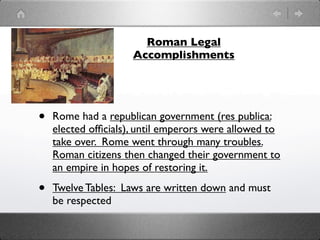
Roman Legal
                     Accomplishments


•   Rome had a republican government (res publica:
    elected officials), until emperors were allowed to
    take over. Rome went through many troubles.
    Roman citizens then changed their government to
    an empire in hopes of restoring it.

•   Twelve Tables: Laws are written down and must
    be respected
Roman Legal
                Accomplishments
                   continued

•   The Founding Fathers of America planned our
    government and copied many Roman elements.
    Like the Romans, we elect our leaders: the
    congress, governors, mayors, etc. The president;
    however, is not elected. The electoral college, a
    group of electors from each state choose the
    president. The supreme court is appointed by the
    president. Like the Romans our government has
    three branches-the president, congress, and courts.
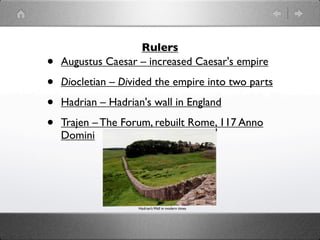
Rulers
•   Augustus Caesar – increased Caesar's empire

•   Diocletian – Divided the empire into two parts

•   Hadrian – Hadrian's wall in England

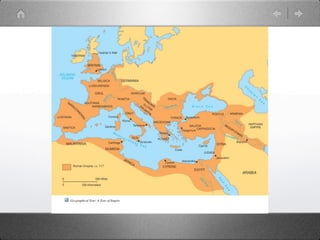
•   Trajen – The Forum, rebuilt Rome, 117 Anno
    Domini


                    Hadrian’s Wall in modern times
Art/Architecture

• Hellenistic (meaning “Greek inspired”)
• Pantheon – first dome
• Roman Arch
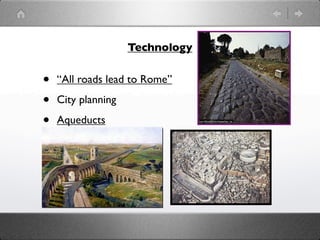
Technology


•   “All roads lead to Rome”

•   City planning

•   Aqueducts
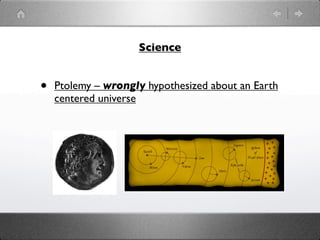
Science


•   Ptolemy – wrongly hypothesized about an Earth
    centered universe
Language


• Latin: the language of Rome
• French, Italian, Spanish, and Portuguese
Decline of Rome

•   Long period of decline

•   Example: at one point they had 22 emperors over
    a 50 year period, 20 died violently

•   Persians and Germans move into empire

•   Hired Germanic soldiers = who had no loyalty to
    Rome and did not understand tradition

•   Overall decline in society, morals, education,
    business
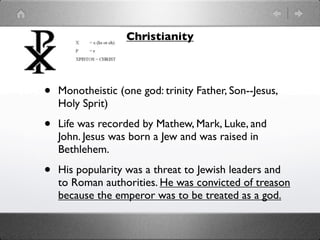
Christianity


•   Monotheistic (one god: trinity Father, Son--Jesus,
    Holy Sprit)

•   Life was recorded by Mathew, Mark, Luke, and
    John. Jesus was born a Jew and was raised in
    Bethlehem.

•   His popularity was a threat to Jewish leaders and
    to Roman authorities. He was convicted of treason
    because the emperor was to be treated as a god.
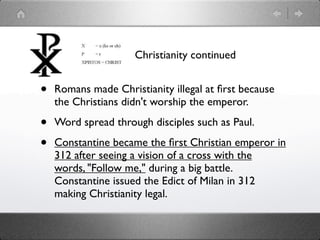
Christianity continued


•   Romans made Christianity illegal at first because
    the Christians didn't worship the emperor.

•   Word spread through disciples such as Paul.

•   Constantine became the first Christian emperor in
    312 after seeing a vision of a cross with the
    words, "Follow me," during a big battle.
    Constantine issued the Edict of Milan in 312
    making Christianity legal.
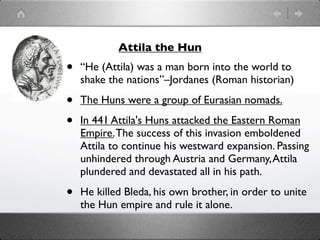
Attila the Hun
•   “He (Attila) was a man born into the world to
    shake the nations”–Jordanes (Roman historian)

•   The Huns were a group of Eurasian nomads.

•   In 441 Attila's Huns attacked the Eastern Roman
    Empire. The success of this invasion emboldened
    Attila to continue his westward expansion. Passing
    unhindered through Austria and Germany, Attila
    plundered and devastated all in his path.

•   He killed Bleda, his own brother, in order to unite
    the Hun empire and rule it alone.
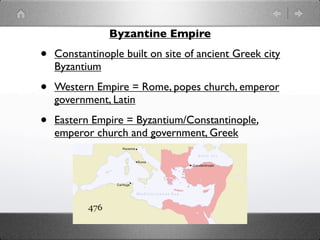
Byzantine Empire

•   Constantinople built on site of ancient Greek city
    Byzantium

•   Western Empire = Rome, popes church, emperor
    government, Latin

•   Eastern Empire = Byzantium/Constantinople,
    emperor church and government, Greek
America Today
                  (Copy any three or more facts below)

•   Unemployment 8.1 to 10.5%--Reuters.com

•   Americans’ addiction to entertainment has been compared to the bread and
    circuses of Rome (Latin: panem et circenses)--Bloomberg columnist Alice Schroeder

•   The crime rate has decreased dramatically--Economist.com

•   Charitable giving is up--Economist.com

•   76% of Americans say moral values in the United States are getting worse--
    Gallup.com


•   U.S. National Debt is over 16 trillion dollars ($16, 000, 000, 000, 000)

•   The foundations of U.S. economic freedom remain strong--heritage.com

•   The regulatory burden on business continues to increase rapidly--heritage.com

•   American students rank 31/141 nations in education performance--Edweek.org
Academic Reminders


           - Replace negative thinking with positive thoughts.
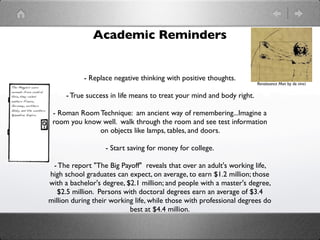
                                                                       Renaissance Man by da vinci

     - True success in life means to treat your mind and body right.

 - Roman Room Technique: am ancient way of remembering...Imagine a
 room you know well. walk through the room and see test information
              on objects like lamps, tables, and doors.

                   - Start saving for money for college.

 - The report "The Big Payoff"  reveals that over an adult's working life,
high school graduates can expect, on average, to earn $1.2 million; those
with a bachelor's degree, $2.1 million; and people with a master's degree,
   $2.5 million.  Persons with doctoral degrees earn an average of $3.4
million during their working life, while those with professional degrees do
                            best at $4.4 million.

Rome and Byzantine Empire

  • 1.
    Rome and theByzantine Empire Copy the underlined facts. Mr. Bluma
  • 3.
    Roman Legal Accomplishments • Rome had a republican government (res publica: elected officials), until emperors were allowed to take over. Rome went through many troubles. Roman citizens then changed their government to an empire in hopes of restoring it. • Twelve Tables: Laws are written down and must be respected
  • 4.
    Roman Legal Accomplishments continued • The Founding Fathers of America planned our government and copied many Roman elements. Like the Romans, we elect our leaders: the congress, governors, mayors, etc. The president; however, is not elected. The electoral college, a group of electors from each state choose the president. The supreme court is appointed by the president. Like the Romans our government has three branches-the president, congress, and courts.
  • 5.
    Rulers • Augustus Caesar – increased Caesar's empire • Diocletian – Divided the empire into two parts • Hadrian – Hadrian's wall in England • Trajen – The Forum, rebuilt Rome, 117 Anno Domini Hadrian’s Wall in modern times
  • 6.
    Art/Architecture • Hellenistic (meaning“Greek inspired”) • Pantheon – first dome • Roman Arch
  • 7.
    Technology • “All roads lead to Rome” • City planning • Aqueducts
  • 8.
    Science • Ptolemy – wrongly hypothesized about an Earth centered universe
  • 9.
    Language • Latin: thelanguage of Rome • French, Italian, Spanish, and Portuguese
  • 10.
    Decline of Rome • Long period of decline • Example: at one point they had 22 emperors over a 50 year period, 20 died violently • Persians and Germans move into empire • Hired Germanic soldiers = who had no loyalty to Rome and did not understand tradition • Overall decline in society, morals, education, business
  • 11.
    Christianity • Monotheistic (one god: trinity Father, Son--Jesus, Holy Sprit) • Life was recorded by Mathew, Mark, Luke, and John. Jesus was born a Jew and was raised in Bethlehem. • His popularity was a threat to Jewish leaders and to Roman authorities. He was convicted of treason because the emperor was to be treated as a god.
  • 12.
    Christianity continued • Romans made Christianity illegal at first because the Christians didn't worship the emperor. • Word spread through disciples such as Paul. • Constantine became the first Christian emperor in 312 after seeing a vision of a cross with the words, "Follow me," during a big battle. Constantine issued the Edict of Milan in 312 making Christianity legal.
  • 13.
    Attila the Hun • “He (Attila) was a man born into the world to shake the nations”–Jordanes (Roman historian) • The Huns were a group of Eurasian nomads. • In 441 Attila's Huns attacked the Eastern Roman Empire. The success of this invasion emboldened Attila to continue his westward expansion. Passing unhindered through Austria and Germany, Attila plundered and devastated all in his path. • He killed Bleda, his own brother, in order to unite the Hun empire and rule it alone.
  • 14.
    Byzantine Empire • Constantinople built on site of ancient Greek city Byzantium • Western Empire = Rome, popes church, emperor government, Latin • Eastern Empire = Byzantium/Constantinople, emperor church and government, Greek
  • 15.
    America Today (Copy any three or more facts below) • Unemployment 8.1 to 10.5%--Reuters.com • Americans’ addiction to entertainment has been compared to the bread and circuses of Rome (Latin: panem et circenses)--Bloomberg columnist Alice Schroeder • The crime rate has decreased dramatically--Economist.com • Charitable giving is up--Economist.com • 76% of Americans say moral values in the United States are getting worse-- Gallup.com • U.S. National Debt is over 16 trillion dollars ($16, 000, 000, 000, 000) • The foundations of U.S. economic freedom remain strong--heritage.com • The regulatory burden on business continues to increase rapidly--heritage.com • American students rank 31/141 nations in education performance--Edweek.org
  • 16.
    Academic Reminders - Replace negative thinking with positive thoughts. Renaissance Man by da vinci - True success in life means to treat your mind and body right. - Roman Room Technique: am ancient way of remembering...Imagine a room you know well. walk through the room and see test information on objects like lamps, tables, and doors. - Start saving for money for college. - The report "The Big Payoff"  reveals that over an adult's working life, high school graduates can expect, on average, to earn $1.2 million; those with a bachelor's degree, $2.1 million; and people with a master's degree, $2.5 million.  Persons with doctoral degrees earn an average of $3.4 million during their working life, while those with professional degrees do best at $4.4 million.