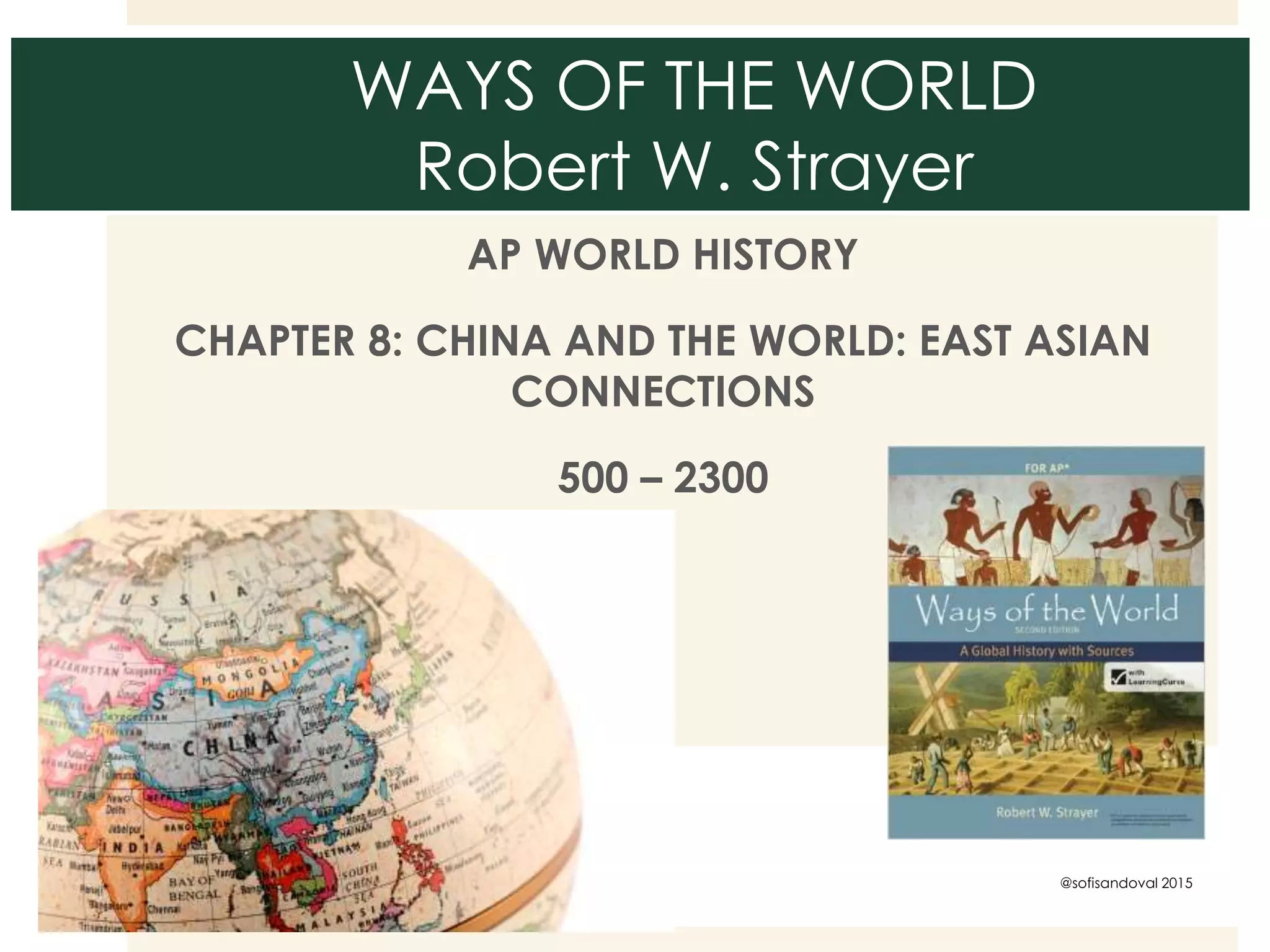
WAYS OF THE WORLD
Robert W. Strayer
AP WORLD HISTORY
CHAPTER 8: CHINA AND THE WORLD: EAST ASIAN
CONNECTIONS
500 – 2300
@sofisandoval 2015
The reemergence of unified China
 Chinese history has often been viewed in the Est as
impressive perhaprs, but largely static or changeless and self
contained or ilsolated.
 The collapse of the Han dynasty ushered in more than 3
centuries of political fragmentation in China and signaled
the rise of powerful and locally entrenched aristocratic
families.
 Chinese migration southward toward the Yangzi river valley
(because of political fragmentation) = created disunity,
discredited confucianism and opened the door to a greater
acceptance of Buddhsm and Daoism among the elite.
A “Golden Age” of Chinese
Achievement
 China regained its unity under the Sui dynasty, its emperors
solidified that unity by a vast extension of the country´s canal
system. The canals linked northern and southern China and
contribuited much to the prosperity that followed.
 Nevertheless, the Sui emperors campaign to conquer Korea
exhausted the state´s resources and soon the dynasty was
overthrown. = desintegration of the Chinese state.
 The Tang and the Song dynasty renewed unity. = “golden age”
of arts and literature, poetry, landscape painting, ceramics.
Particularly the Song dynasty and also gave rise to Neo-
Confucianism (incorporating thoughts of Buddhism and
Daoism).
TANG AND SONG DYNASTIES STATE
STRUCTURE
 Six major ministries:
 Personnel, Finance, rites, army,
justice and public works.
 Regulated by a Censorate
(agency of surveillance over each
ministry)
 The examination system was
revived
 Rigorous exams- central figure
upper class life. Substantial
percentage positions went to the
sons of the privileged (had
education and preparation for
exams).
 Ability to print books for the first
time in the world history.
Economic Revolution – Song Dynasty
 China´s prosperity was its rapid growth in population,
jumped from 50 million during the Tang dynasty to 120
million by 1200!
 China was the most urbanized country in the world. Song
dynasty capital Hangzhou was home to more than a million
people.
 Marco Polo describes Hangzhou “beyond dispute the finest
and noblest city in the world”
 China´s iron industry increased its input dramatically.- by
11th century 32,000 suits of armor, 16 million arrowheads,
coins, tools, construction material.
Women in the Song Dynasty
 The “Golden Age” for the song dynasty
in China was perhaps less than
“golden” for many of its women.
 The patriarchal restrictions on women
were tighten. To restore some of the
earlier Han dynasty notions of female
submission and passivity.
 Confucian writers highlighted the
suborditaion of women to men and the
need to keep males and females
separate in every domain of life. A
song historian wrote “The boy leads the
girls, and the girl must follow”.
 The most compelling expression of
tightening patriarchy lay in the foot
binding. Among dancers and
courtesans in the 11th century this
practice involved tight wrapping of
youngs girl´s feet, usually breaking the
bones.
Foot binding
 Many mothers imposed this painful
procedure on their daughters, to
enhance marriage prospects and assist
them in competing with concubines.
 Foot binding also served to distinguish
Chinese women from their “barbarian”
cunterparts and elite women from
commoners and peasants.
 Women still grew silk worms, but lost the
more lucrative income generating
world of weaving silk fabrics. Men took
controll of skilled tasks on textiles.
 https://youtu.be/P56LAPlFfgk?list=PLo1Z
1rDpsUOKyZhhpTUxqXD3CrhO6t5xD
China and the Northern Nomads
 China´s most enduring and intense
interaction with foreigners lay to the north,
involving nomadic pastoral people.
Nomads focused their economies on
raising livestock (sheep, cattle, goats) and
the mastery of horse riding.
 These nomads organized in kinship groups,
tribes – created larger states powerful
because of their impressive horsemanship
and military skills (male societies).
 These nomads were drawn to China
(trading).
 Chinese built Great Wall to keep nomads
out.
 But needed the nomads (horses, furs,
amber, skins valuable to China).
The Tribute System
 China´s relationship with these people
(nomads) known as the “tribute
system”. Foreigners seeking access to
China had to send a delegation to the
chinese court, where they would
perform a “Kowtow”, series of rituals
bowings and prostrations, and present
their tribute.
 In return of these expressions of
submission, he would grant permission
for foreigners to trade in China´s rich
markets.
 These attempted to regulate their
relationships with northern nomads and
neighbouring states such as Korea,
Vietman, Tibet.
Tribute System in Practice
 Xiongnu – Nomadic confederency was
the largest reaching from Manchuria to
Central Asia. – Persuaded the Chinese
emperor to negotiate an arrangement
that recognized the nomadic state as
political equal.
 Promised its leader a princess in
marriage, and most important to agreed
to supply him annually with large
quantities of grain, wine and silk.
 The Xiongnu agreed to refrain from
military incursions into China.
 Steppe nomads were generally not
much interested in actually conquering
and ruling China. Its was easier and more
profitable to extort goods from
fuctioning.
Cultural Influence across an
Ecological Frontier
 When nomadic peoples actually ruled parts of China, some of
them adopted Chinese ways, employing Chinese advisers,
governing according to Chinese practices.
 Northern people learned to speak Chinese, wore Chinese
clothing, married Chinese wives. But in contrast with the South
who were gradually abosorbed by the Chinese culture.
 The founders of the Sui and Tang dynasties were in fact a
mixed nomad and Chinese ancestry.
Korea and China
 Chinese conquest of northern Korea
during the Han dynasty and some
colonization by chinese settlers
provided an initial channel for Chinese
cultural influence, particularly in the
form of Buddhism.
 The Silla kingdom alliied with Tang
dynasty China to bring some political
unity to the peninsula for the first time.
But Chinese efforts to have puppet
regimes provoked sharp military
resistance.
 The Silla, Koryo and Yi kingdoms in Korea
generally maintained its political
independence while participating in
China´s tribute system.
Korea and China: Influences
 Capital city of Kumsong was modeled on the Chinese capital
of Chang´an.
 Tribute missions also enabled both official and private trade,
mostly luxury goods and clothing (silk).
 Thousands of Korean were sent to China to study
(confucianism, arts and sciences). Also Buddhists monks visited
learning centers and pilgrimage to China.
 These efforts to plant Confucian values in Chinese culture in
Korea had what one scholar has called an “overwelmingly
negative” impact on Korean women.
WOMEN IN KOREA – CHINESE
INFLUENCE
 Chinese observers noticed and
strongly disapproved of “free choice”
marriages in Korea as well as the
practice of women singing and
dancing.
 Korean women generally gave birth
and went to their parents home to
take care of the baby (joined by
husband), this was strongly
discouraged (offensive for Confucian
orthodoxy) since a married woman
belong to her husband´s family.
KOREA
 Korea remained Korea, after 688 C.E
the countrys´political independence
though periodically threatened was
largely intact. Chinese cultural influence
had little impact beyond aristocracy
and certainly did not penetrate the
lives of Korea´s serf-peasants.
 The examination system never assumed
the prominence, and the Korea´s
aristocratic class was able maintaing an
even stronger monopoly on
bureaucratic office.
 Korea moved toward a greater cultural
independence by developing a
phonetic alphabet, known as HANGUL,
for writing Korean language.
VIETNAM AND CHINA
 As in Korea, the elite culture of Vietnam borrowed
heavily from China. Adopting Confucianism, Daoism,
Administrative techniques, and the examinaton system.
 The heavy pressure of Chinese presence generated
not only a Vietnamese elite schooled in Chinese
culture but also periodic rebellions.
 The weakening of the Tang dynasty (China) enabled
large rebellions to established Vietnam a separate
state.
 Nevertheless, Vietnamese dynasties found Chinese
approach to government useful and established an
aristocracy /examination system.
 Vietnamese elite deeply commited to Chinese culture.
 Vietman retained a greater role for women in social
and economic life, despite heavy chinese influence.
JAPAN AND CHINA
 Unlike Korea and Vietnam, Japan was physically
separated from China by 1000 miles and more of
ocean. This allowed that never successfully
invaded or conquered it.
 Japan´s extensive borrowing from Chinese
civilization was wholly voluntary.
 The inital leader of this borrowing was Shotoku
Taishi. He lauched a series of large scale missions
to China, which took hundreds of Japanese
monks, scholars, artists, students to China. When
they returened they put in practice what they
learned.
 Japanese ruler proclaimed himself as an emperor
(chinese style), encouraging Buddhism and
Confucianism.
 Japanese adopted the Chinese calendar and
Chinese tazation system, and government
ministries. Cities (2 capitals, Kyoto and Nara
modeled on Chinese capital Chang´an.
JAPAN AND CHINA
 Japan was selective from what they
borrowed from China. The Japanese
combined what they had assimilated from
China with elements of their own tradition.
 Japan as a political power became
increaingly decentralized, local authorities
developed their own military forces, the
famous SAMURAI warrior class.
 The samurai developed a distinctive set of
calies featuring skill in martial arts, bravery,
loyalty and honor for death over surrender. –
BUSHIDO (the way of the warrior). ->
contrasted China (values).
 Japan focused on KAMI (sacred spirits
associated with human ancestors, later this
became SHINTO) -> tradition of legitimacy
over imperial family.
JAPANESE WOMEN STATUS
 Japan´s women had more privilege than
Chinese (Japan had less Confucian culture).
 Japanese women inherit property, married
couples lived apart, marriages were made
and broken easily.
 Nevertheless, women loose title at the end of
12th century because of Samurai warriors
replaced marriage alliances as a political
stratefy, the influence of women in political
life was reduced.
 Japan even though borrowed Chinese
culture and some values. They were a
distictive civilization, mixed also foreign
culture without loosing either its political
independence or cultural uniqueness.
SPILLOVERS: CHINA´S IMPACT ON
EURASIA
 China´s economic revolution lay in the diffusion of
its many technological innovations to peoples and
places far from East Asia.
 Chinese techniques for producing salt by solar
evaporation spread to Islamic world.
 Papermaking known in China since the Han dynasty
spread to Korea and Vietnam
 Printing, a Chinese invention rapidly reached Korea,
where a movable type became a highly developed
technique. -> Buddhism, print of sacred texts.
 Gunpowder, Chinese invention 1000, = Europe
cannons (aided by gunpowder) appreared in Islamic
world by 1356.
Chinese prosperity during the Song dynasty greatly
stimulated commercial life and market based behaviour
across the Afro Eurasian trading world.
China as Economic Beneficiary
 China learned about the cultivation and processing of both Cotton and sugar
from India.
 From Vietnam, gained access to new fast drought resistant strains of rice that
made highly productive rice base agriculture. -> Yangzi River grew in population.
 China´s extraordinary burst of creativity owed to the cross cultural contact.
Persian windmills, the 1st printbook in 868 C.E was a famous Buddhist text
“Diamond Sutra”.
 China´s involvement with a woder world derived from its growing participation in
the Indian Ocean trade network.
 Quanzhou city: mixed of Buddhist temples, Muslim mosues and Hindu Phallic
sculptures greaced the mixed rich city. -> these led to rebellions (cultural).
 Merchants achieved a degree of social acceptance.
China and Buddhism
 Buddhism initially entered China via
the Silk Road.
 Han Dynasty – “barbarian religion”
since monastic life of monks seemed
to dishonor Chinese family values, its
concern of Buddhist individual
salvation seemed selfish.
 With the collapse of the Han Dynasty
around 200 C.E, discredited
Confucianism and opened the door
to alternative understandings of the
world.
Buddhism in China
 In South China Buddhism provided some comfort in
the face of collapsing society.
 Buddhist monasteries increasingly provided an array
of social services: travelers accomodation, sick were
treated, children learned read, poor received
charity.
 Buddhist notion of “morality” was translated with the
Confucian term that referred to “submission and
obedience”, also some Indian convepts were
modified in the process of translation. “husband
supports wife” to “husband controls wife”.
 Pure Land School – Buddhism school with emphasis
on salvation by faith without the meditation.
 Examination system on becoming a monk supervised
by the state and education in monasteries required
also the study of Confucian classics understandings.
THE CRISIS OF THE CHINESE BUDDHISM
 800 C.E following centuries of foreign
influence in China, a growing resentment
against foreign culture. AN LUSHAN rebellion
(devastaded Tang Dynasty, foreigh culture)
 Decades later, Chinese state took direct
action against Buddhist establishment,
260,000 monks to returned to normal life tax
paying citizens. Monasteries and temples
destroyed or to public use.
 Europe, where inmigrant religion triumphed
over and excluded all other faiths, Buddhism
in China became assimilated into Chinese
culture alongside its other traditions.
RELIGIONS IN CHINA
CONCLUSION
 The history of China illustrates the range of internal factors that
have driven change. The political era of “warring states” provided
a setting and the motivation for the emergence of Confucianism
and Daoism = Chinese civilization.
 Brutal policies of Shihuangdi – played a role in unification of China
and Qin Dynasty.
 Creation of canals, networks commerce, waterways and
technological achievements.
 Massive inequalities by Chinese society generated peasant
upheavals. – led to new ruling dynasties.
 In the end, clear distinctions between internal and external sources
of change in China´s history are misleading, since between
“inside”and “outside” the line tseld is constantly chaning.
 WHAT COMES FROM BEYOND IS ALWAYS TRANSFORMED BY WHAT
ENCOUNTERS WITHIN.

Chapter 8 Ways of the World AP World History Book By R. Strayer - China and the world

  • 1.
    WAYS OF THEWORLD Robert W. Strayer AP WORLD HISTORY CHAPTER 8: CHINA AND THE WORLD: EAST ASIAN CONNECTIONS 500 – 2300 @sofisandoval 2015
  • 2.
    The reemergence ofunified China  Chinese history has often been viewed in the Est as impressive perhaprs, but largely static or changeless and self contained or ilsolated.  The collapse of the Han dynasty ushered in more than 3 centuries of political fragmentation in China and signaled the rise of powerful and locally entrenched aristocratic families.  Chinese migration southward toward the Yangzi river valley (because of political fragmentation) = created disunity, discredited confucianism and opened the door to a greater acceptance of Buddhsm and Daoism among the elite.
  • 3.
    A “Golden Age”of Chinese Achievement  China regained its unity under the Sui dynasty, its emperors solidified that unity by a vast extension of the country´s canal system. The canals linked northern and southern China and contribuited much to the prosperity that followed.  Nevertheless, the Sui emperors campaign to conquer Korea exhausted the state´s resources and soon the dynasty was overthrown. = desintegration of the Chinese state.  The Tang and the Song dynasty renewed unity. = “golden age” of arts and literature, poetry, landscape painting, ceramics. Particularly the Song dynasty and also gave rise to Neo- Confucianism (incorporating thoughts of Buddhism and Daoism).
  • 4.
    TANG AND SONGDYNASTIES STATE STRUCTURE  Six major ministries:  Personnel, Finance, rites, army, justice and public works.  Regulated by a Censorate (agency of surveillance over each ministry)  The examination system was revived  Rigorous exams- central figure upper class life. Substantial percentage positions went to the sons of the privileged (had education and preparation for exams).  Ability to print books for the first time in the world history.
  • 5.
    Economic Revolution –Song Dynasty  China´s prosperity was its rapid growth in population, jumped from 50 million during the Tang dynasty to 120 million by 1200!  China was the most urbanized country in the world. Song dynasty capital Hangzhou was home to more than a million people.  Marco Polo describes Hangzhou “beyond dispute the finest and noblest city in the world”  China´s iron industry increased its input dramatically.- by 11th century 32,000 suits of armor, 16 million arrowheads, coins, tools, construction material.
  • 6.
    Women in theSong Dynasty  The “Golden Age” for the song dynasty in China was perhaps less than “golden” for many of its women.  The patriarchal restrictions on women were tighten. To restore some of the earlier Han dynasty notions of female submission and passivity.  Confucian writers highlighted the suborditaion of women to men and the need to keep males and females separate in every domain of life. A song historian wrote “The boy leads the girls, and the girl must follow”.  The most compelling expression of tightening patriarchy lay in the foot binding. Among dancers and courtesans in the 11th century this practice involved tight wrapping of youngs girl´s feet, usually breaking the bones.
  • 7.
    Foot binding  Manymothers imposed this painful procedure on their daughters, to enhance marriage prospects and assist them in competing with concubines.  Foot binding also served to distinguish Chinese women from their “barbarian” cunterparts and elite women from commoners and peasants.  Women still grew silk worms, but lost the more lucrative income generating world of weaving silk fabrics. Men took controll of skilled tasks on textiles.  https://youtu.be/P56LAPlFfgk?list=PLo1Z 1rDpsUOKyZhhpTUxqXD3CrhO6t5xD
  • 8.
    China and theNorthern Nomads  China´s most enduring and intense interaction with foreigners lay to the north, involving nomadic pastoral people. Nomads focused their economies on raising livestock (sheep, cattle, goats) and the mastery of horse riding.  These nomads organized in kinship groups, tribes – created larger states powerful because of their impressive horsemanship and military skills (male societies).  These nomads were drawn to China (trading).  Chinese built Great Wall to keep nomads out.  But needed the nomads (horses, furs, amber, skins valuable to China).
  • 9.
    The Tribute System China´s relationship with these people (nomads) known as the “tribute system”. Foreigners seeking access to China had to send a delegation to the chinese court, where they would perform a “Kowtow”, series of rituals bowings and prostrations, and present their tribute.  In return of these expressions of submission, he would grant permission for foreigners to trade in China´s rich markets.  These attempted to regulate their relationships with northern nomads and neighbouring states such as Korea, Vietman, Tibet.
  • 10.
    Tribute System inPractice  Xiongnu – Nomadic confederency was the largest reaching from Manchuria to Central Asia. – Persuaded the Chinese emperor to negotiate an arrangement that recognized the nomadic state as political equal.  Promised its leader a princess in marriage, and most important to agreed to supply him annually with large quantities of grain, wine and silk.  The Xiongnu agreed to refrain from military incursions into China.  Steppe nomads were generally not much interested in actually conquering and ruling China. Its was easier and more profitable to extort goods from fuctioning.
  • 11.
    Cultural Influence acrossan Ecological Frontier  When nomadic peoples actually ruled parts of China, some of them adopted Chinese ways, employing Chinese advisers, governing according to Chinese practices.  Northern people learned to speak Chinese, wore Chinese clothing, married Chinese wives. But in contrast with the South who were gradually abosorbed by the Chinese culture.  The founders of the Sui and Tang dynasties were in fact a mixed nomad and Chinese ancestry.
  • 12.
    Korea and China Chinese conquest of northern Korea during the Han dynasty and some colonization by chinese settlers provided an initial channel for Chinese cultural influence, particularly in the form of Buddhism.  The Silla kingdom alliied with Tang dynasty China to bring some political unity to the peninsula for the first time. But Chinese efforts to have puppet regimes provoked sharp military resistance.  The Silla, Koryo and Yi kingdoms in Korea generally maintained its political independence while participating in China´s tribute system.
  • 13.
    Korea and China:Influences  Capital city of Kumsong was modeled on the Chinese capital of Chang´an.  Tribute missions also enabled both official and private trade, mostly luxury goods and clothing (silk).  Thousands of Korean were sent to China to study (confucianism, arts and sciences). Also Buddhists monks visited learning centers and pilgrimage to China.  These efforts to plant Confucian values in Chinese culture in Korea had what one scholar has called an “overwelmingly negative” impact on Korean women.
  • 14.
    WOMEN IN KOREA– CHINESE INFLUENCE  Chinese observers noticed and strongly disapproved of “free choice” marriages in Korea as well as the practice of women singing and dancing.  Korean women generally gave birth and went to their parents home to take care of the baby (joined by husband), this was strongly discouraged (offensive for Confucian orthodoxy) since a married woman belong to her husband´s family.
  • 15.
    KOREA  Korea remainedKorea, after 688 C.E the countrys´political independence though periodically threatened was largely intact. Chinese cultural influence had little impact beyond aristocracy and certainly did not penetrate the lives of Korea´s serf-peasants.  The examination system never assumed the prominence, and the Korea´s aristocratic class was able maintaing an even stronger monopoly on bureaucratic office.  Korea moved toward a greater cultural independence by developing a phonetic alphabet, known as HANGUL, for writing Korean language.
  • 16.
    VIETNAM AND CHINA As in Korea, the elite culture of Vietnam borrowed heavily from China. Adopting Confucianism, Daoism, Administrative techniques, and the examinaton system.  The heavy pressure of Chinese presence generated not only a Vietnamese elite schooled in Chinese culture but also periodic rebellions.  The weakening of the Tang dynasty (China) enabled large rebellions to established Vietnam a separate state.  Nevertheless, Vietnamese dynasties found Chinese approach to government useful and established an aristocracy /examination system.  Vietnamese elite deeply commited to Chinese culture.  Vietman retained a greater role for women in social and economic life, despite heavy chinese influence.
  • 17.
    JAPAN AND CHINA Unlike Korea and Vietnam, Japan was physically separated from China by 1000 miles and more of ocean. This allowed that never successfully invaded or conquered it.  Japan´s extensive borrowing from Chinese civilization was wholly voluntary.  The inital leader of this borrowing was Shotoku Taishi. He lauched a series of large scale missions to China, which took hundreds of Japanese monks, scholars, artists, students to China. When they returened they put in practice what they learned.  Japanese ruler proclaimed himself as an emperor (chinese style), encouraging Buddhism and Confucianism.  Japanese adopted the Chinese calendar and Chinese tazation system, and government ministries. Cities (2 capitals, Kyoto and Nara modeled on Chinese capital Chang´an.
  • 18.
    JAPAN AND CHINA Japan was selective from what they borrowed from China. The Japanese combined what they had assimilated from China with elements of their own tradition.  Japan as a political power became increaingly decentralized, local authorities developed their own military forces, the famous SAMURAI warrior class.  The samurai developed a distinctive set of calies featuring skill in martial arts, bravery, loyalty and honor for death over surrender. – BUSHIDO (the way of the warrior). -> contrasted China (values).  Japan focused on KAMI (sacred spirits associated with human ancestors, later this became SHINTO) -> tradition of legitimacy over imperial family.
  • 19.
    JAPANESE WOMEN STATUS Japan´s women had more privilege than Chinese (Japan had less Confucian culture).  Japanese women inherit property, married couples lived apart, marriages were made and broken easily.  Nevertheless, women loose title at the end of 12th century because of Samurai warriors replaced marriage alliances as a political stratefy, the influence of women in political life was reduced.  Japan even though borrowed Chinese culture and some values. They were a distictive civilization, mixed also foreign culture without loosing either its political independence or cultural uniqueness.
  • 20.
    SPILLOVERS: CHINA´S IMPACTON EURASIA  China´s economic revolution lay in the diffusion of its many technological innovations to peoples and places far from East Asia.  Chinese techniques for producing salt by solar evaporation spread to Islamic world.  Papermaking known in China since the Han dynasty spread to Korea and Vietnam  Printing, a Chinese invention rapidly reached Korea, where a movable type became a highly developed technique. -> Buddhism, print of sacred texts.  Gunpowder, Chinese invention 1000, = Europe cannons (aided by gunpowder) appreared in Islamic world by 1356. Chinese prosperity during the Song dynasty greatly stimulated commercial life and market based behaviour across the Afro Eurasian trading world.
  • 21.
    China as EconomicBeneficiary  China learned about the cultivation and processing of both Cotton and sugar from India.  From Vietnam, gained access to new fast drought resistant strains of rice that made highly productive rice base agriculture. -> Yangzi River grew in population.  China´s extraordinary burst of creativity owed to the cross cultural contact. Persian windmills, the 1st printbook in 868 C.E was a famous Buddhist text “Diamond Sutra”.  China´s involvement with a woder world derived from its growing participation in the Indian Ocean trade network.  Quanzhou city: mixed of Buddhist temples, Muslim mosues and Hindu Phallic sculptures greaced the mixed rich city. -> these led to rebellions (cultural).  Merchants achieved a degree of social acceptance.
  • 22.
    China and Buddhism Buddhism initially entered China via the Silk Road.  Han Dynasty – “barbarian religion” since monastic life of monks seemed to dishonor Chinese family values, its concern of Buddhist individual salvation seemed selfish.  With the collapse of the Han Dynasty around 200 C.E, discredited Confucianism and opened the door to alternative understandings of the world.
  • 23.
    Buddhism in China In South China Buddhism provided some comfort in the face of collapsing society.  Buddhist monasteries increasingly provided an array of social services: travelers accomodation, sick were treated, children learned read, poor received charity.  Buddhist notion of “morality” was translated with the Confucian term that referred to “submission and obedience”, also some Indian convepts were modified in the process of translation. “husband supports wife” to “husband controls wife”.  Pure Land School – Buddhism school with emphasis on salvation by faith without the meditation.  Examination system on becoming a monk supervised by the state and education in monasteries required also the study of Confucian classics understandings.
  • 24.
    THE CRISIS OFTHE CHINESE BUDDHISM  800 C.E following centuries of foreign influence in China, a growing resentment against foreign culture. AN LUSHAN rebellion (devastaded Tang Dynasty, foreigh culture)  Decades later, Chinese state took direct action against Buddhist establishment, 260,000 monks to returned to normal life tax paying citizens. Monasteries and temples destroyed or to public use.  Europe, where inmigrant religion triumphed over and excluded all other faiths, Buddhism in China became assimilated into Chinese culture alongside its other traditions.
  • 25.
  • 26.
    CONCLUSION  The historyof China illustrates the range of internal factors that have driven change. The political era of “warring states” provided a setting and the motivation for the emergence of Confucianism and Daoism = Chinese civilization.  Brutal policies of Shihuangdi – played a role in unification of China and Qin Dynasty.  Creation of canals, networks commerce, waterways and technological achievements.  Massive inequalities by Chinese society generated peasant upheavals. – led to new ruling dynasties.  In the end, clear distinctions between internal and external sources of change in China´s history are misleading, since between “inside”and “outside” the line tseld is constantly chaning.  WHAT COMES FROM BEYOND IS ALWAYS TRANSFORMED BY WHAT ENCOUNTERS WITHIN.

Editor's Notes

  • #17 VIETNAMESE DEVELOPED A VARIATION OF CHINESE WRITTING CALLED “CHU NOM” (SOUTHERN SCRIPT). CHINESE VISITOR SAID “HE WAS DISGUST THAT VIETNAMESE PREFFERED THE BIRTH OF A GIRL THAN OF A BOY.
  • #19 Japan emerged a unique writing system known as TANKA, combined with chinese characters and series of phonetic words. Japanese women largely escaped the more oppressive features of Chinese Confucian culture.
  • #24 Chinas reunification under the Sui and Tang Dynasties witnessed growing state support for Buddhism. The Sui emperor Wendi (581 to 604 C.E) had monasteries contructed at the base of Chinaás five sacred mountains.
  • #27 The rapidity of change in modern societies is among the most distictive features of recent history, but change and transformation at various rates have been constants in the human story. Explaining how and why human socities change is perhaps the central issue that historians confront. Ideas of great thinkers? Policies of leaders? Struggle for power? Conflict of classes? New technologies? Growth of population? = hisotical transformations.