ROMAN EMPIRE
Ch. 5
Pax Romana
   Roman Empire at its peak
   Jesus born during this time
Augustus
   1st Citizen of Rome
   Shared power with Senate
   Also known as
     Augustus (title of divinity, honor, majesty)
     Caesar

     Emperor
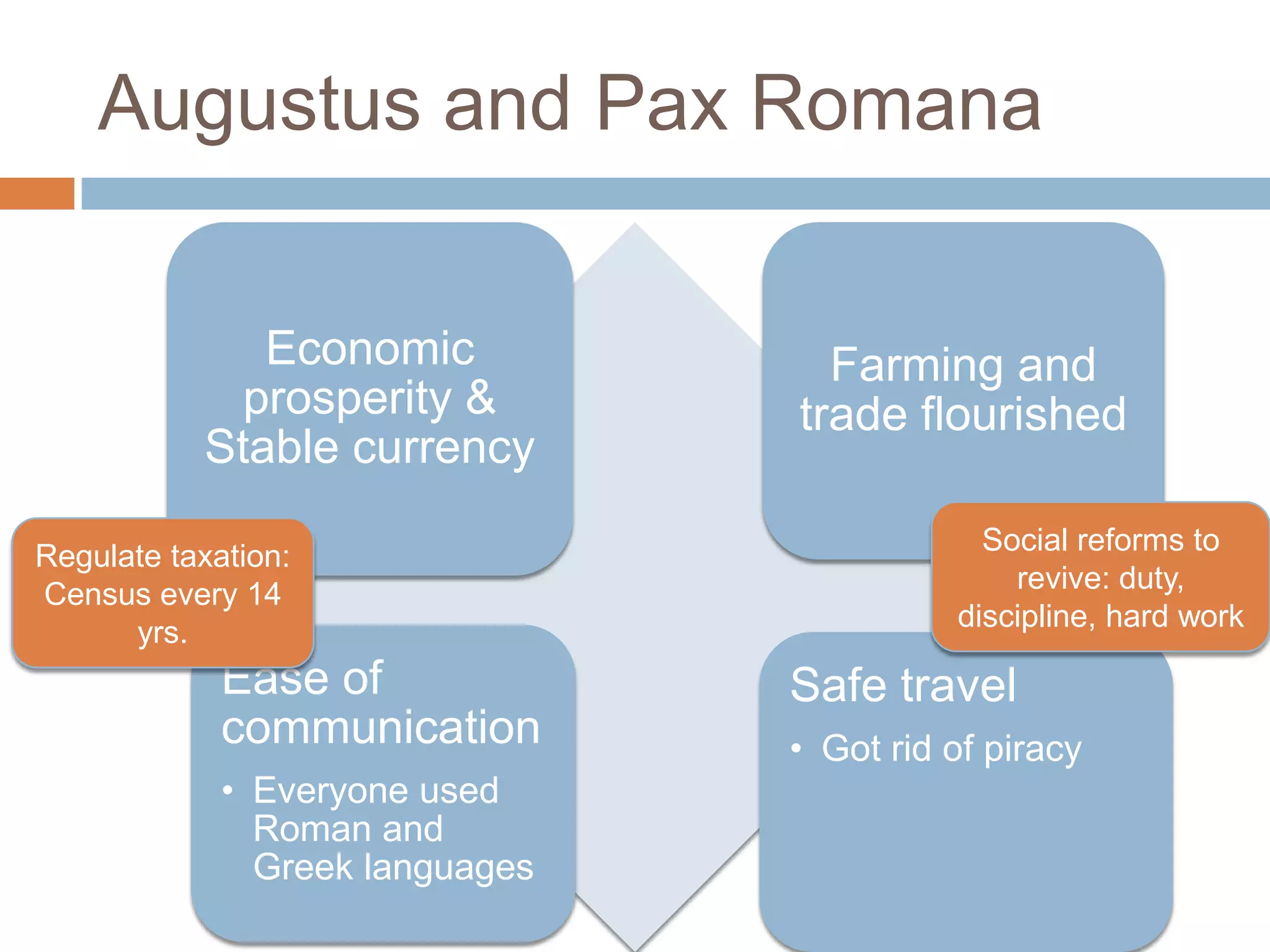
Augustus and Pax Romana


              Economic             Farming and
             prosperity &        trade flourished
           Stable currency
                                             Social reforms to
Regulate taxation:
                                               revive: duty,
Census every 14
                                           discipline, hard work
      yrs.
             Ease of             Safe travel
             communication       • Got rid of piracy
             • Everyone used
               Roman and
               Greek languages
Roman Culture &
Achievement
Law
   System of justice
     Protected  individual rights
     Many European adopted these principles into
      their current law
Literature
   Influenced by Greeks
     Virgil   (70-19BC)
       Greatest  roman poet
       Glorified Rome
       “Rome was destined to rule the world”

     Horace
       Friendof Virgil
       Warned of danger of luxury and ease
       Praised virtues of morality, justice, moderation and courage

     Ovid
       Wrote about mythology and love
       Popular among upper class Rome
After Augustus death, mood of writers
             changed…

Juvenal
• Satires about loose morals and
  social problems
Tacitus
• Favored old republic to new empire
• Wrote about Germanic peoples
Latin language
remains main used
language throughout
Medieval times
Greek Influence
   Plutarch
     Wrote   about influential Greeks and Romans
   Galen
     Advances in medical knowledge
     Wrote medical encyclopedia

   Ptolemy
     Theorythat earth is center of universe
     (geocentric)
Art and Architecture
   Art
     Generalsbrought back from conquests
     Copied Greek statues
       Romans   excelled at busts
       Statues realistic (scars and all)
       Excelled at relief art

   Architecture
     Aqueducts

     Bridges

     Road  system
     Buildings were: large, durable, and practical
Religious Beliefs
   nature gods  mythology philosophy
   Epicureans (Lucretius)
     Freeyour mind from fear and pain
     Seek happiness for yourself

   Stoics (Seneca)
     Goal   of romans to seek “good behavior”
       Courage
       Dignity
       Duty
       service
Eastern Influence
   Mystery religions
     Polytheisticand mythological
     Tolerated by Romans as long as acknowledged
      emperor as a god too
   Pontifex maximus – worship of emperor
     Christianspersecuted because they would not
     participate in this
Introduction of Christianity
A World Made Ready
   God prepared world for birth of Christ
     Romans
       Made   travel safe
       Political stability

     Greeks
       Main    language understood in all empire
     Jews
       Temple  destroyed
       Jews built synagogues as places of worship
       Translated OT into Greek so all could read (Septuagint)
             Jews and Gentiles
Turning Point in History
   God sent Jesus to redeem sinful man
   Born in Roman Province – Judea
   Most Jews rejected Jesus as Messiah
     They   wanted freedom from Roman oppression
   He offended Jewish religious leaders (Pharisees)
     They plotted His death
     Brought Him before Pontius Pilate
       Charge  Him wanted to overthrow Roman rule
       Pontius Pilate gave in to keep peace in province

   Jesus death and resurrection brought HOPE to
    world
     Jesus   changed history
Spread of Gospel
   Jesus charged disciples to spread gospel in all
    world
   Conditions were favorable for spread of Gospel
   Jerusalem became center of early Church
     Disciples
              preached and converted thousands in
     Jerusalem
   Persecution of Christians in Jerusalem
     Lead   to spread of Christianity throughout
       Judea and Samaria
       Even further because of:
            Conversion of Paul
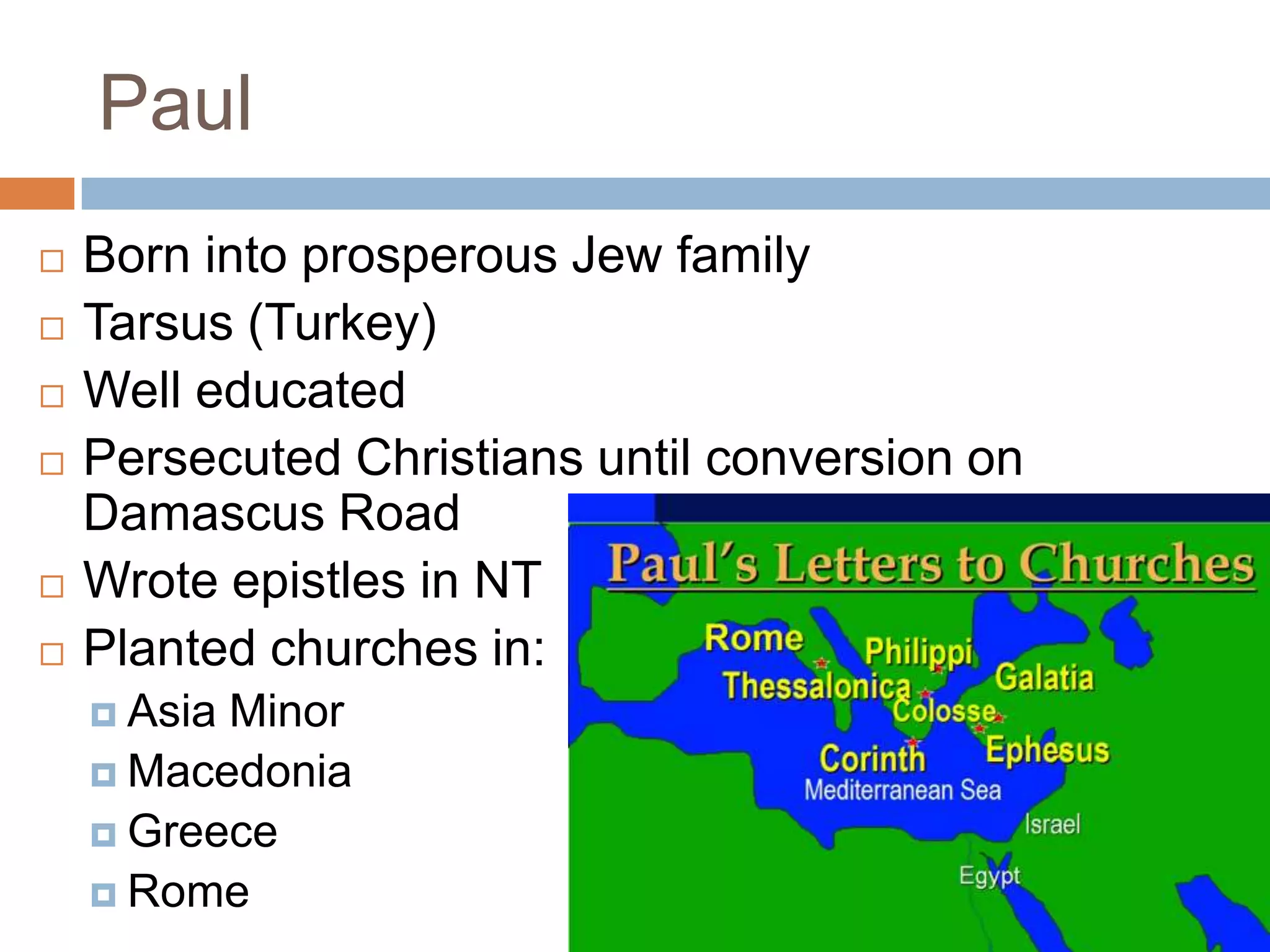
Paul
   Born into prosperous Jew family
   Tarsus (Turkey)
   Well educated
   Persecuted Christians until conversion on
    Damascus Road
   Wrote epistles in NT
   Planted churches in:
     AsiaMinor
     Macedonia
     Greece
     Rome
Destruction of Jerusalem
   586 BC – 70 AD – Jerusalem under foreign rule
       Chaldeans
       Persians
       Alexander the Great
       Ptolemies
       Seleucids
       Romans

   Jews grew restless under Roman rule
     66 AD- Rebellion
     70 AD- Roman legions arrive and destroy city
         Looted temple
         Jews scatter throughout world
Church Organizational
              Development
   First Christians met in homes or synagogues
   Early leaders  apostles chosen by Jesus
    Christ
   Pastor and Elders were equal at first
     LaterElders took care of business
     Pastor concentrated in studying scripture

   As churches grew in size power and prestige of
    pastor/bishop grew
   Problems facing early church:
     Rapidlyincreasing membership
     Persecution
Persecution to Acceptance
   Nero  Diocletian
     54   AD  305 AD
   Nevertheless, Christianity grew and flourished
   313 AD – Edict of Milan by Emperor
    Constantine
     Made  Christianity legal
     Dramatically changed history of church

     Rome changes from persecutor of Christianity to its
      protector and patron
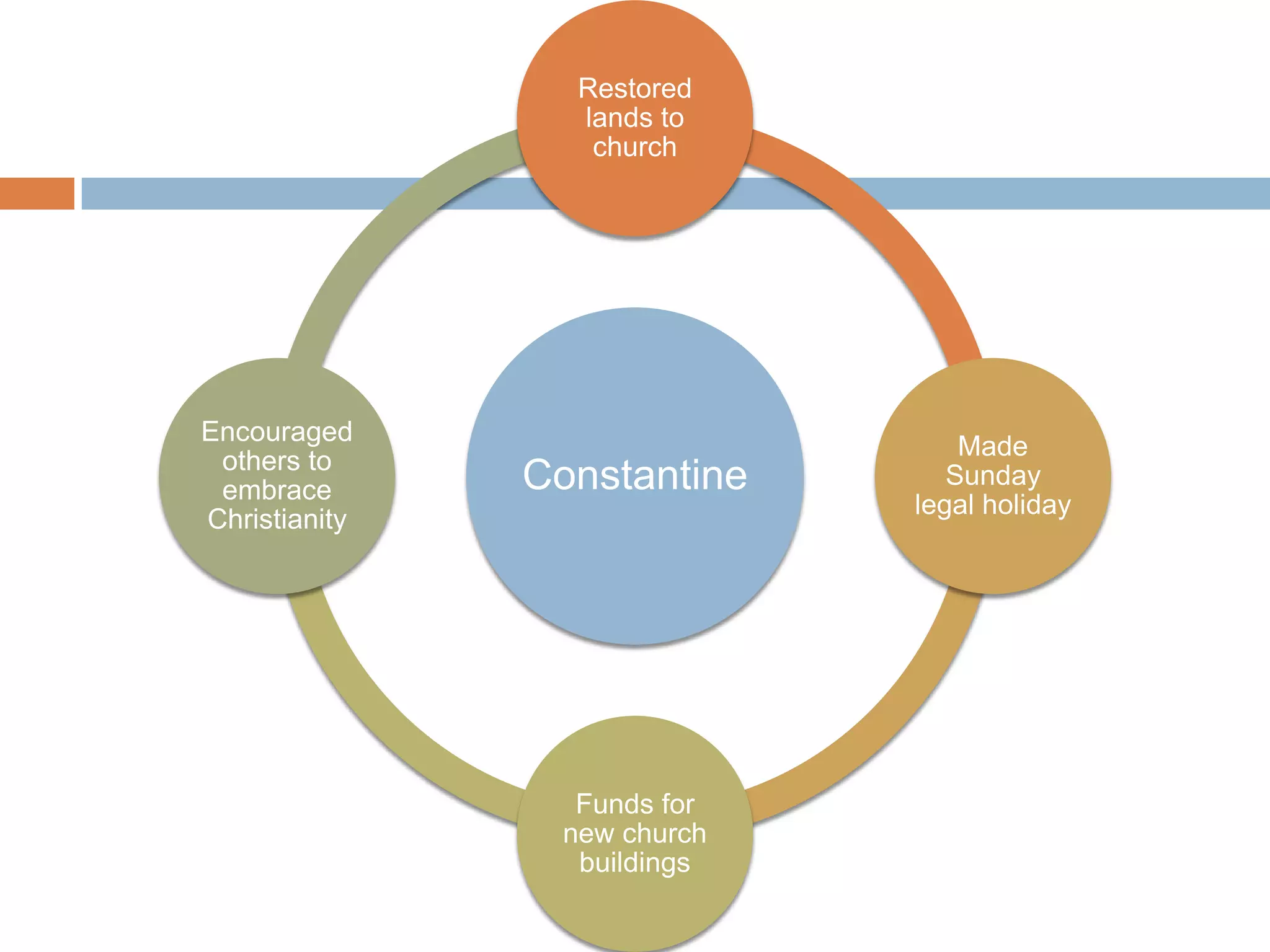
Restored
                 lands to
                  church


Encouraged
                                 Made
 others to
 embrace       Constantine      Sunday
                             legal holiday
Christianity


                 Funds for
                new church
                 buildings
   Arius
     Heretic who challenged deity of Christ
     Constantine called general assembly of church
      leaders
       Council   of Nicea 325 AD
            Affirmed Christ deity and Trinity
       Emperor    involved in church business
            Brought power and prosperity to church
   Theodosius I
     Made
         Christianity official and exclusive religion in
     Roman state
Church
   Grows in number and prosperity
   Decline in purity
     Peoplejoin just because it’s “the thing to do”
     Pagan practices leak in:
       Monasticism   – live separate from society
            Influence from Eastern religions
            DOES NOT HAVE ANY BIBLICAL BASE!
   Organization changes
     Hierarchy similar to political system instead of based
     on Biblical teachings
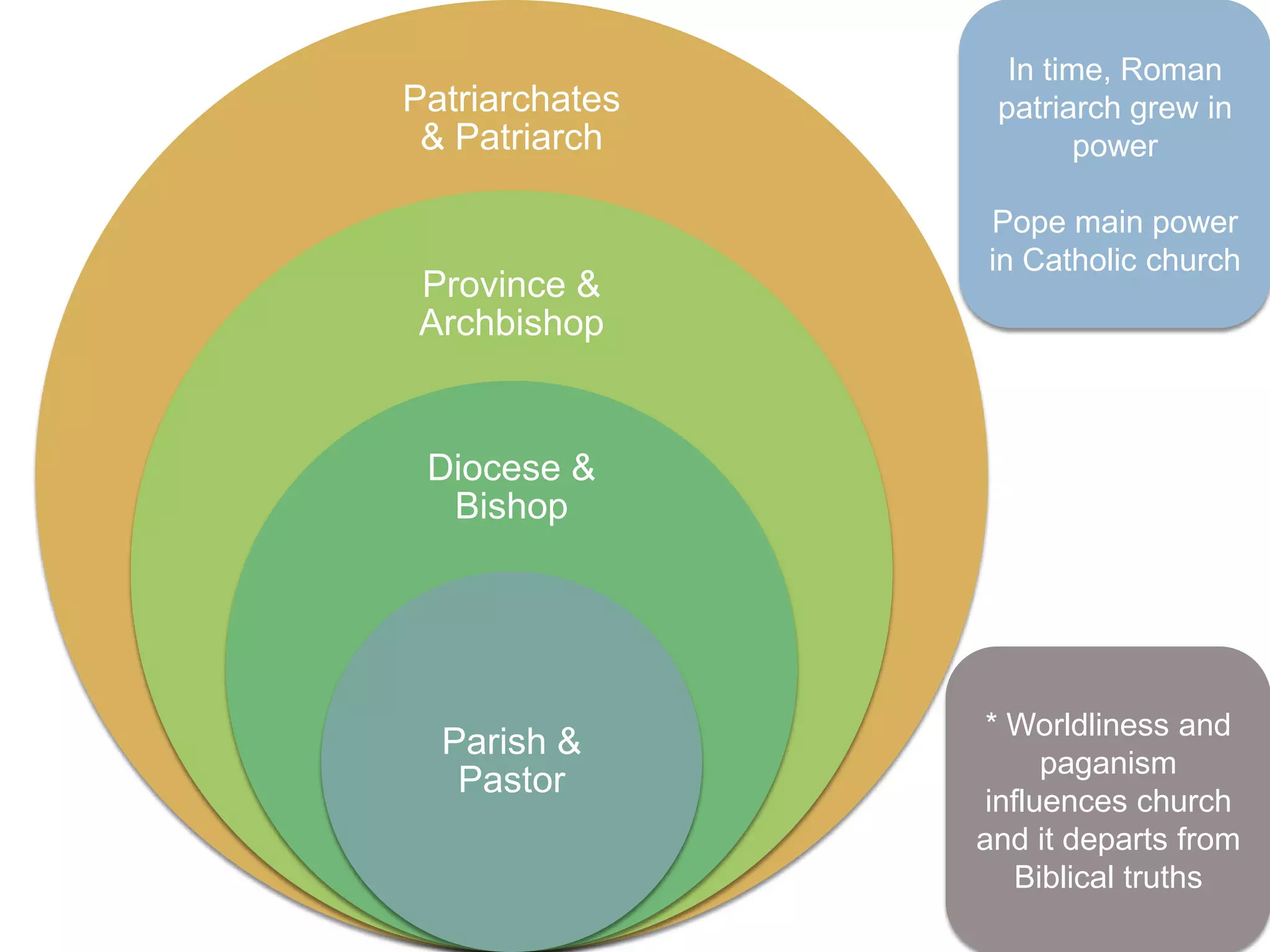
In time, Roman
Patriarchates    patriarch grew in
 & Patriarch            power

                Pope main power
                in Catholic church
Province &
Archbishop


 Diocese &
  Bishop


                 * Worldliness and
  Parish &
                      paganism
   Pastor
                 influences church
                and it departs from
                    Biblical truths
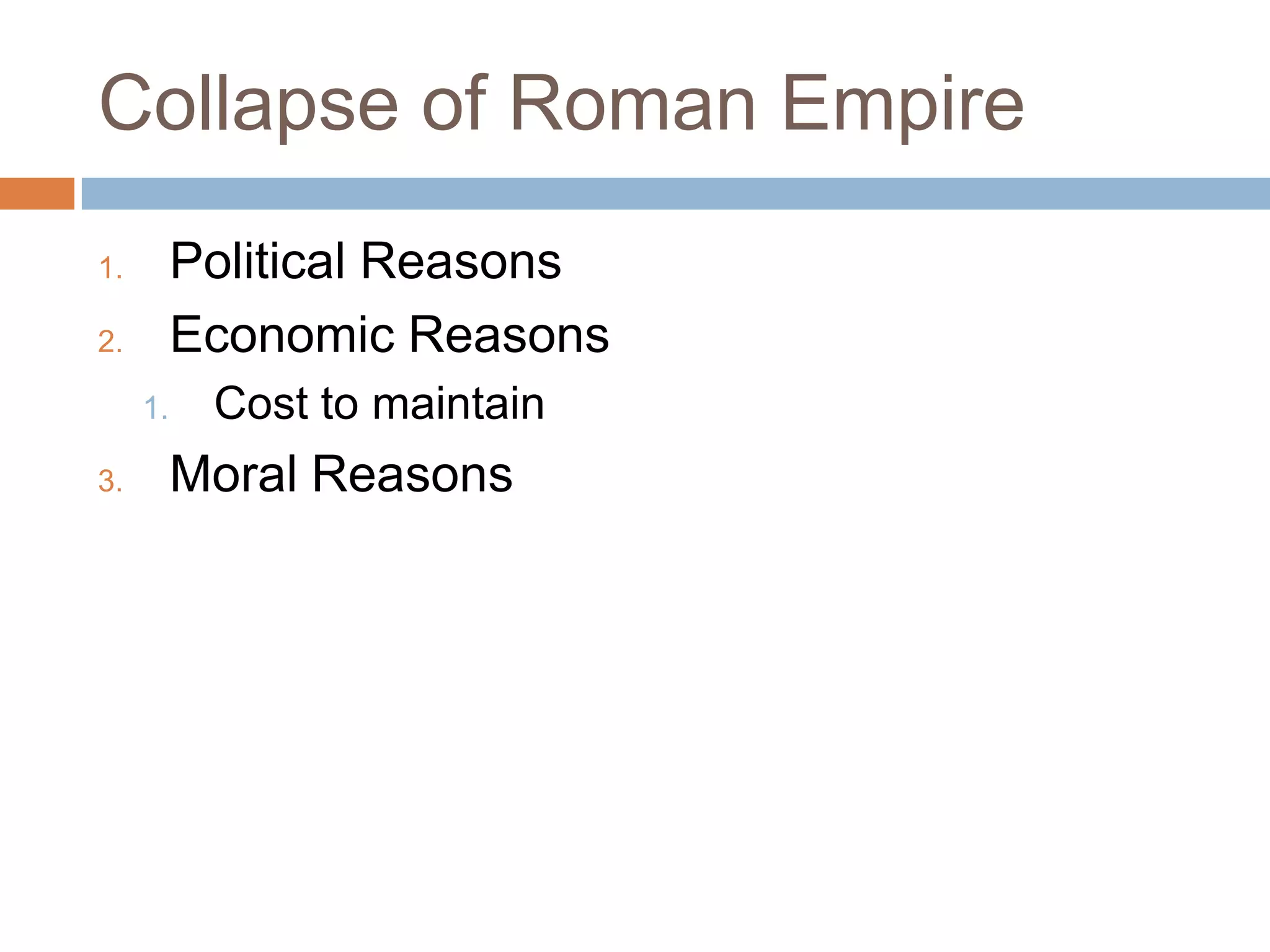
Collapse of Roman Empire
1.        Political Reasons
2.        Economic Reasons
     1.    Cost to maintain
3.        Moral Reasons
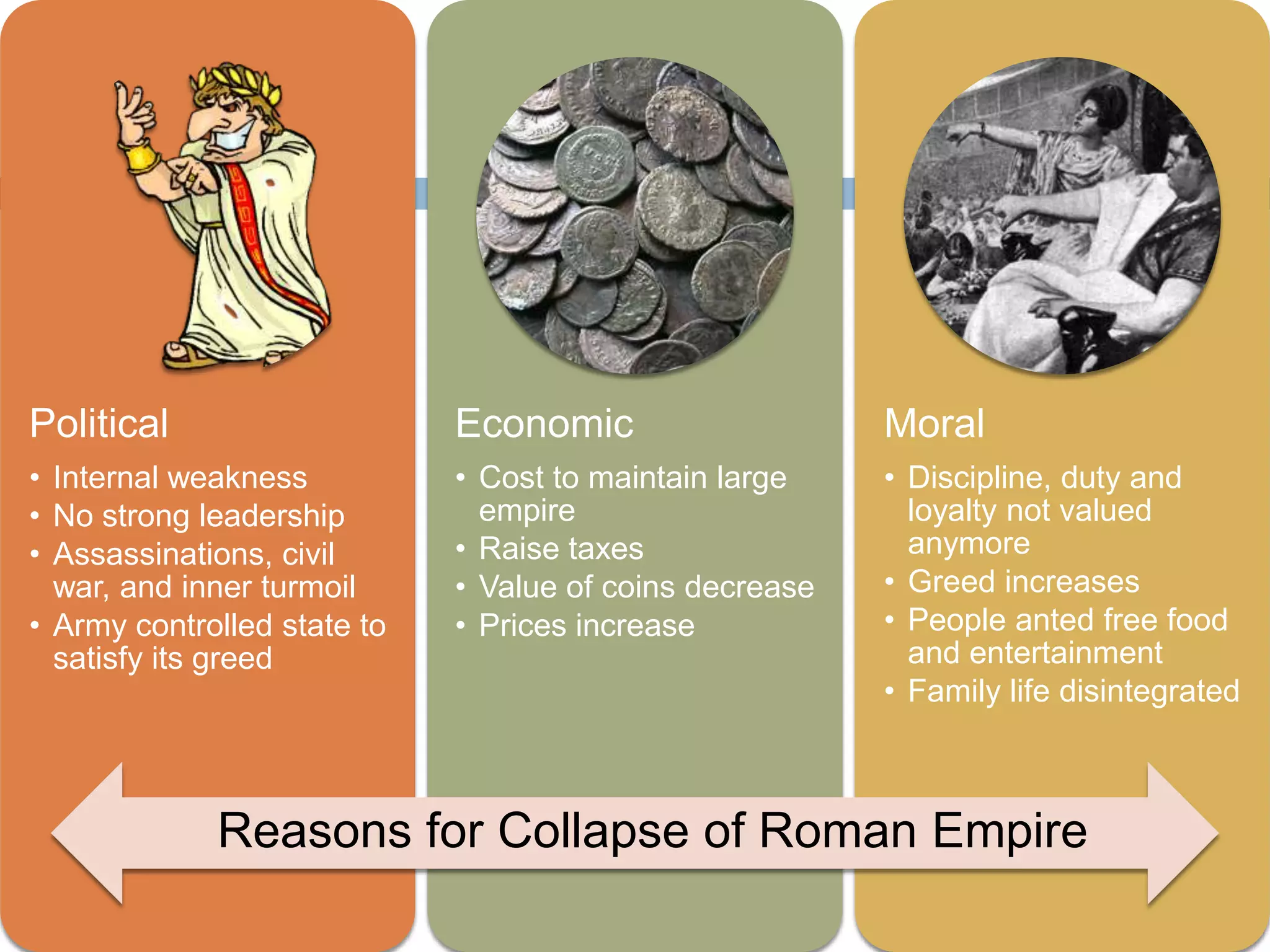
Political                    Economic                    Moral
• Internal weakness          • Cost to maintain large    • Discipline, duty and
• No strong leadership         empire                      loyalty not valued
• Assassinations, civil      • Raise taxes                 anymore
  war, and inner turmoil     • Value of coins decrease   • Greed increases
• Army controlled state to   • Prices increase           • People anted free food
  satisfy its greed                                        and entertainment
                                                         • Family life disintegrated


             Reasons for Collapse of Roman Empire
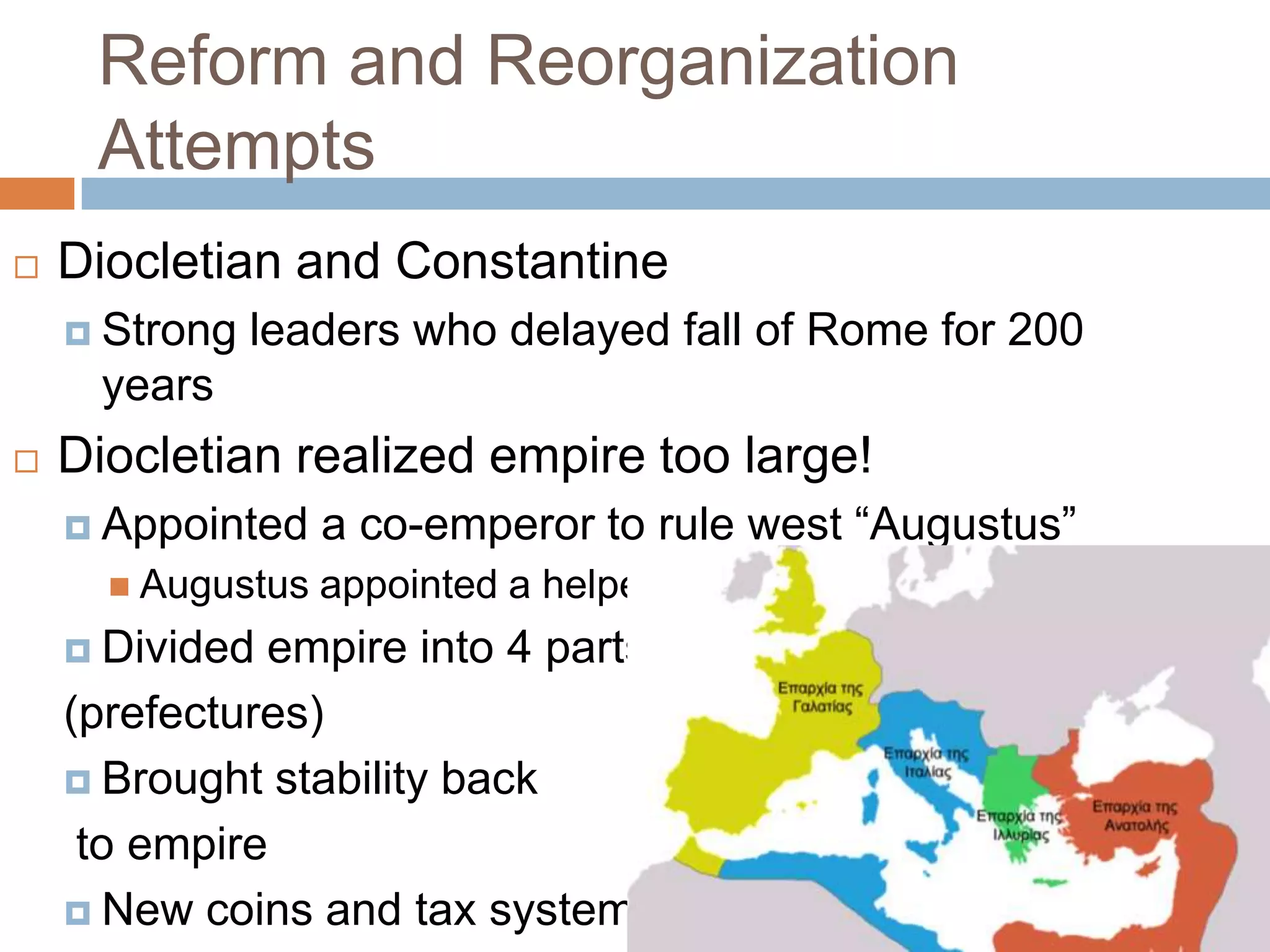
Reform and Reorganization
     Attempts
   Diocletian and Constantine
     Strong   leaders who delayed fall of Rome for 200
      years
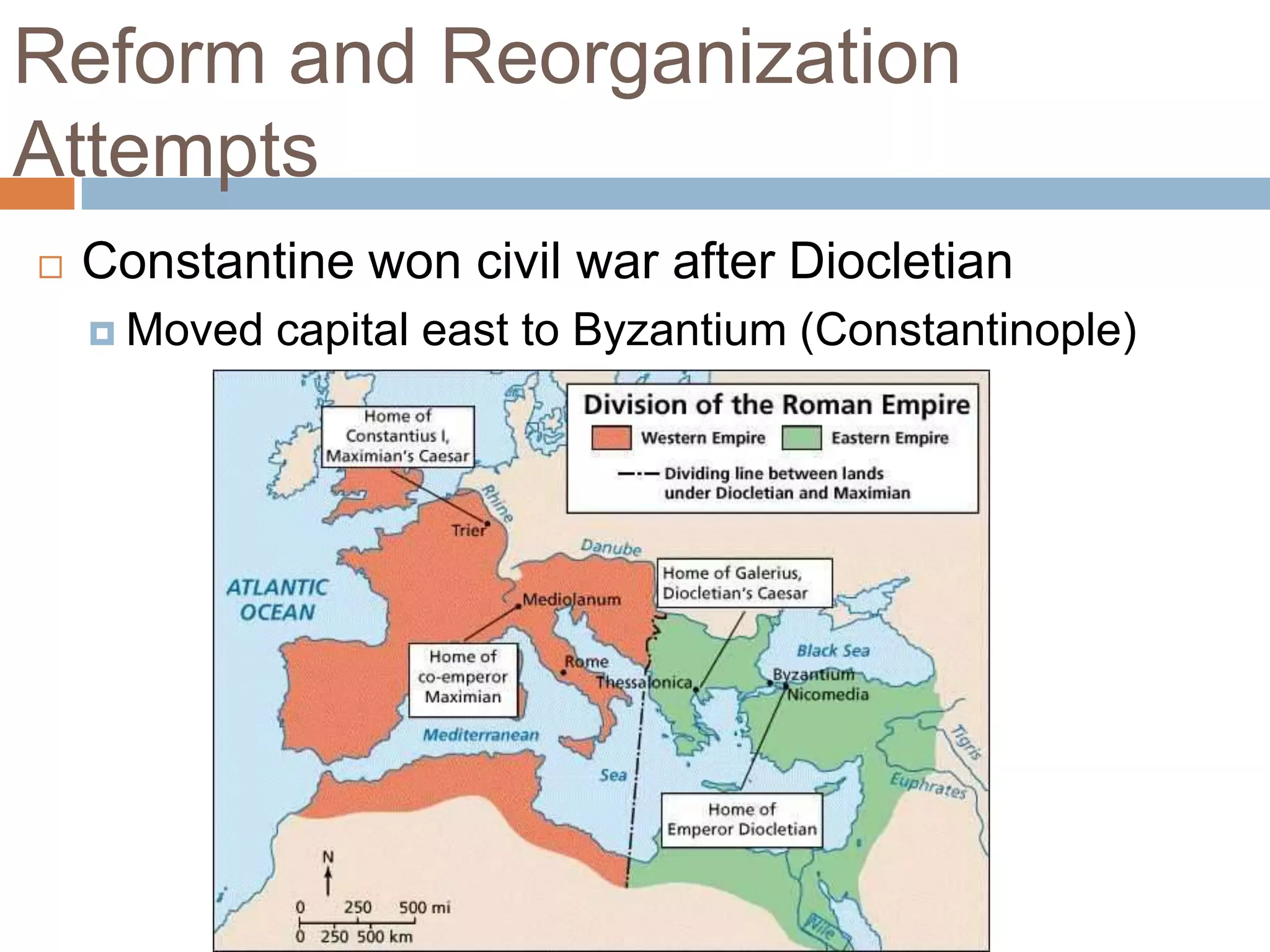
   Diocletian realized empire too large!
     Appointed    a co-emperor to rule west “Augustus”
       Augustus   appointed a helper = Caesar
     Divided empire into 4 parts
    (prefectures)
     Brought stability back

     to empire
     New coins and tax system
Reform and Reorganization
Attempts
   Constantine won civil war after Diocletian
     Moved   capital east to Byzantium (Constantinople)
Barbarian Invasions
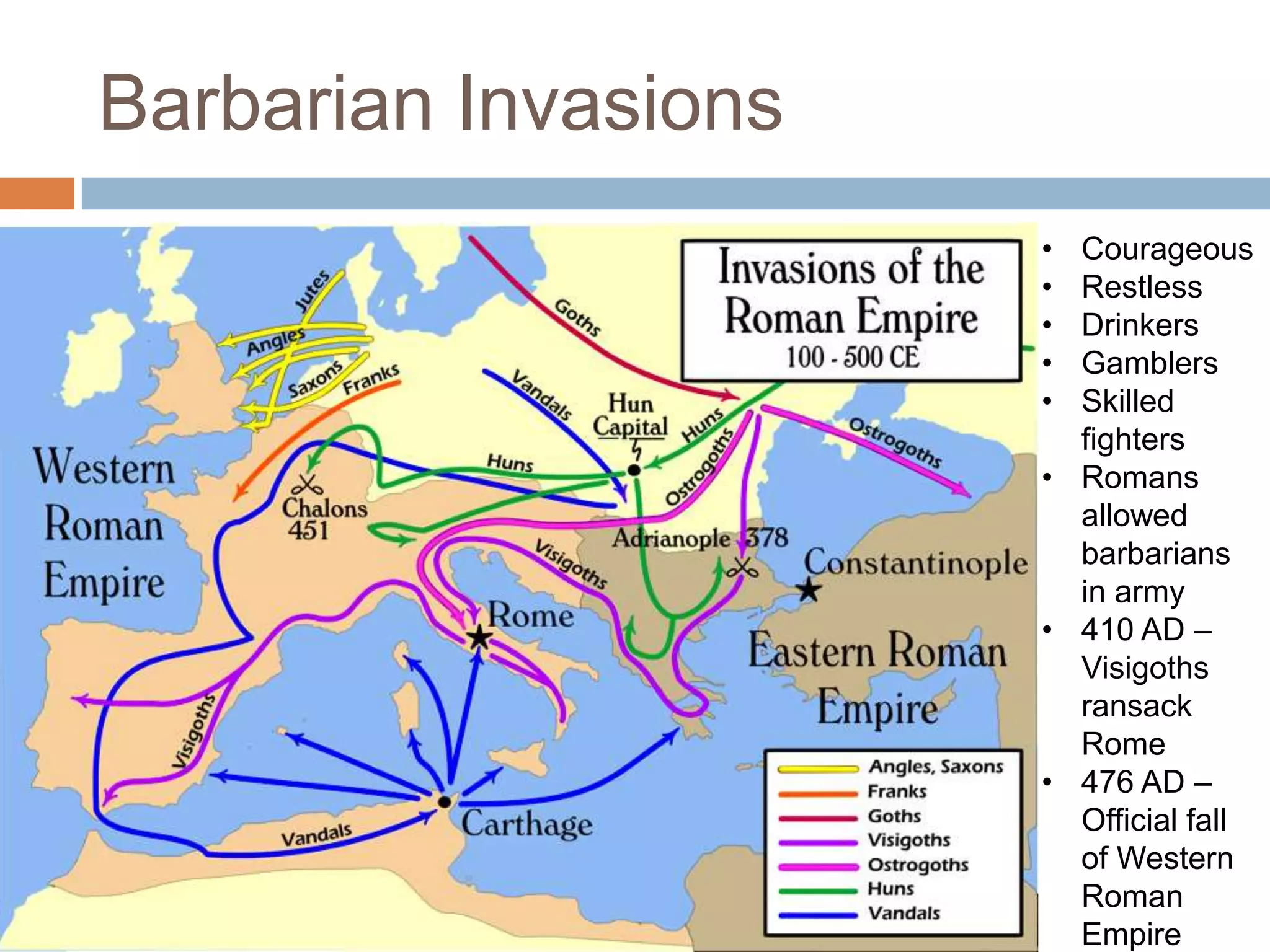
                      • Courageous
                      • Restless
                      • Drinkers
                      • Gamblers
                      • Skilled
                        fighters
                      • Romans
                        allowed
                        barbarians
                        in army
                      • 410 AD –
                        Visigoths
                        ransack
                        Rome
                      • 476 AD –
                        Official fall
                        of Western
                        Roman
                        Empire

Chapter 5 - Roman Empire

  • 1.
  • 2.
    Pax Romana  Roman Empire at its peak  Jesus born during this time
  • 3.
    Augustus  1st Citizen of Rome  Shared power with Senate  Also known as  Augustus (title of divinity, honor, majesty)  Caesar  Emperor
  • 4.
    Augustus and PaxRomana Economic Farming and prosperity & trade flourished Stable currency Social reforms to Regulate taxation: revive: duty, Census every 14 discipline, hard work yrs. Ease of Safe travel communication • Got rid of piracy • Everyone used Roman and Greek languages
  • 5.
  • 6.
    Law  System of justice  Protected individual rights  Many European adopted these principles into their current law
  • 7.
    Literature  Influenced by Greeks  Virgil (70-19BC)  Greatest roman poet  Glorified Rome  “Rome was destined to rule the world”  Horace  Friendof Virgil  Warned of danger of luxury and ease  Praised virtues of morality, justice, moderation and courage  Ovid  Wrote about mythology and love  Popular among upper class Rome
  • 8.
    After Augustus death,mood of writers changed… Juvenal • Satires about loose morals and social problems Tacitus • Favored old republic to new empire • Wrote about Germanic peoples
  • 9.
    Latin language remains mainused language throughout Medieval times
  • 10.
    Greek Influence  Plutarch  Wrote about influential Greeks and Romans  Galen  Advances in medical knowledge  Wrote medical encyclopedia  Ptolemy  Theorythat earth is center of universe (geocentric)
  • 11.
    Art and Architecture  Art  Generalsbrought back from conquests  Copied Greek statues  Romans excelled at busts  Statues realistic (scars and all)  Excelled at relief art  Architecture  Aqueducts  Bridges  Road system  Buildings were: large, durable, and practical
  • 12.
    Religious Beliefs  nature gods  mythology philosophy  Epicureans (Lucretius)  Freeyour mind from fear and pain  Seek happiness for yourself  Stoics (Seneca)  Goal of romans to seek “good behavior”  Courage  Dignity  Duty  service
  • 13.
    Eastern Influence  Mystery religions  Polytheisticand mythological  Tolerated by Romans as long as acknowledged emperor as a god too  Pontifex maximus – worship of emperor  Christianspersecuted because they would not participate in this
  • 14.
  • 15.
    A World MadeReady  God prepared world for birth of Christ  Romans  Made travel safe  Political stability  Greeks  Main language understood in all empire  Jews  Temple destroyed  Jews built synagogues as places of worship  Translated OT into Greek so all could read (Septuagint)  Jews and Gentiles
  • 16.
    Turning Point inHistory  God sent Jesus to redeem sinful man  Born in Roman Province – Judea  Most Jews rejected Jesus as Messiah  They wanted freedom from Roman oppression  He offended Jewish religious leaders (Pharisees)  They plotted His death  Brought Him before Pontius Pilate  Charge Him wanted to overthrow Roman rule  Pontius Pilate gave in to keep peace in province  Jesus death and resurrection brought HOPE to world  Jesus changed history
  • 17.
    Spread of Gospel  Jesus charged disciples to spread gospel in all world  Conditions were favorable for spread of Gospel  Jerusalem became center of early Church  Disciples preached and converted thousands in Jerusalem  Persecution of Christians in Jerusalem  Lead to spread of Christianity throughout  Judea and Samaria  Even further because of:  Conversion of Paul
  • 18.
    Paul  Born into prosperous Jew family  Tarsus (Turkey)  Well educated  Persecuted Christians until conversion on Damascus Road  Wrote epistles in NT  Planted churches in:  AsiaMinor  Macedonia  Greece  Rome
  • 19.
    Destruction of Jerusalem  586 BC – 70 AD – Jerusalem under foreign rule  Chaldeans  Persians  Alexander the Great  Ptolemies  Seleucids  Romans  Jews grew restless under Roman rule  66 AD- Rebellion  70 AD- Roman legions arrive and destroy city  Looted temple  Jews scatter throughout world
  • 20.
    Church Organizational Development  First Christians met in homes or synagogues  Early leaders  apostles chosen by Jesus Christ  Pastor and Elders were equal at first  LaterElders took care of business  Pastor concentrated in studying scripture  As churches grew in size power and prestige of pastor/bishop grew  Problems facing early church:  Rapidlyincreasing membership  Persecution
  • 21.
    Persecution to Acceptance  Nero  Diocletian  54 AD  305 AD  Nevertheless, Christianity grew and flourished  313 AD – Edict of Milan by Emperor Constantine  Made Christianity legal  Dramatically changed history of church  Rome changes from persecutor of Christianity to its protector and patron
  • 22.
    Restored lands to church Encouraged Made others to embrace Constantine Sunday legal holiday Christianity Funds for new church buildings
  • 23.
    Arius  Heretic who challenged deity of Christ  Constantine called general assembly of church leaders  Council of Nicea 325 AD  Affirmed Christ deity and Trinity  Emperor involved in church business  Brought power and prosperity to church  Theodosius I  Made Christianity official and exclusive religion in Roman state
  • 24.
    Church  Grows in number and prosperity  Decline in purity  Peoplejoin just because it’s “the thing to do”  Pagan practices leak in:  Monasticism – live separate from society  Influence from Eastern religions  DOES NOT HAVE ANY BIBLICAL BASE!  Organization changes  Hierarchy similar to political system instead of based on Biblical teachings
  • 25.
    In time, Roman Patriarchates patriarch grew in & Patriarch power Pope main power in Catholic church Province & Archbishop Diocese & Bishop * Worldliness and Parish & paganism Pastor influences church and it departs from Biblical truths
  • 26.
    Collapse of RomanEmpire 1. Political Reasons 2. Economic Reasons 1. Cost to maintain 3. Moral Reasons
  • 27.
    Political Economic Moral • Internal weakness • Cost to maintain large • Discipline, duty and • No strong leadership empire loyalty not valued • Assassinations, civil • Raise taxes anymore war, and inner turmoil • Value of coins decrease • Greed increases • Army controlled state to • Prices increase • People anted free food satisfy its greed and entertainment • Family life disintegrated Reasons for Collapse of Roman Empire
  • 28.
    Reform and Reorganization Attempts  Diocletian and Constantine  Strong leaders who delayed fall of Rome for 200 years  Diocletian realized empire too large!  Appointed a co-emperor to rule west “Augustus”  Augustus appointed a helper = Caesar  Divided empire into 4 parts (prefectures)  Brought stability back to empire  New coins and tax system
  • 29.
    Reform and Reorganization Attempts  Constantine won civil war after Diocletian  Moved capital east to Byzantium (Constantinople)
  • 30.
    Barbarian Invasions • Courageous • Restless • Drinkers • Gamblers • Skilled fighters • Romans allowed barbarians in army • 410 AD – Visigoths ransack Rome • 476 AD – Official fall of Western Roman Empire