Secession & the Outbreak
of the Civil War
Secession in the South
Lincoln’s election led to
secession by 7 states in the
Deep South but that did not
necessarily mean “civil war”
Two things had to happen first:
–One last failed attempt to
reconcile the North & South
–The North had to use its
military to protect the Union
The failed Crittenden
Compromise in 1860
Fort Sumter, South Carolina
SC seceded on
Dec 20,1860The entire Deep South
seceded by Feb 1861
The Upper South did not view
Lincoln’s election as a death sentence
& did not secede immediately
“Lame duck” Buchanan took no action
to stop the South from seceding
Some Northerners thought the U.S.
would be better off if the South
was allowed to peacefully secede
The Decision to Secede
What is the “United States”?
The Southern decision to secede
was based on old arguments:
–The USA was a “compact
between states,” not a national
gov’t “above the states”
–Therefore, states could leave
the Union freely & peacefully
–States’ rights must be protected
as a guarantee of liberty
Southerners had threatened secession during a
Congressional debate over slavery in 1790, the
Missouri Crisis of 1820, the Nullification Crisis
of 1832, & the crisis over California in 1850
Individuals have the right to own property
(slaves) & have the right to have their
property returned (Fugitive Slave Law)
Secession & the Formation of the
Confederate States of AmericaOn Feb 4, 1861, the Confederate
States of America were formed
The CSA constitution resembled the U.S., but
with 4 key changes: (1) it protected states’
rights, (2) guaranteed slavery, (3) referenced
God, & (4) prohibited protective tariffs
Mississippi Senator Jefferson Davis
was elected CSA president
The Deep South Secedes
Moderate Republicans proposed
the Crittenden CompromiseCrittenden Compromise to lure
the South back into the Union:
–offered to extend the Missouri
Compromise line to the Pacific
–promised a Constitutional
amendment to protect slavery
Both Lincoln & Davis rejected
the compromise leaving the North
with 2 choices…
The South rejected it
because they had
created a new nation
Lincoln rejected it
because he was
committed to free soilAllow for peaceful separation…OR…
fight to preserve the Union
Fort Sumter, South Carolina
In April 1861, a skirmish at Fort Sumter, SC
led to the 1st
shots fired of the Civil War
Effects of Fort Sumter
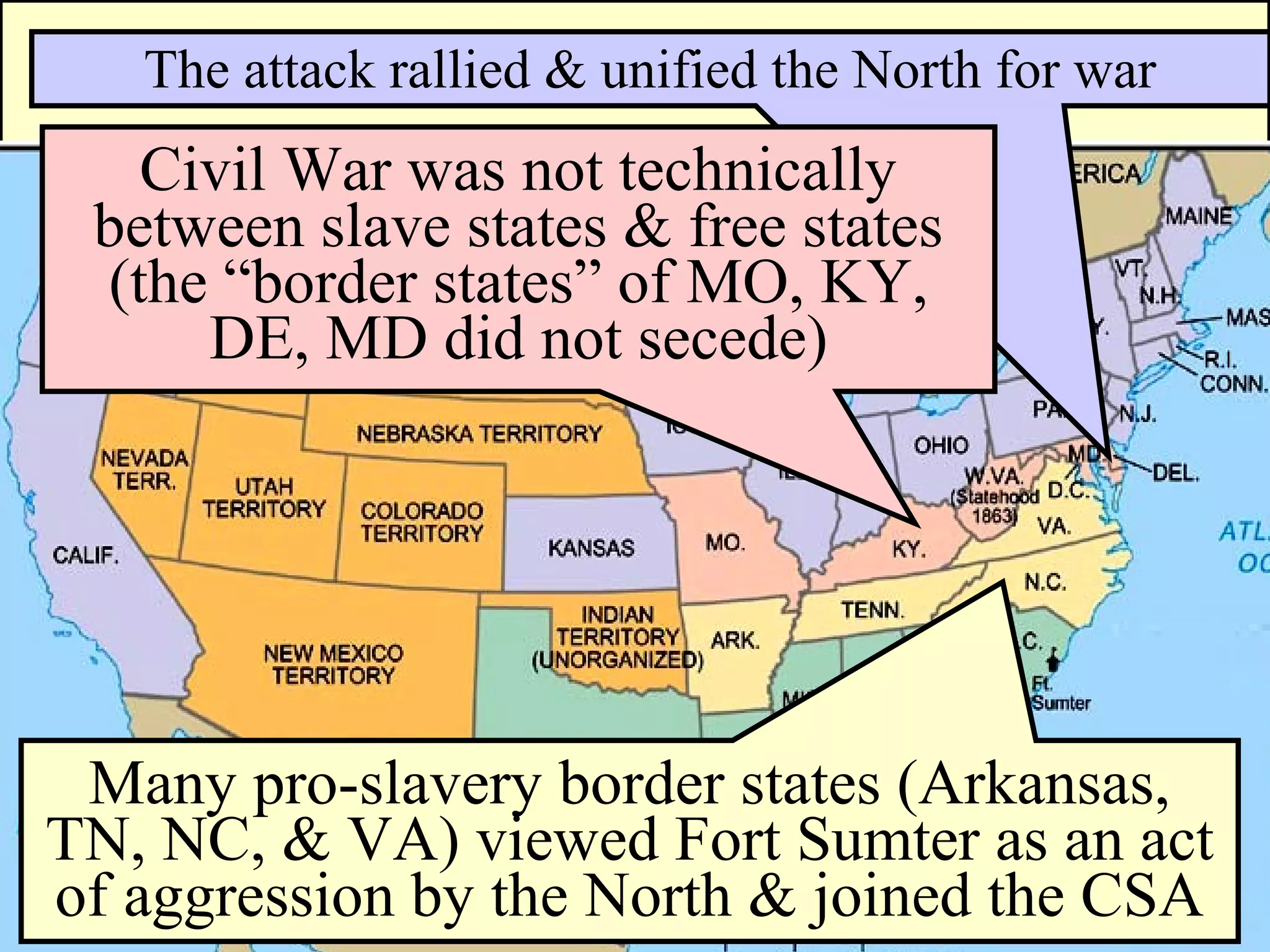
Many pro-slavery border states (Arkansas,
TN, NC, & VA) viewed Fort Sumter as an act
of aggression by the North & joined the CSA
The attack rallied & unified the North for war
Civil War was not technically
between slave states & free states
(the “border states” of MO, KY,
DE, MD did not secede)
Adjusting to
Total War
Northern Advantages
At the outbreak of the Civil War,
the North had lots of advantages:
–Larger population for troops
–Greater industrial capacity
–Huge edge in RR transportation
Problem for the North:
–Had to invade the South to win
–Difficult to maintain enthusiasm
& support for war over time
Southern Advantages
Although outnumbered & less
industrial, South had advantages:
–President Davis knew that they
did not have to “win” the war;
the South only had to drag out
the fight & make the North quit
–Had the best military leaders
–England & France appeared
more willing to support the South
Robert E “Stonewall” J.E.B.
Lee Jackson Stuart
“King Cotton”
diplomacy
Winfield Scott’s Anaconda Plan
Blockade the
Southern coast
Take control of the
Mississippi River
Divide the West
from South
Take the CSA capital
at Richmond
Ulysses
Grant in the
West
George
McClellan
was in
charge of
Army of the
Potomac
Southern strategy was an “offensive defense”:
drag out the war & strategically attack the
North to destroy Northern morale
Political Leadership During the Civil War
Davis was less
effective:
–concerned
mainly with
military duties
–neglected the
economy
–obstructed by
state governors
who resisted
conscription
Lincoln
expanded his
powers:
–declared
martial law
–imprisoned
“subversives”
–briefly closed
down a few
newspapers
The Diplomatic Struggle
From 1861 to 1862, the South
used “cotton diplomacy” to get
England & France to aid them:
–Napoleon III favored the South
but wanted England to do so 1st
–England offered “belligerent”
status to the CSA; but otherwise
chose a hands-off policy
By 1863, “King Cotton” diplomacy
failed because Egyptian & Indian
cotton filled the European demand
Fighting the Civil War
The
Civil
War
1st battle was Bull Run (Manassas, VA) on
July 21, 1861; “On to Richmond” campaign
was repulsed by “Stonewall” Jackson
The U.S. & CSA forces fought to a
draw at Antietam in Sept 1862—the
single bloodiest day of the Civil War
From 1861-1863, the South consistently
beat the North due to poor Union leadership
& the Southern defensive strategy
Fighting “Total War”
The Civil War was the world’s 1st
“total war” in which the entire
economy was devoted to winning:
–North & South drafted soldiers
–North & South employed female
workers to meet supply demands
–New weapons, old tactics, &
sheer numbers of troops in
battle led to massive casualties
Women took gov’t jobs as bookkeepers,
clerks & secretaries; A number of women
also served as spies (Rose Greenhow, CSA)
Women’s most prominent role were as nurses
on the battlefield: distributing medical
supplies, organizing hospitals, & offering
comfort to wounded or dying soldiers
Cone-shaped bullets &
grooved barrel rifles
Repeating rifles &
the Gatling gun
Shrapnel, booby traps,
& land mines
Massive frontal assaults and massed
formations with as many as 100,000 soldiers
Battle of the Ironclads (1862)Battle of the Ironclads (1862):
CSS Virginia vs. USS Monitor
Confederate ironclad CSS Virginia was built
using the remains of the USS Merrimack
USS Monitor was a revolutionary design:
rotating turret & low profile
Casualties of the Civil War
Union Prison Camp at Andersonville,
GA
Confederate Prison Camp in
Andersonville, GA
Built to hold 10,000 prisoners;
but held more than 32,000 Union POWs
Mobilizing the Home Fronts
Both the North & South faced
problems supporting the war:
–Both sides began running out of
troops; in 1862, the North &
South began conscription (draft)
–Funding the war was difficult;
both sides printed paper money
(greenbacks) to accommodate
spending needs; led to runaway
inflation (9,000% in the South)
The draft was unpopular among Southern
governors & Northern, antiwar “Copperheads”
"My paramount object in this
struggle is to save the Union, and
is not either to save or to destroy
slavery. If I could save the Union
without freeing any slave I would
do it, and if I could save it by
freeing all the slaves I would do it;
and if I could save it by freeing
some and leaving others alone I
would also do that."
—Abraham Lincoln, 18621862
The Emancipation Proclamation
Union “success” at Antietam led
Lincoln to issue the EmancipationEmancipation
ProclamationProclamation on January 1, 1863:
–Lincoln freed all slaves in
Confederate territories
–This did not free a single slave
but it gave the North a new
reason fight the Civil War
–Inspired slaves to flee North
Pushed for the 13th
Amendment
Passed after the Civil War
ended on Jan 31, 1865
Read the text of Lincoln’s
Emancipation Proclamation
The
Civil
War
In July 1863, General Grant took Vicksburg
& gained control of the Mississippi River
Lee led an attack into the North,
but lost at Gettysburg; North’s
1st real victory in the east
Due to Grant’s success in the west,
Lincoln made Grant supreme commander
of Union army in 1864; Grant devised a
strategy to invade the South on all fronts
Grant began a siege on Richmond and…
William Sherman began his
“march to the sea” (Atlanta to Savannah)
& destroyed everything of military value
Gettysburg Address
Four score and seven
years ago our
forefathers brought
forth on this continent,
a new nation,
conceived in Liberty,
and dedicated to the
proposition that all
men are created equal.
Now we are engaged in a
great civil war, testing
whether that nation, or any
nation so conceived and so
dedicated, can long endure.
We are met on a great battle-
field of that war. We have
come to dedicate a portion of
that field, as a final resting
place for those who here
gave their lives that that
nation might live. It is
altogether fitting and proper
that we should do this.
But, in a larger sense,
we can not dedicate,
we can not consecrate,
we can not hallow this
ground. For the brave
men, living and dead,
who struggled here,
have consecrated it far
above our poor power
to add or detract.
The world will little
note or long remember
what we say here, but it
can never forget what
they did here. It is for
us the living, rather, to
be dedicated here to the
unfinished work which
they who fought here
have thus far so nobly
advanced.
It is rather for us to be
here dedicated to the
great task remaining
before us—that from
these honored dead we
take increased devotion
to that cause for which
they gave the last full
measure of devotion—
—that we here highly
resolve that these dead
shall not have died in
vain—that this nation,
under God, shall have a
new birth of freedom—
and that government of
the people, by the
people, and for the
people, shall not perish
from the earth.
Election of 1864
Meanwhile, Lincoln faced a tough
re-election in 1864 against
General George McClellan:
–War failures were a key issue
–Radical Republicans considered
dropping Lincoln from the ticket
But, when Atlanta fell during
Sherman’s “March to the Sea,”
Lincoln regained support and was
overwhelmingly reelected
In his 2nd
inaugural address, Lincoln promised
a Reconstruction Plan for the Union with
“malice towards none & charity for all”
On April 9, 1865, Lee surrendered
to Grant at Appomattox Courthouse,
ending the fighting of Civil War
The Death of Lincoln
Northern celebration was short lived;
On April 14, 1865, Lincoln was shot
by pro-Southerner John Wilkes Booth
Effects of the War
Effects of the War
Social changesSocial changes:
–618,000 troops were dead
–Women in both the North &
South were forced to take on
more non-domestic roles
–13th
Amendment ended slavery
–Nativism decreased as many
immigrants fought in Civil War
Effects of the War
Political changesPolitical changes:
–The Civil War established that
the national gov’t is supreme
over the states
–With no Southern opposition,
Republicans passed new laws:
Homestead Act (1862), Morrill
Act (1862), a protective tariff,
land grants to RR companies, &
a national banking system
Ended the Southern argument over
nullification & states’ rights
Conclusions
The turning point of the war: 1863
–The Civil War began as a
conflict “to preserve the Union,”
but by 1863 it became a war for
human liberty (Emancipation
Proclamation was issued)
–The South dominated the early
campaigns of the war due, but
by 1863 (Gettysburg) the weight
of Northern industry & population
wore down the South

Secession and civil war ppt

  • 1.
    Secession & theOutbreak of the Civil War
  • 2.
    Secession in theSouth Lincoln’s election led to secession by 7 states in the Deep South but that did not necessarily mean “civil war” Two things had to happen first: –One last failed attempt to reconcile the North & South –The North had to use its military to protect the Union The failed Crittenden Compromise in 1860 Fort Sumter, South Carolina
  • 3.
    SC seceded on Dec20,1860The entire Deep South seceded by Feb 1861 The Upper South did not view Lincoln’s election as a death sentence & did not secede immediately “Lame duck” Buchanan took no action to stop the South from seceding Some Northerners thought the U.S. would be better off if the South was allowed to peacefully secede
  • 4.
  • 5.
    What is the“United States”? The Southern decision to secede was based on old arguments: –The USA was a “compact between states,” not a national gov’t “above the states” –Therefore, states could leave the Union freely & peacefully –States’ rights must be protected as a guarantee of liberty Southerners had threatened secession during a Congressional debate over slavery in 1790, the Missouri Crisis of 1820, the Nullification Crisis of 1832, & the crisis over California in 1850 Individuals have the right to own property (slaves) & have the right to have their property returned (Fugitive Slave Law)
  • 6.
    Secession & theFormation of the Confederate States of AmericaOn Feb 4, 1861, the Confederate States of America were formed The CSA constitution resembled the U.S., but with 4 key changes: (1) it protected states’ rights, (2) guaranteed slavery, (3) referenced God, & (4) prohibited protective tariffs Mississippi Senator Jefferson Davis was elected CSA president
  • 7.
    The Deep SouthSecedes Moderate Republicans proposed the Crittenden CompromiseCrittenden Compromise to lure the South back into the Union: –offered to extend the Missouri Compromise line to the Pacific –promised a Constitutional amendment to protect slavery Both Lincoln & Davis rejected the compromise leaving the North with 2 choices… The South rejected it because they had created a new nation Lincoln rejected it because he was committed to free soilAllow for peaceful separation…OR… fight to preserve the Union
  • 8.
    Fort Sumter, SouthCarolina In April 1861, a skirmish at Fort Sumter, SC led to the 1st shots fired of the Civil War
  • 9.
    Effects of FortSumter Many pro-slavery border states (Arkansas, TN, NC, & VA) viewed Fort Sumter as an act of aggression by the North & joined the CSA The attack rallied & unified the North for war Civil War was not technically between slave states & free states (the “border states” of MO, KY, DE, MD did not secede)
  • 10.
  • 11.
    Northern Advantages At theoutbreak of the Civil War, the North had lots of advantages: –Larger population for troops –Greater industrial capacity –Huge edge in RR transportation Problem for the North: –Had to invade the South to win –Difficult to maintain enthusiasm & support for war over time
  • 12.
    Southern Advantages Although outnumbered& less industrial, South had advantages: –President Davis knew that they did not have to “win” the war; the South only had to drag out the fight & make the North quit –Had the best military leaders –England & France appeared more willing to support the South Robert E “Stonewall” J.E.B. Lee Jackson Stuart “King Cotton” diplomacy
  • 13.
    Winfield Scott’s AnacondaPlan Blockade the Southern coast Take control of the Mississippi River Divide the West from South Take the CSA capital at Richmond Ulysses Grant in the West George McClellan was in charge of Army of the Potomac Southern strategy was an “offensive defense”: drag out the war & strategically attack the North to destroy Northern morale
  • 14.
    Political Leadership Duringthe Civil War Davis was less effective: –concerned mainly with military duties –neglected the economy –obstructed by state governors who resisted conscription Lincoln expanded his powers: –declared martial law –imprisoned “subversives” –briefly closed down a few newspapers
  • 15.
    The Diplomatic Struggle From1861 to 1862, the South used “cotton diplomacy” to get England & France to aid them: –Napoleon III favored the South but wanted England to do so 1st –England offered “belligerent” status to the CSA; but otherwise chose a hands-off policy By 1863, “King Cotton” diplomacy failed because Egyptian & Indian cotton filled the European demand
  • 16.
  • 17.
    The Civil War 1st battle wasBull Run (Manassas, VA) on July 21, 1861; “On to Richmond” campaign was repulsed by “Stonewall” Jackson The U.S. & CSA forces fought to a draw at Antietam in Sept 1862—the single bloodiest day of the Civil War From 1861-1863, the South consistently beat the North due to poor Union leadership & the Southern defensive strategy
  • 18.
    Fighting “Total War” TheCivil War was the world’s 1st “total war” in which the entire economy was devoted to winning: –North & South drafted soldiers –North & South employed female workers to meet supply demands –New weapons, old tactics, & sheer numbers of troops in battle led to massive casualties Women took gov’t jobs as bookkeepers, clerks & secretaries; A number of women also served as spies (Rose Greenhow, CSA) Women’s most prominent role were as nurses on the battlefield: distributing medical supplies, organizing hospitals, & offering comfort to wounded or dying soldiers Cone-shaped bullets & grooved barrel rifles Repeating rifles & the Gatling gun Shrapnel, booby traps, & land mines Massive frontal assaults and massed formations with as many as 100,000 soldiers
  • 19.
    Battle of theIronclads (1862)Battle of the Ironclads (1862): CSS Virginia vs. USS Monitor Confederate ironclad CSS Virginia was built using the remains of the USS Merrimack USS Monitor was a revolutionary design: rotating turret & low profile
  • 20.
  • 21.
    Union Prison Campat Andersonville, GA Confederate Prison Camp in Andersonville, GA Built to hold 10,000 prisoners; but held more than 32,000 Union POWs
  • 22.
    Mobilizing the HomeFronts Both the North & South faced problems supporting the war: –Both sides began running out of troops; in 1862, the North & South began conscription (draft) –Funding the war was difficult; both sides printed paper money (greenbacks) to accommodate spending needs; led to runaway inflation (9,000% in the South) The draft was unpopular among Southern governors & Northern, antiwar “Copperheads”
  • 23.
    "My paramount objectin this struggle is to save the Union, and is not either to save or to destroy slavery. If I could save the Union without freeing any slave I would do it, and if I could save it by freeing all the slaves I would do it; and if I could save it by freeing some and leaving others alone I would also do that." —Abraham Lincoln, 18621862
  • 24.
    The Emancipation Proclamation Union“success” at Antietam led Lincoln to issue the EmancipationEmancipation ProclamationProclamation on January 1, 1863: –Lincoln freed all slaves in Confederate territories –This did not free a single slave but it gave the North a new reason fight the Civil War –Inspired slaves to flee North Pushed for the 13th Amendment Passed after the Civil War ended on Jan 31, 1865 Read the text of Lincoln’s Emancipation Proclamation
  • 25.
    The Civil War In July 1863,General Grant took Vicksburg & gained control of the Mississippi River Lee led an attack into the North, but lost at Gettysburg; North’s 1st real victory in the east Due to Grant’s success in the west, Lincoln made Grant supreme commander of Union army in 1864; Grant devised a strategy to invade the South on all fronts Grant began a siege on Richmond and… William Sherman began his “march to the sea” (Atlanta to Savannah) & destroyed everything of military value
  • 26.
    Gettysburg Address Four scoreand seven years ago our forefathers brought forth on this continent, a new nation, conceived in Liberty, and dedicated to the proposition that all men are created equal. Now we are engaged in a great civil war, testing whether that nation, or any nation so conceived and so dedicated, can long endure. We are met on a great battle- field of that war. We have come to dedicate a portion of that field, as a final resting place for those who here gave their lives that that nation might live. It is altogether fitting and proper that we should do this. But, in a larger sense, we can not dedicate, we can not consecrate, we can not hallow this ground. For the brave men, living and dead, who struggled here, have consecrated it far above our poor power to add or detract. The world will little note or long remember what we say here, but it can never forget what they did here. It is for us the living, rather, to be dedicated here to the unfinished work which they who fought here have thus far so nobly advanced. It is rather for us to be here dedicated to the great task remaining before us—that from these honored dead we take increased devotion to that cause for which they gave the last full measure of devotion— —that we here highly resolve that these dead shall not have died in vain—that this nation, under God, shall have a new birth of freedom— and that government of the people, by the people, and for the people, shall not perish from the earth.
  • 27.
    Election of 1864 Meanwhile,Lincoln faced a tough re-election in 1864 against General George McClellan: –War failures were a key issue –Radical Republicans considered dropping Lincoln from the ticket But, when Atlanta fell during Sherman’s “March to the Sea,” Lincoln regained support and was overwhelmingly reelected In his 2nd inaugural address, Lincoln promised a Reconstruction Plan for the Union with “malice towards none & charity for all”
  • 28.
    On April 9,1865, Lee surrendered to Grant at Appomattox Courthouse, ending the fighting of Civil War
  • 29.
    The Death ofLincoln Northern celebration was short lived; On April 14, 1865, Lincoln was shot by pro-Southerner John Wilkes Booth
  • 30.
  • 31.
    Effects of theWar Social changesSocial changes: –618,000 troops were dead –Women in both the North & South were forced to take on more non-domestic roles –13th Amendment ended slavery –Nativism decreased as many immigrants fought in Civil War
  • 32.
    Effects of theWar Political changesPolitical changes: –The Civil War established that the national gov’t is supreme over the states –With no Southern opposition, Republicans passed new laws: Homestead Act (1862), Morrill Act (1862), a protective tariff, land grants to RR companies, & a national banking system Ended the Southern argument over nullification & states’ rights
  • 33.
    Conclusions The turning pointof the war: 1863 –The Civil War began as a conflict “to preserve the Union,” but by 1863 it became a war for human liberty (Emancipation Proclamation was issued) –The South dominated the early campaigns of the war due, but by 1863 (Gettysburg) the weight of Northern industry & population wore down the South

Editor's Notes

  • #6 Threats of secession were nothing new. Some Southerners had threatened to leave the Union during a Congressional debate over slavery in 1790, the Missouri Crisis of 1819 and 1820, the Nullification Crisis of 1831 and 1832, and the crisis over California statehood in 1850. In each case, the crisis was resolved by compromise. Many expected the same pattern to prevail in 1861. Drawing on arguments developed by John C. Calhoun, the convention held that the states were sovereign entities that could leave the Union as freely as they joined. Among the many indictments of the northern states and people, nothing seems more central than the issue of trust with respect to the capture and return of fugitive slaves
  • #7 Some wished to “let the South depart in peace”
  • #14 This plan maximized the North’s industrial advantages but required better leadership than North had
  • #19 One reason why the Civil War was so lethal was the introduction of improved weaponry. Cone-shaped bullets replaced musket balls, and beginning in 1862, smooth-bore muskets were replaced with rifles with grooved barrels, which imparted spin on a bullet and allowed a soldier to hit a target a quarter of a mile away. The new weapons had appeared so suddenly that commanders did not immediately realize that they needed to compensate for the increased range and accuracy of rifles. The Civil War was the first war in which soldiers used repeating rifles (which could fire several shots without reloading), breechloading arms (which were loaded from behind the barrel instead of through the muzzle), and automated weapons like the Gatling gun. The Civil War also marked the first use by Americans of shrapnel, booby traps, and land mines. Outdated strategy also contributed to the high number of casualties. Massive frontal assaults and massed formations resulted in large numbers of deaths. In addition, far larger numbers of soldiers were involved in battles than in the past. In the Mexican War, no more than 15,000 soldiers opposed each other in a single battle, but some Civil War battles involved as many as 100,000 soldiers. The Civil War separated families in unprecedented numbers and freed women to assume many new roles. With the departure of many men into the military, women entered many occupations previously reserved for men only: in factories, shops, and especially, the expanding civil service, where women took jobs as clerks, bookkeepers, and secretaries. A number of women also served as spies (like Rose O'Neal Greenhow (1814-1864), a Confederate spy in Washington) and even as soldiers (like Albert Cashier, whose real name was Jennie Hodgers). But it was as nurses that women achieved particular prominence. Louisa May Alcott and Clara Barton were among thousands of women, North and South, who carried supplies to soldiers and nursed wounded men on the battlefield and in hospitals. Through organizations like the Christian Commission (formed by the North's YMCAs) and the U.S. Sanitary Commission (one of whose founders was Elizabeth Blackwell, the first American woman to earn a medical degree), women agents distributed medical supplies, organized hospitals, passed out Bibles and religious tracts, and offered comfort to wounded or dying soldiers. Initially, Lincoln and his generals anticipated a conventional war in which Union soldiers would respect civilians' property. Convinced that there was residual unionist support in the South, they expected to preserve the South's economic base, including its factories and rail lines. But as the war dragged on, the Civil War became history's first total war, a war in which the Union sought the Confederacy's total defeat and unconditional surrender. To achieve success, Union officers such as Ulysses S. Grant and William Tecumseh Sherman believed that it was necessary to break the South's will to fight. Sherman summed up the idea of total war in blunt terms: "We are not only fighting hostile armies," he declared in 1864, "but a hostile people, and must make old and young, rich and poor, feel the hard hand of war.“ A year earlier, a general order was issued that declared that military necessity "allows of all destruction of property" and "appropriation of whatever an enemy's country affords necessary for the subsistence and safety of the Army." This order allowed soldiers to destroy anything that might be of use to the Confederacy.
  • #20 The 1st battle of two ironclad warships was the Battle of Hampton Roads in March 1862
  • #23 1 confederate dollar worth 8 cents in 1863
  • #27 Yeah…it’s Johnny Cash reading the Gettysburg Address
  • #33 gave free land to western settlers created new colleges