Evaluation Of Capsule
Presented by
Md. Shahin Alam
Roll : 171320
Session : 2016-17
Department of Pharmacy, PUST
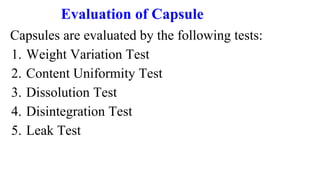
Evaluation of Capsule
Capsules are evaluated by the following tests:
1. Weight Variation Test
2. Content Uniformity Test
3. Dissolution Test
4. Disintegration Test
5. Leak Test
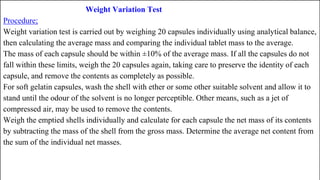
Weight Variation Test
Procedure;
Weight variation test is carried out by weighing 20 capsules individually using analytical balance,
then calculating the average mass and comparing the individual tablet mass to the average.
The mass of each capsule should be within ±10% of the average mass. If all the capsules do not
fall within these limits, weigh the 20 capsules again, taking care to preserve the identity of each
capsule, and remove the contents as completely as possible.
For soft gelatin capsules, wash the shell with ether or some other suitable solvent and allow it to
stand until the odour of the solvent is no longer perceptible. Other means, such as a jet of
compressed air, may be used to remove the contents.
Weigh the emptied shells individually and calculate for each capsule the net mass of its contents
by subtracting the mass of the shell from the gross mass. Determine the average net content from
the sum of the individual net masses.
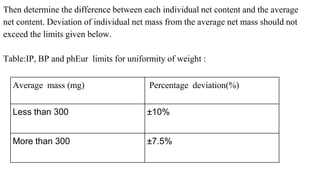
Then determine the difference between each individual net content and the average
net content. Deviation of individual net mass from the average net mass should not
exceed the limits given below.
Table:IP, BP and phEur limits for uniformity of weight :
Average mass (mg) Percentage deviation(%)
Less than 300 ±10%
More than 300 ±7.5%
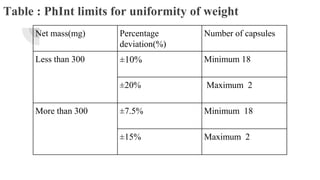
Table : PhInt limits for uniformity of weight
Net mass(mg) Percentage
deviation(%)
Number of capsules
Less than 300 ±10% Minimum 18
±20% Maximum 2
More than 300 ±7.5% Minimum 18
±15% Maximum 2
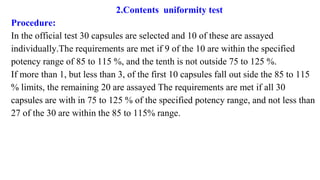
2.Contents uniformity test
Procedure:
In the official test 30 capsules are selected and 10 of these are assayed
individually.The requirements are met if 9 of the 10 are within the specified
potency range of 85 to 115 %, and the tenth is not outside 75 to 125 %.
If more than 1, but less than 3, of the first 10 capsules fall out side the 85 to 115
% limits, the remaining 20 are assayed The requirements are met if all 30
capsules are with in 75 to 125 % of the specified potency range, and not less than
27 of the 30 are within the 85 to 115% range.
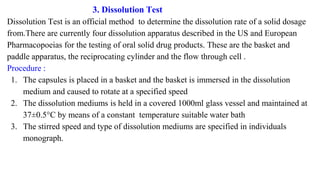
3. Dissolution Test
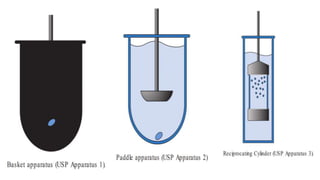
Dissolution Test is an official method to determine the dissolution rate of a solid dosage
from.There are currently four dissolution apparatus described in the US and European
Pharmacopoeias for the testing of oral solid drug products. These are the basket and
paddle apparatus, the reciprocating cylinder and the flow through cell .
Procedure :
1. The capsules is placed in a basket and the basket is immersed in the dissolution
medium and caused to rotate at a specified speed
2. The dissolution mediums is held in a covered 1000ml glass vessel and maintained at
37±0.5°C by means of a constant temperature suitable water bath
3. The stirred speed and type of dissolution mediums are specified in individuals
monograph.
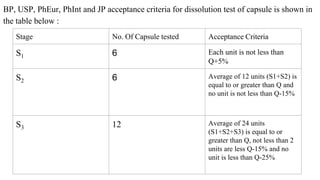
BP, USP, PhEur, PhInt and JP acceptance criteria for dissolution test of capsule is shown in
the table below :
Stage No. Of Capsule tested Acceptance Criteria
S1 6 Each unit is not less than
Q+5%
S2 6 Average of 12 units (S1+S2) is
equal to or greater than Q and
no unit is not less than Q-15%
S3 12 Average of 24 units
(S1+S2+S3) is equal to or
greater than Q, not less than 2
units are less Q-15% and no
unit is less than Q-25%
Disintegration Test
Procedure :
The USP disintegration apparatus consist of 6 glass tubes that are 3 inches long,
open at the top, and held against a 10-mesh screen at the
bottom end of the basket rack assembly.
To test for disintegration time, one capsule is placed in each tube and the basket
rack is positioned in specified medium at 37±2ºC such that capsule remains 2.5
cm below the surface of the liquid on their upward movement and descend not
closer than 2.5 cm from the bottom of the beaker. A standard motor driven device
is used to move the basket assembly containing the capsules up and down through
distance of 5 to 6 cm at a frequency of 28 to 32 cycles per minute. Operate the
apparatus for the specified time.
The capsule complies with the test according to USP, if all of the capsules have
disintegrated completely. If 1 or 2 capsules fail to disintegrate completely, repeat the
test on 12 additional capsules. The requirement is met if not less than 16 of the total of
18 capsules tested are disintegrated.
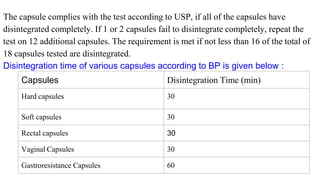
Disintegration time of various capsules according to BP is given below :
Capsules Disintegration Time (min)
Hard capsules 30
Soft capsules 30
Rectal capsules 30
Vaginal Capsules 30
Gastroresistance Capsules 60
5)Leak test
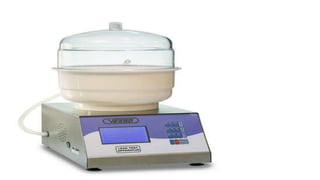
Procedure(PT-LT apparatus):
Samples are placed into the desiccator’s housing and the lid is placed in position. The
pump starts to produce a vacuum inside the desiccator and the sample is held for a pre-
set time. After the test, the tested package should keep its shape indicating a good seal.
It is also possible to use a colored dye solution (normally Methylene Blue). If there are
any holes in the seal, the dye penetrates the contents of the packaging.
References:
https://www.who.int›phint›pdfPDF5.2Uniformityofmassforsingle-dosepreparations
https://www.beautifultf.wordpress.com
https://www.usp.org
https://www.sciencedomain.org
https://www.journalrepository.org
https://www.semanticscholar.org/paper/ln-process-and-finished-products-quality-control-to-Uddin-
Mamun/
http://ajprd.com/index.php/journal/article/view/370/337
https://www.slideshare.net
Aulton's Pharmaceutics: The design and manufacture of medicine, Micheal Aulton, 4th Edition,
Ansel, H.C., Popovich, N.G. and Allen, L.V., editors.Pharmaceutical Dosage Forms and Drug Delivery
Systems, 10th edition
Md. Sahab Uddin,Abdullah Al Mamun, Mamunur Rashid and Md. Asaduzzaman: In-Process and
Finished Products Quality Control Tests for Pharmaceutical capsules ; British Journal of Pharmaceutical
Research

Evaluation of capsules

  • 1.
    Evaluation Of Capsule Presentedby Md. Shahin Alam Roll : 171320 Session : 2016-17 Department of Pharmacy, PUST
  • 2.
    Evaluation of Capsule Capsulesare evaluated by the following tests: 1. Weight Variation Test 2. Content Uniformity Test 3. Dissolution Test 4. Disintegration Test 5. Leak Test
  • 3.
    Weight Variation Test Procedure; Weightvariation test is carried out by weighing 20 capsules individually using analytical balance, then calculating the average mass and comparing the individual tablet mass to the average. The mass of each capsule should be within ±10% of the average mass. If all the capsules do not fall within these limits, weigh the 20 capsules again, taking care to preserve the identity of each capsule, and remove the contents as completely as possible. For soft gelatin capsules, wash the shell with ether or some other suitable solvent and allow it to stand until the odour of the solvent is no longer perceptible. Other means, such as a jet of compressed air, may be used to remove the contents. Weigh the emptied shells individually and calculate for each capsule the net mass of its contents by subtracting the mass of the shell from the gross mass. Determine the average net content from the sum of the individual net masses.
  • 4.
    Then determine thedifference between each individual net content and the average net content. Deviation of individual net mass from the average net mass should not exceed the limits given below. Table:IP, BP and phEur limits for uniformity of weight : Average mass (mg) Percentage deviation(%) Less than 300 ±10% More than 300 ±7.5%
  • 5.
    Table : PhIntlimits for uniformity of weight Net mass(mg) Percentage deviation(%) Number of capsules Less than 300 ±10% Minimum 18 ±20% Maximum 2 More than 300 ±7.5% Minimum 18 ±15% Maximum 2
  • 6.
    2.Contents uniformity test Procedure: Inthe official test 30 capsules are selected and 10 of these are assayed individually.The requirements are met if 9 of the 10 are within the specified potency range of 85 to 115 %, and the tenth is not outside 75 to 125 %. If more than 1, but less than 3, of the first 10 capsules fall out side the 85 to 115 % limits, the remaining 20 are assayed The requirements are met if all 30 capsules are with in 75 to 125 % of the specified potency range, and not less than 27 of the 30 are within the 85 to 115% range.
  • 7.
    3. Dissolution Test DissolutionTest is an official method to determine the dissolution rate of a solid dosage from.There are currently four dissolution apparatus described in the US and European Pharmacopoeias for the testing of oral solid drug products. These are the basket and paddle apparatus, the reciprocating cylinder and the flow through cell . Procedure : 1. The capsules is placed in a basket and the basket is immersed in the dissolution medium and caused to rotate at a specified speed 2. The dissolution mediums is held in a covered 1000ml glass vessel and maintained at 37±0.5°C by means of a constant temperature suitable water bath 3. The stirred speed and type of dissolution mediums are specified in individuals monograph.
  • 8.
    BP, USP, PhEur,PhInt and JP acceptance criteria for dissolution test of capsule is shown in the table below : Stage No. Of Capsule tested Acceptance Criteria S1 6 Each unit is not less than Q+5% S2 6 Average of 12 units (S1+S2) is equal to or greater than Q and no unit is not less than Q-15% S3 12 Average of 24 units (S1+S2+S3) is equal to or greater than Q, not less than 2 units are less Q-15% and no unit is less than Q-25%
  • 10.
    Disintegration Test Procedure : TheUSP disintegration apparatus consist of 6 glass tubes that are 3 inches long, open at the top, and held against a 10-mesh screen at the bottom end of the basket rack assembly. To test for disintegration time, one capsule is placed in each tube and the basket rack is positioned in specified medium at 37±2ºC such that capsule remains 2.5 cm below the surface of the liquid on their upward movement and descend not closer than 2.5 cm from the bottom of the beaker. A standard motor driven device is used to move the basket assembly containing the capsules up and down through distance of 5 to 6 cm at a frequency of 28 to 32 cycles per minute. Operate the apparatus for the specified time.
  • 11.
    The capsule complieswith the test according to USP, if all of the capsules have disintegrated completely. If 1 or 2 capsules fail to disintegrate completely, repeat the test on 12 additional capsules. The requirement is met if not less than 16 of the total of 18 capsules tested are disintegrated. Disintegration time of various capsules according to BP is given below : Capsules Disintegration Time (min) Hard capsules 30 Soft capsules 30 Rectal capsules 30 Vaginal Capsules 30 Gastroresistance Capsules 60
  • 12.
    5)Leak test Procedure(PT-LT apparatus): Samplesare placed into the desiccator’s housing and the lid is placed in position. The pump starts to produce a vacuum inside the desiccator and the sample is held for a pre- set time. After the test, the tested package should keep its shape indicating a good seal. It is also possible to use a colored dye solution (normally Methylene Blue). If there are any holes in the seal, the dye penetrates the contents of the packaging.
  • 14.
    References: https://www.who.int›phint›pdfPDF5.2Uniformityofmassforsingle-dosepreparations https://www.beautifultf.wordpress.com https://www.usp.org https://www.sciencedomain.org https://www.journalrepository.org https://www.semanticscholar.org/paper/ln-process-and-finished-products-quality-control-to-Uddin- Mamun/ http://ajprd.com/index.php/journal/article/view/370/337 https://www.slideshare.net Aulton's Pharmaceutics: Thedesign and manufacture of medicine, Micheal Aulton, 4th Edition, Ansel, H.C., Popovich, N.G. and Allen, L.V., editors.Pharmaceutical Dosage Forms and Drug Delivery Systems, 10th edition Md. Sahab Uddin,Abdullah Al Mamun, Mamunur Rashid and Md. Asaduzzaman: In-Process and Finished Products Quality Control Tests for Pharmaceutical capsules ; British Journal of Pharmaceutical Research